
Ceiling Lights Market Share, Size & Demand by 2034
Coverage: by Type (LED, Halogen, CFL, Fluorescent, Others); Installation (Hanging Lighting Systems, Tile Lighting Systems, Mounted Lighting Systems); Distribution Channel (Online, Offline); End-user (Residential, Commercial, Industrial) , and Geography (North America, Europe, Asia Pacific, and South and Central America)
- Status : Data Released
- Report Code : TIPRE00012244
- Category : Electronics and Semiconductor
- No. of Pages : 150
- Available Report Formats :


- Last update date : July 28, 2026


2025 Market Size
US$ 14.03 Bn
Base year value
2034 Forecast
US$ 19.89 Bn
Projected by 2034
CAGR 2026-2034
3.95 %
Growth rate
Addressable Market
US$ 154.03 Bn
(2026-2034)
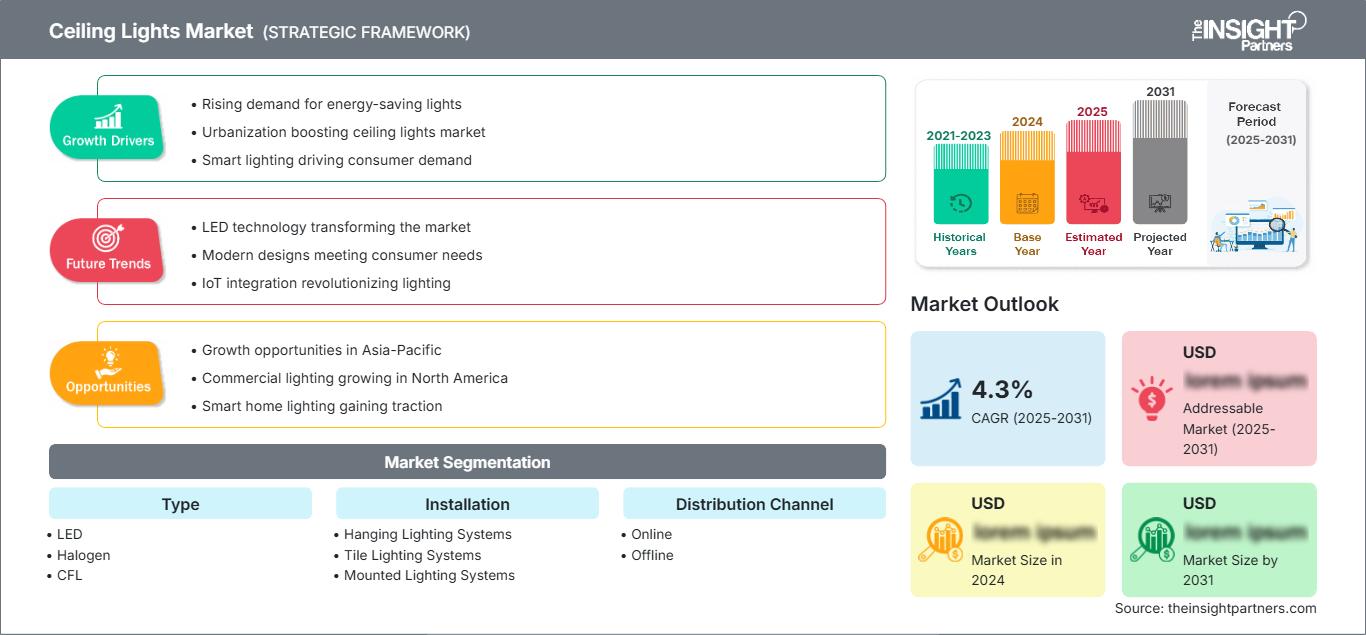
Ceiling Lights Market Size was recorded at US$ 14.03 billion in 2025 and is expected to reach US$ 19.89 billion in 2034 with a CAGR of 3.95% for the period of 2026-2034. The report includes ceiling lights based on different types such as LED ceiling lights, halogen ceiling lights, CFL ceiling lights, and fluorescent ceiling lights in residential, commercial, and industrial segments through both offline and online modes.
North America continues to be a high-quality-driven market due to renovations, increasing smart-home penetration, and retrofits in commercial spaces. Ceiling Lights Market Size in North America is expected to grow with a CAGR rate between 3.6% and 4.2% from 2026-2034.
Ceiling Lights Market Assessment and Insights
- North America: The region accounts for 26–30% share in 2025 and grows at a CAGR range of 3.6–4.2% during 2026–2034, led by retrofit activity, smart homes, and commercial energy upgrades.
- US: The country represents 78–82% of North America in 2025 and grows at a CAGR range of 3.7–4.3% during 2026–2034, supported by renovation and retail lighting replacement.
- Europe: The region holds 21–25% share in 2025 and grows at a CAGR range of 3.2–3.8% during 2026–2034, with Germany, the UK, France, Italy, and Spain leading adoption.
- Asia Pacific: The region holds 34–38% share in 2025 and grows at a CAGR range of 4.5–5.1% during 2026–2034, led by China, India, Japan, South Korea, and Australia.
- Largest Segment: LED holds 62–66% market share in 2025 and grows at a CAGR range of 4.4–5.0% during 2026–2034 due to efficiency, lifespan, and smart compatibility.
- High Growth Segment: Online holds 24–28% market share in 2025 and grows at a CAGR range of 5.1–5.7% during 2026–2034 as digital discovery and direct delivery expand.
- Key companies analyzed in detail: Acuity Brands, Inc.; Cree Lighting, a company of ADLT Lighting Group; Eaton Corporation plc; GE Lighting, a Savant company; Halla, a.s.; Signify N.V.; LIGMAN Lighting Co., Ltd.; ams-OSRAM AG; TREVOS, a.s.; Wipro Consumer Care and Lighting.
Source: The Insight Partners' analysis based on proprietary research, government publications, company annual reports, investor presentations, industry databases, and expert interviews.
Ceiling lights have evolved from functional devices for basic illumination to devices designed to offer energy efficiency and digital controls. The market for Ceiling Lights is growing due to the reduction in LED prices, dimmability, and the need for fixtures to perform three roles – ambient, task, and decorative. Today’s manufacturing dynamics focus on modular drive systems, reduced-glare optics, slimline cases, recycled materials, and reduced SKUs for brands and project specifications.
Growth in the future will be influenced by residential renovations, refreshments of hospitality installations, workplace redesigns, and energy efficiency initiatives in public buildings. According to IEA, lighting consumes significant energy; therefore, there is a policy push towards efficient LED luminaires. Future growth will also be towards housing of Asia Pacific cities, Middle Eastern commercial projects, and integrated devices with occupancy sensors, tunable white, and mobile controls.
Ceiling Lights Market Report Scope
| Report Attribute | Details |
|---|---|
| Market size in 2025 | US$ 14.03 Billion |
| Market Size by 2034 | US$ 19.89 Billion |
| Global CAGR (2026 - 2034) | 3.95% |
| Historical Data | 2021-2024 |
| Forecast period | 2026-2034 |
Ceiling Lights Market Analysis
Demand centers on buildings where lighting affects energy costs, visual satisfaction, and interior value. House buyers are opting for LED flush-mount, panel, pendant, and application-based lights instead of their previous light fittings, while commercial buyers are concerned about reduced maintenance and even lighting. The Ceiling Lights Market growth will benefit from renovation-based replacement, more stringent efficiency standards, and use of ceiling-based lighting in dense cities.
Participants include LED chips makers, LED driver producers, optics suppliers, fixture assemblers, designers, electrical installers, wholesalers, e-commerce sellers, and building experts. Supply factors include standardization of components, shipping cost, stock control in retail businesses, and certification requirements. The criteria for assessing lighting include efficiency, color accuracy, lack of glare, ease of installation, warranties, suitability for smart-platforms, and design uniformity throughout rooms/floors.
The Ceiling Lights market analysis shows competition between diversified lighting companies and specialized players with architectural and industrial strengths. Acuity Brands, Inc., Signify N.V., Eaton Corporation plc, GE Lighting, and ams-OSRAM AG compete on branding and product range, whereas Cree Lighting, LIGMAN Lighting Co., Ltd., TREVOS, a.s., Halla, a.s., and Wipro Consumer Care and Lighting specialize in applications.
The key trends for investments include smart controls, human-centric lighting, recyclable enclosures, high-efficiency LED modules, and specialized channel portfolios. The strategic position depends on the way to market, with project suppliers concentrated on specification support and documentation and retail-oriented brands focused on styling, packaging, and digital merchandizing. Reliability, design portfolio, performance certification, and versatility to work on both retrofit and new construction projects will become major areas for differentiation.
● REPORT CUSTOMIZATION
Tailor This Report To Align With Your Specific Business Requirements
This report can be customized to align precisely with your business objectives, scope, and target markets. Customization options include tailored segmentation, geography, competitive analysis, and strategic insights to support informed decision-making.
Customize This Report →WHAT YOU CAN ADJUST
- ● Segmentations
- ● Geography
- ● Competitive Analysis
- ● Language Preferences
Ceiling Lights Market: Strategic Insights
Regional Insights
North America Ceiling Lights Market
North America holds 26–30% share in 2025 and is projected to grow at a CAGR range of 3.6–4.2% during 2026–2034. Ceiling Lights Market share is supported by home renovation, office modernization, healthcare upgrades, and replacement of inefficient lamps with integrated LED fixtures across residential and commercial spaces.
Demand benefits from energy codes, smart-home adoption, and retail access through home improvement chains and online platforms. U.S. and Canadian buyers increasingly compare fixture efficacy, design finish, color temperature, warranty, and app compatibility. Commercial retrofits prioritize low maintenance, glare control, and quick installation, particularly in offices, schools, clinics, and hospitality properties.
U.S. Ceiling Lights Market
The United States will constitute 78%-82% of North America in 2025 and will be growing at the CAGR rate of 3.7%-4.3% during 2026-2034. Acuity Brands, Inc., Cree Lighting, Eaton Corporation plc, GE Lighting, and Signify N.V. enjoy high specification influence via commercial luminaires, retail sales, and smart lighting product lineups.
Applications are found in kitchens, living areas, multi-family units, hotels, offices, schools, and healthcare facilities ceiling replacements. Buyers seek products such as LED panels, flush-mount fixtures, downlights, and pendant lights that offer reliable dimming and sleek designs. Professional applications are interested in UL listings, optics, emergency compatibility, and distributorship availability.
Europe Ceiling Lights Market
Europe accounts for 21–25% market share in 2025 and experiences 3.2–3.8% CAGR from 2026 to 2034. The largest driver for Europe is Germany due to office and industrial renovation and energy-efficient house lighting. The UK drives demand with renovation of residential buildings and retail spaces, France, Italy, and Spain – with hospitality and public buildings as well as interior design installations.
Procurement in Europe focuses on ecodesign compatibility, decreased standby power loss, recyclable materials, light pollution reduction, and color rendering. The age of existing building portfolio makes replacement more important than greenfield constructions. Signify N.V., ams-OSRAM AG, TREVOS, a.s., and Halla, a.s. benefit from their local compliance expertise, while premium decorative luminaire manufacturers compete with finishing and eco-friendly claims.
APAC Ceiling Lights Market
The Asia-Pacific region accounts for 34–38% market share in 2025 and will register a CAGR of 4.5–5.1% during the forecast period 2026–2034. China leads by constructing apartments, factories, and smart cities whereas India derives advantage from housing legalization, shopping growth, and cheaper LED lights. Premium renovation and efficiency efforts drive the demand in Japan, South Korea, and Australia.
Government initiatives on energy efficient lights, manufacturing ecosystems, and increasing e-commerce contribute to the uptake within the region. The Ceiling Lights Market is positively impacted owing to high-density housing in the cities which requires compactly-mounted lights, tiles, and LED panels. Intense competition exists in the segment owing to global brands competing with local brands.
Middle East & Africa Ceiling Lights Market
Growth in Middle East & Africa is anticipated at a CAGR of 3.4% to 4.0% in the period 2026–2034. Leading contributors will include Saudi Arabia (with its hospitality, mixed-use projects, airports, and public infrastructure) and UAE, which helps meet demand in premium interiors. South Africa makes a contribution via retail, office, and industrial renovation.
Energy-saving properties, heat resistance, and aesthetics are among the main factors considered when making purchase decisions in this geography. Although offline sales channels will continue to be significant in project specifications and contractor purchasing, online sales channels have made improvements with respect to product search in urban settings.
Segmentation Analysis
Type
Type is projected to grow at a CAGR range of 3.8–4.4% during 2026–2034. The Ceiling Lights Market scope by type reflects a decisive transition toward LED fixtures because energy savings, longer service life, dimming flexibility, and smart compatibility outweigh higher upfront costs. Legacy halogen, CFL, and fluorescent products persist mainly in replacement-sensitive or price-constrained applications.
- LED: LED dominates new installations because it combines energy efficiency, long lifespan, compact optics, and compatibility with sensors, dimmers, and smart-home platforms across homes and commercial interiors.
- Halogen: Halogen demand is concentrated in decorative replacement niches where warm light quality and fixture compatibility matter, but efficiency regulations and operating costs restrict broader adoption.
- CFL: CFL products remain relevant in price-sensitive replacement scenarios, although slower warm-up, mercury handling, and weaker smart compatibility continue to reduce strategic importance.
- Fluorescent: Fluorescent ceiling lighting persists in older offices, schools, and industrial sites, yet retrofit projects increasingly replace tubes and panels with integrated LED alternatives.
Installation
Installation is expected to grow at a CAGR range of 3.6–4.2% during 2026–2034. Mounted lighting systems remain widely used because they serve residential rooms, corridors, offices, and retail spaces with simple installation. Hanging systems support decorative and hospitality demand, while tile lighting systems gain relevance in modular offices, healthcare areas, and institutional ceilings.
- Hanging Lighting Systems: Hanging systems address dining areas, lobbies, boutiques, and hospitality interiors where visual identity, focal illumination, and fixture styling influence purchase decisions.
- Tile Lighting Systems: Tile systems fit suspended ceiling grids in offices, schools, clinics, and retail floors, supporting uniform light distribution, faster replacement, and clean architectural integration.
- Mounted Lighting Systems: Mounted systems hold broad demand because flush mounts, surface panels, and downlights provide affordable, compact, and adaptable lighting for varied ceiling conditions.
Distribution Channel
Distribution Channel is forecast to grow at a CAGR range of 4.0–4.6% during 2026–2034. Offline remains larger because contractors, distributors, and specialty stores support specification, verification, and after-sales service. Online channels are expanding faster as buyers compare styles, dimensions, reviews, smart features, and delivery options before purchasing standard residential and small commercial fixtures.
- Online: Online channels are strategically important for residential replacement, decorative fixtures, and smart lighting because digital catalogs improve comparison, customization, reviews, and direct delivery.
- Offline: Offline channels dominate project-led demand where installers, wholesalers, lighting showrooms, and contractors guide specification, compliance, availability, and warranty decisions.
End-user
End-user is projected to grow at a CAGR range of 3.7–4.3% during 2026–2034. Residential applications remain the largest base because ceiling lights are replaced during renovations and new home furnishing. Commercial demand is supported by offices, retail, hospitality, and healthcare, while industrial facilities prioritize durability, uniformity, and lower maintenance in production and warehouse areas.
- Residential: Residential demand is driven by renovation, apartment construction, smart-home adoption, and decorative preferences across kitchens, living rooms, bedrooms, corridors, and balconies.
- Commercial: Commercial buyers prioritize low maintenance, visual comfort, brand ambience, and energy savings across offices, hotels, retail stores, hospitals, schools, and public buildings.
- Industrial: Industrial users require robust ceiling fixtures for warehouses, workshops, plants, and utility areas where durability, light output, and service life influence operating cost.
Opportunity Snapshot
| End-user | Revenue Contribution | Trend Tag | Adoption Stage |
| Residential | High | Smart Decor | Scaling |
| Commercial | High | Retrofit Codes | Mature |
| Industrial | Medium | Durable Output | Scaling |
Ceiling Lights Market Growth Drivers and Impact Analysis
LED Replacement Cycles Reduce Energy and Maintenance Costs
LED conversion is the best structural push factor since ceiling lights are found in almost all buildings and the need for conversion often hinges on electricity costs, maintenance and aesthetics. LEDs can significantly reduce energy costs compared to other bulbs such as halogen, CFL, and fluorescent, and with their increased lifespans, maintenance of high-ceiling commercial buildings becomes less frequent. Practical application of this concept is evidenced in offices, hotels, hospitals, educational institutions, retail stores and even residential buildings where management needs to realize guaranteed energy saving without rewiring.
Residential Renovation Expands Decorative Fixture Demand
The expense on renovation aids the installation of fixtures as light is one of the most obvious and cost-effective methods of revamping a space. The consumers are renovating their kitchen, living room, bedroom, and entrance area through the installation of flush mount, pendant, recessed panel, and intelligent ceiling lights that match the furniture and interiors of the place. This trend broadens the scope of the Ceiling Lights Market from utilitarian lighting to design-driven purchases, where factors such as finish, form, dimming, and app control are important for retailers and manufacturers.
Commercial Buildings Prioritize Code-Compliant Illumination
The commercial building industry is embracing lighting fixtures that will facilitate compliance with energy codes, improve workplace comfort, and optimize budget allocation for maintenance activities. For the office setting, lighting solutions that offer minimal glare and suspended ceiling lights are required due to the hybrid work settings in offices. Lighting solutions that define the client experience are needed by retail and hotel facilities. Reliable luminaries with constant color quality and emergency readiness will be demanded by health care, educational, and public facilities. The effect will be a continuous flow of LED products into the specification market via distribution channels.
Ceiling Lights Market Future Trends
Human-Centric and Circadian Lighting Moves Mainstream
The Ceiling Lights Market trends will increasingly feature tunable white lights that vary intensity and color temperature based on activities, time of day, and individual preferences. In homes, natural light scenes will be employed in kitchens and working zones; in office buildings, health care establishments, and educational institutions, lights for optimal visual comfort and performance of tasks will be specified. The following step will entail sensors and wireless control, together with app interfaces, not needing elaborate commissioning process at all.
Circular Design Influences Fixture Selection
Sustainable requirements will lead to changes in procurement practices for ceiling lights from purely watt-based comparison to transparency regarding materials, servicing, and end-of-life options. Owners of buildings and retailers are requesting increased lifetime, driver replacements, recycling capabilities of the housing, and packaging minimization. The modular architecture of fixtures will benefit from this because of its capability to increase lifetime and eliminate e-waste. Sustainable performance will become competitive among manufacturers through environmental reporting, reparability, use of low carbon footprint materials, and aesthetic design.
Ceiling Lights Market Opportunities
Smart Retrofit Bundles for Homes and Small Businesses
Ceiling Lights Market Forecasts support investment in retrofit bundles that combine LED fixtures, sensors, dimmers, and mobile control for homes, small offices, clinics, and shops. Many buyers want smarter lighting but avoid complex installations and platform uncertainty. Suppliers can capture opportunity by offering room-based kits, clear compatibility labeling, installer partnerships, and simple warranty coverage. Retailers can improve conversion through guided selection by ceiling height, room size, finish, and preferred ambience. The strongest value proposition is reduced energy use, better comfort, and a straightforward upgrade path from ordinary fixtures to connected lighting.
Specification-Grade Panels for Commercial Renovation
Commercial renovation creates an actionable opportunity for efficient panels, mounted systems, and tile lighting that can be installed with limited disruption. Offices, schools, hospitals, and retail properties need consistent light quality, low glare, emergency options, and reliable supply for phased projects. Manufacturers should target electrical consultants, facility managers, and contractors with photometric files, sample kits, compliance documentation, and fast replacement programs. The opportunity is strongest where building owners are combining energy upgrades with interior modernization. Coordinated fixture and control packages can raise project value while simplifying procurement and commissioning.
Recent Developments
- April 2026: Govee introduced the Ceiling Light Ultra, a next-generation smart ceiling light designed to transform ceilings into interactive visual canvases. The product features a 616-pixel RGB LED matrix, up to 5,000 lumens of brightness, adjustable 2,700K–6,500K white light, AI-generated lighting effects, DaySync circadian lighting, music synchronization, and Matter compatibility with major smart home ecosystems. The launch reflects the growing demand for multifunctional smart ceiling lighting that combines ambient illumination, personalization, and immersive visual experiences.
- July 2026: Nanoleaf launched the Smart Multicolor Ceiling Light, a Matter-enabled smart ceiling fixture featuring dual-sided illumination with 28 individually addressable color zones, up to 2,600 lumens of brightness, tunable white light (2,700K–6,500K), music synchronization, circadian lighting, and seamless integration with major smart home ecosystems via Wi-Fi. The launch highlights the increasing demand for intelligent ceiling lighting that combines functional illumination with immersive ambient effects and cross-platform smart home compatibility.
- July 2025: Lumeil launched its "Partner with Us" program for architects and interior designers, offering trade-exclusive pricing, priority support, early access to new decorative lighting collections, personalized product recommendations, and end-to-end project assistance. The initiative is designed to simplify premium lighting procurement and strengthen collaboration with design professionals through a digital-first sourcing platform.
Frequently Asked Questions

- Comprehensive Market Sizing and Forecast Analysis
- Detailed Segmentation Analysis
- In-Depth Market Dynamics Assessment
- Regional and Country-Level Insights
- Competitive Landscape and Company Benchmarking
- Strategic Business Intelligence
Recent Reports
Testimonials

The Insight Partners' SCADA System Market report is comprehensive, with valuable insights on current trends and future forecasts. The team was highly professional, responsive, and supportive throughout. We are very satisfied and highly recommend their services.
RAN KEDEM Partner, Reali Technologies LTDs
I requested a report on a very specific software market and the team produced the report in a few days. The information was very relevant and well presented. I then requested some changes and additions to the report. The team was again very responsive and I got the final report in less than a week.
JEAN-HERVE JENN Chairman, Future Analytica
We worked with The Insight Partners for an important market study and forecast. They gave us clear insights into opportunities and risks, which helped shape our plans. Their research was easy to use and based on solid data. It helped us make smart, confident decisions. We highly recommend them.
PIYUSH NAGPAL Sr. Vice President, High Beam Global
The Insight Partners delivered insightful, well-structured market research with strong domain expertise. Their team was professional and responsive throughout. The user-friendly website made accessing industry reports seamless. We highly recommend them for reliable, high-quality research services
YUKIHIKO ADACHI CEO, Deep Blue, LLC.
This is the first time I have purchased a market report from The Insight Partners.While I was unsure at first, I visited their web site and felt more comfortable to take the risk and purchase a market report.I am completely satisfied with the quality of the report and customer service. I had several questions and comments with the initial report, but after a couple of dialogs over email with their analyst I believe I have a report that I can use as input to our strategic planning process.Thank you so much for taking the extra time and making this a positive experience.I will definitely recommend your service to others and you will be my first call when we need further market data.
JOHN SUZUKI President and Chief Executive Officer, Board Director, BK Technologies
I wish to appreciate your support and the professionalism you displayed in the course of attending to my request for information regarding to infectious disease IVD market in Nigeria. I appreciate your patience, your guidance, and the fact that you were willing to offer a discount, which eventually made it possible for us to close a deal. I look forward to engaging The Insight Partners in the future, all thanks to the impression you have created in me as a result of this first encounter.
DR CHIJIOKE ONYIA MANAGING DIRECTOR, PineCrest Healthcare Ltd.Reason to Buy
- Informed Decision-Making
- Understanding Market Dynamics
- Competitive Analysis
- Identifying Emerging Markets
- Customer Insights
- Market Forecasts
- Risk Mitigation
- Boosting Operational Efficiency
- Strategic Planning
- Investment Justification
- Tracking Industry Innovations
- Aligning with Regulatory Trends





 Get Free Sample for