
Cellulose Esters Market Demand, Trends & Forecast by 2034
Coverage: by Type (Cellulose Acetate, Cellulose Acetate Propionate, Cellulose Acetate Butyrate, Cellulose Nitrate, Others); Application (Coatings, Plasticizers, Cigarette Filters, Films and Tapes, Inks, Others) , and Geography (North America, Europe, Asia Pacific, and South and Central America)
- Status : Data Released
- Report Code : TIPRE00007985
- Category : Chemicals and Materials
- No. of Pages : 150
- Available Report Formats :


- Last update date : August 06, 2026


2025 Market Size
US$ 14.77 Bn
Base year value
2034 Forecast
US$ 24.56 Bn
Projected by 2034
CAGR 2026-2034
5.82 %
Growth rate
Addressable Market
US$ 178.27 Bn
(2026-2034)
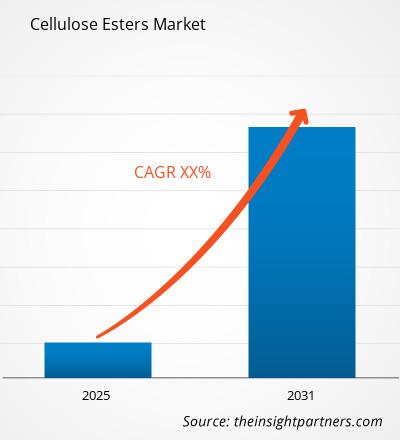
The Cellulose Esters market in 2025 was worth US$ 14.77 Billion and is estimated to grow to US$ 24.56 Billion by 2034, exhibiting a CAGR of 5.82% during the period 2026–2034. The market growth is being driven by increased demand for high-performing bio-polymers in coatings, plastics, filtration, and specialty industrial applications. Increased material innovation, sustainability focus via regulations, and increased adoption of products in consumer and industrial applications are expected to drive growth in the market over the forecast period.
For North America, increased investment in sustainable materials, advanced coatings, and specialty plastics is boosting manufacturing in the region. Demand from the automotive, construction, and consumer goods sectors, coupled with favorable environmental regulations for renewables, continues to aid the market for Cellulose Esters. In the coming years, the regional Cellulose Esters Market size is estimated to register growth at a CAGR between 5.3% and 5.8%, aided by established chemical manufacturing and innovations.
Cellulose Esters Market Assessment and Insights
- North America: Accounted for a 31–34% Cellulose Esters Market share in 2025 and is expected to grow at a CAGR of 5.3–5.8% during 2026–2034. Strong specialty chemicals manufacturing, sustainable material adoption, and continuous investment in coatings and filtration technologies support regional expansion.
- U.S.: Represented 78–82% of the North American market in 2025 and is projected to register a CAGR of 5.4–5.9% during 2026–2034, supported by demand from automotive coatings, cigarette filters, pharmaceuticals, and industrial plastics.
- Europe: Held 27–30% share in 2025 and is anticipated to expand at a CAGR of 5.1–5.6% during 2026–2034. Germany, France, Italy, and the UK remain major manufacturing and innovation hubs for specialty cellulose derivatives.
- Asia Pacific: Captured 29–32% share in 2025 and is forecast to witness the fastest expansion with a CAGR of 6.3–6.8% during 2026–2034. China, Japan, South Korea, and India continue to strengthen production capacity and downstream demand.
- Largest Segment: Cellulose Acetate accounted for 44–48% market share in 2025 and is projected to grow at a CAGR of 5.6–6.0% during 2026–2034, supported by widespread use in cigarette filters, films, and specialty plastics.
- High Growth Segment: Coatings represented 24–28% market share in 2025 and is anticipated to register a CAGR of 6.4–6.9% during 2026–2034, driven by increasing demand for environmentally compliant industrial and automotive coating formulations.
- Key companies analyzed in detail: Eastman Chemical Company, Solvay SA, Celanese Corporation, China National Tobacco Corporation, Daicel Corporation, Acordis Cellulosic Fibers Inc., Mitsubishi Chemical Group Corporation, Sichuan Push Acetati Co., Ltd., Rayonier Advanced Materials Inc., and Sappi Limited.
Source: The Insight Partners' analysis based on proprietary research, government publications, company annual reports, investor presentations, industry databases, and expert interviews.
The need for sustainability, evolving manufacturing techniques, and diverse end-use industries have been among the key factors driving changes in the Cellulose Esters industry over the last ten years. In particular, producers have started to emphasize the purity of products, efficiency, and high functionality to cater to the demands of coatings, engineered plastics, filtration media, and specialty films. Manufacturers have started to pay more attention to using sustainable feedstocks and producing cellulose esters through energy-efficient manufacturing processes, while also incorporating advanced quality control and digital manufacturing into supply chains.
Further market growth is forecast to be fueled by investment in production capacity in Asia Pacific, modernization of specialty chemicals manufacturing facilities, and tightening of environmental legislation, which will favor the use of biodegradable raw materials. The growing number of studies on advanced cellulose derivatives for the development of pharmaceuticals, electronics, and sustainable packaging solutions will open up new avenues of business development.
Cellulose Esters Market Report Scope
| Report Attribute | Details |
|---|---|
| Market size in 2025 | US$ 14.77 Billion |
| Market Size by 2034 | US$ 24.56 Billion |
| Global CAGR (2026 - 2034) | 5.82% |
| Historical Data | 2021-2024 |
| Forecast period | 2026-2034 |
Cellulose Esters Market Analysis
Increasing industrial preferences for performance materials from renewable sources are expected to boost the market growth in various applications. Increasing use in automotive coatings, protective coatings, packaging films, printing inks, and filtration materials demanding good clarity and chemical resistance is anticipated to drive the demand. Increased regulation related to reduced VOC emissions also makes the manufactures substitute petrochemical-based polymers with cellulose-based products. Increased investment in specialty chemicals production and growing demand for engineering plastic in emerging economies will also act as a driving force for the industry in the coming years.
Supply chain of the industry includes sustainable sourcing of wood pulp and cotton linters, chemical processing, esterification, compounding, distribution, and downstream manufacturing. Manufacturers are increasingly adopting an integrated approach that includes raw material sourcing along with latest manufacturing technologies to ensure consistent product quality and cut down on production cost. Improved coordination between wood pulp and cotton linters suppliers, specialty chemicals producers, converters, and end-users have made the supply chain robust even amidst fluctuating raw material prices and rising logistics cost.
Competitive intensity increases as companies focus more on product differentiation, sustainability, and customized formulation. The Cellulose Esters Market study shows that the market leaders are developing their manufacturing capabilities to include production optimization, low emission manufacturing techniques, and application-specific products. Eastman Chemical Company, Daicel Corporation, Celanese Corporation, Rayonier Advanced Materials Inc., and Mitsubishi Chemical Group Corporation are continuously improving their R&D capabilities for specialty coatings, engineered plastics, and valuable industrial applications.
Strategic investments also include investments in regional manufacturing operations, digitized manufacturing systems, and long-term contracts with downstream consumers. Solvay SA, Sappi Limited, Sichuan Push Acetati Co., Ltd., China National Tobacco Corporation, and Acordis Cellulosic Fibers Inc. are continuously increasing their operational capabilities through technology improvements and manufacturing efficiencies. Growing focus on circular economy goals, renewable raw materials, and sustainable product development will increase competitive differentiation and long-term profitability of the global cellulose esters industry.
● REPORT CUSTOMIZATION
Tailor This Report To Align With Your Specific Business Requirements
This report can be customized to align precisely with your business objectives, scope, and target markets. Customization options include tailored segmentation, geography, competitive analysis, and strategic insights to support informed decision-making.
Customize This Report →WHAT YOU CAN ADJUST
- ● Segmentations
- ● Geography
- ● Competitive Analysis
- ● Language Preferences
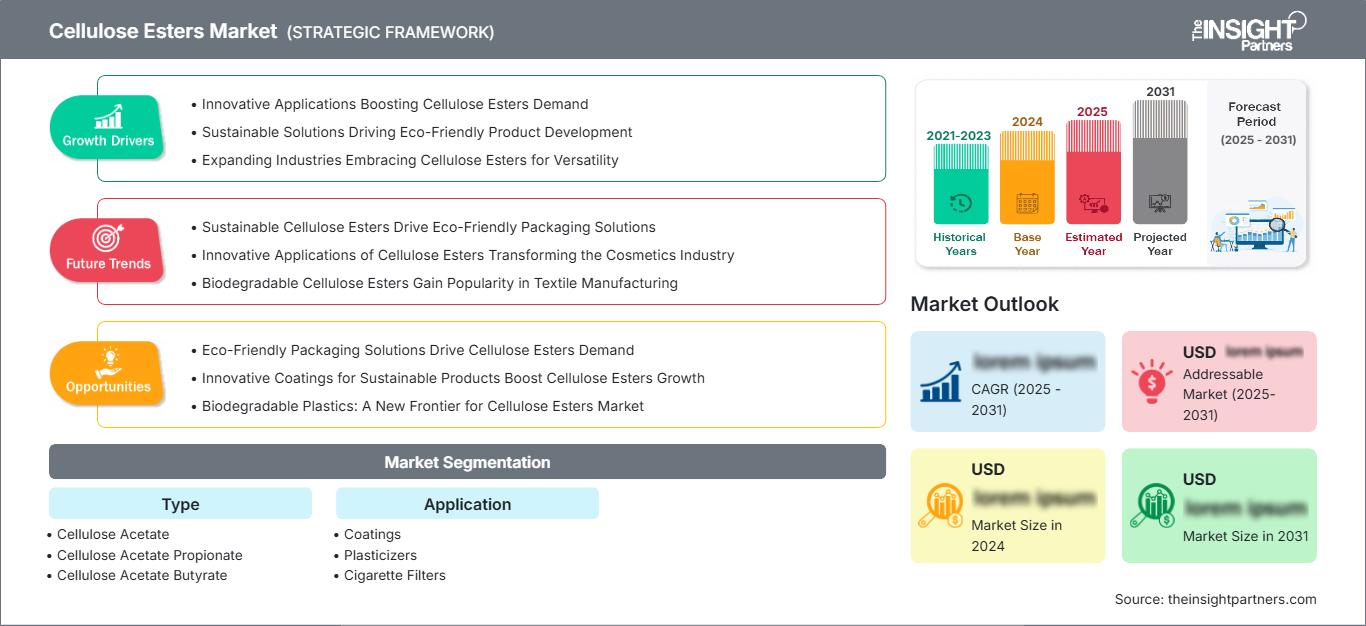
Cellulose Esters Market: Strategic Insights
Regional Insights
North America Cellulose Esters Market
North America held 31-34% share of the global Cellulose Esters Market in 2025 and is expected to grow at a CAGR of 5.3-5.8% through 2026-2034. The regional market is driven by existing specialty chemicals production capabilities, demand for sustainable polymers, and growing adoption of premium quality coating materials in automotive, aerospace, packaging, and construction sectors. Initiatives that promote bio-sourced products and low emissions of volatile organic compounds drive product development and commercialization.
The US and Canada are focusing on technology and sustainable manufacturing processes to enhance their efficiency and performance. Growing consumption of environmentally friendly coatings, engineered plastics, and specialty films along with innovations in cellulose derivatives ensures growth in the coming years. Availability of raw materials and logistics infrastructure coupled with collaborations among chemical companies and end-users is likely to make North America a highly competitive region over the forecast period.
U.S. Cellulose Esters Market
The U.S. was accounting for 78-82% share of the North American market in 2025 and is projected to have a CAGR of 5.4-5.9% in 2026-2034. The dominance of the U.S. can be attributed to its well-developed chemical manufacturing infrastructure, significant research base and high demand for cellulose derivatives from various applications, including coatings, plastics, filtration, and cigarette filters. Continued efforts on sustainable materials and specialty polymers would help in expanding domestic manufacturing and increasing applications.
Key players keep improving their manufacturing capacity by making substantial investments in cellulose derivative technology innovations for their use in industrial coatings, consumer goods, and engineered materials. Demand from automotive refinishing, architectural coatings, healthcare products, and specialty packaging continues to remain strong. Excellent cooperation among raw material suppliers, converters and end-user industries ensures smooth development of products within the specialty chemicals industry of the country.
Europe Cellulose Esters Market
Europe occupied 27-30% share of the world market in 2025, and it is expected to have a CAGR of 5.1-5.6% from 2026 to 2034. Germany will remain the major producer in the region because of well-developed specialty chemicals industry, modern manufacturing facilities, and advanced automotive coatings production in the country. Specialty formulations and sustainable materials are key sectors for the UK; meanwhile, continuous development of bio-based chemical technologies will increase industrial competitiveness of the region.
France, Italy, and Spain are the major consumers because of coatings, packaging materials, printing inks, and industrial plastics industries in these countries. France, Italy, and Spain continuously develop renewable materials to meet the requirements of strict regulations and improve manufacturing performance. Investments in circular economy initiatives and sustainable industrial production will ensure the competitive advantage of Europe in high-performance cellulose derivative manufacturing.
APAC Cellulose Esters Market
Asia Pacific captured 29–32% of the global market in 2025 and is projected to record the highest CAGR of 6.3–6.8% during 2026–2034. China leads regional production owing to extensive manufacturing capacity, followed by Japan, South Korea, and India, where demand continues increasing across coatings, engineered plastics, and filtration products.
Industrial expansion, favorable manufacturing policies, and investments in specialty chemicals production continue to support regional capacity additions. Australia contributes through advanced materials research and high-value industrial applications, while growing infrastructure and packaging industries across emerging Asian economies create sustained downstream demand.
Middle East & Africa Cellulose Esters Market
The Middle East & Africa market is projected to expand at a CAGR of 4.8–5.3% during 2026–2034. Saudi Arabia and the UAE continue investing in downstream chemical manufacturing to diversify industrial output beyond petrochemicals, while South Africa remains an important consumer of specialty coatings and industrial materials.
Infrastructure development, expanding construction activities, and increasing industrial diversification are creating additional demand for sustainable coating materials and specialty polymers. Government initiatives promoting domestic manufacturing and industrial value addition are expected to improve regional adoption of cellulose ester products throughout the forecast period.
Segmentation Analysis
Type
The Type segment is expected to register a CAGR of 5.7–6.2% during 2026–2034. Product selection depends on performance characteristics such as transparency, durability, chemical resistance, processability, and compatibility with downstream applications. The Cellulose Esters Market scope continues expanding through innovations in specialty formulations designed for coatings, plastics, filtration, and industrial manufacturing, supporting wider commercial adoption across multiple industries.
- Cellulose Acetate remains the dominant product due to extensive utilization in cigarette filters, specialty films, optical applications, textiles, and engineered plastics requiring excellent clarity, toughness, and processing flexibility.
- Cellulose Acetate Propionate is increasingly adopted for premium automotive coatings, consumer products, and specialty plastics because of its superior weather resistance, dimensional stability, and improved surface appearance.
- Cellulose Acetate Butyrate demonstrates strong demand in protective coatings, inks, and industrial finishes where excellent UV resistance, low moisture absorption, and long-term durability are required.
- Cellulose Nitrate continues serving specialized applications, including printing inks, coatings, lacquers, and selected industrial formulations requiring rapid drying characteristics and strong film-forming performance.
Application
The Application segment is anticipated to grow at a CAGR of 6.1–6.6% during 2026–2034. Expanding demand for environmentally compatible materials, durable coatings, specialty films, and advanced printing technologies continues to support consumption across diverse industrial sectors. Innovation in high-performance formulations is expected to broaden future commercial opportunities.
- Coatings remain the fastest-growing application as industries increasingly adopt durable, transparent, and environmentally compliant formulations for automotive, architectural, industrial, and wood finishing applications.
- Plasticizers support improved flexibility, processing efficiency, and mechanical performance in specialty polymer formulations used across consumer goods, industrial products, and engineered plastics.
- Cigarette Filters continue to represent a major application because cellulose acetate remains the preferred filtration material owing to its consistent processing characteristics and large-scale commercial manufacturing.
- Films and Tapes experience steady demand across packaging, electronics, medical, and industrial sectors, where dimensional stability, optical clarity, and mechanical strength remain essential performance requirements.
- Inks benefit from increasing use in specialty printing, flexible packaging, labeling, and industrial graphics requiring rapid drying, strong adhesion, and high-quality surface finish.
Opportunity Snapshot
| Application | Revenue Contribution | Trend Tag | Adoption Stage |
|---|---|---|---|
| Coatings | High | Low-VOC | Scaling |
| Plasticizers | Medium | Flexible Plastics | Mature |
| Cigarette Filters | High | Filter Media | Mature |
| Films and Tapes | Medium | Barrier Films | Scaling |
| Inks | Medium | Digital Printing | Emerging |
Cellulose Esters Market Growth Drivers and Impact Analysis
Growing Demand for Sustainable and Bio-Based Performance Materials
Increasing environmental regulations and corporate sustainability commitments are accelerating the transition from petroleum-derived polymers toward renewable cellulose-based materials. Cellulose esters provide favorable characteristics, including biodegradability, transparency, chemical resistance, and excellent processability, making them suitable for coatings, specialty plastics, films, and filtration products. Governments in North America and Europe continue strengthening policies that encourage the use of renewable raw materials and lower-emission manufacturing processes. Brand owners are also incorporating bio-based materials into product portfolios to meet environmental targets and customer expectations. These developments are stimulating investments in production capacity, process optimization, and advanced material development across the specialty chemicals industry. Growing commercialization of sustainable packaging, consumer products, and industrial applications is expected to reinforce long-term demand while reducing dependence on conventional fossil-based polymers throughout the global value chain.
Expansion of High-Performance Coatings and Specialty Plastics Industries
Rapid industrialization and infrastructure development continue to increase the consumption of advanced coatings and engineered plastics across automotive, aerospace, electronics, and construction industries. Cellulose esters deliver excellent film formation, weather resistance, gloss retention, and compatibility with modern coating systems, making them preferred additives for high-performance formulations. Automotive manufacturers increasingly utilize lightweight and durable materials to improve product performance while complying with environmental standards. Construction activities across the Asia Pacific and North America also generate substantial demand for protective coatings and specialty materials. Continuous innovation in industrial coatings, decorative finishes, printing inks, and engineered plastic compounds is encouraging manufacturers to expand production capabilities. Strong collaboration between specialty chemical producers and downstream users further accelerates the commercialization of advanced cellulose ester formulations designed for demanding industrial applications.
Advancements in Manufacturing Technologies and Specialty Applications
Continuous improvements in esterification technologies, process automation, and digital quality control are enabling manufacturers to produce higher-purity cellulose esters with improved consistency and lower production costs. Modern manufacturing facilities increasingly incorporate advanced monitoring systems that optimize raw material utilization, reduce waste generation, and improve operational efficiency. Research institutions and specialty chemical companies are also developing customized grades for medical devices, electronics, optical films, filtration media, and sustainable packaging solutions. These technological advancements broaden application opportunities while supporting compliance with evolving environmental and product quality standards. Growing investments in research and development, combined with stronger collaboration across the supply chain, are expected to enhance innovation capabilities and strengthen the competitive position of cellulose ester manufacturers during the forecast period.
Cellulose Esters Market Future Trends
Integration of Circular Economy Principles into Specialty Chemical Manufacturing
Manufacturers are increasingly adopting circular economy practices by improving raw material efficiency, expanding renewable feedstock utilization, and implementing recycling initiatives throughout production processes. Cellulose Esters market trends indicate that companies are investing in energy-efficient manufacturing technologies, waste reduction systems, and environmentally responsible product development to meet tightening sustainability regulations. Greater collaboration among pulp suppliers, chemical manufacturers, converters, and end users is expected to strengthen resource optimization while improving supply chain resilience. As environmental standards become more stringent worldwide, circular manufacturing strategies are likely to become a key competitive differentiator across specialty cellulose derivative markets.
Development of Advanced Functional Grades for Emerging Industries
The market is expected to witness increasing demand for highly specialized cellulose ester formulations designed for electronics, medical technologies, optical films, advanced packaging, and sustainable industrial products. Manufacturers are expanding research into customized performance characteristics, including improved thermal stability, enhanced transparency, superior mechanical strength, and greater compatibility with advanced manufacturing processes. Digital manufacturing technologies and artificial intelligence-assisted material development are expected to accelerate product innovation while shortening commercialization timelines. These developments will enable suppliers to address evolving customer requirements across high-value industrial sectors and strengthen long-term market competitiveness.
Cellulose Esters Market Opportunities
Expansion into High-Growth Sustainable Packaging Applications
Growing consumer preference for environmentally responsible packaging materials presents significant opportunities for cellulose ester manufacturers. Companies are investing in innovative film technologies, biodegradable packaging solutions, and high-performance barrier materials capable of replacing conventional petroleum-based plastics. Increasing regulatory restrictions on single-use plastics across multiple regions further support commercial adoption. Cellulose Esters market Forecasts indicate that sustained investment in renewable packaging technologies, strategic partnerships with packaging manufacturers, and development of recyclable material solutions will create attractive long-term revenue opportunities for both established producers and new market participants seeking sustainable growth.
Increasing Commercialization Across Medical and Electronics Industries
Demand for specialty cellulose esters continues expanding beyond traditional industrial applications into medical devices, pharmaceutical components, electronics, and optical technologies. Manufacturers are developing customized materials that satisfy stringent quality, purity, and regulatory requirements while delivering enhanced functional performance. Rising investment in advanced electronics manufacturing, diagnostic technologies, and healthcare infrastructure supports broader commercial adoption. Companies capable of developing application-specific formulations, strengthening research partnerships, and expanding regional manufacturing capabilities are expected to secure higher-value business opportunities while diversifying revenue streams across multiple rapidly evolving end-use industries.
Recent Developments
- January 2026: Eastman Chemical Company and Kolmar Korea signed a memorandum of understanding to advance sustainable innovation in personal care. The collaboration focuses on expanding the commercialization of Eastman's Esmeri™ technology, including Esmeri™ CC1N10 biodegradable cellulose ester micropowder, while developing high-performance cosmetic ingredients that comply with evolving global sustainability and EU microplastics regulations.
- October 2025: Fraunhofer Institute for Structural Durability and System Reliability (Fraunhofer LBF) announced the successful development of cellulose ester-based bio-based reactive resins and high-performance adhesives. The newly engineered cellulose methacrylates and acrylates demonstrated strong performance in reactive anchoring compounds and LED-curable industrial adhesives, while utilizing wood pulp-derived renewable feedstocks. The institute is seeking manufacturing partners to commercialize the technology for adhesives, coatings, and flame-retardant applications.
Frequently Asked Questions

- Comprehensive Market Sizing and Forecast Analysis
- Detailed Segmentation Analysis
- In-Depth Market Dynamics Assessment
- Regional and Country-Level Insights
- Competitive Landscape and Company Benchmarking
- Strategic Business Intelligence
Recent Reports
Testimonials

The Insight Partners provided valuable market intelligence that supported our global go-to-market strategy. Their team was professional, responsive, and attentive to our feedback, providing thoughtful analysis and helpful methodological clarifications throughout the project.
Junmo Kim Chief Financial Officer (CFO), Enertech Co., Ltd.
The Insight Partners' SCADA System Market report is comprehensive, with valuable insights on current trends and future forecasts. The team was highly professional, responsive, and supportive throughout. We are very satisfied and highly recommend their services.
RAN KEDEM Partner, Reali Technologies LTDs
I requested a report on a very specific software market and the team produced the report in a few days. The information was very relevant and well presented. I then requested some changes and additions to the report. The team was again very responsive and I got the final report in less than a week.
JEAN-HERVE JENN Chairman, Future Analytica
We worked with The Insight Partners for an important market study and forecast. They gave us clear insights into opportunities and risks, which helped shape our plans. Their research was easy to use and based on solid data. It helped us make smart, confident decisions. We highly recommend them.
PIYUSH NAGPAL Sr. Vice President, High Beam Global
The Insight Partners delivered insightful, well-structured market research with strong domain expertise. Their team was professional and responsive throughout. The user-friendly website made accessing industry reports seamless. We highly recommend them for reliable, high-quality research services
YUKIHIKO ADACHI CEO, Deep Blue, LLC.
This is the first time I have purchased a market report from The Insight Partners.While I was unsure at first, I visited their web site and felt more comfortable to take the risk and purchase a market report.I am completely satisfied with the quality of the report and customer service. I had several questions and comments with the initial report, but after a couple of dialogs over email with their analyst I believe I have a report that I can use as input to our strategic planning process.Thank you so much for taking the extra time and making this a positive experience.I will definitely recommend your service to others and you will be my first call when we need further market data.
JOHN SUZUKI President and Chief Executive Officer, Board Director, BK Technologies
I wish to appreciate your support and the professionalism you displayed in the course of attending to my request for information regarding to infectious disease IVD market in Nigeria. I appreciate your patience, your guidance, and the fact that you were willing to offer a discount, which eventually made it possible for us to close a deal. I look forward to engaging The Insight Partners in the future, all thanks to the impression you have created in me as a result of this first encounter.
DR CHIJIOKE ONYIA MANAGING DIRECTOR, PineCrest Healthcare Ltd.Reason to Buy
- Informed Decision-Making
- Understanding Market Dynamics
- Competitive Analysis
- Identifying Emerging Markets
- Customer Insights
- Market Forecasts
- Risk Mitigation
- Boosting Operational Efficiency
- Strategic Planning
- Investment Justification
- Tracking Industry Innovations
- Aligning with Regulatory Trends





 Get Free Sample for