
Cellulosic Fire Protection Intumescent Coatings Market Trends, Share & Demand by 2034
Cellulosic Fire Protection Intumescent Coatings Market Size and Forecasts (2021–2034), Global and Regional Share, Trends, and Growth Opportunity Analysis Report Coverage : by Type (Water-borne, Solvent-borne); Raw Material (Polyurethane, PVC, Polyurea, Acrylic, ABS, Polystyrene); Substrate Type (Structural Steel & Cast Iron, Wood); End Use (Residential, Commercial); and Geography (North America, Europe, Asia Pacific, and South and Central America)
- Status : Data Released
- Report Code : TIPRE00040240
- Category : Chemicals and Materials
- No. of Pages : 150
- Available Report Formats :


- Last update date : August 06, 2026


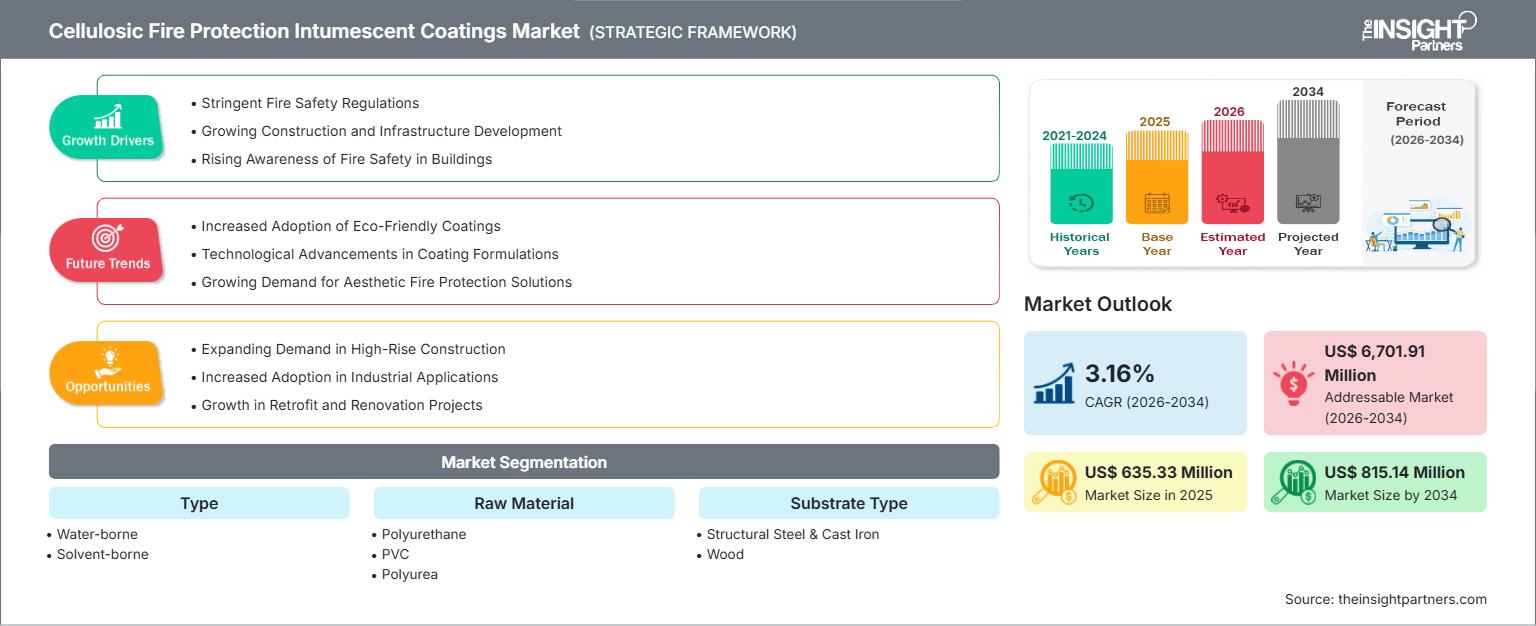
2025 Market Size
US$ 635.33 Mn
Base year value
2034 Forecast
US$ 815.14 Mn
Projected by 2034
CAGR 2026-2034
3.16 %
Growth rate
Addressable Market
US$ 6,701.91 Mn
(2026-2034)
The Cellulosic Fire Protection Intumescent Coatings Market size stood at US$ 635.33 million in 2025 and is predicted to be valued at US$ 815.14 million by 2034, increasing at a CAGR of 3.16% in 2026–2034. The market size is evolving further as fire protection regulations become increasingly stringent, thereby driving the demand for environmentally friendly intumescent coating solutions that can offer passive fire protection.
North America is expected to remain one of the technologically progressive markets owing to the constant investments being made in the modernization of commercial infrastructure, as well as renovation and modernization of old industrial structures. This region continues to show increasing demand for cellulosic fire protection intumescent coatings market in the form of low VOC, water-based coating solutions for structural steel and wood applications. The regional market is estimated to experience growth at a CAGR of 3.0% to 3.5% through 2034.
Cellulosic Fire Protection Intumescent Coatings Market Assessment and Insights
- North America: Accounted for a 32–36% cellulosic fire protection intumescent coatings market share in 2025 and is projected to expand at a CAGR between 3.0% and 3.5% during 2026–2034, supported by stringent fire safety codes, commercial renovation activities, and sustained investments in industrial and public infrastructure.
- U.S.: Represented 74–78% of the North American market in 2025 and is expected to register a CAGR between 3.1% and 3.6% during 2026–2034, driven by continuous commercial construction and increasing refurbishment of structural steel buildings.
- Europe: Held 28–32% share in 2025 and is forecast to grow at a CAGR between 2.9% and 3.3% during 2026–2034, with Germany, the UK, France, Italy, and the Netherlands leading demand through regulatory compliance and sustainable construction initiatives.
- Asia Pacific: Accounted for a 24–28% share in 2025 and is anticipated to expand at a CAGR between 3.7% and 4.3% during 2026–2034, supported by rapid urbanization, industrial construction, and stronger fire safety enforcement in China, Japan, South Korea, and India.
- Largest Segment: Water-borne coatings represented 56–60% market share in 2025 and are expected to grow at a CAGR between 3.4% and 3.8% during 2026–2034, reflecting increasing preference for environmentally compliant formulations.
- High Growth Segment: Wood substrate accounted for 24–28% market share in 2025 and is projected to register a CAGR between 4.3% and 4.8% during 2026–2034, supported by expanding timber construction and green building initiatives.
- Key companies analyzed in detail: Kansai Paint Co., Ltd., Etex Group S.A., Sika AG, RPM International Inc., Jotun AS, PPG Industries, Inc., The Sherwin-Williams Company, Akzo Nobel N.V., GCP Applied Technologies Inc., RUDOLF HENSEL GMBH, ISOLATEK INTERNATIONAL.
Source: The Insight Partners' analysis based on proprietary research, government publications, company annual reports, investor presentations, industry databases, and expert interviews.
Increased use of sustainable passive fire protection products has changed the dynamics of product design within the construction materials industry. There is an increased focus on water-based systems, enhanced durability, reduced emission of volatile organic compounds, and better adhesion to structural steel and wood. Innovations in polymer chemistry, improved binders, and eco-friendly flame retardants have not only improved the performance of products but helped manufacturers comply with changing international building codes.
Market growth in the future is likely to be driven by increasing infrastructure investments in Asia Pacific, improvements in commercial structures in North America and Europe, and greater acceptance of engineered wood construction. Building resilience policies, safety of buildings, and increased construction of industrial buildings will provide manufacturers of coating products with an incentive to invest in coating technology, manufacturing capability, and sustainable raw materials during the forecast period.
Cellulosic Fire Protection Intumescent Coatings Market Report Scope
| Report Attribute | Details |
|---|---|
| Market size in 2025 | US$ 635.33 Million |
| Market Size by 2034 | US$ 815.14 Million |
| Global CAGR (2026 - 2034) | 3.16% |
| Historical Data | 2021-2024 |
| Forecast period | 2026-2034 |
Cellulosic Fire Protection Intumescent Coatings Market Analysis
Growing investments in commercial buildings, logistics centers, health care infrastructures, and public transport constructions are boosting the global demand for passive fire protection materials. Growth in the Cellulosic Fire Protection Intumescent Coatings Market is being driven by growing stringency in building codes, requiring certification of fire resistance of construction structure. Growing popularity of engineered wood structures and sustainable construction practices further drives applications, while coating producers keep improving their product quality in terms of environmental and application efficiency. Suppliers are getting increasingly involved into cooperation with contractors, metal fabricators, architects, testing laboratories, and distributors in order to meet changing requirements for fire protection of construction.
Procurement of raw materials remains the competitive element for producers, as they should achieve a certain level of performance while complying with regulations and sustainability goals. Acrylic resins, polyurethane systems, polyurea systems, and specific additives continue evolving towards less pollution and extended lifetime. Growing investments in environmentally friendly production technologies, local manufacture plants, and support services can improve the availability of products, reducing lead time in construction and infrastructure projects.
The competition is still marked by innovation in products, certification and expansion into new construction regions. The Cellulosic Fire Protection Intumescent Coatings Market report shows that businesses are trying to distinguish themselves in terms of environment-friendly products, application features, technical consultations and certificates. Manufacturers also try to develop cooperation with engineering companies, contractors and building owners in order to cover the needs for fire protection systems for commercial, industrial and institutional infrastructure.
The leading players, which include Kansai Paint Co., Ltd., Etex Group S.A., Sika AG, RPM International Inc., Jotun AS, PPG Industries, Inc., The Sherwin-Williams Company, Akzo Nobel N.V., GCP Applied Technologies Inc., RUDOLF HENSEL GMBH, and ISOLATEK INTERNATIONAL, keep on developing their products, optimizing production processes and expanding geographically. They focus their efforts more and more on low VOC technologies, digital specifications tools, regionally manufactured products and conformity to new international fire resistance standards.
● REPORT CUSTOMIZATION
Tailor This Report To Align With Your Specific Business Requirements
This report can be customized to align precisely with your business objectives, scope, and target markets. Customization options include tailored segmentation, geography, competitive analysis, and strategic insights to support informed decision-making.
Customize This Report →WHAT YOU CAN ADJUST
- ● Segmentations
- ● Geography
- ● Competitive Analysis
- ● Language Preferences
Cellulosic Fire Protection Intumescent Coatings Market: Strategic Insights
Regional Insights
North America Cellulosic Fire Protection Intumescent Coatings Market
North America accounted for 32–36% of the global Cellulosic Fire Protection Intumescent Coatings Market share in 2025 and is projected to expand at a CAGR between 3.0% and 3.5% through 2034. Market expansion is supported by rigorous fire protection regulations, modernization of commercial buildings, increasing warehouse construction, and sustained investments in healthcare, education, transportation, and industrial infrastructure requiring certified passive fire protection systems.
Manufacturers continue introducing environmentally compliant coating formulations that satisfy increasingly stringent environmental regulations while improving application efficiency and durability. Growing refurbishment activities for aging steel structures, higher adoption of engineered timber construction, and increased awareness of lifecycle fire safety performance continue to support demand throughout the region. Strong certification frameworks and established construction standards further reinforce market stability and encourage continuous product innovation.
U.S. Cellulosic Fire Protection Intumescent Coatings Market
The United States represented 74–78% of the North American market in 2025 and is anticipated to record a CAGR between 3.1% and 3.6% through 2034. Commercial construction, industrial modernization, logistics infrastructure expansion, and institutional building renovation continue to support a steady demand for certified intumescent coating technologies across structural steel and timber applications.
The country maintains a strong presence of global coating manufacturers, engineering consultants, and fire testing organizations that accelerate product development and regulatory compliance. Increasing adoption of sustainable building materials, renovation of aging commercial infrastructure, and stronger integration of passive fire protection during building design continue to support long-term market expansion while improving overall construction safety and asset protection.
Europe Cellulosic Fire Protection Intumescent Coatings Market
Europe contributed around 28-32% to the total demand in 2025 and is estimated to show CAGR growth of 2.9%-3.3% up to 2034. Germany has emerged as the top regional market in terms of demand owing to sophisticated industrial manufacturing, extensive commercial construction, and stringent fire safety legislation. The UK has continued to boost demand owing to building remediation and passive fire protection in the public and domestic infrastructure.
France, Italy, and Spain together generate significant demand for their commercial developments, industrial upgradation, and infrastructure redevelopment programs. The growing usage of environmentally friendly building materials, coatings with low emissions, and timber buildings has continued to fuel product innovations in the region. Standardized regulations in Europe have also made way for more certified products among the manufacturers.
APAC Cellulosic Fire Protection Intumescent Coatings Market
Asia Pacific represented 24–28% of global demand in 2025 and is forecast to grow at a CAGR between 3.7% and 4.3% through 2034. China leads regional consumption, followed by Japan, South Korea, India, and Australia, supported by rapid urbanization, industrial expansion, and commercial construction investments.
Governments continue strengthening fire safety regulations while encouraging sustainable infrastructure development. Rising investments in manufacturing facilities, logistics centers, public infrastructure, and high-rise commercial buildings are accelerating demand for advanced passive fire protection coatings throughout the region.
Middle East & Africa Cellulosic Fire Protection Intumescent Coatings Market
The Middle East & Africa market is projected to expand at a CAGR between 3.3% and 3.8% during 2026–2034. Saudi Arabia leads regional demand, followed by the UAE and South Africa, supported by large-scale infrastructure projects, industrial investments, and expanding commercial real estate developments.
Growing energy infrastructure, transportation investments, and stricter building safety regulations continue encouraging wider adoption of certified intumescent coatings. Regional governments are increasingly emphasizing resilient construction practices, creating long-term opportunities for advanced passive fire protection solutions across both public and private infrastructure.
Segmentation Analysis
Type
The Type segment plays a central role in determining coating performance, environmental compliance, and application suitability across commercial and residential projects. The Cellulosic Fire Protection Intumescent Coatings Market scope continues to expand as manufacturers prioritize sustainable formulations and enhanced fire resistance. The segment is projected to grow at a CAGR between 3.2% and 3.6% during 2026–2034, supported by stricter environmental regulations and increasing adoption of low-emission coating technologies.
- Water-borne: Water-borne coatings dominate market demand owing to their low VOC emissions, simplified application, regulatory compliance, and suitability for commercial buildings, educational facilities, healthcare infrastructure, and sustainable construction projects requiring certified passive fire protection.
- Solvent-borne: Solvent-borne coatings remain preferred for demanding industrial environments where superior adhesion, moisture resistance, and performance under challenging climatic conditions are required for structural steel fire protection applications.
Raw Material
Raw material selection directly influences coating expansion efficiency, durability, adhesion, environmental performance, and long-term fire resistance. Continuous innovation in polymer chemistry encourages manufacturers to improve coating performance while reducing environmental impact. The Raw Material segment is expected to register a CAGR between 3.1% and 3.5% during 2026–2034, supported by increasing investments in advanced resin technologies.
- Polyurethane: Polyurethane formulations provide excellent mechanical durability, chemical resistance, and adhesion, making them suitable for commercial infrastructure and industrial facilities requiring extended service life under demanding operating conditions.
- PVC: PVC-based formulations continue serving specialized applications where cost efficiency, compatibility with existing coating systems, and reliable passive fire protection remain important purchasing considerations.
- Polyurea: Polyurea materials are increasingly selected for projects requiring rapid curing, high flexibility, impact resistance, and superior environmental durability across industrial and infrastructure applications.
- Acrylic: Acrylic systems support environmentally compliant coating development through lower emissions, excellent weather resistance, color stability, and compatibility with water-based formulations for commercial construction.
- ABS: ABS-based materials are utilized in specialized coating formulations requiring balanced mechanical strength, dimensional stability, and improved processing characteristics for selected structural applications.
- Polystyrene: Polystyrene contributes to lightweight formulation development and controlled expansion characteristics, supporting selected passive fire protection systems requiring optimized insulation performance during fire exposure.
Substrate Type
The Substrate Type segment determines formulation requirements based on substrate characteristics, fire exposure conditions, and construction practices. Growing use of engineered timber and continued demand for protected structural steel support segment expansion. The segment is forecast to grow at a CAGR between 3.5% and 3.9% during 2026–2034, reflecting evolving building materials and higher fire safety requirements.
- Structural Steel & Cast Iron: Structural steel and cast iron remain the largest application base because commercial, industrial, transportation, and institutional buildings require certified passive fire protection to preserve structural integrity during fire incidents.
- Wood: Wood applications continue expanding as mass timber construction gains wider acceptance in sustainable building projects, increasing demand for coatings that preserve structural performance while maintaining architectural aesthetics.
End Use
The End Use segment reflects growing investments in fire-safe buildings across public and private infrastructure. Increasing implementation of stringent building regulations and higher awareness regarding occupant safety continue to support market expansion. The segment is anticipated to grow at a CAGR between 3.2% and 3.6% during 2026–2034, with commercial construction remaining the principal demand center.
- Residential: Residential demand is increasing through wider adoption of engineered timber housing, multi-family developments, and stricter building regulations emphasizing passive fire protection and sustainable construction practices.
- Commercial: Commercial buildings account for the largest share of coating consumption due to extensive use of structural steel, complex occupancy requirements, and rigorous compliance with international fire protection standards.
Opportunity Snapshot
| End Use | Revenue Contribution | Trend Tag | Adoption Stage |
|---|---|---|---|
| Residential | Medium | Timber Housing | Scaling |
| Commercial | High | High-Rise Safety | Mature |
Cellulosic Fire Protection Intumescent Coatings Market Growth Drivers and Impact Analysis
Expansion of Fire Safety Regulations Across Commercial Infrastructure
Fire safety codes related to commercial buildings, transportation centers, hospitals, schools, and factories have been getting stricter over time. New codes now demand that buildings should have a passive fire protection system approved and certified to be able to sustain structural integrity when exposed to fires. The emergence of these regulations encourages architectural companies, engineering companies, and contractors to use more advanced intumescent coatings both in the process of new construction and in renovations. With increasing population and development of cities, building owners are concerned about making their buildings fireproof. The continuous implementation of fire safety codes in different countries will keep the product demand stable.
Rising Adoption of Sustainable and Low-VOC Coating Technologies
Increasingly, environmental sustainability is becoming a key buying criterion for construction firms, infrastructural builders, and public authorities. There is increasing preference for the use of low VOC and water-based coatings technology that will conform to requirements of green building schemes and changing environmental regulations. There are ongoing investments in innovative resins, additives, and processes in manufacturing that have lower emission levels without affecting the performance in terms of fire resistance. There is a trend towards greater focus on environmental performance throughout the product life cycle, which will further enhance the switch from solvent-based technologies in commercial and public infrastructures.
Growth in Structural Steel and Engineered Timber Construction
The fast growth of commercial structures, logistic centers, production centers, air traffic infrastructure, and government buildings keeps pushing up the need for structural steel that is provided with certified intumescent protective coatings. At the same time, timber-engineered construction becomes increasingly popular amid governmental efforts to use less carbon-intensive building materials and develop sustainable cities. Cross-laminated timber and other timber-engineered products need passive fire protection solutions to keep their structural capacity during a fire outbreak. Such developments create more opportunities for coating manufacturers and provide impetus for research into better adhesive, durability, cosmetic, and compatibility properties of coatings.
Cellulosic Fire Protection Intumescent Coatings Market Future Trends
Growing Preference for Water-Borne Sustainable Fire Protection Systems
Environmental regulations and green building initiatives are reshaping product development across the passive fire protection industry. The Cellulosic Fire Protection Intumescent Coatings Market trends indicate that manufacturers are increasingly introducing water-borne formulations with lower volatile organic compound emissions while maintaining high fire resistance performance and durability. These products support compliance with green building certification programs and evolving environmental legislation across commercial and institutional construction. Research activities are also focused on improving coating adhesion, drying time, weather resistance, and lifecycle performance. As sustainability objectives become integral to infrastructure planning, demand for environmentally responsible intumescent coatings is expected to accelerate, encouraging continued investments in advanced polymer technologies, bio-based additives, and efficient manufacturing processes throughout the forecast period.
Integration of Digital Fire Safety Design and Performance Modeling
Digital engineering tools are becoming increasingly important in building design, enabling architects and engineers to optimize passive fire protection during project planning. Building Information Modeling (BIM), digital twins, and fire simulation software are supporting more accurate specification of intumescent coating systems based on structural design and fire exposure scenarios. Manufacturers are responding by providing digital specification libraries, performance data, and technical support that integrate with engineering platforms. These digital capabilities improve project planning, reduce installation errors, and simplify regulatory compliance. As infrastructure projects become larger and more technically complex, digital integration is expected to become a standard requirement for passive fire protection product suppliers worldwide.
Cellulosic Fire Protection Intumescent Coatings Market Opportunities
Expansion of Passive Fire Protection Solutions for Mass Timber Construction
The increasing adoption of engineered wood buildings presents significant opportunities for coating manufacturers developing specialized fire protection solutions. Government policies supporting lower-carbon construction materials, together with technological advancements in cross-laminated timber and glulam structures, are encouraging broader use of timber in commercial and institutional projects. Cellulosic Fire Protection Intumescent Coatings Market Forecasts indicate that demand for advanced coatings compatible with exposed timber structures will continue expanding as architects seek to balance aesthetics, structural integrity, and fire safety. Manufacturers capable of delivering certified, environmentally compliant products with long service life and attractive finishes are well-positioned to strengthen their market presence while addressing evolving building performance requirements across developed and emerging economies.
Growing Investments in Infrastructure Renovation and Building Rehabilitation
Aging commercial buildings, transportation facilities, manufacturing plants, and public infrastructure require modernization to satisfy updated fire safety regulations and sustainability objectives. Renovation projects increasingly incorporate passive fire protection upgrades that improve structural resilience without extensive reconstruction. This trend creates attractive opportunities for coating suppliers offering high-performance retrofit solutions suitable for existing steel and timber structures. Companies investing in rapid-application technologies, digital inspection tools, and certified renovation systems are expected to benefit from expanding refurbishment activities. Long-term government infrastructure investment programs, combined with stricter enforcement of fire protection standards, are likely to sustain demand for advanced intumescent coatings across renovation and rehabilitation markets.
Recent Developments
- March 2026: PPG Industries, Inc. introduced PPG STEELGUARD 652, a water-borne intumescent coating designed for interior structural steel. The coating delivers up to three hours of cellulosic fire protection while improving application efficiency, smooth finish quality, and environmental performance through a low-VOC formulation suitable for commercial buildings and infrastructure projects.
- July 2025: Jotun AS unveiled SteelMaster 1200WF, a next-generation water-borne passive fire protection coating developed for structural steel used in infrastructure and commercial buildings. The product is designed to improve application productivity while providing certified cellulosic fire protection and supporting sustainable construction through reduced VOC emissions.
Frequently Asked Questions

- Comprehensive Market Sizing and Forecast Analysis
- Detailed Segmentation Analysis
- In-Depth Market Dynamics Assessment
- Regional and Country-Level Insights
- Competitive Landscape and Company Benchmarking
- Strategic Business Intelligence
Recent Reports
Testimonials

The Insight Partners' SCADA System Market report is comprehensive, with valuable insights on current trends and future forecasts. The team was highly professional, responsive, and supportive throughout. We are very satisfied and highly recommend their services.
RAN KEDEM Partner, Reali Technologies LTDs
I requested a report on a very specific software market and the team produced the report in a few days. The information was very relevant and well presented. I then requested some changes and additions to the report. The team was again very responsive and I got the final report in less than a week.
JEAN-HERVE JENN Chairman, Future Analytica
We worked with The Insight Partners for an important market study and forecast. They gave us clear insights into opportunities and risks, which helped shape our plans. Their research was easy to use and based on solid data. It helped us make smart, confident decisions. We highly recommend them.
PIYUSH NAGPAL Sr. Vice President, High Beam Global
The Insight Partners delivered insightful, well-structured market research with strong domain expertise. Their team was professional and responsive throughout. The user-friendly website made accessing industry reports seamless. We highly recommend them for reliable, high-quality research services
YUKIHIKO ADACHI CEO, Deep Blue, LLC.
This is the first time I have purchased a market report from The Insight Partners.While I was unsure at first, I visited their web site and felt more comfortable to take the risk and purchase a market report.I am completely satisfied with the quality of the report and customer service. I had several questions and comments with the initial report, but after a couple of dialogs over email with their analyst I believe I have a report that I can use as input to our strategic planning process.Thank you so much for taking the extra time and making this a positive experience.I will definitely recommend your service to others and you will be my first call when we need further market data.
JOHN SUZUKI President and Chief Executive Officer, Board Director, BK Technologies
I wish to appreciate your support and the professionalism you displayed in the course of attending to my request for information regarding to infectious disease IVD market in Nigeria. I appreciate your patience, your guidance, and the fact that you were willing to offer a discount, which eventually made it possible for us to close a deal. I look forward to engaging The Insight Partners in the future, all thanks to the impression you have created in me as a result of this first encounter.
DR CHIJIOKE ONYIA MANAGING DIRECTOR, PineCrest Healthcare Ltd.Reason to Buy
- Informed Decision-Making
- Understanding Market Dynamics
- Competitive Analysis
- Identifying Emerging Markets
- Customer Insights
- Market Forecasts
- Risk Mitigation
- Boosting Operational Efficiency
- Strategic Planning
- Investment Justification
- Tracking Industry Innovations
- Aligning with Regulatory Trends





 Get Free Sample for