
Ceramic Beads Market Size, Share & Forecast by 2034
Coverage: By Type (Z, ZY-E, ZY-S, ZC, ZS, Others); Application (Mining, Pharmacy, Paint and Coatings, Others), and Geography (North America, Europe, Asia Pacific, and South and Central America)
- Status : Data Released
- Report Code : TIPRE00014783
- Category : Chemicals and Materials
- No. of Pages : 150
- Available Report Formats :


- Last update date : August 13, 2026


2025 Market Size
US$ 251.82 Mn
Base year value
2034 Forecast
US$ 596.52 Mn
Projected by 2034
CAGR 2026-2034
10.06 %
Growth rate
Addressable Market
US$ 3,773.11 Mn
(2026-2034)
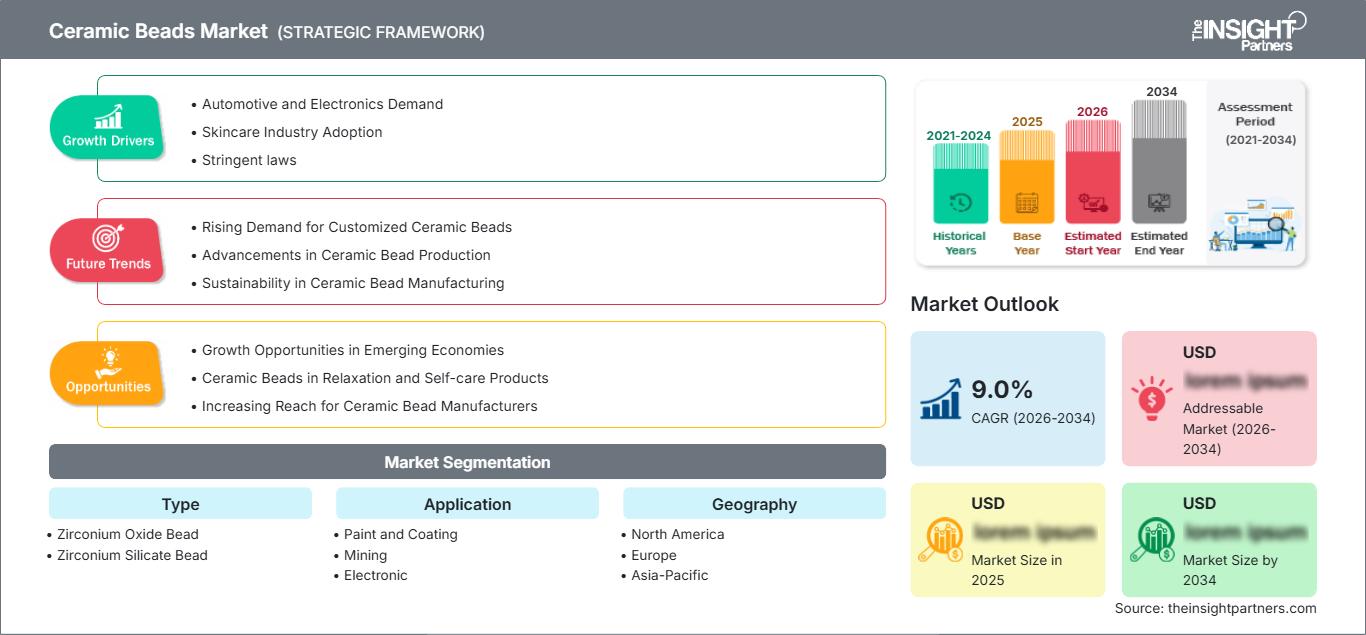
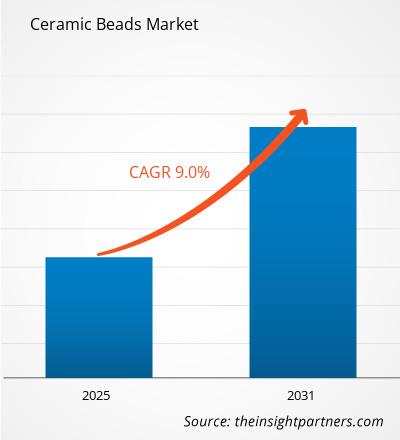
The Ceramic Beads Market was valued at US$ 251.82 million in 2025 and is projected to reach US$ 596.52 million by 2034, expanding at a CAGR of 10.06% during 2026–2034. Increasing demand for high-performance grinding and dispersion media across paints, mining, electronics, and pharmaceutical manufacturing is supporting industry expansion. Continuous advancements in precision ceramic processing, higher wear resistance requirements, and stricter product quality standards are further strengthening long-term commercial adoption across industrial applications.
Across North America, the Ceramic Beads Market Size continues to expand as manufacturers modernize grinding and dispersion systems for advanced coatings, specialty chemicals, and battery materials. The regional market is anticipated to register a CAGR in the range of 8.8%–9.4% during 2026–2034, supported by increasing investments in advanced manufacturing, growth in pharmaceutical production, and wider adoption of energy-efficient milling technologies across the U.S. and Canada.
Ceramic Beads Market Assessment and Insights
- North America: Accounted for 28%–31% share in 2025 and is projected to grow at a CAGR of 8.8%–9.4% during 2026–2034. Demand is supported by specialty coatings, pharmaceutical processing, advanced ceramics manufacturing, and the modernization of industrial grinding equipment.
- U.S.: Represented 76%–80% of the North American market in 2025 and is expected to record a CAGR of 8.9%–9.5% during 2026–2034, driven by investments in electronics manufacturing, battery materials, and premium industrial coatings.
- Europe: Held 24%–27% share in 2025 and is forecast to expand at a CAGR of 8.4%–9.1% during 2026–2034. Germany, France, Italy, and the UK continue to lead demand through automotive coatings, engineered ceramics, and advanced industrial processing.
- Asia Pacific: Captured 36%–39% share in 2025 and is anticipated to register the fastest regional CAGR of 11.2%–11.8% during 2026–2034. China, Japan, South Korea, and India remain major manufacturing hubs benefiting from electronics, chemicals, and mining investments.
- Largest Segment: Zirconium Oxide Bead accounted for 62%–66% market share in 2025 and is expected to grow at a CAGR of 10.4%–10.9% during 2026–2034, supported by superior density, durability, and grinding efficiency.
- High Growth Segment: Electronic applications represented 14%–17% market share in 2025 and are projected to expand at a CAGR of 12.4%–13.0% during 2026–2034, driven by semiconductor materials, electronic ceramics, and battery component manufacturing.
- Key companies analyzed in detail: Compagnie de Saint-Gobain S.A., Toray Industries, Inc., Nikkato Corporation, Cenotec, King’s Beads, Magotteaux, CHEMCO Advanced Materials, AGC Ceramics Co., Ltd., Sigmund Lindner GmbH, and Tosoh Corporation.
Source: The Insight Partners' analysis based on proprietary research, government publications, company annual reports, investor presentations, industry databases, and expert interviews.
Technological developments in the manufacture of engineered ceramic grinding media have come a long way in recent times, owing to the increasing demand for precision, durability, and efficiency from industrial clients. Improved purity of zirconia products, better methods of sintering and more control over the size of the particles are some of the factors that have improved the consistency of products, as well as lowering their contamination levels during the milling process.
Future expansion in the Ceramic Beads Market report is expected to be concentrated in rapidly industrializing economies investing in advanced materials manufacturing, battery supply chains, and specialty chemicals. Government incentives supporting semiconductor production, clean-energy technologies, and domestic manufacturing are encouraging capacity additions for ceramic grinding media. Sustainability initiatives promoting longer equipment life, reduced energy consumption, and lower material waste are expected to accelerate technology upgrades, creating favorable conditions for continued demand across both mature and emerging industrial markets.
Ceramic Beads Market Report Scope
| Report Attribute | Details |
|---|---|
| Market size in 2025 | US$ 251.82 Million |
| Market Size by 2034 | US$ 596.52 Million |
| Global CAGR (2026 - 2034) | 10.06% |
| Historical Data | 2021-2024 |
| Forecast period | 2026-2034 |
Ceramic Beads Market Analysis
Demand for ceramic grinding media continues to increase as manufacturers seek greater milling efficiency, improved particle size distribution, and lower contamination risks across high-value industrial processes. The Ceramic Beads Market analysis indicates that industries requiring precision dispersion, including advanced coatings, electronic materials, pharmaceuticals, and specialty chemicals, increasingly favor zirconia-based products because of their superior hardness and chemical stability. Growing production of lithium-ion battery materials, electronic ceramics, and engineered pigments further strengthens long-term consumption. Rising environmental standards also encourage manufacturers to replace conventional grinding media with longer-lasting ceramic alternatives that reduce waste generation and maintenance requirements.
The supply chain starts with high-quality raw materials like zirconium compounds, ceramic powders, additives, and highly sophisticated machinery and then moves on to stages like powder manufacturing, molding, sintering, sorting, quality control, and international distribution. The accessibility of raw materials continues to be an important factor because the price of the zirconium raw materials used determines the economic viability of production. However, constant investments in state-of-the-art manufacturing facilities have increased efficiency.
Competition continues to intensify in the Ceramic Beads Market as global manufacturers differentiate themselves through material innovation, customized product specifications, and application-specific engineering services. Leading companies, including Compagnie de Saint-Gobain S.A., Toray Industries, Inc., Nikkato Corporation, Tosoh Corporation, Sigmund Lindner GmbH, and AGC Ceramics Co., Ltd., continue expanding technical capabilities for high-performance milling applications. Regional specialists such as King’s Beads, CHEMCO Advanced Materials, Cenotec, and Magotteaux further strengthen competition through specialized product offerings serving mining, chemicals, and industrial processing customers.
Investments in this field are now being made in terms of capacity enlargement, digitization of manufacturing operations, and research in high-density ceramics for use in future industries. The companies are investing in process automation, quality control systems, and energy-efficient kilns, along with working in partnership with machinery suppliers in order to enhance milling efficiency. This is because such measures help to build a competitive edge through cost savings and meeting client needs.
● REPORT CUSTOMIZATION
Tailor This Report To Align With Your Specific Business Requirements
This report can be customized to align precisely with your business objectives, scope, and target markets. Customization options include tailored segmentation, geography, competitive analysis, and strategic insights to support informed decision-making.
Customize This Report →WHAT YOU CAN ADJUST
- ● Segmentations
- ● Geography
- ● Competitive Analysis
- ● Language Preferences
Ceramic Beads Market: Strategic Insights
Regional Insights
North America Ceramic Beads Market
North America accounted for 28%–31% of the global Ceramic Beads Market share in 2025 and is projected to expand at a CAGR of 8.8%–9.4% during 2026–2034. Demand is supported by advanced manufacturing industries emphasizing precision grinding, contamination control, and improved production efficiency. The production of pharmaceuticals, coatings, ceramics, and battery materials continues to drive stable demand within the region.
The modernization and automation of manufacturing facilities play key roles as the companies invest in advanced milling machinery that employs superior grinding media made of ceramics in order to enhance efficiency and product quality. The growing interest in the production of semiconductors, renewable energy technology, and specialty chemicals is another factor contributing to higher demand in the region.
U.S. Ceramic Beads Market
The United States represented 76%–80% of the North American market in 2025 and is expected to register a CAGR of 8.9%–9.5% through 2034 in the Ceramic Beads Market. A robust homegrown manufacturing sector, state-of-the-art pharmaceutical production, electronics manufacturing, and valuable coating sectors continue to ensure steady demand. There are a number of foreign companies that deal in ceramics that have technical sales and engineering facilities in the country.
Battery manufacturing, semiconductor production, and specialty chemicals sectors will continue to present opportunities in premium ceramic grinding media. The rising demand for electric vehicle components and advanced electronic materials will need precision milling processes that avoid contamination, thus making zirconia-based ceramic products more popular.
Europe Ceramic Beads Market
Europe accounted for 24%–27% of the global market in 2025 and is projected to expand at a CAGR of 8.4%–9.1% during 2026–2034 in the Ceramic Beads Market. Germany continues to be the dominant market region-wise due to its advanced chemicals, industrial machinery, and high-performance materials industry. The UK has an advantage in pharmaceutical and specialty chemicals, providing a stable demand for high-quality grinding media. France, Italy, and Spain have continued contributing in terms of production of coatings, engineered ceramics, and industrial minerals, along with investments in advanced manufacturing.
The increasing importance of sustainable manufacturing practices, efficient manufacturing technology, and material processing is expected to drive the use of ceramic grinding media in different industrial segments.
APAC Ceramic Beads Market
Asia Pacific held 36%–39% share in 2025 and is anticipated to register the fastest CAGR of 11.2%–11.8% during 2026–2034. China leads regional production, followed by Japan, South Korea, and India, supported by extensive electronics manufacturing, chemicals processing, and mining activities.
Government support for semiconductor manufacturing, battery supply chains, industrial modernization, and advanced materials production continues to drive investment across the region. Australia further contributes through mining-related demand and mineral processing applications requiring high-performance ceramic grinding media.
Middle East & Africa Ceramic Beads Market
The Middle East & Africa market is projected to expand at a CAGR of 7.6%–8.3% during 2026–2034. Saudi Arabia and the UAE continue investing in industrial diversification, chemicals, and advanced manufacturing, while South Africa remains an important market because of mining and mineral processing activities.
Infrastructure development, industrial processing capacity expansion, and modernization of mining operations continue to support regional demand. Rising investment in downstream manufacturing and industrial efficiency improvements is expected to increase the adoption of advanced ceramic grinding media across multiple end-use industries.
Segmentation Analysis
Type
The Type segment is projected to expand at a CAGR of 10.1%–10.7% during 2026–2034. Product selection is largely determined by grinding efficiency, wear resistance, density, and contamination control requirements. High-performance industrial applications increasingly prefer premium ceramic materials that improve milling consistency, reduce maintenance costs, and extend equipment life. The Ceramic Beads Market scope continues to broaden as manufacturers develop specialized formulations for precision processing across electronics, pharmaceuticals, chemicals, and advanced coatings.
- Zirconium Oxide Bead – Widely adopted across high-performance milling applications because of its exceptional hardness, high density, superior wear resistance, and low contamination characteristics. Demand remains strong in pharmaceutical manufacturing, battery materials, specialty chemicals, and premium coatings production.
- Zirconium Silicate Bead – Preferred for cost-sensitive industrial grinding processes requiring reliable durability and consistent milling performance. It is extensively used in paints, coatings, industrial minerals, pigments, ceramics, and general chemical processing, where balanced performance and operating costs are important.
Application
The Application segment is anticipated to register a CAGR of 10.4%–11.0% during 2026–2034 as manufacturers increasingly adopt advanced grinding media to improve product quality, operational efficiency, and energy utilization. Expanding investments in specialty chemicals, battery materials, industrial coatings, pharmaceuticals, and mineral processing continue to support long-term demand. Technological advancements in wet milling and ultra-fine dispersion processes are expected to further strengthen adoption across diverse industrial sectors.
- Paint and Coating – Ceramic grinding media enable uniform pigment dispersion, improved color consistency, enhanced coating performance, and reduced contamination during manufacturing, making them essential for premium architectural, industrial, automotive, and protective coating production.
- Mining – Mining companies increasingly utilize ceramic beads for ultra-fine mineral grinding because they offer lower wear rates, improved energy efficiency, and longer service life than conventional grinding media in selected processing applications.
- Electronic – Growing semiconductor manufacturing, electronic ceramics production, advanced battery materials, and precision electronic components continue to increase demand for contamination-free milling solutions capable of delivering extremely consistent particle size distribution.
- Agro Chemistry – Manufacturers employ ceramic grinding media to achieve stable formulations, finer particle dispersion, and improved processing efficiency during the production of pesticides, crop protection chemicals, and specialized agricultural formulations.
- Pharmaceutical – Pharmaceutical manufacturers increasingly utilize high-purity ceramic beads for sterile milling applications requiring precise particle size reduction, excellent chemical stability, and minimal contamination throughout active pharmaceutical ingredient and formulation production.
Opportunity Snapshot
| Application | Revenue Contribution | Trend Tag | Adoption Stage |
|---|---|---|---|
| Paint and Coating | High | Fine Dispersion | Mature |
| Mining | High | Mineral Recovery | Scaling |
| Electronic | High | Battery Materials | Scaling |
| Agro Chemistry | Medium | Crop Formulation | Mature |
| Pharmaceutical | Medium | Sterile Milling | Emerging |
Ceramic Beads Market Growth Drivers and Impact Analysis
Expansion of Advanced Battery and Electronic Material Manufacturing
The fast-growing production capacity of lithium-ion batteries, semiconductors, and electronic ceramics is generating a steady need for high-quality ceramic grinding media. Batteries, electronic ceramics, conductive pastes, and other powders need high-control milling operations that have minimal risk of contamination while retaining uniform particle size distribution. Ceramic beads offer better wear and chemical resistance than other grinding media. The increasing investment in battery gigafactories, semiconductor fabrication plants, and electronic material processing in the Asia Pacific, North America, and Europe should support their future consumption. Ceramic Beads Market Forecasts indicate that sustained electrification, digitalization, and electronics manufacturing expansion will continue generating new commercial opportunities for manufacturers supplying high-performance grinding media.
Increasing Adoption of High-Performance Grinding Technologies
Paint producers, coating makers, specialty chemical firms, pharmaceutical companies, and manufacturers of industrial minerals are upgrading their facilities to make use of cutting-edge milling technology, which provides them with better efficiencies and product consistency. Ceramic grinding media results in less machine wear, better milling efficiency, and less contamination, allowing manufacturers to produce high-quality products at lower maintenance costs. The presence of automation in industrial operations, along with process monitoring, encourages manufacturers to adopt high-end grinding solutions that can help in precision manufacturing. A focused approach towards efficiency, product quality, and sustainability keeps motivating the substitution of conventional grinding media with engineered ceramics.
Growth in Specialty Chemicals and Precision Manufacturing
The rising demand for specialty chemicals, functional pigments, engineered ceramics, active pharmaceuticals, and industrial materials keeps stimulating the need for efficient milling media. There is a need for extremely small particle sizes, good dispersion, and consistency in terms of performance reliability for product requirements to be met. Ceramic beads help to achieve these goals due to the advantages such as high mechanical strength, chemical resistance, and long life. Developments in material science and manufacturing technologies are fostering increased usage in various industries. Since the transition of the world industries to more sophisticated engineered products continues, the demand for high-quality ceramic grinding solutions should stay stable.
Ceramic Beads Market Future Trends
Development of Ultra-High-Purity Ceramic Grinding Media
Demand for ultra-high-purity ceramic beads is expected to accelerate as semiconductor manufacturing, advanced battery materials, precision electronics, and biopharmaceutical production require contamination-free milling processes. Manufacturers are investing in refined powder processing, controlled sintering technologies, and precision grading systems to produce ceramic beads with improved density uniformity and longer service life. The Ceramic Beads Market trends indicate that customers increasingly value high-performance grinding media capable of delivering superior milling efficiency while reducing maintenance frequency and production losses. As industrial quality standards become more stringent, suppliers focusing on advanced material engineering and customized ceramic formulations are expected to gain stronger competitive positions across premium application segments worldwide.
Digital Manufacturing and Smart Production Technologies
Digitalization in the industrial sector is changing the way ceramic bead manufacturing is conducted by adopting automation, artificial intelligence-based quality inspection, maintenance predictions, and real-time production monitoring processes. Improved production processes are resulting in enhanced dimensional accuracy, better energy efficiency, fewer manufacturing defects, and higher production volume. Digitalization of the process control and advanced kiln management system is being adopted by manufacturers to increase the reliability of products and minimize operating costs. As Industry 4.0 gains more acceptance within ceramic manufacturing companies, manufacturers will be able to trace their processes, develop new products faster, and cater to individual customer needs in a better way.
Ceramic Beads Market Opportunities
Expansion of Battery Supply Chains and Advanced Energy Storage
Quick investments in the production of electric vehicles and energy storage devices keep increasing the demand for high-quality battery materials that need precise grinding and dispersion processes. Cathode materials, anode powders, conductive additives, and ceramic separators are more often dependent on quality grinding media that would be able to reduce contamination while keeping a constant particle size. The rapid expansion of battery manufacturing in the Asia Pacific, North America, and Europe creates good prospects for ceramic bead producers that can create special ceramic beads for battery material production. Collaboration with battery material producers, machinery makers, and scientific organizations would accelerate the development of new grinding technology and improve long-term revenue prospects.
Customized Solutions for High-Value Industrial Applications
Increasing needs for application-specific grinding media provide potential differentiation options in the form of custom-made ceramic compounds, bead sizes, and wear-resistant material. The processing of pharmaceuticals, electronic materials, coating materials, engineered ceramics, and pure chemicals will need more customized grinding media in their processes. Companies that can provide consultancy services on their processes and customized products for specific customers will help build stronger customer relations and move into premium industrial segments. Research and development activities, precision manufacturing systems, and customer-driven product innovations will help achieve competitive positions and sustained growth opportunities in the global industrial materials industry.
Recent Developments
- August 2025: Tosoh Corporation renewed its Next-Generation Zirconia Creation Industry-Academia Partnership Program to accelerate the development of advanced zirconia ceramics with improved performance for industrial applications. The collaboration focuses on enhancing zirconia materials used across electronics, advanced ceramics, and precision manufacturing, supporting future innovation in zirconia-based ceramic beads and grinding media.
- May 2025: Saint-Gobain ZirPro transferred its Upryze-Shock ultra-tough zirconia ceramic powder business to Nanoe, including technology, patents, trademarks, and customer portfolio. The move enables Nanoe to continue supplying the advanced zirconia material while allowing Saint-Gobain ZirPro to strengthen its strategic focus on its core zirconia product portfolio, including ceramic grinding beads and engineered zirconia solutions.
Frequently Asked Questions

- Comprehensive Market Sizing and Forecast Analysis
- Detailed Segmentation Analysis
- In-Depth Market Dynamics Assessment
- Regional and Country-Level Insights
- Competitive Landscape and Company Benchmarking
- Strategic Business Intelligence
Recent Reports
Testimonials

The Insight Partners' SCADA System Market report is comprehensive, with valuable insights on current trends and future forecasts. The team was highly professional, responsive, and supportive throughout. We are very satisfied and highly recommend their services.
RAN KEDEM Partner, Reali Technologies LTDs
I requested a report on a very specific software market and the team produced the report in a few days. The information was very relevant and well presented. I then requested some changes and additions to the report. The team was again very responsive and I got the final report in less than a week.
JEAN-HERVE JENN Chairman, Future Analytica
We worked with The Insight Partners for an important market study and forecast. They gave us clear insights into opportunities and risks, which helped shape our plans. Their research was easy to use and based on solid data. It helped us make smart, confident decisions. We highly recommend them.
PIYUSH NAGPAL Sr. Vice President, High Beam Global
The Insight Partners delivered insightful, well-structured market research with strong domain expertise. Their team was professional and responsive throughout. The user-friendly website made accessing industry reports seamless. We highly recommend them for reliable, high-quality research services
YUKIHIKO ADACHI CEO, Deep Blue, LLC.
This is the first time I have purchased a market report from The Insight Partners.While I was unsure at first, I visited their web site and felt more comfortable to take the risk and purchase a market report.I am completely satisfied with the quality of the report and customer service. I had several questions and comments with the initial report, but after a couple of dialogs over email with their analyst I believe I have a report that I can use as input to our strategic planning process.Thank you so much for taking the extra time and making this a positive experience.I will definitely recommend your service to others and you will be my first call when we need further market data.
JOHN SUZUKI President and Chief Executive Officer, Board Director, BK Technologies
I wish to appreciate your support and the professionalism you displayed in the course of attending to my request for information regarding to infectious disease IVD market in Nigeria. I appreciate your patience, your guidance, and the fact that you were willing to offer a discount, which eventually made it possible for us to close a deal. I look forward to engaging The Insight Partners in the future, all thanks to the impression you have created in me as a result of this first encounter.
DR CHIJIOKE ONYIA MANAGING DIRECTOR, PineCrest Healthcare Ltd.Reason to Buy
- Informed Decision-Making
- Understanding Market Dynamics
- Competitive Analysis
- Identifying Emerging Markets
- Customer Insights
- Market Forecasts
- Risk Mitigation
- Boosting Operational Efficiency
- Strategic Planning
- Investment Justification
- Tracking Industry Innovations
- Aligning with Regulatory Trends





 Get Free Sample for