
Ceramic Decal Market Size, Share & Demand by 2034
Coverage: By Product (Silkscreen, Digital, Others); Application Method (Water Based, Direct, Indirect); Application (Tableware, Sanitary Ware, Ceramic Tiles, Others) , and Geography (North America, Europe, Asia Pacific, and South and Central America)
- Status : Data Released
- Report Code : TIPRE00017381
- Category : Chemicals and Materials
- No. of Pages : 150
- Available Report Formats :


- Last update date : August 07, 2026


2025 Market Size
US$ 474.98 Mn
Base year value
2034 Forecast
US$ 555.41 Mn
Projected by 2034
CAGR 2026-2034
1.75 %
Growth rate
Addressable Market
US$ 4,666.87 Mn
(2026-2034)
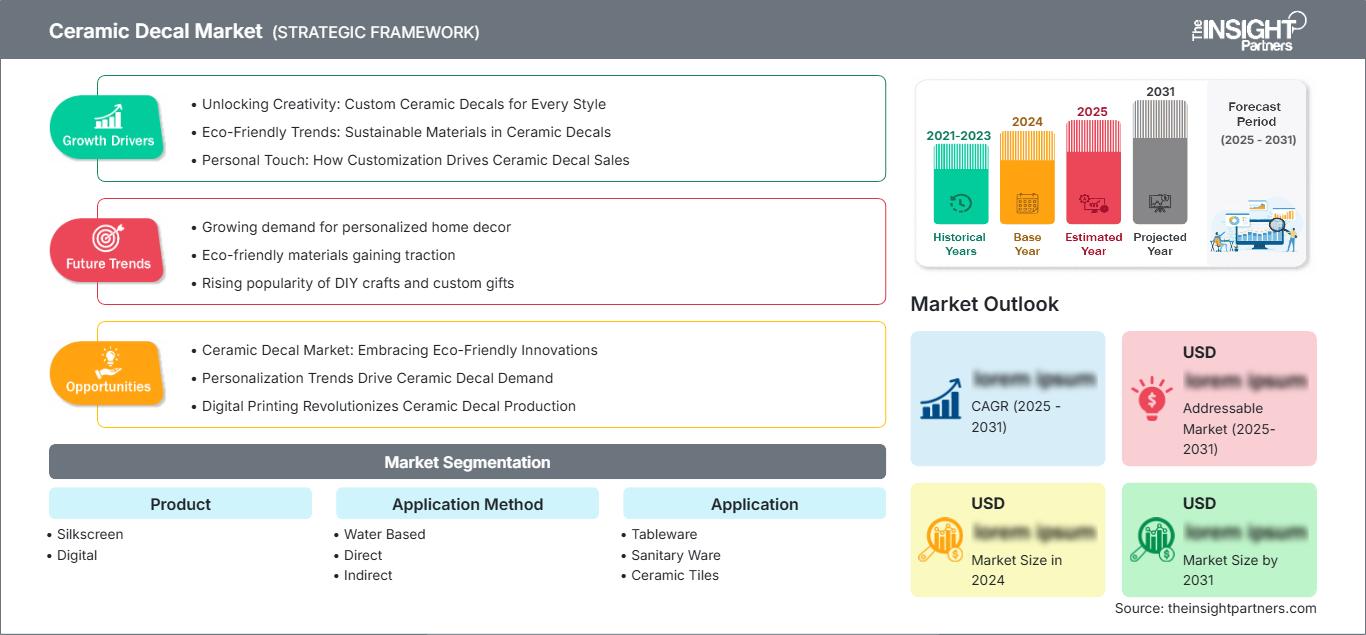
The Ceramic Decal market was valued at US$ 474.98 million in 2025 and is projected to reach US$ 555.41 million by 2034, registering a CAGR of 1.75% during 2026–2034. Demand continues to be supported by the steady production of ceramic tableware, sanitary ware, and decorative tiles, while advances in digital ceramic printing and environmentally compliant ceramic pigments are gradually reshaping decoration processes across industrial and specialty ceramic manufacturing.
North America represents a mature manufacturing and consumption base where demand is driven by premium tableware, customized architectural ceramics, and replacement activity in residential renovation. The Ceramic Decal market size in the region is supported by increasing adoption of digital ceramic decoration technologies, stricter regulations on heavy-metal-free decorative materials, and expanding hospitality investments that require aesthetically differentiated ceramic products. Industry participants are also investing in shorter production runs enabled by digital printing technologies.
Ceramic Decal Market Assessment and Insights
- North America: Accounted for a 26–29% share in 2025 and is expected to expand at a CAGR of 1.5–1.8% during 2026–2034. Stable construction activity, replacement demand for sanitary ware, and premium ceramic tableware continue to support regional consumption.
- U.S.: Represented 74–78% of the North American market in 2025 and is projected to grow at a CAGR of 1.6–1.9% through 2034, supported by hospitality renovations, customized ceramic products, and technological adoption in decorative manufacturing.
- Europe: Held 31–34% market share in 2025 and is anticipated to register a CAGR of 1.4–1.7%. Germany, Italy, Spain, and the UK remain important ceramic manufacturing and decoration centers with strong exports of premium ceramic products.
- Asia Pacific: Accounted for a 34–37% share in 2025 and is forecast to expand at a CAGR of 2.0–2.3%, led by China, India, Japan, and South Korea through sustained ceramic tile production and growing digital decoration capabilities.
- Largest Segment: Tableware represented 43–47% market share in 2025 and is projected to grow at 1.6–1.9% CAGR, supported by continuous replacement demand and premium decorative product launches.
- High Growth Segment: The digital product segment accounted for a 32–35% share in 2025 while expanding at a 2.8–3.2% CAGR, benefiting from shorter production cycles, customized graphics, and reduced setup requirements.
- Key companies analyzed in detail: Bailey Decal Ltd., Design Point Decal, Inc., Fujifilm Sericol India Pvt. Ltd., Hi-Coat, Carl Leipold GmbH, Milestone Decal Art LLC, Siak Transfers Ltd., Stechcol Ceramic Crafts Development (Shenzhen) Co., Ltd., Trinity Decals, Inc., and Tullis Russell Ltd.
Source: The Insight Partners' analysis based on proprietary research, government publications, company annual reports, investor presentations, industry databases, and expert interviews.
The industry continues to evolve from conventional screen-printing toward digitally enabled ceramic decoration systems capable of supporting shorter production runs, greater design flexibility, and improved production efficiency. Regulatory emphasis on lead-free and cadmium-free decorative materials, together with improvements in ceramic inks and transfer media, is encouraging manufacturers to modernize production while maintaining firing durability and color consistency. Digital workflow integration is also improving responsiveness to customized customer requirements across multiple ceramic applications.
Future expansion is expected to be concentrated in Asia Pacific manufacturing clusters and premium architectural ceramics across developed economies. Investments in automated decoration lines, sustainable ceramic pigments, and digitally managed color systems are likely to strengthen competitiveness over the forecast period. Increasing demand for personalized ceramic products in hospitality, residential construction, and branded consumer goods is expected to create additional opportunities for manufacturers specializing in advanced ceramic transfer technologies.
Ceramic Decal Market Report Scope
| Report Attribute | Details |
|---|---|
| Market size in 2025 | US$ 474.98 Million |
| Market Size by 2034 | US$ 555.41 Million |
| Global CAGR (2026 - 2034) | 1.75% |
| Historical Data | 2021-2024 |
| Forecast period | 2026-2034 |
Ceramic Decal Market Analysis
Growing investments in ceramic tiles, premium tableware, and sanitary ware manufacturing continue to support the Ceramic Decal Market growth worldwide. Decorative differentiation has become increasingly important for ceramic manufacturers competing in residential, hospitality, and commercial construction markets. At the same time, consumers are demanding higher-quality decorative finishes, customized graphics, and durable kiln-fired designs, encouraging manufacturers to adopt advanced transfer technologies. These developments have strengthened demand for ceramic decoration materials across both mature and emerging manufacturing regions.
The market ecosystem includes ceramic pigment suppliers, decal paper manufacturers, specialty ink producers, ceramic product manufacturers, kiln equipment providers, distributors, and end users across the construction and consumer goods industries. Improvements in digital workflow integration, automated transfer application, and quality inspection have increased production efficiency while reducing waste and enabling economical short-run production.
The Ceramic Decal Market analysis indicates a moderately fragmented competitive landscape characterized by established specialty manufacturers and regional suppliers serving local ceramic industries. Bailey Decal Ltd., Design Point Decal, Inc., Fujifilm Sericol India Pvt. Ltd., Carl Leipold GmbH, Stechcol Ceramic Crafts Development (Shenzhen) Co., Ltd., and Siak Transfers Ltd. continue investing in digital printing compatibility, advanced ceramic inks, and environmentally compliant decoration materials to strengthen their market positions.
Strategic investments increasingly focus on digital ceramic printing systems, automation, sustainable pigments, and production flexibility rather than manufacturing capacity expansion alone. Companies including Hi-Coat, Trinity Decals, Inc., Milestone Decal Art LLC, and Tullis Russell Ltd. continue emphasizing customized decoration capabilities, rapid design turnaround, and compliance with evolving food-contact and environmental regulations. These initiatives are expected to improve operational efficiency while supporting long-term competitiveness across premium ceramic decoration applications.
● REPORT CUSTOMIZATION
Tailor This Report To Align With Your Specific Business Requirements
This report can be customized to align precisely with your business objectives, scope, and target markets. Customization options include tailored segmentation, geography, competitive analysis, and strategic insights to support informed decision-making.
Customize This Report →WHAT YOU CAN ADJUST
- ● Segmentations
- ● Geography
- ● Competitive Analysis
- ● Language Preferences
Ceramic Decal Market: Strategic Insights
Regional Insights
North America Ceramic Decal Market
North America accounted for 26–29% of the global Ceramic Decal Market share in 2025 and is projected to register a CAGR of 1.5–1.8% during 2026–2034. The regional market benefits from well-established ceramic tableware, sanitary ware, and architectural tile industries that continue investing in decorative differentiation and premium product positioning. Growth is further supported by increasing renovation activity across residential and hospitality sectors, where aesthetically enhanced ceramic products remain in demand. Digital ceramic decoration technologies are gaining wider acceptance because they reduce setup time, enable shorter production runs, and improve design flexibility.
The United States and Canada continue to witness steady adoption of environmentally compliant ceramic pigments and lead-free decorative materials in line with evolving regulatory standards. Manufacturers are integrating automated decoration systems with digital printing platforms to improve production efficiency and product consistency. The presence of established ceramic product manufacturers, specialty distributors, and advanced printing solution providers supports continuous technological development, while customized decorative solutions for commercial interiors and luxury residential projects contribute to stable regional demand throughout the forecast period.
U.S. Ceramic Decal Market
The U.S. represented 74–78% of the North American market in 2025 and is expected to expand at a CAGR of 1.6–1.9% through 2034. Strong demand from premium tableware manufacturers, hospitality refurbishment projects, and residential remodeling continues to sustain consumption of ceramic decals. The country's mature manufacturing infrastructure and growing adoption of digital ceramic printing technologies have enabled producers to offer customized decorative products with shorter production cycles while maintaining high firing quality and color consistency.
Domestic manufacturers increasingly emphasize sustainable decoration materials that comply with food-contact regulations and environmental standards. Investments in digital workflow automation, ceramic ink development, and high-resolution printing systems continue to improve production flexibility. The growing preference for personalized ceramic products among commercial establishments, restaurants, hotels, and interior designers also supports demand for advanced decoration technologies across multiple ceramic applications.
Europe Ceramic Decal Market
Europe held 31–34% of the global market in 2025 and is anticipated to record a CAGR of 1.4–1.7% during 2026–2034, supported by its long-established ceramic manufacturing base. Italy remains the leading regional producer owing to its globally competitive ceramic tile industry and advanced decoration capabilities. Germany contributes through high-value sanitary ware and industrial ceramics, while Spain continues to strengthen exports of decorative ceramic tiles for residential and commercial construction.
The United Kingdom maintains a stable demand for premium tableware and customized decorative ceramics serving hospitality and luxury retail markets. France focuses on high-quality ceramic tableware and decorative homeware, whereas Italy and Spain continue investing in digital ceramic printing equipment to improve manufacturing efficiency and product customization. Increasing adoption of environmentally compliant decorative materials and automated production systems is expected to reinforce Europe's competitive position throughout the forecast period.
APAC Ceramic Decal Market
Asia Pacific accounted for 34–37% of the global market in 2025 and is projected to expand at a CAGR of 2.0–2.3%, making it the fastest-growing regional market. China remains the largest producer of ceramic tiles and tableware, while India continues expanding its ceramic manufacturing capacity through investments in industrial clusters and export-oriented production.
Japan and South Korea emphasize premium ceramic decoration technologies and advanced digital printing solutions, whereas Australia supports steady demand through residential renovation and commercial construction activities. Government support for manufacturing modernization, expanding ceramic exports, and automation initiatives continues to strengthen regional competitiveness.
Middle East & Africa Ceramic Decal Market
The Middle East & Africa market is projected to have a CAGR of 1.7% to 2.0% during 2026-2034, driven by rising construction activity and demand for decorative ceramic tiles in buildings. In Saudi Arabia, large-scale infrastructure development projects drive regional consumption, while in the UAE, there are continuing investments in high-end hotel and real estate construction that require ceramics to be aesthetically finished.
In South Africa, there is significant demand for ceramic tableware and construction materials, while in the rest of MEA, urbanization and housing construction drive demand. An increase in investments in diversified manufacturing, tourist facilities, and sustainable building materials is expected to drive demand for ceramic decoration products.
Segmentation Analysis
Product
The Product segment is expected to post a CAGR of 1.8–2.1% between 2026 and 2034. With product innovation being the key driving force behind ceramic decoration, there is an ongoing trend toward combining production efficiency, flexible designs, and high-quality prints. Silkscreen decals remain popular in volume production for their durability and consistent colors, whereas digital products are increasingly sought after for customizable designs, smaller production batches, and lower stock needs. The Ceramic Decal Market scope is widening due to the integration of digital production into automated ceramic production lines.
- Silkscreen – Continues to dominate high-volume ceramic decoration owing to excellent firing stability, vibrant color reproduction, and cost-effective production for standardized decorative designs used across tableware and ceramic tile manufacturing.
- Digital – Witnessing increasing adoption as manufacturers seek mass customization, shorter lead times, variable graphics, and lower setup costs while improving operational flexibility for premium ceramic decoration projects.
Application Method
The Application Method segment is expected to exhibit a CAGR of 1.6-1.9% between 2026 and 2034. The choice of application method varies with the product geometry, the quantity produced, the required surface finish quality, and efficiency. The water-based application process still holds sway due to its ease of use and ability to fit into the existing manufacturing process. Direct and indirect application methods will continue to play an important role for specialized ceramic products.
- Water-Based – Maintains broad industry adoption because it supports efficient decal positioning, smooth transfer characteristics, and compatibility with large-scale ceramic production across multiple product categories.
- Direct – Preferred for selected industrial applications requiring simplified decoration workflows, improved production speed, and reduced handling during manufacturing operations while maintaining acceptable decorative quality.
- Indirect – Used where intricate decorative patterns, complex product geometries, or premium aesthetic finishes require greater transfer precision before high-temperature firing.
Application
The Applications segment is predicted to post a CAGR of 1.7% to 2.0% from 2026 to 2034. The demand in this market depends on ceramic manufacturing volumes, consumer lifestyles, construction, and hospitality investments. Ceramic decoration has become an important factor in finished ceramic products as manufacturers adopt high-quality decal technology, which provides colorfastness, abrasion resistance, and good aesthetics. Personalized ceramic products are becoming more popular, promoting the development of this market.
- Tableware – Represents the largest application owing to continuous global demand for decorative household products, hospitality dining solutions, and premium branded ceramic collections requiring durable kiln-fired graphics.
- Sanitary Ware – Generates consistent demand through decorative bathroom fixtures, premium residential construction, and commercial infrastructure projects where customized ceramic finishes enhance product value and brand differentiation.
- Ceramic Tiles – Benefits from increasing architectural decoration, luxury interior design, hospitality developments, and commercial construction projects seeking high-quality decorative ceramic surfaces with long-lasting performance.
Opportunity Snapshot
| Application | Revenue Contribution | Trend Tag | Adoption Stage |
| Tableware | High | Premium Dining | Mature |
| Sanitary Ware | Medium | Luxury Bath | Scaling |
| Ceramic Tiles | High | Digital Decor | Scaling |
Ceramic Decal Market Growth Drivers and Impact Analysis
Growing Demand for Premium Decorative Ceramic Products
Consumer preference for aesthetically distinctive ceramics continues to motivate manufacturers to adopt new technologies to decorate their products. The high-end tableware lines, designer sanitary wares, and high-end ceramic tiles now feature complex graphics, personalized branding, and durable finishes that cannot be achieved with traditional coloring techniques. Luxury hospitality, residential, and commercial interior applications also drive the demand for high-quality ceramic decoration. This is being addressed by manufacturers through improved decals, expanded color ranges, and the integration of digital designs into production processes. Value addition through ceramic manufacturing is thus enhanced, and product differentiation is facilitated in the highly competitive environment. With evolving disposable incomes and customer preferences, decorated ceramic products will continue to drive manufacturer growth.
Expansion of Digital Ceramic Printing Technologies
Rapid changes in technology have been taking place in the machinery used for digital ceramic printing, the ceramic ink, and the automated systems employed in production processes. Digital technologies have allowed manufacturers to reduce the number of prints needed, enable variable graphics and customizable designs, and eliminate the setup involved in the conventional screen printing process. This will help in reducing the amount of stock and shorten the time taken in the product development cycle. With ongoing improvements in printing resolution, firing performance, and color consistency, there is increased motivation for ceramic manufacturers to upgrade their factories.
Increasing Construction and Hospitality Investments
Construction, including residential and commercial property, hotels, restaurants, and tourism infrastructure, remains an important driver of demand for decorative ceramics. Decorated ceramic tiles and sanitary ware are becoming more common in high-end construction projects where design and durability are critical. Renovation in developed countries will provide another source of demand for decorative ceramics as replacements. Urbanization in developing countries drives the development of housing, infrastructure, and commercial complexes that use decorated ceramic products. Construction in such segments will continue to create opportunities for ceramic decal manufacturers to produce durable decorative materials that withstand high temperatures during firing and in long-term operation.
Ceramic Decal Market Future Trends
Increasing Adoption of Sustainable Decorative Materials
Manufacturers are accelerating the transition toward environmentally compliant ceramic decoration by adopting lead-free and cadmium-free coloring pigments. Regulations concerning food contact and environmental protection continue to dictate the choice of materials in ceramic manufacture. Firing efficiency and production waste have been optimized through better digital process integration. These developments are expected to strengthen the Ceramic Decal Market trends associated with sustainable manufacturing while supporting long-term regulatory compliance and product quality across global ceramic production.
Integration of Smart Digital Manufacturing Platforms
There is also a growing trend in the industry toward adopting digital manufacturing systems in decorative ceramic production, including automated systems for color management, manufacturing, and inspection. The use of artificial intelligence for print optimization and process control allows manufacturers to reduce production variability and increase consistency at high production volumes. Digital manufacturing software also helps predict maintenance needs for ceramic printing systems. With the increasing adoption of Industry 4.0 in ceramics manufacturing, there is an expectation that the digital production ecosystem will enhance competitiveness and flexibility.
Ceramic Decal Market Opportunities
Expansion into Customized Architectural Ceramic Applications
Architectural ceramics continue to present attractive investment opportunities as commercial buildings, luxury residential developments, airports, hotels, and retail facilities increasingly incorporate customized ceramic finishes. Decorative ceramic façades, interior wall panels, and premium flooring applications require durable, high-resolution decoration that withstands long-term environmental exposure. Ceramic Decal Market Forecasts indicate that companies specializing in digital printing technology and high-quality ceramic pigments, along with customization, will be better positioned to exploit market demand for unique ceramic decals among architects, designers, and construction firms. Collaboration with ceramic tile manufacturers and design firms will prove to be an added strength in achieving market penetration.
Growing Demand for Short-Run and Personalized Ceramic Production
The rise in consumer demand for custom consumer goods presents substantial market opportunities for ceramic decal providers who can deliver solutions for low-volume, high-end manufacturing. Brands in the hospitality industry, promotional product producers, specialty retailers, and luxury tableware providers are seeing rising demand for custom ceramic decoration featuring unique branding, season-specific designs, and limited-edition prints. Ceramic digital printers will be able to serve these unique applications and reduce setup and lead-time expenses. Businesses that incorporate new technological solutions, such as workflow automation and ceramic decoration, will benefit greatly from the growing demand for customized ceramics.
Recent Developments
- May 2026: Kajaria Ceramics Limited reported a 62.3% increase in FY2026 net profit to approximately ₹487 crore and announced a ₹210 crore investment to expand manufacturing capacity in Andhra Pradesh. The company also approved a ₹297 crore share buyback, reinforcing its long-term strategy to strengthen production capacity and improve operational efficiency in ceramic products.
- September 2025: SINTX Technologies, Inc. acquired SiNAPTIC Surgical, LLC, a specialist in ceramic additive manufacturing and silicon nitride-based medical devices. The acquisition expands SINTX's advanced ceramic manufacturing capabilities, strengthens its additive manufacturing platform, and broadens its portfolio of orthopedic and spinal implant technologies, supporting commercialization in the medical ceramics sector.
Frequently Asked Questions

- Comprehensive Market Sizing and Forecast Analysis
- Detailed Segmentation Analysis
- In-Depth Market Dynamics Assessment
- Regional and Country-Level Insights
- Competitive Landscape and Company Benchmarking
- Strategic Business Intelligence
Recent Reports
Testimonials

The Insight Partners' SCADA System Market report is comprehensive, with valuable insights on current trends and future forecasts. The team was highly professional, responsive, and supportive throughout. We are very satisfied and highly recommend their services.
RAN KEDEM Partner, Reali Technologies LTDs
I requested a report on a very specific software market and the team produced the report in a few days. The information was very relevant and well presented. I then requested some changes and additions to the report. The team was again very responsive and I got the final report in less than a week.
JEAN-HERVE JENN Chairman, Future Analytica
We worked with The Insight Partners for an important market study and forecast. They gave us clear insights into opportunities and risks, which helped shape our plans. Their research was easy to use and based on solid data. It helped us make smart, confident decisions. We highly recommend them.
PIYUSH NAGPAL Sr. Vice President, High Beam Global
The Insight Partners delivered insightful, well-structured market research with strong domain expertise. Their team was professional and responsive throughout. The user-friendly website made accessing industry reports seamless. We highly recommend them for reliable, high-quality research services
YUKIHIKO ADACHI CEO, Deep Blue, LLC.
This is the first time I have purchased a market report from The Insight Partners.While I was unsure at first, I visited their web site and felt more comfortable to take the risk and purchase a market report.I am completely satisfied with the quality of the report and customer service. I had several questions and comments with the initial report, but after a couple of dialogs over email with their analyst I believe I have a report that I can use as input to our strategic planning process.Thank you so much for taking the extra time and making this a positive experience.I will definitely recommend your service to others and you will be my first call when we need further market data.
JOHN SUZUKI President and Chief Executive Officer, Board Director, BK Technologies
I wish to appreciate your support and the professionalism you displayed in the course of attending to my request for information regarding to infectious disease IVD market in Nigeria. I appreciate your patience, your guidance, and the fact that you were willing to offer a discount, which eventually made it possible for us to close a deal. I look forward to engaging The Insight Partners in the future, all thanks to the impression you have created in me as a result of this first encounter.
DR CHIJIOKE ONYIA MANAGING DIRECTOR, PineCrest Healthcare Ltd.Reason to Buy
- Informed Decision-Making
- Understanding Market Dynamics
- Competitive Analysis
- Identifying Emerging Markets
- Customer Insights
- Market Forecasts
- Risk Mitigation
- Boosting Operational Efficiency
- Strategic Planning
- Investment Justification
- Tracking Industry Innovations
- Aligning with Regulatory Trends





 Get Free Sample for