
Chainsaw Market Share, Size & Demand by 2034
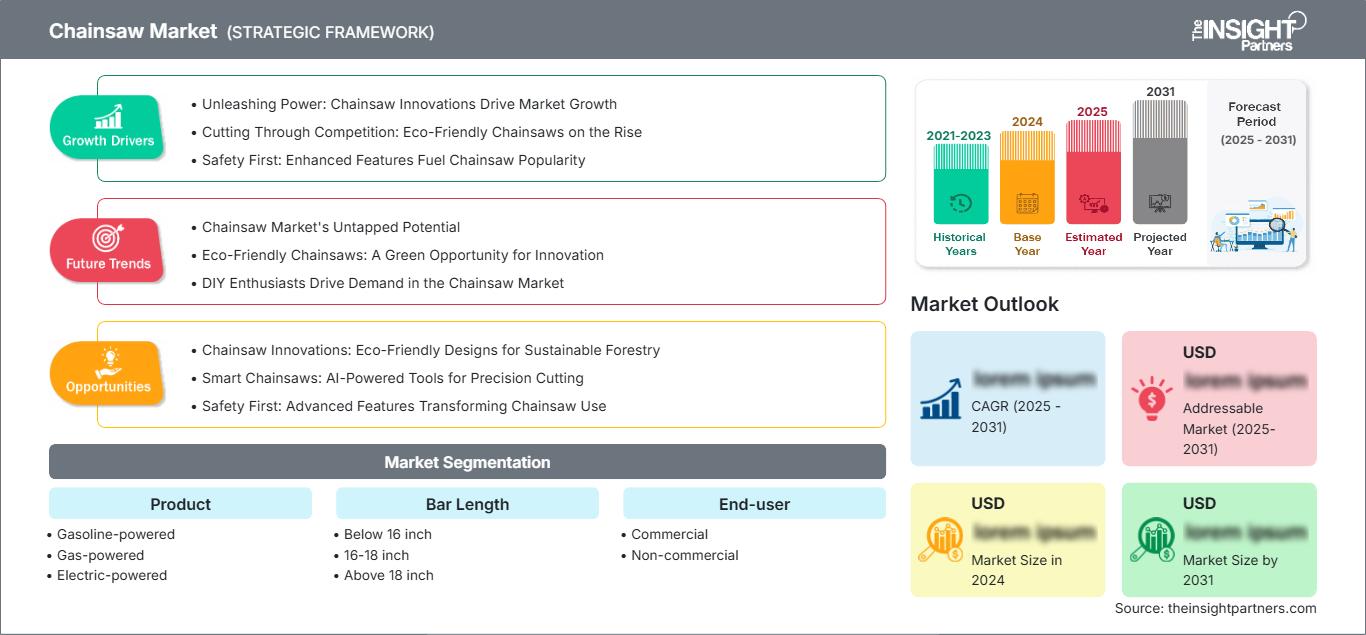
Coverage: By Product (Gasoline-powered, Gas-powered, Electric-powered); Bar Length (Below 16 inch, 16-18 inch, Above 18 inch); End-user (Commercial, Non-commercial) , and Geography (North America, Europe, Asia Pacific, and South and Central America)
- Status : Data Released
- Report Code : TIPRE00019468
- Category : Manufacturing and Construction
- No. of Pages : 150
- Available Report Formats :


- Last update date : July 17, 2026


2025 Market Size
US$ 4.41 Bn
Base year value
2034 Forecast
US$ 6.72 Bn
Projected by 2034
CAGR 2026-2034
4.81 %
Growth rate
Addressable Market
US$ 50.57 Bn
(2026-2034)
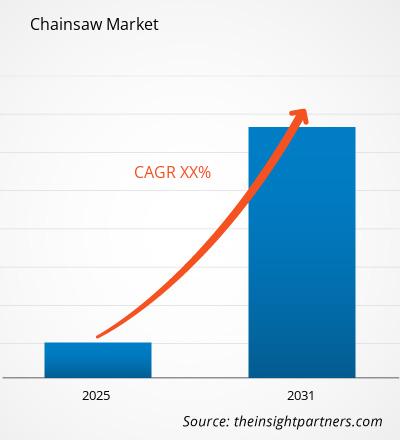
The chainsaw market was valued at US$ 4.41 Billion in 2025 and is projected to reach US$ 6.72 Billion by 2034, growing at a CAGR of 4.81% during 2026–2034. Demand is supported by forestry, landscaping, construction, and residential maintenance applications where portable cutting equipment remains essential. Product innovation is moving toward lower emissions, stronger batteries, improved ergonomics, and safety systems that address professional and non-commercial user needs.
Across North America, chainsaw market size expansion is expected to track a 4.3–4.8% CAGR as storm cleanup, utility vegetation management, wildfire mitigation, and home improvement sustain equipment turnover. The region benefits from mature dealer networks, high landscaping spend, and faster adoption of battery platforms in urban areas where noise limits and small-engine emission rules are reshaping purchasing decisions.
Chainsaw Market Assessment and Insights
- North America accounted for 34–37% share in 2025 and is expected to grow at a CAGR of 4.3–4.8% during 2026–2034, supported by forestry, landscaping, disaster response, and residential property maintenance demand.
- US represented 78–82% of North America revenue in 2025 and is forecast to grow at a CAGR of 4.2–4.7% through 2034.
- Europe held 25–28% share in 2025 and is projected to expand at a CAGR of 3.9–4.4%, led by Germany, France, the UK, Italy, and Nordic forestry markets.
- Asia Pacific captured 22–25% share in 2025 and is set to grow at a CAGR of 5.4–6.0%, with China, Japan, India, South Korea, and Australia driving mechanized land management.
- Largest Segment Commercial end users held 55–59% market share in 2025 and are expected to grow at a CAGR of 4.6–5.1% as fleets prioritize durability and uptime.
- High Growth Segment Electric-powered products held 31–35% market share in 2025 and are forecast to grow at a CAGR of 6.2–6.8% on battery adoption.
- Key companies analyzed in detail: STIHL Holding AG & Co. KG, Husqvarna AB, Yamabiko Corporation, Stanley Black & Decker, Inc., Makita Corporation, Robert Bosch GmbH, Techtronic Industries Co. Ltd., Greenworks Tools, Positec Tool Corporation, Zhejiang Zomax Garden Machinery Co., Ltd.
Source: The Insight Partners' analysis based on proprietary research, government publications, company annual reports, investor presentations, industry databases, and expert interviews.
Equipment design has moved from being driven by displacement to achieving balance between power, reduced vibration, and platform compatibility. The professional buyers continue to utilize gas-powered products for tree felling, bucking, and remote forestry operations, while suppliers are expanding their product lines based on batteries in arboriculture, municipality, and homeowner markets. The production process is being transformed as suppliers are localizing battery manufacturing, refining electronic controls, and implementing the power platform in outdoor products.
In the period ahead, new Asian and Middle Eastern markets will provide additional demand through infrastructure corridors, plantation management, and utilities maintenance. Two-stroke engines' regulations, occupational health standards, and governmental purchasing policies will lead to development of environmentally friendly products. Resources will be invested in improving battery capacity, dealer service support, training, and attachments reducing idle time for commercial customers.
Chainsaw Market Report Scope
| Report Attribute | Details |
|---|---|
| Market size in 2025 | US$ 4.41 Billion |
| Market Size by 2034 | US$ 6.72 Billion |
| Global CAGR (2026 - 2034) | 4.81% |
| Historical Data | 2021-2024 |
| Forecast period | 2026-2034 |
Chainsaw Market Analysis
Chainsaw demand is related to repeat maintenance activities as opposed to one-time purchases of equipment. Utilities maintain right-of-ways, municipal organizations cut down damaged by storms trees, and forestry companies regularly replace worn-out chainsaws. The supply chain comprises engine and motor suppliers, manufacturers of guide bars and chains, battery cell partners, distributors, retailers, rental shops, and after-sales services.
The supply side includes availability of lithium ion cells, prices of magnesium and aluminum components, and safety and environmental compliance. Professional clients value power, speed of cutting, filtration, and serviceability, while consumer clients care about the weight, sound level, and ease of starting the chainsaw. This allows suggesting that both high-performing and gasoline powered, but compact electric versions can be produced based on these considerations.
The chainsaw market analysis shows the chainsaw competitive landscape of moderate concentration, where global chainsaw manufacturers compete based on coverage of the dealer network, battery system, and professionalism of the brand. STIHL Holding AG & Co. KG and Husqvarna AB still play an important role in the manufacture of forestry equipment, while Makita Corporation, Robert Bosch GmbH and Techtronic Industries Co. Ltd use cordless tool platform to address landscapers and consumers.
Battery-based production technology, diagnosis and channel training for conversion of professionals becomes the focus of investments. Stanley Black & Decker, Inc., Greenworks Tools, Positec Tool Corporation, Yamabiko Corporation, and Zhejiang Zomax Garden Machinery Co., Ltd. are classified according to the price segments and regional channel, not the engine size.
● REPORT CUSTOMIZATION
Tailor This Report To Align With Your Specific Business Requirements
This report can be customized to align precisely with your business objectives, scope, and target markets. Customization options include tailored segmentation, geography, competitive analysis, and strategic insights to support informed decision-making.
Customize This Report →WHAT YOU CAN ADJUST
- ● Segmentations
- ● Geography
- ● Competitive Analysis
- ● Language Preferences
Chainsaw Market: Strategic Insights
Regional Insights
North America chainsaw Market
North America held 34–37% of the global chainsaw market share in 2025 and is expected to grow at a CAGR of 4.3–4.8% through 2034. Demand is anchored in professional forestry, storm recovery, fire mitigation, landscaping, and residential yard care. Mature rental channels and dealer-led servicing keep premium brands relevant among contractors.
Battery adoption is accelerating in urban and suburban settings where noise ordinances, emission concerns, and operator convenience influence procurement. Gasoline-powered models remain preferred for heavy timber and remote work, creating a mixed fleet environment. Replacement demand from arborists, municipalities, utilities, and property owners supports steady revenue visibility.
U.S. chainsaw Market
The US made up 78–82% of the North American market in 2025 and is forecasted to increase by 4.2–4.7% CAGR from 2026 to 2034. The use of the chainsaws is diverse, with application areas ranging from tree service companies, public works, fire services, construction contractors, farms, and individuals owning extensive property.
Popular brands have an extensive network of dealerships, retail shops, and online stores in the US, thus ensuring availability of spare parts and training. Electric chainsaws are popular among landscapers and municipal fleets, whereas gasoline professional chainsaws have their niche in the forestry states and hurricane zones.
Europe chainsaw Market
The Europe region holds 25-28% share in 2025 and is expected to grow at a CAGR of 3.9-4.4%. Germany dominates in terms of its production facilities, forest management, and landscape professionals' demand. UK is driven by arboriculture, estates management, and urban use friendly batteries.
France, Italy, and Spain are supported by their vineyards management, storm management, rural property management, and green spaces maintenance. The Nordics hold high demand for professional saws because of their forestry and winter resistance requirements. Regulations in Europe encourage less polluting machines, and dealers are key players in maintenance and training safety issues.
APAC chainsaw Market
In 2025, the Asia Pacific market accounted for 22-25% and has a growth potential of 5.4-6.0% annually, which is the highest regional CAGR. In terms of production, China dominates the markets for construction, plantation management and tools manufacturing whereas, Japan and South Korea focus on compact and silent machinery.
India and Australia contribute through agriculture upkeep, infrastructure clearance and vegetation management due to fire risk. The policy interest in mechanized forestry, rural and urban greening drives the adoption. Price-conscious consumers provide opportunities for local players, while high-end professional fleets move towards safer and efficient machines.
Middle East & Africa chainsaw Market
MEA is forecasted to have a CAGR of 4.0–4.6% between 2026 and 2034. Demand from Saudi Arabia and UAE is driven by landscaping needs, tourism infrastructure, and greening of cities, whereas demand from South Africa is leading to increased use in agriculture, forestry, and post-storm recovery operations.
Equipment is needed in energy projects for construction of access roads and utility corridors. Demand from rest of MEA region continues to be fragmented but improving with expansion of distributor networks. Tough operating conditions make gasoline-powered products more preferred, but electric models are gaining traction for hospitality and city landscaping applications.
Segmentation Analysis
Product
Product is projected to grow at a CAGR of 4.7–5.2% during 2026–2034. The chainsaw market scope within products is shifting as gasoline units keep professional relevance, while electric models gain from emissions rules and battery platforms. Buyers increasingly compare total ownership cost, serviceability, power output, and operator fatigue rather than purchase price alone.
- Gasoline-powered: This sub-segment remains important for high-torque forestry, storm response, and remote work where runtime and refueling speed outweigh noise and emission concerns.
- Gas-powered: Demand is sustained by contractors seeking familiar maintenance routines, broad parts availability, and performance consistency in heavy-duty cutting applications across rural and commercial environments.
- Electric-powered: Adoption is rising among homeowners, landscapers, and municipalities because these saws offer low noise, easier starts, reduced maintenance, and compatibility with broader cordless ecosystems.
Bar Length
Bar Length is expected to grow at a CAGR of 4.4–4.9% during 2026–2034. Shorter bars support pruning and homeowner use, mid-size bars address versatile property maintenance, and longer bars remain essential for professional felling. Manufacturers balance cutting capacity with weight, safety, and maneuverability to match application intensity.
- Below 16 inch: Compact saws serve pruning, trimming, and light firewood work, appealing to homeowners and landscapers who prioritize portability, control, and safer handling.
- 16-18 inch: Mid-range bars occupy a practical middle ground for farms, estates, arborists, and contractors needing flexibility across limbing, bucking, and moderate tree removal.
- Above 18 inch: Longer bars are strategically important in forestry and disaster response where thicker timber, productivity, and professional cutting efficiency justify higher power requirements.
End-user
End-user is forecast to grow at a CAGR of 4.6–5.1% during 2026–2034. Commercial buyers generate higher replacement frequency because tools face daily use, while non-commercial users support volume through seasonal maintenance. Training, safety gear, service support, and product reliability influence purchasing decisions across both customer groups.
- Commercial: Contractors, forestry crews, municipalities, and utilities value durability, uptime, power-to-weight ratio, service support, and parts availability because downtime directly affects productivity.
- Non-commercial: Homeowners, hobby farmers, and property managers prefer easy-starting, lightweight, quieter models for pruning, firewood preparation, storm cleanup, and occasional land maintenance.
Opportunity Snapshot
| End User | Revenue Contribution | Trend Tag | Adoption Stage |
| Commercial | High | Fleet Uptime | Mature |
| Non-commercial | Medium | Home Care | Scaling |
Chainsaw Market Growth Drivers and Impact Analysis
Expansion of professional vegetation management
Utility right-of-ways, transport systems, city parks, and private land require consistent removal of trees for safety and maintenance purposes. This will generate repeated demand for tools that do not result from discretionary buying alone. Contractors usually have several different saw types in their arsenal ranging from pruning to high production cutting machines, giving room for replacement sales as well as additional accessory sales. This will prove to be more effective in areas where weather conditions create frequent clean-up needs due to storm-damaged trees causing excessive wear of chains, bars, and engines.
Battery platforms entering heavier duty tasks
The advancements in lithium-ion technology are enabling better performance in terms of battery run-time, torque delivery, and charging options, making it possible for electric saws to be used not only for light trimming but also in professional landscaping, as well as in some selected arborist operations. Consumers enjoy benefits in form of low noise levels, low maintenance requirements, and ease of starting, increasing efficiency in densely populated areas and outdoors. On the market, it results in gradual shift of money spent on entry-level gas-powered saws to cordless tool kits, batteries, and chargers.
Safety and ergonomics influencing replacement cycles
Chainsaw operation carries kickback, vibration, fatigue, and maintenance risks, making safety features a decisive purchasing factor. Chain brakes, low-kickback designs, anti-vibration handles, improved filtration, and tool-free tensioning reduce user strain and downtime. Commercial employers increasingly view ergonomic upgrades as part of workforce productivity and risk management, especially where operators cut for long shifts. This driver supports premiumization because buyers are willing to pay for tools that improve control and reduce maintenance interruptions. It also encourages manufacturers to market safety training and protective equipment alongside saws.
Chainsaw Market Future Trends
Connected maintenance and usage diagnostics
The chainsaw market trends are moving toward sensors, battery status displays, service alerts, and fleet-level diagnostics that help users track operating hours, overheating, chain condition, and battery health. This trend will be valuable for rental companies, utilities, and municipalities that manage distributed equipment pools. Data-enabled service can reduce unplanned downtime and improve warranty decisions by documenting actual use patterns. Over time, connected features may shift competition from standalone hardware toward service ecosystems, especially for premium professional models where productivity losses are expensive and maintenance histories affect resale values.
Hybrid fleets balancing gasoline and electric tools
Professional buyers are unlikely to replace all gasoline saws at once; instead, fleets will combine electric models for pruning, urban maintenance, and noise-sensitive jobs with gasoline units for long-duration felling and remote work. This hybrid approach allows operators to comply with regulations without sacrificing productivity. Manufacturers will respond by offering clearer application guidance, shared accessories, and financing programs that lower conversion risk. Dealers will become important advisors because mixed fleets require training, charging logistics, fuel management, and parts support across multiple power systems.
Chainsaw Market Opportunities
Battery ecosystem expansion for contractors
The chainsaw market forecasts point to stronger opportunities for brands that bundle saws with high-capacity batteries, rapid chargers, service plans, and compatible outdoor tools. Contractors prefer systems that simplify procurement and reduce battery fragmentation across crews. Suppliers can target landscaping firms, municipalities, and rental channels with subscription-style maintenance, battery health monitoring, and trade-in programs. The opportunity is not only equipment sales but recurring revenue from accessories, replacement packs, chains, bars, and training. Success will depend on proving runtime reliability under real jobsite conditions.
Aftermarket service networks in emerging regions
Emerging markets need reliable service access as mechanized forestry, farm maintenance, infrastructure clearing, and urban landscaping expand. Brands can create advantage by investing in technician training, spare-parts availability, localized pricing, and safety education. Many buyers in developing regions consider serviceability as important as product specification because downtime can delay paid work. Distributor partnerships, mobile service vans, and certified repair programs can improve trust in premium equipment. This creates a defensible opportunity for manufacturers that combine durable hardware with practical local support.
Recent Developments
- October 2025: Husqvarna AB — Husqvarna introduced five new chainsaw models for professional and residential users at Equip Exposition 2025, including the 564 XP fuel-injected saw and 550i XP battery chainsaw, expanding both gasoline and cordless portfolios.
- July 2026: Alfred Kärcher SE & Co. KG and ANDREAS STIHL AG & Co. KG announced the launch of their joint battery alliance. The aim of this strategic partnership is to offer professional users a common, high-performance and future-proof battery standard. At the heart of the alliance is the ALLPRO battery system developed by STIHL, which will be used in the professional equipment of both brands in future.
Frequently Asked Questions

- Comprehensive Market Sizing and Forecast Analysis
- Detailed Segmentation Analysis
- In-Depth Market Dynamics Assessment
- Regional and Country-Level Insights
- Competitive Landscape and Company Benchmarking
- Strategic Business Intelligence
Recent Reports
Testimonials

The Insight Partners' SCADA System Market report is comprehensive, with valuable insights on current trends and future forecasts. The team was highly professional, responsive, and supportive throughout. We are very satisfied and highly recommend their services.
RAN KEDEM Partner, Reali Technologies LTDs
I requested a report on a very specific software market and the team produced the report in a few days. The information was very relevant and well presented. I then requested some changes and additions to the report. The team was again very responsive and I got the final report in less than a week.
JEAN-HERVE JENN Chairman, Future Analytica
We worked with The Insight Partners for an important market study and forecast. They gave us clear insights into opportunities and risks, which helped shape our plans. Their research was easy to use and based on solid data. It helped us make smart, confident decisions. We highly recommend them.
PIYUSH NAGPAL Sr. Vice President, High Beam Global
The Insight Partners delivered insightful, well-structured market research with strong domain expertise. Their team was professional and responsive throughout. The user-friendly website made accessing industry reports seamless. We highly recommend them for reliable, high-quality research services
YUKIHIKO ADACHI CEO, Deep Blue, LLC.
This is the first time I have purchased a market report from The Insight Partners.While I was unsure at first, I visited their web site and felt more comfortable to take the risk and purchase a market report.I am completely satisfied with the quality of the report and customer service. I had several questions and comments with the initial report, but after a couple of dialogs over email with their analyst I believe I have a report that I can use as input to our strategic planning process.Thank you so much for taking the extra time and making this a positive experience.I will definitely recommend your service to others and you will be my first call when we need further market data.
JOHN SUZUKI President and Chief Executive Officer, Board Director, BK Technologies
I wish to appreciate your support and the professionalism you displayed in the course of attending to my request for information regarding to infectious disease IVD market in Nigeria. I appreciate your patience, your guidance, and the fact that you were willing to offer a discount, which eventually made it possible for us to close a deal. I look forward to engaging The Insight Partners in the future, all thanks to the impression you have created in me as a result of this first encounter.
DR CHIJIOKE ONYIA MANAGING DIRECTOR, PineCrest Healthcare Ltd.Reason to Buy
- Informed Decision-Making
- Understanding Market Dynamics
- Competitive Analysis
- Identifying Emerging Markets
- Customer Insights
- Market Forecasts
- Risk Mitigation
- Boosting Operational Efficiency
- Strategic Planning
- Investment Justification
- Tracking Industry Innovations
- Aligning with Regulatory Trends





 Get Free Sample for