
Chemical Indicator Ink Market Developments, Trends, Opportunities, and Forecast by 2034
Coverage: By Product Type (Solvent-Based Ink, Water-Based Ink, UV-Cured.); Application (Tags and Labels, IV and Blood Containers, Sterile Bags, Sterile Bottles, Others) , and Geography (North America, Europe, Asia Pacific, and South and Central America)
- Status : Data Released
- Report Code : TIPRE00023155
- Category : Chemicals and Materials
- No. of Pages : 150
- Available Report Formats :


- Last update date : August 14, 2026


2025 Market Size
US$ 84.56 Bn
Base year value
2034 Forecast
US$ 130.23 Bn
Projected by 2034
CAGR 2026-2034
4.92 %
Growth rate
Addressable Market
US$ 975.06 Bn
(2026-2034)
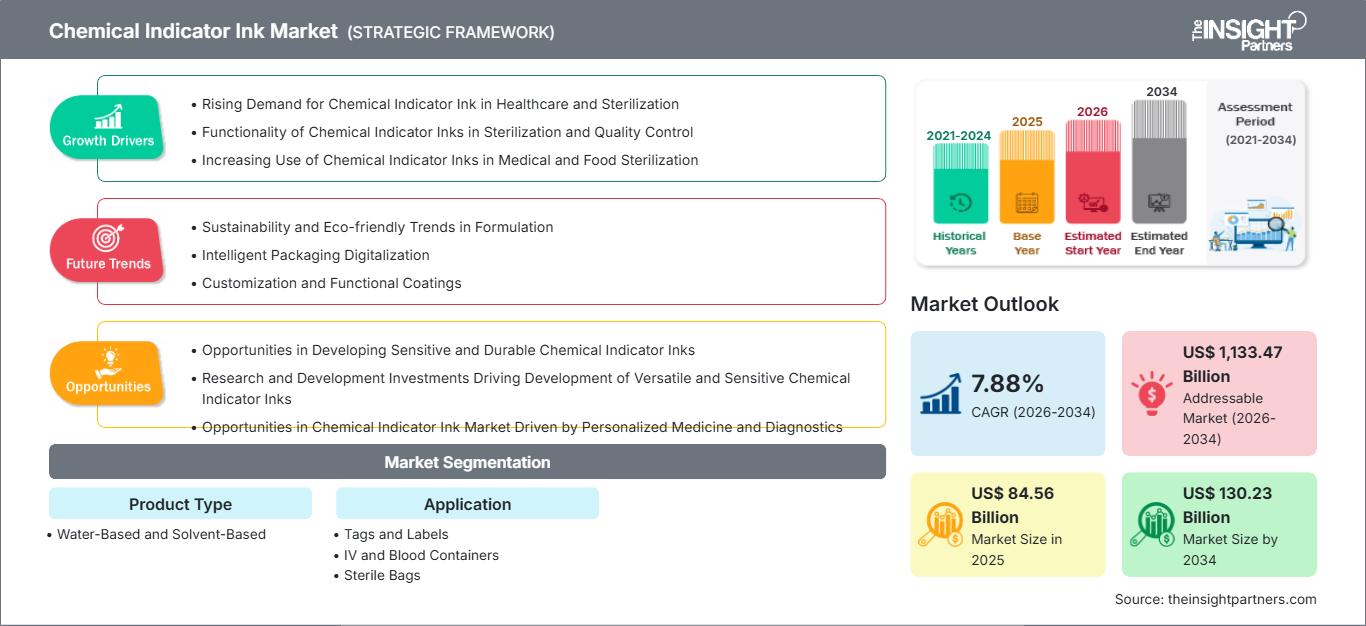
The global Chemical Indicator Ink market was valued at US$ 84.56 billion in 2025 and is expected to reach US$ 130.23 billion by 2034; it is estimated to record a CAGR of 4.92% during 2026-2034.
Chemical Indicator Ink Market Assessment and Insights
- North America: Accounted for a 34–38% Chemical Indicator Ink market share in 2025 and is anticipated to grow at a CAGR of 7.2–7.8% during 2026–2034, supported by stringent sterilization regulations, established healthcare infrastructure, and continuous investments in medical device manufacturing and pharmaceutical packaging.
- U.S.: Represented 72–76% of the North American market in 2025 and is expected to record a CAGR of 7.3–7.9% during 2026–2034, driven by high healthcare expenditure, large sterilization service networks, and advanced medical technology manufacturing.
- Europe: Held 27–31% share in 2025 and is projected to expand at a CAGR of 7.0–7.6% during 2026–2034. Germany, the UK, France, Italy, and Spain remain leading contributors owing to strict medical device regulations and growing pharmaceutical production.
- Asia Pacific: Captured 24–28% share in 2025 and is forecast to grow at a CAGR of 8.8–9.4% during 2026–2034, supported by expanding healthcare infrastructure, rising medical device exports, and manufacturing investments across China, Japan, South Korea, and India.
- Largest Segment: Tags and Labels accounted for 46–50% market share in 2025 and are projected to register a CAGR of 7.7–8.2% during 2026–2034, supported by extensive utilization in sterilization tracking and regulatory labeling across healthcare facilities.
- High Growth Segment: Water-Based products represented 52–56% market share in 2025 and are expected to expand at a CAGR of 8.4–8.9% during 2026–2034, driven by environmental compliance, lower VOC emissions, and increasing preference for sustainable printing technologies.
- Key companies analyzed in detail: 3M Company, ETIGAM B.V., GKE GmbH, LA-CO Industries, Inc., NiGK Corporation, North American Science Associates, LLC, Propper Manufacturing Company, Inc., RIKEN Chemical Co., Ltd., STERIS plc, SteriTec Products Mfg. Co., Inc., Terragene S.A.
Source: The Insight Partners' analysis based on proprietary research, government publications, company annual reports, investor presentations, industry databases, and expert interviews.
There have been major changes brought about by advances in sterilization techniques, regulatory requirements for compliance, and healthcare quality management over the last decade. There has been improvement in ink stability, suitability of substrate materials and accuracy in response to steam sterilization, ethylene oxide, hydrogen peroxide plasma sterilization and formaldehyde sterilization procedures. Adoption of automatic tracking systems for sterilization procedures, traceability solutions and environmental sustainability practices have spurred innovations, while there has been more concern about the process verification in order to ensure patient safety.
The future growth of the Chemical Indicator Ink market is likely to be driven by increased investment in the manufacture of healthcare products in the Asia Pacific region, Latin America and the Middle East regions. The medical device sterilization regulations, the export of sterile healthcare products and the development of pharmaceutical packaging facilities will offer additional growth opportunities. The sustainability measures that favor reduction of volatile organic compound emissions, and research on multi-function indicators are anticipated to enhance future commercial potential for manufacturers.
Chemical Indicator Ink Market Report Scope
| Report Attribute | Details |
|---|---|
| Market size in 2025 | US$ 84.56 Billion |
| Market Size by 2034 | US$ 130.23 Billion |
| Global CAGR (2026 - 2034) | 4.92% |
| Historical Data | 2021-2024 |
| Forecast period | 2026-2034 |
Chemical Indicator Ink Market Analysis
The Chemical Indicator Ink market growth path can be explained by the increased healthcare services, growing surgical procedures, and the rising production of sterile medical devices around the world. Infection prevention measures have continued to be developed at healthcare institutions while regulatory bodies impose stringent requirements on sterilization validation of reusable surgical tools and packaged medical items. With sterilization assurance becoming an increasingly common component of quality management systems, the need for dependable indicator inks is likely to grow among hospitals, drug manufacturers, contract sterilizers, and medical devices manufacturers.
Product availability has been improved by the better working together of pigments suppliers, specialty chemical producers, substrates providers, sterilization equipment producers, and healthcare packaging firms. Innovations in color change technology, better adhesion properties, and compatibility with different sterilization processes have allowed suppliers to develop better performing products for various uses in healthcare facilities.
According to Chemical Indicator Ink market analysis, it can be seen that the competitiveness among firms operating in the industry is now based on the development of new formulations, regulation compliance, quality of manufacture and global distribution. The key players in this regard are 3M Company, STERIS plc, GKE GmbH, RIKEN Chemical Co., Ltd., ETIGAM B.V., Terragene S.A., and SteriTec Products Mfg. Co., Inc. that is making investments into new developments to meet international sterilization standards as well as extend regional distribution channels via strategic alliances and local production capabilities.
Increasingly, investment is being made into environmentally-friendly water-based formulations, advanced technologies for automatic quality control and custom-designed indicators intended for special sterilization processes. Some companies like LA-CO Industries, Inc., Propper Manufacturing Company, Inc., North American Science Associates, LLC, and NiGK Corporation are improving their technical support services along with cooperation with healthcare manufacturers in order to develop application-specific products.
● REPORT CUSTOMIZATION
Tailor This Report To Align With Your Specific Business Requirements
This report can be customized to align precisely with your business objectives, scope, and target markets. Customization options include tailored segmentation, geography, competitive analysis, and strategic insights to support informed decision-making.
Customize This Report →WHAT YOU CAN ADJUST
- ● Segmentations
- ● Geography
- ● Competitive Analysis
- ● Language Preferences
Chemical Indicator Ink Market: Strategic Insights
Regional Insights
North America Chemical Indicator Ink Market
North America held a share of 34–38% of Chemical Indicator Ink in 2025, and is estimated to exhibit a CAGR of 7.2–7.8% between 2026 and 2034. The region is known for having an advanced healthcare infrastructure, strong sterilization standards, and ongoing investment in the prevention of infections. The presence of regulations by healthcare authorities and the increasing demand for solutions that can ensure validation of sterilization processes in hospitals, pharmaceuticals, and medical devices will continue driving market growth in the region. There are many advancements in the techniques of sterilization such as hydrogen peroxide plasma and low-temperature sterilization that will help in further Chemical Indicator Ink market expansion.
United States is the major Chemical Indicator Ink market in the region; at the same time, Canada is making investment in upgrading its healthcare sector and manufacturing of medical devices. There has been a steady rise in outpatient surgeries, pharmaceutical packaging, and production of sterile medical devices, which have encouraged the use of chemical indicators ink. Moreover, there has been growing integration of digital sterilization tracking systems with chemical indicators in healthcare organizations.
U.S. Chemical Indicator Ink Market
The US was responsible for 72-76% of the market size of North America in 2025 and is expected to achieve a CAGR of 7.3-7.9% during 2026-2034. This country holds a dominant market share owing to its large network of hospitals, advanced pharmaceutical industry, and considerable medical device manufacturing capabilities. Sterilization validation norms, rising number of surgeries, and constant investments made by healthcare bodies in quality assurance have resulted in constant demand for top-performing chemical inks.
There are numerous sterilization solution providers, distributors, and manufacturers that hold a considerable market presence in the United States, and this is helping in constant innovation in this technology. Increasing adoption of steam, ethylene oxide, and vaporized hydrogen peroxide has resulted in higher demand for efficient indicators. Moreover, the growing importance of eco-friendly inks that can be printed easily is also driving innovation in this market.
Europe Chemical Indicator Ink Market
Europe occupied a market share of 27–31% in 2025 and is predicted to grow with a CAGR of 7.0–7.6% between 2026 and 2034. Germany is the dominant national market in Europe on account of its medical device production capability, presence of well-established pharmaceutical industries, and strict adherence to the European sterilization standards. Continuous investment in technology and quality control systems within the healthcare industry ensures consistent growth in demand for high-quality chemical indicator ink in hospitals and industrial sterilization facilities.
The United Kingdom continues to reap the advantages of increasing modernization of healthcare infrastructure and expansion of pharmaceutical packaging operations in the country. In addition, there has been an increase in adoption of the products in France due to the growth in the production of medical devices and stringent infection prevention measures. Italy and Spain have witnessed growing use of sterilization monitoring products due to increased healthcare infrastructure development, contract sterilization operations, and export of sterile healthcare products.
APAC Chemical Indicator Ink Market
Asia Pacific region has gained a 24-28% share in 2025 and will continue to record the highest regional CAGR of 8.8-9.4% in the coming years of 2026-2034. China leads the demand for the region by contributing large-scale production of medical devices, while Japan and South Korea help with healthcare technology and sterilization facilities.
India, on the other hand, is continuously increasing its capacity for manufacturing pharmaceuticals and healthcare services, while Australia contributes with strict healthcare regulations and sterilization practices. Increase in the exports of sterile healthcare products, industrial policies, and investments in healthcare manufacturing make the Asia Pacific region the fastest-growing market.
Middle East & Africa Chemical Indicator Ink Market
Middle East & Africa market is anticipated to post a CAGR of 6.8-7.4% between 2026-2034 owing to developments in the healthcare infrastructure, increased pharmaceutical manufacturing, and innovations in sterilization technologies. Growth in the Middle East region is driven by Saudi Arabia, whereas UAE will keep on focusing on developing advanced healthcare technologies and facilities.
South Africa holds its importance as the healthcare manufacturing country of Africa owing to growing healthcare infrastructure and regulatory authorities paying attention towards infections prevention. Rest of the Middle East & Africa will witness the adoption of sterilization monitoring systems in a gradual way owing to improvement in healthcare investment, pharmaceutical manufacturing, and industrial healthcare norms in emerging countries.
Segmentation Analysis
Product Type
The Product Type segment is projected to register a CAGR of 8.0–8.5% during 2026–2034. Product innovation increasingly focuses on environmental compliance, substrate compatibility, color stability, and sterilization accuracy. Manufacturers continue developing formulations that perform consistently across multiple sterilization technologies while addressing evolving regulatory requirements, sustainability objectives, and healthcare quality assurance standards. The Chemical Indicator Ink scope continues expanding as healthcare providers demand safer, more durable, and application-specific indicator formulations.
- Water-Based: Water-based chemical indicator inks are gaining wider adoption due to reduced volatile organic compound emissions, improved workplace safety, excellent print quality, and increasing compliance with environmental regulations across healthcare and pharmaceutical manufacturing facilities.
- Solvent-Based: Solvent-based formulations continue serving applications requiring superior adhesion, faster drying characteristics, and enhanced durability on specialized packaging substrates used for demanding sterilization environments and long-term storage conditions.
Application
The Application segment is anticipated to register a CAGR of 8.2–8.8% during 2026–2034. Growing sterilization requirements across healthcare institutions, pharmaceutical production facilities, and medical device manufacturing continue driving demand for reliable indicator technologies. Regulatory compliance, product traceability, and infection prevention initiatives are encouraging broader deployment of chemical indicator inks across diverse sterile packaging and labeling applications.
- Tags and Labels: Tags and labels remain the largest application because they provide immediate visual verification of sterilization exposure while supporting inventory management, traceability, and regulatory documentation across hospitals and sterilization centers.
- IV and Blood Containers: Indicator inks applied on IV and blood containers help verify sterilization exposure, supporting patient safety, quality assurance, and compliance with increasingly stringent healthcare packaging requirements.
- Sterile Bags: Sterile bags utilize chemical indicator inks to provide rapid confirmation of sterilization cycles while improving packaging reliability for surgical instruments, laboratory products, and pharmaceutical materials.
- Sterile Bottles: Sterile bottle applications continue expanding with increasing pharmaceutical production and laboratory operations requiring validated sterilization monitoring throughout packaging and distribution processes.
Opportunity Snapshot
| Application | Revenue Contribution | Trend Tag | Adoption Stage |
|---|---|---|---|
| Tags and Labels | High | Smart Labels | Mature |
| IV and Blood Containers | Medium | Sterility Control | Scaling |
| Sterile Bags | High | Barrier Packaging | Scaling |
| Sterile Bottles | Medium | Pharma Filling | Scaling |
| Others | Low | Specialty Sterilization | Emerging |
Chemical Indicator Ink Market Growth Drivers and Impact Analysis
Expanding Regulatory Requirements for Sterilization Validation
Healthcare authorities worldwide continue strengthening sterilization validation requirements for medical devices, pharmaceutical packaging, and surgical instruments. Standards issued by organizations such as the World Health Organization (WHO), ISO, and national regulatory agencies increasingly emphasize documented sterilization verification throughout healthcare supply chains. As hospitals and manufacturers seek to reduce healthcare-associated infections and improve patient safety, chemical indicator inks have become an essential component of sterilization monitoring systems. Growing regulatory harmonization across developed and emerging economies is encouraging manufacturers to develop highly reliable formulations with improved color transition accuracy, broader sterilization compatibility, and longer shelf stability. These developments continue supporting sustained demand across healthcare institutions, contract sterilization providers, pharmaceutical companies, and medical device manufacturers while creating long-term opportunities for technologically advanced indicator ink suppliers.
Increasing Production of Sterile Medical Devices and Pharmaceutical Packaging
Global healthcare expansion, aging populations, and increasing surgical procedures continue driving production of sterile medical devices and pharmaceutical products. Manufacturers require dependable sterilization verification throughout packaging operations to ensure regulatory compliance and product integrity before distribution. Chemical indicator inks provide rapid visual confirmation of sterilization exposure on labels, packaging materials, containers, and medical products, reducing operational risk while strengthening quality assurance. Expanding investments in pharmaceutical manufacturing facilities across the Asia Pacific, North America, and Europe further reinforce market demand. As medical device exports increase and healthcare manufacturing capacity expands globally, suppliers continue investing in improved formulations capable of supporting diverse sterilization technologies while maintaining consistent performance under varying environmental and processing conditions.
Growing Preference for Sustainable and High-Performance Ink Technologies
Environmental regulations encouraging reduced volatile organic compound emissions are accelerating the transition toward water-based chemical indicator inks without compromising sterilization performance. Healthcare manufacturers increasingly prioritize environmentally responsible materials alongside high printing efficiency, substrate compatibility, and long-term stability. Technological innovation has enabled suppliers to improve color consistency, drying characteristics, and resistance to environmental degradation while supporting multiple sterilization methods, including steam, ethylene oxide, and hydrogen peroxide plasma. Growing sustainability commitments among pharmaceutical manufacturers, healthcare institutions, and packaging suppliers continue to encourage investments in next-generation formulations. As environmental compliance becomes increasingly integrated into procurement decisions, manufacturers offering sustainable, regulatory-compliant, and technically advanced products are expected to strengthen their competitive positioning across international healthcare markets.
Chemical Indicator Ink Market Future Trends
Integration of Smart Sterilization Monitoring Technologies
Digital transformation is reshaping sterilization monitoring through the integration of chemical indicators with automated documentation, barcode identification, RFID technologies, and electronic traceability systems. Healthcare providers increasingly seek comprehensive sterilization management platforms that reduce manual verification while improving compliance documentation and operational efficiency. These Chemical Indicator Ink market trends are encouraging manufacturers to develop indicator formulations optimized for digital healthcare workflows, enabling seamless compatibility with automated sterilization management systems. Future innovation is expected to combine advanced indicator chemistries with intelligent tracking technologies, strengthening traceability throughout medical device manufacturing, pharmaceutical packaging, and hospital sterilization departments while improving patient safety and operational transparency across healthcare ecosystems.
Development of Multi-Process Indicator Formulations
Manufacturers are increasingly investing in indicator inks capable of responding accurately across multiple sterilization technologies while maintaining excellent adhesion, print quality, and storage stability. Hospitals and contract sterilization providers continue seeking versatile products that simplify inventory management and improve operational flexibility. Research activities are focused on enhancing color precision, environmental durability, and substrate compatibility while reducing formulation complexity. As healthcare organizations adopt diversified sterilization processes for increasingly sophisticated medical devices, multifunctional indicator technologies are expected to gain broader commercial acceptance and create new opportunities for manufacturers emphasizing innovation, regulatory compliance, and application versatility.
Chemical Indicator Ink Market Opportunities
Expansion Across Emerging Healthcare Manufacturing Economies
Rapid investments in pharmaceutical manufacturing, medical device production, and healthcare infrastructure across Asia Pacific, Latin America, and the Middle East are creating substantial long-term growth opportunities for indicator ink manufacturers. Rising exports of sterile healthcare products require stronger compliance with international sterilization standards, encouraging broader adoption of advanced monitoring technologies. Chemical Indicator Ink market Forecasts indicate that manufacturers establishing localized production facilities, technical service capabilities, and strategic distribution partnerships within emerging economies will be better positioned to capture growing regional demand. Investment in regional manufacturing capacity, regulatory certification, and application-specific product development will remain essential for expanding global market presence while supporting evolving healthcare quality requirements.
Innovation in Sustainable Specialty Indicator Formulations
The transition toward environmentally responsible healthcare manufacturing creates attractive opportunities for companies developing advanced water-based and specialty indicator ink formulations. Future investments are expected to emphasize low-emission chemistries, recyclable packaging compatibility, enhanced substrate adhesion, and improved sterilization sensitivity across multiple processing technologies. Manufacturers capable of combining sustainability objectives with high technical performance will strengthen their competitive advantage as healthcare procurement increasingly incorporates environmental criteria alongside regulatory compliance. Continuous collaboration between specialty chemical companies, packaging manufacturers, healthcare providers, and medical device producers is expected to accelerate the commercialization of next-generation chemical indicator technologies, supporting long-term Chemical Indicator Ink market expansion and higher-value product differentiation.
Recent Developments
- June 2025: Solventum launched the Attest™ Super Rapid Vaporized Hydrogen Peroxide (VH₂O₂) Clear Challenge Pack, the first FDA-cleared preassembled VH₂O₂ test pack for routine sterilization monitoring across multiple sterilizer brands and cycle types. The solution integrates a biological indicator and a chemical indicator into a single transparent pack, simplifying sterilization verification while improving workflow efficiency and supporting infection prevention in healthcare facilities.
- January 2026: GKE GmbH published updated guidance aligned with EN ISO 11140-1 covering chemical indicator classification and sterilization monitoring, reinforcing the adoption of advanced chemical indicator technologies for healthcare sterilization processes. The update supports broader implementation of higher-performance indicator products across hospitals and medical device sterilization.
Frequently Asked Questions

- Comprehensive Market Sizing and Forecast Analysis
- Detailed Segmentation Analysis
- In-Depth Market Dynamics Assessment
- Regional and Country-Level Insights
- Competitive Landscape and Company Benchmarking
- Strategic Business Intelligence
Recent Reports
Testimonials

The Insight Partners' SCADA System Market report is comprehensive, with valuable insights on current trends and future forecasts. The team was highly professional, responsive, and supportive throughout. We are very satisfied and highly recommend their services.
RAN KEDEM Partner, Reali Technologies LTDs
I requested a report on a very specific software market and the team produced the report in a few days. The information was very relevant and well presented. I then requested some changes and additions to the report. The team was again very responsive and I got the final report in less than a week.
JEAN-HERVE JENN Chairman, Future Analytica
We worked with The Insight Partners for an important market study and forecast. They gave us clear insights into opportunities and risks, which helped shape our plans. Their research was easy to use and based on solid data. It helped us make smart, confident decisions. We highly recommend them.
PIYUSH NAGPAL Sr. Vice President, High Beam Global
The Insight Partners delivered insightful, well-structured market research with strong domain expertise. Their team was professional and responsive throughout. The user-friendly website made accessing industry reports seamless. We highly recommend them for reliable, high-quality research services
YUKIHIKO ADACHI CEO, Deep Blue, LLC.
This is the first time I have purchased a market report from The Insight Partners.While I was unsure at first, I visited their web site and felt more comfortable to take the risk and purchase a market report.I am completely satisfied with the quality of the report and customer service. I had several questions and comments with the initial report, but after a couple of dialogs over email with their analyst I believe I have a report that I can use as input to our strategic planning process.Thank you so much for taking the extra time and making this a positive experience.I will definitely recommend your service to others and you will be my first call when we need further market data.
JOHN SUZUKI President and Chief Executive Officer, Board Director, BK Technologies
I wish to appreciate your support and the professionalism you displayed in the course of attending to my request for information regarding to infectious disease IVD market in Nigeria. I appreciate your patience, your guidance, and the fact that you were willing to offer a discount, which eventually made it possible for us to close a deal. I look forward to engaging The Insight Partners in the future, all thanks to the impression you have created in me as a result of this first encounter.
DR CHIJIOKE ONYIA MANAGING DIRECTOR, PineCrest Healthcare Ltd.Reason to Buy
- Informed Decision-Making
- Understanding Market Dynamics
- Competitive Analysis
- Identifying Emerging Markets
- Customer Insights
- Market Forecasts
- Risk Mitigation
- Boosting Operational Efficiency
- Strategic Planning
- Investment Justification
- Tracking Industry Innovations
- Aligning with Regulatory Trends





 Get Free Sample for