
Chloroform Market Growth, Trends & Forecast by 2034
Coverage: By Application (Reagent, Solvent, Intermediate); End-User Industry (Pharmaceuticals, Agriculture, Chemicals, Food and Beverages), and Geography (North America, Europe, Asia Pacific, and South and Central America)
- Status : Data Released
- Report Code : TIPRE00016164
- Category : Chemicals and Materials
- No. of Pages : 150
- Available Report Formats :


- Last update date : September 01, 2026


2025 Market Size
US$ 518.08 Mn
Base year value
2034 Forecast
US$ 867.50 Mn
Projected by 2034
CAGR 2026-2034
5.89 %
Growth rate
Addressable Market
US$ 6,275.45 Mn
(2026-2034)
The Chloroform Market stood at US$ 518.08 Million in 2025 and is projected to reach US$ 867.50 Million by 2034, registering a CAGR of 5.89% during 2026–2034. The market remains supported by its role as a solvent, reagent, and chemical intermediate across pharmaceutical, agricultural, and chemical processing activities. Demand is increasingly shaped by purity requirements, environmental controls, feedstock economics, and the gradual substitution of chloroform in applications where safer solvent systems are technically viable.
North America is expected to expand at an estimated 4.8–5.5% CAGR through 2034, supported by pharmaceutical research, specialty chemical manufacturing, and laboratory consumption. The region's stringent handling requirements favor standardized grades and controlled distribution channels. These factors provide a stable foundation for the Chloroform Market size outlook, although substitution initiatives and regulatory scrutiny constrain demand expansion in several mature applications.
Chloroform Market Assessment and Insights
- North America: North America is estimated to hold a 22–26% share in 2025 and grow at a 4.8–5.5% CAGR between 2026 and 2034, supported by pharmaceutical research, specialty chemicals, regulated laboratory use, and established chemical distribution networks.
- U.S.: The U.S. represents approximately 18–21% of global demand in 2025 and is projected to expand at a 4.7–5.4% CAGR between 2026 and 2034, led by pharmaceutical and research applications.
- Europe: Europe accounts for an estimated 20–24% share in 2025 and is expected to register a 4.2–5.0% CAGR between 2026 and 2034, with Germany, France, Italy, and the UK supporting pharmaceutical, chemical, and laboratory consumption.
- Asia Pacific: Asia Pacific holds approximately a 31–35% share in 2025 and is expected to grow at a 6.0–6.8% CAGR between 2026 and 2034, led by China and India, followed by Japan and South Korea.
- Largest Segment: Pharmaceuticals represent the largest end-user segment, with an estimated 31–35% market share in 2025 and a 5.8–6.4% CAGR during 2026–2034, reflecting high-purity solvent requirements.
- High-Growth Segment: Chemicals represent the high-growth end-user segment, with an estimated 25–29% market share in 2025 and a 6.1–6.8% CAGR during 2026–2034, supported by intermediate applications.
- Key companies analyzed in detail: ADEKA Corporation, Akzo Nobel N.V., BASF SE, Chemceed, Olin Corporation, Productos Aditivos, S.A., Shin-Etsu Chemical Co., Ltd., Solvay S.A., Tokuyama Corporation, Gujarat Alkalies and Chemicals Limited, Dow Inc.
Source: The Insight Partners' analysis based on proprietary research, government publications, company annual reports, investor presentations, industry databases, and expert interviews.
Production of chloroform is developing on the basis of integrated chloromethane production chains, more rigorous purity requirements, stabilization of formulations, and controlled distribution system. Producers of chloroform are becoming more efficient at optimizing chlorine consumption and integration, whereas pharmaceutical and laboratory clients tend to have a consistent profile of impurities. Thus, technological trends involve chemical manufacturing techniques along with higher focus on efficiency, containment, stability of storage, and traceability within the supply chain.
The most active expansion is expected in the new pharmaceutical and chemical industry regions, especially in India and China. The areas of interest of investors are becoming to focus on reliability, quality, safe distribution, and integration with upstream production of chlorine and chloromethane. Exposure, emissions, storage, and waste management regulations will become more important for specifying procurement, whereas diversified users should be better prepared to substitute pressures.
Chloroform Market Report Scope
| Report Attribute | Details |
|---|---|
| Market size in 2025 | US$ 518.08 Million |
| Market Size by 2034 | US$ 867.50 Million |
| Global CAGR (2026 - 2034) | 5.89% |
| Historical Data | 2021-2024 |
| Forecast period | 2026-2034 |
Chloroform Market Analysis
Chloroform Market growth prospects are dependent upon pharmaceutical synthesis, agrochemicals processing, chemical intermediates, and lab uses. Chloroform serves as a solvent for organic substances and as an intermediary substance in chemical synthesis. This implies that the demand depends on the level of production in the downstream industries, and not on the consumption by end-users. The value chain starts from feedstocks of chlorine and methane and ends with specialized distributors and manufacturers.
Supply depends on integrated chlor-alkali production, feedstock supply, economic aspects of production, and regional distribution channels. Integrated producers benefit from better control of chlorine usage and cost efficiency, while un-integrated buyers are more sensitive to feedstock and shipping costs. Environmental factors play their role in supply because producers and distributors should provide adequate containment, labeling, shipping, and disposal facilities at all stages of the product life cycle.
The Chloroform Market review reveals an intermediate degree of competition between suppliers that includes integrated chemical companies, chlor-alkali manufacturers, specialty chemicals, and distributors. These companies are BASF SE, Olin Corporation, Solvay S.A., Shin-Etsu Chemical Co., Ltd., Tokuyama Corporation, and Dow Inc. who have extensive chemical product lines, along with ADEKA Corporation, Chemceed, Productos Aditivos, S.A., and Gujarat Alkalies and Chemicals Limited who provide additional regional or specialty offerings.
The degree of competition is becoming more based on reliability of supply, product consistency, compliance, and packaging that is specific to customers. The company Gujarat Alkalies and Chemicals Limited noted increased plant usage at its chloromethanes plant in FY2025, showing the relevance of having integrated chlorine downstream manufacturing. On the other hand, BASF SE has updated its intermediates plant equipment in Ludwigshafen.
● REPORT CUSTOMIZATION
Tailor This Report To Align With Your Specific Business Requirements
This report can be customized to align precisely with your business objectives, scope, and target markets. Customization options include tailored segmentation, geography, competitive analysis, and strategic insights to support informed decision-making.
Customize This Report →WHAT YOU CAN ADJUST
- ● Segmentations
- ● Geography
- ● Competitive Analysis
- ● Language Preferences
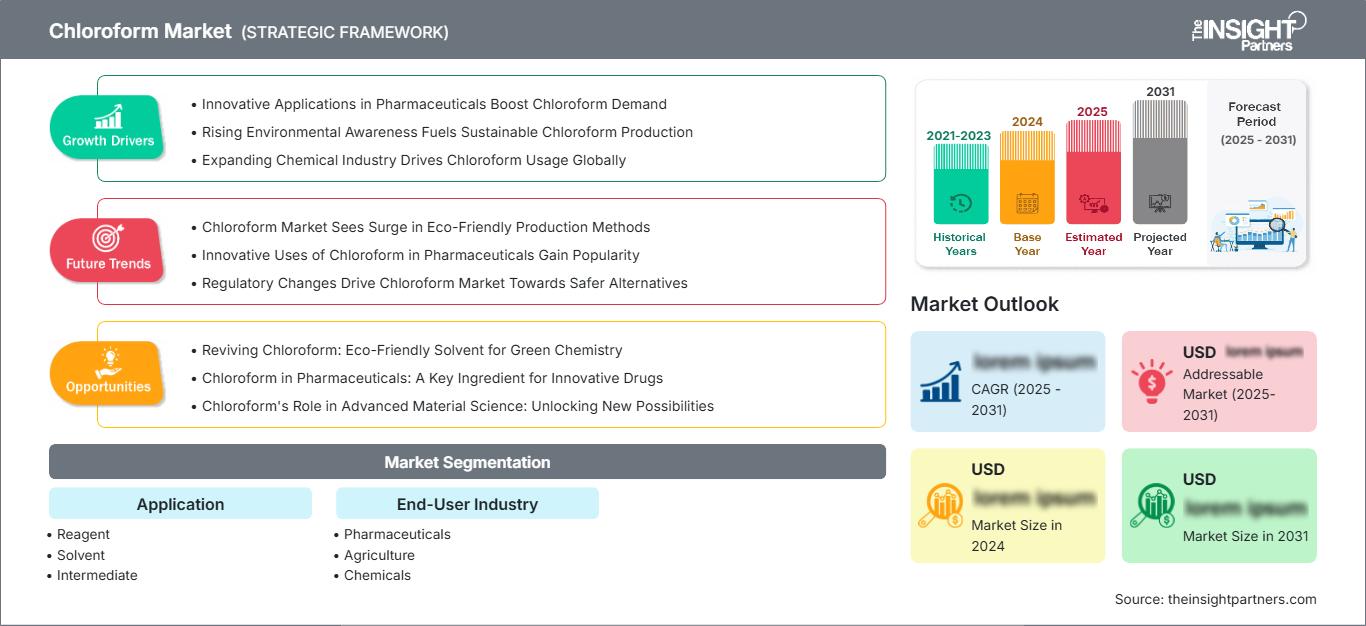
Chloroform Market: Strategic Insights
Regional Insights
North America Chloroform Market
North America is estimated to account for 22–26% of global Chloroform demand in 2025, with the U.S. representing the principal consumption center. The regional market is supported by pharmaceutical research, chemical synthesis, analytical laboratories, and specialized manufacturing. Demand is concentrated among organizations capable of managing controlled solvent handling, storage, and disposal requirements.
The region is projected to expand at a 4.8–5.5% CAGR during 2026–2034. Pharmaceutical development, specialty chemical production, and laboratory testing should provide recurring demand, while substitution by less hazardous solvents limits volume expansion. Canada contributes through pharmaceutical and chemical applications but remains considerably smaller than the U.S. Procurement increasingly emphasizes purity certificates, stabilized formulations, reliable delivery, and regulatory documentation, favoring established suppliers with strong quality systems and distribution infrastructure.
U.S. Chloroform Market
The U.S. is estimated to represent 18–21% of global Chloroform demand in 2025 and approximately 78–82% of North America's consumption. Demand is anchored in pharmaceutical manufacturing, research laboratories, specialty chemical synthesis, and regulated analytical applications. The market is expected to grow at a 4.7–5.4% CAGR during 2026–2034.
American consumers have started placing greater emphasis on analytical consistencies, packaging consistencies, control over exposures, and compliance documentation. Applications in pharmaceutical and research use necessitate higher grades, while industrial users want consistent supply through reliable sources. Organizations such as Olin Corporation, BASF SE, Dow Inc., and chemical distributors like Chemceed are part of the larger supply chain. The regulatory pressure favors closed systems and management systems for solvents, while substitution efforts promote users to look at alternatives.
Europe Chloroform Market
Europe is estimated to hold 20–24% of global Chloroform demand in 2025 and is projected to expand at a 4.2–5.0% CAGR through 2034. Germany is the leading country, supported by chemical manufacturing and pharmaceutical production, while the UK, France, Italy, and Spain contribute through laboratory, pharmaceutical, and specialty chemical applications.
Market focus for the UK includes pharmaceuticals, laboratory analysis, and industrial control. Germany gets advantages from its integrated chemical manufacturing facilities and industrial infrastructure. France relies on pharmaceuticals and specialty chemicals to maintain its demand. Italy and Spain promote their products based on applications in chemical processing, research, and manufacture. Buyers in Europe have very stringent environmental and occupational requirements, hence the need for good documentation, stabilizing of grades, proper storage, and waste management systems. Substitution regulations continue to affect applications where viable substitutes are available.
APAC Chloroform Market
Asia Pacific holds approximately 31–35% of the Chloroform Market share in 2025 and is expected to record a 6.0–6.8% CAGR during 2026–2034. China is the leading country, followed by India, Japan, and South Korea. Large pharmaceutical and chemical manufacturing bases underpin regional demand.
China profits from the extensive production of chemicals, whereas India has the advantage of pharmaceuticals, agrochemicals, and specialty chemicals. Japan and South Korea have their advantages through chemical and research applications, while Australia forms a smaller but well-established laboratory and industrial market. Growth in manufacturing facilities, chemical infrastructure development, and regional pharmaceutical investments contribute to consumption. On the other hand, environmental regulations have been favoring a more careful approach and substitution evaluation.
Middle East & Africa Chloroform Market
The Middle East & Africa represent a smaller demand center, with Saudi Arabia and the UAE supported by chemical and industrial infrastructure. South Africa contributes through pharmaceuticals, laboratories, and chemical processing, while the rest of MEA remains fragmented. The region is projected to grow at a 4.0–4.8% CAGR during 2026–2034.
Saudi Arabia is positioned as the leading regional market because of its expanding downstream chemical ecosystem. UAE demand is linked to industrial distribution and pharmaceutical activities, while South Africa maintains laboratory and chemical applications. Investments in industrial diversification, chemical manufacturing, and logistics infrastructure can strengthen regional availability. However, demand remains sensitive to import economics, downstream capacity, and regulatory requirements governing hazardous chemical handling.
Segmentation Analysis
Application
Application demand is differentiated by purity, technical performance, and the degree of process control required by users. The segment is projected to expand at a 5.6–6.3% CAGR during 2026–2034. The Chloroform Market scope extends from laboratory reagents to industrial solvents and chemical intermediates, creating varied procurement requirements across customer groups.
- Reagent: Reagent applications require controlled impurity levels and reliable analytical performance, supporting demand from research laboratories, quality-control facilities, pharmaceutical testing, and academic institutions.
- Solvent: Solvent demand remains broad because chloroform dissolves numerous organic compounds, supporting extraction, purification, formulation, laboratory preparation, and selected industrial processing activities.
- Intermediate: Intermediate applications connect chloroform consumption with downstream chemical synthesis, particularly fluorochemical and specialty chemical value chains, where process economics influence purchasing decisions.
End-User Industry
End-user demand reflects differences in manufacturing scale, regulatory exposure, and product specifications. The segment is expected to grow at a 5.7–6.4% CAGR during 2026–2034. Pharmaceutical customers typically prioritize purity and documentation, while chemical and agricultural users place greater emphasis on dependable industrial supply and cost efficiency.
- Pharmaceuticals: Pharmaceuticals represent the largest demand base, supported by solvent and processing requirements in drug synthesis, analytical testing, research, and quality-control activities.
- Agriculture: Agriculture demand is linked primarily to agrochemical manufacturing, where chloroform can participate in solvent and intermediate functions within crop-protection chemical synthesis.
- Chemicals: Chemicals provide substantial demand through intermediate and solvent applications, particularly where integrated manufacturing economics and established process chemistry support continued utilization.
- Food and Beverages: Food and Beverages represents a comparatively specialized application base, with use subject to strict controls and substitution considerations, limiting its relative contribution to overall demand.
Opportunity Snapshot
| Application | Revenue Contribution | Trend Tag | Adoption Stage |
|---|---|---|---|
| Reagent | Medium | Lab Purity | Mature |
| Solvent | High | Extraction Use | Mature |
| Intermediate | High | Chemical Synthesis | Scaling |
Chloroform Market Growth Drivers and Impact Analysis
Expansion of Pharmaceutical Manufacturing and Research
Pharmaceutical manufacturing remains an important demand foundation because chloroform can function as a solvent in synthesis, extraction, purification, and laboratory procedures. Increased demand for generic drugs production, contract research, and development, as well as analytical and research activities, broadens the customer base for which purity chemicals become desirable. It is especially true in the case when manufactures have a need for a reproducible specification and documentation of their supplies. In addition, pharmaceutical purchasers prefer suppliers able to provide them with certificates of analysis and controlled packaging with good batch-to-batch consistency. As a result, growth in pharmaceutical demand can lead to an increase in the demand for value even in the case of moderate increases in the demand for consumption.
Industrial Chemical Synthesis and Intermediate Demand
By the utilization of chloroform as a chemical intermediate, the demand is affected by more than just the consumption of the solvent itself. The industrial customers use it as an input in their desired chemical reactions pertaining to the manufacturing of fluorinated compounds and specialty chemicals. The demand, therefore, depends upon the capacity utilization, cost structures of the inputs and environmental policies applicable to the end-product. The companies having integrated units for the production of chlorine and chloromethane would benefit through better feedstock utilization and flexibility. In economies that develop their chemical industry, the higher capacity utilization of the end-product generates extra demand for the industrial grade product. Nevertheless, the possibilities in the long run are affected by legislative changes in specific end-products and technology substitution.
Growth of Analytical and Laboratory Applications
Analytical labs, research facilities, and quality control facilities will always form a reliable layer of demand due to continued usefulness of chloroform in processes such as extractions, sample preparations, and organic chemistry. Reagents need to work consistently in pharmaceutical and chemical testing, making purity and packaging key factors in purchases. Building up of lab infrastructure in developing countries will widen the range of consumers, especially in those countries developing their pharmaceutical and chemical research capabilities. In terms of demand from this sector, it is not as affected by large industrial manufacturing cycles as intermediate applications, but there is a greater tendency for users to assess safe solvents. This means that suppliers can maintain value through providing validated grades, documentation, stabilizers, and smaller packaging sizes.
Chloroform Market Future Trends
Rising Preference for Controlled-Purity and Stabilized Grades
Quality specifications, standardization, and documentation during acquisition have become defining factors in the Chloroform Market trends. Reproducible properties of solvents are needed by pharmaceutical companies and laboratories, whereas distributors need to maintain proper conditions for storing and handling the material. Companies that have the ability to provide solvent with constant grade in different regions and package sizes will enjoy a competitive advantage. Documentation, digital traceability, and quality management systems will become more important criteria in purchasing decisions. Manufacturers can also consider creating specific specifications based on pharmaceutical, laboratory, and industrial applications. While substitutions will happen on environmental grounds, special applications, which have strict requirements, will ensure the demand for pure solvents. In the long term, competition will be less about availability and more about reliability and documented performance.
Increasing Integration of Environmental and Supply-Risk Management
Manufacturers are expected to place greater emphasis on environmental controls, worker protection, transport security, and supply continuity. Chloroform is increasingly evaluated within broader solvent-management programs because users must balance performance with exposure, waste, and regulatory considerations. Producers can respond through improved containment, optimized production efficiency, responsible packaging, and transparent product documentation. Regional sourcing strategies may also gain importance as companies seek to reduce disruption from freight volatility, feedstock shortages, or regulatory changes. Integrated chlor-alkali and chloromethane producers have an advantage because upstream control can improve supply visibility. The resulting competitive environment should reward suppliers that combine reliable availability with robust stewardship practices and technical assistance for customers managing regulated chemical inventories.
Chloroform Market Opportunities
Expanding High-Purity Supply for Pharmaceutical and Laboratory Users
Investment in high-purity production, packaging, quality control, and regional distribution can create attractive opportunities in pharmaceutical and laboratory applications. Buyers in these sectors typically place greater weight on batch consistency, documentation, traceability, and dependable delivery than on minimum purchase price alone. Suppliers can capture value by developing dedicated grades, smaller controlled packages, and technical support programs for regulated customers. India and the Asia Pacific offer particularly relevant opportunities because pharmaceutical and chemical manufacturing capabilities continue to deepen. North American and European customers can provide higher-value demand where compliance and quality requirements are stringent. The opportunity is strongest for producers that combine manufacturing reliability with documented quality systems and efficient logistics rather than competing solely through commodity-scale pricing.
Regional Manufacturing and Supply-Chain Localization
The Chloroform Market Forecasts indicate that localized production and distribution can become increasingly important as chemical manufacturers seek shorter supply chains and greater feedstock security. Investments near chlor-alkali and chloromethane facilities can improve integration, while regional warehouses can reduce lead times for pharmaceutical and laboratory customers. India, China, and selected Middle Eastern markets offer opportunities where chemical infrastructure is expanding, and downstream industries are developing. Producers can also use regional partnerships to improve technical support and regulatory compliance. Strategic investments should prioritize feedstock access, safe storage, transportation capabilities, and diversified customer portfolios. Such localization can reduce exposure to freight disruptions while allowing suppliers to respond more quickly to changes in regional demand, procurement standards, and environmental requirements.
Recent Developments
- April 2026: TGV SRAAC Limited — TGV SRAAC announced capacity expansions across six product lines effective April 10, 2026, including an additional 12,450 tonnes per annum of chloroform capacity, taking its total declared chloroform capacity to 62,050 tonnes per annum. The expansion also covered methylene chloride, liquid chlorine, potassium hydroxide, carbon tetrachloride, and hydrochloric acid, strengthening the company's integrated chloromethanes manufacturing platform.
- September 2025: Grasim Industries Limited and The Lubrizol Corporation — Grasim Industries and Lubrizol announced a partnership to establish India's largest CPVC resin plant, strengthening domestic CPVC resin manufacturing capacity. The project supports the localization of CPVC resin supply and is strategically relevant to the expanding Indian CPVC value chain, particularly applications involving pipes, fittings, fire-sprinkler systems, and other infrastructure uses.
Frequently Asked Questions

- Comprehensive Market Sizing and Forecast Analysis
- Detailed Segmentation Analysis
- In-Depth Market Dynamics Assessment
- Regional and Country-Level Insights
- Competitive Landscape and Company Benchmarking
- Strategic Business Intelligence
Recent Reports
Testimonials

The Insight Partners provided valuable market intelligence that supported our global go-to-market strategy. Their team was professional, responsive, and attentive to our feedback, providing thoughtful analysis and helpful methodological clarifications throughout the project.
Junmo Kim Chief Financial Officer (CFO), Enertech Co., Ltd.
The Insight Partners' SCADA System Market report is comprehensive, with valuable insights on current trends and future forecasts. The team was highly professional, responsive, and supportive throughout. We are very satisfied and highly recommend their services.
RAN KEDEM Partner, Reali Technologies LTDs
I requested a report on a very specific software market and the team produced the report in a few days. The information was very relevant and well presented. I then requested some changes and additions to the report. The team was again very responsive and I got the final report in less than a week.
JEAN-HERVE JENN Chairman, Future Analytica
We worked with The Insight Partners for an important market study and forecast. They gave us clear insights into opportunities and risks, which helped shape our plans. Their research was easy to use and based on solid data. It helped us make smart, confident decisions. We highly recommend them.
PIYUSH NAGPAL Sr. Vice President, High Beam Global
The Insight Partners delivered insightful, well-structured market research with strong domain expertise. Their team was professional and responsive throughout. The user-friendly website made accessing industry reports seamless. We highly recommend them for reliable, high-quality research services
YUKIHIKO ADACHI CEO, Deep Blue, LLC.
This is the first time I have purchased a market report from The Insight Partners.While I was unsure at first, I visited their web site and felt more comfortable to take the risk and purchase a market report.I am completely satisfied with the quality of the report and customer service. I had several questions and comments with the initial report, but after a couple of dialogs over email with their analyst I believe I have a report that I can use as input to our strategic planning process.Thank you so much for taking the extra time and making this a positive experience.I will definitely recommend your service to others and you will be my first call when we need further market data.
JOHN SUZUKI President and Chief Executive Officer, Board Director, BK Technologies
I wish to appreciate your support and the professionalism you displayed in the course of attending to my request for information regarding to infectious disease IVD market in Nigeria. I appreciate your patience, your guidance, and the fact that you were willing to offer a discount, which eventually made it possible for us to close a deal. I look forward to engaging The Insight Partners in the future, all thanks to the impression you have created in me as a result of this first encounter.
DR CHIJIOKE ONYIA MANAGING DIRECTOR, PineCrest Healthcare Ltd.Reason to Buy
- Informed Decision-Making
- Understanding Market Dynamics
- Competitive Analysis
- Identifying Emerging Markets
- Customer Insights
- Market Forecasts
- Risk Mitigation
- Boosting Operational Efficiency
- Strategic Planning
- Investment Justification
- Tracking Industry Innovations
- Aligning with Regulatory Trends





 Get Free Sample for