
Chloromethanes Market Trends, Share & Demand by 2034
Coverage: By Type (Methyl Chloride, Methylene Chloride, Chloroform, Carbon Tetrachloride); Application (Silicone Polymers, Agrochemicals, Chemicals and Intermediates, Adhesives, Pharmaceuticals, Refrigerants, Others) , and Geography (North America, Europe, Asia Pacific, and South and Central America)
- Status : Data Released
- Report Code : TIPRE00008916
- Category : Chemicals and Materials
- No. of Pages : 150
- Available Report Formats :


- Last update date : September 08, 2026


2025 Market Size
US$ 3.86 Bn
Base year value
2034 Forecast
US$ 7.07 Bn
Projected by 2034
CAGR 2026-2034
6.94 %
Growth rate
Addressable Market
US$ 49.32 Bn
(2026-2034)
The Chloromethanes market was valued at US$ 3.86 Billion in 2025 and is projected to reach US$ 7.07 Billion by 2034, registering a CAGR of 6.94% during 2026–2034. The market encompasses methyl chloride, methylene chloride, chloroform, and carbon tetrachloride, serving silicone polymers, agrochemicals, chemical intermediates, adhesives, pharmaceuticals, and refrigerants. Its development is shaped by integrated chlor-alkali production, downstream chemical demand, solvent regulations, and regional manufacturing expansion.
North America is positioned for steady expansion as pharmaceutical processing, specialty chemicals, silicone applications, and advanced manufacturing sustain chloromethane consumption. The Chloromethanes Market size outlook is supported by integrated chlorine availability and established chemical infrastructure, while regulatory controls are encouraging tighter process management, closed handling systems, and greater emphasis on product purity and application-specific grades.
Chloromethanes Market Assessment and Insights
- North America: North America represented a modeled 22–25% share in 2025, supported by integrated chlor-alkali infrastructure, pharmaceuticals, silicones, and specialty chemical production, with growth estimated at a 5.8–6.5% CAGR between 2026 and 2034.
- U.S.: The U.S. accounted for 72–76% of North American demand in 2025, supported by domestic chemical manufacturing and pharmaceutical processing, with a 5.6–6.2% CAGR between 2026 and 2034.
- Europe: Europe held an estimated 19–22% share in 2025, with Germany, France, Italy, the UK, and Spain supporting demand through chemicals, pharmaceuticals, fluorochemicals, and specialty manufacturing, expanding at a 5.1–5.8% CAGR between 2026 and 2034.
- Asia Pacific: Asia Pacific represented approximately 43–47% share in 2025, led by China, India, Japan, and South Korea, with silicone, pharmaceutical, agrochemical, and chemical manufacturing supporting a 7.2–8.0% CAGR between 2026 and 2034.
- Largest Segment: Methylene Chloride held a modeled 40–44% market share in 2025, reflecting broad solvent and pharmaceutical applications, with a 6.2–7.0% CAGR between 2026–2034.
- High Growth Segment: Silicone Polymers represented approximately 28–32% share in 2025 and are expected to record a 7.6–8.5% CAGR between 2026 and 2034, supported by construction, electronics, and automotive applications.
- Key companies analyzed in detail: Akzo Nobel N.V., Thermo Fisher Scientific Inc., AGC Inc., Dow Inc., Ercros S.A., Gujarat Alkalies and Chemicals Limited, INEOS Limited, KEM ONE SAS, Occidental Petroleum Corporation, Shin-Etsu Chemical Co., Ltd.
Source: The Insight Partners' analysis based on proprietary research, government publications, company annual reports, investor presentations, industry databases, and expert interviews.
Industry development has taken an integrated direction towards chlorine, hydrochloric acid, methanol, and derivative production. Optimization of chloromethane production rates becomes common among the products in one stream rather than optimization of separate product streams. Methylene chloride is used as a solvent, and methyl chloride as a component of silicone. The company Shin-Etsu includes methyl chloride, methylene chloride, and chloroform in the infrastructure materials range.
Future development will focus on regional supply security, energy efficiency, emission management, and high-valued integration further along the chain. Asia Pacific will continue to be the leading market region, while North America has the benefit of already available raw materials. Europe faces more stringent regulations, especially on methylene chloride, which makes the development of professional uses and substitution evaluation important. According to INEOS, European markets of chloromethanes are primarily regional, methylene chloride is marketed through spot and distribution channels, while chloroform – under long-term contracts.
Chloromethanes Market Report Scope
| Report Attribute | Details |
|---|---|
| Market size in 2025 | US$ 3.86 Billion |
| Market Size by 2034 | US$ 7.07 Billion |
| Global CAGR (2026 - 2034) | 6.94% |
| Historical Data | 2021-2024 |
| Forecast period | 2026-2034 |
Chloromethanes Market Analysis
The distribution of demand takes place through a chain of ecosystems where chlor-alkali, methanol, chloromethane producers, distribution centers, and processors determine economics of delivery. Growth of the chloromethanes market relies heavily on silicone polymers, pharmaceuticals, agrochemicals, refrigerants, and chemical intermediates. Economics of production tend to favor the plants that will be able to produce methyl chloride, methylene chloride, chloroform, and carbon tetrachloride in accordance with demand from the end-users.
Integration of the feedstocks becomes especially important due to chlorine, hydrochloric acid, and methanol being the key raw materials in the production process. The proximity of the plant to the chlor-alkali facilities allows reducing logistics expenses and securing the supply of feedstock. For instance, the market structure in India demonstrates production of chloromethanes together with other chlorine-based chemicals. Utilization of the chloromethanes production capacities in GACL equaled 82% in FY2024–25.
The competitive landscape is made up of vertically integrated chemical firms along with regional players and specialty distributors. Shin-Etsu is positioned with chloromethane along with its methanol, caustic soda, PVC, and silicon businesses, allowing for internal feedstocks and vertical synergies. Similarly, AGC is vertically integrated with its chloromethane along with its fluorine chemicals and chlorinated chemicals businesses, while INEOS Inovyn is positioned with European chlorine derivatives. Strategic positioning will be more concerned with supply reliability, regulatory compliance, and vertical integration versus volume growth. Occidental Petroleum Corporation, Dow Inc., KEM ONE SAS, Ercros S.A., and Gujarat Alkalies & Chemicals Ltd are part of larger chemical networks that can facilitate procurement and distribution.
● REPORT CUSTOMIZATION
Tailor This Report To Align With Your Specific Business Requirements
This report can be customized to align precisely with your business objectives, scope, and target markets. Customization options include tailored segmentation, geography, competitive analysis, and strategic insights to support informed decision-making.
Customize This Report →WHAT YOU CAN ADJUST
- ● Segmentations
- ● Geography
- ● Competitive Analysis
- ● Language Preferences
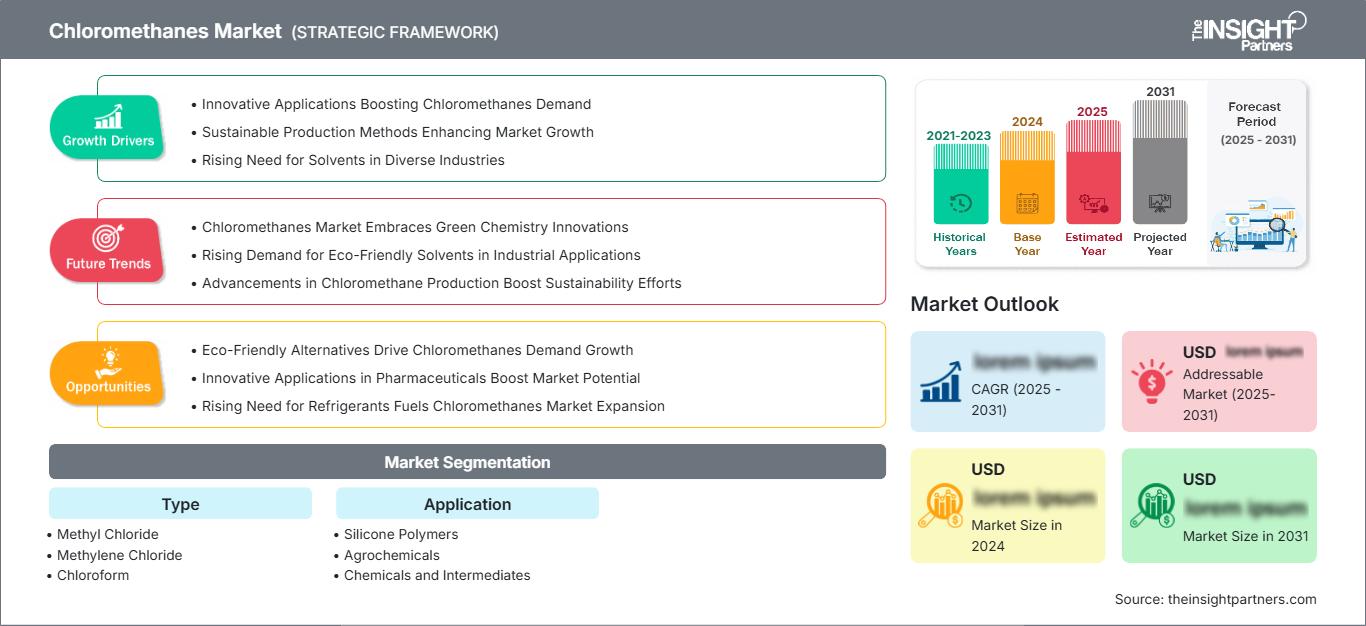
Chloromethanes Market: Strategic Insights
Regional Insights
North America Chloromethanes Market
North America accounted for a modeled 22–25% of the Chloromethanes Market share in 2025 and is projected to expand at a 5.8–6.5% CAGR through 2034. The area has existing infrastructure for chlorine, methanol, and specialty chemicals, especially in the U.S. Gulf Coast. Pharmaceuticals, silicones, refrigerants, and industrial solvents create a diverse demand profile, minimizing the dependency on just one downstream market.
The U.S. leads the consumption in the region due to its substantial footprint in chemical manufacturing and integrated feedstocks. Manufacturers have started to focus on process containment and product stewardship due to rising standards in occupational and environmental concerns. Canada and Mexico also add demand in pharmaceuticals, industrial goods, building, and chemicals segments. However, their demand is less compared to the U.S. market.
U.S. Chloromethanes Market
The U.S. represented 72–76% of North American Chloromethanes Market in 2025 and is expected to grow at a 5.6–6.2% CAGR through 2034. The competitive edge in this case comes about through the integration of the petrochemical facilities, domestic sources of chlorine and downstream manufacture of products. The main areas of demand include pharmaceutical production processes, chemical intermediates, silicone polymers, refrigerants and solvents.
Some major chemical manufacturers in the Chloromethanes Market use interdependent supply chain networks in the Gulf Coast, which facilitate easy movement of feed stocks and intermediates through various production facilities. In the case of pharmaceutical applications, there is need for controlled solvent quality, while the case of silicone production facilitates methyl chloride demand. The increased regulatory oversight calls for better storage, transport and protection of workers and better closed systems.
Europe Chloromethanes Market
Europe held an estimated 19–22% Chloromethanes Market in 2025, with a 5.1–5.8% CAGR expected through 2034. Germany is still an important industrial location, and France, Italy, the UK, and Spain contribute with the help of pharmaceuticals, chemical, fluorochemical, coating, and specialized manufacturing processes.
Both the UK and Germany have existing chemical infrastructure and distribution networks. According to INEOS, methylene chloride and chloroform markets are highly regionalized in Europe with sales of these materials facilitated through direct customer relationships and distribution. Regulation is a very important aspect in terms of procurement especially after the European reclassification of methylene chloride.
France, Italy, and Spain fuel demand from pharmaceuticals, chemical processing, coating, and industrial manufacturing. Italy is significant in connection with chloromethane and fluorochemical value chains whereas both France and Germany consume large amounts of specialty chemicals. Spain helps through industrial solvents, pharmaceuticals, and chemical processing. In general, Germany continues to be the most important European country owing to its wide manufacturing base and chemical infrastructure.
APAC Chloromethanes Market
APAC represented approximately 43–47% Chloromethanes Market in 2025 and is projected to grow at a 7.2–8.0% CAGR through 2034. China leads regional demand, followed by Japan, India, South Korea, and Australia. Expansion of silicones, pharmaceuticals, agrochemicals, and chemical intermediates supports consumption.
Industrial investment, domestic chemical capacity expansion, and supply-chain localization reinforce regional demand. China benefits from extensive downstream manufacturing, while India is strengthening domestic chloromethane production. Japan and South Korea contribute through high-value chemical and electronics-related applications. Australia remains comparatively smaller but supports specialty chemical and industrial solvent demand.
Middle East & Africa Chloromethanes Market
The Middle East and Africa demand is expected to expand at a 5.2–6.0% CAGR, supported by chemical diversification, infrastructure development, pharmaceuticals, and industrial processing. The Saudi Arabia market is the dominant one regionally; the UAE offers distribution and specialty chemicals facilities.
The South African market makes its contributions via chemicals from mining, manufacturing, and the pharmaceutical industry; the other MEA markets are relatively small and dependent on imports. Availability of energy and petrochemical integration could enable production economies for the region, although logistics and special handling requirements are key challenges.
Segmentation Analysis
Type
Type segmentation remains central to Chloromethanes Market Forecast because the four products serve distinct chemical functions and downstream chains. The Type segment is estimated to expand at a 6.6–7.2% CAGR from 2026–2034, with methylene chloride maintaining the largest position and methyl chloride benefiting from silicone-linked demand.
- Methyl Chloride: Methyl chloride serves primarily as a feedstock for silicones, methylcellulose, pesticides, and surfactants. Its strategic importance is increasing as silicon manufacturing expands across construction, automotive, electronics, healthcare, and consumer applications.
- Methylene Chloride: Methylene chloride remains widely used as a solvent because of its strong solvency, low boiling point, and suitability for pharmaceutical processing, extraction, cleaning, and polymer-related applications.
- Chloroform: Chloroform retains an important position as a chemical intermediate and fluorochemical feedstock. Demand is supported by controlled industrial applications and integrated production chains where chlorine derivatives are efficiently converted into downstream products.
- Carbon Tetrachloride: Carbon tetrachloride occupies a specialized position because many traditional uses have been restricted. Remaining consumption is associated primarily with controlled chemical processes and specific intermediate applications.
Application
Application demand is diversified across silicone polymers, agrochemicals, chemical intermediates, adhesives, pharmaceuticals, and refrigerants. The segment is projected to grow at a 6.8–7.6% CAGR from 2026–2034, with application economics increasingly determined by purity requirements, regulatory compliance, and downstream value addition. The Chloromethanes Market scope, therefore, extends across both commodity-linked and specialized downstream markets.
- Silicone Polymers: Silicone polymers represent a strategically important demand center because methyl chloride is integral to silicone manufacturing. Construction sealants, automotive components, electronics, healthcare products, and specialty coatings support sustained consumption.
- Agrochemicals: Agrochemical manufacturing uses chloromethanes as solvents, intermediates, and chemical building blocks. Agricultural productivity requirements and formulation development support demand, particularly across large farming economies in the Asia Pacific.
- Chemicals and Intermediates: Chemical intermediates provide broad consumption across multiple downstream synthesis routes. Their importance stems from chloromethanes’ ability to participate in chlorination, methylation, solvent, and fluorochemical production processes.
- Adhesives: Adhesive applications primarily depend on solvent and formulation requirements. Demand is linked with construction, automotive, packaging, and industrial bonding, although environmental considerations encourage controlled use and formulation optimization.
- Pharmaceuticals: Pharmaceutical manufacturing requires high-quality solvents and intermediates, making product purity and traceability critical. Expanding drug production in India, China, and North America supports long-term consumption.
- Refrigerants: Refrigerant applications remain relevant through chloromethane-derived fluorochemical pathways. Regulatory transition toward lower-global-warming-potential refrigerants is reshaping product demand and favoring producers with adaptable downstream integration.
Opportunity Snapshot
| Application | Revenue Contribution | Trend Tag | Adoption Stage |
|---|---|---|---|
| Silicone Polymers | High | Silicone Demand | Scaling |
| Agrochemicals | Medium | Crop Protection | Mature |
| Chemicals and Intermediates | High | Feedstock Integration | Mature |
| Adhesives | Medium | Solvent Optimization | Scaling |
| Pharmaceuticals | High | Pharma Solvents | Scaling |
| Refrigerants | Medium | Refrigerant Transition | Scaling |
Chloromethanes Market Growth Drivers and Impact Analysis
Expansion of Silicone Polymer Manufacturing
Silicone manufacturing is a major structural driver because methyl chloride is an essential raw material for producing organosilicon intermediates. Silicone sealants, elastomers, fluids, coatings, and specialty products require strong demand from the construction, automotive, electronics, healthcare, and electrical sectors. Additional growth in high performance electronics and heat-resistant materials is an additional factor driving the demand for silicone products. The effects will be felt through the methyl chloride value chain because higher methyl chloride demand would help to optimize chlor-alkali and methanol facilities. Manufacturers with access to downstream silicone products could benefit more and lower their dependence on methyl chloride merchant products. Such a scenario would prove beneficial especially in Asia Pacific because of growing manufacturing and domestic demand.
Rising Pharmaceutical and Specialty Chemical Production
There are strong fundamentals of demand due to the presence of a strong usage of methylene chloride and other chloromethanes in controlled solvent and intermediate applications. There is a trend of spreading pharmaceuticals' production to different geographical locations like India, China, North America, and Europe. The impact of this trend on suppliers is not only related to growing volumes since pharmaceutical users always focus on purity, documentation, traceability, and consistent supply. Therefore, there is an opportunity to sell to those companies that can provide stable specifications and comply with regulations. As manufacturing becomes more focused on value-added products such as active ingredients, complex intermediates and formulations, there is still an opportunity for solvent grades with strong specifications to stay robust despite weak commodity cycles.
Expansion of Integrated Chemical Manufacturing
In integrated chemical complexes, it is possible to enhance the economics of chloromethane through linking up all of its components together such as chlorine, hydrochloric acid, methanol, and subsequent derivatives in the same production system. This helps avoid being exposed to risks of external sourcing of the raw material, provides for continued usage, and enables manufactures to vary their product output based on the requirements of the market. Such an approach is being followed in India where domestic chloromethane capacities have been enhanced as well as the utilization at new plants has improved. GACL’s FY2024–25 financial reporting confirms this trend and shows the business benefit from the same.
Chloromethanes Market Future Trends
Shift Toward Higher-Purity and Controlled-Use Products
In the Chloromethanes Market trends' next phase, higher purity standards, specific formulations and controlled handling are likely to come into focus. Customers in the pharmaceuticals, electronics, specialties chemicals and advanced materials sectors increasingly demand lower levels of contamination and more stable performance per batch. This means that manufacturers will focus on purification, analysis, packaging and tracking technologies rather than purely on volume sales. Hazardous solvent exposure regulations will contribute to this trend since they will encourage closed handling and professional uses. The case of methylene chloride demonstrates this trend since the European regulatory evolution is placing increased importance on worker exposure, classification and downstream uses.
Regionalization of Chlorine-Derivative Supply Chains
Regional supply-chain development is likely to become increasingly important as chemical manufacturers seek shorter logistics routes and greater control over critical intermediates. Chloromethanes are closely linked with chlorine and methanol economics, making proximity to feedstock infrastructure valuable. Asia Pacific is expected to strengthen its production position, while India continues to develop domestic capacity to reduce reliance on imports. North American producers benefit from integrated petrochemical infrastructure, and European manufacturers are adapting to tighter regulatory conditions. The resulting structure should favor regional production hubs supported by established distribution networks. Producers may increasingly use long-term contracts for strategic applications while maintaining merchant sales for spot-sensitive products. This approach can improve supply reliability while limiting exposure to short-term price volatility.
Chloromethanes Market Opportunities
Developing Domestic Production in Import-Dependent Economies
Investment in domestic chloromethane production offers an opportunity for countries with expanding pharmaceutical, agrochemical, silicone, and chemical industries but substantial import exposure. Local production can reduce freight costs, improve delivery reliability, and strengthen downstream chemical integration. India provides a clear strategic example, where domestic capacity expansion has been directed toward reducing dependence on imported methylene chloride. Investors can prioritize facilities located near chlor-alkali, methanol, ports, and downstream chemical clusters to improve operating economics. Flexible production systems capable of manufacturing multiple chloromethane products can further reduce market risk by balancing output according to application demand. Partnerships with established technology providers and downstream customers can improve utilization during ramp-up and accelerate qualification for high-value applications.
Expanding Low-Emission and Energy-Efficient Production Platforms
Producers can capture long-term value by modernizing chloromethane manufacturing with energy-efficient equipment, improved heat integration, emission monitoring, and optimized chlorine utilization. Sustainability expectations are increasingly influencing chemical procurement, particularly among multinational pharmaceutical, electronics, and specialty chemical customers. Investment in lower-energy production can reduce operating costs while strengthening compliance with environmental requirements. Integrated facilities can also improve resource efficiency by directing chlorine derivatives toward higher-value downstream products instead of relying heavily on merchant markets. Companies with established chlor-alkali assets are particularly well-positioned because they can coordinate feedstock, utilities, and downstream processing. Future capital allocation is therefore likely to favor debottlenecking and process optimization alongside selective capacity additions.
Recent Developments
- September 2025: INEOS Inovyn announced the mothballing of its chloromethane production facility in Tavaux, France, effective September 1, 2025. The company cited persistently weak market demand, high energy costs, increased operational costs, and challenging regulatory requirements. To mitigate customer impact, INEOS Inovyn stated that it would optimize chloromethane production at its Rosignano facility in Italy.
- April 2026: TGV SRAAC Limited announced significant capacity additions across its chloromethanes portfolio, effective April 10, 2026. The expansion added 17,817 tonnes per annum of methylene chloride, 12,450 tonnes per annum of chloroform, and 1,534 tonnes per annum of carbon tetrachloride. The additions increased declared capacities to 98,550, 62,050, and 7,665 tonnes per annum, respectively.
Frequently Asked Questions

- Comprehensive Market Sizing and Forecast Analysis
- Detailed Segmentation Analysis
- In-Depth Market Dynamics Assessment
- Regional and Country-Level Insights
- Competitive Landscape and Company Benchmarking
- Strategic Business Intelligence
Recent Reports
Testimonials

The Insight Partners' SCADA System Market report is comprehensive, with valuable insights on current trends and future forecasts. The team was highly professional, responsive, and supportive throughout. We are very satisfied and highly recommend their services.
RAN KEDEM Partner, Reali Technologies LTDs
I requested a report on a very specific software market and the team produced the report in a few days. The information was very relevant and well presented. I then requested some changes and additions to the report. The team was again very responsive and I got the final report in less than a week.
JEAN-HERVE JENN Chairman, Future Analytica
We worked with The Insight Partners for an important market study and forecast. They gave us clear insights into opportunities and risks, which helped shape our plans. Their research was easy to use and based on solid data. It helped us make smart, confident decisions. We highly recommend them.
PIYUSH NAGPAL Sr. Vice President, High Beam Global
The Insight Partners delivered insightful, well-structured market research with strong domain expertise. Their team was professional and responsive throughout. The user-friendly website made accessing industry reports seamless. We highly recommend them for reliable, high-quality research services
YUKIHIKO ADACHI CEO, Deep Blue, LLC.
This is the first time I have purchased a market report from The Insight Partners.While I was unsure at first, I visited their web site and felt more comfortable to take the risk and purchase a market report.I am completely satisfied with the quality of the report and customer service. I had several questions and comments with the initial report, but after a couple of dialogs over email with their analyst I believe I have a report that I can use as input to our strategic planning process.Thank you so much for taking the extra time and making this a positive experience.I will definitely recommend your service to others and you will be my first call when we need further market data.
JOHN SUZUKI President and Chief Executive Officer, Board Director, BK Technologies
I wish to appreciate your support and the professionalism you displayed in the course of attending to my request for information regarding to infectious disease IVD market in Nigeria. I appreciate your patience, your guidance, and the fact that you were willing to offer a discount, which eventually made it possible for us to close a deal. I look forward to engaging The Insight Partners in the future, all thanks to the impression you have created in me as a result of this first encounter.
DR CHIJIOKE ONYIA MANAGING DIRECTOR, PineCrest Healthcare Ltd.Reason to Buy
- Informed Decision-Making
- Understanding Market Dynamics
- Competitive Analysis
- Identifying Emerging Markets
- Customer Insights
- Market Forecasts
- Risk Mitigation
- Boosting Operational Efficiency
- Strategic Planning
- Investment Justification
- Tracking Industry Innovations
- Aligning with Regulatory Trends





 Get Free Sample for