
Chloroprene Rubber Market Growth, Share & Trends by 2034
Coverage: By Application (Coating and Adhesives, Wires and Cables, Hoses and Tubes, Others); End Use Industry (Automotive, Construction, Furniture, Electronics, Textiles, Others), and Geography (North America, Europe, Asia Pacific, and South and Central America)
- Status : Data Released
- Report Code : TIPRE00016509
- Category : Chemicals and Materials
- No. of Pages : 150
- Available Report Formats :


- Last update date : September 01, 2026


2025 Market Size
US$ 1.25 Bn
Base year value
2034 Forecast
US$ 1.86 Bn
Projected by 2034
CAGR 2026-2034
4.48 %
Growth rate
Addressable Market
US$ 14.10 Bn
(2026-2034)
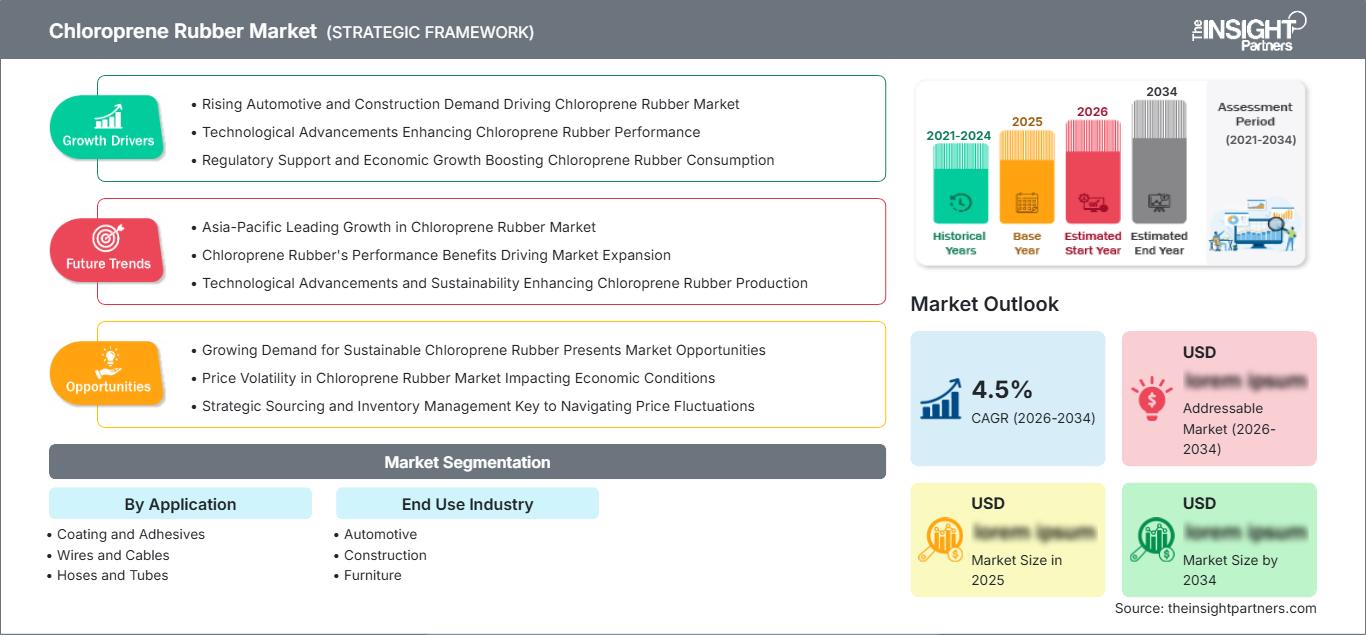
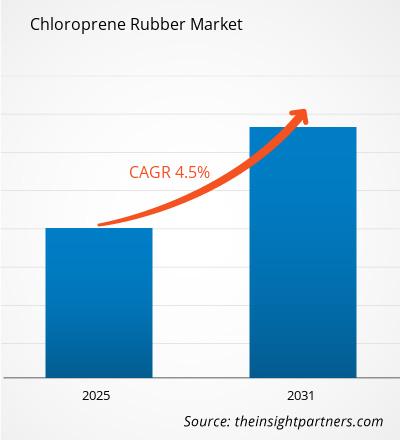
The Chloroprene Rubber Market was valued at US$ 1.25 Billion in 2025 and is projected to reach US$ 1.86 Billion by 2034, registering a CAGR of 4.48% during 2026–2034. Demand is supported by the material's balanced resistance to oil, weathering, ozone, heat, and flame, enabling use in automotive hoses, belts, seals, wires, cables, coatings, adhesives, and industrial components. Production economics remain closely linked to chloroprene monomer availability, energy costs, and regional manufacturing capacity.
North America remains strategically important because automotive replacement demand, construction activity, industrial maintenance, and specialty adhesive consumption support stable material requirements. The Chloroprene Rubber Market size outlook is further influenced by demand for durable elastomers in demanding operating environments. Regional consumption is expected to expand at approximately 3.8–4.4% CAGR through 2034, with technical rubber goods and infrastructure refurbishment providing structural support.
Chloroprene Rubber Market Assessment and Insights
- North America: North America is estimated to account for a 24–28% share in 2025 and is expected to grow at a 3.8–4.4% CAGR between 2026 and 2034, supported by automotive components, industrial sealing systems, construction products, and replacement applications.
- U.S.: The U.S. represents approximately 67–71% of North America's 2025 share, with a 3.7–4.3% CAGR between 2026–2034, supported by automotive aftermarket and industrial equipment demand.
- Europe: Europe holds an estimated 22–26% share in 2025 and is projected to expand at a 3.5–4.1% CAGR between 2026 and 2034, led by Germany, France, Italy, and the UK, where technical rubber and mobility applications remain important.
- Asia Pacific: Asia Pacific represents approximately 40–44% share in 2025 and is expected to register a 4.8–5.4% CAGR between 2026–2034, led by China, Japan, South Korea, and India through automotive, electronics, construction, and industrial manufacturing.
- Largest Segment: Coating and Adhesives accounts for an estimated 31–35% market share in 2025, with a 4.3–4.8% CAGR during 2026–2034, reflecting durable bonding and protective-coating requirements.
- High Growth Segment: Electronics is estimated at an 8–11% share in 2025, with a 5.0–5.5% CAGR during 2026–2034, supported by wire insulation, sealing, and component protection.
- Key companies analyzed in detail: ARLANXEO Holding B.V., BRP Manufacturing, Inc., Chongqing Changshou Chemical Co., Ltd., Denka Company Limited, LANXESS AG, RADO Gummi GmbH, Shanxi Synthetic Rubber Group Co., Ltd., Resonac Holdings Corporation, Tosoh Corporation, Zenith Industrial Rubber Products Private Limited.
Source: The Insight Partners' analysis based on proprietary research, government publications, company annual reports, investor presentations, industry databases, and expert interviews.
The development of the material continues to be driven by better formulation controls, specialized grades, and improved polymerization technology. The differentiation among grades is now based on factors such as Mooney viscosity, the type of modification, curing, and end-user application. Emulsion polymerization, which utilizes water, continues to be used in the large-scale manufacturing of chloroprene, while compounders are improving the formulations to ensure durability, fire resistance, and flexibility at low temperatures. Such developments will increase technical uses of the material away from molded rubber products.
Future growth will be concentrated in the manufacturing regions of Asia Pacific, specialized automotive parts, elastomer use in electronics, and infrastructure applications. Facility construction will take into consideration regional supply of raw materials, logistic security, compliance with environmental regulations, and customer qualification. On the other hand, the use of low-impact reinforcing and specialized grades, which lighten the formulation process, continues to be considered.
Chloroprene Rubber Market Report Scope
| Report Attribute | Details |
|---|---|
| Market size in 2025 | US$ 1.25 Billion |
| Market Size by 2034 | US$ 1.86 Billion |
| Global CAGR (2026 - 2034) | 4.48% |
| Historical Data | 2021-2024 |
| Forecast period | 2026-2034 |
Chloroprene Rubber Market Analysis
Demand in automotive, construction, industrial machines, electronics, and special products is the basis of growth in Chloroprene Rubber Market. Value chain involves the manufacture of chloroprene monomers, the process of polymerization, compounding, curing, molding, extrusion, coating, and fabrication of the end-product. Cost of feedstock and energy affects the economics of the polymer, while the end-user values consistencies in viscosity, curing behavior, tensile strength, and ozone and oil resistance. Automotive hoses, belts, seals, vibration damping parts, and wire products are among key applications.
Supply trends have been driven by consolidation among the producers and capacity optimization. Closure or capacity reduction in a big plant may reduce local availability due to the difficulty of qualifying alternative sources. Producers thus maintain a balance between their capacity utilization and stock levels, and customer commitments. Asia Pacific region became crucial for Chloroprene Rubber Market due to the chemical infrastructure and manufacturing base of the region. European and North American customers value supply reliability and technical documentation in qualified elastomer producers.
Positioning within the Chloroprene Rubber Market depends on the quality of polymers, variety of grades offered, geographic presence, technical services, and reliability of supply. ARLANXEO Holding B.V. has a wide portfolio of Baypren grades including modified and specialty grades, whereas Denka Company Limited, Tosoh Corporation, and Resonac Holdings Corporation are involved in Japan-based specialty chemicals eco-systems. LANXESS AG possesses industry experience in rubber and technologies of formulations, while local producers operate based on competitive pricing and geographic location close to downstream converters.
The strategic focus on investments is on efficiency of production, specialty grades, and continuity of supply, not on excessive capacity growth. An example of such an initiative is an increase in chloroprene rubber capacity by 22,000 tons per year that is planned by Tosoh to be implemented in its Nanyo facility in 2027 and become operational in 2030. Denka's temporary closure of its U.S.-based chloroprene rubber production facilities is another example.
● REPORT CUSTOMIZATION
Tailor This Report To Align With Your Specific Business Requirements
This report can be customized to align precisely with your business objectives, scope, and target markets. Customization options include tailored segmentation, geography, competitive analysis, and strategic insights to support informed decision-making.
Customize This Report →WHAT YOU CAN ADJUST
- ● Segmentations
- ● Geography
- ● Competitive Analysis
- ● Language Preferences
Chloroprene Rubber Market: Strategic Insights
Regional Insights
North America Chloroprene Rubber Market
North America is estimated to have a 24–28% of the Chloroprene Rubber Market share in 2025, with demand concentrated in the U.S. automotive, construction, industrial machinery, and aftermarket sectors. A 3.8–4.4% CAGR is expected through 2034 as manufacturers replace conventional materials with elastomers offering strong weathering, ozone, and oil resistance. Automotive hoses, belts, seals, vibration-control products, and industrial gaskets remain important applications.
The U.S. dominates regional consumption, accounting for approximately 67–71% of North America's 2025 market share. Demand is supported by vehicle maintenance, commercial transportation, industrial equipment, and construction refurbishment. Canada contributes through mining, energy, transportation, and industrial applications, while Mexico benefits from automotive manufacturing. Regional customers increasingly prioritize qualified suppliers, consistent grades, and secure delivery schedules as production disruptions can affect downstream component manufacturing.
U.S. Chloroprene Rubber Market
The U.S. represents 67–71% of North America's 2025 share and is projected to grow at a 3.7–4.3% CAGR during 2026–2034. Automotive hoses, belts, seals, wires, and industrial parts constitute the primary sources of demand. Construction and infrastructural maintenance add up to the sources of demand for coated fabrics, expansion joint materials, gaskets, and adhesives.
There are many major foreign firms that cater to the market needs along with compounders through their distribution and technical network. Customer requirements of controlled viscosity, curing ability, and system compatibility become essential. The temporary shutdown of the manufacturing unit of Denka Corporation in the United States has further raised the awareness regarding diversification of sources.
Europe Chloroprene Rubber Market
Europe is estimated to represent a 22–26% Chloroprene Rubber Market in 2025, with a 3.5–4.1% CAGR through 2034. Germany continues to be a strong market due to automobile engineering and the manufacture of industrial equipment. In the case of France and Italy, transportation, machinery, construction, and rubber transformation contribute to the demand in Europe, and the UK continues to have the demand coming from industries, infrastructures, and automobiles.
The demand in the UK Chloroprene Rubber Market comes from industrial assets that need constant maintenance, transportation assets, and specialized seals. The market favors technically competent products that have good resistance against weathering and chemicals. European consumers continue to look at material traceability, efficiency of formulations, and environmental documents in their procurement process.
The strong positioning of Germany lies in the fact that the country requires high quality and durable elastomers for production of automobiles, machinery, and components. Chloroprene based materials are used wherever ozone resistance, oil resistance, aging properties and mechanical properties are important. Germany also has vast networks of rubber processing industries and components manufacturers, which creates regular demand from both original equipment and replacement segments.
France, Italy, and Spain have diverse demand from automobile components, construction items, machinery, electrical items, and consumer goods. The relevance of Italy lies in the rubber conversion machinery, whereas France takes advantage of transportation and manufacturing industries. The demand from Spain is fueled by automobile and infrastructure industries. Overall, these regions prefer stable supply of application specific materials with Germany remaining the strongest European demand source.
APAC Chloroprene Rubber Market
APAC holds approximately 40–44% Chloroprene Rubber Market in 2025 and is projected to grow at 4.8–5.4% CAGR through 2034. Market leadership is held by China followed by Japan, South Korea, and India respectively. Australia’s contribution to the market lies primarily in terms of its infrastructure and industrial uses. Consumption is sustained by automotive manufacturing, electronics, construction, and industrial manufacture.
China's manufacturing capacity enables it to maintain its leadership position while Japan and South Korea add value to the market through advanced use of automotive and electronic applications. India is increasingly gaining relevance due to its vehicle manufacture, infrastructure development, and industrialization.
Middle East & Africa Chloroprene Rubber Market
The Middle East and Africa represent a smaller but strategically relevant demand base, with an estimated 3.6–4.2% CAGR through 2034. Both Saudi Arabia and the UAE benefit from diversification of industries, construction, development of energy infrastructure and transport system. South Africa will benefit from demand in hose, seals, coated goods, gaskets and cables due to mining industry, automobile sector, machinery industries and infrastructure maintenance requirements.
The Middle East can be benefited from large scale industrialization and infrastructural projects which require hoses, seals, coated goods and gaskets. Saudi Arabia emerges as the largest market within this region, while the UAE acts as the industrial and logistics center for the region. South Africa is still significant in terms of mining applications.
Segmentation Analysis
By Application
The Chloroprene Rubber Market scope by application covers Coating and Adhesives, Wires and Cables, Hoses and Tubes, and Others. Application requirements differ according to adhesion, flexibility, weather resistance, flame performance, and chemical exposure. The application segment is projected to grow at approximately 4.3–4.8% CAGR during 2026–2034, supported by continued utilization in industrial and infrastructure components.
- Coating and Adhesives: This category remains the leading application because chloroprene polymers provide strong adhesion, environmental resistance, and durability across industrial, construction, transportation, and specialty bonding systems.
- Wires and Cables: Demand is linked to insulation and protective sheathing requirements where resistance to weathering, oils, abrasion, and mechanical stress improves service reliability in demanding environments.
- Hoses and Tubes: Automotive, industrial, and machinery applications use chloroprene-based compounds where flexibility, ozone resistance, oil resistance, and long-term mechanical performance are important.
End Use Industry
The End Use Industry segment is projected to grow at a 4.4–4.9% CAGR during 2026–2034. Automotive remains central because hoses, belts, seals, mounts, and vibration-control components require balanced elastomer properties. Construction, electronics, furniture, and textiles broaden consumption through adhesives, coated materials, seals, and flexible components. Industrial diversification should support steady demand across multiple application environments.
- Automotive: Vehicle production, replacement components, hoses, belts, seals, vibration-control products, and under-hood applications make automotive the principal consumption center for durable chloroprene compounds.
- Construction: Expansion joints, waterproofing systems, seals, adhesives, flooring products, and protective components support consumption where weather resistance and long service life are required.
- Furniture: Adhesives, flexible components, coated fabrics, and cushioning-related applications create specialized demand, particularly where strong bonding and durability are required.
- Electronics: Wire insulation, cable protection, seals, and component-related applications benefit from controlled elastomer performance, particularly in environments involving heat, moisture, and mechanical stress.
- Textiles: Coated fabrics, elastic components, protective materials, and industrial textile products use chloroprene formulations where flexibility and resistance to environmental exposure are important.
Opportunity Snapshot
| End Use Industry | Revenue Contribution | Trend Tag | Adoption Stage |
|---|---|---|---|
| Automotive | High | Vehicle Sealing | Mature |
| Construction | High | Infrastructure Repair | Mature |
| Furniture | Medium | Bonding Systems | Scaling |
| Electronics | Medium | Cable Protection | Scaling |
| Textiles | Medium | Coated Fabrics | Scaling |
Chloroprene Rubber Market Growth Drivers and Impact Analysis
Expansion of Automotive and Transportation Component Manufacturing
The auto industry continues to be a major driver of demand in the Chloroprene Rubber Market since the chloroprenes offer a combination of oil resistance, ozone resistance, flexibility, and strength for applications such as hoses, belts, seals, mounts, and anti-vibration parts. Increased demand for automobiles means that there is an increased demand from original equipment suppliers, while the aging vehicle fleet ensures that there is a need for replacement parts. The effect goes beyond cars into commercial vehicles, buses, construction equipment, and other transportation equipment. There is also an increasing need for constant property characteristics for component suppliers to automate their process and achieve consistency in their products.
Infrastructure and Industrial Maintenance Requirements
Infrastructure rehabilitation and industrial maintenance create sustained demand for durable elastomer products used in seals, expansion joints, hoses, coated materials, and adhesive systems. Chloroprene is attractive where components face sunlight, ozone, oils, moisture, vibration, and repeated mechanical loading. Construction projects create direct demand for waterproofing, sealing, and bonding applications, while industrial facilities require replacement components throughout operating cycles. Mining, energy, transportation, and manufacturing facilities can generate recurring demand even when new construction activity fluctuates. The resulting consumption profile is less dependent on a single industry and provides resilience across economic cycles. Suppliers that combine polymer supply with technical support can benefit because compounders often require consistent processing behavior across repeated procurement cycles and geographically distributed production facilities.
Increasing Demand for High-Performance Specialty Elastomers
The shift toward application-specific elastomers is encouraging suppliers to develop modified grades with controlled processing characteristics and targeted performance. Customers increasingly evaluate resistance to temperature, chemicals, ozone, abrasion, and mechanical fatigue alongside conventional tensile properties. This supports premium opportunities in electronics, transportation, industrial machinery, medical products, and specialized adhesives. Specialty grades can also improve production efficiency by simplifying formulation or reducing the quantity of additives required to achieve a desired property profile. Suppliers therefore have an incentive to differentiate through grade portfolios, technical documentation, and application engineering rather than relying exclusively on volume competition. Over time, demand for performance consistency should strengthen the position of producers capable of supporting qualification programs and customized compound development.
Chloroprene Rubber Market Future Trends
Lower-carbon chloroprene rubber production
The Chloroprene Rubber Market trends increasingly include lower-carbon manufacturing and renewable-input strategies. In June 2026, ARLANXEO and Covestro reported that ARLANXEO's entire CR production had transitioned to ISCC PLUS-certified chlorine from January 2026. The companies indicated an average reduction in global warming potential of approximately 20% compared with 2025 levels, depending on grade. Such initiatives may influence procurement specifications as automotive, construction, and adhesive customers seek lower-footprint materials. Future product differentiation is therefore likely to include environmental attributes alongside mechanical performance, particularly where multinational customers apply supplier-level carbon accounting.
Regionalization of Production and Supply Security
Supply-chain resilience is becoming increasingly important as chloroprene rubber production remains concentrated among specialized producers. Customers are seeking alternative sourcing routes, longer-term contracts, safety inventories, and geographically diversified procurement to reduce exposure to plant outages or raw-material disruptions. Denka's temporary suspension of U.S. chloroprene rubber production illustrates how individual facility decisions can influence regional supply strategies. At the same time, Tosoh's planned capacity expansion demonstrates the opposite response, with investment aimed at addressing anticipated global demand. These developments point toward a market in which capacity location, logistics reliability, and customer qualification become increasingly important alongside polymer performance and price.
Chloroprene Rubber Market Opportunities
Capacity Expansion for Asia Pacific Downstream Manufacturing
Asia Pacific offers an attractive investment environment because automotive, electronics, construction, and industrial manufacturing continue to expand across major production centers. New capacity or upgraded facilities positioned close to downstream compounders can reduce logistics exposure and improve customer responsiveness. China and Japan provide established chemical and manufacturing ecosystems, while India offers increasing automotive and infrastructure opportunities. Investors can target specialty grades rather than undifferentiated capacity, focusing on formulations for hoses, seals, cable protection, adhesives, and high-performance components. Capacity planning should consider monomer availability, energy intensity, environmental requirements, and proximity to converters. Producers that integrate technical service with regional distribution may also reduce customer qualification barriers and capture recurring demand from multinational component manufacturers.
Development of Specialty and Sustainable Chloroprene Grades
Specialty formulations provide an opportunity to improve margins by addressing performance requirements that conventional grades cannot fully satisfy. Producers can prioritize modified polymers for electronics, high-durability automotive components, industrial seals, specialty adhesives, and environmentally conscious applications. Development programs involving cellulose nanofiber or other lower-impact reinforcement technologies demonstrate how product differentiation can address sustainability objectives while retaining elastomer functionality. Customers may increasingly require evidence covering durability, processing efficiency, environmental characteristics, and lifecycle performance. Consequently, suppliers should combine polymer research with compounder collaboration, application testing, and customer qualification programs. The Chloroprene Rubber Market Forecasts indicate that value creation should increasingly depend on specialty applications and differentiated grades rather than solely on broad volume expansion.
Recent Developments
- June 2026: ARLANXEO Holding B.V. and Covestro AG — ARLANXEO transitioned its entire global chloroprene rubber production to ISCC PLUS-certified chlorine supplied by Covestro from January 2026. The companies reported that the transition reduced the global warming potential of ARLANXEO's Baypren chloroprene rubber portfolio by approximately 20% compared with 2025 levels, depending on the product grade.
- May 2025: Denka Company Limited — Denka suspended operations at its LaPlace, Louisiana, chloroprene rubber facility after reporting significant financial pressure. The company cited rising costs, staffing challenges, production restrictions, and operational disruptions. Denka indicated that it would evaluate options for the facility, including a potential sale, while continuing customer supply through inventory and production from its Omi facility in Japan.
Frequently Asked Questions

- Comprehensive Market Sizing and Forecast Analysis
- Detailed Segmentation Analysis
- In-Depth Market Dynamics Assessment
- Regional and Country-Level Insights
- Competitive Landscape and Company Benchmarking
- Strategic Business Intelligence
Recent Reports
Testimonials

The Insight Partners' SCADA System Market report is comprehensive, with valuable insights on current trends and future forecasts. The team was highly professional, responsive, and supportive throughout. We are very satisfied and highly recommend their services.
RAN KEDEM Partner, Reali Technologies LTDs
I requested a report on a very specific software market and the team produced the report in a few days. The information was very relevant and well presented. I then requested some changes and additions to the report. The team was again very responsive and I got the final report in less than a week.
JEAN-HERVE JENN Chairman, Future Analytica
We worked with The Insight Partners for an important market study and forecast. They gave us clear insights into opportunities and risks, which helped shape our plans. Their research was easy to use and based on solid data. It helped us make smart, confident decisions. We highly recommend them.
PIYUSH NAGPAL Sr. Vice President, High Beam Global
The Insight Partners delivered insightful, well-structured market research with strong domain expertise. Their team was professional and responsive throughout. The user-friendly website made accessing industry reports seamless. We highly recommend them for reliable, high-quality research services
YUKIHIKO ADACHI CEO, Deep Blue, LLC.
This is the first time I have purchased a market report from The Insight Partners.While I was unsure at first, I visited their web site and felt more comfortable to take the risk and purchase a market report.I am completely satisfied with the quality of the report and customer service. I had several questions and comments with the initial report, but after a couple of dialogs over email with their analyst I believe I have a report that I can use as input to our strategic planning process.Thank you so much for taking the extra time and making this a positive experience.I will definitely recommend your service to others and you will be my first call when we need further market data.
JOHN SUZUKI President and Chief Executive Officer, Board Director, BK Technologies
I wish to appreciate your support and the professionalism you displayed in the course of attending to my request for information regarding to infectious disease IVD market in Nigeria. I appreciate your patience, your guidance, and the fact that you were willing to offer a discount, which eventually made it possible for us to close a deal. I look forward to engaging The Insight Partners in the future, all thanks to the impression you have created in me as a result of this first encounter.
DR CHIJIOKE ONYIA MANAGING DIRECTOR, PineCrest Healthcare Ltd.Reason to Buy
- Informed Decision-Making
- Understanding Market Dynamics
- Competitive Analysis
- Identifying Emerging Markets
- Customer Insights
- Market Forecasts
- Risk Mitigation
- Boosting Operational Efficiency
- Strategic Planning
- Investment Justification
- Tracking Industry Innovations
- Aligning with Regulatory Trends





 Get Free Sample for