
Cold Chain Monitoring Market Growth, Share & Trends by 2034
Coverage: by Offering (Hardware, Software, Services); Temperature Type (Frozen, Chilled); Logistics (Storage, Transportation); Application (Pharmaceuticals and Healthcare, Food and Beverages, Chemicals, Others) , and Geography (North America, Europe, Asia Pacific, and South and Central America)
- Status : Data Released
- Report Code : TIPRE00011316
- Category : Electronics and Semiconductor
- No. of Pages : 150
- Available Report Formats :


- Last update date : August 05, 2026


2025 Market Size
US$ 8.52 Bn
Base year value
2034 Forecast
US$ 15.42 Bn
Projected by 2034
CAGR 2026-2034
7.70 %
Growth rate
Addressable Market
US$ 113.16 Bn
(2026-2034)
The Cold Chain Monitoring Market value stood at US$ 8.52 Billion in 2025 and will be worth US$ 15.42 Billion by 2034 and will be registering a CAGR of 7.70% between 2026 and 2034. The factors driving demand include the need for improved compliance with temperatures, greater distribution of biological products, increased responsibility for spoilage in foods, healthcare, chemicals, and transportation.
North America continues to lead in structurally advanced adoption grounds with players projected to expand at 7.2 – 7.8% CAGR, driven by pharmaceutical serialization, modernization of refrigerated fleet, and distribution of high-value food. The Cold Chain Monitoring Market Size in North America can be attributed to dense 3PL networks, FDA-compliant documentation procedures, and increasing usage of cloud dashboards to prevent excursions.
Cold Chain Monitoring Market Assessment and Insights
- North America accounted for 34–37% share in 2025 and is projected to grow at a CAGR between 7.2–7.8% during 2026–2034, supported by validated pharma logistics, refrigerated warehousing density, and mature telematics adoption.
- US represented 78–82% of North America in 2025 and is expected to grow at a CAGR between 7.1–7.6% during 2026–2034, led by biologics, food safety, and 3PL investment.
- Europe held 25–28% share in 2025 and is forecast to grow at a CAGR between 6.8–7.4% during 2026–2034, with Germany, the UK, France, Italy, and Spain leading GDP-compliant adoption.
- Asia Pacific captured 22–25% share in 2025 and should grow at a CAGR between 8.4–9.2% during 2026–2034, driven by China, India, Japan, South Korea, and Australia.
- Largest Segment Hardware held 52–56% market share in 2025 and is expected to grow at a CAGR between 6.9–7.5% during 2026–2034, anchored by sensors, data loggers, and gateways.
- High Growth Segment Software Services held 44–48% market share in 2025 and is projected to grow at a CAGR between 8.3–9.1% during 2026–2034, led by analytics and compliance automation.
- Key companies analyzed in detail: ORBCOMM Inc., Aeris Communications, Inc., Ambetronics Engineers Pvt. Ltd., Berlinger & Co. AG, Hanwell Solutions Ltd., hIOTron, Kii Corporation, Monnit Corporation, Roambee Corporation, and Sensitech Inc.
Source: The Insight Partners' analysis based on proprietary research, government publications, company annual reports, investor presentations, industry databases, and expert interviews.
There have been changes from periodic logger checks to the use of continuous sensing, connectivity through cell and satellite, and exception-based workflow. Additionally, there is evolution in production dynamics through inclusion of calibration and battery optimization and reporting through cloud in standardized product offering by the device vendors. In the Cold Chain Monitoring Market, this ensures fewer checks, increased traceability and condition verification through hand-offs at storage depots, ports, trucks, airplanes, and last-mile health care distribution.
The future growth in demand will be driven by new markets developing infrastructure for vaccines, food security and export logistics. There are tailwinds for regulatory push by GDP, FSMA-style food safety, and airline temperature control programs for buyers to have their validated monitoring records. The market will also benefit from low-cost sensors, wide LPWAN coverage, and initiatives on sustainability that need energy and temperature performance tracking of refrigerated assets.
Cold Chain Monitoring Market Report Scope
| Report Attribute | Details |
|---|---|
| Market size in 2025 | US$ 8.52 Billion |
| Market Size by 2034 | US$ 15.42 Billion |
| Global CAGR (2026 - 2034) | 7.70% |
| Historical Data | 2021-2024 |
| Forecast period | 2026-2034 |
Cold Chain Monitoring Market Analysis
There is increased demand as temperature swings lead to direct losses of product, potential recall due to product compromise, and patient/consumer safety concerns. The Cold Chain Monitoring Market has experienced the fastest growth in applications where biologic products, vaccines, frozen foods, and specialty chemicals need audit-trails for multimodal transportation.
The ecosystem consists of sensor makers, connectivity solution providers, cloud software companies, cold storage warehouses, carriers, packagers, and compliance departments. The supply dynamic favors companies offering robust hardware with interoperable data services. Consumers are now requiring API integration, calibration tracking capabilities, and exception reports over simple standalone logger systems.
There is fragmentation in competition but it is becoming more platform-based. The competing players ORBCOMM Inc., Sensitech Inc., Roambee Corporation, Monnit Corporation, and Berlinger & Co. AG offer competition by offering visibility depth, pharmaceutical validation, and global capability. Cold Chain Monitoring Market report reveals that competitive positioning today requires software intelligence, device quality and capability, and the capability to cater to both transport and static monitoring requirements.
The direction of funding now seems to be toward predictive analytics, multi-network support, and automatic product release documents. Aeris Communications, Inc., Kii Corporation, hIOTron, Hanwell Solutions Ltd., and Ambetronics Engineers Pvt. Ltd. meet the demands of the companies through IoT enablers, environmental monitoring, and cloud control. Consolidation is likely to occur where credibility exists in the field of life sciences and software revenue streams.
● REPORT CUSTOMIZATION
Tailor This Report To Align With Your Specific Business Requirements
This report can be customized to align precisely with your business objectives, scope, and target markets. Customization options include tailored segmentation, geography, competitive analysis, and strategic insights to support informed decision-making.
Customize This Report →WHAT YOU CAN ADJUST
- ● Segmentations
- ● Geography
- ● Competitive Analysis
- ● Language Preferences
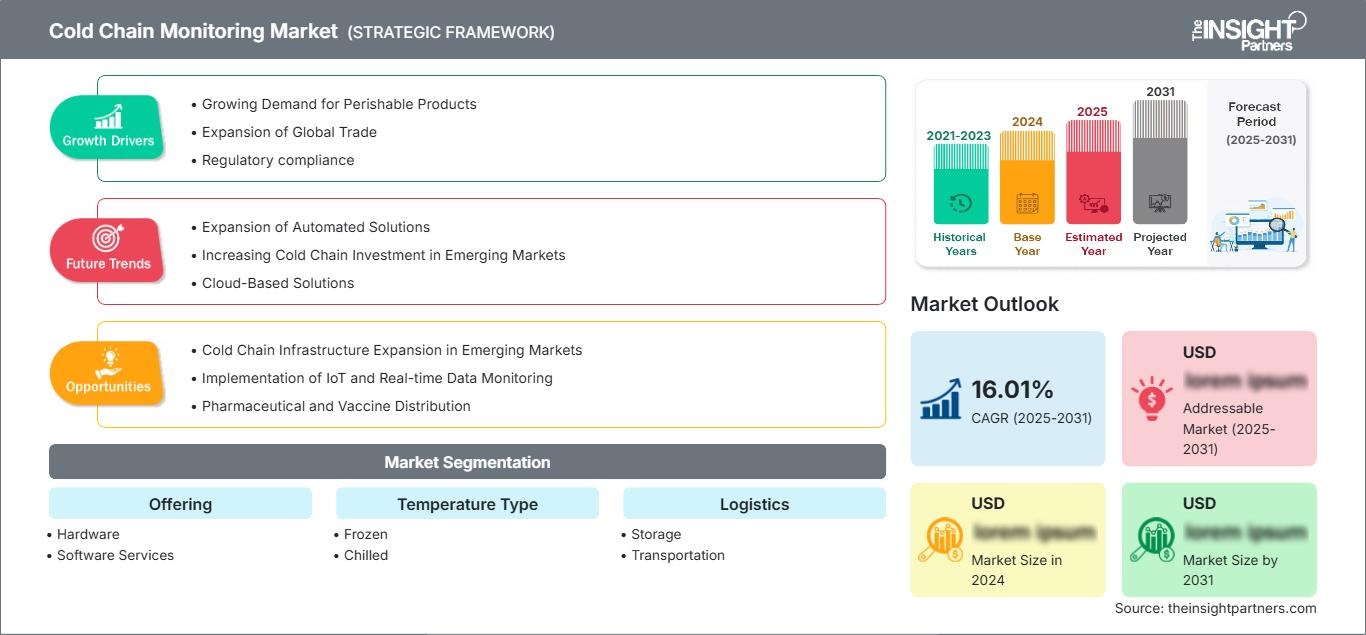
Cold Chain Monitoring Market: Strategic Insights
Regional Insights
North America Cold Chain Monitoring Market
In North America, the market held a 34–37% share in 2025, which is expected to grow by 7.2–7.8% CAGR during 2026-2034. North American Cold Chain Monitoring Market share is driven by advanced refrigeration storage facilities, extensive distribution channels for specialty drugs, and effective temperature logging. IATA's CEIV Pharma standard improves the standard air-cargo processes for critical healthcare cargo and increases the requirement for cold chain monitoring at the airports and forwarders.
The region has a very high level of implementation of cellular tracking devices, reefers telematics, and cloud-based analytical solutions. Growing demands in biologicals logistics, groceries' cold chain logistics, and warehouse control systems of the United States will continue to drive the market growth.
U.S. Cold Chain Monitoring Market
United States represented 78–82% of North America in 2025 and is anticipated to have a CAGR of 7.1–7.6% in 2026–2034. High pharmaceutical distribution, fast-moving food logistics, and robust adoption of carrier technology are some of the key factors driving the continuous adoption of sensor-based, gateway, and compliance automation solutions.
A number of companies operate in this market, which include ORBCOMM Inc., Sensitech Inc., Monnit Corporation, Aeris Communications, Inc., and Roambee Corporation, providing visibility in fleet, warehouse, and shipment. In terms of application, biologics, vaccines, frozen foods, and direct-to-patient healthcare logistics are expected to gain significant traction with the help of real-time alert mechanism.
Europe Cold Chain Monitoring Market
Europe accounts for 25-28% of the market in 2025 and will continue to see growth in the 6.8-7.4% CAGR range, driven by Germany. The UK has an advantage through its pharmaceutical import restrictions, clinical trials, and parcel networks requiring validated temperature performance capabilities for the health care and cold food transport industries.
Germany plays an important role in stimulating regional demand by producing medicines, automated warehousing, and logistics networks that target exporting goods. Other nations, like France, Italy, and Spain, support this by producing vaccines, fresh foods, chemicals, and hospitals. Validation reports are essential in both GDP and international transport to ensure compliance.
APAC Cold Chain Monitoring Market
APAC held 22-25% share in 2025 and is expected to grow at 8.4-9.2% CAGR range. China will lead regional adoption. China, Japan, South Korea, India and Australia are expanding refrigerated logistics for biologics, seafood, dairy, frozen foods and specialty chemicals.
Connected monitoring is being driven by industrial policy, urban grocery delivery, healthcare access expansion, and export quality requirements. “Investments in vaccine and food processing in India and a disciplined quality culture in Japan drive demand for calibrated devices, cloud alerts and route-level analytics.
Middle East & Africa Cold Chain Monitoring Market
The CAGR of Middle East & Africa ranges from 7.6% to 8.3%, driven by growth in UAE. Pharmaceutical imports, food security, and temperature-controlled airport logistics are growing markets in Saudi Arabia, UAE, South Africa, and Rest of MEA.
Long distances, energy-intensive cooling requirements, and exposure to varying climates make excursion avoidance highly significant. Growth in healthcare logistics, seaport logistics, and cold chain logistics in supermarkets fosters the adoption of telematics, stationary monitoring, and audit trail automation.
Segmentation Analysis
Offering
The Offering segment is projected to grow at a 7.5–8.2% CAGR range during 2026–2034. Cold Chain Monitoring Market scope within this segment spans device procurement, software subscriptions, calibration, alerts, analytics, and managed services. Adoption is shifting toward bundled models as buyers seek lower integration burden, recurring compliance support, and standardized reporting across multiple warehouses, carriers, and shipment lanes.
- Hardware remains the largest sub-segment because sensors, data loggers, gateways, and trackers are required at product, pallet, container, vehicle, and facility levels for continuous condition capture.
- Software Services is gaining strategic importance as customers move toward predictive alerts, automated compliance reports, dashboard integration, and managed monitoring support for global shipment networks.
Temperature Type
The Temperature Type segment is expected to grow at a 7.3–8.0% CAGR range through 2034. Demand is balanced between frozen logistics for food and biologics and chilled logistics for vaccines, fresh products, and clinical materials. Monitoring requirements differ by excursion tolerance, route duration, packaging design, and product-release rules, requiring configurable alarms and validated temperature profiles.
- Frozen demand is anchored by frozen food, seafood, biopharmaceutical storage, and ultra-low-temperature shipment workflows where energy use, door openings, and route delays can affect quality.
- Chilled applications are strategically important in vaccines, fresh foods, dairy, and healthcare distribution, where narrow temperature bands require reliable alerts and documented handoff visibility.
Logistics
The Logistics segment is forecast to grow at a 7.4–8.1% CAGR range during 2026–2034. Storage monitoring is becoming more automated as warehouses connect temperature, humidity, door, and power data. Transportation monitoring is expanding faster because multimodal routes involve more handoffs, higher disruption risk, and greater customer demand for shipment-level transparency.
- Storage includes warehouses, cold rooms, distribution centers, and clinical depots where stationary sensors, mapping studies, and automated audit trails support compliance and inventory protection.
- Transportation covers road, air, ocean, and rail movements where GPS, reefer telematics, cellular, satellite, and disposable trackers help manage excursions across extended supply chains.
Application
The Application segment is projected to grow at a 7.6–8.4% CAGR range through 2034. Pharmaceuticals and healthcare require validated, auditable records, while food and beverages emphasize spoilage reduction, freshness, and regulatory assurance. Chemicals add specialized demand where temperature-sensitive formulations need documented stability during storage and transport.
- Pharmaceuticals and Healthcare is strategically critical because biologics, vaccines, cell therapies, and clinical trial materials require traceable temperature history before release or patient administration.
- Food and Beverages generates broad volume demand across frozen meals, meat, dairy, produce, seafood, and beverages, where monitoring supports freshness, waste reduction, and retailer accountability.
- Chemicals adoption is concentrated in specialty ingredients, laboratory reagents, and industrial formulations where stability, safety, and quality documentation are important during controlled logistics.
Opportunity Snapshot
| Application | Revenue Contribution | Trend Tag | Adoption Stage |
| Pharmaceuticals and Healthcare | High | Biologics Release | Scaling |
| Food and Beverages | High | Freshness Control | Mature |
| Chemicals | Medium | Stability Tracking | Scaling |
| Others | Low | Asset Visibility | Emerging |
Cold Chain Monitoring Market Growth Drivers and Impact Analysis
Biologics Distribution Requires Auditable Temperature Integrity
Biologics, vaccines and specialty medicines have a higher monitoring intensity due to high product value and limited tolerance to excursions. Pharmaceutical air cargo requires specialized equipment, storage facilities, harmonized procedures and cooperation among cold chain partners, IATA said. That drives the demand for calibrated sensors, visibility of shipments, and automated exception records. Healthcare lanes between manufacturing sites, airports, clinical depots, and hospitals have the greatest market impact. Simple tracking providers are less desirable than vendors supporting validated workflows, immutable data capture, and quick product-release decisions.
Food Waste Reduction Strengthens Digital Cold Chain Investment
Food and beverage operators are under pressure to reduce spoilage while maintaining freshness over long distribution chains. Monitoring temperatures can help retailers, distributors and producers see the conditions of custody and spot weak points such as loading delays, door openings, power interruptions and route disruptions. The impact is as much operational as regulatory, because data enables supplier accountability, claims management and shelf-life optimization. Adoption is moving from large refrigerated fleets to regional warehouses and urban delivery networks, where cheaper sensors and cloud alerts can improve visibility without a costly overhaul of the infrastructure.
Connected Logistics Platforms Reduce Manual Compliance Burden
The manual tracking of temperatures is becoming less viable for businesses dealing with multi-regional transportation and outsourced carriers as well as rigorous audits on behalf of their customers. Connected solutions will simplify processes through combining data from sensors, alerting users, recording the information, and connecting to transport management systems. The commercial advantage will be clear in recurring income from software, high switching costs, and wide adoption of solutions among storage and transportation assets. Exception management is an important criterion that allows suppliers providing APIs, analytics, calibrations, and management services to create more value in accounts.
Cold Chain Monitoring Market Future Trends
Predictive Excursion Prevention
Cold Chain Monitoring Market trends are shifting from post-shipment reporting toward predictive excursion prevention. Future platforms will combine temperature, humidity, door, power, location, route, and weather signals to predict risk before a product breaches limits. This approach should reduce investigation workload and protect high-value inventory. Vendors will differentiate through algorithms trained on lane history, packaging profiles, and carrier performance. Buyers will increasingly evaluate solutions by intervention success, not only data capture, making analytics credibility a key purchasing criterion.
Lower-Carbon Frozen Logistics Monitoring
Sustainability programs will make energy-aware monitoring more important in frozen logistics. ORBCOMM’s participation in the Move to -15°C coalition highlights interest in using telematics data to quantify energy and emissions benefits from adjusted frozen-food temperature standards. Future systems will monitor not only product safety but also refrigeration efficiency, dwell time, and carbon impact. This creates opportunities for dashboards that combine compliance, asset utilization, and sustainability reporting for retailers, shippers, and maritime operators.
Cold Chain Monitoring Market Opportunities
Pharma Release Automation for Global Supply Chains
Cold Chain Monitoring Market Forecasts indicate strong opportunity in automating pharmaceutical product-release evaluations. Life-sciences companies need faster release decisions without weakening compliance, especially for biologics, clinical trials, and cross-border shipments. Platforms that connect logger data, lane qualification, alarm review, and batch documentation can shorten cycle times and reduce manual quality review. Investment should prioritize validated SaaS, secure audit trails, and integration with enterprise quality systems. Vendors with pharmaceutical credibility can convert monitoring from a logistics tool into a release-enablement capability.
Emerging Market Cold Infrastructure Digitization
Emerging markets offer opportunity as governments and private operators expand vaccine storage, food-processing parks, export logistics, and modern retail. Monitoring adoption can leapfrog manual practices because new cold rooms and fleets are often built with connectivity in mind. Investors should target scalable device-service bundles, multilingual dashboards, and support models suited to fragmented carrier bases. Partnerships with logistics providers, healthcare distributors, and refrigeration equipment suppliers can accelerate deployment while lowering customer integration complexity.
Recent Developments
- July 2026: Omniflex implemented its cloud-based Data2Desktop platform across 17 SAMRC facilities to continuously monitor laboratory refrigerators, ultra-low freezers, cryogenic storage, and incubators. The system provides real-time temperature alerts, helping safeguard vaccines, biological samples, and research materials while improving regulatory compliance.
- April 2025: Ocean Network Express (ONE) introduced a digital platform that provides real-time visibility into refrigerated container conditions, including temperature and location. The solution enables proactive shipment monitoring, improves cargo integrity, and enhances supply chain efficiency for temperature-sensitive goods such as pharmaceuticals and food products.
- July 2025: Geotab introduced upgraded IOX-COLD and IOX-COLD RUGGED devices alongside enhanced software capabilities to provide real-time monitoring of temperature-sensitive shipments. The solution offers deeper integration with refrigeration units, automated alerts, improved compliance reporting, and greater visibility to help food and pharmaceutical fleets reduce spoilage and maintain product integrity.
Frequently Asked Questions

- Comprehensive Market Sizing and Forecast Analysis
- Detailed Segmentation Analysis
- In-Depth Market Dynamics Assessment
- Regional and Country-Level Insights
- Competitive Landscape and Company Benchmarking
- Strategic Business Intelligence
Recent Reports
Testimonials

The Insight Partners' SCADA System Market report is comprehensive, with valuable insights on current trends and future forecasts. The team was highly professional, responsive, and supportive throughout. We are very satisfied and highly recommend their services.
RAN KEDEM Partner, Reali Technologies LTDs
I requested a report on a very specific software market and the team produced the report in a few days. The information was very relevant and well presented. I then requested some changes and additions to the report. The team was again very responsive and I got the final report in less than a week.
JEAN-HERVE JENN Chairman, Future Analytica
We worked with The Insight Partners for an important market study and forecast. They gave us clear insights into opportunities and risks, which helped shape our plans. Their research was easy to use and based on solid data. It helped us make smart, confident decisions. We highly recommend them.
PIYUSH NAGPAL Sr. Vice President, High Beam Global
The Insight Partners delivered insightful, well-structured market research with strong domain expertise. Their team was professional and responsive throughout. The user-friendly website made accessing industry reports seamless. We highly recommend them for reliable, high-quality research services
YUKIHIKO ADACHI CEO, Deep Blue, LLC.
This is the first time I have purchased a market report from The Insight Partners.While I was unsure at first, I visited their web site and felt more comfortable to take the risk and purchase a market report.I am completely satisfied with the quality of the report and customer service. I had several questions and comments with the initial report, but after a couple of dialogs over email with their analyst I believe I have a report that I can use as input to our strategic planning process.Thank you so much for taking the extra time and making this a positive experience.I will definitely recommend your service to others and you will be my first call when we need further market data.
JOHN SUZUKI President and Chief Executive Officer, Board Director, BK Technologies
I wish to appreciate your support and the professionalism you displayed in the course of attending to my request for information regarding to infectious disease IVD market in Nigeria. I appreciate your patience, your guidance, and the fact that you were willing to offer a discount, which eventually made it possible for us to close a deal. I look forward to engaging The Insight Partners in the future, all thanks to the impression you have created in me as a result of this first encounter.
DR CHIJIOKE ONYIA MANAGING DIRECTOR, PineCrest Healthcare Ltd.Reason to Buy
- Informed Decision-Making
- Understanding Market Dynamics
- Competitive Analysis
- Identifying Emerging Markets
- Customer Insights
- Market Forecasts
- Risk Mitigation
- Boosting Operational Efficiency
- Strategic Planning
- Investment Justification
- Tracking Industry Innovations
- Aligning with Regulatory Trends





 Get Free Sample for