
Combine Harvesters Market Size, Share & Demand by 2034
Coverage: by Power (Below 200 HP, 200-400 HP, Above 400 HP); Application (Wheat Harvesting, Corn Harvesting, Rice Harvesting, Others) , and Geography (North America, Europe, Asia Pacific, and South and Central America)
- Status : Data Released
- Report Code : TIPRE00009706
- Category : Manufacturing and Construction
- No. of Pages : 150
- Available Report Formats :


- Last update date : July 21, 2026


2025 Market Size
US$ 11.76 Bn
Base year value
2034 Forecast
US$ 16.08 Bn
Projected by 2034
CAGR 2026-2034
3.54 %
Growth rate
Addressable Market
US$ 126.46 Bn
(2026-2034)
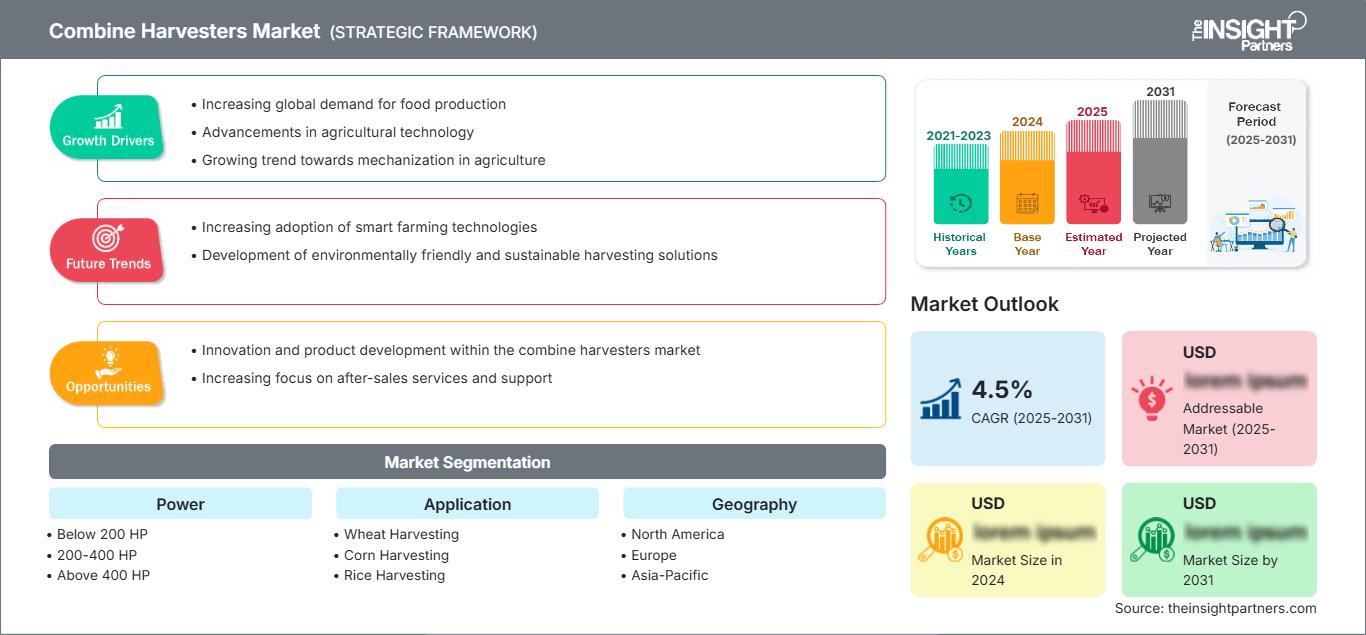
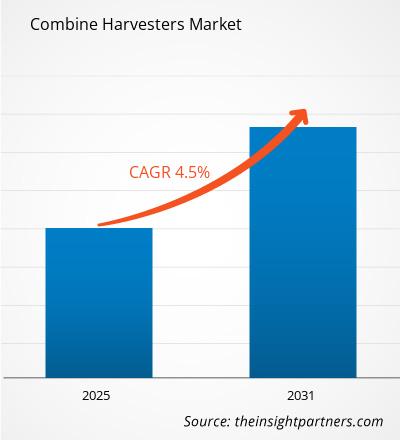
The global combine harvesters market size is expected to rise from US$ 11.76 billion in 2025 to US$ 16.08 billion in 2034, with a CAGR of 3.54% from 2026 to 2034. This growth will be attributed to continuous replacement of aging harvesting fleets, increasing demand for timely harvest of cereals, and need for mechanization in wheat, corn, and rice cultivation practices.
North America is an innovation-led market region wherein combine harvesters market size growth is driven by factors such as the replacement of high-horsepower fleet, adoption of precision agriculture techniques, and large-scale farming of grains. The regional CAGR is forecast to be 3.1%–3.5% in the period between 2026 and 2034, driven more by replacement than initial adoption of technology.
Combine Harvesters Market Assessment and Insights
- North America accounted for 18–20% share in 2025 and is expected to grow at a CAGR of 3.1–3.5% during 2026–2034, driven by fleet replacement, large-acreage grain farms, and automation adoption.
- US represented 82–86% of North America in 2025 and is projected to grow at a CAGR of 3.0–3.4% during 2026–2034.
- Europe held 23–25% share in 2025 and is forecast to expand at a CAGR of 2.8–3.2% during 2026–2034, led by Germany, France, the UK, Italy, and Spain.
- Asia Pacific captured 44–47% share in 2025 and is anticipated to grow at a CAGR of 4.0–4.5% during 2026–2034, with China, India, Japan, Australia, and South Korea supporting demand.
- Largest Segment 200-400 HP held 48–52% market share in 2025 and is projected to grow at a CAGR of 3.3–3.7% during 2026–2034.
- High Growth Segment Above 400 HP held 18–22% market share in 2025 and is projected to grow at a CAGR of 4.2–4.8% during 2026–2034.
- Key companies analyzed in detail: AGCO Corporation, CLAAS KGaA mbH, CNH Industrial N.V., Deere & Company, Iseki & Co., Ltd., Kubota Corporation, Lovol Heavy Industry Co., Ltd., Rostselmash, Sampo-Rosenlew Oy, Yanmar Holdings Co., Ltd.
Source: The Insight Partners' analysis based on proprietary research, government publications, company annual reports, investor presentations, industry databases, and expert interviews.
Mechanical harvesting has evolved from its mere ability to thresh to productivity systems. Competition among manufacturers centers on minimizing grain loss, ground speed automation, telematics, energy savings, and the ergonomic design of the cabin. Dynamics in manufacturing are still characterized by the use of high amounts of steel, access to electronic components, and local assembly. Data from the public domain suggests that the Asia Pacific region continues to dominate as the leading regional base, with North America and Europe preferring a high-horsepower harvesters replacement cycle.
In the future, new geographic markets will benefit from the subsidy programs, custom hiring system, and consolidation of grain production. Investments are moving towards autonomy and predictive maintenance and harvesting specific crops. Pressure on emissions and soil compaction will drive the development of light chassis, efficient drivetrain, and residue-management equipment. This will set up the stage for sustained growth until 2034.
Combine Harvesters Market Report Scope
| Report Attribute | Details |
|---|---|
| Market size in 2025 | US$ 11.76 Billion |
| Market Size by 2034 | US$ 16.08 Billion |
| Global CAGR (2026 - 2034) | 3.54% |
| Historical Data | 2021-2024 |
| Forecast period | 2026-2034 |
Combine Harvesters Market Analysis
Growth expectations in the combine harvester market hinge on the stability of cereals production, shortage of agricultural manpower, and reduced wastage in the harvesting process within reduced timeframes. Wheat, corn, and rice farmers are seeking to invest in harvesters that are characterized by both high capacity and crop quality management. Factors such as dealer financing, service agreements, and resale of older equipment help make the technology more affordable for medium-sized farms.
Factors that impact supply include engine technologies, header compatibility, hydraulic systems, electronics, and dealership presence in various regions. Some of the participants in the value chain are the component makers, manufacturing facilities, precision farming software developers, distributors, and service providers for used equipment. The companies that have guaranteed parts supply and calibration services during the harvesting seasons can translate the machinery reliability into sales.
Concentration persists in the competitive environment among leading brands, including Deere & Company, CNH Industrial N.V., CLAAS KGaA mbH, AGCO Corporation, Kubota Corporation, and Yanmar Holdings Co., Ltd. In addition to that, there is regional or specialized competition between companies such as Iseki & Co., Ltd., Lovol Heavy Industry Co., Ltd., Rostselmash, and Sampo-Rosenlew Oy. According to the analysis of the combine harvesters market, the competition is becoming software-oriented and based on reliability, uptime, and crop adaptability.
The trend in investments suggests that the emphasis has moved away from the power of machines to automation and sensor cleaning, diagnostics, connectivity, and reduced fuel consumption. Consequently, strategic positioning is not simply about machine availability but rather about lifecycle economics. An OEM with an integrated digital platform and a dense dealer network will have a better position to maintain its margins as farmers analyze costs per hectare of harvested land.
● REPORT CUSTOMIZATION
Tailor This Report To Align With Your Specific Business Requirements
This report can be customized to align precisely with your business objectives, scope, and target markets. Customization options include tailored segmentation, geography, competitive analysis, and strategic insights to support informed decision-making.
Customize This Report →WHAT YOU CAN ADJUST
- ● Segmentations
- ● Geography
- ● Competitive Analysis
- ● Language Preferences
Combine Harvesters Market: Strategic Insights
Regional Insights
North America Combine Harvesters Market
North America held 18–20% share in 2025 and is expected to expand at a CAGR of 3.1–3.5% during 2026–2034. The combine harvesters market share is supported by large wheat, corn, soybean, and barley farms that require high-capacity equipment to protect yield during compressed harvest windows.
Replacement cycles, use of precision agriculture and uptime programs supported by dealerships influence regional sales. North America is the dominant market, with U.S. taking the lead and Canada through Prairie grain farming. The focus now is on evaluation of automation systems, grain quality and fuel efficiency in purchases.
U.S Combine Harvesters Market
The U.S. accounted for 82–86% of North America in 2025 and is projected to grow at a CAGR of 3.0–3.4% during 2026–2034. Large grain belts, high mechanization, and strong dealer density make the country the principal regional revenue contributor for combine harvesters.
Application demand is concentrated in corn, wheat, soybean, and special grains; high horsepower platforms are preferred by the larger farms. Deere & Company, CNH Industrial N.V., AGCO Corporation, and CLAAS KGaA mbH have notable presence of products and services through their offerings.
Europe Combine Harvesters Market
Europe held 23–25% share in 2025 and is forecast to grow at a CAGR of 2.8–3.2% during 2026–2034. Germany remains the leading country because of advanced farm equipment adoption, strong OEM presence, and demand for high-efficiency grain harvesting.
Fleet replacement and contractor-based harvesting are hallmarks of the UK combine harvesters market. Germany has technology-driven farming systems of cereals as well as engineering hubs. Wheat, corn, rice and polyculture cultivation drive demand in France, Italy and Spain. Regulations on sustainability promote efficient engines, residue management and soil-friendly operations.
APAC Combine Harvesters Market
APAC accounted for 44–47% share in 2025 and is expected to grow at a CAGR of 4.0–4.5% during 2026–2034. China leads regional demand, while India offers strong mechanization headroom through subsidy and custom-hiring channels.
While Japan and South Korea prefer small harvesters with technological advancements, Australia needs large harvesters for its broadacre grain farms. Policies, labor shortages in the countryside, and increasing goals for cereal production can promote adoption of combine harvesters.
Middle East & Africa Combine Harvesters Market
MEA & Africa region is forecasted to experience a CAGR growth rate of 3.2% - 3.8% during 2026-2034, with South Africa being the key adopter country in the region. Mechanized farming is encouraged in Saudi Arabia and the UAE for certain grain and fodder projects.
Demand from the Rest of MEA will be uneven on account of poor finance availability and fragmentation of farms in the region. Infrastructure development, food security drives, and leasing practices will help boost demand for farms facing harvest losses due to low mechanization levels.
Segmentation Analysis
Power
The power segment is expected to grow at a CAGR of 3.4–3.9% during 2026–2034. The combine harvesters scope across power bands reflects farm size, crop density, terrain, and capital availability. Mid-range machines serve the broadest demand base, while higher-power platforms gain traction where contractors and large farms need faster throughput and lower harvest risk.
- Below 200 HP machines serve small and fragmented farms, particularly in rice and mixed-crop systems where affordability, maneuverability, and lower maintenance requirements outweigh maximum harvesting throughput.
- 200-400 HP machines represent the core commercial category, balancing productivity, acquisition cost, fuel use, and compatibility with diverse headers across wheat, corn, and rice applications.
- Above 400 HP platforms are strategically important for large farms and contractors that prioritize high daily acreage, automation readiness, and reduced exposure to weather-related harvest delays.
Application
The application segment is expected to grow at a CAGR of 3.3–3.8% during 2026–2034. Demand is tied to cereal acreage, crop-specific headers, grain moisture conditions, and residue management needs. Wheat and corn harvesting remain the major revenue contributors, while rice harvesting requires machines adapted for wet fields, track options, and lower grain damage.
- Wheat Harvesting remains a major application because large cereal farms need reliable threshing, low grain loss, and rapid field completion across temperate production belts.
- Corn Harvesting supports demand for higher-capacity machines, durable headers, and efficient separation systems as producers manage heavy biomass, large yields, and tight harvest schedules.
- Rice Harvesting requires machines suited to wet soil, smaller plots, and grain sensitivity, making compact, track-compatible, and regionally serviced equipment strategically important.
Opportunity Snapshot
| Application | Revenue Contribution | Trend Tag | Adoption Stage |
| Wheat Harvesting | High | Yield Control | Mature |
| Corn Harvesting | High | Header Efficiency | Scaling |
| Rice Harvesting | Medium | Track Mobility | Scaling |
| Others | Low | Crop Flex | Emerging |
Combine Harvesters Market Growth Drivers and Impact Analysis
Labor Scarcity and Narrow Harvest Windows
Farm operators face recurring labor shortages during peak harvesting periods, especially in grain belts where crop maturity is concentrated over a short period. combine harvesters reduce dependence on seasonal workers by integrating reaping, threshing, and cleaning into one pass. The impact is strongest in wheat and corn systems, where delayed harvesting can lower grain quality, increase lodging losses, and disrupt planting schedules for the next crop. Buyers therefore increasingly justify equipment upgrades through avoided losses and lower labor exposure rather than capacity alone.
The scarcity of skilled agricultural manpower has led to increased demand for highly efficient harvesting machines in farming areas worldwide. The scarcity of such manpower is due to rural-to-urban migration; therefore, farmers prefer machines that can increase productivity using few manpower resources. The use of advanced combines equipped with automated control systems, enhanced threshing processes, and improved user-friendly machines helps compensate for the scarcity of manpower. Furthermore, an increase in wage rates during harvest times is another reason for the growing attraction to mechanization in agriculture. Another factor driving the development of such technology is the increase in the number of contracting businesses and large farming operations buying more capacity machines that will service a number of farms during the reduced harvest time period.
Precision Agriculture Integration
Connected harvesting is now gaining importance when it comes to buying decisions because farmers are in need of better yield maps, grain quality logs, fuel consumption tracking, and machine health information. Contemporary combines are getting more and more equipped with sensors, satellite guidance systems, automatic speed controls, and telemetry systems, which allow for keeping an optimal throughput regardless of crop variability. All this helps make better decisions after the harvesting process has been completed: storage, resource management, and benchmarking become easier.
The integration of precision agriculture technologies is transforming combine harvesters from standalone machines into data-driven agricultural platforms. Sensors installed throughout harvesting systems can monitor grain flow, moisture levels, losses, and machine performance in real time, allowing operators to make immediate adjustments during field operations. GPS-based navigation and automation technologies improve harvesting accuracy while reducing operator fatigue, particularly during long working hours. Data collected from connected equipment also enables predictive maintenance, reducing unexpected downtime during critical harvest periods. OEMs are increasingly focusing on digital services, cloud-based farm management tools, and remote diagnostics to create long-term customer relationships beyond equipment sales. As farms become more technology-oriented, demand is shifting toward intelligent combines that deliver measurable improvements in productivity, resource efficiency, and operational transparency. This transition is expected to support higher adoption of advanced harvesting solutions, particularly among commercial farms and technology-focused agricultural enterprises.
Mechanization Programs in Emerging Economies
Government-backed mechanization programs, rural credit, and custom-hiring centers are expanding access to harvesting equipment in Asia and parts of Africa. Smallholders often cannot purchase machines outright, but rental and service models allow them to mechanize key harvesting operations without full ownership. This improves utilization rates for equipment owners and reduces crop losses for farmers. The driver is commercially important because it broadens the addressable customer base for compact and mid-power combine harvesters while supporting dealer-led service ecosystems.
In many emerging economies, agricultural mechanization is being promoted as a solution to labor constraints, low productivity, and post-harvest losses. Public initiatives that provide subsidies, financing support, and access to shared machinery are helping farmers overcome the high upfront costs associated with combine harvesters. Custom-hiring centers have become particularly important by allowing small and fragmented farms to access modern harvesting technology on a pay-per-use basis. These models improve machine utilization, create new revenue opportunities for equipment owners, and strengthen rural service networks. Growing cereal production in countries across Asia and Africa is also increasing the need for timely harvesting solutions to protect yields and improve market quality. Manufacturers are responding by introducing smaller, more affordable combines suited to diverse farm sizes and operating conditions. As infrastructure, financing availability, and dealer networks improve, emerging markets are expected to represent a significant growth opportunity for combine harvester manufacturers seeking broader market penetration.
Combine Harvesters Market Future Trends
Autonomous Harvest Optimization
The combine harvesters market trends will increasingly center on autonomous support rather than fully driverless deployment in the near term. Predictive ground speed, automated crop sensing, machine-learning calibration, and route planning will reduce operator workload while improving consistency. This shift matters because farms face an experience gap as skilled operators retire. Equipment capable of self-adjusting to crop height, moisture, weed patches, and terrain variation will command higher value in premium markets and gradually migrate into mid-range platforms as sensor costs decline.
Lower-Emission and Soil-Friendly Designs
Future engineering priorities will include efficient engines, alternative power-assist systems, lighter materials, and improved track options that reduce compaction. Farmers and contractors increasingly evaluate fuel consumption, soil structure protection, and residue distribution as part of total economic performance. The shift will be strongest in Europe and North America, where environmental regulation and sustainability-linked financing influence equipment choices. Over time, OEMs that combine power, fuel efficiency, and lower field impact can strengthen positioning in premium grain regions.
Manufacturers are also exploring hybrid technologies, precision-controlled power management, and advanced combustion systems to improve operational efficiency without compromising harvesting capacity. Reduced soil disturbance is becoming a key consideration as farmers focus on long-term field productivity and conservation practices. These developments are expected to encourage the adoption of next-generation combine harvesters designed to deliver higher output with reduced environmental impact.
Combine Harvesters Market Opportunities
Service-Led Expansion in Asia
Custom-hiring platforms, dealer-operated fleets, and seasonal rental networks create a practical route for expanding combine harvesters market forecasts in India, Southeast Asia, and parts of China. The opportunity is not limited to machine sales; it includes financing, preventive maintenance, operator training, telematics subscriptions, and spare-parts logistics. OEMs that support fleet operators with quick service turnaround and crop-specific configurations can improve utilization and brand loyalty. This model also helps small farms mechanize harvesting without taking on high capital risk.
Premium Replacement in Mature Grain Belts
Mature markets offer opportunity through premium replacement rather than fleet expansion. North American, European, and Australian farmers increasingly replace older machines with models that improve uptime, fuel economy, grain quality, and digital recordkeeping. Financing packages, guaranteed service windows, and trade-in programs can accelerate conversion. Suppliers that quantify savings per hectare, including lower grain loss and reduced downtime, will be better positioned to defend pricing. The opportunity favors OEMs with strong dealer coverage and integrated precision agriculture platforms.
As farm operations become more data-driven, replacement decisions are increasingly based on long-term productivity gains rather than initial purchase costs. Advanced combines with automation features, remote diagnostics, and improved operator comfort are gaining preference among large-scale producers seeking operational consistency. Manufacturers that provide comprehensive after-sales support, software upgrades, and customized solutions can strengthen customer loyalty and capture recurring revenue opportunities in these established agricultural markets.
Recent Developments
- August 2025: CLAAS KGaA mbH announced 2026 LEXION updates, including higher horsepower on selected models, a new LEXION 8500, larger grain tank availability, premium LED lighting, and expanded CLAAS connect packages for steering, mapping, and machine management.
- April 2025: Deere & Company introduced model year 2026 combine enhancements, including expanded predictive ground speed automation, terrain-sensitive speed adjustment, weed detection sensing, and improved use of Operations Center data to support automated harvest planning.
Frequently Asked Questions

- Comprehensive Market Sizing and Forecast Analysis
- Detailed Segmentation Analysis
- In-Depth Market Dynamics Assessment
- Regional and Country-Level Insights
- Competitive Landscape and Company Benchmarking
- Strategic Business Intelligence
Recent Reports
Testimonials

The Insight Partners' SCADA System Market report is comprehensive, with valuable insights on current trends and future forecasts. The team was highly professional, responsive, and supportive throughout. We are very satisfied and highly recommend their services.
RAN KEDEM Partner, Reali Technologies LTDs
I requested a report on a very specific software market and the team produced the report in a few days. The information was very relevant and well presented. I then requested some changes and additions to the report. The team was again very responsive and I got the final report in less than a week.
JEAN-HERVE JENN Chairman, Future Analytica
We worked with The Insight Partners for an important market study and forecast. They gave us clear insights into opportunities and risks, which helped shape our plans. Their research was easy to use and based on solid data. It helped us make smart, confident decisions. We highly recommend them.
PIYUSH NAGPAL Sr. Vice President, High Beam Global
The Insight Partners delivered insightful, well-structured market research with strong domain expertise. Their team was professional and responsive throughout. The user-friendly website made accessing industry reports seamless. We highly recommend them for reliable, high-quality research services
YUKIHIKO ADACHI CEO, Deep Blue, LLC.
This is the first time I have purchased a market report from The Insight Partners.While I was unsure at first, I visited their web site and felt more comfortable to take the risk and purchase a market report.I am completely satisfied with the quality of the report and customer service. I had several questions and comments with the initial report, but after a couple of dialogs over email with their analyst I believe I have a report that I can use as input to our strategic planning process.Thank you so much for taking the extra time and making this a positive experience.I will definitely recommend your service to others and you will be my first call when we need further market data.
JOHN SUZUKI President and Chief Executive Officer, Board Director, BK Technologies
I wish to appreciate your support and the professionalism you displayed in the course of attending to my request for information regarding to infectious disease IVD market in Nigeria. I appreciate your patience, your guidance, and the fact that you were willing to offer a discount, which eventually made it possible for us to close a deal. I look forward to engaging The Insight Partners in the future, all thanks to the impression you have created in me as a result of this first encounter.
DR CHIJIOKE ONYIA MANAGING DIRECTOR, PineCrest Healthcare Ltd.Reason to Buy
- Informed Decision-Making
- Understanding Market Dynamics
- Competitive Analysis
- Identifying Emerging Markets
- Customer Insights
- Market Forecasts
- Risk Mitigation
- Boosting Operational Efficiency
- Strategic Planning
- Investment Justification
- Tracking Industry Innovations
- Aligning with Regulatory Trends





 Get Free Sample for