
Combustion Equipment Market Size, Growth & Trends by 2034
Combustion Equipment Market Size and Forecasts (2021–2034), Global and Regional Share, Trends, and Growth Opportunity Analysis Report Coverage : By Application (Power Generation, Industrial Heating, Waste Incineration, Residential Heating), Fuel Type (Gas, Coal, Oil, Biomass), Combustion Technology (Conventional Combustion, Fluidized Bed Combustion, Oxy-Fuel Combustion), Market Size (Small-Scale, Medium-Scale, Large-Scale), End-Use Industry (Manufacturing, Power Generation, Mining, Chemical Processing)
- Status : Data Released
- Report Code : TIPRE00039789
- Category : Manufacturing and Construction
- No. of Pages : 150
- Available Report Formats :


- Last update date : July 17, 2026


2025 Market Size
US$ 45.43 Bn
Base year value
2034 Forecast
US$ 62.13 Bn
Projected by 2034
CAGR 2026-2034
3.54 %
Growth rate
Addressable Market
US$ 488.51 Bn
(2026-2034)
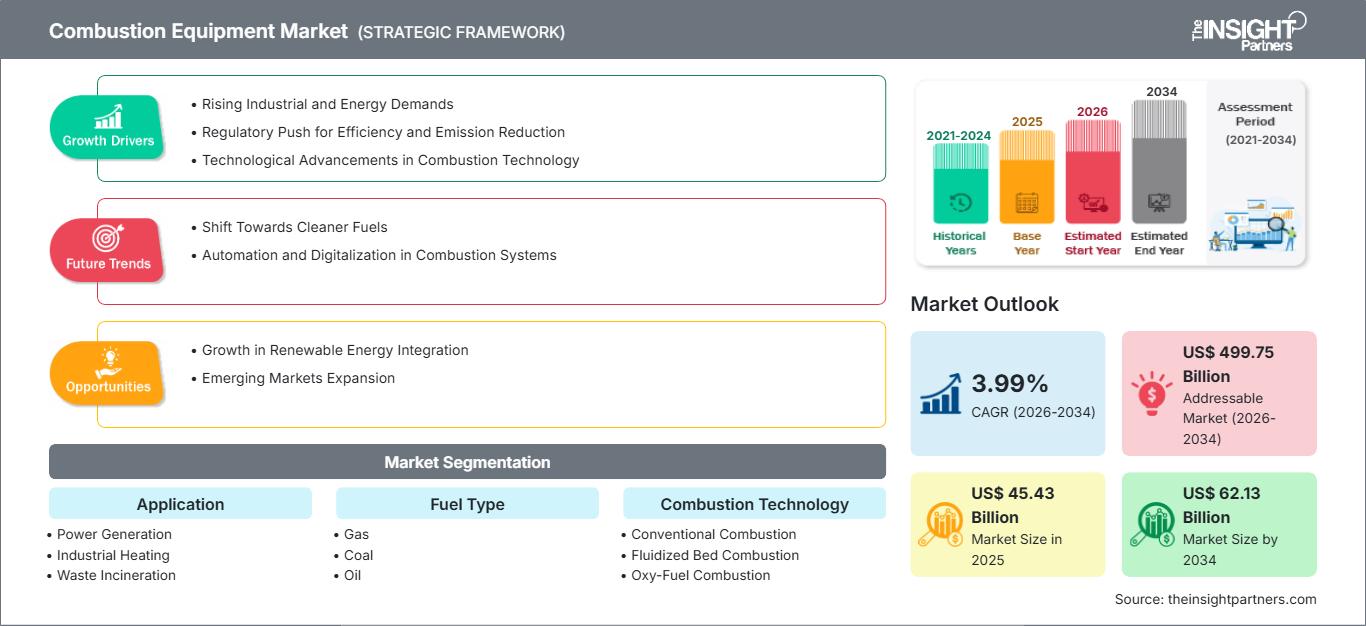
The Combustion Equipment market was valued at US$ 45.43 billion in 2025 and is expected to reach US$ 62.13 billion by 2034; it is estimated to record a CAGR of 3.54% during 2026-2034.
Combustion Equipment Market Assessment and Insights
- North America accounted for 27–30% share in 2025 and is expected to grow at a CAGR of 3.4–3.8% between 2026–2034, supported by boiler retrofits, emissions compliance, and gas-fired industrial heat upgrades.
- US represented 78–82% of North America in 2025 and is projected to grow at a CAGR of 3.5–3.9% between 2026–2034, led by manufacturing, refining, and utility modernization.
- Europe held 23–26% share in 2025 and is expected to grow at a CAGR of 3.0–3.4% between 2026–2034, with Germany, the UK, France, Italy, and Spain leading low-emission burner adoption.
- Asia Pacific captured 34–38% share in 2025 and is projected to expand at a CAGR of 4.5–4.9% between 2026–2034, driven by China, India, Japan, South Korea, and Australia industrial heat demand.
- Largest Segment Power Generation held 36–40% combustion equipment market share in 2025 and is expected to grow at a CAGR of 3.6–4.0% between 2026–2034 as thermal fleets require efficiency and reliability upgrades.
- High Growth Segment Waste Incineration accounted for 10–13% market share in 2025 and is projected to grow at a CAGR of 4.8–5.2% between 2026–2034 due to waste-to-energy and landfill diversion policies.
- Key companies analyzed in detail: General Electric Company, Alfa Laval AB, Doosan Enerbility Co., Ltd., Spirax Group plc, Combustion Technologies, Inc., Viessmann Climate Solutions SE, John Zink Hamworthy Combustion, Siemens AG, Cleaver-Brooks, Inc., Coen Company, Inc.
Source: The Insight Partners' analysis based on proprietary research, government publications, company annual reports, investor presentations, industry databases, and expert interviews.
Equipment developments will progress from self-contained firing devices to entire combustion trains that feature burners, boilers, combustion controls, oxygen control, flue gas recycle, heat recoveries, and remote control capabilities. Moreover, the production context will transform through localization of equipment manufacturing, finding different sources of parts, and redesigning systems so as to reduce nitrogen oxides emissions. The most promising areas will be found in the brownfield operations, since the potential dangers of shut downs make replacement modules, digital diagnostics, and fuel flexibility more attractive than higher capacity.
Capital expenditures will be mainly made in the Asia Pacific, the Gulf region, and some North American industrial regions featuring investments in power generation, chemical, metals and waste treatment facilities. Favorable regulations will support the sale of low emission burners, boiler systems that can use biomass fuels, oxy-fuel pilots, and combustion controls that can demonstrate emissions performance. Public investments in infrastructure and energy security will provide procurement certainty, particularly where there are no alternatives in electricity supply.
Combustion Equipment Market Report Scope
| Report Attribute | Details |
|---|---|
| Market size in 2025 | US$ 45.43 Billion |
| Market Size by 2034 | US$ 62.13 Billion |
| Global CAGR (2026 - 2034) | 3.54% |
| Historical Data | 2021-2024 |
| Forecast period | 2026-2034 |
Combustion Equipment Market Analysis
Demand is based on industrial heat intensity, reliable energy requirements, and emission-based cycle of equipment replacement. Growth of the combustion equipment market is directly connected with installations which have a need for constant steam production, heating, or thermal processing and cannot change their processes into electrification right away. The supply chain consists of fuel providers, OEMs of burners and boilers, providers of automation equipment, refractory producers, EPC contractors, and service providers which perform installation, adjustment, and lifecycle services of equipment.
There is low supply due to the fact that the engineered products must be certified and there must be knowledge and application-specific commissioning for materials. Pressure parts, valves, sensors, and control panels, which are long-lead items, could affect delivery time; however, regional production will reduce this possibility. Buyers would look at the total costs for fuel, availability, risk of permitting, and the responsiveness of the service organizations.
The competition structure is divided between the diverse group of power technology organizations and the specialized companies dealing in burners, boilers, and heat transfer technologies. Based on the combustion equipment market analysis, there is competition from General Electric Company, Siemens AG, Doosan Enerbility Co., Ltd., and Alfa Laval AB through access to large projects.
Increasingly, strategic positioning revolves around low-NOx solutions, digital optimization, flexibility in fuel types, and after-market services. The Spirax Group plc and the Viessmann Climate Solutions SE take advantage of expertise in thermal systems, while the larger Original Equipment Manufacturers (OEM) form alliances to tie combustion capabilities to monitoring systems. Investments are being made in control systems, sensors, hydrogen readiness test systems, and modules.
● REPORT CUSTOMIZATION
Tailor This Report To Align With Your Specific Business Requirements
This report can be customized to align precisely with your business objectives, scope, and target markets. Customization options include tailored segmentation, geography, competitive analysis, and strategic insights to support informed decision-making.
Customize This Report →WHAT YOU CAN ADJUST
- ● Segmentations
- ● Geography
- ● Competitive Analysis
- ● Language Preferences
Combustion Equipment Market: Strategic Insights
Regional Insights
North America combustion equipment Market
North America accounted for 27–30% share in 2025 and is expected to advance at a 3.4–3.8% CAGR through 2034. Mature industrial infrastructure creates steady replacement demand, while stricter permitting for boilers, process heaters, and waste incinerators supports higher-value low-emission systems. The combustion equipment market share is also influenced by natural gas availability and established service networks.
Industries, power, institutional steam, and refinery applications continue to be the major demand drivers. Efficiency initiatives at the federal and state level provide incentives for energy savings through fuel reduction and monitoring improvements. The equipment manufacturers get a boost from repeat business through periodic maintenance and emissions tests of their equipment over decades of operation.
U.S. Combustion Equipment Market
In 2025, the U.S. was 78-82% of the North American market, expected to expand at a CAGR of 3.5-3.9% from 2026 to 2034. The end-users include power generation, food and beverages, chemical industries, hospitals, universities, and refining. Installed base of equipment provides retro-fit opportunity for burners, controls, economizers, and combustion safety.
General Electric Company, Siemens AG, Cleaver-Brooks, Inc., Coen Company, Inc., and John Zink Hamworthy Combustion have high relevancy in the U.S. market due to its product portfolio in the power sector, boilers, and process burners. Market trends indicate preference for gas-fired packages, emissions upgrade, and air-fuel control automation due to reliable operations and volatile fuels.
Europe Combustion Equipment Market
Europe accounted for 23-26% share in 2025 and is forecast to witness growth at CAGR of 3.0-3.4% from 2026-2034. Leading countries include Germany, due to its strong presence in chemicals, metals, food processing, and district heating applications. The UK market focuses on boilers, energy efficiency of industry and institutions, and air quality policies.
German engineering continues to be the cornerstone of the region, characterized by high demand for accurate burners, hydrogen testing capabilities, and heat recovery technologies. Countries like France, Italy, and Spain demonstrate even distribution of adoption in manufacturing, waste-to-energy, and heating equipment for residential sector. European customers value their emissions performance, lifetime support, and fuel flexibility including biomass and biogas options.
APAC Combustion Equipment Market
The Asia-Pacific region recorded 34–38% market share in 2025 and is estimated to register a CAGR of 4.5–4.9% in the period between 2026 and 2034. China dominates the market with investments in power generation, chemicals, steel, and waste treatment, whereas India is growing its industrial boiler and process heating capacity.
Efficiency improvement and combustion of hydrogen are the priorities of Japan and South Korea. Increased demand is provided by the mining industry, food processing industry, and distributed generation in Australia. There are different policies in each country; yet, they could be related to particulate matter emissions reduction, fuel flexibility, and safe industrial heating. Local producers increase the share of their products among conventional boilers while foreign producers prevail among advanced boilers.
Middle East & Africa Combustion Equipment Market
Middle East & Africa is projected to have a CAGR of 3.7% to 4.1% in 2026–2034. Among the countries, Saudi Arabia leads because of cogeneration, petrochemical applications, refining and industrial cities applications. UAE has contributions from district cooling support, waste treatment and institutional energy improvement programs.
South Africa continues to be an important country for industrial boilers, mining heating applications, and utility reliability programs, while the remaining MEA will be selective in procurement due to its relationship with power generation and municipal waste. Availability of fuel, tough environmental conditions and local service capability drive the equipment choice in MEA.
Segmentation Analysis
Application
Application is expected to grow at a CAGR of 3.8–4.2% during 2026–2034. The combustion equipment market scope across applications is shaped by heat intensity, operating hours, fuel economics, and emissions rules. Power generation remains the largest use case, while industrial heating and waste incineration drive modernization because equipment performance directly affects uptime, energy cost, and permit compliance.
- Power Generation holds the leading position because thermal plants, cogeneration units, and backup systems require dependable boilers, burners, and controls for baseload, peaking, and grid-support operations.
- Industrial Heating shows steady demand from chemicals, metals, cement, food processing, and pulp applications where precise flame control, heat uniformity, and fuel efficiency influence production economics.
- Waste Incineration is strategically important as municipalities and industrial users adopt thermal treatment for waste volume reduction, energy recovery, and stricter landfill diversion targets.
- Residential Heating remains mature but relevant, with demand shaped by replacement cycles, condensing technology adoption, fuel switching, and regional climate requirements.
Fuel Type
Fuel Type is projected to grow at a CAGR of 3.6–4.0% during 2026–2034. Gas remains the preferred fuel where pipeline access is reliable, while coal and oil persist in legacy plants and energy-security contexts. Biomass gains attention in district energy, food processing, and policy-supported industrial heating, but feedstock logistics and ash management remain practical adoption constraints.
- Gas dominates new installations in many regions because it supports lower local pollutants, fast response, and compatibility with advanced low-NOx burner and control packages.
- Coal remains concentrated in heavy industry and power assets where fuel availability, existing boilers, and energy-security considerations delay replacement despite tightening emissions controls.
- Oil serves backup, remote, marine, and selected industrial applications where storage flexibility and high energy density offset higher emissions and price volatility.
- Biomass is gaining strategic relevance in heat applications with accessible residues, sustainability mandates, and interest in reducing fossil-fuel exposure without abandoning combustion infrastructure.
Combustion Technology
Combustion Technology is expected to grow at a CAGR of 4.0–4.4% during 2026–2034. Conventional systems retain the largest installed base because operators understand maintenance, controls, and safety procedures. Fluidized bed systems gain from fuel flexibility and waste fuels, while oxy-fuel combustion remains more selective, tied to carbon capture, high-temperature processes, and demonstration-scale decarbonization projects.
- Conventional Combustion remains central to boilers, furnaces, and burners because it offers proven reliability, broad service availability, and relatively predictable retrofit pathways across industries.
- Fluidized Bed Combustion is favored for low-grade fuels, biomass, waste-derived fuels, and emissions control because bed mixing improves heat transfer and combustion completeness.
- Oxy-Fuel Combustion is strategically relevant for carbon capture and specialized high-temperature processes, but adoption depends on oxygen supply cost and integration complexity.
Opportunity Snapshot
| Application | Revenue Contribution | Trend Tag | Adoption Stage |
| Power Generation | High | Grid Support | Mature |
| Industrial Heating | High | Heat Efficiency | Scaling |
| Waste Incineration | Medium | Waste Energy | Scaling |
| Residential Heating | Medium | Boiler Replacement | Mature |
Combustion Equipment Market Growth Drivers and Impact Analysis
Industrial Heat Reliability and Fleet Modernization
Industrial sites continue to depend on combustion systems for steam, drying, melting, curing, and process heat that must operate continuously. Many installed boilers and burners are beyond mid-life, making reliability upgrades a practical capital priority. Modern systems reduce unplanned outages, improve heat transfer, and integrate sensors that support predictive maintenance. The real market impact is visible in brownfield procurement, where customers often prefer phased replacement over full plant redesign. This keeps spending resilient even when new plant construction slows, because lost production from thermal equipment failure can exceed equipment cost.
Emission Compliance and Low-NOx Retrofit Demand
Air-quality rules for nitrogen oxides, sulfur oxides, particulate matter, and carbon intensity are pushing operators to replace or tune combustion assets. Low-NOx burners, flue gas recirculation, oxygen trim, and digital combustion controls allow facilities to comply without abandoning existing thermal processes. This driver is strongest in North America and Europe, but Asian urban-industrial regions are also tightening standards. The impact is a shift from commodity equipment to engineered packages with testing, documentation, and service contracts, increasing revenue per installation and favoring vendors with emissions expertise.
Fuel Flexibility Across Gas, Biomass, and Waste Fuels
Fuel price volatility and energy-security concerns are increasing demand for systems that can handle gas, oil backup, biomass blends, and selected waste-derived fuels. Flexible combustion architecture helps operators manage supply risk while meeting local regulations and sustainability objectives. Biomass-ready boilers and fluidized bed systems are gaining attention where residues are available, while gas systems remain preferred for controllability. The impact is higher engineering content in procurement specifications, including burner turndown, fuel changeover controls, corrosion management, and ash handling requirements for complex fuel streams.
Combustion Equipment Market Future Trends
Digital Combustion Optimization Platforms
Future combustion equipment market trends will be shaped by connected controls that continuously adjust air-fuel ratios, draft, oxygen levels, and flame stability. Instead of periodic manual tuning, plants will use analytics to identify fouling, sensor drift, burner imbalance, and efficiency loss earlier. This will support outcome-based service models where suppliers monitor fleets remotely and recommend maintenance before performance deteriorates. Adoption will be fastest in facilities with high fuel spend, strict permits, and multiple boilers or process heaters that justify centralized monitoring investments.
Hydrogen-Ready and Oxy-Fuel System Development
Hydrogen-ready burners and oxy-fuel systems will move from pilot activity toward selective commercial adoption where policy incentives, fuel supply, and carbon capture infrastructure align. These systems require redesigned flame management, materials selection, safety controls, and operator training because hydrogen combustion changes flame speed and heat transfer behavior. Near-term uptake will focus on refineries, chemicals, steel reheating, and power demonstrations rather than broad residential heating. Suppliers that validate performance across blended fuels will gain early specification influence.
Combustion Equipment Market Opportunities
Retrofit Packages for Industrial Boiler Rooms
Retrofit packages offer a high-probability opportunity because many customers need measurable efficiency gains without replacing entire plants. Suppliers can bundle burners, controls, economizers, safety systems, and emissions testing into standardized upgrade programs. The combustion equipment market forecasts indicate that service-led modernization can generate recurring revenue through inspection, tuning, spare parts, and remote diagnostics. The best targets are hospitals, universities, food plants, chemical facilities, and district heating systems where downtime windows are limited and payback depends on fuel savings, compliance assurance, and avoided production interruption.
Waste-to-Energy and Biomass Heat Projects
Municipal waste pressure and industrial decarbonization strategies create opportunities for incineration, biomass boilers, and fluidized bed systems. Equipment vendors can differentiate through fuel characterization, ash handling, corrosion-resistant materials, and emissions control integration. Projects are most attractive where landfill capacity is constrained, biomass residues are locally available, or district heating networks can absorb recovered heat. Investors should prioritize jurisdictions with stable feedstock contracts and permitting clarity because project economics depend as much on waste logistics and heat offtake as on combustion performance.
Recent Developments
- July 2026: Doosan Enerbility Co., Ltd. — signed an MOU with Createch to expand its B-EYES generator monitoring system business after deployment for the Temelin Nuclear Power Plant generator replacement project, strengthening digital reliability services for power assets.
- July 2026: Chinese engine manufacturer Weichai Power has announced a major advancement in engine production. The company's newly developed WP15 hydrogen engine successfully completed full vehicle emissions certification at the CATARC Automotive Test Center in Tianjin.
Frequently Asked Questions

- Comprehensive Market Sizing and Forecast Analysis
- Detailed Segmentation Analysis
- In-Depth Market Dynamics Assessment
- Regional and Country-Level Insights
- Competitive Landscape and Company Benchmarking
- Strategic Business Intelligence
Recent Reports
Testimonials

The Insight Partners provided valuable market intelligence that supported our global go-to-market strategy. Their team was professional, responsive, and attentive to our feedback, providing thoughtful analysis and helpful methodological clarifications throughout the project.
Junmo Kim Chief Financial Officer (CFO), Enertech Co., Ltd.
The Insight Partners' SCADA System Market report is comprehensive, with valuable insights on current trends and future forecasts. The team was highly professional, responsive, and supportive throughout. We are very satisfied and highly recommend their services.
RAN KEDEM Partner, Reali Technologies LTDs
I requested a report on a very specific software market and the team produced the report in a few days. The information was very relevant and well presented. I then requested some changes and additions to the report. The team was again very responsive and I got the final report in less than a week.
JEAN-HERVE JENN Chairman, Future Analytica
We worked with The Insight Partners for an important market study and forecast. They gave us clear insights into opportunities and risks, which helped shape our plans. Their research was easy to use and based on solid data. It helped us make smart, confident decisions. We highly recommend them.
PIYUSH NAGPAL Sr. Vice President, High Beam Global
The Insight Partners delivered insightful, well-structured market research with strong domain expertise. Their team was professional and responsive throughout. The user-friendly website made accessing industry reports seamless. We highly recommend them for reliable, high-quality research services
YUKIHIKO ADACHI CEO, Deep Blue, LLC.
This is the first time I have purchased a market report from The Insight Partners.While I was unsure at first, I visited their web site and felt more comfortable to take the risk and purchase a market report.I am completely satisfied with the quality of the report and customer service. I had several questions and comments with the initial report, but after a couple of dialogs over email with their analyst I believe I have a report that I can use as input to our strategic planning process.Thank you so much for taking the extra time and making this a positive experience.I will definitely recommend your service to others and you will be my first call when we need further market data.
JOHN SUZUKI President and Chief Executive Officer, Board Director, BK Technologies
I wish to appreciate your support and the professionalism you displayed in the course of attending to my request for information regarding to infectious disease IVD market in Nigeria. I appreciate your patience, your guidance, and the fact that you were willing to offer a discount, which eventually made it possible for us to close a deal. I look forward to engaging The Insight Partners in the future, all thanks to the impression you have created in me as a result of this first encounter.
DR CHIJIOKE ONYIA MANAGING DIRECTOR, PineCrest Healthcare Ltd.Reason to Buy
- Informed Decision-Making
- Understanding Market Dynamics
- Competitive Analysis
- Identifying Emerging Markets
- Customer Insights
- Market Forecasts
- Risk Mitigation
- Boosting Operational Efficiency
- Strategic Planning
- Investment Justification
- Tracking Industry Innovations
- Aligning with Regulatory Trends





 Get Free Sample for