
Commercial Kitchen Equipment Market Growth, Size & Forecast by 2034
Coverage: by Type (Braising Pans/Tilting Skillets, Broilers, Cook-chill Systems, Fryers, Ovens, Cookers, Kettles, Steamers, Others); End-user (Full Service Restaurant and Hotels, Quick Service Restaurants, Catering Service) , and Geography (North America, Europe, Asia Pacific, and South and Central America)
- Status : Data Released
- Report Code : TIPRE00007031
- Category : Manufacturing and Construction
- No. of Pages : 150
- Available Report Formats :


- Last update date : September 08, 2026


2025 Market Size
US$ 10.77 Bn
Base year value
2034 Forecast
US$ 19.51 Bn
Projected by 2034
CAGR 2026-2034
6.82 %
Growth rate
Addressable Market
US$ 136.77 Bn
(2026-2034)
The global commercial kitchen equipment Market size was valued at US$ 10.77 Billion in 2025 and is projected to reach US$ 19.51 Billion by 2034, registering a CAGR of 6.82% from 2026 to 2034. This growth is underpinned by the expanding foodservice industry, technological advancements in cooking equipment, and the rising demand for energy-efficient solutions across commercial kitchens.
North America represents a significant revenue pocket for the global commercial kitchen equipment market, with the region exhibiting a CAGR range of 5–7% through the forecast period. Structural growth drivers in the region include the rapid expansion of quick-service restaurant (QSR) chains and cloud kitchen models, along with stringent regulatory mandates promoting energy-efficient and connected equipment solutions.
Commercial Kitchen Equipment Market Assessment and Insights
- North America accounted for approximately 26–30% Commercial Kitchen Equipment Market share in 2025 and is expected to grow at a CAGR of 5.0–6.0% from 2026 to 2034. The region benefits from a mature foodservice sector and significant replacement demand for energy-efficient equipment.
- U.S. captured around 22–26% of the global market in 2025 and is projected to register a CAGR of 5.5–6.5% during the forecast period. The U.S. foodservice industry's robust procurement activity drives equipment demand, supported by the adoption of IoT-enabled kitchen solutions.
- Europe accounted for approximately 20–24% share of the global market in 2025, with a projected CAGR of 5.5–6.5%. Leading countries include Germany, the UK, France, and Italy, where energy efficiency regulations and sustainability mandates are accelerating replacement cycles.
- Asia Pacific is the fastest-growing region, holding approximately 22–26% market share in 2025 and projected to grow at a CAGR of 7.0–8.0%. China, Japan, India, and South Korea are key contributors, driven by urbanization, rising disposable incomes, and QSR expansion .
- Largest Segment—Ovens hold the largest market share in 2025 (28–32%), supported by the widespread adoption of combi ovens and high-speed cooking platforms across FSR and QSR formats, with a projected CAGR of 6.0–7.0% through 2034.
- High Growth Segment—Fryers represent the high-growth segment (6–8% share in 2025), projected to achieve the highest CAGR range of 7.5–8.5% through 2034, driven by the proliferation of QSR and fast-casual dining concepts globally.
- Key companies analyzed in detail: Electrolux Professional Group, Ali Group S.r.l., Alto-Shaam, Inc., Duke Manufacturing, Fujimak Corporation, Illinois Tool Works Inc. (ITW), RATIONAL AG, The Middleby Corporation, Hoshizaki Corporation, MEIKO Maschinenbau GmbH & Co. KG
Source: The Insight Partners' analysis based on proprietary research, government publications, company annual reports, investor presentations, industry databases, and expert interviews.
The Commercial Kitchen Equipment Market space is witnessing a notable change owing to technology convergence. Technology features such as IoT sensor integration, AI-powered performance monitoring, and cloud connectivity in the product offering will help track real-time performance, maintainability, and energy savings. The trend of adopting compact and modular kitchens especially in urban food service areas is expected to change the dynamics of production. The need to compensate labor shortages by the equipment manufacturers has been the reason behind developing cooking solutions which require less kitchen personnel to operate and provide consistent quality outputs.
As we move forward into the future, growth prospects for the Commercial Kitchen Equipment Market can be witnessed in the emerging economies in Southeast Asia, Latin America, and the Middle East regions. Investments in tourism, hospitality, and institutional catering segments are the major drivers for equipment purchase cycles. Moreover, the trend of becoming carbon neutral and moving towards electrification is resulting in the rise of adoption of induction cooking equipment and energy-efficient warewashing equipment. Government regulations pertaining to food safety and energy consumption are the main reasons for upgrading kitchen equipment infrastructure.
Commercial Kitchen Equipment Market Report Scope
| Report Attribute | Details |
|---|---|
| Market size in 2025 | US$ 10.77 Billion |
| Market Size by 2034 | US$ 19.51 Billion |
| Global CAGR (2026 - 2034) | 6.82% |
| Historical Data | 2021-2024 |
| Forecast period | 2026-2034 |
Commercial Kitchen Equipment Market Analysis
Market growth in the commercial kitchen equipment industry is driven by strong demand factors in several end user categories. The rapid growth of the global foodservice industry and development of QSR chains and cloud kitchens have generated a continuous demand for standardized high-throughput cooking equipment. In value chain dynamics, it becomes evident that the commercial kitchen equipment industry is characterized by a highly competitive environment in which OEMs increasingly collaborate with tech companies to equip their products with smart features. As for the supply dynamics, they are influenced by the prices of the materials used for production, namely stainless steel and electronics. Also, manufacturers are responding to changes in consumer demands regarding healthy cooking solutions, leading to the growing demand for air fryers, steamers, and griddles that require less oil.
In the competitive commercial kitchen equipment market analysis, the presence of large global companies such as Electrolux Professional Group, Illinois Tool Works Inc. (ITW), RATIONAL AG, The Middleby Corporation, as well as regional specialists Fujimak Corporation and MEIKO Maschinenbau GmbH & Co. KG is observed. Investment trends indicate the clear tendency towards investment in R&D aimed at the development of energy efficient solutions and equipment integration with digital platforms. In this context, companies invest substantial funds to develop IoT-enabled equipment with the features of remote diagnostics and usage statistics. Strategic positioning is largely determined by the availability of aftermarket services in which major players expand their service networks and develop various maintenance solutions that enable building long-lasting relationships with customers. M&A continues to be a popular strategy helping companies diversify their portfolios and expand geographically.
● REPORT CUSTOMIZATION
Tailor This Report To Align With Your Specific Business Requirements
This report can be customized to align precisely with your business objectives, scope, and target markets. Customization options include tailored segmentation, geography, competitive analysis, and strategic insights to support informed decision-making.
Customize This Report →WHAT YOU CAN ADJUST
- ● Segmentations
- ● Geography
- ● Competitive Analysis
- ● Language Preferences
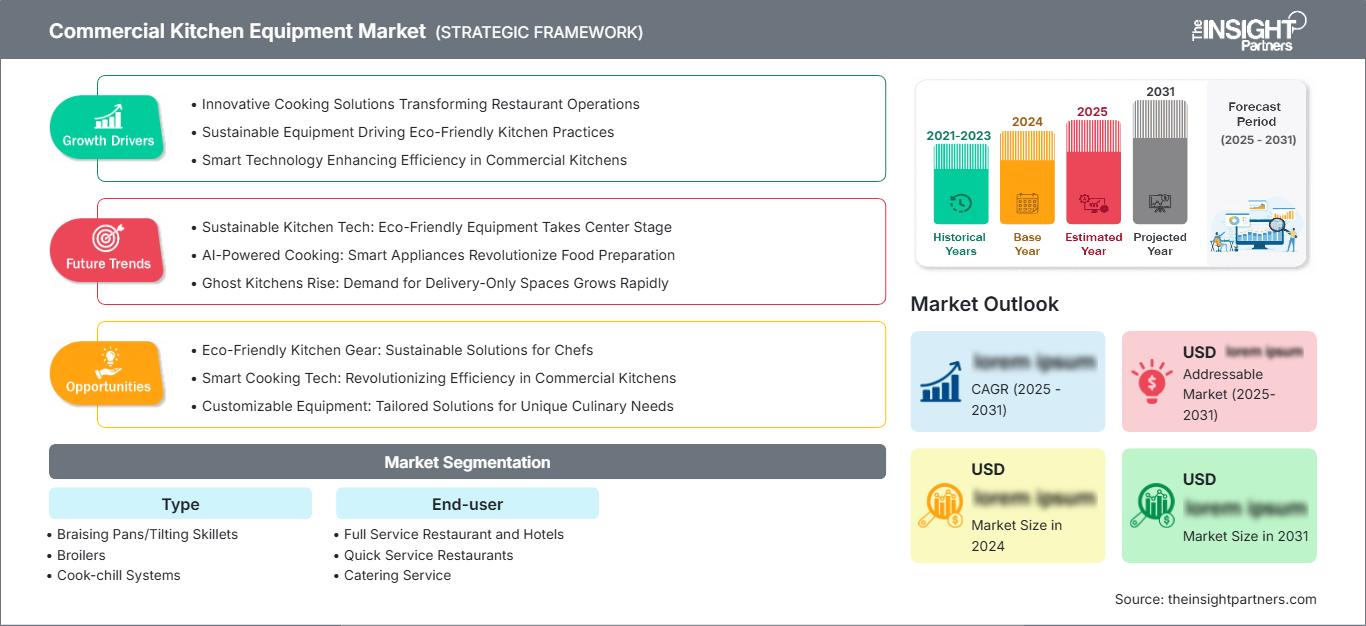
Commercial Kitchen Equipment Market: Strategic Insights
Regional Insights
North America Commercial Kitchen Equipment Market
The North American Commercial Kitchen Equipment Market demonstrated robust growth in 2025, accounting for 26–30% of the global market share, with a projected CAGR of 5.0–6.0% through 2034. The U.S. dominated the regional landscape, driven by the substantial scale of its foodservice industry, which surpassed US$ 1.1 trillion in sales in 2024. Growth within this area is supported through the fast-growing chain QSRs, the development of cloud kitchens, and substantial replacement needs due to the age of the equipment infrastructure. Regulatory policies, such as the U.S. AIM Act and ENERGY STAR certifications, are pushing the industry towards the usage of sustainable and energy-saving equipment. The Canadian market, though smaller in size, shows analogous trends, with operators focusing on equipment that is efficient and compliant with rigorous food safety standards.
U.S. Commercial Kitchen Equipment Market
The U.S. Commercial Kitchen Equipment Market, representing 22–26% of the global market in 2025, is projected to grow at a CAGR of 5.5–6.5% during the forecast period. Given that the United States accounts for the majority of the revenue generated in North America, it has a high level of penetration of sophisticated cooking equipment such as the combination ovens, induction ranges, and automated fryers. The presence of key fast food brands such as McDonald's, Yum! Brands, and Restaurant Brands International is responsible for steady growth in the need for standardized equipment among the many branches that the companies own. The regulations on energy efficiency and refrigerants are driving the need for upgrading of old equipment to ENERGY STAR-compliant equipment.
Europe Commercial Kitchen Equipment Market
The European Commercial Kitchen Equipment Market accounted for 20–24% of the global share in 2025 and is projected to register a CAGR of 5.5–6.5%. Germany is dominant in the region owing to its strong industry for the manufacturing of food service equipment and high usage of energy-saving technology. The UK market constitutes 32% of the total European market and is fueled by fast growth of the QSR and delivery platforms. Markets represented by France, Italy, and Spain have their significance as demand for quality cooking and refrigeration equipment is generated through the activities in hospitality and tourism industry. With the EU Energy Efficiency Directive and national sustainability initiatives being in effect, operators are now forced to install energy-saving equipment with minimum carbon footprint.
APAC Commercial Kitchen Equipment Market
The Asia Pacific Commercial Kitchen Equipment Market, holding 22–26% of the global share in 2025, is the fastest-growing regional market with a projected CAGR of 7.0–8.0%. The Chinese market for equipment is the largest in the world by volume and generates substantial equipment demand in the country's urban food service industry [citation:13]. The Indian food service industry, which makes up around 1.8% of the country's GDP and is forecasted to grow at an ~8% CAGR, presents itself as a promising area of equipment market growth. In Japan, South Korea, and Australia, there is strong demand for top quality, efficient, and small sized equipment, due to the need to update hospitality and meet safety standards.
Middle East & Africa Commercial Kitchen Equipment Market
The Middle East & Africa Commercial Kitchen Equipment Market is projected to register a CAGR of 6.5–7.5% through 2034, driven by large-scale infrastructure developments and hospitality investments. In Saudi Arabia, the procurement cycle for kitchen equipment is being developed in multi-year plans, with projects like the Diriyah project. In the UAE, especially in Dubai and Abu Dhabi, this market continues to be very important, because of the strategic location of the region as a global tourism destination and mega-event destination. South Africa is the country with a steady growth rate in this market, due to the investment in infrastructure and hospitality industry. The whole MEA region provides opportunities for the provision of energy-efficient equipment which can operate under difficult climatic conditions.
Segmentation Analysis
Type
The global commercial kitchen equipment market scope by type is segmented into braising pans/tilting skillets, broilers, cook-chill systems, fryers, ovens, cookers, kettles, and steamers. This segment is projected to exhibit a CAGR range of 6.0–7.0% from 2026 to 2034. The diverse equipment types cater to varying operational requirements across foodservice establishments, from high-volume frying to precise slow-cooking applications. The growing trend toward menu diversification and operational specialization is driving demand for specific cooking equipment types that enable consistency, speed, and quality in food preparation.
- Braising Pans/Tilting Skillets: These versatile units are widely used in institutional catering and high-volume kitchens for batch cooking, braising, and pan-frying applications. Their ability to handle large quantities and facilitate easy food release drives steady demand, particularly in healthcare and education foodservice segments.
- Broilers: Broilers are essential for high-temperature grilling and charbroiling applications in steakhouses and casual dining restaurants. The equipment's ability to deliver consistent heat and create distinct flavor profiles sustains demand, particularly in markets with strong meat and poultry consumption patterns.
- Cook-chill Systems: These systems are increasingly adopted in institutional catering and centralized kitchens for large-scale food production. The technology enables efficient cooking and rapid chilling, ensuring food safety and extended shelf life, aligning with the growing preference for prepared meals in healthcare and corporate settings.
- Fryers: Fryers represent a high-growth equipment type, driven by the rapid expansion of QSR chains offering fried food options. The development of energy-efficient and oil-filtration technologies is enhancing operational efficiency and reducing total cost of ownership for operators.
- Ovens: Ovens, including combi ovens and convection ovens, form the largest equipment category, offering multifunctional capabilities for baking, roasting, steaming, and proofing. The adoption of smart ovens with recipe management software is accelerating across FSR and QSR formats.
- Cookers: Cookers, including range tops and griddles, are fundamental equipment in commercial kitchens for basic cooking operations. The shift toward induction-based cookers is gaining momentum due to their energy efficiency, precise temperature control, and enhanced kitchen safety features.
- Kettles: Steam-jacketed kettles are essential for preparing soups, sauces, and large-batch items in institutional and high-volume kitchens. Their durability and capacity to handle diverse recipes make them a staple in healthcare, education, and contract catering segments.
- Steamers: Steamers are valued for their ability to cook food quickly while preserving nutritional content and moisture. The demand for pressure steamers and convection steamers is rising in healthcare and fine-dining segments, where food quality and consistency are paramount.
End-user
The End-user segment comprises Full Service Restaurants and Hotels, Quick Service Restaurants, and Catering Service, with a projected CAGR range of 6.0–7.0% from 2026 to 2034. This segmentation reflects the diverse operational scales and equipment requirements across various foodservice formats.
- Full Service Restaurant and Hotels: This segment represents a premium end-user category, characterized by high adoption of technologically advanced and aesthetically integrated kitchen equipment. Luxury hotels and upscale dining establishments prioritize equipment that combines performance with design integration, driving demand for premium cooking and refrigeration solutions.
- Quick Service Restaurants: QSRs represent the largest and fastest-growing end-user segment, driven by the global expansion of fast-food chains and delivery-first formats. Equipment requirements emphasize speed, consistency, and reliability, with operators favoring modular and easy-to-maintain equipment. The segment's high volume and rapid replacement cycles create a stable demand base for cooking, refrigeration, and warewashing equipment.
- Catering Service: The catering segment, including contract catering and event-based foodservice, demands durable and high-capacity equipment capable of batch cooking and extended operation. Institutional catering for healthcare, education, and corporate settings requires specialized equipment that complies with food safety standards and offers cost-effective long-term operations.
Opportunity Snapshot
| End-user Segment | Revenue Contribution | Trend Tag | Adoption Stage |
|---|---|---|---|
| Full Service Restaurant and Hotels | High | Experience-Driven | Mature |
| Quick Service Restaurants | High | Speed Optimization | Scaling |
| Catering Service | Medium | Batch Efficiency | Emerging |
Commercial Kitchen Equipment Market Growth Drivers and Impact Analysis
Rapid Expansion of Quick Service and Cloud Kitchen Models
Rapid growth in QSR chain restaurants and cloud kitchen concepts will be instrumental in changing the dynamics of equipment demand. The global QSR chains are rapidly increasing their presence in emerging markets with every restaurant opening equipped with standard equipment kits. Cloud kitchens are designed to cater to deliveries alone and need equipment that is highly efficient and compact with an objective of increasing the speed of food preparation in constrained environments. Equipment manufacturers are catering to such demand by manufacturing highly efficient equipment that includes high-speed ovens, automated fryers, and induction cooktops.
Stringent Energy Efficiency and Sustainability Regulations
Regulatory frameworks aimed at reducing energy consumption and greenhouse gas emissions are compelling commercial kitchen operators to prioritize energy-efficient equipment. In North America, the U.S. AIM Act is limiting high-GWP refrigerants and mandating stricter leak detection protocols, driving replacement activity in refrigeration systems. European operators are adapting to updated F-gas rules and national energy efficiency directives that push toward natural refrigerants and low-energy cooking platforms. These regulatory tailwinds are accelerating the adoption of ENERGY STAR-rated equipment, induction-based cooking systems, and heat recovery solutions that reduce operational costs while ensuring compliance.
Advancements in Smart and Automated Kitchen Technologies
The integration of IoT sensors, AI-driven analytics, and cloud connectivity into commercial kitchen equipment is transforming operational efficiency and food quality management. Smart ovens with recipe management software enable consistent cooking results across multiple locations, while connected refrigeration systems provide real-time temperature monitoring and compliance logging. The growing labor shortage in developed economies is driving demand for semi-automated and fully automated equipment that reduces dependency on skilled kitchen staff. Equipment manufacturers are investing in R&D to develop platforms that offer remote diagnostics, predictive maintenance alerts, and energy optimization features, creating value-added propositions for operators.
Commercial Kitchen Equipment Market Future Trends
Electrification and Induction-Based Cooking Systems
The global commercial kitchen equipment market trends are shifting toward decarbonization is accelerating the transition from gas-powered to electric cooking equipment in commercial kitchens. Induction cooktops, which offer superior energy efficiency, precise temperature control, and enhanced safety features, are gaining traction across QSR and fine-dining formats. This trend is reinforced by building codes in urban centers that favor all-electric back-of-house configurations and the increasing availability of high-capacity electrical infrastructure in new developments. Equipment manufacturers are expanding their induction and electric cooking portfolios to capture this growing demand.
Data-Driven Kitchen Management Platforms
The convergence of commercial kitchen equipment with data analytics is creating a new paradigm of operational intelligence. Operators are increasingly adopting equipment that provides real-time performance data, including cooking cycle history, energy consumption patterns, and maintenance alerts. These platforms enable chain operators to standardize food quality, optimize energy usage, and reduce unplanned downtime through predictive maintenance. The trend toward connected ecosystems is also facilitating centralized management of equipment fleets across multiple locations, aligning with the operational needs of expanding QSR and hospitality groups.
Commercial Kitchen Equipment Market Opportunities
Expansion in Emerging Hospitality and Tourism Hubs
The commercial kitchen equipment market forecasts government-led investments in tourism infrastructure across Southeast Asia, the Middle East, and Latin America are creating significant opportunities for commercial kitchen equipment suppliers. Mega-projects, including hotel developments, convention centers, and entertainment complexes, require comprehensive kitchen equipment packages for their F&B operations. Additionally, the expansion of international hotel chains in emerging markets is driving demand for premium cooking and refrigeration equipment that meets global brand standards. Equipment manufacturers can capitalize on this trend by establishing local service networks and offering customized solutions tailored to regional culinary practices.
Service-Led Business Models and Equipment-as-a-Service (EaaS)
The transition toward service-led business models presents a growth opportunity for commercial kitchen equipment manufacturers. Operators, particularly cloud kitchens and independent restaurants, are increasingly interested in equipment-as-a-service (EaaS) models that reduce upfront capital expenditure and offer predictable operational costs. These models typically include maintenance, repairs, and equipment upgrades as part of the service package, fostering long-term customer relationships. Manufacturers with robust aftermarket capabilities and digital monitoring platforms are well-positioned to capture this emerging revenue stream.
Recent Developments
- March 2026: Powers Equipment has announced the launch of KitchenKold, a new commercial refrigeration line shipping in June 2026. The lineup includes stainless steel reach-in refrigerators, reach-in freezers, and sandwich prep units designed specifically for dealers and distributors serving the foodservice industry. Focused on high-demand core refrigeration categories, KitchenKold products combine durable construction, modern design, and service-friendly engineering to support reliable performance in busy commercial kitchens. All units are UL and NSF/ANSI 7 certified and feature competitive pricing with strong margin potential for dealers
- February 2026: KitchenAid is introducing a new range of smart kitchen appliances at the 2026 Kitchen & Bath Industry Show (KBIS), held February 17–19 in Orlando, Florida. The launches form part of the brand’s largest product-line relaunch in more than a decade. The headline innovation is the KitchenAid Smart Double Wall Oven with Intelligent Cooking Camera, which was named a 2026 Best of KBIS Award finalist. Its camera can recognize supported foods—including chicken, cookies, bread, bacon and pizza—and automatically initiate cooking.
Frequently Asked Questions

- Comprehensive Market Sizing and Forecast Analysis
- Detailed Segmentation Analysis
- In-Depth Market Dynamics Assessment
- Regional and Country-Level Insights
- Competitive Landscape and Company Benchmarking
- Strategic Business Intelligence
Testimonials

The Insight Partners' SCADA System Market report is comprehensive, with valuable insights on current trends and future forecasts. The team was highly professional, responsive, and supportive throughout. We are very satisfied and highly recommend their services.
RAN KEDEM Partner, Reali Technologies LTDs
I requested a report on a very specific software market and the team produced the report in a few days. The information was very relevant and well presented. I then requested some changes and additions to the report. The team was again very responsive and I got the final report in less than a week.
JEAN-HERVE JENN Chairman, Future Analytica
We worked with The Insight Partners for an important market study and forecast. They gave us clear insights into opportunities and risks, which helped shape our plans. Their research was easy to use and based on solid data. It helped us make smart, confident decisions. We highly recommend them.
PIYUSH NAGPAL Sr. Vice President, High Beam Global
The Insight Partners delivered insightful, well-structured market research with strong domain expertise. Their team was professional and responsive throughout. The user-friendly website made accessing industry reports seamless. We highly recommend them for reliable, high-quality research services
YUKIHIKO ADACHI CEO, Deep Blue, LLC.
This is the first time I have purchased a market report from The Insight Partners.While I was unsure at first, I visited their web site and felt more comfortable to take the risk and purchase a market report.I am completely satisfied with the quality of the report and customer service. I had several questions and comments with the initial report, but after a couple of dialogs over email with their analyst I believe I have a report that I can use as input to our strategic planning process.Thank you so much for taking the extra time and making this a positive experience.I will definitely recommend your service to others and you will be my first call when we need further market data.
JOHN SUZUKI President and Chief Executive Officer, Board Director, BK Technologies
I wish to appreciate your support and the professionalism you displayed in the course of attending to my request for information regarding to infectious disease IVD market in Nigeria. I appreciate your patience, your guidance, and the fact that you were willing to offer a discount, which eventually made it possible for us to close a deal. I look forward to engaging The Insight Partners in the future, all thanks to the impression you have created in me as a result of this first encounter.
DR CHIJIOKE ONYIA MANAGING DIRECTOR, PineCrest Healthcare Ltd.Reason to Buy
- Informed Decision-Making
- Understanding Market Dynamics
- Competitive Analysis
- Identifying Emerging Markets
- Customer Insights
- Market Forecasts
- Risk Mitigation
- Boosting Operational Efficiency
- Strategic Planning
- Investment Justification
- Tracking Industry Innovations
- Aligning with Regulatory Trends





 Get Free Sample for