
Well Cementing Services Market Size, Growth & Demand by 2034
Coverage: by Type (Primary Cementing, Remedial Cementing, Others); Application (Onshore, Offshore) , and Geography (North America, Europe, Asia Pacific, and South and Central America)
- Status : Data Released
- Report Code : TIPRE00010058
- Category : Manufacturing and Construction
- No. of Pages : 150
- Available Report Formats :


- Last update date : September 28, 2026


2025 Market Size
US$ 9.76 Bn
Base year value
2034 Forecast
US$ 13.38 Bn
Projected by 2034
CAGR 2026-2034
3.57 %
Growth rate
Addressable Market
US$ 105.11 Bn
(2026-2034)
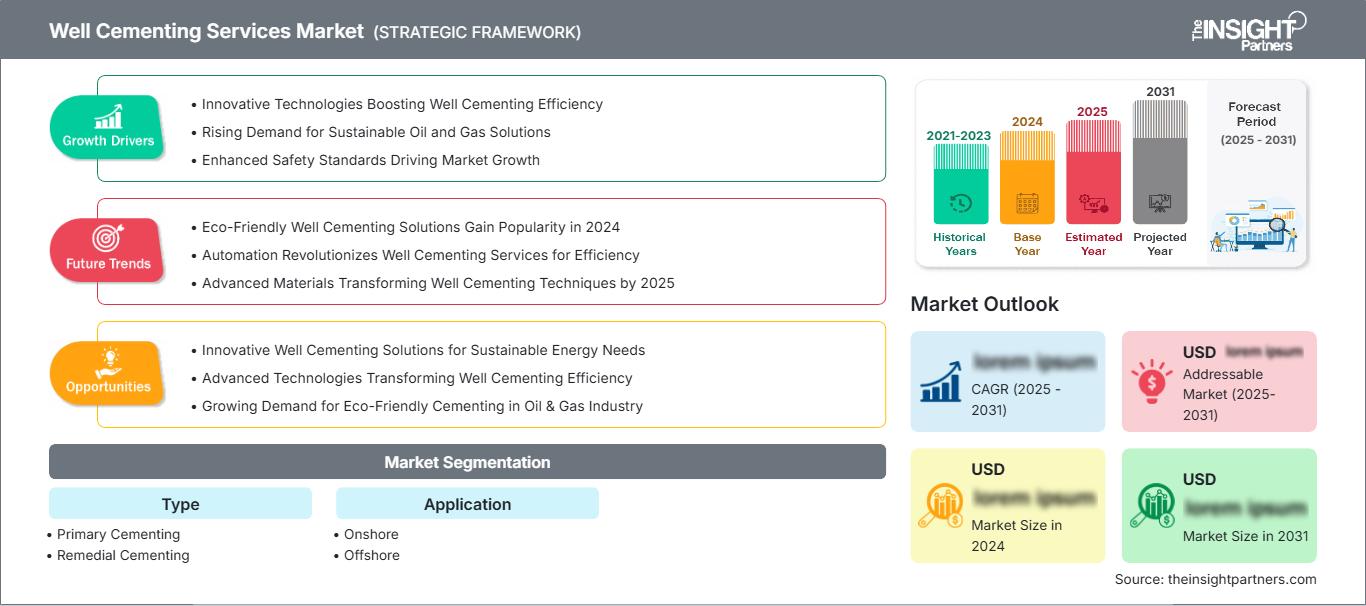
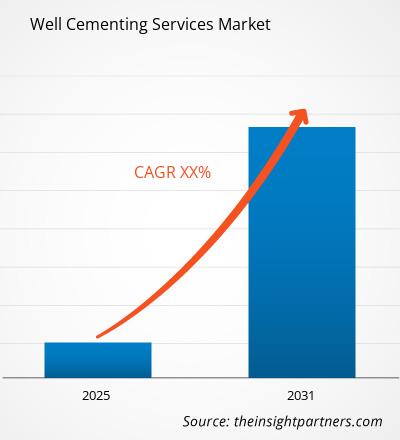
The well cementing services market was valued at US$ 9.76 Billion in 2025 and is projected to reach US$ 13.38 Billion by 2034, expanding at a CAGR of 3.57% during 2026–2034. The market covers specialized services used to design, place, evaluate, and maintain cement barriers in oil and gas wells. Primary and remedial operations remain central to well integrity, while increasingly complex drilling environments are encouraging greater use of engineered cement systems and digital job-design capabilities.
Across North America, the well cementing services market size is expected to expand at an estimated 3.8–4.5% CAGR through 2034. Structural support comes from sustained unconventional drilling, deeper well construction, mature-well intervention, and regulatory emphasis on well integrity. Offshore activity in the Gulf of Mexico also supports specialized cementing demand, particularly where high pressure, high temperature, narrow operating windows, and extended casing programs require customized slurry designs.
Well Cementing Services Market Assessment and Insights
- North America: North America represented approximately 34–38% share in 2025 and is expected to grow at a 3.8–4.5% CAGR between 2026–2034, supported by unconventional drilling, mature-field intervention, offshore development, and stringent integrity requirements.
- US: The US accounted for approximately 74–78% of North American demand in 2025 and is projected to expand at a 3.9–4.6% CAGR between 2026–2034, reflecting shale activity and complex well construction.
- Europe: Europe held approximately 18–22% share in 2025 and is projected to register a 3.1–3.8% CAGR between 2026–2034. Norway, the UK, and Italy remain important markets because of offshore activity, mature assets, and well abandonment requirements.
- Asia Pacific: Asia Pacific captured approximately 22–26% share in 2025 and is anticipated to grow at a 4.2–5.0% CAGR between 2026–2034, led by China, Australia, India, Indonesia, and Malaysia amid upstream investment and energy-security priorities.
- Largest Segment: Primary cementing represented approximately 72–76% market share in 2025 and is expected to expand at a 3.3–4.0% CAGR between 2026–2034, reflecting its essential role in new well construction.
- High Growth Segment: Offshore applications represented approximately 27–31% market share in 2025 and are projected to grow at a 4.3–5.1% CAGR between 2026–2034 as deepwater projects demand advanced barrier technologies.
- Key companies analyzed in detail: Baker Hughes, Calfrac Well Services Ltd., China Oilfield Services Limited, Daleel Petroleum LLC, Halliburton Energy Services, Inc., National Energy Services Reunited Corp., Sanjel Energy Services, Schlumberger Limited, Trican Well Service Ltd., and Weatherford International plc.
Source: The Insight Partners' analysis based on proprietary research, government publications, company annual reports, investor presentations, industry databases, and expert interviews.
Well construction has shifted toward longer horizontal sections, higher-pressure formations, extended-reach wells, and increasingly narrow drilling margins. These changes raise the importance of slurry rheology, displacement efficiency, compressive-strength development, gas-migration control, and cement evaluation. Service providers increasingly combine laboratory formulation, simulation software, automated mixing, specialized equipment, and post-job diagnostics to improve placement quality while reducing nonproductive time.
Looking ahead, the market is likely to benefit from activity in offshore basins, unconventional reservoirs, mature-field redevelopment, and well decommissioning. Investment in lower-carbon cement systems, automation, remote monitoring, and data-assisted job design should increasingly influence purchasing decisions. The Well Cementing Services Market report highlights that regulatory attention to methane containment, groundwater protection, permanent abandonment, and carbon storage also broadens the technical role of cementing beyond conventional production wells.
Well Cementing Services Market Report Scope
| Report Attribute | Details |
|---|---|
| Market size in 2025 | US$ 9.76 Billion |
| Market Size by 2034 | US$ 13.38 Billion |
| Global CAGR (2026 - 2034) | 3.57% |
| Historical Data | 2021-2024 |
| Forecast period | 2026-2034 |
Well Cementing Services Market Analysis
The well cementing services market growth is closely connected with drilling and completion activity because cementing is required to secure casing, isolate formations, and establish durable well barriers. Demand correlates with rig efficiency, number of wells, depth of penetration, casing design, and intervention activity. The supply chain consists of companies producing cement and additives, service companies, drilling rigs producers, drilling contractors, operators, laboratories, and independent well integrity experts.
Service differentiation is becoming more about technical performance rather than pumping efficiency only. Operators need slurry systems able to cope with high temperature and corrosive environments, weak formations, lost circulation, gas-bearing reservoirs, and pressure cycling. Supply factors are thus defined by the availability of specific chemicals, laboratories, pumping capacities, technical staff, and software for designing slurry systems. Logistics, in some cases, influence pricing, particularly in the case of offshore operations.
The well cementing services market analysis indicates a competitive structure led by integrated oilfield service companies with broad well-construction portfolios. Competitive actions in Halliburton Energy Services, Inc., Schlumberger Limited, Baker Hughes, and Weatherford International plc include cement systems, software, evaluation technology, equipment integration, and field network internationally. Expert firms like Calfrac Well Services Ltd., Sanjel Energy Services, and Trican Well Service Ltd. add competitive actions in the pressure-pumping and cementing sectors of North America.
Strategic investments are currently focusing on automation, low-carbon cements, remote operating capabilities, predictive modeling, and well integrity services. In China, China Oilfield Services Limited offers regional capability for offshore and onshore operations, whereas National Energy Services Reunited Corp. enhances its market position in the Middle East, North Africa, and Asia. Daleel Petroleum LLC adds operator capability in Oman, where mature field services may lead to recurring intervention activities along with drilling activities. According to the Well Cementing Services Market forecast, competitive differentiation is expected to increasingly depend on well-integrity expertise, environmental compliance capabilities, digital service integration, and the ability to deliver cost-efficient cementing solutions across both conventional and emerging energy applications.
● REPORT CUSTOMIZATION
Tailor This Report To Align With Your Specific Business Requirements
This report can be customized to align precisely with your business objectives, scope, and target markets. Customization options include tailored segmentation, geography, competitive analysis, and strategic insights to support informed decision-making.
Customize This Report →WHAT YOU CAN ADJUST
- ● Segmentations
- ● Geography
- ● Competitive Analysis
- ● Language Preferences
Well Cementing Services Market: Strategic Insights
Regional Insights
North America well cementing services market
North America held approximately 34–38% of global demand in 2025 and is expected to register a 3.8–4.5% CAGR through 2034. The area is supported by abundant shale drilling activities, mature well intervention, offshore operations, and complex service infrastructure. Demand drivers include US operators and Canadian production, which comes from unconventional, heavy oil, and thermal applications requiring specific cement formulations.
Operations are focusing on minimizing wellbore interventions, ensuring casing protection, and cutting the waiting time on cement. Service companies have thus introduced automated mixing, computer simulation, and real-time monitoring of cementing operations, as well as advanced slurry systems. Environmental concerns relating to methane control and permanent well sealing further drive the need for technical cementing solutions. The Gulf of Mexico offshore projects are another demand driver, where high pressure and tight fracture windows add complexity.
U.S. well cementing services Market
The U.S. accounted for approximately 74–78% of North American demand in 2025 and is projected to grow at a 3.9–4.6% CAGR through 2034. Its location is a result of intensive shale formations, drilling and workover activities, deep water drilling, and infrastructure for oilfield service companies. Permian, Eagle Ford, Bakken, and the Gulf of Mexico are strategic fields for operation.
The trends in application involve engineered primary cementing on long horizontal wells and remedial services for mature fields. Digital design, evaluation of cement, automatic pumping, and slurries are becoming more relevant for reducing the number of intervention cases. Baker Hughes, Halliburton Energy Services, Inc., Schlumberger Limited, and Weatherford International plc are present in the field through technologies and field services, while regional experts compete based on efficiency.
Europe well cementing services Market
Europe represented approximately 18–22% of the global well cementing services market demand in 2025 and is expected to expand at a 3.1–3.8% CAGR through 2034. Norway dominates the regional market, while the UK, Italy, France, and Spain follow. The combination of offshore drilling, mature field development, decommissioning, and carbon storage projects provides a variety of engineering needs.
The UK market is driven by mature North Sea fields and increasing demands for permanent well abandonment. Well operators need efficient barriers, pressure testing, and cements that can stand the test of time under harsh environmental conditions. Norway combines offshore drilling and rigorous well integrity requirements to provide valuable engineering opportunities. Italy, France, and Spain feature smaller yet important activities related to mature fields, offshore drilling, geothermal opportunities, and decommissioning programs. European clients assess the supplier’s integrity, efficiency, and environmental friendliness rather than pumping capabilities only.
APAC well cementing services Market
APAC held approximately 22–26% of the well cementing services market share in 2025 and is expected to grow at a 4.2–5.0% CAGR through 2034. China remains the leading market, followed by Australia, India, Indonesia, Japan, and South Korea. Energy-security policies and domestic upstream investment support drilling and intervention requirements.
China benefits from extensive upstream operations, while Australia provides opportunities through offshore gas and complex development projects. India and Indonesia are expanding domestic exploration and mature-field programs. Japan and South Korea contribute specialized offshore and engineering capabilities. Across the region, national energy policies, local-content requirements, deepwater development, and increasing attention to well integrity support the adoption of engineered cementing technologies.
Middle East & Africa well cementing services Market
The Middle East and Africa well cementing services market is expected to record approximately 3.5–4.2% CAGR through 2034. Saudi Arabia leads regional demand, followed by the UAE and other Gulf producers, while South Africa and the rest of MEA provide selective opportunities through offshore, mature-field, and exploration programs.
Saudi Arabia and the UAE are supported by large upstream portfolios and efforts to sustain production from established reservoirs. South Africa offers smaller but technically differentiated opportunities. Rest-of-MEA demand remains closely tied to exploration cycles, offshore developments, and infrastructure availability. National energy strategies, field redevelopment, and well-integrity requirements should sustain demand for primary and remedial cementing across complex operating environments.
Segmentation Analysis
Type
Type segmentation remains fundamental because cementing requirements differ between newly constructed wells and interventions on existing well barriers. The Type segment is expected to grow at a 3.2–3.9% CAGR during 2026–2034. Primary cementing dominates because it is integral to casing installation, while remedial work provides recurring demand from integrity failures, production optimization, and abandonment. Current Well Cementing Services Market trends indicate increasing emphasis on well-integrity management, regulatory compliance, and lifecycle well services, supporting demand for both primary and remedial cementing operations across conventional and unconventional developments.
- Primary Cementing: Primary cementing remains the core service requirement for casing placement and zonal isolation. Demand follows drilling activity and increasingly requires customized slurry density, rheology, strength development, and thermal resistance for complex well profiles.
- Remedial Cementing: Remedial cementing addresses channeling, poor bonding, sustained casing pressure, lost isolation, and abandonment requirements. Operators increasingly value diagnostic-led intervention planning that limits unnecessary workover time and restores dependable barriers.
Application
Application segmentation is expected to expand at a 3.9–4.7% CAGR during 2026–2034. Onshore operations provide the larger installed base, while offshore projects generate higher technical complexity and greater demand for specialized equipment, logistics planning, and high-performance cement systems.
- Onshore: Onshore operations benefit from established infrastructure, large well populations, and repeat activity across shale, conventional, and mature fields. Service differentiation increasingly centers on fleet utilization, execution speed, automated equipment, and consistency across multiwell campaigns.
- Offshore: Offshore cementing requires specialized casing equipment, narrow pressure windows, advanced slurry systems, and disciplined logistics. Deepwater and high-pressure developments create opportunities for technology capable of reducing operational exposure while improving barrier reliability.
Opportunity Snapshot
| Application | Revenue Contribution | Trend Tag | Adoption Stage |
| Onshore | High | Shale Optimization | Mature |
| Offshore | Medium | Deepwater Integrity | Scaling |
Well Cementing Services Market Growth Drivers and Impact Analysis
Complex Well Architectures Increase Engineering Requirements
Horizontal wells with longer lengths, extended reach wells, multilaterals, and high-pressure reservoirs are among the factors that contribute to the higher sensitivity of cementing operations. The architecture results in a smaller window of operation between formation fracture pressure and hydrostatic considerations, leading to the need for careful handling of cement density, rheology, thickening time, and displacement efficiency. Such a scenario makes it valuable for operators to conduct pre-cementing modeling and qualification in the lab, as opposed to standard cement mixes. Such service companies can thus take advantage of higher technical value from customized solutions, real-time monitoring, and integrated casing equipment. For operators, improved cementing will translate to reduced need for remediation, protection of production zones, and nonproductive time savings.
Well Integrity and Environmental Requirements Strengthen Barrier Spending
Well integrity requirements are expanding from just being associated with the production stage to cover the entire well lifecycle. There is now increased emphasis on issues such as sustaining casing pressures, methane management, water contamination, well abandonment, and formation isolation. The result is an increasing need for testing of cement, verification of barriers, remedial cementing, and abandonment systems. This impacts business in that cementing is moving from being seen simply as a construction phase to being viewed as an integrity phase. Suppliers who have capabilities covering formulation, delivery, testing, and remediation are capable of covering more of the operator’s needs. There is also potential in the area of carbon capture and storage wells due to extended exposure to CO2.
Digitalization Improves Cement Job Predictability and Execution
There have been many digital advancements that are influencing the design, control, and evaluation of cementing programs. It is now possible to use simulation technology for modeling the flow displacement and pressure response, thermal effects, and slurry properties prior to actual operations, while sensors and automated machinery offer greater consistency in mixing and pumping. Analyzing data in real time could assist engineers in recognizing problems that emerge during the operation and allow quicker solutions to the problem. This would reduce reliance on manual analysis and would lead to repeatability in multi-well programs. Digitalization allows service companies to distinguish themselves through digital solutions as opposed to equipment capabilities. Digitalization offers operators advantages in planning, reduced operational uncertainties, and detailed post-operation records.
Well Cementing Services Market Future Trends
Low-Carbon Cement Systems Expand Beyond Conventional Oil Wells
Lower-carbon cement formulas are anticipated to become increasingly important as operators try to cut down on emissions during well construction and long-term storage operations. Research and use are shifting towards reduced Portland formulations, different binders, geopolymer mixes, and materials meant for CO2-rich environments. This is likely to become increasingly important in the carbon capture and storage space, where cement longevity is an issue. Manufacturers are expected to compete based on demonstrated lifetime performance, material compatibility, and robustness under varying pressures and temperatures. Bidding teams may also add environmental criteria to technical criteria when considering cementing proposals. Eventually, the most significant potential will lie with those who can produce cement mixes that have lower carbon without losing out on compression, elasticity, placement ease, or zonal isolation properties.
Remote and Autonomous Cementing Becomes More Practical
Remote execution technologies are likely to progress from selective offshore applications toward broader deployment where operational exposure, logistics, or labor availability create constraints. Automated mixing and pumping can improve consistency, while remote monitoring allows specialists to oversee multiple operations without remaining continuously at the wellsite. Digital twins and predictive models may increasingly support pre-job decisions and post-job verification, linking design assumptions with field measurements. Such systems could be particularly valuable in deepwater environments, isolated onshore fields, and decommissioning campaigns where personnel movement is costly or operationally difficult. The longer-term trend is toward integrated workflows in which equipment, software, laboratory data, and field measurements operate as one decision environment. This could improve standardization while allowing engineers to retain intervention capability for abnormal well conditions.
Well Cementing Services Market Opportunities
Integrated Lifecycle Well-Integrity Services
An important opportunity lies in combining cementing with evaluation, remediation, abandonment, and ongoing barrier-management services. Operators managing mature portfolios increasingly require a coordinated view of well integrity rather than isolated intervention activities. Suppliers can develop integrated packages covering diagnostic interpretation, cement design, placement, verification, and remedial execution. Such offerings may reduce contractor interfaces and simplify responsibility for barrier performance. The opportunity is particularly relevant in mature offshore basins where operators face increasing abandonment obligations and limited access to aging infrastructure. Companies with established cementing fleets can strengthen their position by integrating digital records, risk-based intervention planning, and permanent barrier technologies. Investment should focus on scalable service models that address both producing wells and end-of-life assets while maintaining clear technical accountability.
Specialized Cementing for Carbon Storage and Difficult Formations
Emerging carbon-storage projects and technically difficult reservoirs create opportunities for specialized cement systems that conventional formulations cannot adequately address. CO2 exposure, thermal cycling, corrosive fluids, weak formations, and narrow pressure margins require materials with carefully engineered mechanical and chemical properties. Suppliers can pursue growth by developing validated formulations, testing protocols, and monitoring methods tailored to these environments. The opportunity also extends to geothermal wells and selected mature-field applications where high temperatures or unusual fluid chemistry challenge standard cement designs. Companies that combine material science with field engineering can establish differentiated positions through qualification data and application expertise. Strategic investment in laboratories, modelling, and specialized pumping equipment should help providers serve emerging applications while transferring successful technologies into conventional oil and gas operations.
Frequently Asked Questions

- Comprehensive Market Sizing and Forecast Analysis
- Detailed Segmentation Analysis
- In-Depth Market Dynamics Assessment
- Regional and Country-Level Insights
- Competitive Landscape and Company Benchmarking
- Strategic Business Intelligence
Testimonials

The Insight Partners' SCADA System Market report is comprehensive, with valuable insights on current trends and future forecasts. The team was highly professional, responsive, and supportive throughout. We are very satisfied and highly recommend their services.
RAN KEDEM Partner, Reali Technologies LTDs
I requested a report on a very specific software market and the team produced the report in a few days. The information was very relevant and well presented. I then requested some changes and additions to the report. The team was again very responsive and I got the final report in less than a week.
JEAN-HERVE JENN Chairman, Future Analytica
We worked with The Insight Partners for an important market study and forecast. They gave us clear insights into opportunities and risks, which helped shape our plans. Their research was easy to use and based on solid data. It helped us make smart, confident decisions. We highly recommend them.
PIYUSH NAGPAL Sr. Vice President, High Beam Global
The Insight Partners delivered insightful, well-structured market research with strong domain expertise. Their team was professional and responsive throughout. The user-friendly website made accessing industry reports seamless. We highly recommend them for reliable, high-quality research services
YUKIHIKO ADACHI CEO, Deep Blue, LLC.
This is the first time I have purchased a market report from The Insight Partners.While I was unsure at first, I visited their web site and felt more comfortable to take the risk and purchase a market report.I am completely satisfied with the quality of the report and customer service. I had several questions and comments with the initial report, but after a couple of dialogs over email with their analyst I believe I have a report that I can use as input to our strategic planning process.Thank you so much for taking the extra time and making this a positive experience.I will definitely recommend your service to others and you will be my first call when we need further market data.
JOHN SUZUKI President and Chief Executive Officer, Board Director, BK Technologies
I wish to appreciate your support and the professionalism you displayed in the course of attending to my request for information regarding to infectious disease IVD market in Nigeria. I appreciate your patience, your guidance, and the fact that you were willing to offer a discount, which eventually made it possible for us to close a deal. I look forward to engaging The Insight Partners in the future, all thanks to the impression you have created in me as a result of this first encounter.
DR CHIJIOKE ONYIA MANAGING DIRECTOR, PineCrest Healthcare Ltd.Reason to Buy
- Informed Decision-Making
- Understanding Market Dynamics
- Competitive Analysis
- Identifying Emerging Markets
- Customer Insights
- Market Forecasts
- Risk Mitigation
- Boosting Operational Efficiency
- Strategic Planning
- Investment Justification
- Tracking Industry Innovations
- Aligning with Regulatory Trends





 Get Free Sample for