
Complex Fertilizers Market Size, Share & Trends by 2034
Coverage: By Type (Incomplete Complex Fertilizers, Complete Complex Fertilizers); Crop Type (Cereals, Oilseeds, Fruits and Vegetables, Others); Form (Solid, and Liquid), and Geography
- Status : Data Released
- Report Code : TIPRE00004886
- Category : Chemicals and Materials
- No. of Pages : 150
- Available Report Formats :


- Last update date : May 22, 2026


2025 Market Size
US$ 41.37 Bn
Base year value
2034 Forecast
US$ 78.42 Bn
Projected by 2034
CAGR 2026-2034
7.36 %
Growth rate
Addressable Market
US$ 540.03 Bn
(2026-2034)
The global complex fertilizers market size is projected to reach US$ 78.42 billion by 2034 from US$ 41.37 billion in 2025. The market is anticipated to register a CAGR of 7.36% during the forecast period 2026–2034.
Key market dynamics include a heightening global focus on food security for an expanding population, rising demand for high-efficiency nutrient solutions, and a significant shift toward precision agriculture. Additionally, the market is expected to benefit from the growing popularity of balanced fertilization practices, expansion in greenhouse and hydroponic farming across emerging economies, and the increasing inclusion of micronutrients in NPK formulations to address depleting soil fertility.
Complex Fertilizers Market Analysis
The complex fertilizers market analysis reveals a structural transition toward supply-led stability as physical execution and logistics capacity become critical growth determinants. The market trends show that while bulk NPK remains the volume foundation, the highest value growth is migrating toward smart fertilizers that utilize digital agriculture for variable-rate application. Strategic opportunities are expanding in regions facing severe soil nutrient depletion, where complex fertilizers, especially those enhanced with secondary nutrients like magnesium and sulfur, are integrated into holistic soil fertility management programs. The analysis further highlights that market competitiveness is increasingly tied to logistics control and freight optionality, particularly in high-demand zones like Brazil and the Middle East. Competitive differentiation now stands out depending on branding that highlights IoT-enabled nutrient tracking, climate-smart manufacturing, and the ability to reduce chemical dependence through organic-inorganic compound hybrids. This approach helps producers secure long-term contracts with large-scale agricultural cooperatives and government-supported food security initiatives.
Complex Fertilizers Market Overview
Complex fertilizers have transitioned from being viewed as basic commodities to high-performance technological inputs essential for modern industrial farming. The market encompasses a wide array of chemically combined nutrients, ranging from traditional granular blends to advanced water-soluble powders designed for high-value export crops. Both global integrated producers and agile specialty chemical firms compete in this market, leveraging innovations like slow-release coatings and membrane filtration. Growing demand for nutrient-dense food production among urbanized populations in Asia-Pacific and North America has increased the popularity of complex fertilizers as a tool for maximizing output on shrinking arable land. North America leads in technological revenue due to its highly mechanized corn and soy belts, while Asia-Pacific remains the largest volume consumer driven by staple grain requirements. The US market represents a highly sophisticated landscape characterized by extensive mechanization and widespread adoption of precision agriculture. Demand is primarily driven by large-scale commercial farming operations in the corn and soy belts. Competition remains intense, fostering continuous innovation in specialized nutrient delivery and sustainable crop management solutions.
Market Assessment and Insights
- Global market for Complex Fertilizers was valued at US$ 41.37 Billion in 2025
- Annual market size is expected to reach US$ 78.42 Billion by 2034
- Total addressable market (TAM) during 2026-2034 is projected to reach approximately US$ 540.03 Billion
- Market is anticipated to register a CAGR of 7.36% during the forecast period
- The United States represents a key market, supported by Increasing global food demand, as well as evolving industry dynamics
- Market analysis covers North America, Europe, Asia-Pacific, South and Central America, Middle East and Africa, with growth evaluated across the forecast period
- Market opportunities such as Precision agriculture integration and Sustainable formulations are expected to influence market dynamics and addressable market
- Report profiles industry participants, including Agrium Inc., CF Industries Holdings, Inc, .Coromandel International Limited, EuroChem Group AG, Haifa Chemicals Ltd., Helena Agri Enterprises LLC, Israel Chemicals Ltd(ICL), PhosAgro, Potash Corporation of Saskatchewan Inc., The Mosaic Company, while analyzing competitive strategies and innovation developments
-
Source: The Insight Partners' analysis based on proprietary research, government publications, company annual reports, investor presentations, industry databases, and expert interviews.
● REPORT CUSTOMIZATION
Tailor This Report To Align With Your Specific Business Requirements
This report can be customized to align precisely with your business objectives, scope, and target markets. Customization options include tailored segmentation, geography, competitive analysis, and strategic insights to support informed decision-making.
Customize This Report →WHAT YOU CAN ADJUST
- ● Segmentations
- ● Geography
- ● Competitive Analysis
- ● Language Preferences
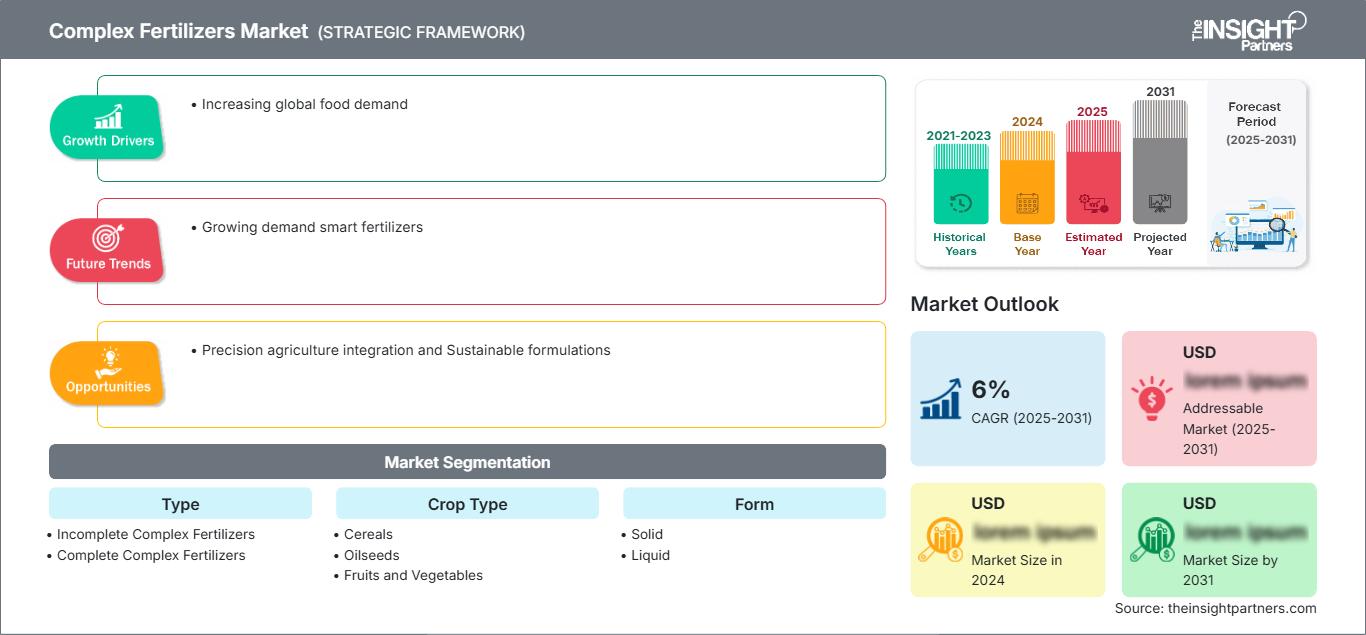
Complex Fertilizers Market: Strategic Insights
-
Get Top Key Market Trends of this report.This FREE sample will include data analysis, ranging from market trends to estimates and forecasts.
Complex Fertilizers Market Drivers and Opportunities
Market Drivers:
- Depleting Soil Fertility and Monocropping: Intensive farming has disrupted the natural soil balance. Complex fertilizers harmoniously restore multiple nutrients in one application, which helps in conditioning the soil and arresting yield decline risks.
- Global Shift to Protein-Rich Diets: As economies develop, consumption patterns move toward grain-fed livestock. This creates an intensive demand for high-performance complex fertilizers to support the massive production of maize, soy, and wheat.
- Technological Advancements in Application: The adoption of drip irrigation and fertigation systems, particularly in arid regions, has sustained high demand for water-soluble complex inputs that can be delivered precisely to plant roots.
Market Opportunities:
- Integration with Digital Agriculture: Beyond simple application, incorporating AI-driven nutrient scheduling and drone-assisted delivery offers significant opportunities to improve nutrient use efficiency (NUE) and reduce waste.
- Growth in Vertical Farming and Urban Agriculture: Precision indoor farming systems require highly customized nutrient solutions. Developing specialized complex liquid formulas for these environments provides a high-margin growth corridor.
- Strategic Expansion in Emerging Phosphate Hubs: Tapping into new production facilities in regions like the Al-Anbar province can strengthen supply chain security and support long-term domestic needs in developing agricultural economies.
Complex Fertilizers Market Report Segmentation Analysis
The complex fertilizers market share is analyzed across various segments to provide a clearer understanding of its structure, growth potential, and emerging trends. Below is the standard segmentation approach used in industry reports:
By Type:
- Complete Complex Fertilizers: The dominant segment, favored for providing a balanced nutrition profile (e.g., NPK 15-15-15 or 12-32-16) that simplifies field management for diverse cropping systems.
- Incomplete Complex Fertilizers: A significant market share holder, including products like Diammonium Phosphate (DAP) and Monoammonium Phosphate (MAP), tailored for specific soil conditions and as starter fertilizers.
By Crop Type:
- Cereals: The primary volume driver, as large-scale production of rice, wheat, and corn requires massive nutrient inputs to address global food scarcity.
- Oilseeds: A fast-growing segment where complex fertilizers are chosen for their ability to enhance oil content through balanced phosphorus and potassium programs.
- Fruits and Vegetables: Driven by rising health awareness and export-oriented horticulture, requiring targeted nutrients to improve aesthetic and nutritional quality.
- Others: Includes fiber crops, sugarcane, and pulses, which benefit from specialized nutrient ratios during crop rotation.
By Form:
- Solid: The most common form, expected to dominate approximately 75% of the market in 2026 due to its long shelf-life and convenience for mechanized spreading.
- Liquid: The fastest-rising form, particularly in developed markets where automated dosing and variable-rate application technologies are used for optimal nutrient uptake.
By Geography:
- North America
- Europe
- Asia Pacific
- South & Central America
- Middle East & Africa
Complex Fertilizers Market Report Scope
| Report Attribute | Details |
|---|---|
| Market size in 2025 | US$ 41.37 Billion |
| Market Size by 2034 | US$ 78.42 Billion |
| Global CAGR (2026 - 2034) | 7.36% |
| Historical Data | 2021-2024 |
| Forecast period | 2026-2034 |
| Segments Covered |
By Type
|
| Regions and Countries Covered |
North America
|
| Market leaders and key company profiles |
|
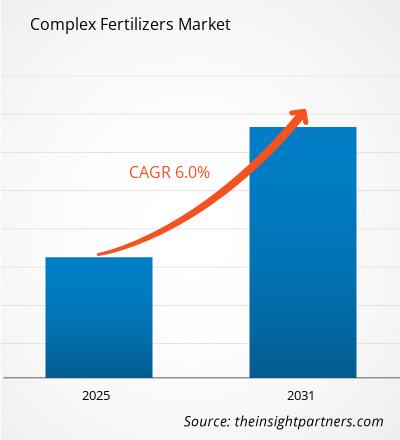
Complex Fertilizers Market Players Density: Understanding Its Impact on Business Dynamics
The Complex Fertilizers Market is growing rapidly, driven by increasing end-user demand due to factors such as evolving consumer preferences, technological advancements, and greater awareness of the product's benefits. As demand rises, businesses are expanding their offerings, innovating to meet consumer needs, and capitalizing on emerging trends, which further fuels market growth.
Complex Fertilizers Market Share Analysis by Geography
Asia-Pacific is expected to grow fastest in the coming years. Emerging markets in South & Central America, the Middle East, and Africa also have many untapped opportunities for premium nutrient producers and precision-agriculture manufacturers to expand. The complex fertilizers market is undergoing a significant transformation, moving from a commodity-heavy industry to a high-value technology-led sector. Growth is driven by the rising prevalence of soil degradation, a surge in demand for sustainable intensification, and the expansion of the high-value horticultural sector. Below is a summary of market share and trends by region:
1. North America
- Market Share: A mature yet expanding segment, driven by large-scale commercial farming and the growth of precision AgTech.
- Key Drivers:
- Rising consumer preference for sustainably grown produce and low-carbon farming outputs
- Mainstreaming of specialty nutrients in high-end farming operations and commercial cooperatives
- Widespread adoption of automated variable-rate application technologies (VRT)
- Trends: Scaling of liquid fertilizer distribution and the successful adoption of customized nutrient packages (e.g., Sulfur-enriched NPK) to appeal to yield-focused demographics.
2. Europe
- Market Share: Holds a significant share globally, anchored by strict environmental regulations and high-tech greenhouse ecosystems in the Netherlands, France, and Germany.
- Key Drivers:
- High domestic demand for low-carbon fertilizers to meet European Green Deal targets
- Established processing infrastructure for specialty chemicals and water-soluble formulations
- Robust government support for reduced nitrogen runoff and sustainable nutrient management
- Trends: A strategic shift toward prioritizing bio-enhanced complex fertilizers over traditional chemical versions. There is also an increasing focus on circular nutrient systems to meet the demands of eco-conscious European consumers.
3. Asia-Pacific
- Market Share: The fastest-growing region and largest volume consumer, with China and India acting as the primary drivers for the entire global market.
- Key Drivers:
- Massive consumer base seeking food security and higher protein intake through grain and oilseed production
- Government-supported agricultural initiatives focused on high-value smart farming and nutrient-based subsidies
- Rapid urbanization and shrinking arable land are leading to a preference for high-efficiency yield boosters
- Trends: Heavy reliance on B2B contracts for high-end complex powders used in the growing hydroponic and protected cultivation industries, alongside a surge in nano-fertilizer adoption.
4. South and Central America
- Market Share: An emerging hub for commercial row crops with a growing specialty sector in countries like Brazil and Argentina.
- Key Drivers:
- Increasing awareness of the nutritional superiority of complex fertilizers for soybean and corn yield optimization
- Modernization of large-scale plantations into commercial-grade operations requiring high-analysis phosphorus blends
- Rising interest in export-quality produce requiring precise nutrient management
- Trends: Decisive shift into a supply-led market where logistics and port execution play a major role in pricing, coupled with the introduction of specialized liquid NPK blends.
5. Middle East and Africa
- Market Share: Developing market with a focus on domestic fertilizer security and the modernization of phosphate-rich mineral production.
- Key Drivers:
- Investments in local manufacturing facilities and large-scale desalination-linked fertigation projects
- High demand for water-soluble NPKs to maximize nutrient efficiency in water-stressed, arid climates
- Strategic focus on smart agriculture to improve local food security and reduce import reliance
- Trends: Implementation of modern fertigation technologies to formalize the informal agricultural market, coupled with a focus on high-nutrient-density powders for the horticultural segment.
High Market Density and Competition
Competition is intensifying as larger companies consolidate to expand their market reach and leverage economies of scale. Industry leaders like Nutrien Ltd., Yara International, and The Mosaic Company are increasingly focusing on digital farming and global distribution networks.
This competitive environment pushes vendors to differentiate through:
- Technological Innovation: Developing smart fertilizers that release nutrients directly when needed, thereby reducing environmental footprints and waste.
- Enterprise Solutions: Offering co-branded OEM solutions and integrated soil monitoring to provide real-time insights for large-scale farm decision-making.
- Sustainability Benchmarking: Companies are now benchmarking products based on their ability to improve soil health and resilience against abiotic stress.
Opportunities and Strategic Moves
- Partner with AgTech firms and digital farming platforms to tap into the surging demand for data-driven and site-specific nutrient application in Asia-Pacific and North American markets.
- Incorporate low-carbon manufacturing and regenerative agriculture certifications to appeal to environmentally conscious regulators and supply chain partners seeking sustainable agricultural inputs.
Major Companies operating in the Complex Fertilizers Market are:
- Agrium Inc.
- CF Industries Holdings, Inc
- Coromandel International Limited
- EuroChem Group AG
- Haifa Chemicals Ltd.
- Helena Agri Enterprises LLC
- Israel Chemicals Ltd (ICL)
- PhosAgro
- Potash Corporation of Saskatchewan Inc.
- The Mosaic Company
Disclaimer: The companies listed above are not ranked in any particular order.
Complex Fertilizers Market News and Recent Developments
- In January 2026, CF Industries Holdings, Inc. launched a pilot project with major agriculture co-operatives to jointly develop a low-carbon fertilizers supply chain. The goal of the pilot is to demonstrate how the use of low-carbon nitrogen fertilizer can substantially reduce the carbon intensity of corn and enable the production of low-carbon ethanol for use in motor fuel and export.
- In April 2025, Coromandel International Limited, India’s leading agri-solutions provider, and Ma’aden, one of the world’s largest producers of phosphate fertilisers, announced to strengthen their longstanding partnership by signing a Memorandum of Understanding (MoU) for the long-term supply of Di-Ammonium Phosphate (DAP) and NP/NPK fertilisers.
Complex Fertilizers Market Report Coverage and Deliverables
The Complex Fertilizers Market Size and Forecast (2021–2034) report provides a detailed analysis of the market covering below areas:
- Complex Fertilizers Market size and forecast at global, regional, and country levels for all the key market segments covered under the scope
- Complex Fertilizers Market trends, as well as market dynamics such as drivers, restraints, and key opportunities
- Detailed PEST and SWOT analysis
- Complex Fertilizers Market analysis covering key market trends, global and regional framework, major players, regulations, and recent market developments
- Industry landscape and competition analysis covering market concentration, heat map analysis, prominent players, and recent developments in the Complex Fertilizers Market.
- Detailed company profiles
Frequently Asked Questions

- Comprehensive Market Sizing and Forecast Analysis
- Detailed Segmentation Analysis
- In-Depth Market Dynamics Assessment
- Regional and Country-Level Insights
- Competitive Landscape and Company Benchmarking
- Strategic Business Intelligence
Recent Reports
Testimonials

The Insight Partners provided valuable market intelligence that supported our global go-to-market strategy. Their team was professional, responsive, and attentive to our feedback, providing thoughtful analysis and helpful methodological clarifications throughout the project.
Junmo Kim Chief Financial Officer (CFO), Enertech Co., Ltd.
The Insight Partners' SCADA System Market report is comprehensive, with valuable insights on current trends and future forecasts. The team was highly professional, responsive, and supportive throughout. We are very satisfied and highly recommend their services.
RAN KEDEM Partner, Reali Technologies LTDs
I requested a report on a very specific software market and the team produced the report in a few days. The information was very relevant and well presented. I then requested some changes and additions to the report. The team was again very responsive and I got the final report in less than a week.
JEAN-HERVE JENN Chairman, Future Analytica
We worked with The Insight Partners for an important market study and forecast. They gave us clear insights into opportunities and risks, which helped shape our plans. Their research was easy to use and based on solid data. It helped us make smart, confident decisions. We highly recommend them.
PIYUSH NAGPAL Sr. Vice President, High Beam Global
The Insight Partners delivered insightful, well-structured market research with strong domain expertise. Their team was professional and responsive throughout. The user-friendly website made accessing industry reports seamless. We highly recommend them for reliable, high-quality research services
YUKIHIKO ADACHI CEO, Deep Blue, LLC.
This is the first time I have purchased a market report from The Insight Partners.While I was unsure at first, I visited their web site and felt more comfortable to take the risk and purchase a market report.I am completely satisfied with the quality of the report and customer service. I had several questions and comments with the initial report, but after a couple of dialogs over email with their analyst I believe I have a report that I can use as input to our strategic planning process.Thank you so much for taking the extra time and making this a positive experience.I will definitely recommend your service to others and you will be my first call when we need further market data.
JOHN SUZUKI President and Chief Executive Officer, Board Director, BK Technologies
I wish to appreciate your support and the professionalism you displayed in the course of attending to my request for information regarding to infectious disease IVD market in Nigeria. I appreciate your patience, your guidance, and the fact that you were willing to offer a discount, which eventually made it possible for us to close a deal. I look forward to engaging The Insight Partners in the future, all thanks to the impression you have created in me as a result of this first encounter.
DR CHIJIOKE ONYIA MANAGING DIRECTOR, PineCrest Healthcare Ltd.Reason to Buy
- Informed Decision-Making
- Understanding Market Dynamics
- Competitive Analysis
- Identifying Emerging Markets
- Customer Insights
- Market Forecasts
- Risk Mitigation
- Boosting Operational Efficiency
- Strategic Planning
- Investment Justification
- Tracking Industry Innovations
- Aligning with Regulatory Trends





 Get Free Sample for