
Concrete Floor Coating Market Trends, Demand & Growth by 2034
Coverage: By Resin Type (Epoxy, Polyurethane, Hybrid); Coating Type (Water-Based, Solvent-Based); End Use (Manufacturing, Aviation and Transport, Food Processing, Industrial Shop Floor); Geography (North America, Europe, Asia-Pacific, South and Central America, Middle East and Africa)
- Status : Data Released
- Report Code : TIPTE100001093
- Category : Chemicals and Materials
- No. of Pages : 150
- Available Report Formats :


- Last update date : August 27, 2026


2025 Market Size
US$ 2.83 Bn
Base year value
2034 Forecast
US$ 5.06 Bn
Projected by 2034
CAGR 2026-2034
6.67 %
Growth rate
Addressable Market
US$ 35.67 Bn
(2026-2034)
The Concrete Floor Coating Market is valued at US$ 2.83 Billion in 2025 and is projected to reach US$ 5.06 Billion by 2034, expanding at a CAGR of 6.67% during 2026–2034. Demand is supported by the increasing specification of durable, chemically resistant, and hygienic flooring systems across industrial facilities. Resin technology, application requirements, environmental considerations, and maintenance cycles continue to influence product selection across major end-use environments.
In North America, Concrete Floor Coating Market size is expected to expand at an estimated CAGR of 6.1–6.7% during 2026–2034. Structural growth is supported by refurbishment of aging industrial facilities and continued investment in manufacturing, logistics, food processing, and transportation infrastructure. Demand is also influenced by requirements for abrasion resistance, rapid return-to-service, chemical protection, slip resistance, and low-emission coating systems.
Concrete Floor Coating Market Assessment and Insights
- North America: North America represented a 27–31% share in 2025 and is projected to grow at a CAGR of 6.1–6.7% between 2026–2034, supported by industrial refurbishment, warehouse construction, and stringent performance requirements.
- US: The US accounted for 79–83% of North American demand in 2025 and is expected to expand at a CAGR of 6.0–6.6%, led by manufacturing and logistics applications.
- Europe: Europe held a 25–29% share in 2025 and is projected to grow at 6.2–6.9% CAGR between 2026–2034, with Germany, the UK, France, Italy, and Spain supporting demand through industrial modernization and sustainability-driven coating specifications.
- Asia Pacific: Asia Pacific captured a 31–35% share in 2025 and is forecast to grow at a CAGR of 7.1–7.8%, with China, Japan, India, and South Korea benefiting from manufacturing expansion and infrastructure investment.
- Largest Segment: Epoxy within Resin Type held a 54–58% market share in 2025 and is expected to grow at a CAGR of 6.3–6.8%, retaining leadership through durability and chemical resistance.
- High Growth Segment: Hybrid within Resin Type represented a 10–13% market share in 2025 and is projected to grow at a CAGR of 7.8–8.4%, supported by performance customization.
- Key companies analyzed in detail: A&I Coatings, dsm-firmenich AG, Nippon Paint Co., Ltd., The Lubrizol Corporation, 3M Company, Akzo Nobel N.V., BASF SE, Axalta Coating Systems Ltd., Asian Paints PPG Pvt. Ltd., and PPG Industries, Inc.
Source: The Insight Partners' analysis based on proprietary research, government publications, company annual reports, investor presentations, industry databases, and expert interviews.
The Concrete Floor Coating Market has evolved from conventional protective layers toward engineered flooring systems combining resin chemistry, aggregates, primers, sealers, and functional topcoats. Epoxy continues to be relevant when it comes to adhesive capability and chemical resistance, while polyurethane, polyaspartic, and hybrid coatings are suitable for flexibility, UV stability, fast curing, and maintenance-intensive environments. The development of formulations now focuses more on the application rate, preparation of the surface, longevity, and reduction of emissions.
It seems that future innovation will center on formulations that are water-based and high-solids, fast-curing systems, and specialized coatings for industrial environments. Manufacturing centers in Asia Pacific are expected to get much of the investment, along with the need to meet the stringent environmental regulations in Europe.
Concrete Floor Coating Market Report Scope
| Report Attribute | Details |
|---|---|
| Market size in 2025 | US$ 2.83 Billion |
| Market Size by 2034 | US$ 5.06 Billion |
| Global CAGR (2026 - 2034) | 6.67% |
| Historical Data | 2021-2024 |
| Forecast period | 2026-2034 |
Concrete Floor Coating Market Analysis
Demand is being reinforced by industrial facilities seeking longer maintenance intervals and reduced disruption from floor repairs. The Concrete Floor Coating Market growth is closely linked with manufacturing output, warehouse construction, food processing capacity, and the refurbishment of existing slabs. The value chain includes resin and additive suppliers, formulators, aggregate producers, distributors, specialist flooring contractors, and facility operators, with system performance depending strongly on surface preparation and installation quality.
Supply dynamics increasingly favor suppliers capable of delivering complete flooring systems rather than individual coating materials. Epoxy and polyurethane resins remain central, while curing agents, pigments, aggregates, and functional additives differentiate final systems. Regional production footprints help reduce transport exposure and improve technical responsiveness. Concrete Floor Coating Market share is increasingly shaped by lifecycle performance, downtime requirements, substrate compatibility, and contractor capabilities rather than coating price alone.
The competitive intensity of these firms will depend on the formulation skills, application skills, regional production facilities, and diversity of products. Firms like Sika, BASF, Akzo Nobel, Axalta, Nippon Paint, and Asian Paints PPG have competing product portfolios that range broadly in terms of paints. The Lubrizol Corporation has its competitive intensity in the polymer and formulation skills.
Investment is increasingly directed toward low-emission chemistry, production flexibility, and localized technical infrastructure. The Concrete Floor Coating Market analysis indicates that suppliers with strong resin platforms can extend into multiple industrial applications by adapting curing profiles, chemical resistance, slip characteristics, and decorative properties. Strategic positioning is consequently shifting from standalone coatings toward integrated systems supported by specification assistance, contractor relationships, and lifecycle service capabilities.
● REPORT CUSTOMIZATION
Tailor This Report To Align With Your Specific Business Requirements
This report can be customized to align precisely with your business objectives, scope, and target markets. Customization options include tailored segmentation, geography, competitive analysis, and strategic insights to support informed decision-making.
Customize This Report →WHAT YOU CAN ADJUST
- ● Segmentations
- ● Geography
- ● Competitive Analysis
- ● Language Preferences
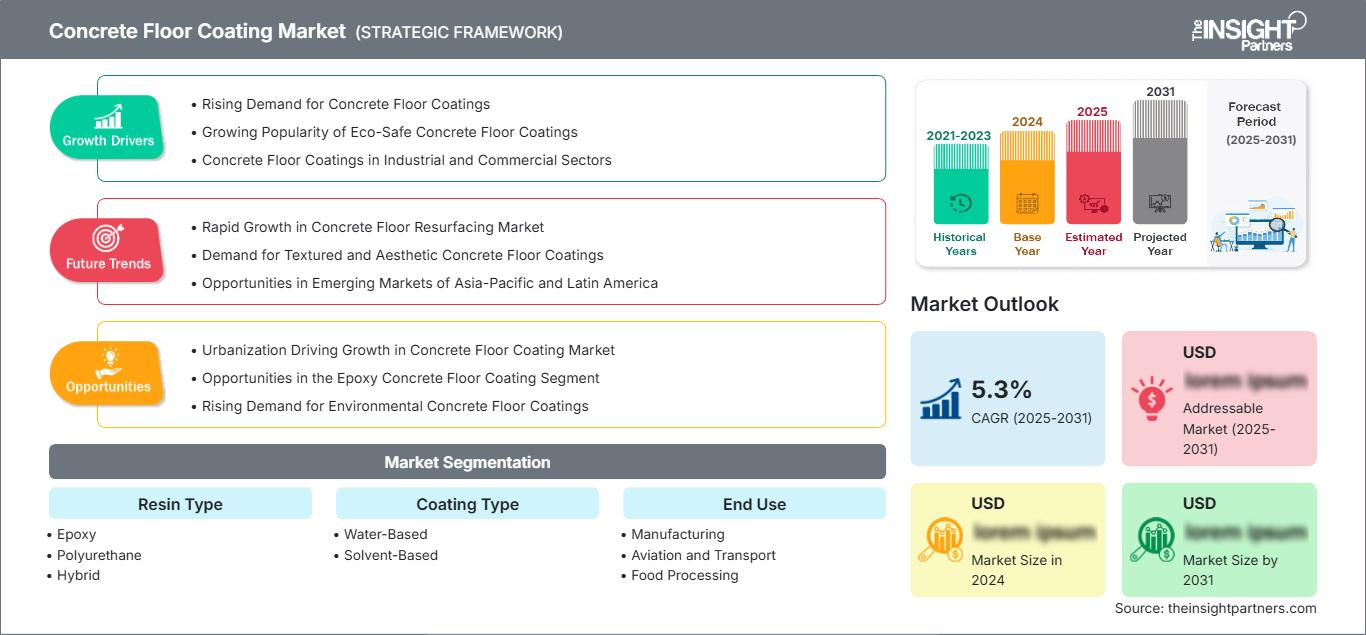
Concrete Floor Coating Market: Strategic Insights
Regional Insights
North America Concrete Floor Coating Market
North America accounted for a 27–31% share of global demand in 2025 and is expected to grow at a CAGR of 6.1–6.7% through 2034, according to the Concrete Floor Coating Market report. The United States leads regional consumption, while Canada provides support through manufacturing, warehousing, food processing, and infrastructure upgrades. The need for surfaces with abrasion-resistant, chemical-resistant, hygienic, and maintainable properties is becoming a necessity at industrial facilities. Floor replacement due to worn-out conditions is another source of regular demand.
The regional market benefits from the significant number of existing industrial facilities and investments in logistics facilities. Epoxy will continue to be popular in tough conditions, while polyurethane and water-based technology will meet the needs of flexibility and odor. Increasingly, contractors and facility owners will require fast installation without shutdown periods. The regional market will benefit from rising demand for specialist flooring for the food, pharmaceuticals, automotive, aircraft, and advanced manufacturing industries.
U.S. Concrete Floor Coating Market
The U.S. represented 79–83% of North American demand in 2025 and is expected to expand at a CAGR of 6.0–6.6%, according to the Concrete Floor Coating Market forecast. Demand is concentrated in manufacturing plants, distribution centers, food facilities, aviation sites, and industrial workshops. Sika, BASF, Axalta, PPG, 3M Company, and other suppliers maintain commercial or technical presence, supporting broad product availability and contractor networks.
Current application trends are leaning toward fast-drying, low-smelling, and traffic-resistant coating systems. Food and beverage industries need cleanable and non-slip surfaces, while warehouses prefer abrasion-resistant systems that are easy to maintain. The manufacturing industry creates a need for coatings that are conductive, anti-static, and resistant to chemicals. Refurbishment is necessary since operators may be seeking floor systems without doing any structural work.
Europe Concrete Floor Coating Market
Europe held a 25–29% share in 2025 and is projected to grow at a CAGR of 6.2–6.9% through 2034, with Germany serving as the leading country. The UK, Germany, France, Italy, and Spain collectively provide a broad industrial base, while environmental regulation encourages lower-emission formulations and efficient application practices, reflecting evolving Concrete Floor Coating Market trends.
The UK market is supported by logistics, food processing, manufacturing, refurbishment, and transportation infrastructure. Germany benefits from automotive, engineering, chemical, and industrial production facilities requiring durable floor systems. France, Italy, and Spain add demand through manufacturing, warehousing, food processing, and commercial-industrial refurbishment. Across Europe, coating specifications increasingly consider emissions, worker exposure, substrate preparation, durability, and maintenance intervals alongside initial cost.
APAC Concrete Floor Coating Market
The Concrete Floor Coating Market in APAC represented a 31–35% share in 2025 and is forecast to grow at a CAGR of 7.1–7.8% through 2034. China is the leading country, followed by Japan, South Korea, India, and Australia. Manufacturing expansion, logistics development, electronics production, and industrial modernization support demand.
China provides the largest regional manufacturing base, while India is supported by industrial corridors and warehouse development. Japan and South Korea emphasize high-performance flooring in advanced manufacturing, electronics, and automotive facilities. Australia contributes through mining-related infrastructure, logistics, and industrial refurbishment. Policy emphasis on manufacturing capacity, infrastructure investment, and environmental performance is encouraging greater adoption of engineered coating systems.
Middle East & Africa Concrete Floor Coating Market
The Concrete Floor Coating Market in the Middle East & Africa represents a smaller regional base, with Saudi Arabia and the UAE leading demand through industrial diversification, logistics, aviation, and infrastructure programs. The manufacturing sector, mining installations, warehouses, and food processing are the major ways through which South Africa makes its contributions. The growth rate for the regional market is estimated at a CAGR of 5.8 to 6.5% until 2034.
Saudi Arabia profits from investments in industry and infrastructure; UAE experiences high demand for logistics, aviation, manufacturing, and commercial installations. Energy-intensive installations need chemicals and abrasion resistance, while food and pharmaceuticals need hygiene. The demand for RO-MEA is fragmented but supported by infrastructure upgradation and industry.
Segmentation Analysis
Resin Type
Resin Type remains the principal basis for performance differentiation, with epoxy retaining the largest installed base. The Concrete Floor Coating Market scope increasingly includes polyurethane and hybrid systems where flexibility, ultraviolet stability, rapid curing, or specialized chemical resistance is required. The segment is projected to expand at a CAGR of 6.3–7.1% during 2026–2034 as industrial users prioritize lifecycle performance and application-specific specifications.
- Epoxy: Epoxy remains the dominant resin because of strong adhesion, chemical resistance, mechanical durability, and suitability for heavy industrial floors. It is widely selected for manufacturing, warehouses, and processing facilities.
- Polyurethane: Polyurethane systems address environments requiring flexibility, abrasion resistance, thermal cycling, and improved ultraviolet stability. Their suitability for demanding service conditions supports adoption in industrial and transport-related facilities.
- Hybrid: Hybrid systems combine selected performance attributes from multiple resin chemistries. Their strategic importance is increasing where users require customized curing, durability, aesthetics, and application characteristics within a single flooring specification.
Coating Type
In the Concrete Floor Coating Market, Coating Type influences application conditions, environmental profile, curing behavior, and facility suitability. Water-Based formulations are gaining attention where lower odor and reduced solvent exposure are important, while Solvent-Based systems remain relevant for demanding performance requirements. The segment is expected to grow at a CAGR of 6.1–7.0% during 2026–2034.
- Water-Based: Water-Based coatings support applications where lower odor, easier handling, and reduced solvent emissions are priorities. Their adoption is strengthened by occupied-facility refurbishment and sustainability-oriented procurement requirements.
- Solvent-Based: Solvent-Based systems remain important where penetration, application characteristics, or established performance requirements influence specification. Their use persists in selected industrial environments with experienced contractors and controlled application conditions.
End Use
End Use determines coating selection through traffic intensity, exposure conditions, hygiene requirements, and operational downtime. Manufacturing represents a core demand base, while aviation and transport, food processing, and industrial shop floors require increasingly specialized systems. The segment is projected to grow at a CAGR of 6.5–7.2% during 2026–2034, supported by industrial refurbishment and facility modernization.
- Manufacturing: Manufacturing facilities require resistance to mechanical wear, oils, chemicals, impacts, and continuous vehicle movement. Coatings also support easier cleaning and visual zoning across production areas.
- Aviation and Transport: Aviation and transport facilities prioritize resistance to fuels, hydraulic fluids, abrasion, and heavy equipment movement. Rapid curing is strategically valuable where operational interruptions must be minimized.
- Food Processing: Food processing facilities emphasize hygiene, cleanability, slip resistance, chemical resistance, and thermal durability. Flooring systems are selected to withstand repeated washing, sanitization, and exposure to food-processing chemicals.
- Industrial Shop Floor: Industrial shop floors require dependable protection against traffic, abrasion, impacts, and spills. Coating specifications commonly balance durability, installation speed, maintenance requirements, and total lifecycle cost.
Opportunity Snapshot
| End Use | Revenue Contribution | Trend Tag | Adoption Stage |
| Manufacturing | High | Heavy Duty | Mature |
| Aviation and Transport | Medium | Rapid Cure | Scaling |
| Food Processing | Medium | Hygienic Floors | Scaling |
| Industrial Shop Floor | High | Wear Resistance | Mature |
Concrete Floor Coating Market Growth Drivers and Impact Analysis
Expansion of Automated Manufacturing and Logistics Facilities
The need for abrasion resistance, impact resistance, cleanliness, and maintenance at predictable intervals becomes important due to the increasing mechanical loads on concrete floors as forklifts, mobile robots, pallet systems, and other machines work constantly. In addition, new factories give coating manufacturers an opportunity to specify the coatings at the very beginning of the construction of facilities. For coating manufacturers, this trend translates into an increase in demand for system approaches based on the use of primers, resins, aggregates, and top coats. Facility owners benefit from decreased surface wear and easier maintenance. The influence of the factor is especially strong in the case of high-throughput facilities, where any damage to floors may affect the flow of materials. The trend will continue as automation levels increase.
Greater Emphasis on Industrial Hygiene and Workplace Safety
There is an increasing emphasis on industrial flooring as a part of facility hygiene and safety as opposed to mere protection. Cleanrooms, food-processing facilities, and other controlled environments need floorings that will resist cleaning chemicals, frequent washes, thermal shock, and traffic, and still retain the slip-resistance property. Similar needs exist in manufacturing plants where floorings should minimize dusting, be easy to clean, and be visually organized. This increases the technical relevance of resin coatings and special topcoats. Manufacturers who are able to prove the compatibility of their products under such conditions have better chances for specifications. There is an additional market effect in addition to the demand created by new buildings, since old facilities frequently need refurbishment in order to maintain standards of operation.
Shift Toward Lower-Emission and More Efficient Formulations
Environmental considerations are driving formulation choices within industrial coating applications, especially in cases where facilities are occupied during the renovation process or where there is careful control over exposure of workers. Water-borne, high solids, low odor, and faster curing systems will limit application constraints while meeting environmental goals. This becomes a new factor of competition since formulators have to maintain abrasion resistance, adhesion, chemical resistance, and aesthetics while limiting solvent use or improving application efficiency. Suppliers who are ahead of the curve in terms of polymer and curing agent technologies can distinguish themselves through performance with reduced emissions. On the other hand, faster curing will help users save on downtime. Gradually, procurement criteria will focus more on formulation qualities and application performance as opposed to simply the type of resin or cost.
Concrete Floor Coating Market Future Trends
Integration of Smart Specification and Digital Application Tools
Flooring purchasing in the future will become more data-oriented, with digital means facilitating the process for contractors and owners of facilities in terms of matching coatings with the condition of substrate, traffic load, chemical exposure, temperature, and maintenance needs. Digital means of selecting products can help avoid mistakes in specifications by correlating operational factors with coatings that are compatible with each other in terms of primers, resins, aggregates, and topcoats. Documentation of installation conditions and maintenance schedules via digital means can increase the traceability of the processes. From the perspective of manufacturers, digitalization can be an instrument for building technical relations with clients, avoiding physical visits to sales. In the long run, the process can bring consistency in system selection and increased efficiency of contractors. The trend should be especially applicable in international networks of manufacturing enterprises.
Growth of Bio-Based and Lower-Carbon Resin Platforms
Formulators of coatings are to be encouraged to substitute renewable or lower-carbon feedstocks wherever they can fulfill the high-performance standards that are necessary. The shift is unlikely to be uniform since industry flooring needs to have high levels of chemical, mechanical, and thermal resistance. Rather, bio-based ingredients will be substituted by way of selective resins, binders, additives, or cures that maintain performance. Hybrid systems will offer a midway point where performance and lower impact can be combined. Durability and carbon footprint are to be evaluated in addition to the maintenance cycles, which is because of the fact that a higher lifetime can make up for some of the environmental costs of replacing them.
Concrete Floor Coating Market Opportunities
Specialized Flooring Systems for High-Value Manufacturing
High-value manufacturing settings present some interesting possibilities for those suppliers who are able to tailor their coatings according to certain process-specific challenges as opposed to general industrial specifications. The semiconductor, electronic, pharmaceutical, battery, and precision engineering industries may have particular needs for chemical resistance, electrostatic control, cleanliness, reduced particle creation, and dimensional stability. Suppliers can increase value by adding system engineering services, substrate analysis, coating application monitoring, and maintenance planning to their offerings. Regional investments in manufacturing can be a good chance for technical centers in the area that are able to provide specification and contractor training services. In addition, manufacturers do not necessarily have to compete on the basis of resin pricing but on the basis of performance and reliability of coating systems.
Retrofit Solutions for Aging Industrial Building Stock
The industrial buildings offer a major opportunity in this regard, considering that there is a need for surface refurbishment without necessarily having to replace the slab. The systems can be designed specifically for cracking, deterioration, chemical contamination, and heavily used surfaces, all the while reducing downtime. In addition, there is an opportunity for developing quick cure systems, moisture-tolerant primers, thin build resurfacing systems, and local repairs for such uses. Furthermore, contractors form another channel through which the products can be marketed due to the fact that the success of the refurbishing process depends on the preparation of the surface, moisture evaluation, mixing, and application thickness, among others.
Recent Developments
- March 2026: ARMOVEX announced the official launch of its groundbreaking concrete floor coating system, a spray-applied solution purpose-built for both professional contractors and serious DIY installers. Designed from the start to strip away the complexity, mess, and hazards that have long defined the concrete coating industry, ARMOVEX arrives as a category-defining product that fundamentally changes how floors get done.
- June 2026: TORQ Coatings, a premium concrete coating company specializing in high-performance residential and commercial flooring solutions, announced its official launch across the Chicagoland region, with expansion into the Milwaukee market already underway.
Frequently Asked Questions

- Comprehensive Market Sizing and Forecast Analysis
- Detailed Segmentation Analysis
- In-Depth Market Dynamics Assessment
- Regional and Country-Level Insights
- Competitive Landscape and Company Benchmarking
- Strategic Business Intelligence
Recent Reports
Testimonials

The Insight Partners provided valuable market intelligence that supported our global go-to-market strategy. Their team was professional, responsive, and attentive to our feedback, providing thoughtful analysis and helpful methodological clarifications throughout the project.
Junmo Kim Chief Financial Officer (CFO), Enertech Co., Ltd.
The Insight Partners' SCADA System Market report is comprehensive, with valuable insights on current trends and future forecasts. The team was highly professional, responsive, and supportive throughout. We are very satisfied and highly recommend their services.
RAN KEDEM Partner, Reali Technologies LTDs
I requested a report on a very specific software market and the team produced the report in a few days. The information was very relevant and well presented. I then requested some changes and additions to the report. The team was again very responsive and I got the final report in less than a week.
JEAN-HERVE JENN Chairman, Future Analytica
We worked with The Insight Partners for an important market study and forecast. They gave us clear insights into opportunities and risks, which helped shape our plans. Their research was easy to use and based on solid data. It helped us make smart, confident decisions. We highly recommend them.
PIYUSH NAGPAL Sr. Vice President, High Beam Global
The Insight Partners delivered insightful, well-structured market research with strong domain expertise. Their team was professional and responsive throughout. The user-friendly website made accessing industry reports seamless. We highly recommend them for reliable, high-quality research services
YUKIHIKO ADACHI CEO, Deep Blue, LLC.
This is the first time I have purchased a market report from The Insight Partners.While I was unsure at first, I visited their web site and felt more comfortable to take the risk and purchase a market report.I am completely satisfied with the quality of the report and customer service. I had several questions and comments with the initial report, but after a couple of dialogs over email with their analyst I believe I have a report that I can use as input to our strategic planning process.Thank you so much for taking the extra time and making this a positive experience.I will definitely recommend your service to others and you will be my first call when we need further market data.
JOHN SUZUKI President and Chief Executive Officer, Board Director, BK Technologies
I wish to appreciate your support and the professionalism you displayed in the course of attending to my request for information regarding to infectious disease IVD market in Nigeria. I appreciate your patience, your guidance, and the fact that you were willing to offer a discount, which eventually made it possible for us to close a deal. I look forward to engaging The Insight Partners in the future, all thanks to the impression you have created in me as a result of this first encounter.
DR CHIJIOKE ONYIA MANAGING DIRECTOR, PineCrest Healthcare Ltd.Reason to Buy
- Informed Decision-Making
- Understanding Market Dynamics
- Competitive Analysis
- Identifying Emerging Markets
- Customer Insights
- Market Forecasts
- Risk Mitigation
- Boosting Operational Efficiency
- Strategic Planning
- Investment Justification
- Tracking Industry Innovations
- Aligning with Regulatory Trends





 Get Free Sample for