
Concrete Mixer Market Demand, Size & Forecast by 2034
Coverage: by Product (Diesel Mixer, Drum Rotating Mixer, Tilting Mixer, Non-Tilting Mixer, Twin Shaft Mixer); End-user (Residential, Commercial, Industrial) , and Geography (North America, Europe, Asia Pacific, and South and Central America)
- Status : Data Released
- Report Code : TIPRE00007914
- Category : Manufacturing and Construction
- No. of Pages : 150
- Available Report Formats :


- Last update date : July 17, 2026


2025 Market Size
US$ 3.97 Bn
Base year value
2034 Forecast
US$ 6.16 Bn
Projected by 2034
CAGR 2026-2034
5.00 %
Growth rate
Addressable Market
US$ 45.96 Bn
(2026-2034)
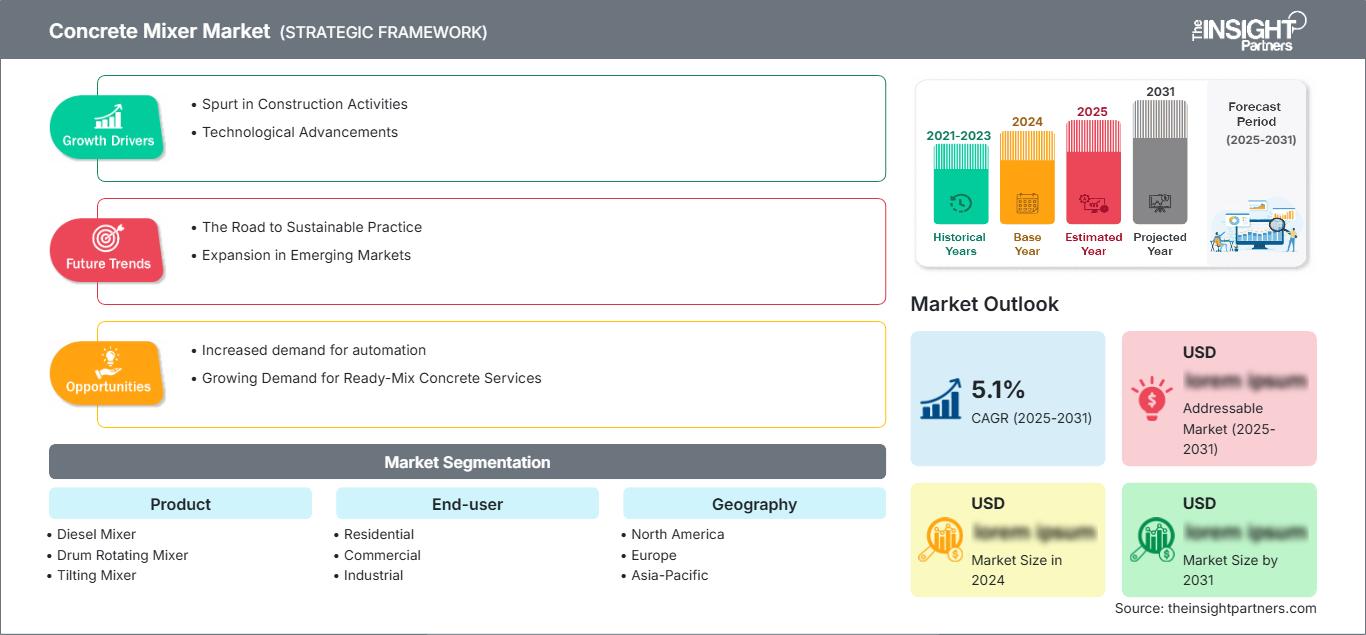
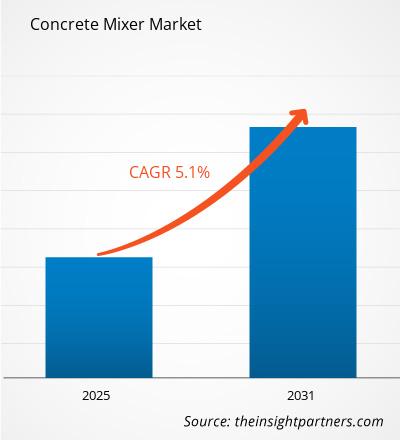
The concrete mixer market was valued at US$ 3.97 Billion in 2025 and is projected to reach US$ 6.16 Billion by 2034, growing at a CAGR of 5.00% during 2026–2034. Demand is being shaped by urban construction, ready-mix penetration, equipment automation, and the need for consistent concrete quality across residential, commercial, and industrial sites.
North America remains a high-value region as contractors upgrade fleets for urban infill, bridge repair, utilities, and warehouse construction. The concrete mixer market size outlook in the region reflects an estimated CAGR range of 4.3–4.8% through 2034, supported by equipment replacement cycles, rental fleet modernization, and tighter jobsite productivity requirements in the U.S. and Canada.
Concrete Mixer Market Assessment and Insights
- North America accounted for 27–30% share in 2025 and is expected to grow at a CAGR of 4.3–4.8% during 2026–2034, driven by infrastructure rehabilitation and fleet renewal.
- US represented 78–82% of North America in 2025 and is projected to grow at 4.4–4.9% CAGR, led by commercial concrete demand.
- Europe held 22–25% share in 2025 and may grow at 4.0–4.6% CAGR, with Germany, France, the UK, Italy, and Spain leading replacement demand.
- Asia Pacific captured 34–38% share in 2025 and is forecast to expand at 5.6–6.2% CAGR, led by China, India, Japan, South Korea, and Australia.
- Largest Segment Diesel Mixer held 38–42% market share in 2025 and is expected to grow at 4.2–4.8% CAGR, supported by affordability and site mobility.
- High Growth Segment Twin Shaft Mixer accounted for 12–15% market share in 2025 and is projected to grow at 6.1–6.7% CAGR, supported by high-output batching.
- Key companies analyzed in detail: Akona Engineering Pvt. Ltd., Caterpillar Inc., Liebherr-International AG, Lino Sella World, SANY Heavy Industry Co., Ltd., Shantui Construction Machinery Co., Ltd., Sinotruk Hong Kong Limited, Terex Corporation, Zhengzhou SanqGroup Machinery & Equipment Co., Ltd., Zoomlion Heavy Industry Science & Technology Co., Ltd.
Source: The Insight Partners' analysis based on proprietary research, government publications, company annual reports, investor presentations, industry databases, and expert interviews.
Equipment development has evolved from simple rotating drums to controlled mixing, telematics, automated discharge and fuel-efficient drives. Changes in manufacturing strategy include component localization, platform standardization and reaction to regional emissions laws. In terms of concrete mixer providers, the major development lies in the increasing disparity between the low-cost mixers found on site and high productivity mixers utilized in ready-mix plants, infrastructure corridors, and prefabrication facilities.
The future demand for concrete mixers will come from India, Southeast Asia, Gulf, and parts of Africa owing to infrastructure development initiatives that generate repeated demand. Regulatory challenges indicate that low-emission equipment is the way forward, and life-cycle costs and equipment availability form part of considerations by contractors prior to purchase decision-making. It implies that the concrete mixer market will witness sustainable growth.
Concrete Mixer Market Report Scope
| Report Attribute | Details |
|---|---|
| Market size in 2025 | US$ 3.97 Billion |
| Market Size by 2034 | US$ 6.16 Billion |
| Global CAGR (2026 - 2034) | 5.00% |
| Historical Data | 2021-2024 |
| Forecast period | 2026-2034 |
Concrete Mixer Market Analysis
The growth pattern in the concrete mixer market is based on increased usage of concrete in urban housing, industrial estates, logistical facilities, and transportation infrastructures. The contractors seek consistency in mixing of concrete, reduced labor requirement and faster mixing process especially where time window for ready mix delivery is limited. The demand is further impacted by the availability of cement, aggregate transportation and accessibility of construction site, hence portable and mobile concrete mixers become essential.
The value chain consists of steel manufacturing, hydraulic systems, engines, drums, controls, dealers, rentals and aftersales services providers. The supply environment is still vulnerable to the price of steel, electronics and engine standards in different locations. Manufacturers who are able to assemble locally and have adequate spare parts enjoy better customer retention because the production of concrete affects the pouring schedule and costs.
The concrete mixer market analysis indicates moderate competition, with global equipment groups competing against regional specialists and Chinese exporters. In comparison to Caterpillar Inc., Liebherr-International AG, SANY Heavy Industry Co., Ltd., Terex Corporation, and Zoomlion Heavy Industry Science & Technology Co., Ltd., Akona Engineering Pvt. Ltd. and Lino Sella World focus on localized construction requirements through technology, service area, and efficiency of fleets.
The use of electrical drive drum units, automation of batch interface, compact front discharge units, and diagnostic systems has been witnessing increased investments. Positioning varies from one region to another such that while the developed countries look into compliance and cost of ownership, developing countries go for capability, ruggedness, financing, and dealer support. There is thus space for high-end connected machinery and rugged mixers as well.
● REPORT CUSTOMIZATION
Tailor This Report To Align With Your Specific Business Requirements
This report can be customized to align precisely with your business objectives, scope, and target markets. Customization options include tailored segmentation, geography, competitive analysis, and strategic insights to support informed decision-making.
Customize This Report →WHAT YOU CAN ADJUST
- ● Segmentations
- ● Geography
- ● Competitive Analysis
- ● Language Preferences
Concrete Mixer Market: Strategic Insights
Regional Insights
North America concrete mixer Market
North America accounted for 27–30% of 2025 revenue and is projected to grow at a 4.3–4.8% CAGR during 2026–2034. The region’s concrete mixer market share is supported by public infrastructure repair, warehouse construction, and replacement of aging ready-mix equipment. Fleet operators are prioritizing machines with improved fuel economy, safer discharge control, and easier maintenance access.
Demand is concentrated in the U.S. and Canada, where contractors serve dispersed suburban projects and dense city jobs. Emissions rules, noise restrictions, and skilled labor shortages are encouraging automated water control, drum monitoring, and operator assistance. Rental penetration also supports recurring purchases because fleet managers refresh mixers to protect uptime and resale value.
U.S. concrete mixer Market
The U.S. accounted for 78-82% of North America in 2025 and is projected to grow at a CAGR of 4.4-4.9% up until 2034. Demand drivers include highway maintenance, utilities, data center installations, manufacturing relocation, and repairs in the housing sector. The use of small mixers and front-discharge models is increasing to address restricted site access and fast placement of concrete.
Terex Corporation has an obvious presence in the domestic market through the ADVANCE and ProAll product lines. Caterpillar Inc. is an influencer due to the construction machinery connection and expectations from dealers regarding service. The applications range from basic slab construction towards infrastructure renovation projects, municipal construction, and special pours.
Europe concrete mixer Market
Europe occupied 22-25% market share in 2025 and expected to register a CAGR of 4.0-4.6%. Germany ranks first owing to the availability of ready-mixed concrete maturity, engineering standard, and replacement requirement. The UK takes advantage of the improvement of transportation infrastructure and home renovations whereas France sustains strong demand through public works and urban redevelopment projects.
Both Italy and Spain show high demand for portable equipment because a large number of companies prefer using smaller construction sites and perform renovation work. The European buyers take care of environmental aspects, noise pollution, safety concerns, and accurate batching. They like Liebherr-International AG and Lino Sella World the most. The electrified drive and modular concrete batch plant systems offer bright growth prospects.
APAC concrete mixer Market
The APAC region held a share of 34-38% in 2025 and is estimated to grow at a CAGR of 5.6%-6.2%. Demand from China arises due to infrastructure renewal and export of machinery, whereas in India, demand is supported by road, metro, housing and industrial corridor projects.
In Japan, South Korea and Australia, emphasis is on quality, safety and life cycle costs resulting in demand for automation and durable machines. In the APAC region, companies like SANY Heavy Industry Co., Ltd., Shantui Construction Machinery Co., Ltd., Sinotruk Hong Kong Limited and Zoomlion Heavy Industry Science & Technology Co., Ltd. are prominent.
Middle East & Africa concrete mixer Market
Middle East & Africa segment will register growth at a CAGR of 5.1–5.7% during 2026–2034 driven by demand from Saudi Arabia, through cities associated with energy sector, transport corridors, and tourism projects. UAE will be significant for tall building construction and infrastructures that require reliable ready-mix logistics.
South Africa and Rest of MEA have inconsistent yet repeatable demand due to roads, mining support facilities, water projects, and industrial development. Buyers tend to favor robust equipment along with access to spare parts and financing from dealers due to tough geographical conditions.
Segmentation Analysis
Product
The Product segment is expected to grow at a 4.8–5.4% CAGR during 2026–2034. The concrete mixer market scope across product types reflects divergent needs: diesel models serve cost-sensitive sites, drum systems support general work, and twin shaft mixers address high-throughput batching where consistency and short cycle times are critical.
- Diesel Mixer remains the largest product type because it suits remote sites, inconsistent power access, and small contractor fleets needing mobility, durability, and straightforward maintenance.
- Drum Rotating Mixer supports broad construction use because it combines simple operation, familiar maintenance routines, and adequate output for residential and commercial pours.
- Tilting Mixer is preferred where controlled discharge and smaller batch flexibility matter, especially in repair work, precast yards, and compact project locations.
- Non-Tilting Mixer serves users needing stable mixing and predictable output, with demand linked to medium-scale projects and contractors prioritizing operational simplicity.
- Twin Shaft Mixer is strategically important for high-strength concrete, infrastructure batching, and industrial applications requiring rapid mixing, uniformity, and better control over material consistency.
End-user
The End-user segment is expected to grow at a 4.9–5.5% CAGR during 2026–2034. Residential buyers favor smaller and mobile machines, commercial projects need predictable output, and industrial users require robust equipment for foundations, plants, warehouses, and utility structures. The segment benefits from contractor professionalization and tighter quality expectations.
- Residential demand is supported by housing repair, low-rise construction, and small developers that prefer portable mixers for lower batch volumes and flexible deployment.
- Commercial projects require reliable output for offices, retail, hospitality, healthcare, and logistics buildings, making uptime and consistent mix quality central purchasing factors.
- Industrial users prioritize heavy-duty machines for plants, warehouses, energy facilities, and infrastructure-linked projects where productivity, durability, and controlled batching influence project economics.
Opportunity Snapshot
| End-user | Revenue Contribution | Trend Tag | Adoption Stage |
| Residential | Medium | Urban Repair | Scaling |
| Commercial | High | Logistics Build | Mature |
| Industrial | High | Factory Expansion | Scaling |
Concrete Mixer Market Growth Drivers and Impact Analysis
Infrastructure Rehabilitation and Urban Construction
The need for infrastructure redevelopment is creating a continuous requirement for mixers that will not only be able to construct roadways, bridges, transport systems, drainage systems, and public building infrastructures without affecting the schedule of the projects but will also have to serve mature economies through equipment replacements and emerging economies through new corridor capacity and urban capacities. The second driver increases the requirement for mobile and truck mounted machines as concrete often has to be mixed or transported near the site under limited space conditions.
Ready-Mix Expansion and Quality Requirements
Rapid acceptance of ready-mixed concrete is driving producers and constructors towards machines that will allow for mixing with consistent results, precise dosing of water and reliable discharge. Increased performance expectations in industrial flooring, bridge, tower and precast construction raise the significance of consistent batches above that of the purchase cost of machinery itself. Machines with advanced drum design, dual-shaft mechanism and instrumentation prevent segregation and avoid the need for rework. The effect is most pronounced when the owners of the projects require quality documentation.
Fleet Modernization and Operator Productivity
Fleet owners are replacing older mixers to reduce fuel consumption, maintenance downtime, and operator fatigue. Newer models integrate improved controls, safer access points, automated wash systems, and telematics, helping contractors track utilization and service needs. Productivity gains are especially valuable in markets facing skilled labor shortages and tight delivery windows. The impact extends beyond equipment sales because service packages, parts availability, and operator training become differentiators. Buyers increasingly evaluate total ownership cost, encouraging manufacturers to combine durable engineering with digital support and responsive dealer networks.
Concrete Mixer Market Future Trends
Electrified Drum Drives and Low-Emission Sites
Low-emission construction zones will accelerate concrete mixer market trends toward electric drum drives, hybrid auxiliaries, and quieter urban operation. Early adoption is expected in Europe, North America, Japan, and selected premium city projects where emissions, noise, and idling restrictions affect site access. Electrification will not replace diesel immediately, but it will reshape specifications for truck mixers, compact units, and batching plants. Manufacturers that combine battery safety, charging compatibility, and service readiness can capture higher-margin demand as contractors prepare fleets for stricter municipal procurement standards.
Connected Mixing and Predictive Maintenance
Digitalization will increasingly move from premium fleets into mainstream construction equipment. Sensors can monitor drum speed, hydraulic health, water use, load cycles, and operating hours, creating actionable maintenance records for fleet managers. Predictive alerts reduce unplanned downtime, while remote diagnostics improve dealer response and parts planning. Over the forecast period, connected mixers may also support material traceability and automated documentation for large projects. This trend favors manufacturers with software capability, not only mechanical engineering, because customers will value uptime visibility and lifecycle transparency.
Concrete Mixer Market Opportunities
Localized Manufacturing in High-Growth Regions
Manufacturers can improve competitiveness by localizing assembly, welding, drums, and service parts in India, Southeast Asia, the Gulf, and Africa. Local operations reduce lead times, import exposure, and parts shortages, which are decisive for contractors operating on tight construction schedules. The concrete mixer market forecasts point to rising demand in regions where public infrastructure and industrial investment are expanding together. Partnerships with dealers, rental firms, and finance providers can convert demand into recurring orders by lowering upfront purchase barriers and improving service confidence.
Rental and Equipment-as-a-Service Models
Rental models create an opportunity to reach small contractors that need mixers for intermittent projects but cannot justify full ownership. Equipment-as-a-service can bundle maintenance, telematics, operator training, and uptime commitments, shifting customer evaluation from purchase price to productivity. This is especially relevant for compact mixers, volumetric units, and specialized equipment used in urban work, utilities, and repair projects. Manufacturers that support rental fleets with robust machines and predictable residual values can build repeat sales while improving market access in fragmented contractor communities.
Recent Developments
- January 2026: Bay-Lynx is proud to announce the launch of a new product line in partnership with Crewmix. The Crewmix line is a series of compact, tow-behind and track-mounted volumetric mixers. Engineered to bridge the gap between high-capacity industrial production and mobile small-batch requirements usually fulfilled by hand with a wheelbarrow, the Crewmix series is designed for crews who prioritize speed, control, and efficiency without the overhead of larger volumetric units.
- November 2025: Rapid International introduced a new version of their Rapidmix mobile continuous mixing plant in the USA, featuring full weighing for aggregates, cement, and water. This upgrade improves accuracy and consistency for concrete production. Rollcon LLC, a contractor specializing in roller compacted concrete (RCC), was among the first to deploy the new plant
- January 2025: Cemen Tech launches the latest version of ACCU-POUR™ fleet management software with new features. As part of the platform, customers can now request quotes, track orders, and view invoices through a digital portal. This cloud-based productivity solution connects the office, dispatch and volumetric mixer fleet, allowing near real-time flexibility to adjust schedules while maintaining a constant workflow.
Frequently Asked Questions

- Comprehensive Market Sizing and Forecast Analysis
- Detailed Segmentation Analysis
- In-Depth Market Dynamics Assessment
- Regional and Country-Level Insights
- Competitive Landscape and Company Benchmarking
- Strategic Business Intelligence
Recent Reports
Testimonials

The Insight Partners' SCADA System Market report is comprehensive, with valuable insights on current trends and future forecasts. The team was highly professional, responsive, and supportive throughout. We are very satisfied and highly recommend their services.
RAN KEDEM Partner, Reali Technologies LTDs
I requested a report on a very specific software market and the team produced the report in a few days. The information was very relevant and well presented. I then requested some changes and additions to the report. The team was again very responsive and I got the final report in less than a week.
JEAN-HERVE JENN Chairman, Future Analytica
We worked with The Insight Partners for an important market study and forecast. They gave us clear insights into opportunities and risks, which helped shape our plans. Their research was easy to use and based on solid data. It helped us make smart, confident decisions. We highly recommend them.
PIYUSH NAGPAL Sr. Vice President, High Beam Global
The Insight Partners delivered insightful, well-structured market research with strong domain expertise. Their team was professional and responsive throughout. The user-friendly website made accessing industry reports seamless. We highly recommend them for reliable, high-quality research services
YUKIHIKO ADACHI CEO, Deep Blue, LLC.
This is the first time I have purchased a market report from The Insight Partners.While I was unsure at first, I visited their web site and felt more comfortable to take the risk and purchase a market report.I am completely satisfied with the quality of the report and customer service. I had several questions and comments with the initial report, but after a couple of dialogs over email with their analyst I believe I have a report that I can use as input to our strategic planning process.Thank you so much for taking the extra time and making this a positive experience.I will definitely recommend your service to others and you will be my first call when we need further market data.
JOHN SUZUKI President and Chief Executive Officer, Board Director, BK Technologies
I wish to appreciate your support and the professionalism you displayed in the course of attending to my request for information regarding to infectious disease IVD market in Nigeria. I appreciate your patience, your guidance, and the fact that you were willing to offer a discount, which eventually made it possible for us to close a deal. I look forward to engaging The Insight Partners in the future, all thanks to the impression you have created in me as a result of this first encounter.
DR CHIJIOKE ONYIA MANAGING DIRECTOR, PineCrest Healthcare Ltd.Reason to Buy
- Informed Decision-Making
- Understanding Market Dynamics
- Competitive Analysis
- Identifying Emerging Markets
- Customer Insights
- Market Forecasts
- Risk Mitigation
- Boosting Operational Efficiency
- Strategic Planning
- Investment Justification
- Tracking Industry Innovations
- Aligning with Regulatory Trends





 Get Free Sample for