
Concrete Surface Treatment Chemicals Market Demand, Trends & Forecast by 2034
Coverage: By Product Type (Sealants, Mold release agents, Curing compounds, Others); End-User (Commercial, Municipal, Industrial, Residential) , and Geography (North America, Europe, Asia Pacific, and South and Central America)
- Status : Data Released
- Report Code : TIPRE00018863
- Category : Chemicals and Materials
- No. of Pages : 150
- Available Report Formats :


- Last update date : August 27, 2026


2025 Market Size
US$ 9.64 Bn
Base year value
2034 Forecast
US$ 13.27 Bn
Projected by 2034
CAGR 2026-2034
3.61 %
Growth rate
Addressable Market
US$ 104.03 Bn
(2026-2034)
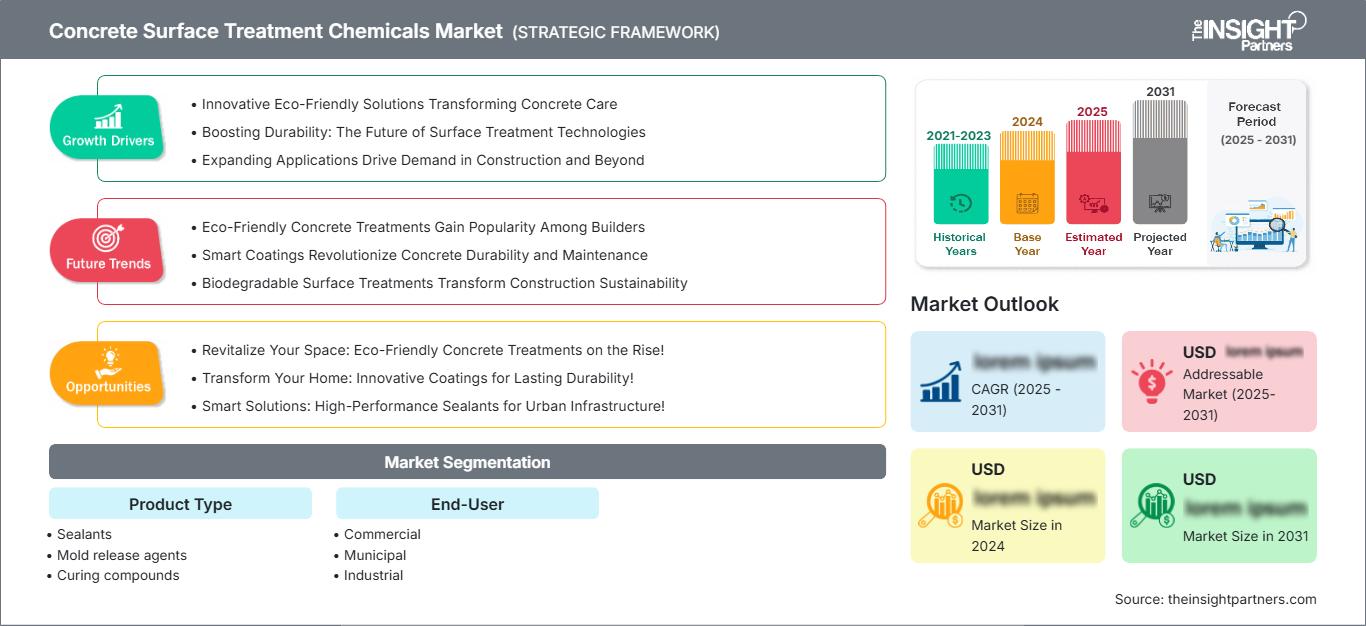
The global Concrete Surface Treatment Chemicals market was valued at US$ 9.64 billion in 2025 and is expected to reach US$ 13.27 billion by 2034; it is estimated to record a CAGR of 3.61% during 2026-2034.
Concrete Surface Treatment Chemicals Market Assessment and Insights
- North America: The region is estimated to hold a 25–29% share in 2025 and expand at a 3.7–4.3% CAGR between 2026–2034, supported by infrastructure rehabilitation, commercial development, and maintenance of aging concrete assets.
- US: The US is estimated to represent 80–84% of North American demand in 2025 and is projected to grow at a 3.6–4.2% CAGR between 2026–2034, led by infrastructure and commercial applications.
- Europe: Europe is estimated to account for a 23–27% share in 2025 and grow at a 3.5–4.1% CAGR, with Germany, France, the UK, Italy, and Spain supporting demand through renovation and infrastructure programs.
- Asia Pacific: Asia Pacific is estimated to command a 30–34% share in 2025 and expand at a 5.0–5.6% CAGR, led by China, India, Japan, South Korea, and Australia.
- Largest Segment: Sealants are estimated to hold a 46–50% market share in 2025 and are projected to grow at a 4.0–4.5% CAGR through 2034.
- High Growth Segment: Municipal end users are estimated to represent a 21–25% share in 2025 and are expected to expand at a 4.8–5.4% CAGR through 2034.
- Key companies analyzed in detail: Akzo Nobel N.V., Arkema SA, BASF SE, Croda International Plc., Dow Inc., Henkel Corporation, Laticrete International, Inc., Sika AG, The Euclid Chemical Company, and RPM International Inc.
Source: The Insight Partners' analysis based on proprietary research, government publications, company annual reports, investor presentations, industry databases, and expert interviews.
The concrete surface treatment chemicals market has shifted toward multifunctional formulations that combine protection, durability, curing control, and application efficiency. The sealants are becoming more advanced in terms of the use of polymers, which will enable movement, moisture, chemicals, and temperature changes. In addition, there are mold release agents that are shifting towards the production of water-based and low-emission products, and curing products that will emphasize moisture retention. The future trends will involve the development of products that are low-VOC, use bio-based materials, and are recyclable products, as well as products that can fit in lower-carbon concrete systems. There is growth in the construction market in the Asia Pacific, the Middle East and Africa due to increasing infrastructure investments.
Concrete Surface Treatment Chemicals Market Report Scope
| Report Attribute | Details |
|---|---|
| Market size in 2025 | US$ 9.64 Billion |
| Market Size by 2034 | US$ 13.27 Billion |
| Global CAGR (2026 - 2034) | 3.61% |
| Historical Data | 2021-2024 |
| Forecast period | 2026-2034 |
Concrete Surface Treatment Chemicals Market Analysis
Demand growth is closely linked with concrete construction, infrastructure maintenance, precast production, and building refurbishment. The concrete surface treatment chemicals market growth is influenced by the need to prevent moisture penetration, control premature water loss, improve surface appearance, and simplify formwork stripping. The value chain spans chemical producers, resin and additive suppliers, formulation specialists, distributors, contractors, precast manufacturers, and project owners.
Supply dynamics are driven by the availability of polymers, resins, minerals, waxes, and specialty additives, with different performances from formulation depending on substrate, weather, application type, and requirements of the projects. Sealants need to have adhesive and movement properties, curing compounds need controlled film formation, and mold release agents need separation properties and good surface appearance. Technical assistance is thus essential to tailor-made products.
The competitive environment consists of diversified specialty chemicals firms and construction-oriented suppliers. Akzo Nobel N.V., Arkema SA, BASF SE, Croda International Plc., Dow Inc., and Henkel Corporation offer chemical technologies, binders, additives, and construction formulations, whereas Sika AG, Laticrete International, Inc., The Euclid Chemical Company, and RPM International Inc. operate in application-based construction systems.
Strategic investment is increasingly directed toward sustainable formulations, localized production, and application laboratories. Suppliers with broad distribution networks can bundle surface treatment products with broader concrete and construction systems, while specialists can differentiate through formulation performance. The concrete surface treatment chemicals market analysis indicates that competitive positioning increasingly depends on lifecycle performance, environmental profile, application productivity, and compatibility with changing concrete mix designs.
● REPORT CUSTOMIZATION
Tailor This Report To Align With Your Specific Business Requirements
This report can be customized to align precisely with your business objectives, scope, and target markets. Customization options include tailored segmentation, geography, competitive analysis, and strategic insights to support informed decision-making.
Customize This Report →WHAT YOU CAN ADJUST
- ● Segmentations
- ● Geography
- ● Competitive Analysis
- ● Language Preferences
Concrete Surface Treatment Chemicals Market: Strategic Insights
Regional Insights
North America Concrete Surface Treatment Chemicals Market
North America is estimated to hold a 25–29% of the Concrete Surface Treatment Chemicals Market in 2025 and is expected to expand at a 3.7–4.3% CAGR through 2034. The US is the leading regional market, while Canada’s contributions include rehabilitation of infrastructure, commercial construction, transportation works, and industrial growth. Deteriorating bridges, car parks, roads, and public facilities give rise to regular needs to protect the concrete structure.
The regional market will be driven by the need for products that will minimize moisture penetration, wear-and-tear effects, cracks, and the need for repeated maintenance. The commercial and industrial consumers are gradually considering chemical treatments not only based on the price but also based on the lifespan of the products and application efficiency.
U.S. Concrete Surface Treatment Chemicals Market
The US represents an estimated 80–84% share of North American demand in 2025 and is projected to grow at a 3.6–4.2% CAGR through 2034. Sika AG, BASF SE, Henkel Corporation, Dow Inc., The Euclid Chemical Company, and RPM International Inc. maintain significant construction-related portfolios serving multiple concrete applications. The Concrete Surface Treatment Chemicals Market report assesses the competitive positioning and strategic developments of these key industry participants.
Demand is generated by commercial buildings, transportation systems, industries, and housing constructions. Sealants are especially needed in those places where there is a need for movement compensation and moisture protection, and curing agents are essential during the laying of large areas of concrete. Rehabilitation programs in cities are creating more demand for protective coatings applied to bridges, pavements, public buildings, and water supply systems.
Europe Concrete Surface Treatment Chemicals Market
Europe is estimated to account for a 23–27% share in 2025 and is expected to expand at a 3.5–4.1% CAGR through 2034. Germany is the leading country, followed by France, the UK, Italy, and Spain. Renovation, infrastructure modernization, energy-efficiency upgrades, and environmental requirements support adoption of advanced surface protection technologies in the Concrete Surface Treatment Chemicals Market.
In the UK and Germany, there is a high demand for coatings used for refurbishments, infrastructure maintenance, commercial construction, and industrial applications. In France and Italy, transportation infrastructure and renovation of buildings are important uses for paints and coatings, whereas in Spain, the uses include urban development, construction related to tourism, and infrastructure construction. In Europe, low-VOC paints, water-based paints, and durable coatings are gaining more importance.
APAC Concrete Surface Treatment Chemicals Market
APAC is estimated to hold a 30–34% share in 2025 and is projected to grow at a 5.0–5.6% CAGR through 2034. China leads regional demand, followed by India, Japan, South Korea, and Australia. Infrastructure development, industrial construction, urbanization, and refurbishment support broad product adoption in the Concrete Surface Treatment Chemicals Market.
China and India provide substantial volume opportunities, while Japan and South Korea emphasize durability and advanced construction quality. Australia benefits from infrastructure maintenance and commercial development. Policy support for transport, housing, industrial facilities, and urban infrastructure should increase demand for protective and curing systems, particularly where longer service life and reduced maintenance requirements are prioritized.
Middle East & Africa Concrete Surface Treatment Chemicals Market
The Middle East & Africa is projected to grow at a 4.4–5.0% CAGR through 2034, with Saudi Arabia leading regional demand. The UAE contributes through commercial, hospitality, infrastructure, and urban development, while South Africa remains important for industrial and infrastructure applications.
Large energy, transport, water, and urban projects create demand for concrete protection under severe climatic conditions. High temperatures, ultraviolet exposure, dust, and moisture variation increase the importance of reliable curing and sealing. Saudi Arabia and the UAE are expected to remain key growth centers, while infrastructure development across the rest of MEA broadens the addressable opportunity.
Segmentation Analysis
Product Type
The Product Type segment is expected to expand at a 3.9–4.4% CAGR through 2034, with Sealants representing the largest category. Product selection increasingly depends on the required balance between moisture resistance, movement capability, curing behavior, surface finish, application speed, and environmental characteristics across concrete structures.
- Sealants: Sealants maintain the leading position because joints, cracks, penetrations, and interfaces require flexible barriers against moisture and environmental exposure across commercial, municipal, industrial, and residential structures.
- Mold release agents: Mold release agents remain essential in precast and cast-in-place production because clean separation reduces surface defects, improves formwork productivity, and can extend mold service life.
- Curing compounds: Curing compounds support concrete strength development and surface quality by limiting premature moisture loss, particularly across large slabs, pavements, exposed structures, and projects with constrained water-curing access.
End-User
The End-User segment is projected to grow at a 4.2–4.7% CAGR during 2026–2034. Municipal applications are expected to record comparatively faster expansion as infrastructure rehabilitation increases, while commercial and industrial users continue emphasizing durability, maintenance efficiency, and lifecycle cost management.
- Commercial: Commercial construction requires reliable sealants and curing solutions across floors, façades, joints, parking structures, and service areas where appearance, durability, and maintenance requirements influence product selection.
- Municipal: Municipal users require surface treatment chemicals for roads, bridges, public buildings, water infrastructure, and other assets where extending service life can reduce recurring rehabilitation costs.
- Industrial: Industrial facilities prioritize resistance to chemicals, abrasion, moisture, temperature variation, and heavy traffic, creating demand for specialized treatments capable of maintaining concrete performance under demanding operating conditions.
- Residential: Residential demand is concentrated across floors, driveways, garages, foundations, joints, and decorative concrete, with contractors increasingly selecting easier-to-apply formulations offering reliable protection and improved surface appearance.
Opportunity Snapshot
| End-User | Revenue Contribution (High/Medium/Low) | Trend Tag | Adoption Stage |
| Commercial | High | Joint Protection | Mature |
| Municipal | High | Asset Rehabilitation | Scaling |
| Industrial | Medium | Chemical Resistance | Mature |
| Residential | Medium | Surface Protection | Scaling |
Concrete Surface Treatment Chemicals Market Growth Drivers and Impact Analysis
Rising expenditure on infrastructure rehabilitation and maintenance
Another factor is the increasing demand for the preservation of existing concrete structures rather than the exclusive use of reconstruction. Deterioration is experienced by bridges, roads, parking facilities, water systems, tunnels, and other public facilities due to moisture, freeze/thaw action, chemicals, traffic, and weathering. Chemicals used for surface treatment can help in dealing with the specific deterioration mechanism and allow for extended intervals between maintenance applications when correctly specified. This provides a repetitive demand from the cities, facility owners, and construction companies. The importance of such demand is especially evident due to the fact that rehabilitation works will require a solution that is specific to the application and cannot be standardized like construction chemicals.
Growing requirements for concrete durability and service-life extension
Modern concrete specifications take into account not only the performance of the concrete but also its service life, permeability, susceptibility to cracking, and resistance to environmental exposure. Such a development adds greater significance to the concept of surface treatment as it is the concrete cover and the exposed surface that are mostly subject to interactions with water, chemical substances, abrasion, and temperature variations. Surface treatments allow for the protection of a concrete structure without changing the basic structure itself. The practical implications of such a change include the evolution of performance-based procurement, where the contractors and owners evaluate the projected durability and maintenance needs rather than merely choose the cheapest option available.
Increasing adoption of efficient construction and precast production
Improvements in productivity are spurring construction firms and manufacturers to focus on decreasing application time, increasing uniformity, and reducing rework. In addition, mold release agents will help increase formwork stripping time as well as ensure cleaner surfaces, and curing compounds will decrease dependency on expensive manual water curing operations. The importance of such factors becomes especially noticeable in precast manufacturing because the repetitive nature of production makes any minor improvement commercially viable. On the market, there is a growing demand for fast construction projects with lower labor costs, which means that manufacturers are creating products that can be sprayed and applied uniformly. With the use of automated batching, spraying machines, and controlled conditions, manufacturers have an opportunity to increase product repeatability. Considering total installed costs, the products that reduce labor, surface imperfections, cleaning needs, or formwork stripping time may become more desirable despite higher material cost.
Concrete Surface Treatment Chemicals Market Future Trends
Development of lower-emission and water-based treatment systems
The concrete surface treatment chemicals market trends are expected to increasingly favor water-based, low-VOC, and lower-hazard formulations across commercial and institutional construction. The product developers will probably have to re-formulate sealants, mold release agents, and curing agents to use less solvent while not affecting the adhesion, effectiveness of release, curing action, or appearance of the surface. Environmental aspects will become an important part of the procurement evaluation criteria, along with technical aspects, as more building owners will demand sustainable materials. Waterborne technology is also beneficial for improving working conditions at the construction site, as it will decrease the smell of solvents and their presence in the air. Eventually, more environmentally-friendly components and raw materials will be used if there is any possibility from a technical point of view. However, the best formulas will be those with proven equal or better field performance.
Greater compatibility with low-carbon concrete formulations
As cement systems incorporate more supplementary cementitious materials and alternative binders, surface behavior can change through differences in hydration, porosity, moisture movement, and early-age strength. This creates a need for treatment chemicals formulated around the characteristics of newer concrete compositions. Future suppliers are likely to conduct more compatibility testing between curing compounds, sealants, release agents, and lower-clinker concrete systems. Digital formulation tools may also accelerate product screening by linking substrate characteristics with treatment performance. The concrete surface treatment chemicals market trends should therefore move toward system-level solutions rather than isolated products. Suppliers that understand both concrete chemistry and surface protection can provide stronger technical recommendations. This approach can reduce application failures while helping contractors adopt lower-carbon concrete without compromising durability or finishing quality.
Concrete Surface Treatment Chemicals Market Opportunities
Localized manufacturing for high-growth construction markets
The concrete surface treatment chemicals market scope extends beyond established construction economies because developing regions increasingly require localized solutions for infrastructure and urban construction. Setting up manufacturing or formulation facilities near major construction zones could help cut down on transport costs, ensure reliability of supply, and help manufacturers modify their products to suit regional aggregates, climatic conditions, and construction methodologies. The Asia Pacific region, the Middle East region, and some selected African countries provide investment opportunities because there are growing pipelines of infrastructure investments in those areas. There are technical skills development programs in these regions that make it easier for investors to establish operations. Investment should be made in regions where there is heavy cement and ready-mix manufacturing, high spending on infrastructure, and heavy reliance on imports.
Integrated lifecycle solutions for infrastructure owners
The concrete surface treatment chemicals market Forecasts indicate an opportunity to develop integrated solutions around inspection, preparation, treatment, and maintenance rather than selling individual chemicals. Infrastructure owners increasingly need predictable maintenance outcomes, creating demand for systems that address moisture ingress, joint deterioration, surface dusting, cracking, and repeated exposure. Suppliers can respond by combining sealants, curing compounds, protective treatments, technical inspection, and application guidance into project-specific packages. Such offerings can improve customer retention because performance becomes linked to the complete treatment system rather than one material. Strategic investment should focus on application laboratories, contractor training, compatibility testing, and lifecycle documentation. Digital inspection tools can further strengthen this model by helping owners identify deterioration mechanisms and select appropriate treatment intervals. This approach can support higher-value contracts while improving measurable maintenance outcomes.
Recent Developments
- March 2026: Sherwin Williams Protective and Marine Coatings launched a new range of systems designed to provide comprehensive, compliant protection, tailored to a versatile set of applications. The ControlTech range of chemical-resistant coating systems protect concrete containment areas and the surrounding environment from hazardous chemicals, fuels, and oils when tanks or pipes fail.
- August 2025: Master Builders Solutions, a renowned global leader in innovative concrete admixtures and construction systems, announced the acquisition of Rapid Mix Group, including Rapid Mix S.r.l. and BMix S.r.l. as producers of mortars, screeds and other construction chemicals products for Italy’s construction market. This investment will further strengthen the company’s capabilities and reaffirm our ongoing commitment to serve Italian customers with a broad range of high-quality products for their construction needs.
Frequently Asked Questions

- Comprehensive Market Sizing and Forecast Analysis
- Detailed Segmentation Analysis
- In-Depth Market Dynamics Assessment
- Regional and Country-Level Insights
- Competitive Landscape and Company Benchmarking
- Strategic Business Intelligence
Recent Reports
Testimonials

The Insight Partners' SCADA System Market report is comprehensive, with valuable insights on current trends and future forecasts. The team was highly professional, responsive, and supportive throughout. We are very satisfied and highly recommend their services.
RAN KEDEM Partner, Reali Technologies LTDs
I requested a report on a very specific software market and the team produced the report in a few days. The information was very relevant and well presented. I then requested some changes and additions to the report. The team was again very responsive and I got the final report in less than a week.
JEAN-HERVE JENN Chairman, Future Analytica
We worked with The Insight Partners for an important market study and forecast. They gave us clear insights into opportunities and risks, which helped shape our plans. Their research was easy to use and based on solid data. It helped us make smart, confident decisions. We highly recommend them.
PIYUSH NAGPAL Sr. Vice President, High Beam Global
The Insight Partners delivered insightful, well-structured market research with strong domain expertise. Their team was professional and responsive throughout. The user-friendly website made accessing industry reports seamless. We highly recommend them for reliable, high-quality research services
YUKIHIKO ADACHI CEO, Deep Blue, LLC.
This is the first time I have purchased a market report from The Insight Partners.While I was unsure at first, I visited their web site and felt more comfortable to take the risk and purchase a market report.I am completely satisfied with the quality of the report and customer service. I had several questions and comments with the initial report, but after a couple of dialogs over email with their analyst I believe I have a report that I can use as input to our strategic planning process.Thank you so much for taking the extra time and making this a positive experience.I will definitely recommend your service to others and you will be my first call when we need further market data.
JOHN SUZUKI President and Chief Executive Officer, Board Director, BK Technologies
I wish to appreciate your support and the professionalism you displayed in the course of attending to my request for information regarding to infectious disease IVD market in Nigeria. I appreciate your patience, your guidance, and the fact that you were willing to offer a discount, which eventually made it possible for us to close a deal. I look forward to engaging The Insight Partners in the future, all thanks to the impression you have created in me as a result of this first encounter.
DR CHIJIOKE ONYIA MANAGING DIRECTOR, PineCrest Healthcare Ltd.Reason to Buy
- Informed Decision-Making
- Understanding Market Dynamics
- Competitive Analysis
- Identifying Emerging Markets
- Customer Insights
- Market Forecasts
- Risk Mitigation
- Boosting Operational Efficiency
- Strategic Planning
- Investment Justification
- Tracking Industry Innovations
- Aligning with Regulatory Trends





 Get Free Sample for