
Construction Chemicals Market Demand, Size & Forecast by 2034
Coverage: By Product (Concrete Admixtures, Asphalt Additives, Waterproofing Chemicals, Adhesives and Sealants, Flame Retardants, and Others), Application (Residential, Commercial, Industrial, Institutional, and Infrastructure), and Geography
- Status : Data Released
- Report Code : TIPRE00003947
- Category : Chemicals and Materials
- No. of Pages : 150
- Available Report Formats :


- Last update date : August 28, 2026


2025 Market Size
US$ 75.39 Bn
Base year value
2034 Forecast
US$ 143.86 Bn
Projected by 2034
CAGR 2026-2034
7.44 %
Growth rate
Addressable Market
US$ 988.13 Bn
(2026-2034)
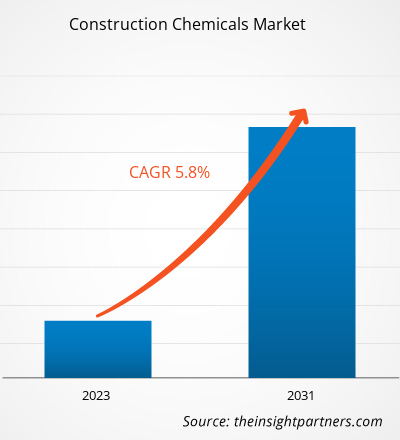
The construction chemicals market was valued at US$ 75.39 Billion in 2025 and is projected to reach US$ 143.86 Billion by 2034, expanding at a 7.44% CAGR from 2026 to 2034. Increasing infrastructure investment, urban development, renovation, and demand for durable building systems are strengthening consumption of concrete admixtures, waterproofing chemicals, adhesives, sealants, asphalt additives, and flame retardants across major construction economies.
North America is expected to remain a significant regional contributor, supported by infrastructure modernization, commercial refurbishment, and adoption of higher-performance building materials. The construction chemicals market size in the region is estimated to expand at a 5.8–6.3% CAGR during 2026–2034, with demand benefiting from repair and rehabilitation activity, energy-efficient construction, and increasing specification of products that extend structural service life.
Construction Chemicals Market Assessment and Insights
- North America: North America is estimated to account for 23–27% share in 2025, supported by infrastructure rehabilitation, commercial construction, and renovation, while expanding at a 5.8–6.3% CAGR between 2026–2034.
- US: The US represents approximately 79–83% of North American revenue in 2025, with construction modernization and repair requirements supporting a 5.7–6.2% CAGR between 2026–2034.
- Europe: Europe is estimated at 22–26% share in 2025, led by Germany, France, the UK, Italy, and Spain, with renovation and decarbonization supporting a 5.2–5.7% CAGR between 2026–2034.
- Asia Pacific: Asia Pacific is estimated to hold 34–38% share in 2025, led by China, India, Japan, South Korea, and Australia, and is projected to grow at a 8.0–8.6% CAGR between 2026–2034.
- Largest Segment: Concrete Admixtures is estimated to hold 29–33% market share in 2025, supported by performance requirements, with a 7.0–7.5% CAGR during 2026–2034.
- High Growth Segment: Waterproofing Chemicals are estimated at 17–20% market share in 2025 and are projected to expand at a 8.1–8.6% CAGR during 2026–2034.
- Key companies analyzed in detail: Ashland Global Holdings Inc., BASF SE, Mapei S.p.A., Linde plc, Sika AG, Fosroc, Inc., Compagnie de Saint-Gobain S.A., Pidilite Industries Limited, Choksey Chemicals Pvt Ltd, RPM International Inc., Dow Inc., MBCC Group, H.B. Fuller Company, LATICRETE International, Inc., Oriental Yuhong, MC-Bauchemie.
Source: The Insight Partners' analysis based on proprietary research, government publications, company annual reports, investor presentations, industry databases, and expert interviews.
The construction chemicals market has shifted toward performance-oriented formulations that improve concrete workability, durability, water resistance, adhesion, and fire performance. A combination of polymer chemistry, mineral additives, dispersing agents and other special functional chemicals for meeting specific construction needs is increasingly seen among manufacturers. More localized production footprints will also be possible, which allows for responding to climate conditions, raw materials, specifications of projects and construction practices, as well as minimizing logistical risks.
Future growth will increasingly emanate from the Asia Pacific region, the Middle East and selected emerging countries where significant infrastructural and urban development projects continue to be implemented. Localized manufacturing facilities, technical labs and distribution channels can also be expected along with demand growth. Building durability, energy efficiency, safety and reduced environmental impact will drive formulation changes, especially waterproofing, admixtures, asphalt modification and special adhesives.
Construction Chemicals Market Report Scope
| Report Attribute | Details |
|---|---|
| Market size in 2025 | US$ 75.39 Billion |
| Market Size by 2034 | US$ 143.86 Billion |
| Global CAGR (2026 - 2034) | 7.44% |
| Historical Data | 2021-2024 |
| Forecast period | 2026-2034 |
Construction Chemicals Market Analysis
The construction chemicals market growth is being supported by infrastructure development, residential construction, renovation, and the increasing technical requirements of modern buildings. The value chain starts with suppliers of petrochemicals, minerals, polymers, and specialty chemicals and goes all the way through formulators, distributors, contractors, ready-mix manufacturers, applicators, and construction materials manufacturers. Performance is now becoming a major criterion for procurement since chemical products can cut down maintenance needs and increase the longevity of projects.
Concrete admixtures have strong ties with cement and ready-mix manufacturing processes, whereas waterproofing chemicals are dependent upon residential, commercial, and infrastructural uses. As for asphalt modifiers, they can be affected by construction and pavement renovation cycles. Specialties such as adhesives, sealants, and fire retardants are used in more narrow areas.
The construction chemicals market analysis indicates a competitive environment combining diversified chemical companies, construction-material specialists, and regional formulators. Sika AG, Mapei S.p.A., BASF SE, Compagnie de Saint-Gobain S.A., Pidilite Industries Limited, and RPM International Inc. rely on wide-ranging offerings and specialized know-how to compete. Oriental Yuhong and MC-Bauchemie represent key players in this segment, while Linde plc, Dow Inc., Ashland Global Holdings Inc., and H.B. Fuller Company have an offering in selected chemical technologies.
The strategic positioning trend has increasingly been about geographical expansion, local manufacturing capabilities, mergers & acquisitions and product systems instead of individual formulation technology platforms. Sika AG increased its capacity for manufacturing and made several acquisitions in the year 2025. Saint-Gobain has kept on growing its construction chemicals platform by way of acquiring more firms. Pidilite Industries Limited has also shown volume growth in the financial year 2026.
● REPORT CUSTOMIZATION
Tailor This Report To Align With Your Specific Business Requirements
This report can be customized to align precisely with your business objectives, scope, and target markets. Customization options include tailored segmentation, geography, competitive analysis, and strategic insights to support informed decision-making.
Customize This Report →WHAT YOU CAN ADJUST
- ● Segmentations
- ● Geography
- ● Competitive Analysis
- ● Language Preferences
Construction Chemicals Market: Strategic Insights

Regional Insights
North America Construction Chemicals Market
North America is estimated to represent 23–27% of the construction chemicals market share in 2025 and is projected to expand at a 5.8–6.3% CAGR through 2034. Infrastructure rehabilitation, commercial building development, housing improvement, and the need for building durability-enhancing materials favor the region. Waterproofing, concrete admixtures, repair products, and sealing materials become especially relevant when old buildings must be renovated to improve their performance level without being rebuilt from scratch.
The United States controls regional consumption, whereas Canada supports the region through infrastructure rehabilitation, housing, transport projects, and commercial building activities. Lifecycle cost concerns influence demand increasingly, as customers want products reducing maintenance needs and improve asset performance. Concrete admixtures retain their relevance within the ready-mix concrete market, whereas waterproofing chemicals can enjoy roofing, below-ground, facade, and wet-area applications.
U.S. Construction Chemicals Market Market
The US accounts for approximately 79–83% of North American construction chemicals market in 2025 and is expected to grow at a 5.7–6.2% CAGR from 2026 to 2034. Infrastructure rehabilitation, residential remodeling, commercial refurbishment, and industrial construction create diversified demand. Concrete admixtures remain important in large construction projects, while waterproofing and sealants serve building-envelope and repair applications.
Sika AG, BASF SE, RPM International Inc., H.B. Fuller Company, Dow Inc., and LATICRETE International, Inc. maintain established market positions across selected applications. Product selection increasingly emphasizes durability, application efficiency, moisture resistance, and compatibility with newer construction substrates. Industrial and institutional projects can support higher-value formulations because specifications frequently require documented performance, technical support, and consistent installation outcomes across large project footprints.
Europe Construction Chemicals Market Market
Europe is estimated to account for 22–26% share of the construction chemicals market in 2025 and is projected to grow at a 5.2–5.7% CAGR through 2034. Germany represents the leading national market, followed by the UK, France, Italy, and Spain. Renovation, infrastructure rehabilitation, building-efficiency upgrades, and stricter sustainability expectations are important demand foundations. Product suppliers increasingly emphasize low-emission formulations, durability, and resource-efficient construction practices.
Germany benefits from its industrial construction base and advanced building-material ecosystem. The UK combines renovation activity with commercial refurbishment and infrastructure requirements. France benefits from transport, residential, and institutional construction, while Italy and Spain have substantial renovation and tourism-related building activity. Across these markets, waterproofing, admixtures, repair materials, adhesives, and sealants increasingly support projects where extending asset life is prioritized over short-term material cost.
APAC Construction Chemicals Market
APAC is estimated to hold 34–38% share of the construction chemicals market in 2025, the largest regional position, and is projected to expand at an 8.0–8.6% CAGR through 2034. China leads regional demand, followed by India, Japan, South Korea, and Australia. Large infrastructure programs, industrial development, urbanization, and residential construction support consumption across product categories.
China's extensive construction ecosystem sustains admixtures and waterproofing demand, while India's urbanization and infrastructure expansion provide strong growth opportunities. Japan emphasizes renovation and high-performance construction, South Korea benefits from industrial facilities, and Australia contributes through infrastructure and housing. Regional governments increasingly emphasize resilient infrastructure and improved construction quality, supporting higher adoption of engineered chemical solutions rather than commodity materials.
Middle East & Africa Construction Chemicals Market Market
The Middle East & Africa construction chemicals market is expected to expand at approximately 6.5–7.1% CAGR through 2034, with Saudi Arabia representing the leading market. UAE construction and infrastructure activity provides significant additional demand, while South Africa remains an important market for residential, commercial, and industrial applications. The region's construction pipeline supports admixtures, waterproofing systems, sealants, and repair chemicals.
Energy diversification, transport infrastructure, tourism developments, and large urban projects are increasing chemical-material requirements across Gulf markets. Saudi Arabia's development programs support large project volumes, while the UAE demand benefits from commercial and hospitality construction. South Africa and the rest of MEA provide more diversified requirements. Climate exposure, water management, and demanding operating conditions also strengthen the importance of waterproofing and durable concrete technologies.
Segmentation Analysis
Product
The Product segment of the construction chemicals market is projected to grow at a 7.2–7.8% CAGR from 2026–2034, supported by increasing technical requirements across concrete, roads, building envelopes, interior systems, and fire-protection applications. Product selection is increasingly determined by durability, application efficiency, regulatory compliance, and lifecycle performance.
- Concrete Admixtures: Concrete admixtures represent the largest product category because they improve workability, strength development, setting behavior, durability, and resource efficiency. Their broad use across ready-mix, precast, infrastructure, and high-performance concrete supports sustained demand.
- Asphalt Additives: Asphalt additives are increasingly important for improving pavement durability, temperature performance, adhesion, and recycling efficiency. Road construction and rehabilitation programs create demand for modifiers that extend pavement service life and reduce maintenance requirements.
- Waterproofing Chemicals: Waterproofing chemicals address moisture intrusion across foundations, roofs, tunnels, bathrooms, façades, and water-retaining structures. Their strategic importance is increasing as asset owners prioritize prevention of corrosion, leakage, structural deterioration, and costly repairs.
- Adhesives and Sealants: Adhesives and sealants support bonding, joint protection, façade installation, flooring, insulation, and interior applications. Demand is shaped by faster installation, improved aesthetics, substrate compatibility, and increasing use of lightweight and prefabricated building components.
- Flame Retardants: Flame retardants provide fire-performance characteristics in selected building materials, insulation systems, sealants, coatings, and polymer-based components. Demand is influenced by fire-safety requirements, building codes, material specifications, and increased use of engineered polymeric construction products.
Application
The Construction Chemicals Market Report indicates that the Application segment is expected to expand at a 7.5–8.0% CAGR from 2026–2034. Infrastructure and commercial projects provide substantial chemical-material consumption, while residential and institutional construction create recurring requirements for waterproofing, adhesives, repair products, admixtures, and sealants.
- Residential: Residential construction generates demand through foundations, flooring, bathrooms, roofing, insulation, repair, and decorative installation. Renovation activity is particularly relevant because chemical systems can improve durability without extensive structural reconstruction.
- Commercial: Commercial buildings require extensive waterproofing, flooring, façade, sealant, concrete, and interior solutions. Hotels, offices, retail facilities, and mixed-use developments provide diversified demand where appearance, installation speed, and lifecycle performance influence specifications.
- Industrial: Industrial facilities require high-performance concrete, flooring, waterproofing, sealants, and specialized protective systems. Manufacturing plants, warehouses, logistics facilities, and energy projects can generate higher-value demand because operating conditions often require enhanced durability.
- Institutional: Institutional buildings such as hospitals, schools, universities, and government facilities prioritize long service life, safety, hygiene, and maintenance efficiency. These requirements support construction chemicals that deliver consistent performance under intensive occupancy and usage.
- Infrastructure: Infrastructure represents a major application base covering roads, bridges, tunnels, railways, airports, dams, and utilities. Large project scale and lifecycle requirements support extensive use of admixtures, waterproofing, asphalt additives, repair systems, and sealants.
Opportunity Snapshot
| Application | Revenue Contribution | Trend Tag | Adoption Stage |
| Residential | Medium | Retrofit Systems | Mature |
| Commercial | High | Green Buildings | Mature |
| Industrial | High | Asset Protection | Scaling |
| Institutional | Medium | Durable Facilities | Scaling |
| Infrastructure | High | Resilient Assets | Scaling |
Construction Chemicals Market Growth Drivers and Impact Analysis
Infrastructure Investment and Asset Rehabilitation
Investments in infrastructure are an important catalyst since roads, bridges, tunnels, airports, water, and energy infrastructure all need chemicals as part of the process of building, maintaining, and rehabilitating. Additives in concrete can help with placement and durability, while waterproofing chemicals can be used on structures that will be in contact with ground and surface water. Chemicals in asphalt are needed to help achieve pavement performance and pavement recycling goals. There is a repetitive nature to rehabilitation since structures age and need to be addressed before deterioration becomes a structural issue. The economic effect is positive for companies that offer technical services since there are often performance specifications, testing, and applications involved in big infrastructure projects. Governments and infrastructure owners are now taking into account lifecycle cost considerations when assessing projects, and not just construction cost considerations.
Urbanization and Increasing Construction Material Performance Requirements
Rapidly rising urban populations coupled with growing metropolitan areas are leading to increased construction intensity for residential, commercial, industrial, and institutional construction. At the same time, the technical complexity of buildings is rising and calls for materials that have the capability to handle issues such as moisture, thermal fluctuation, movement, fires, and tight construction timelines. The function of construction chemicals in addressing such demands includes altering the characteristics of concrete, providing protection to the building envelope, promoting adhesion and preventing water infiltration. The rise in density of developments is further causing increased costs associated with construction problems since leakage, cracking, and degradation of buildings early in their lives can affect occupancy and create costly repairs. Developers and contractors are increasingly looking at chemical systems on the basis of reliability and performance over the lifecycle of the project.
Demand for Durable and Resource-Efficient Construction
Sustainability-related factors are gradually shifting from issues relating to energy consumption to material efficiency, durability, reparability, and resource utilization. Construction chemicals may play an important role in enhancing the durability of concrete, improving the performance of asphalt, water-resistance properties, facilitating the creation of thin and light structures, and reducing the frequency of maintenance operations. The use of concrete admixtures may be useful in creating concrete mixes with certain workability and performance properties. The regulatory requirements, as well as green building systems, are motivating the owners of projects to document the environmental and technical properties of projects. The result is that there is now an opportunity for producers of construction materials to create distinctions based on performance, low emission levels, recyclability, and lifecycle aspects of materials. The influence will be the most prominent in Europe and in Asia, but it is spreading to developing countries.
Construction Chemicals Market Future Trends
Digitalization of Construction Material Specification
The construction chemicals market trends are expected to increasingly incorporate digital specification, project documentation, and application-support technologies. Manufacturers can use digital platforms to provide technical data, compatibility information, dosage recommendations, environmental documentation, and installation guidance to contractors and engineers. Digital tools can also connect product selection with project-specific parameters such as substrate type, climate, exposure, curing conditions, and expected service life. This may reduce specification errors and strengthen relationships between manufacturers and professional users. As construction projects become more complex, digital technical support can become a competitive differentiator alongside chemistry itself. Suppliers may increasingly integrate product databases, mobile application tools, automated calculations, and environmental documentation into their commercial strategies. The trend should favor companies with broad technical portfolios and established relationships with architects, engineers, contractors, applicators, and construction-material producers.
Integrated Low-Carbon Construction Chemistry
Future product development is likely to focus on reducing environmental impacts across the lifecycle of construction materials rather than addressing isolated formulation attributes. Manufacturers are expected to optimize admixtures, waterproofing systems, asphalt additives, adhesives, and sealants for lower emissions, improved resource efficiency, and longer service life. This trend will encourage greater use of performance-based formulation, renewable or recycled feedstocks where technically appropriate, and products that support lower-carbon concrete or more durable pavement systems. Environmental product declarations and verified carbon-footprint information should become increasingly important in specification processes. Suppliers may also develop coordinated product systems that allow contractors to meet multiple sustainability and performance requirements through a single technical platform. The competitive implication is significant because environmental documentation, formulation transparency, and measurable lifecycle benefits could increasingly influence procurement alongside conventional metrics such as price and bond strength.
Construction Chemicals Market Opportunities
Localized Production Across High-Growth Emerging Markets
The Construction Chemicals Market Forecasts point toward attractive opportunities for localized manufacturing in India, Southeast Asia, the Middle East, and selected African markets. Local production can reduce transportation exposure, improve delivery reliability, and enable formulations adapted to regional climate and construction practices. Manufacturers can prioritize concrete admixtures and waterproofing chemicals because both categories benefit from large infrastructure and building programs. Establishing technical laboratories alongside production facilities can further improve product adoption by enabling local testing, formulation adjustment, and contractor training. Partnerships with ready-mix producers, infrastructure contractors, distributors, and building-material manufacturers can provide access to established project channels. Investment decisions should assess raw-material availability, import dependence, project concentration, distribution infrastructure, and regulatory requirements. Companies that combine local manufacturing with technical service can strengthen customer relationships while reducing supply-chain vulnerabilities and responding faster to project-specific requirements.
Specialized Systems for Infrastructure Resilience
Infrastructure resilience provides an opportunity for suppliers to develop integrated chemical systems rather than individual products. Roads, bridges, tunnels, water infrastructure, and coastal assets increasingly require solutions that address multiple deterioration mechanisms, including water ingress, corrosion, freeze-thaw exposure, thermal cycling, and heavy traffic. Manufacturers can combine admixtures, repair compounds, waterproofing materials, sealants, and protective systems into coordinated specifications for infrastructure owners and contractors. Such system-based offerings can increase technical differentiation and improve the predictability of project outcomes. Suppliers should prioritize application engineering, field testing, durability modeling, and long-term performance documentation. Emerging infrastructure markets offer particularly strong potential because large projects increasingly adopt international engineering specifications. Companies capable of transferring proven technologies while adapting formulations to local aggregates, cement systems, climate conditions, and construction practices can establish defensible positions in these markets.
Recent Developments
- June 2026: Compagnie de Saint-Gobain S.A. — Saint-Gobain announced the acquisition of Xypex, a specialist in high-value-added waterproofing solutions. The transaction strengthens Saint-Gobain's construction chemicals platform and expands its position in waterproofing technologies. Xypex's solutions are designed for concrete waterproofing and protection, adding a specialized product capability to Saint-Gobain's broader construction chemicals portfolio.
- June 2025: Sika AG — Sika acquired Gulf Additive Factory LLC in Qatar, expanding its local construction chemicals manufacturing footprint. The acquired business produces concrete admixtures, mortars, flooring, waterproofing, and façade systems. Sika stated that the transaction would strengthen local production and support opportunities linked to infrastructure, commercial construction, energy, utilities, healthcare, tourism, and industrial projects in Qatar and neighboring markets.
Frequently Asked Questions

- Comprehensive Market Sizing and Forecast Analysis
- Detailed Segmentation Analysis
- In-Depth Market Dynamics Assessment
- Regional and Country-Level Insights
- Competitive Landscape and Company Benchmarking
- Strategic Business Intelligence
Recent Reports
Testimonials

The Insight Partners' SCADA System Market report is comprehensive, with valuable insights on current trends and future forecasts. The team was highly professional, responsive, and supportive throughout. We are very satisfied and highly recommend their services.
RAN KEDEM Partner, Reali Technologies LTDs
I requested a report on a very specific software market and the team produced the report in a few days. The information was very relevant and well presented. I then requested some changes and additions to the report. The team was again very responsive and I got the final report in less than a week.
JEAN-HERVE JENN Chairman, Future Analytica
We worked with The Insight Partners for an important market study and forecast. They gave us clear insights into opportunities and risks, which helped shape our plans. Their research was easy to use and based on solid data. It helped us make smart, confident decisions. We highly recommend them.
PIYUSH NAGPAL Sr. Vice President, High Beam Global
The Insight Partners delivered insightful, well-structured market research with strong domain expertise. Their team was professional and responsive throughout. The user-friendly website made accessing industry reports seamless. We highly recommend them for reliable, high-quality research services
YUKIHIKO ADACHI CEO, Deep Blue, LLC.
This is the first time I have purchased a market report from The Insight Partners.While I was unsure at first, I visited their web site and felt more comfortable to take the risk and purchase a market report.I am completely satisfied with the quality of the report and customer service. I had several questions and comments with the initial report, but after a couple of dialogs over email with their analyst I believe I have a report that I can use as input to our strategic planning process.Thank you so much for taking the extra time and making this a positive experience.I will definitely recommend your service to others and you will be my first call when we need further market data.
JOHN SUZUKI President and Chief Executive Officer, Board Director, BK Technologies
I wish to appreciate your support and the professionalism you displayed in the course of attending to my request for information regarding to infectious disease IVD market in Nigeria. I appreciate your patience, your guidance, and the fact that you were willing to offer a discount, which eventually made it possible for us to close a deal. I look forward to engaging The Insight Partners in the future, all thanks to the impression you have created in me as a result of this first encounter.
DR CHIJIOKE ONYIA MANAGING DIRECTOR, PineCrest Healthcare Ltd.Reason to Buy
- Informed Decision-Making
- Understanding Market Dynamics
- Competitive Analysis
- Identifying Emerging Markets
- Customer Insights
- Market Forecasts
- Risk Mitigation
- Boosting Operational Efficiency
- Strategic Planning
- Investment Justification
- Tracking Industry Innovations
- Aligning with Regulatory Trends





 Get Free Sample for