
Construction Drones Market Trends, Share & Demand by 2034
Coverage: by Component (Solution, Services); Type (Fixed Wing, Rotary Blade); Application (Surveying, Inspection, Security and Surveillance, Disaster Recovery, Filming and Photography, Others) , and Geography (North America, Europe, Asia Pacific, and South and Central America)
- Status : Data Released
- Report Code : TIPRE00012272
- Category : Manufacturing and Construction
- No. of Pages : 150
- Available Report Formats :


- Last update date : July 21, 2026


2025 Market Size
US$ 4.50 Bn
Base year value
2034 Forecast
US$ 9.84 Bn
Projected by 2034
CAGR 2026-2034
9.08 %
Growth rate
Addressable Market
US$ 64.13 Bn
(2026-2034)
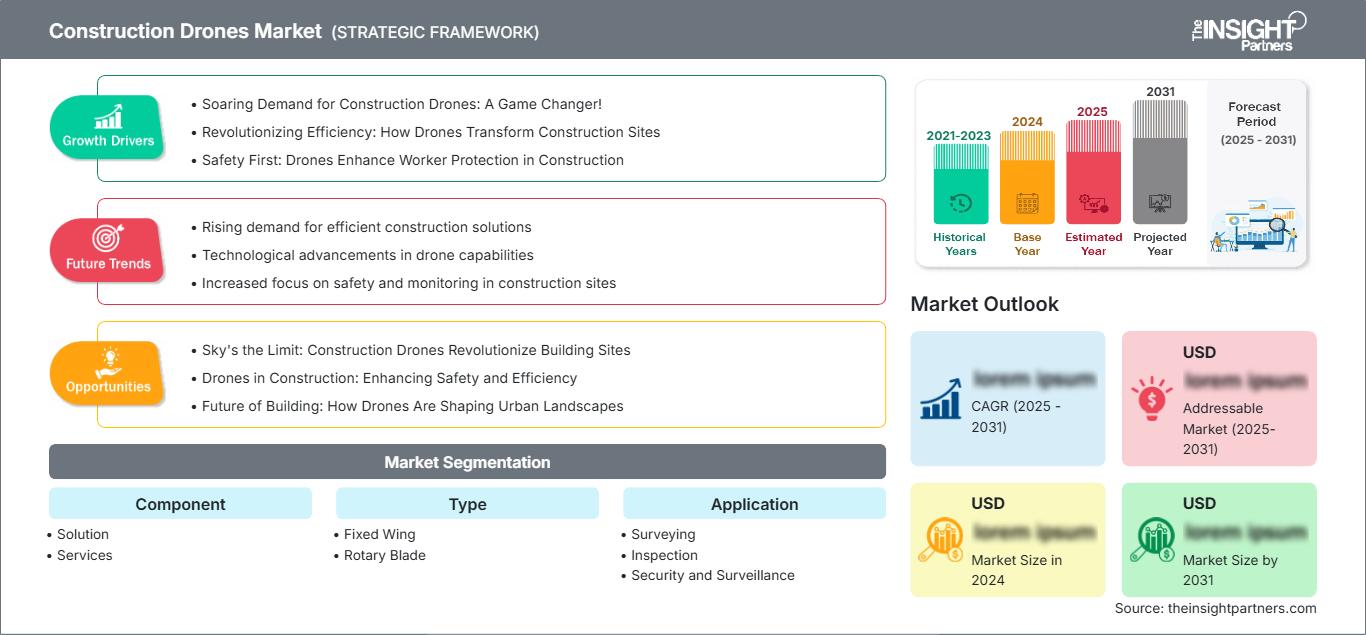
The construction drones market size was valued at US$ 4.50 Billion in 2025 and is projected to reach US$ 9.84 Billion by 2034; it is expected to register a CAGR of 9.08% during 2026–2034. The demand for drones is shifting from experimental aerial capturing to repeatable site intelligence as constructors, surveyors, and asset managers use drones for improving site visibility, increasing inspection rates, and increasing the accuracy of documentation processes.
The construction drones market in North America is fueled by the process of infrastructure modernization, digitalization of commercial buildings, and the development of drone regulation practices. In 2034, the market in the region is projected to expand at a CAGR of 8.2–8.8% while using drones in surveying, inspecting, and security operations.
Construction Drones Market Assessment and Insights
- North America accounted for 39–42% of the construction drones market share in 2025 and is expected to grow at a CAGR of 8.2–8.8% during 2026–2034, supported by infrastructure renewal, FAA-led BVLOS pathways, and mature construction technology budgets.
- US represented 78–82% of North America in 2025 and is projected to grow at 8.0–8.6% CAGR during 2026–2034, led by highway, energy, and commercial project monitoring.
- Europe held 22–25% share in 2025 and is estimated to grow at 8.5–9.1% CAGR during 2026–2034, with Germany, the UK, and France leading BIM-linked aerial surveying adoption.
- Asia Pacific captured 26–29% share in 2025 and is forecast to expand at 10.0–10.8% CAGR during 2026–2034, driven by China, India, Japan, South Korea, and Australia infrastructure pipelines.
- Largest Segment Rotary Blade held 68–72% market share in 2025 and is expected to grow at 8.8–9.4% CAGR during 2026–2034 because short-range site flights require maneuverability.
- High Growth Segment Surveying accounted for 36–40% market share in 2025 and is forecast to expand at 9.8–10.6% CAGR during 2026–2034 as digital terrain models become routine.
- Key companies analyzed in detail: 3D Robotics, Inc.; Leptron Unmanned Aircraft Systems, Inc.; Parrot Drones SAS; PrecisionHawk, Inc.; SZ DJI Technology Co., Ltd.; Trimble Inc.; Yuneec International Co., Ltd.; Wingtra AG; Delair SAS; AgEagle Aerial Systems Inc.
Source: The Insight Partners' analysis based on proprietary research, government publications, company annual reports, investor presentations, industry databases, and expert interviews.
Construction drones projects have moved from sporadic use of aerial images to drone data capture workflow driven by survey control, tracking of construction progress, and safety inspections. The rotary drones take precedence on crowded construction sites while the fixed wing drones and VTOL drones are more prevalent on linear infrastructure and earthwork corridor projects. Construction production factors have moved towards procurement of a complete package of hardware, software, and analytics since the clients are demanding consistent measurement output rather than individual flights.
The regulatory transparency, public spending on infrastructure projects, and cheaper LiDAR sensor technology is likely to boost the demand in Asia Pacific, Middle East, and selected regions of Europe through to 2034. The greatest value proposition will be seen where the drone measurements are used as a basis for payment milestones, dispute avoidance, environmental monitoring, and risk documentation purposes.
Construction Drones Market Report Scope
| Report Attribute | Details |
|---|---|
| Market size in 2025 | US$ 4.50 Billion |
| Market Size by 2034 | US$ 9.84 Billion |
| Global CAGR (2026 - 2034) | 9.08% |
| Historical Data | 2021-2024 |
| Forecast period | 2026-2034 |
Construction Drones Market Analysis
Growth in the market for construction drones is due to quicker cycles of surveying, greater safety for inspections, and increased need for quantifiable documentation. Drones are used by contractors to carry out surveys that were traditionally done manually on rooftops, facades, stockpiles, bridges, and earthworks. The supply chain consists of aircraft, payloads, mission planning, positioning, cloud processing, analytics, and managed services.
The dynamics of the supply chain are shifting towards integrated solutions as the raw images collected by drones have little practical value if not paired with georeferencing, quality assurance, and process integration. Suppliers of components such as batteries, RTK receivers, thermal cameras, and LIDAR modules are enhancing their products, and software companies are integrating drones' aerial imagery into BIM and digital twin solutions.
Competitive positioning in the construction drones market report depends on payload flexibility, compliance, security of data collected, and data processing accuracy. SZ DJI Technology Co., Ltd. continues being a significant player in the domain of enterprise platforms, whereas Trimble Inc. enhances positioning with geospatial correction and mapping. Wingtra AG, Delair SAS, Parrot Drones SAS, and AgEagle Aerial Systems Inc. compete on surveying, fixed-wing and mission-oriented approaches.
Capital flows from aircraft purchases into the entire life cycle intelligence. Big contractors choose suppliers depending on uptime, auditing capability, integration, cybersecurity and service area. PrecisionHawk, Inc., 3D Robotics, Inc., Leptron Unmanned Aircraft Systems, Inc., and Yuneec International Co., Ltd. demonstrate how different types of players such as enterprise platforms, legacy drone vendors, and workflow-oriented solutions exist within the category.
● REPORT CUSTOMIZATION
Tailor This Report To Align With Your Specific Business Requirements
This report can be customized to align precisely with your business objectives, scope, and target markets. Customization options include tailored segmentation, geography, competitive analysis, and strategic insights to support informed decision-making.
Customize This Report →WHAT YOU CAN ADJUST
- ● Segmentations
- ● Geography
- ● Competitive Analysis
- ● Language Preferences
Construction Drones Market: Strategic Insights
Regional Insights
North America Construction Drones Market
North America held 39–42% construction drones market share in 2025 and is expected to grow at 8.2–8.8% CAGR during 2026–2034. Adoption is strongest in transportation infrastructure, commercial real estate, utilities, and industrial construction, where aerial progress evidence supports schedule control and safety documentation.
Regulatory progress remains important. FAA documentation shows rising BVLOS approvals and a proposed framework for scalable low-altitude operations, which could reduce inspection and survey constraints. Contractors also benefit from mature cloud ecosystems, insurance familiarity, and established geospatial service providers, making the region a benchmark for enterprise deployment.
U.S. Construction Drones Market
The U.S. represented 78–82% of North America in 2025 and is projected to grow at 8.0–8.6% CAGR during 2026–2034. Federal infrastructure programs, state transportation upgrades, renewable energy projects, and private commercial construction sustain recurring demand for surveying, inspection, and security monitoring.
Company presence is broad, with Trimble Inc., 3D Robotics, Inc., PrecisionHawk, Inc., Leptron Unmanned Aircraft Systems, Inc., and AgEagle Aerial Systems Inc. serving geospatial, analytics, and operational needs. Applications are shifting toward automated progress reporting, façade inspection, volumetric measurement, and site perimeter surveillance.
Europe Construction Drones Market
Europe accounted for 22–25% share in 2025 and is forecast to grow at 8.5–9.1% CAGR during 2026–2034. Germany is the leading country because civil engineering firms combine drone mapping with BIM, railway upgrades, and industrial site inspection.
The UK market is supported by transport maintenance, brownfield redevelopment, and surveying demand from utilities and commercial contractors. Germany benefits from engineering-led procurement, construction automation, and precision geospatial workflows. France, Italy, and Spain show steady demand in road, energy, port, and urban development programs, although permitting complexity can extend deployment timelines.
APAC Construction Drones Market
APAC held 26–29% share in 2025 and is expected to grow at 10.0–10.8% CAGR during 2026–2034. China is the leading country, supported by drone manufacturing depth, infrastructure scale, and smart construction policies. Japan and South Korea prioritize inspection automation for aging assets.
India and Australia add growth through highways, metros, mining-linked civil works, and renewable energy construction. Regional buyers increasingly seek survey-grade outputs, not only aerial imagery. Policy modernization and lower-cost enterprise drones are widening adoption among mid-sized contractors and engineering consultants.
Middle East & Africa Construction Drones Market
Middle East & Africa is projected to grow at 9.0–9.8% CAGR during 2026–2034, with Saudi Arabia leading adoption. Giga-projects, energy infrastructure, industrial cities, and utilities create demand for aerial progress monitoring, security oversight, and remote inspection across large construction zones.
The UAE emphasizes smart city and real estate construction, while South Africa uses drones for mining-adjacent infrastructure and utilities. Rest of MEA adoption remains project-specific, shaped by airspace permissions, operator availability, and the need for cost-effective monitoring across dispersed assets.
Segmentation Analysis
Component
The component segment is expected to grow at 8.7–9.3% CAGR during 2026–2034. The construction drones market scope increasingly covers integrated solution stacks, where aircraft, sensors, positioning, processing, and managed services operate as one workflow. Buyers prioritize output reliability, cybersecurity, and platform compatibility with construction management tools.
- Solution remains the core revenue contributor because contractors require flight planning, mapping, analytics, and reporting tools that convert imagery into usable measurements for planning and control.
- Services are gaining importance as owners outsource piloting, data processing, regulatory compliance, and repeat site capture to specialist providers with survey and construction domain expertise.
Type
The type segment is projected to grow at 8.9–9.5% CAGR during 2026–2034. Rotary blade systems dominate active jobsites because they hover, maneuver near structures, and operate in confined areas. Fixed wing systems remain relevant for corridors, mines, large campuses, and infrastructure routes where endurance and coverage efficiency matter.
- Fixed Wing platforms support long-distance mapping, corridor surveys, and large-area earthwork documentation where flight endurance, route efficiency, and consistent terrain capture are operational priorities.
- Rotary Blade platforms lead dense construction environments because vertical takeoff, hovering, and close-range inspection capability fit high-rise, industrial, bridge, and utility site conditions.
Application
The application segment is forecast to grow at 9.2–9.9% CAGR during 2026–2034. Surveying remains the largest use case, while inspection and surveillance are expanding as construction owners demand safer, more frequent, and better documented site visibility. Applications increasingly connect to risk management, payment validation, and compliance workflows.
- Surveying delivers the strongest strategic value by accelerating terrain capture, volumetric measurement, route planning, and digital model creation for preconstruction and active site control.
- Inspection demand is rising as drones reduce worker exposure while documenting façades, roofs, cranes, bridges, scaffolding, utilities, and inaccessible structural elements.
- Security and Surveillance supports perimeter monitoring, equipment tracking, material yard visibility, and incident documentation, especially on large projects with dispersed assets and multiple contractors.
- Disaster Recovery is project-critical after storms, floods, fires, and structural incidents because drones rapidly capture damage evidence for insurance, safety review, and restoration planning.
- Filming and Photography remains useful for progress communication, stakeholder reporting, marketing documentation, and visual records, although measurement-led applications command higher strategic priority.
Opportunity Snapshot
| Segment Name | Revenue Contribution | Trend Tag | Adoption Stage |
| Surveying | High | Terrain Models | Mature |
| Inspection | High | Safer Access | Scaling |
| Security and Surveillance | Medium | Site Watch | Scaling |
| Disaster Recovery | Medium | Damage Mapping | Emerging |
| Filming and Photography | Low | Progress Media | Mature |
Construction Drones Market Growth Drivers and Impact Analysis
Digital Jobsite Monitoring Moves Into Core Project Controls
Construction project owners have raised their expectations for regular, unbiased, and traceable visibility into construction project status. Drone technology provides the means to create consistent documentation that can be measured against schedules, drawings, and budgets, thus eliminating manual tracking procedures. The importance of this driver lies in its direct effect on the marketplace, since drone photography becomes a regular business expense and not an optional one associated with media events. As construction companies implement drone surveys weekly or based on milestones, service providers can offer them subscription fees for software and data analysis.
Safety and Inspection Requirements Favor Remote Access Tools
Construction sites have a number of risks including that of height, enclosed spaces, electricity, and unstable structures. Inspection via drones lowers the need for the use of ladders, scaffolds, hoists, and access by humans in selected activities while creating visual proof for safety teams and insurance companies. The effect is greatest in bridge, roof, tower, crane, façade, and energy construction projects. As the safety team calls for more frequent inspections, there will be more opportunity for the drone companies to package the services of thermal vision, zooming, and defect identification.
Survey Productivity Pressures Accelerate Aerial Mapping Adoption
The surveying team must be able to provide faster baselines, earthworks figures, and as-built data without increasing the size of their survey crews in the field. The drone fitted with RTK/PPK, photogrammetry, and LiDAR sensors is capable of delivering fast surveying of vast sites to give out results that can be used for planning, grading, and verifying the progress made. It is clear that there will be an impact in the market since surveying is one of the simplest applications to be able to justify in terms of reducing labor and speeding up decision making cycles.
Construction Drones Market Future Trends
Autonomous Site Intelligence Workflows
In the construction drones market trends, increasing focus is anticipated in areas of autonomous capture, automated problem detection, and comparison with digital models. Rather than flying one drone on an ad hoc basis, contractors will use drones for scheduled flights to produce consistent outputs for purposes of project control, safety, and quality control. AI-driven analysis will help detect problems, unfinished construction tasks, material movement, and access problems. This trend will benefit those companies which offer reliable drones along with cloud-based analysis and construction dashboards. Eventually, drones could be another layer of digital twins.
BVLOS-Enabled Infrastructure Monitoring
The regulatory trend towards routine BVLOS operations is set to slowly transform monitoring of long corridor constructions. Road projects, railroads, pipelines, electric power distribution corridors, and renewable energy projects need inspection over lengths where it is inefficient to use a visual-line-of-sight approach. With the regulations becoming more clear, companies will be able to develop missions that rely on fewer personnel in the field and better data collection. This development should increase the need for fixed-wing, VTOL, detect and avoid, and communication solutions.
Construction Drones Market Opportunities
Managed Drone Data Services for Mid-Sized Contractors
Many mid-sized contractors lack internal drone pilots, survey specialists, and analytics teams, yet still need better jobsite visibility. This creates an opportunity for managed service providers offering compliant flights, processing, dashboards, and recurring reporting under predictable monthly contracts. The construction drones market forecasts indicate that application-led revenue will increasingly favor providers that reduce operational burden for clients. A practical investment route is to specialize in repeatable packages for earthwork, progress reporting, inspection, and security, with clear service-level commitments. Providers can differentiate through local permitting expertise, insured operations, and compatibility with common construction software.
High-Accuracy Mapping for Public Infrastructure Programs
Public works programs present an enduring opportunity for drone mapping services due to the need for speedier evidence for design verification, billing of contractors, regulatory requirements, and turnover to maintenance. Suppliers of RTK, PPK, LiDAR, and secure data transfer services can target the transportation, water, energy, and building markets for their opportunities. The opportunity is very practical in nature: suppliers should match their output capabilities to the language of agencies and procurement processes. Cooperation with engineering firms can hasten the adoption process because the drone-derived data becomes part of an entire process chain.
Recent Developments
- July 2025: Wingtra AG — launched WingtraRAY, a survey-focused drone designed for faster urban infrastructure and large-site mapping. The platform supports waiver-free operations over people in much of the U.S. with a parachute add-on, six hot-swap payloads, and workflows that can capture 100 hectares in ten minutes.
- June 2025: SZ DJI Technology Co., Ltd. — introduced Matrice 400, an enterprise drone platform with 59-minute flight time, up to 6 kg payload capacity, and LiDAR plus mmWave radar obstacle sensing. DJI positioned the system for construction, engineering, mapping, emergency response, and power line inspection applications
- September 2024: Trimble Inc. — launched the Trimble APX RTX portfolio for UAV mapping sensors, integrating CenterPoint RTX for real-time and post-mission direct georeferencing. The portfolio supports centimeter-level mapping accuracy without base stations, improving productivity for uncrewed airborne surveying and construction mapping workflows.
Frequently Asked Questions

- Comprehensive Market Sizing and Forecast Analysis
- Detailed Segmentation Analysis
- In-Depth Market Dynamics Assessment
- Regional and Country-Level Insights
- Competitive Landscape and Company Benchmarking
- Strategic Business Intelligence
Recent Reports
Testimonials

The Insight Partners provided valuable market intelligence that supported our global go-to-market strategy. Their team was professional, responsive, and attentive to our feedback, providing thoughtful analysis and helpful methodological clarifications throughout the project.
Junmo Kim Chief Financial Officer (CFO), Enertech Co., Ltd.
The Insight Partners' SCADA System Market report is comprehensive, with valuable insights on current trends and future forecasts. The team was highly professional, responsive, and supportive throughout. We are very satisfied and highly recommend their services.
RAN KEDEM Partner, Reali Technologies LTDs
I requested a report on a very specific software market and the team produced the report in a few days. The information was very relevant and well presented. I then requested some changes and additions to the report. The team was again very responsive and I got the final report in less than a week.
JEAN-HERVE JENN Chairman, Future Analytica
We worked with The Insight Partners for an important market study and forecast. They gave us clear insights into opportunities and risks, which helped shape our plans. Their research was easy to use and based on solid data. It helped us make smart, confident decisions. We highly recommend them.
PIYUSH NAGPAL Sr. Vice President, High Beam Global
The Insight Partners delivered insightful, well-structured market research with strong domain expertise. Their team was professional and responsive throughout. The user-friendly website made accessing industry reports seamless. We highly recommend them for reliable, high-quality research services
YUKIHIKO ADACHI CEO, Deep Blue, LLC.
This is the first time I have purchased a market report from The Insight Partners.While I was unsure at first, I visited their web site and felt more comfortable to take the risk and purchase a market report.I am completely satisfied with the quality of the report and customer service. I had several questions and comments with the initial report, but after a couple of dialogs over email with their analyst I believe I have a report that I can use as input to our strategic planning process.Thank you so much for taking the extra time and making this a positive experience.I will definitely recommend your service to others and you will be my first call when we need further market data.
JOHN SUZUKI President and Chief Executive Officer, Board Director, BK Technologies
I wish to appreciate your support and the professionalism you displayed in the course of attending to my request for information regarding to infectious disease IVD market in Nigeria. I appreciate your patience, your guidance, and the fact that you were willing to offer a discount, which eventually made it possible for us to close a deal. I look forward to engaging The Insight Partners in the future, all thanks to the impression you have created in me as a result of this first encounter.
DR CHIJIOKE ONYIA MANAGING DIRECTOR, PineCrest Healthcare Ltd.Reason to Buy
- Informed Decision-Making
- Understanding Market Dynamics
- Competitive Analysis
- Identifying Emerging Markets
- Customer Insights
- Market Forecasts
- Risk Mitigation
- Boosting Operational Efficiency
- Strategic Planning
- Investment Justification
- Tracking Industry Innovations
- Aligning with Regulatory Trends





 Get Free Sample for