
Construction Sustainable Materials Market Trends, Share & Demand by 2034
Coverage: by Product Type (Structural Products, Interior Products, Exterior Products, Building Systems); Application (Insulation, Roofing, Framing, Interior, Finishing, Exterior, Siding, Others); End-User Industry (Commercial Buildings, Industrial Construction, Residential Construction, Others), and Geography (North America, Europe, Asia Pacific, and South and Central America)
- Status : Data Released
- Report Code : TIPRE00013038
- Category : Chemicals and Materials
- No. of Pages : 150
- Available Report Formats :


- Last update date : September 01, 2026


2025 Market Size
US$ 341.54 Bn
Base year value
2034 Forecast
US$ 929.78 Bn
Projected by 2034
CAGR 2026-2034
11.77 %
Growth rate
Addressable Market
US$ 5,585.80 Bn
(2026-2034)
Construction Sustainable Materials Market is expanding from US$ 341.54 Billion in 2025 to US$ 929.78 Billion by 2034, representing a CAGR of 11.77% during 2026–2034. Growth reflects accelerating use of lower-carbon, energy-efficient, circular, and resource-efficient building products across new construction and renovation. Structural products, insulation, roofing, and interior systems are increasingly evaluated through embodied carbon, operational efficiency, durability, recyclability, and whole-life performance criteria.
North American demand is supported by energy-efficiency retrofits, green-building certification, resilient construction, and public investment in infrastructure and housing. The Construction Sustainable Materials Market size is expected to advance at an estimated 10.2–11.4% CAGR during 2026–2034, with demand strengthened by stricter building performance requirements and greater use of environmental product declarations.
Construction Sustainable Materials Market Assessment and Insights
- North America: North America is estimated to hold a 30–34% Construction Sustainable Materials Market in 2025 and grow at a 10.2–11.4% CAGR between 2026–2034, supported by renovation, energy codes, resilient construction, and institutional green-building procurement.
- US: The US represents 64–69% of North American demand in 2025 and is expected to expand at a 10.4–11.6% CAGR during 2026–2034, led by commercial retrofits and efficient building envelopes.
- Europe: Europe is estimated at a 24–28% share in 2025 and a 10.7–11.9% CAGR through 2034, with Germany, the UK, France, Italy, and Spain supporting demand through renovation, energy-performance rules, and circularity initiatives.
- Asia Pacific: Asia Pacific accounts for a 31–35% share in 2025 and is projected to grow at an 11.9–13.2% CAGR during 2026–2034, led by China, India, Japan, South Korea, and Australia.
- Largest Segment: Structural Products holds an estimated 38–42% market share in 2025 and is expected to grow at a 10.8–12.0% CAGR during 2026–2034, reflecting broad use across building envelopes and structures.
- High Growth Segment: Building Systems holds an estimated 16–20% market share in 2025 and is projected to grow at a 12.6–14.0% CAGR during 2026–2034, supported by integrated energy and prefabricated solutions.
- Key companies analyzed in detail: The Alumasc Group plc, Amvic Inc., BASF SE, Bauder Ltd., CertainTeed Corporation, DuPont de Nemours, Inc., Forbo International SA, Interface, Inc., Kingspan Group plc, and Owens Corning.
Source: The Insight Partners' analysis based on proprietary research, government publications, company annual reports, investor presentations, industry databases, and expert interviews.
Materials used in construction are being substituted for traditional, carbon-emitting materials by those which not only provide better performance but are also environmentally responsible. Recycled materials, biological sources, low-carbon binders, high-performance insulation, modular systems, and life cycle assessments are increasingly playing roles in specification. Low energy processes, localization, material traceability, and design for disassembly in production along with embodied carbon in architecture are also increasing in importance.
Renovation, urbanization, climate change adaption, and disclosure are factors that will define the future in this area. In developing countries, development could be achieved by local production of recycled aggregates, insulation, engineered wood products, and efficient envelope systems. Investments will be made in companies which can supply environmental product declarations, reliable technical performance, recycled or renewable raw materials, and scale-up manufacturing process without major installation changes.
Construction Sustainable Materials Market Report Scope
| Report Attribute | Details |
|---|---|
| Market size in 2025 | US$ 341.54 Billion |
| Market Size by 2034 | US$ 929.78 Billion |
| Global CAGR (2026 - 2034) | 11.77% |
| Historical Data | 2021-2024 |
| Forecast period | 2026-2034 |
Construction Sustainable Materials Market Analysis
The demand for sustainability is becoming more oriented towards overall building performance than material properties alone. As such, the factors affecting the Construction Sustainable Materials Market growth include developers, architects, builders, building owners, certification agencies, and manufacturers all along the chain. Insulating and envelope materials help reduce energy requirements, while recycled and biological materials take care of the carbon footprint and resource utilization.
The supply chain will be driven by recyclable raw materials, renewable energy, competent production facilities, logistics, and certification facilities. Suppliers that integrate raw materials procurement and have regional production facilities will be able to improve their supply chain efficiency and avoid the risks of transportation. Some high-performance materials may require additional qualification and installation steps that might slow down the process.
Competition is becoming more and more reliant on portfolio range, carbon clarity, product performance, and building systems integration. The Construction Sustainable Materials Market report features BASF SE, Kingspan Group plc, Owens Corning, and DuPont de Nemours, Inc. as well as niche players such as The Alumasc Group plc, Bauder Ltd., Amvic Inc., Forbo International SA, and Interface, Inc.
Capital will flow into lower carbon insulation, closed loop flooring, energy-efficient roofing, engineered wood structures, and pre-fab systems. Kingspan Group plc is working to advance their insulation envelope solutions, and Interface, Inc. is developing recycling and biogenic content. BASF SE is focusing on lower carbon chemistry and footprint measurement. Increasingly, competitive advantage is determined by lifecycle case, production close to market, specifying support, and regulatory compliance.
● REPORT CUSTOMIZATION
Tailor This Report To Align With Your Specific Business Requirements
This report can be customized to align precisely with your business objectives, scope, and target markets. Customization options include tailored segmentation, geography, competitive analysis, and strategic insights to support informed decision-making.
Customize This Report →WHAT YOU CAN ADJUST
- ● Segmentations
- ● Geography
- ● Competitive Analysis
- ● Language Preferences
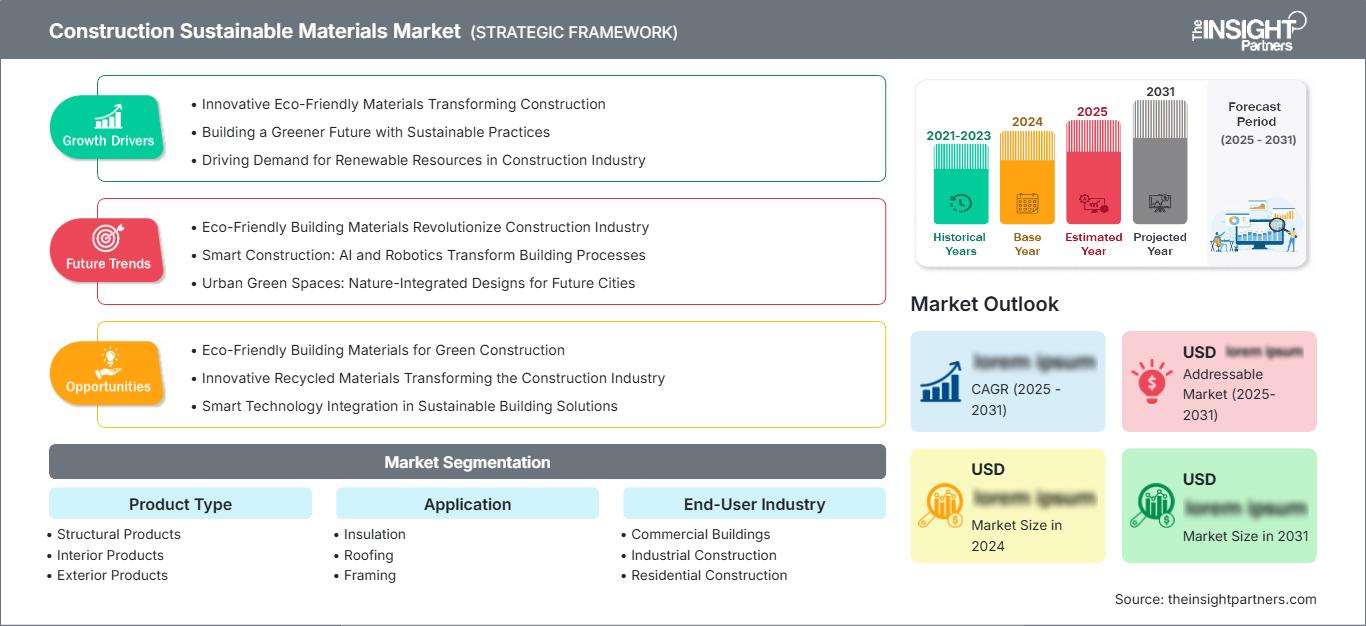
Construction Sustainable Materials Market: Strategic Insights
Regional Insights
North America Construction Sustainable Materials Market
It is estimated that North America will account for 30–34% of 2025 demand on the back of 10.2–11.4% CAGR to 2034. Renovation activities, energy efficiency regulations, resilience in construction, and institutional procurement norms provide an enabling environment. While the US will continue to take a lead, Canada adds value in terms of efficient housing and buildings.
The regional manufacturing base is developed with competitive advantages in insulation, roofing, flooring, framing, and building envelopes. Green building certifications and environmental product declarations also drive demand. Manufacturers with manufacturing facilities and contractor networks will benefit in responding to changing specifications and minimize the risk of exposure to logistics.
U.S. Construction Sustainable Materials Market
The US accounts for 64–69% of North American demand in 2025 and is expected to expand at a 10.4–11.6% CAGR through 2034. Demands for materials are seen in insulation, roofing, framing, exterior and interior products, where both commercial and residential renovations present many opportunities.
Companies such as BASF SE, Owens Corning, Kingspan Group Plc, CertainTeed Corporation and Interface, Inc. hold key positions in their categories. Increasingly, there is preference for materials that are efficient in terms of energy use, durable, recyclable and environmentally sound. Commercial buildings are more sensitive about certifications while residential applications benefit from energy savings.
Europe Construction Sustainable Materials Market
Europe is estimated to hold a 24–28% share in 2025 and grow at a 10.7–11.9% CAGR through 2034. Germany is the leading country, while the UK, France, Italy, and Spain contribute through renovation, insulation, roofing, and circular construction.
For the UK, there is building decarbonization, retrofit demand, and whole life carbon impacts. For Germany, there are renovations and highly performing building envelopes, where manufactures are focusing on insulation and efficiency of systems. In France, there are renovation and low carbon building requirements; for Italy and Spain, there is renovation and climate adaptation and efficient cooling systems.
APAC Construction Sustainable Materials Market
APAC is estimated at a 31–35% share in 2025 and is expected to grow at an 11.9–13.2% CAGR through 2034. China leads the market, followed by Japan, India, South Korea, and Australia. The factors driving the market include urban growth, infrastructure investments, energy efficiency, and resource limitations.
In China, it is the combination of high levels of construction along with sustainable building practices and manufacturing on an industrial scale. In India, it is driven by urbanization and commercial development. Efficiency and high-tech materials are favored in Japan and South Korea, whereas performance is key in Australia.
Middle East & Africa Construction Sustainable Materials Market
Middle East and Africa demand is smaller but increasingly influenced by infrastructure programs, climate adaptation, and energy efficiency. Saudi Arabia is the leading market, followed by the UAE and South Africa, while the rest of MEA presents selective opportunities.
The regional market is expected to expand at an 8.8–10.2% CAGR through 2034. High cooling requirements increase the value of efficient insulation and reflective roofing, while major developments support durable envelope systems. Saudi Arabia and the UAE benefit from urban projects, whereas South Africa has stronger retrofit and efficiency needs. Local sourcing remains important.
Segmentation Analysis
Product Type
Structural Products are expected to grow at a 10.8–12.0% CAGR during 2026–2034. They benefit from lower-carbon structures, engineered components, and durable envelopes. Building Systems are gaining faster as integrated energy and prefabricated solutions become more common. Interior and exterior categories increasingly compete on lifecycle performance, recycled content, and installation efficiency.
- Structural Products: Demand centers on lower-carbon structural solutions, engineered components, and durable assemblies. Their importance is high because structural choices influence embodied carbon, longevity, material efficiency, and construction productivity.
- Interior Products: Flooring and finishes increasingly incorporate recycled or bio-based content. Specification is influenced by indoor environmental quality, durability, maintenance cycles, circularity, and documented product attributes.
- Exterior Products: Exterior products benefit from weather resistance, thermal performance, and facade durability. Their importance is rising as buildings face stronger heat, moisture, wind, and climate-related performance requirements.
- Building Systems: Integrated systems combine multiple performance functions and simplify installation. Adoption is supported by prefabrication, energy efficiency, reduced site waste, standardized components, and predictable construction schedules.
Application
Application demand is projected to develop at an 11.2–12.4% CAGR during 2026–2034 as energy performance, weather protection, and resource efficiency become embedded in project specifications. Insulation and roofing remain strategically important because they affect building energy performance, while framing, finishing, siding, and exterior systems increasingly incorporate circular attributes.
- Insulation: High-performance insulation remains central to reducing heating and cooling requirements. Demand is strengthened by energy-performance expectations, retrofit activity, climate adaptation, and improved envelope efficiency.
- Roofing: Roofing systems are increasingly specified for durability, reflectivity, insulation compatibility, water management, and lifecycle performance. Sustainable roofing can reduce heat gain while extending replacement intervals.
- Framing: Framing demand reflects material efficiency, engineered construction, prefabrication, and lower embodied carbon. Developers favor systems that shorten installation time while meeting structural and fire-performance requirements.
- Interior: Interior applications include flooring and finishes where recycled content, low-emission formulations, durability, and circularity influence purchasing decisions, particularly in commercial and institutional projects.
- Finishing: Sustainable finishing solutions emphasize low emissions, efficient application, durability, and resource use. Certification and ingredient transparency increasingly affect selection by architects, contractors, and building owners.
- Exterior: Exterior applications require weather resistance, durability, thermal performance, and reduced maintenance. Demand is supported by climate resilience and improved building-envelope performance.
- Siding: Siding solutions are increasingly evaluated for durability, insulation compatibility, recycled content, maintenance requirements, and resistance to moisture and temperature variation.
End-User Industry
Commercial Buildings are expected to remain the largest end-user category, while Residential Construction offers substantial volume through renovation and efficiency upgrades. Industrial Construction benefits from demand for efficient envelopes, durable materials, and buildings designed for demanding operating environments. Overall, the segment is projected to grow at an 11.0–12.2% CAGR during 2026–2034.
- Commercial Buildings: Offices, retail, hospitality, healthcare, and institutional facilities increasingly use sustainable materials to meet certification, energy, lifecycle, and occupant-comfort objectives.
- Industrial Construction: Warehouses, manufacturing plants, logistics facilities, and data infrastructure prioritize durable envelopes, thermal control, rapid installation, and predictable lifecycle performance.
- Residential Construction: Housing demand is shaped by energy costs, building codes, resilience, affordability, and retrofit economics. Efficient insulation, roofing, framing, and exterior products are key adoption areas.
Opportunity Snapshot
| Application | Revenue Contribution | Trend Tag | Adoption Stage |
|---|---|---|---|
| Insulation | High | Thermal Efficiency | Mature |
| Roofing | High | Cool Roofing | Mature |
| Framing | Medium | Low Carbon | Scaling |
| Interior | Medium | Circular Interiors | Scaling |
| Finishing | Medium | Low Emission | Scaling |
| Exterior | Medium | Climate Resilience | Scaling |
| Siding | Medium | Durable Envelopes | Scaling |
Construction Sustainable Materials Market Growth Drivers and Impact Analysis
Energy-efficiency requirements strengthen material replacement cycles
Energy performance needs are making insulation, roofing, framing, and enclosure systems key investments rather than sustainable options. Buyers are evaluating products based on energy performance, maintenance, longevity, and embodied carbon footprint. The reason is that high price can still be cost-effective as long as the total lifecycle costs are low. The effect is even greater for retrofit projects where insulation and roofing replacements can take place without reconstructing the entire structure. Those manufacturers which provide evidence regarding their products' energy performance, longevity, recycled materials, and carbon footprint will have an advantage when specifying products. The effect is not limited to the volume of the material alone.
Carbon disclosure accelerates adoption of measurable low-impact products
The growing use of life-cycle assessment, environmental product declarations, and embodied-carbon benchmarks is changing how sustainable materials are evaluated. The buyers have begun demanding evidence-based comparisons instead of just general statements about environment, which has led to an increasing need on the part of manufacturers to quantify their impact regarding raw materials, emissions in manufacturing, recycled content, and their end-of-life. This has resulted in an increased need for digital data related to products, traceability of inputs used, and declarations. This has also resulted in an increased demand for suppliers who can develop products that have reduced footprints without any loss of performance parameters like structure, thermal insulation, resistance to fire, moisture, or durability.
Urbanization and infrastructure investment broaden sustainable material demand
Urban population growth and infrastructure expansion are increasing construction volumes across emerging economies while governments and developers seek to limit resource consumption. The use of sustainable materials may meet this need by employing prefabrication techniques, energy-efficient envelopes, recycling of materials, durable surfaces, and low waste construction processes. For rapidly growing urban centers, local manufacturing helps reduce logistics expenses and supply chain risks, thereby enhancing the commercial viability of such products. Projects involving infrastructure and buildings provide opportunities on a large scale for those suppliers who can adopt proven technology using regional raw materials and climatic conditions. This effect is felt the most in cases where construction efficiency is limited due to the nature of an integrated process that can simultaneously reduce on-site labor, installation time, and material wastage.
Construction Sustainable Materials Market Future Trends
Carbon-storing and bio-based material platforms move toward scale
The Construction Sustainable Materials Market trends are shifting from simple resource efficiency toward materials designed to reduce, avoid, or store carbon across their lifecycle. Materials such as bio-derived binders, engineered wood, captured carbon sources, mineralization materials, recycled plastics, and biomass balanced chemistry are making the move from niche applications into wider commercial applications. In the next step, there will be an emphasis on feedstock reliability, certification, economic viability, and capability to work with current production machinery. Carbon footprints of products will form an increasingly important part of specifications, enabling comparisons to be made. Suppliers may well produce hybrid products incorporating low carbon content in addition to existing capabilities instead of requiring a whole new construction technique to be developed. This could reduce adoption timescales as the contractor can use existing construction techniques, but the project owner achieves better sustainability.
Digital material passports improve procurement and circularity
Digitalization will increasingly connect material specifications with carbon data, recycled content, maintenance information, and end-of-life pathways. Digital material passports can support procurement decisions and improve traceability throughout a building’s lifecycle. For manufacturers, this creates an opportunity to distinguish products through verified performance rather than marketing claims. For contractors, standardized digital information can simplify compliance, reduce specification errors, and support material recovery during renovation or demolition. The Construction Sustainable Materials Market will consequently become more data-intensive, with product databases, building information models, environmental declarations, and lifecycle calculations becoming increasingly interconnected. Over time, procurement platforms may rank materials using cost, performance, carbon, circularity, and durability simultaneously. This can encourage suppliers to redesign products around measurable lifecycle outcomes and make secondary-material markets easier to integrate into mainstream construction workflows.
Construction Sustainable Materials Market Opportunities
Regional manufacturing of circular material inputs
Investment opportunities are emerging in regional production platforms for recycled aggregates, recycled polymers, engineered timber, low-carbon insulation, and other circular construction inputs. Localized facilities can reduce transportation exposure, improve feedstock utilization, and adapt products to regional building codes and climate conditions. Investors and manufacturers can prioritize markets where construction volumes are high but imported sustainable materials remain costly or inconsistent. Partnerships with demolition companies, recyclers, utilities, forestry operators, and construction firms can strengthen feedstock security while creating closed-loop supply arrangements. The Construction Sustainable Materials Market scope therefore extends beyond finished products into upstream collection, processing, certification, and digital traceability. Companies that integrate these stages can improve quality control and provide more reliable environmental data. Such models can create defensible regional positions because access to suitable waste streams and qualified processing capacity can become a competitive barrier.
Integrated building-envelope solutions for retrofit markets
Retrofit programs offer substantial opportunity for suppliers that package insulation, roofing, exterior systems, framing components, and finishing products into coordinated solutions. Building owners often face fragmented procurement, uncertain installation quality, and limited project disruption windows. Integrated packages can address these constraints by providing compatible components, standardized installation methods, technical guidance, and lifecycle documentation. The Construction Sustainable Materials Market Forecasts indicate that suppliers able to link product performance with retrofit economics can strengthen their position as efficiency spending expands. Commercial portfolios, schools, healthcare facilities, and multifamily housing are particularly suitable because repeatable building types enable standardized solutions. Companies can also use digital assessments to identify energy losses and recommend product combinations. This creates a service-enabled model in which material sales are supported by design assistance, performance verification, maintenance planning, and post-installation documentation.
Recent Developments
- April 2026: TimberHP, the first U.S.-based manufacturer of wood fiber insulation, announced a strategic investment from FTAI Infrastructure Inc. (NASDAQ: FIP), managed by Fortress Investment Group. The investment marks a significant milestone in TimberHP's growth and will support the continued ramp-up of production at its Madison, Maine facility and the expansion of its commercial footprint across North America. As demand increases for cost-effective, low-carbon building materials, the partnership positions TimberHP to better scale safer, more sustainable insulation solutions while boosting U.S. manufacturing. The collaboration reflects a shared commitment to advancing high-performance building materials and accelerating the transition to more sustainable construction practices.
- February 2026: Verdane, the European specialist growth equity investment firm, announced a partnership investment in Ashcourt Group, a leading UK-based provider of waste management and sustainable construction materials. Ashcourt Group has established itself as a trusted partner to the construction industry across Yorkshire, Lincolnshire and the North East of England. The business offers a comprehensive range of solutions including recycled and virgin aggregate products, waste recycling services, ready-mix concrete, haulage and plant hire, supported by a substantial operational footprint, logistical network and strategically located sites.
Frequently Asked Questions

- Comprehensive Market Sizing and Forecast Analysis
- Detailed Segmentation Analysis
- In-Depth Market Dynamics Assessment
- Regional and Country-Level Insights
- Competitive Landscape and Company Benchmarking
- Strategic Business Intelligence
Recent Reports
Testimonials

The Insight Partners' SCADA System Market report is comprehensive, with valuable insights on current trends and future forecasts. The team was highly professional, responsive, and supportive throughout. We are very satisfied and highly recommend their services.
RAN KEDEM Partner, Reali Technologies LTDs
I requested a report on a very specific software market and the team produced the report in a few days. The information was very relevant and well presented. I then requested some changes and additions to the report. The team was again very responsive and I got the final report in less than a week.
JEAN-HERVE JENN Chairman, Future Analytica
We worked with The Insight Partners for an important market study and forecast. They gave us clear insights into opportunities and risks, which helped shape our plans. Their research was easy to use and based on solid data. It helped us make smart, confident decisions. We highly recommend them.
PIYUSH NAGPAL Sr. Vice President, High Beam Global
The Insight Partners delivered insightful, well-structured market research with strong domain expertise. Their team was professional and responsive throughout. The user-friendly website made accessing industry reports seamless. We highly recommend them for reliable, high-quality research services
YUKIHIKO ADACHI CEO, Deep Blue, LLC.
This is the first time I have purchased a market report from The Insight Partners.While I was unsure at first, I visited their web site and felt more comfortable to take the risk and purchase a market report.I am completely satisfied with the quality of the report and customer service. I had several questions and comments with the initial report, but after a couple of dialogs over email with their analyst I believe I have a report that I can use as input to our strategic planning process.Thank you so much for taking the extra time and making this a positive experience.I will definitely recommend your service to others and you will be my first call when we need further market data.
JOHN SUZUKI President and Chief Executive Officer, Board Director, BK Technologies
I wish to appreciate your support and the professionalism you displayed in the course of attending to my request for information regarding to infectious disease IVD market in Nigeria. I appreciate your patience, your guidance, and the fact that you were willing to offer a discount, which eventually made it possible for us to close a deal. I look forward to engaging The Insight Partners in the future, all thanks to the impression you have created in me as a result of this first encounter.
DR CHIJIOKE ONYIA MANAGING DIRECTOR, PineCrest Healthcare Ltd.Reason to Buy
- Informed Decision-Making
- Understanding Market Dynamics
- Competitive Analysis
- Identifying Emerging Markets
- Customer Insights
- Market Forecasts
- Risk Mitigation
- Boosting Operational Efficiency
- Strategic Planning
- Investment Justification
- Tracking Industry Innovations
- Aligning with Regulatory Trends





 Get Free Sample for