
Consumer Telematics Market Demand, Size & Forecast by 2034
Coverage: By Solution (Fleet Management, Navigation Systems, User-based Insurance service, V2V, Infotainment Systems, Analytics, Remote Alarm and Monitoring, Insurance Telematics, Others); Component (Hardware, Software and Service); End User (Automotive, Insurance, Government Agencies, Logistics, Telecommunication and IT, Others) , and Geography (North America, Europe, Asia Pacific, and South and Central America)
- Status : Data Released
- Report Code : TIPTE100000903
- Category : Electronics and Semiconductor
- No. of Pages : 150
- Available Report Formats :


- Last update date : July 31, 2026


2025 Market Size
US$ 40.98 Bn
Base year value
2034 Forecast
US$ 195.84 Bn
Projected by 2034
CAGR 2026-2034
18.98 %
Growth rate
Addressable Market
US$ 970.59 Bn
(2026-2034)
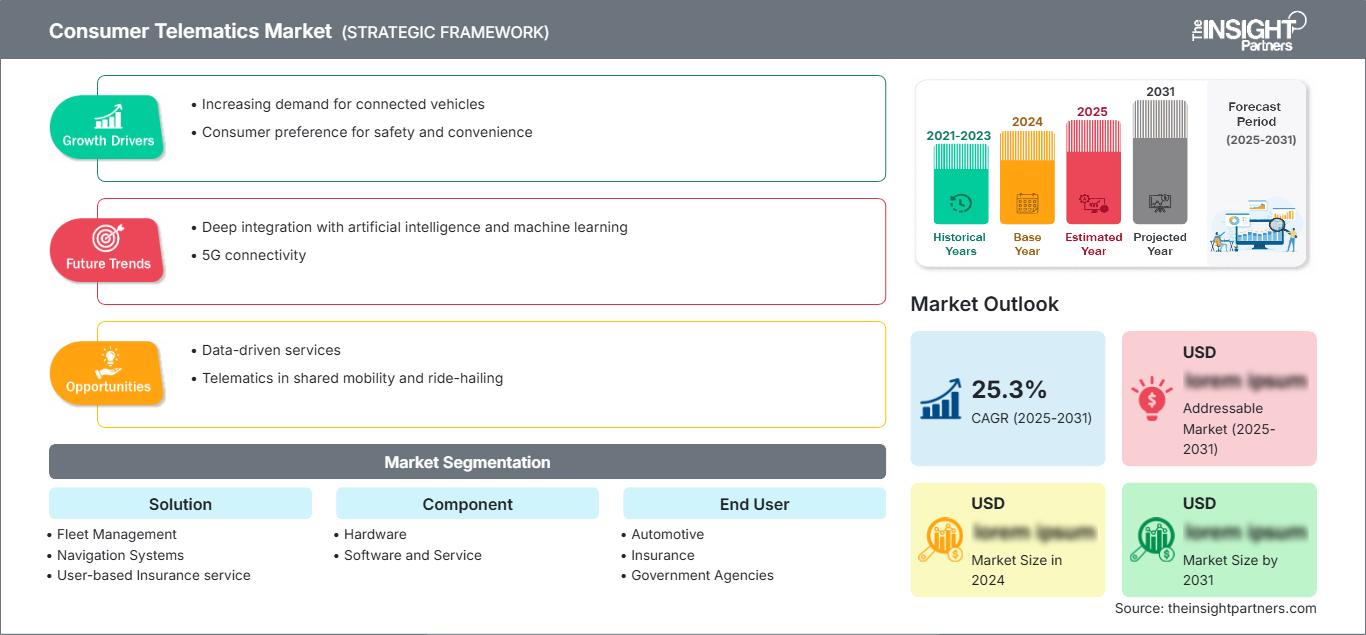
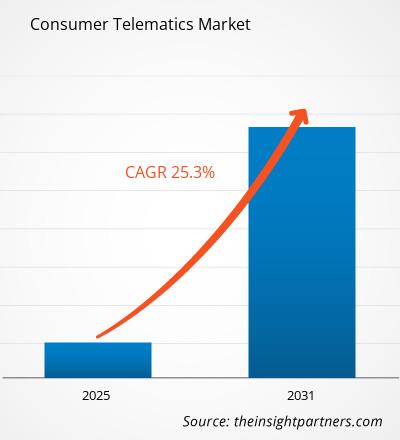
The Consumer Telematics Market will be worth US$ 40.98 Billion in 2025 and is estimated to grow to US$ 195.84 Billion by 2034 with a CAGR of 18.98% during 2026–2034. There will be increased adoption in view of connected cars, communication embedded systems, driver behavior analytics, insurance telematics, infotainment, remote diagnosis, and vehicle-to-vehicle services that have become crucial for consumer transportation, efficiency in fleets, and data-driven automotive businesses.
North America continues to represent a key demand center with the Consumer Telematics Market size backed by forecast growth of 17.5–19.0% CAGR during 2026–2034. Such growth is linked to a high connected car penetration rate, mature cellular network infrastructure, usage-based insurance programs of insurers, fleet management digitalization in enterprises, and advanced adoption of telematics control units prepared for 5G technology and over-the-air services.
Consumer Telematics Market Assessment and Insights
- North America: The region holds a 34–38% share in 2025 and is forecast to grow at a CAGR of 17.5–19.0% during 2026–2034, led by connected vehicle services, insurer programs, and fleet analytics.
- US: The country represents 80–84% of North America in 2025 and is projected to grow at a CAGR of 17.8–19.3% during 2026–2034.
- Europe: Europe accounts for a 24–28% share in 2025 and is expected to grow at a CAGR of 16.8–18.4% during 2026–2034, led by Germany, the UK, France, Italy, and Spain.
- Asia Pacific: Asia Pacific represents a 26–30% share in 2025 and is forecast to grow at a CAGR of 20.5–22.3% during 2026–2034, with China, Japan, South Korea, India, and Australia driving adoption.
- Largest Segment: Fleet Management holds 29–33% market share in 2025 and is expected to grow at a CAGR of 18.0–19.6% during 2026–2034.
- High Growth Segment: User-based Insurance service holds 12–16% market share in 2025 and is expected to grow at a CAGR of 22.0–24.2% during 2026–2034.
- Key companies analyzed in detail: Inseego Corp.; Telefónica S.A.; Verizon Communications Inc.; Trimble Inc.; AT&T Intellectual Property II, L.P.; TomTom N.V.; Powerfleet, Inc.; Harman International Industries, Incorporated; Solera Holdings, LLC; Robert Bosch GmbH.
Source: The Insight Partners' analysis based on proprietary research, government publications, company annual reports, investor presentations, industry databases, and expert interviews.
Vehicle connectivity has transitioned from being a luxury to being a recurrent digital platform connecting drivers, automotive companies, insurance providers, telcos, and mobility platforms. Telematics control unit, cloud platform, embedded SIM cards, GPS unit, and analytics engine enable functionalities such as navigation, accident notification, vehicle condition management, infotainment, and pay-as-you-drive insurance. The market is changing thanks to quick OEM integration, growth of aftermarket device uptake, and increasing monetization of vehicle data within the mobility ecosystem.
Drivers of demand in the future would be software-defined vehicles, electric car diagnostics, availability of 5G networks, regulation-compliant safety programs, and the experience of the vehicle as an app for customers. New markets will emerge with rising numbers of smartphone users, the prevalence of digital insurance, and logistics requirements in urban areas. Investments are focused on scalable service platforms, security, open APIs, and data collaborations that may lead to value from vehicle data in the form of safety, convenience, claims, and fleet efficiency.
Consumer Telematics Market Report Scope
| Report Attribute | Details |
|---|---|
| Market size in 2025 | US$ 40.98 Billion |
| Market Size by 2034 | US$ 195.84 Billion |
| Global CAGR (2026 - 2034) | 18.98% |
| Historical Data | 2021-2024 |
| Forecast period | 2026-2034 |
Consumer Telematics Market Analysis
The demand for consumer telematics is driven by the adoption of connected cars, delivery vehicles, expectations regarding personal safety, and insurance offerings based on measured driver behavior. The Consumer Telematics Market is also dependent on emergency response capabilities, vehicle tracking for recovery in the event of a theft, navigation services, and predictive maintenance that convert data from the vehicles into value-based services for the customers.
Value Chain in the market includes chipset providers, hardware and device providers, telecom network providers, automobile manufacturers, insurers, cloud computing providers, analytics companies, and service providers. Favorable supply dynamics are seen in platforms that scale across embedded devices, tethered devices, and aftermarket installations with cybersecurity capabilities, security measures, and high availability.
Competitive analysis is determined by telecom operators, navigation providers, fleet management systems, Tier I Electronics providers, and insurance technology providers. Consumer Telematics Market report shows that Verizon Communications Inc., Telefónica S.A., AT&T Intellectual Property II, L.P., Trimble Inc., TomTom N.V., Harman International Industries, Incorporated, Robert Bosch GmbH, Inseego Corp., Powerfleet, Inc., and Solera Holdings, LLC are competing using the metrics of connectivity capability, analytics, device capabilities, and services.
Investment themes revolve around 5G telematics control units, over-the-air diagnostics, edge analytics, secure eSIM provisioning, and insurance data platforms. Strategic positioning becomes increasingly dependent on blending the margins from hardware with revenues from software. Players who can handle consent management, cybersecurity, roaming across borders, and vehicle data harmonization will be able to protect value in a world where simple tracking is commoditizing.
● REPORT CUSTOMIZATION
Tailor This Report To Align With Your Specific Business Requirements
This report can be customized to align precisely with your business objectives, scope, and target markets. Customization options include tailored segmentation, geography, competitive analysis, and strategic insights to support informed decision-making.
Customize This Report →WHAT YOU CAN ADJUST
- ● Segmentations
- ● Geography
- ● Competitive Analysis
- ● Language Preferences
Consumer Telematics Market: Strategic Insights
Regional Insights
North America Consumer Telematics Market
North America holds a 34–38% share in 2025 and is projected to grow at a CAGR of 17.5–19.0% during 2026–2034. Consumer Telematics Market share is reinforced by mature LTE and 5G coverage, high vehicle ownership, insurer experimentation with usage-based premiums, and advanced fleet-management adoption.
The regional demand for the products has encouraged the usage of embedded telematics, aftermarket OBD, driver scoring, remote alarm systems, infotainment, and predictive maintenance services. There is also a rise in subscriptions from OEMs and telecommunications companies, while the logistics companies use route, fuel, and driver information to reduce downtime.
U.S. Consumer Telematics Market
North America holds a share of 80–84% of demand in the United States in 2025 and is forecasted to grow at a CAGR of 17.8–19.3% from 2026 through 2034. The applications include insurance scoring, car-theft retrieval, teenage driver monitoring, navigation, infotainment, and connectivity solutions embedded in passenger cars and light commercial vehicles.
The corporate presence includes Verizon Communications Inc., AT&T Intellectual Property II, L.P., Trimble Inc., Inseego Corp., Harman International Industries, Incorporated, and Solera Holdings, LLC. The customers prefer good quality networks, security solutions, claim management, and mobile application support. The Consumer Telematics Market has achieved the maximum penetration in the regions where risk reduction can be measured by the insurer or the fleet operator.
Europe Consumer Telematics Market
Europe holds 24-28% of the market share in 2025 and is expected to exhibit a CAGR of 16.8-18.4% between 2026 and 2034. Germany dominates through premium cars connected, industrial logistics, and eCall-based embedded telematics. The UK is adding demand through insurance telematics, fleet leasing, and safety of consumer solutions.
France, Italy, and Spain are contributing to the field of urban mobility, insurer cooperation, and navigation solutions. European procurement practices are affected by laws related to privacy, automotive cybersecurity, and carbon efficiencies. Telefónica S.A., TomTom N.V., Robert Bosch GmbH, and Harman International Industries, Incorporated are participating in the Consumer Telematics Market in terms of connectivity, mapping, electronics, and platforms, respectively.
APAC Consumer Telematics Market
The APAC region is projected to have a 26-30% market share in 2025, with an estimated growth rate of 20.5-22.3% during 2026-2034. China dominates the country, thanks to the electric vehicle trend, the pilot projects of the digital insurance model, smart transport system policies, and connected infotainment requirements.
Other countries like Japan, South Korea, India, and Australia help boost the growth of the segment, with the OEM telematics technology, smartphone integration, digitization of logistics, and safety road initiatives. The industrial drivers of this market are electronics manufacturing, deployment of 5G networks, and cloud platforms.
Middle East & Africa Consumer Telematics Market
The Middle East & Africa market segment will experience a growth rate of 15.2–17.0% CAGR between 2026 and 2034. Saudi Arabia is the market leader in the region due to the growth in smart city development, logistics, and vehicle safety monitoring. The UAE provides value-added connected services and fleet applications for the region.
South Africa and Rest of MEA have adopted telematics through insurance-based applications, anti-theft recovery, mining fleets, and public sector projects. The energy availability and connectivity reliability continue to play a vital role since service availability requires reliable network coverage and channel support.
Segmentation Analysis
Solution
The Solution segment is projected to grow at a CAGR of 18.4–20.2% during 2026–2034. Consumer Telematics Market scope spans services that convert vehicle data into fleet visibility, navigation, driver risk scoring, infotainment, insurance workflows, remote alerts, and analytics. Demand is strongest where providers can combine reliable connectivity, real-time processing, and user-facing applications.
- Fleet Management remains the largest solution as logistics, rental, leasing, and service fleets use location, driver behavior, maintenance, and route data to lower operating costs.
- Navigation Systems support everyday mobility through traffic awareness, route optimization, charging-location discovery, and location-based services that increase the usefulness of embedded and smartphone-linked platforms.
- User-based Insurance service is expanding as insurers use consent-based driving data to price risk, improve claims handling, and encourage safer behavior through personalized feedback.
- V2V enables vehicles to exchange safety and movement signals, supporting collision avoidance, cooperative mobility, and future intelligent transport systems requiring low-latency communication.
- Infotainment Systems strengthen consumer engagement by integrating media, navigation, voice assistance, app ecosystems, and connected services within increasingly software-defined vehicle interiors.
- Analytics converts telematics data into maintenance forecasts, risk models, usage patterns, and monetizable insights for automakers, insurers, fleet operators, and mobility service providers.
- Remote Alarm and Monitoring supports theft alerts, geofencing, vehicle health checks, remote immobilization, and emergency notifications, making it valuable for personal safety and asset protection.
- Insurance Telematics links driving behavior, mileage, braking, acceleration, and location data with underwriting, fraud detection, claims triage, and customer retention strategies.
Component
The Component segment is estimated to grow at a CAGR of 17.8–19.5% during 2026–2034. Hardware remains essential for data capture, while software and service layers create recurring value through analytics, connectivity management, device provisioning, and customer support. Buyers increasingly evaluate total lifecycle reliability rather than standalone device cost.
- Hardware includes telematics control units, GPS modules, sensors, antennas, OBD devices, and embedded SIMs that capture vehicle, driver, location, and connectivity data.
- Software and Service include dashboards, analytics engines, mobile apps, connectivity subscriptions, integration support, cybersecurity updates, and managed services that monetize data after deployment.
End User
The End User segment is projected to grow at a CAGR of 18.0–19.8% during 2026–2034. Automotive users drive embedded adoption, while insurers, logistics firms, government agencies, telecom operators, and IT providers expand service demand. Each group uses connected vehicle data differently, from safety assurance to premium pricing, route efficiency, and platform monetization.
- Automotive users integrate telematics into connected cars, software-defined vehicle platforms, remote diagnostics, infotainment, EV monitoring, and lifecycle customer engagement services.
- Insurance users apply driving data to usage-based policies, claims assessment, fraud detection, driver coaching, and customer segmentation across personal and commercial lines.
- Government Agencies use telematics for road safety, emergency response, regulatory compliance, public fleets, intelligent transport systems, and traffic-management initiatives.
- Logistics users depend on telematics for route planning, fuel efficiency, asset tracking, driver monitoring, cold-chain visibility, and predictive maintenance.
- Telecommunication and IT users provide connectivity, cloud hosting, data platforms, API integration, cybersecurity, and managed services that support connected mobility ecosystems.
Opportunity Snapshot
| End User | Revenue Contribution | Trend Tag | Adoption Stage |
| Automotive | High | Embedded Services | Scaling |
| Insurance | High | Risk Pricing | Scaling |
| Government Agencies | Medium | Road Safety | Emerging |
| Logistics | High | Fleet Visibility | Mature |
| Telecommunication and IT | Medium | Vehicle APIs | Scaling |
Consumer Telematics Market Growth Drivers and Impact Analysis
Connected Vehicle Penetration and Embedded Service Models
The most important structural change factor is the increased penetration of connected cars due to the increased embedding of telematics during manufacture and activation of subscriptions. Consumers are increasingly expecting vehicles to have features such as navigation, emergency calls, remote locking, diagnosis, and infotainment updates that are just as reliable as their smartphones. From the perspective of car manufacturers, embedding telematics results in recurring revenue after selling a car. From the market point of view, there will be a transition from selling one-off hardware to service packages.
Usage-Based Insurance and Data-Led Risk Pricing
The growing popularity of usage-based insurance is fueled by the fact that it gives customers an incentive to provide information on their driving habits directly through a financial benefit. Information such as mileage, braking, acceleration, turning, time of the day, and location will be used by insurance companies to tailor their rates, prevent fraud, and speed up claims processes. This driver widens the addressable market to include not only car owners willing to purchase telematics for convenience but also other drivers.
Fleet Digitization Across Urban Mobility and Logistics
Telematics is being used in urban logistics, fleet operations, leasing companies, and last-mile delivery companies to increase vehicle utilization, route compliance, fuel consumption, and driver safety. It is also becoming popular with mobility service providers for consumers, such as rentals, subscription vehicles, car sharing, and monitoring of family cars. The effects on the ground include reduced downtime, more effective scheduling of maintenance services, and prevention of unauthorized use. Telematics providers who incorporate dashboards, mobile applications, and alerts can move from tracking to workflow management.
Consumer Telematics Market Future Trends
AI-Based Predictive Mobility Services
Consumer Telematics Market trends will move beyond descriptive dashboards toward predictive services that anticipate maintenance needs, driver risk, charging behavior, route disruption, and claims likelihood. AI models trained on vehicle, traffic, weather, and behavior data can convert routine telemetry into recommendations for drivers, insurers, and fleet operators. Future differentiation will depend on explainable scoring, privacy-safe data processing, and platform interoperability. As software-defined vehicles expand, predictive mobility services may become a core subscription layer rather than a specialist analytics add-on.
Open Vehicle APIs and Cross-Industry Data Exchange
Open vehicle APIs will become more important as automakers, telecom operators, insurers, repair networks, and mobility platforms need standardized access to permissioned vehicle data. Instead of building isolated integrations for each brand or device, service providers will seek common data models that reduce deployment time and improve service consistency. This trend can accelerate innovation in remote diagnostics, claims automation, EV charging support, and emergency response. Trust frameworks, cybersecurity controls, and consent management will determine whether data exchange scales commercially.
Consumer Telematics Market Opportunities
Insurance Data Platforms for Personalized Mobility Pricing
Consumer Telematics Market Forecasts indicate a strong opportunity for platforms that help insurers launch personalized pricing without building full technology stacks internally. Vendors can provide device onboarding, mobile scoring, consent capture, claims data integration, and actuarial dashboards as managed services. The action path is to package telematics data into auditable risk signals that insurers can trust across policy origination, renewal, and claims. This opportunity is attractive because recurring platform revenue can scale with policy volume while improving customer retention and loss control.
EV Diagnostics and Battery-Aware Connected Services
Electric vehicles create an opportunity to link telematics with battery health, charging behavior, range prediction, thermal monitoring, and service planning. Consumers need reliable information on remaining range and charging options, while fleets need data that protects uptime and residual value. Vendors can develop EV-specific dashboards, alerts, and analytics for automakers, insurers, leasing firms, and charging networks. The opportunity is strongest where telematics providers combine vehicle data with energy pricing, charging infrastructure visibility, and maintenance recommendations.
Recent Developments
- July 2026: Targa Telematics partnered with Hyundai Connected Mobility to integrate connected vehicle data streams from Hyundai vehicles into Targa’s fleet management platform. The collaboration enables hardware-free fleet monitoring by using embedded vehicle telematics, allowing fleet operators to access real-time vehicle location, mileage, fuel level, battery status, EV charging information, driving analysis, maintenance insights, and fault monitoring to improve fleet efficiency, safety, and sustainability.
- February 2026: LG Electronics unveiled its next-generation smart telematics solution at MWC Barcelona 2026, featuring an integrated Telematics Control Unit (TCU) and antenna module designed to enhance vehicle connectivity, system efficiency, and automotive design flexibility. The solution supports multiple communication technologies, including 5G, GPS, Vehicle-to-Everything (V2X), and satellite communications, while reducing wiring complexity, improving signal processing, and enabling faster data exchange for the transition from Software-Defined Vehicles (SDVs) to AI-Defined Vehicles (AIDVs).
- July 2026: VitalEdge Technologies acquired LHP Telematics to expand machine intelligence capabilities for heavy equipment dealers, rental fleets, OEMs, and mixed-fleet operators. The acquisition integrates LHP Telematics’ connected equipment solutions with VitalEdge’s dealer management platforms, enabling access to machine-level insights such as equipment location, utilization, meter readings, engine hours, fault codes, and asset health data. The combined capabilities aim to improve fleet visibility, predictive maintenance, service response, equipment uptime, and AI-driven decision-making across construction, agriculture, material handling, and rental industries.
Frequently Asked Questions

- Comprehensive Market Sizing and Forecast Analysis
- Detailed Segmentation Analysis
- In-Depth Market Dynamics Assessment
- Regional and Country-Level Insights
- Competitive Landscape and Company Benchmarking
- Strategic Business Intelligence
Recent Reports
Testimonials

The Insight Partners provided valuable market intelligence that supported our global go-to-market strategy. Their team was professional, responsive, and attentive to our feedback, providing thoughtful analysis and helpful methodological clarifications throughout the project.
Junmo Kim Chief Financial Officer (CFO), Enertech Co., Ltd.
The Insight Partners' SCADA System Market report is comprehensive, with valuable insights on current trends and future forecasts. The team was highly professional, responsive, and supportive throughout. We are very satisfied and highly recommend their services.
RAN KEDEM Partner, Reali Technologies LTDs
I requested a report on a very specific software market and the team produced the report in a few days. The information was very relevant and well presented. I then requested some changes and additions to the report. The team was again very responsive and I got the final report in less than a week.
JEAN-HERVE JENN Chairman, Future Analytica
We worked with The Insight Partners for an important market study and forecast. They gave us clear insights into opportunities and risks, which helped shape our plans. Their research was easy to use and based on solid data. It helped us make smart, confident decisions. We highly recommend them.
PIYUSH NAGPAL Sr. Vice President, High Beam Global
The Insight Partners delivered insightful, well-structured market research with strong domain expertise. Their team was professional and responsive throughout. The user-friendly website made accessing industry reports seamless. We highly recommend them for reliable, high-quality research services
YUKIHIKO ADACHI CEO, Deep Blue, LLC.
This is the first time I have purchased a market report from The Insight Partners.While I was unsure at first, I visited their web site and felt more comfortable to take the risk and purchase a market report.I am completely satisfied with the quality of the report and customer service. I had several questions and comments with the initial report, but after a couple of dialogs over email with their analyst I believe I have a report that I can use as input to our strategic planning process.Thank you so much for taking the extra time and making this a positive experience.I will definitely recommend your service to others and you will be my first call when we need further market data.
JOHN SUZUKI President and Chief Executive Officer, Board Director, BK Technologies
I wish to appreciate your support and the professionalism you displayed in the course of attending to my request for information regarding to infectious disease IVD market in Nigeria. I appreciate your patience, your guidance, and the fact that you were willing to offer a discount, which eventually made it possible for us to close a deal. I look forward to engaging The Insight Partners in the future, all thanks to the impression you have created in me as a result of this first encounter.
DR CHIJIOKE ONYIA MANAGING DIRECTOR, PineCrest Healthcare Ltd.Reason to Buy
- Informed Decision-Making
- Understanding Market Dynamics
- Competitive Analysis
- Identifying Emerging Markets
- Customer Insights
- Market Forecasts
- Risk Mitigation
- Boosting Operational Efficiency
- Strategic Planning
- Investment Justification
- Tracking Industry Innovations
- Aligning with Regulatory Trends





 Get Free Sample for