
Container Handling Equipment Market Trends, Demand & Growth by 2034
Coverage: By Engine Capacity (Less than 7 Litre, 7-10 Litre, More than 10 Litre); Power (Less than150 kW, 150-200 kW, 201-300 kW, More than 300 kW); Propulsion Type (Output Electric, Diesel, Hybrid); Equipment Type (Laden Forklift Truck (FLT), Automated Stacking Crane (ASC), Rail Mounted Gantry (RMG) Crane, Rubber Tired Gantry (RTG) Crane, Mobile Harbor Crane (MHC), Others) , and Geography (North America, Europe, Asia Pacific, and South and Central America)
- Status : Data Released
- Report Code : TIPEL00002119
- Category : Manufacturing and Construction
- No. of Pages : 150
- Available Report Formats :


- Last update date : July 21, 2026


2025 Market Size
US$ 8.21 Bn
Base year value
2034 Forecast
US$ 12.50 Bn
Projected by 2034
CAGR 2026-2034
4.78 %
Growth rate
Addressable Market
US$ 94.00 Bn
(2026-2034)
The global container handling equipment market size stood at US$ 8.21 Billion in 2025, and is expected to reach US$ 12.50 Billion in 2034. It is anticipated to grow at a CAGR of 4.78% from 2026 to 2034. Port upgrades, yard automation, growth of intermodal transport, and replacement of old diesel engines are expected to drive the demand.
In North America, the container handling equipment market is driven by port electrification, distribution center connections to railways, and improved dwell-time management at major gateways. This region is expected to grow at a CAGR range of 4.2–4.8% from 2026 to 2034.
Container Handling Equipment Market Assessment and Insights
- North America accounted for 28–32% container handling equipment market share in 2025 and is growing at a CAGR of 4.2–4.8% between 2026–2034, led by port electrification, intermodal rail activity, and terminal productivity upgrades.
- US represented 76–80% of North America in 2025 and is growing at a CAGR of 4.1–4.7% between 2026–2034, supported by gateway modernization and inland logistics expansion.
- Europe held 22–26% share in 2025 and is growing at a CAGR of 4.0–4.6% between 2026–2034, with Germany, the Netherlands, Belgium, Spain, and the UK leading replacement-led procurement.
- Asia Pacific captured 30–34% share in 2025 and is growing at a CAGR of 5.1–5.7% between 2026–2034, driven by China, India, Japan, South Korea, and Australia through port expansion and export logistics.
- Largest Segment Diesel propulsion held 48–52% market share in 2025 and is growing at a CAGR of 3.4–4.0% during 2026–2034 due to heavy-duty reliability.
- High Growth Segment Output Electric propulsion held 18–22% market share in 2025 and is growing at a CAGR of 6.2–6.8% during 2026–2034 as terminals decarbonize fleets.
- Key companies analyzed in detail: Kalmar Corporation, Hyster-Yale Materials Handling, Inc., CVS Ferrari S.p.A., Konecranes Plc, Liebherr-International Deutschland GmbH, SANY Heavy Industry Co., Ltd., Hoist Liftruck Mfg., LLC, Steelbro Group Limited, Taylor Machine Works, Inc., Combilift Unlimited Company.
Source: The Insight Partners' analysis based on proprietary research, government publications, company annual reports, investor presentations, industry databases, and expert interviews.
Operators have shifted from standalone equipment to fleet systems that integrate cranes, forklifts, telematics, energy management, and maintenance services. The equipment used in container handling industry has changed due to increased call volume, labor force availability, emissions requirements and yard congestion. Equipment manufacturers are focusing on production with respect to modular electric drive, automation-ready controls and service offerings in their regions while buyers consider lifecycle cost instead of mere purchasing cost.
The investment will continue gaining momentum in newly established maritime trade routes in which throughput of containers, migration of manufacturing industries, and logistics parks have grown. Regulations favoring low-emission cargo handling, port resilience, and energy efficiency will drive replacement cycles. The connected equipment fleet will prompt buyers to make investments in suppliers who can provide machinery reliability, software, operator safety and diverse power sources.
Container Handling Equipment Market Report Scope
| Report Attribute | Details |
|---|---|
| Market size in 2025 | US$ 8.21 Billion |
| Market Size by 2034 | US$ 12.50 Billion |
| Global CAGR (2026 - 2034) | 4.78% |
| Historical Data | 2021-2024 |
| Forecast period | 2026-2034 |
Container Handling Equipment Market Analysis
Growth in the container handling equipment market is supported by the standardization of container trade, the management of port congestion, and the requirement to increase moves per hour while maintaining the same footprint. The analysis from the World Bank of port performance places the time a vessel spends in a port as one of the key efficiency indicators, emphasizing investment in faster yard transfers, stacking, and gates.
On the supply side, the factors affecting the market include the price of steel, batteries, availability of engines with higher horsepower, as well as the long delivery periods of gantry cranes. The purchasers are increasingly focusing on the availability of standardized platforms and aftersales in their regions in order to decrease downtime.
The competitive landscape within the market for container handling equipment reveals the presence of moderate concentration, as companies like Kalmar Corporation, Konecranes Plc, Liebherr-International Deutschland GmbH, SANY Heavy Industry Co., Ltd., and Hyster-Yale Materials Handling, Inc. are competing on automation capabilities, service provision, energy efficiency, and engineering of solutions tailored to particular applications.
Investments in the industry focus on brownfield facility improvements, the implementation of electric forklifts, automatic stacking crane systems, and hybrid mobile harbor cranes. Specialized manufacturers, including CVS Ferrari S.p.A., Hoist Liftruck Mfg., LLC, Steelbro Group Limited, Taylor Machine Works, Inc., and Combilift Unlimited Company, remain relevant by specializing in load handling in confined spaces.
● REPORT CUSTOMIZATION
Tailor This Report To Align With Your Specific Business Requirements
This report can be customized to align precisely with your business objectives, scope, and target markets. Customization options include tailored segmentation, geography, competitive analysis, and strategic insights to support informed decision-making.
Customize This Report →WHAT YOU CAN ADJUST
- ● Segmentations
- ● Geography
- ● Competitive Analysis
- ● Language Preferences
Container Handling Equipment Market: Strategic Insights
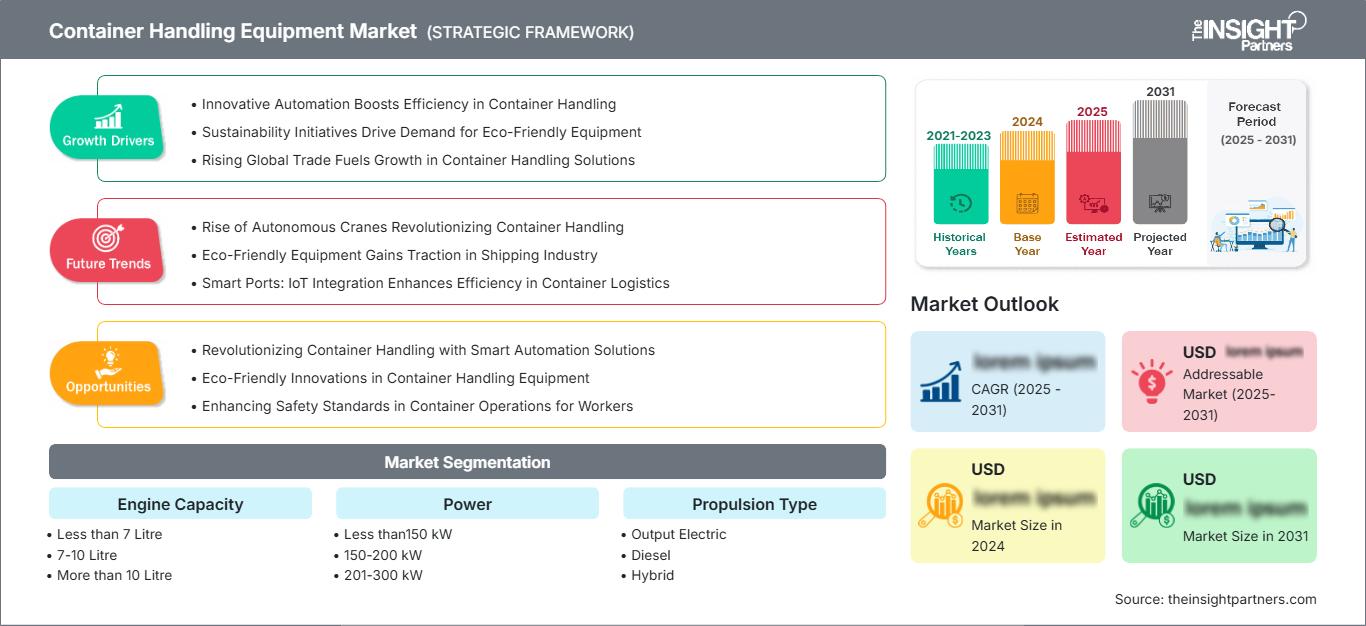
Regional Insights
North America Container Handling Equipment Market
The market share of North America was 28-32% in 2025 due to large marine gateways, rail-connected inland ports and high replacement needs in diesel yards. The region will experience an average annual growth rate of 4.2%-4.8% between 2026 and 2034 due to focus on electrified forklifts, rubber-tired gantry upgradation and telemetry-based maintenance.
Structure demands are driven by dwell-time minimization projects and government initiatives aimed at reducing carbon emissions for logistics activities. Data from the World Bank shows consistent inefficiency in the ports sector, while IATA highlighted the record global air cargo demand in 2025.
U.S. Container Handling Equipment Market
The United States comprised of 76–80% of the share of North America in 2025 and is forecasted to witness a CAGR of 4.1–4.7% from 2026 to 2034. Market demand centers on the logistics gateways of Los Angeles, Long Beach, Savannah, Houston, New York-NJ, and Gulf Coast, wherein efficient container handling, automation of warehouses, and efficient rail connectivity necessitate strong fleets.
The presence of players remains broad, with Kalmar Corporation, Hyster-Yale Materials Handling, Inc., Taylor Machine Works, Inc., and Hoist Liftruck Mfg., LLC serving terminals, rail yards, and other industries. Purchase trends are now leaning towards forklifts powered by lithium-ion technology, hybrid cranes, and predictive maintenance systems.
Europe Container Handling Equipment Market
Europe held the largest share of 22–26% in 2025 and has been predicted to register a CAGR of 4.0–4.6% till 2034. Germany leads the Europe region owing to high inland logistics density, exports of automotive products, and integration of rail terminals. In the UK, the market is driven by automation of ports, freeport-linked warehousing, and the replacement of the existing diesel fleet.
Germany has a competitive edge owing to ports of Hamburg, Bremerhaven, Duisburg-related inland terminals, and freight flow generated by manufacturing which need rail-mounted cranes and heavy-duty forklifts. Selective growth in France, Italy, and Spain can be attributed to transshipment through Mediterranean ports, concessions in ports and logistics corridors linked with consumer goods, automotive parts, and agriculture exports.
APAC Container Handling Equipment Market
APAC has been enjoying market share of 30–34% in 2025 and is anticipated to have a CAGR of 5.1–5.7% between 2026 and 2034. It will be growing fastest among all regions. China dominates owing to its vast coastal ports, domestic manufacturing capabilities, and capacity to manufacture cranes locally.
Japan and South Korea emphasize automation of their terminals and reliability of maintenance of these terminals. India and Australia drive growth through the privatization of their ports, mineral exports, container railway lines, and distribution centers.
Middle East & Africa Container Handling Equipment Market
Middle East & Africa is expected to grow at a CAGR of 4.6–5.2% during 2026–2034, supported by port expansion, energy project logistics, and free-zone development. Saudi Arabia is the leading country as industrial diversification increases containerized inputs and export cargo.
The UAE continues to invest in transshipment and logistics parks, while South Africa and the Rest of MEA require equipment upgrades to improve vessel turnaround and inland connectivity. Demand favors mobile harbor cranes, diesel forklifts, and hybrid systems suited to variable grid reliability.
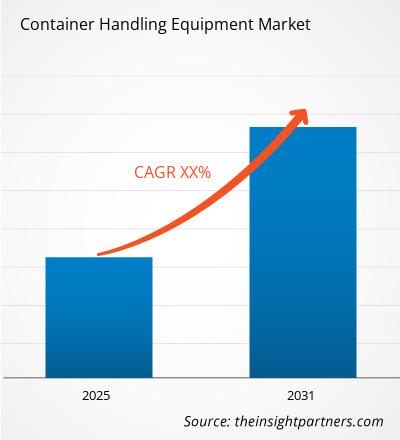
Segmentation Analysis
Engine Capacity
Engine Capacity is expected to grow at a CAGR of 4.3–4.9% during 2026–2034 as terminal operators align power output with duty cycle, fuel efficiency, and maintenance cost. The container handling equipment market scope across this segment is defined by fleet size, operating intensity, load frequency, and whether equipment works in port yards, rail terminals, or industrial depots.
- Less than 7 Litre equipment serves lighter yard operations, small depots, and maintenance-sensitive fleets where fuel economy, maneuverability, and lower upfront cost matter more than maximum lift performance.
- 7-10 Litre engines remain strategically important for medium-duty container handling, offering balanced torque, reliability, and serviceability across ports managing mixed cargo volumes and variable operating hours.
- More than 10 Litre engines support heavy-duty applications, high-load cycles, and demanding terminal environments where sustained power, durability, and uptime outweigh higher fuel and maintenance costs.
Power
Power is projected to record a CAGR of 4.4–5.0% from 2026 to 2034, reflecting demand for application-specific lifting, travel speed, and energy efficiency. Buyers are moving away from oversized fleets and toward right-powered equipment that reduces operating cost while maintaining peak-hour capacity in container yards and intermodal transfer points.
- Less than15 kW equipment is used in auxiliary handling, light depot work, and low-intensity operations where compact design, lower energy use, and ease of charging support daily productivity.
- 15-2 kW equipment addresses moderate movement cycles in small terminals and warehouses, where operators need dependable handling capacity without the cost of high-power platforms.
- 21-3 kW equipment supports mid-range container movement, balancing operating flexibility, stronger lift performance, and suitability for mixed fleets serving both port and inland logistics environments.
- More than 3 kW equipment remains essential for intensive port operations where continuous lifting, high travel frequency, and operational resilience are required during peak vessel windows.
Propulsion Type
Propulsion Type is expected to grow at a CAGR of 4.9–5.5% during 2026–2034 as emission compliance, fuel volatility, and charging infrastructure reshape purchasing decisions. Diesel remains relevant for heavy-duty continuity, while electric and hybrid platforms gain traction where ports can combine grid upgrades, predictable duty cycles, and sustainability-linked financing.
- Output Electric platforms are gaining strategic importance in zero-emission terminal programs, particularly where predictable routes, overnight charging, and lower noise support urban port operations.
- Diesel equipment retains the largest installed base because high torque, refueling speed, and proven service ecosystems suit heavy lifting, remote terminals, and high-utilization fleets.
- Hybrid systems bridge operational reliability and decarbonization needs, helping terminals reduce fuel use while avoiding full dependence on charging infrastructure during long shifts.
Equipment Type
Equipment Type is projected to expand at a CAGR of 4.6–5.2% from 2026 to 2034, shaped by yard density, berth productivity, container weight, and automation maturity. Terminals are combining mobile and fixed assets to improve throughput, reduce idle time, and manage different container flows across quay, stack, rail, and gate interfaces.
- Laden Forklift Truck remains vital for flexible container movement in smaller terminals, industrial sites, and repair yards where operators value maneuverability and lower infrastructure requirements.
- Automated Stacking Crane supports high-density terminals seeking predictable yard sequencing, labor optimization, and higher safety through controlled movement within automated container blocks.
- Rail Mounted Gantry Crane is important for intermodal terminals and rail-connected ports where precise stacking, high throughput, and long-span operations support container transfer efficiency.
- Rubber Tired Gantry Crane serves flexible yard operations and brownfield ports, offering mobility across stacks while increasingly adopting hybrid or electric power systems.
- Mobile Harbor Crane is strategically relevant for multipurpose ports handling containers and breakbulk, providing adaptable berth-side capacity without permanent quay crane infrastructure.
Opportunity Snapshot
| Equipment Type | Revenue Contribution | Trend Tag | Adoption Stage |
| Laden Forklift Truck | High | Fleet Renewal | Mature |
| Automated Stacking Crane | Medium | Yard Automation | Scaling |
| Rail Mounted Gantry Crane | Medium | Intermodal Lift | Scaling |
| Rubber Tired Gantry Crane | High | Hybrid Yard | Mature |
| Mobile Harbor Crane | Medium | Flexible Berth | Scaling |
Container Handling Equipment Market Growth Drivers and Impact Analysis
Port productivity pressure and larger vessel calls
There is significant pressure on container ports to ensure efficient ship turnarounds due to the increasing size of vessels used by shipping companies and the continued sensitivity of scheduling to congestion. In its analysis of container ports, the World Bank has identified vessel time at ports, related logistics costs, and emissions, with equipment efficiency as a quantifiable operational factor. This would drive up the demand for rail-mounted gantry cranes, rubber tire gantry cranes, automated stacking cranes, and high-capacity forklifts capable of increasing moves per hour.
Emission rules accelerate propulsion transition
There is increasing pressure on ports to decrease pollution and emissions from port cargo handling equipment. This results in demand for electric or hybrid equipment in scenarios where the operational path is consistent and the charging can coincide with shifts. Diesel will still be needed in difficult conditions, but procurement criteria are placing greater emphasis on efficiency, batteries, and maintenance services. This means the commercial implication is a longer replacement-cycle planning horizon, considering grid constraints, charging capabilities, and total cost of ownership.
Intermodal logistics expansion raises inland demand
Demand is expanding due to increased rail connectivity, inland container depots, and manufacturing logistics. The shippers have started using inland points to manage congestion, reduce drayage distance, and place their inventory closer to consumer points. There is a growing need for equipment like medium-duty forklifts, rubber-tired gantry cranes, and rail mounted gantry cranes for performing repeated handling operations at these inland locations. The manufacturers of the equipment have more varied demand while the operators need machinery that is capable of handling varying loads and interfacing with the terminal operating systems.
Container Handling Equipment Market Future Trends
Automation-ready fleets become standard procurement
The next phase of container handling equipment market trends will center on automation-ready designs rather than full automation alone. Terminals are expected to buy machines with sensor packages, remote diagnostics, drive-by-wire capability, and integration interfaces even when manual operation remains the default. This approach lets operators phase automation gradually while protecting current productivity. Suppliers that can provide interoperable software, cybersecurity controls, and operator training will gain strategic advantage. The trend also shifts value from hardware margins toward lifecycle services, data analytics, and upgrade pathways that extend equipment relevance across multiple terminal operating models.
Battery ecosystems reshape fleet economics
Battery-electric adoption will increasingly depend on the ecosystem around the machine, including chargers, energy management software, spare battery logistics, and grid connection planning. Ports with predictable duty cycles can optimize charging windows and lower operating cost, while high-intensity terminals may require hybrid bridge solutions. Financing models could bundle batteries, maintenance, and uptime guarantees to reduce buyer risk. As battery performance improves, equipment selection will move from simple powertrain comparison to a broader assessment of energy resilience, peak-demand charges, and operational continuity during extended cargo peaks.
Container Handling Equipment Market Opportunities
Brownfield terminal modernization packages
Brownfield ports represent a strong opportunity because many terminals must raise capacity without major land expansion. Suppliers can package rubber tired gantry crane upgrades, electric forklifts, telematics, charger planning, and maintenance services into staged modernization programs. The container handling equipment market forecasts indicate that buyers will favor lower-disruption projects that improve yard density and energy efficiency while keeping berths operational. Successful vendors will offer retrofit pathways, operator training, parts availability, and financing structures that help terminals sequence investments across budget cycles rather than rely on single large procurement events.
Inland depots and rail terminals
Inland depots and rail terminals offer attractive growth because container flows are increasingly managed away from congested seaports. Equipment suppliers can target operators that need compact forklifts, rail mounted gantry cranes, and service contracts suited to distributed locations. These facilities often require flexible assets capable of handling import, export, and empty container repositioning in the same yard. Opportunity is strongest where governments develop industrial corridors, dry ports, and multimodal logistics parks, allowing equipment vendors to build recurring revenue through maintenance, fleet analytics, operator training, and phased expansion support.
Recent Developments
- June 2026: Kalmar Corporation — concluded separate agreements with customers in Inner Mongolia, Tianjin, Shanghai and Hong Kong to supply a total of four Kalmar electric reachstackers. The machines are the first units to feature Kalmar’s next-generation lithium-ion battery technology, which delivers enhanced energy capacity, improved thermal stability, and a longer, more predictable performance curve across a wide range of operating environments.
- July 2026: Leading global terminal operator YILPORT Holding has ordered 53 E-Hybrid Rubber-Tired Gantry (RTG) cranes from Konecranes to reinforce its long-term growth strategy and plans to reduce emissions. The order covers RTG deployments across four YILPORT-operated terminals in Europe, Africa and Central America, supporting capacity growth, automation and lower‑emission operations. The order includes 10 Automated E‑Hybrid RTGs for Liscont Container Terminal in Portugal, 10 Automated E‑Hybrid RTGs for Leixões Port in Portugal, 18 E‑Hybrid RTGs for Acajutla Port in El Salvador, 15 E‑Hybrid RTGs for Takoradi Port in Ghana.
Frequently Asked Questions

- Comprehensive Market Sizing and Forecast Analysis
- Detailed Segmentation Analysis
- In-Depth Market Dynamics Assessment
- Regional and Country-Level Insights
- Competitive Landscape and Company Benchmarking
- Strategic Business Intelligence
Recent Reports
Testimonials

The Insight Partners provided valuable market intelligence that supported our global go-to-market strategy. Their team was professional, responsive, and attentive to our feedback, providing thoughtful analysis and helpful methodological clarifications throughout the project.
Junmo Kim Chief Financial Officer (CFO), Enertech Co., Ltd.
The Insight Partners' SCADA System Market report is comprehensive, with valuable insights on current trends and future forecasts. The team was highly professional, responsive, and supportive throughout. We are very satisfied and highly recommend their services.
RAN KEDEM Partner, Reali Technologies LTDs
I requested a report on a very specific software market and the team produced the report in a few days. The information was very relevant and well presented. I then requested some changes and additions to the report. The team was again very responsive and I got the final report in less than a week.
JEAN-HERVE JENN Chairman, Future Analytica
We worked with The Insight Partners for an important market study and forecast. They gave us clear insights into opportunities and risks, which helped shape our plans. Their research was easy to use and based on solid data. It helped us make smart, confident decisions. We highly recommend them.
PIYUSH NAGPAL Sr. Vice President, High Beam Global
The Insight Partners delivered insightful, well-structured market research with strong domain expertise. Their team was professional and responsive throughout. The user-friendly website made accessing industry reports seamless. We highly recommend them for reliable, high-quality research services
YUKIHIKO ADACHI CEO, Deep Blue, LLC.
This is the first time I have purchased a market report from The Insight Partners.While I was unsure at first, I visited their web site and felt more comfortable to take the risk and purchase a market report.I am completely satisfied with the quality of the report and customer service. I had several questions and comments with the initial report, but after a couple of dialogs over email with their analyst I believe I have a report that I can use as input to our strategic planning process.Thank you so much for taking the extra time and making this a positive experience.I will definitely recommend your service to others and you will be my first call when we need further market data.
JOHN SUZUKI President and Chief Executive Officer, Board Director, BK Technologies
I wish to appreciate your support and the professionalism you displayed in the course of attending to my request for information regarding to infectious disease IVD market in Nigeria. I appreciate your patience, your guidance, and the fact that you were willing to offer a discount, which eventually made it possible for us to close a deal. I look forward to engaging The Insight Partners in the future, all thanks to the impression you have created in me as a result of this first encounter.
DR CHIJIOKE ONYIA MANAGING DIRECTOR, PineCrest Healthcare Ltd.Reason to Buy
- Informed Decision-Making
- Understanding Market Dynamics
- Competitive Analysis
- Identifying Emerging Markets
- Customer Insights
- Market Forecasts
- Risk Mitigation
- Boosting Operational Efficiency
- Strategic Planning
- Investment Justification
- Tracking Industry Innovations
- Aligning with Regulatory Trends





 Get Free Sample for