
Containerboard Market Share, Growth & Forecast by 2034
Coverage: By Material (Virgin Fibers, Recycled Fibers, and Virgin + Recycled Fibers), Product Type (Linerboard, Corrugating Medium, and White Top), Type (Kraftliners, Testliners, and Flutings), End-Use Industry (Food and Beverages, Consumer Goods, Industrial, Personal Care and Cosmetics, Pharmaceuticals, Electrical and Electronics, and Others), and Geography
- Status : Data Released
- Report Code : TIPRE00039020
- Category : Chemicals and Materials
- No. of Pages : 150
- Available Report Formats :


- Last update date : September 01, 2026


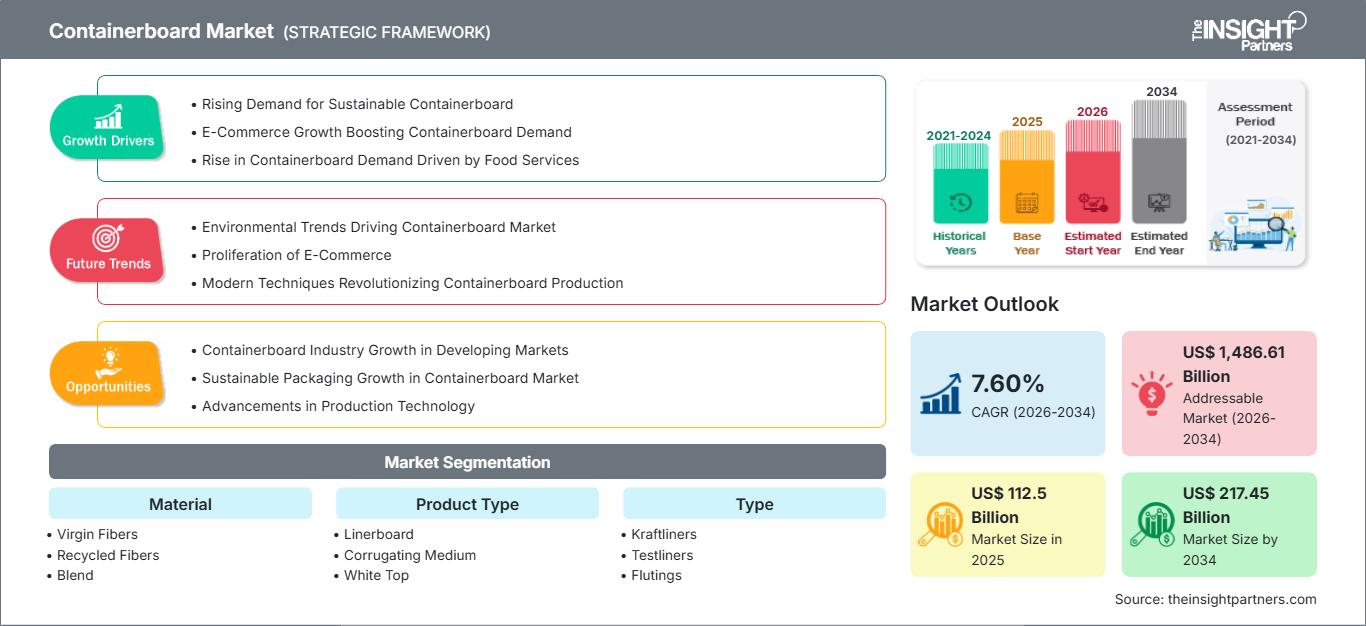
2025 Market Size
US$ 112.5 Bn
Base year value
2034 Forecast
US$ 217.45 Bn
Projected by 2034
CAGR 2026-2034
7.60 %
Growth rate
Addressable Market
US$ 1,486.61 Bn
(2026-2034)
The Containerboard Market was valued at US$ 112.5 Billion in 2025 and is projected to reach US$ 217.45 Billion by 2034, expanding at a CAGR of 7.60% during 2026–2034. The market includes grades of paperboard that are used for producing corrugated packaging; factors affecting the demand include the e-commerce shipments, food and beverages distribution, industrial shipping, recycled fiber recovery, lightweighting, and investments in integrated pulp, paper and converting manufacturing capabilities across all main production locations.
North America continues to be structurally important producer and consumer market of the Containerboard, with the Containerboard Market size forecast to grow at an estimated 4.0–4.6% CAGR in 2026-2034. The shipments related to e-commerce and packaged foods distribution provide the baseline demand while the capacity rationalization and modernization of the mills have improved the supply discipline.
Containerboard Market Assessment and Insights
- North America: North America represented approximately 27–31% share in 2025 and is projected to grow at a 4.0–4.6% CAGR during 2026–2034, supported by e-commerce fulfillment, food distribution, industrial packaging, and strategic capacity rationalization.
- US: The US accounted for approximately 88–92% of North America's 2025 share and is estimated to expand at a 3.9–4.5% CAGR during 2026–2034, supported by mature corrugated packaging demand and mill optimization.
- Europe: Europe represented approximately 23–27% share in 2025 and is expected to register a 4.5–5.1% CAGR during 2026–2034, with Germany, Italy, France, Spain, and the UK supported by recycled packaging, food distribution, and industrial applications.
- Asia Pacific: Asia Pacific represented approximately 37–41% share in 2025 and is projected to grow at a 7.8–8.5% CAGR during 2026–2034, led by China, Japan, India, South Korea, and Southeast Asian manufacturing and logistics activity.
- Largest Segment: Recycled Fibers represented approximately 49–53% market share in 2025 and are projected to grow at a 7.1–7.8% CAGR during 2026–2034, supported by circularity and recovered-paper availability.
- High Growth Segment: White Top represented approximately 7–11% market share in 2025 and is expected to grow at a 8.1–8.9% CAGR during 2026–2034, supported by premium printability and retail-ready packaging.
- Key companies analyzed in detail: International Paper Company, Oji Fibre Solutions (NZ) Limited, Smurfit Kappa Group, Mondi Limited, Sappi Limited, WestRock Company, Cascades Inc., Nine Dragons Paper (Holdings) Limited, DS Smith, Georgia-Pacific LLC, Svenska Cellulosa Aktiebolaget SCA, and Mitsubishi Corporation Packaging Ltd.
Source: The Insight Partners' analysis based on proprietary research, government publications, company annual reports, investor presentations, industry databases, and expert interviews.
The sector is progressing through increasing recycling, high-strength light weights, automated control and integration of pulp-to-box production. The containerboard producers are also making changes in the machines’ setup to produce different types of grades. The latest capacity additions have more emphasis on alignment of production with regional demands, and new machines are being made based on efficiency of energy use, optimum fiber consumption and basis weight control.
Prospects of the industry are good for Asia Pacific due to growing needs of packaging from industrial activity, e-commerce, processed food delivery and manufacturing companies focusing on exports. In the matured markets, investments will be made for updating the technology, producing specialty grades and reduction in some capacities. Packaging restrictions imposed by governments and recycling fiber-based packaging from customers are going to provide additional impetus for the investments.
Containerboard Market Report Scope
| Report Attribute | Details |
|---|---|
| Market size in 2025 | US$ 112.5 Billion |
| Market Size by 2034 | US$ 217.45 Billion |
| Global CAGR (2026 - 2034) | 7.60% |
| Historical Data | 2021-2024 |
| Forecast period | 2026-2034 |
Containerboard Market Analysis
Growth in the Containerboard Market is very much dependent on the manufacturing of corrugated boxes, which in turn depends on the distribution, e-commerce fulfillment, shipping of food and beverages, consumer goods, agriculture, and industry logistics. The participants include forest companies, recovered paper collectors, pulp manufacturers, paper mills, sheet plants, corrugated converters, packaging distributors, retailers, and brand owners. Demand is thus driven by consumer activities and by the level of industrial shipments.
Supply economics are influenced by the fiber availability, utilization of mills, energy costs, recovered paper prices, transportation, and integrated production. The virgin-fiber producers have an advantage in terms of strength and performance; the recycled fiber producers have an advantage in terms of circularity and collection system. The operating rate in the US market was more than 91% in 2025 despite declining production levels.
The Containerboard Market report defines the structure competition based on scale, vertical integration, geography, fiber, and converting. The International Paper Company, WestRock Company, Smurfit Kappa Group, Mondi Limited, DS Smith, Georgia-Pacific LLC, and Oji Fibre Solutions hold a market dominance share in their specific geographical area and grades. Nine Dragons Paper contributes an Asian scale, while Cascades Inc. dominates the North America geographical region for recycled fiber.
Investments have become more strategic. For instance, Mondi recently invested in a 420,000 ton per year recycling containerboard line in Duino, Italy, while Smurfit Westrock recently reduced capacity by over 500,000 tons of capacity in 2025. International Paper has recently made mill closures of 1.8 million tons of containerboard capacity in 2025. This shows that the companies are balancing investment and capacity.
● REPORT CUSTOMIZATION
Tailor This Report To Align With Your Specific Business Requirements
This report can be customized to align precisely with your business objectives, scope, and target markets. Customization options include tailored segmentation, geography, competitive analysis, and strategic insights to support informed decision-making.
Customize This Report →WHAT YOU CAN ADJUST
- ● Segmentations
- ● Geography
- ● Competitive Analysis
- ● Language Preferences
Containerboard Market: Strategic Insights
Regional Insights
North America Containerboard Market
North America constituted an approximate Containerboard Market share of 27-31% in 2025 and is predicted to grow at 4.0-4.6% CAGR in 2026-2034. The North American region features a mature corrugated packaging ecosystem due to food & beverage industry, retail, e-commerce, agricultural & industrial shipments. Integrated manufacturers enjoy established networks of fiber sourcing, converting facilities and long-term customers. The demand tends to be resilient since the demand for corrugated packaging is required irrespective of the channel of distribution.
There has been a shift towards optimizing capacities instead of expanding arbitrarily in North America. Mill closures, maintenance spending, conversion, and rationalization are the methods utilized to optimize the utilization and pricing discipline. Infrastructure for using recycled fiber plays a crucial role as recovered paper constitutes the key input material for manufacturing recycled containerboard. Lightweighting is on the rise as converters attempt to save on material but retain stacking and compression performance.
U.S. Containerboard Market
The US was estimated to contribute 88-92% of the total share held by North America in 2025 and is expected to register a growth of 3.9-4.5% CAGR from 2026 to 2034. Demand for corrugated cases is created due to large presence of food, beverages, retailing, agriculture, and industrial sectors in the US. E-commerce continues to be a key strategic driver as parcels require protection through secondary packaging and optimized dimensions.
Some of the companies with significant presence in the US market include International Paper Company, Georgia-Pacific LLC, WestRock Company, and Cascades Inc. There is an increased emphasis on utilization, product mix, and asset management instead of capacity addition. Announcements of mill closures in 2025 have limited the available capacity and there has been evaluation by the producers on pricing, export, recovered fibre, and downstream integration.
Europe Containerboard Market
The Europe region accounted for around 23-27% share in 2025 and is expected to register growth at a 4.5-5.1% CAGR from 2026-2034. Germany is a key national market driven by manufacturing, food supply chain, retail and logistics sectors. The UK has a matured corrugated industry ecosystem, whereas France, Italy and Spain leverage their strengths in food, beverages, agriculture, consumer goods and industrial transportation segments.
The UK has an ecosystem driven by retail supply chain, e-commerce and food packaging segments. Germany has an established industrial base and recovered paper collection system. France has the demand from food, beverages and consumer goods industries with extensive corrugated conversion, whereas Italy has robust packaging machinery and manufacturing ecosystem. The Spain ecosystem is benefited by its agriculture sector, food exports and industrial logistics segment. Recycled containerboards have a structural significance and virgin kraftliner gives strength to applications.
APAC Containerboard Market
The APAC region held around 37% to 41% market share in 2025 and is expected to witness a CAGR of 7.8% to 8.5% over the forecast period (2026-2034). The China market leads the charge owing to manufacturing, exports, retail distribution, and ecommerce. Japan and South Korea account for mature markets whereas India and Southeast Asia exhibit faster structural growth.
Favorable conditions include industrial production, urbanization, logistics infrastructure, and packaging regulations. Manufacturing capacity is provided by China; India receives help in terms of growing organized retailing and food processing; and agriculture and consumer distribution are provided by Australia. Fiber recovery initiatives and improved efficiency and flexibility of equipment are some actions being taken by manufacturers. Packaging waste and recycling policies in the region will encourage greater fiber recovery.
Middle East & Africa Containerboard Market
Middle East and Africa is projected to expand at approximately 5.5–6.4% CAGR during 2026–2034, supported by food processing, beverages, retail, agriculture, and industrial development. Saudi Arabia and the UAE are important growth centers, while South Africa remains the region's established paper and packaging manufacturing base. Local converting capacity is expanding around major consumption centers.
The factors of energy availability and infrastructure investment have a lot to do with the economics of production. The industry diversification seen in Saudi Arabia is a source of demand for packaging that occurs downstream, whereas the UAE takes advantage of its logistics, trade, and re-exports business. South Africa has recovered-paper collection and packaging of foods and beverages going on. The rest of MEA has future prospects as retail and manufacturing grows, among others.
Segmentation Analysis
Material
The Material segment in the Containerboard Market is projected to grow at a 7.2–7.9% CAGR during 2026–2034. Material selection depends on strength, recycled-content requirements, fiber availability, printability, moisture resistance, and customer sustainability targets. Recycled fibers remain highly relevant for mainstream corrugated packaging, while virgin fibers retain advantages in demanding applications where strength-to-weight performance is critical.
- Virgin Fibers: Virgin fibers support high-strength kraftliner and demanding corrugated applications requiring compression performance, moisture resistance, and consistent runnability. They remain strategically important for heavy-duty packaging and premium logistics applications.
- Recycled Fibers: Recycled fibers provide a circular feedstock for corrugated packaging and are increasingly favored where customers prioritize recovered content. Collection infrastructure, fiber quality, and contamination control strongly influence adoption.
- Blend: Blended grades combine virgin and recycled fibers to balance strength, performance, cost, and sustainability. They provide converters with flexible specifications for applications requiring optimized material efficiency.
Product Type
The Product Type segment in the Containerboard Market is expected to expand at a 7.4–8.1% CAGR during 2026–2034. Linerboard and corrugating medium are essential components of corrugated structures, while white top serves applications requiring improved surface appearance and print quality. Grade selection is increasingly tied to box performance, branding, lightweighting, and automated converting requirements.
- Linerboard: Linerboard forms the outer surfaces of corrugated board and provides strength, printability, and protection. Demand is supported by e-commerce, food distribution, industrial packaging, and retail-ready formats.
- Corrugating Medium: Corrugating medium forms the fluted interior layer and provides cushioning and compression resistance. Producers increasingly optimize basis weight and flute performance to reduce material consumption while maintaining box strength.
- White Top: White top combines a high-quality printable surface with containerboard functionality. It is strategically important for retail-facing packaging, shelf-ready displays, and brands requiring stronger graphics without shifting to heavier packaging.
Type
The Type segment in the Containerboard Market is forecast to grow at a 7.3–8.0% CAGR during 2026–2034. Kraftliners, testliners, and flutings serve different structural and performance requirements. The mix is influenced by fiber source, box specifications, printing requirements, transport conditions, and converter equipment. Grade optimization remains central to lightweighting strategies.
- Kraftliners: Kraftliners provide strong outer layers for demanding corrugated applications. Virgin grades are particularly relevant where high compression strength, moisture resistance, and consistent performance are required.
- Testliners: Testliners use recycled fiber and provide a cost-effective liner solution for mainstream packaging. Their adoption is supported by circularity objectives, broad availability, and applications where extreme strength is unnecessary.
- Flutings: Flutings form the corrugated medium between liner layers and provide structural resilience. Demand is closely linked to box design, flute profile, basis-weight optimization, and converter performance.
Opportunity Snapshot
| End-Use Application | Revenue Contribution | Trend Tag | Adoption Stage |
| E-commerce and Retail | High | Parcel Optimization | Mature |
| Food and Beverages | High | Food Distribution | Mature |
| Industrial and Logistics | Medium | Heavy-Duty Boxes | Mature |
| Agriculture and Fresh Produce | Medium | Produce Protection | Scaling |
Containerboard Market Growth Drivers and Impact Analysis
E-commerce fulfillment increases corrugated packaging intensity
Online retail continues to increase the number of individual shipments moving through distribution networks, raising demand for corrugated cases, mailers, protective structures, and right-sized packaging. Unlike palletized bulk distribution, parcel fulfillment frequently requires separate outer packaging for individual orders, increasing board consumption per transaction. Retailers and logistics providers are consequently investing in automated packing systems that require consistent board caliper, stiffness, and converting performance. This creates demand for containerboard grades capable of running efficiently through high-speed equipment while maintaining compression strength. The impact is strongest in urban and digitally connected markets, although developing economies are also adopting e-commerce logistics. Producers can benefit by supplying lighter grades with equivalent performance, helping customers reduce material consumption without compromising protection or automated handling requirements.
Packaging substitution favors recyclable fiber-based structures
Regulatory and corporate sustainability initiatives in the Containerboard Market are strengthening the position of fiber-based packaging in applications previously served by less recyclable formats. Containerboard benefits because corrugated packaging is compatible with established paper-recovery systems and can be designed for recycling without complex material separation. Brand owners increasingly assess packaging using recyclability, recycled content, material efficiency, and supply-chain carbon considerations. This creates demand for grades that combine high recovered-fiber content with sufficient strength and printability. Producers are responding through fiber optimization, surface treatment, lightweighting, and improved process control. The market impact extends across both developed and emerging regions because packaging converters can incorporate recycled grades into standardized box designs. As sustainability requirements become embedded in procurement specifications, suppliers with reliable fiber traceability and consistent recycled-content performance can strengthen customer relationships.
Food distribution and fresh-produce logistics expand protective packaging
Food and beverage supply chains require packaging that can withstand stacking, vibration, moisture exposure, temperature changes, and repeated handling. Corrugated packaging remains widely used for cases, trays, produce containers, and transport units because it combines structural performance with relatively low weight. Growth in processed-food distribution and organized retail is increasing the need for standardized packaging formats, while fresh-produce exporters require board structures capable of maintaining integrity through longer logistics routes. Moisture-resistant coatings, semi-chemical flutings, stronger kraftliners, and optimized flute profiles can therefore expand the addressable value of containerboard. The impact is particularly relevant in agricultural economies where packaging must protect products during storage and transport. Producers that develop application-specific grades can capture higher-value demand beyond standardized commodity liner and medium products.
Containerboard Market Future Trends
Digital optimization will reshape mill and converting economics
The Containerboard Market trends are moving toward greater use of sensors, machine vision, predictive maintenance, artificial intelligence, and digital process controls across paper mills and converting operations. Advanced systems can monitor moisture, basis weight, formation, machine vibration, energy consumption, and production defects continuously, enabling faster correction of process deviations. Predictive maintenance can reduce unplanned downtime and improve scheduling of critical equipment interventions. Digital quality systems may also allow producers to correlate fiber characteristics with finished-board performance, supporting more precise raw-material optimization. As mills operate increasingly flexible grade portfolios, real-time control becomes more valuable because frequent product changes can introduce variability. Over the longer term, digital integration across mills, warehouses, and converting plants could improve production planning, inventory management, customer traceability, and energy efficiency while reducing waste and improving asset utilization.
Fiber optimization will enable lighter high-performance grades
Containerboard producers are expected to pursue increasingly sophisticated approaches to lightweighting rather than simply reducing basis weight. Future grades will combine fiber selection, refining, formation control, strength additives, surface treatments, and flute engineering to preserve compression performance at lower material intensity. This approach can reduce board consumption and transportation weight while helping converters maintain box strength. Virgin and recycled fibers may increasingly be combined according to application-specific requirements, allowing producers to balance strength with recovered content. Enhanced testing and digital modeling can accelerate grade development by predicting box performance before large-scale commercial trials. The trend is particularly relevant to e-commerce, where packaging dimensions and weight affect logistics costs across millions of shipments. Successful lightweighting will therefore depend on collaboration between paper producers, corrugated converters, machinery suppliers, and major packaging users.
Containerboard Market Opportunities
Localized recycled-fiber processing can improve supply resilience
The Containerboard Market Forecasts point toward opportunities for investment in regional recovered-paper collection, sorting, cleaning, and preparation facilities, particularly where recycled containerboard demand is growing faster than high-quality recovered fiber availability. Integrated producers can secure supply by partnering with municipalities, waste-management companies, retailers, and large packaging users. Investments in automated sorting and contamination removal can improve fiber quality while increasing usable recovered material. Such systems also reduce dependence on long-distance fiber procurement and can improve resilience against commodity-price volatility. Emerging markets with expanding urban populations may offer particularly attractive opportunities because collection systems can be developed alongside modern retail and logistics infrastructure. Investors should prioritize regions with sufficient paper consumption, established collection volumes, supportive recycling policies, and nearby containerboard mills. Long-term supply agreements can strengthen the economics of new processing assets.
Specialty grades can create value beyond commodity containerboard
Investment in specialty containerboard can provide opportunities to improve margins without relying exclusively on volume expansion. White top grades, moisture-resistant structures, high-strength kraftliners, and application-specific flutings can address customers with demanding performance or presentation requirements. Food exporters, premium consumer brands, industrial manufacturers, and retail chains increasingly seek packaging that combines protection, printability, material efficiency, and sustainability. Producers can differentiate through proprietary surface treatments, controlled fiber blends, consistent basis weight, and technical support for box optimization. Specialty capacity also provides a way to diversify exposure to commodity-grade price cycles. The strongest opportunities are likely to emerge where customers value measurable performance improvements, such as reduced board weight, improved compression strength, better print quality, or enhanced moisture resistance. Strategic partnerships with converters can accelerate qualification and adoption.
Recent Developments
- June 2026: International Paper acquired North Pacific Paper Co. from private equity firm One Rock Capital Partners for $360 million. Norpac operations will be rolled into the IP system.
- April 2026: Mondi, a global leader in sustainable packaging and paper, expanded its paper bags business in Southeast Asia through a joint venture with PT Indocement Tunggal Prakarsa Tbk (“Indocement”), one of the largest cement producers in Indonesia. The joint venture, PT Mondi Indo Prakarsa Kemasan, will be located at Indocement’s CementFactory Complex in Citeureup, West Java, Indonesia and will initially produce paper bags for Indocement, serving the growing local market demand for paper bags in Southeast Asia. Mondi will own a 60% stake, with Indocement owning the remaining 40%. Indocement will act as the anchor customer of the joint venture, providing long-term volume stability.
Frequently Asked Questions

- Comprehensive Market Sizing and Forecast Analysis
- Detailed Segmentation Analysis
- In-Depth Market Dynamics Assessment
- Regional and Country-Level Insights
- Competitive Landscape and Company Benchmarking
- Strategic Business Intelligence
Recent Reports
Testimonials

The Insight Partners provided valuable market intelligence that supported our global go-to-market strategy. Their team was professional, responsive, and attentive to our feedback, providing thoughtful analysis and helpful methodological clarifications throughout the project.
Junmo Kim Chief Financial Officer (CFO), Enertech Co., Ltd.
The Insight Partners' SCADA System Market report is comprehensive, with valuable insights on current trends and future forecasts. The team was highly professional, responsive, and supportive throughout. We are very satisfied and highly recommend their services.
RAN KEDEM Partner, Reali Technologies LTDs
I requested a report on a very specific software market and the team produced the report in a few days. The information was very relevant and well presented. I then requested some changes and additions to the report. The team was again very responsive and I got the final report in less than a week.
JEAN-HERVE JENN Chairman, Future Analytica
We worked with The Insight Partners for an important market study and forecast. They gave us clear insights into opportunities and risks, which helped shape our plans. Their research was easy to use and based on solid data. It helped us make smart, confident decisions. We highly recommend them.
PIYUSH NAGPAL Sr. Vice President, High Beam Global
The Insight Partners delivered insightful, well-structured market research with strong domain expertise. Their team was professional and responsive throughout. The user-friendly website made accessing industry reports seamless. We highly recommend them for reliable, high-quality research services
YUKIHIKO ADACHI CEO, Deep Blue, LLC.
This is the first time I have purchased a market report from The Insight Partners.While I was unsure at first, I visited their web site and felt more comfortable to take the risk and purchase a market report.I am completely satisfied with the quality of the report and customer service. I had several questions and comments with the initial report, but after a couple of dialogs over email with their analyst I believe I have a report that I can use as input to our strategic planning process.Thank you so much for taking the extra time and making this a positive experience.I will definitely recommend your service to others and you will be my first call when we need further market data.
JOHN SUZUKI President and Chief Executive Officer, Board Director, BK Technologies
I wish to appreciate your support and the professionalism you displayed in the course of attending to my request for information regarding to infectious disease IVD market in Nigeria. I appreciate your patience, your guidance, and the fact that you were willing to offer a discount, which eventually made it possible for us to close a deal. I look forward to engaging The Insight Partners in the future, all thanks to the impression you have created in me as a result of this first encounter.
DR CHIJIOKE ONYIA MANAGING DIRECTOR, PineCrest Healthcare Ltd.Reason to Buy
- Informed Decision-Making
- Understanding Market Dynamics
- Competitive Analysis
- Identifying Emerging Markets
- Customer Insights
- Market Forecasts
- Risk Mitigation
- Boosting Operational Efficiency
- Strategic Planning
- Investment Justification
- Tracking Industry Innovations
- Aligning with Regulatory Trends





 Get Free Sample for