
Continuous Inkjet Inks Market Size, Trends & Growth by 2034
Coverage: by Substrate (Paper and Paperboard, Cardboard, Plastic Sheet, Glass, Metal, Others); Ink Type (Aqueous / Water-based Inks, Dye-Based Inks, Pigment-Based Inks, Solvent-Based Inks, UV Curable Inks, Phase Change Ink / Hot Melt Inks); End-Use Industry (Food and Beverage, Pharmaceuticals, Electronical and Electronics, Others) , and Geography (North America, Europe, Asia Pacific, and South and Central America)
- Status : Data Released
- Report Code : TIPRE00011869
- Category : Chemicals and Materials
- No. of Pages : 150
- Available Report Formats :


- Last update date : September 01, 2026


2025 Market Size
US$ 2.43 Bn
Base year value
2034 Forecast
US$ 2.99 Bn
Projected by 2034
CAGR 2026-2034
2.33 %
Growth rate
Addressable Market
US$ 24.58 Bn
(2026-2034)
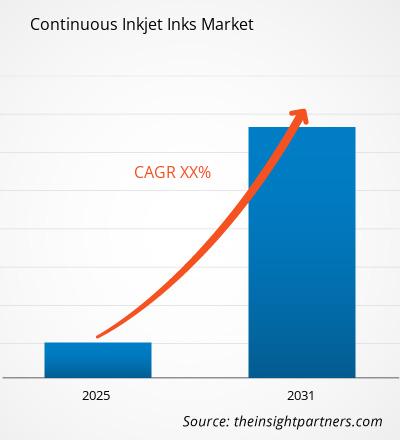
The global Continuous Inkjet Inks market was valued at US$ 2.43 billion in 2025 and is expected to reach US$ 2.99 billion by 2034; it is estimated to record a CAGR of 2.33% during 2026-2034.
Continuous Inkjet Inks Market Assessment and Insights
- North America: North America is estimated to account for 27–31% Continuous Inkjet Inks Market share in 2025 and is projected to grow at a 2.2–2.8% CAGR between 2026–2034, supported by automated packaging, pharmaceuticals, beverages, and electronics manufacturing.
- US: The US represents approximately 72–77% of North America's 2025 share and is expected to expand at a 2.1–2.7% CAGR between 2026–2034, led by automated coding and traceability requirements.
- Europe: Europe holds an estimated 22–26% share in 2025 and is expected to register a 2.0–2.6% CAGR between 2026–2034, with Germany, the UK, France, Italy, and Spain supporting demand through advanced packaging production.
- Asia Pacific: Asia Pacific accounts for approximately 29–33% share in 2025 and is forecast to grow at a 3.0–3.7% CAGR between 2026–2034, with China, Japan, South Korea, India, and Australia forming the principal demand centers.
- Largest Segment: Food and Beverage is estimated to hold a 34–39% market share in 2025, with a 2.7–3.3% CAGR from 2026–2034, reflecting extensive coding across bottles, cans, cartons, and flexible packaging.
- High Growth Segment: Pigment-Based Inks represent approximately 11–15% market share in 2025 and are expected to achieve a 3.5–4.2% CAGR from 2026–2034, supported by durable high-contrast coding.
- Key companies analyzed in detail: Aztec Fluids And Machinery Private Limited, Eastman Kodak Company, International Imaging Materials, Inc., Kao Collins Corporation, Linx Printing Technologies Limited, Needham Inks Limited, Squid Ink Manufacturing, Inc., Sun Chemical Corporation, Tritron GmbH, and Videojet Technologies, Inc.
Source: The Insight Partners' analysis based on proprietary research, government publications, company annual reports, investor presentations, industry databases, and expert interviews.
In terms of the development of industrial coding, it has moved from basic date and batch printing to faster, machine readable identification with the need for consistent droplets, quick drying, and adhesion capabilities on varied substrates. CIJ is still beneficial because there will be a constant stream of droplets for non-contact coding of moving products. Ink lines for commercial purposes will cater to substrates such as plastic films, glass, metal, cardboard, and other challenging materials through specific ink lines for moisture, heat, chemicals, and washdown situations.
According to the Continuous Inkjet Inks Market report, prospective growth will be seen in manufacturing economies that are new where there is growing manufacture of food items, beverages, pharmaceuticals, and electronics. Compliance with traceability and package safety will enhance the coding needs, while environmental compliance will see low VOC, MEK free, mineral oil free, and water based solutions favored by product developers.
Continuous Inkjet Inks Market Report Scope
| Report Attribute | Details |
|---|---|
| Market size in 2025 | US$ 2.43 Billion |
| Market Size by 2034 | US$ 2.99 Billion |
| Global CAGR (2026 - 2034) | 2.33% |
| Historical Data | 2021-2024 |
| Forecast period | 2026-2034 |
Continuous Inkjet Inks Market Analysis
Demand is highly correlated with throughput because CIJ fluids are consumable goods but not capital goods. Date coding, batch numbers, traceability information and handling instructions are applied by food and beverages manufacturers whereas pharmaceuticals need to have reliable identification on primary and secondary packages. Electronics manufacturers need to apply small size codes. Thus, the growth of Continuous Inkjet Inks Market is correlated both with volume and with increase in information content of codes.
The industry value chain involves the suppliers of specialty chemicals and pigments, ink formulators, printer manufacturers, distributors, system integrators and end users. Solvents, resin composition, dispersion of dye or pigment, conductivity, viscosity, drying time and adhesion of ink to substrate are factors affecting performance of ink. Compatibility with the printer is also an issue since inappropriate fluids can affect reliability of printer. Thus, for instance, Linx Company creates special inks for its CIJ printers.
The competition in the Continuous Inkjet Inks Market is dependent on formulation expertise, printer compatibility, applicability, and repeat customer relationships. Videojet makes CIJ ink formulations suited for applications in beverages, food, electronic goods, automotive and package materials, while Linx has a variety of offerings of general purpose, pigment-based, security, and specialized adherence inks. Kao Collins provides CIJ ink formulations suitable for packaging materials and pharmaceutical applications. The portfolios indicate how the competition is based on applicability chemistry and not just black coding ink.
The investments in the Continuous Inkjet Inks Market will thus be in low-emitting formulations, adhesion on specific substrates and secure supply of consumables. Sun Chemical's digital ink activities give a good indication of where the focus is with respect to aqueous and UV-curable ink formulations, whereas the other CIJ companies develop their fluids for harsh production conditions. Based on the findings of the Continuous Inkjet Inks Market, companies with broad chemistry capabilities and good equipment integration have an advantage.
● REPORT CUSTOMIZATION
Tailor This Report To Align With Your Specific Business Requirements
This report can be customized to align precisely with your business objectives, scope, and target markets. Customization options include tailored segmentation, geography, competitive analysis, and strategic insights to support informed decision-making.
Customize This Report →WHAT YOU CAN ADJUST
- ● Segmentations
- ● Geography
- ● Competitive Analysis
- ● Language Preferences
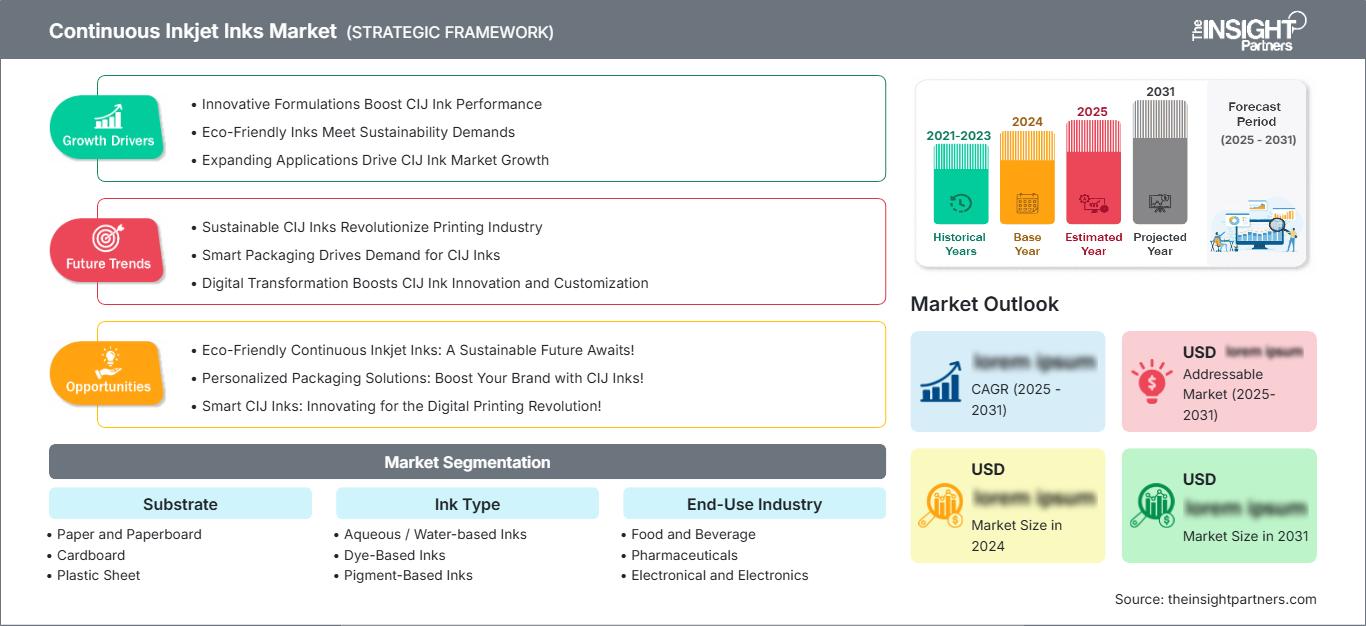
Continuous Inkjet Inks Market: Strategic Insights
Regional Insights
North America Continuous Inkjet Inks Market
It is estimated that North America holds a Continuous Inkjet Inks Market share of 27–31% in 2025 due to high demand in the US driven by developed food processing, beverage filling, pharmaceutical manufacturing, and industrial production. The market is expected to grow at a rate of 2.2–2.8% CAGR up to 2034. High-speed production lines benefit from CIJ due to the fact that non-contact coding is able to function when products are moved on high-speed production lines during filling, packing, and inspection process. Formulations are also used for substrates that experience condensation, oils, heat, or chemicals.
Increasing demand in the region will be directed towards formulations providing both reliable adhesion and better environmental characteristics. Pharmaceuticals serialization and electronics traceability will serve as further application areas besides packaging. Presence of the base of coding equipment results in regular fluid orders whereas manufacturers take into account total cost of operation and serviceability prior to switching from one formulation to another.
U.S. Continuous Inkjet Inks Market Market
The USA accounts for 72-77% of the North American 2025 share and will grow at a CAGR of 2.1-2.7% from 2025 to 2034. Manufacturers in food & beverage, pharmaceuticals, electronics, and industry provide a diversified market base. Relevant capabilities include Videojet, Kao Collins Corporation, Eastman Kodak Company, and International Imaging Materials, Inc.
Trends in applications in the Continuous Inkjet Inks Market include high information, better adhesion for light packaging, and formulations that withstand difficult production environments. In 2025, Videojet announced more than 400,000 printers globally, indicating the extent of the installed base for coding and its recurring consumables needs. Machine readable identification has become important in electronics manufacturing.
Europe Continuous Inkjet Inks Market Market
Europe has been projected to have a 22-26% share in 2025, with CAGR growth projections of 2.0-2.6% through 2034. Germany is the key market for CIJ inks, benefiting from advanced manufacturing and packaging. The other key markets are the UK, France, Italy, and Spain. Environmental compliance, packaging needs, and industrial automation continue to be key factors in the procurement process.
The UK has a robust industrial coding sector, with Linx Printing Technologies producing CIJ fluids in Cambridgeshire, UK. Their product range includes MEK-free, halogen-free, non-CMR, and PFAS-free fluid formulas, demonstrating the significance of both environmental and occupational health considerations.
Germany is a substantial base for industrial ink jet coding, because machinery, automotive parts, food processing, and packaging industry applications need durable coding. Formulations that are able to withstand heat, moisture, chemicals, and transport are in demand.
France, Italy, and Spain deliver demand from the sectors of food processing, beverages production, pharmaceuticals, and manufacturing industries. Regional and international competitors differentiate their products by means of special formulations, distribution, and application expertise. Across Europe, there is growing consideration of sustainability in formulations, without compromising coding performance in high-speed printing.
APAC Continuous Inkjet Inks Market Market
APAC holds an estimated share of 29-33% in 2025 and is projected to register growth of 3.0-3.7% CAGR during 2034 and represents the dominant high growth geography. China represents the biggest market, whereas Japan, South Korea, India, and Australia offer sizeable demand for both packaging and industrial applications.
China and India enjoy growing packaged goods and manufacturing capacity, while Japan and South Korea focus on precision electronics and quality manufacturing. Australia offers stable demand for food, beverage, and industrial segments. Growth would be aided by rising automation and traceability needs, along with investments in state-of-the-art packaging equipment, while vendors look to provide local technical and customized solutions.
Middle East & Africa Continuous Inkjet Inks Market Market
The Middle East & Africa segment is set for gradual growth with a CAGR of 2.4–3.0% by 2034, where Saudi Arabia, the UAE, and South Africa become some of the major markets in terms of demand. The industries here include food and beverage processing, pharmaceutical packaging, construction materials, and manufacture of consumer goods, which all give rise to regular coding applications.
The major market in this region is Saudi Arabia, followed by the UAE and South Africa. Factors affecting demand include diversified industry portfolio, production of packaged foods, and improved logistics. High temperatures coupled with difficult working conditions make it important to have coatings that can dry quickly and perform well. Providers of good adhesion and technical services can satisfy such demands.
Segmentation Analysis
Substrate
The Substrate segment is expected to expand at a 2.5–3.1% CAGR from 2026–2034. Demand is distributed across porous and non-porous materials, with substrate compatibility determining adhesion, drying behavior, contrast, and resistance. Packaging diversification toward films, lightweight containers, cartons, and specialty materials is encouraging suppliers to develop more application-specific formulations. CIJ remains particularly useful where production lines require non-contact marking at high speeds.
- Paper and Paperboard: Paper and paperboard remain important because cartons, labels, cases, and secondary packaging require dates, batch codes, barcodes, and traceability information. Water-based and dye-based formulations support porous surfaces.
- Cardboard: Cardboard applications require rapid drying and strong contrast on corrugated and coated surfaces. Demand is supported by shipping cases, food packaging, and secondary pharmaceutical packaging where variable information is routinely added.
- Plastic Sheet: Plastic sheets and films require strong adhesion because smooth surfaces can resist conventional formulations. Specialist inks address PE, PP, OPP, BOPP, PVC, and other flexible materials used in packaging.
- Glass: Glass coding is prominent in beverage and pharmaceutical applications where condensation, refrigeration, sterilization, and handling can challenge print durability. Formulations must maintain readable codes under demanding processing conditions.
- Metal: Metal substrates require adhesion and resistance against oils, chemicals, heat, and mechanical handling. CIJ inks support coding on cans, components, containers, and industrial parts where durable identification is necessary.
Ink Type
The Ink Type segment is forecast to register a 2.6–3.2% CAGR from 2026–2034. Solvent-based formulations remain important for rapid drying and non-porous surfaces, while aqueous, pigment-based, and lower-emission chemistries are gaining attention as manufacturers balance performance with environmental requirements. The portfolio is becoming more application-specific as packaging materials and regulatory expectations diversify.
- Aqueous / Water-based Inks: Water-based formulations are favored for porous materials and applications prioritizing low-VOC characteristics. They support paper, paperboard, and selected packaging applications where absorption and drying can be controlled.
- Dye-Based Inks: Dye-based inks remain widely used for general-purpose coding because they provide strong contrast and broad substrate compatibility. They are particularly relevant where economical, fast-drying identification is required.
- Pigment-Based Inks: Pigment-based formulations provide durable, high-contrast marks and are increasingly selected for colored or difficult substrates. Their strategic role is expanding in electronics, cables, plastics, and applications requiring enhanced resistance.
- Solvent-Based Inks: Solvent-based inks remain central to CIJ because rapid evaporation enables high-speed printing on non-porous materials. They support plastics, glass, metals, and packaging lines where immediate handling is required.
- UV Curable Inks: UV curable formulations offer rapid curing and strong resistance properties. Their adoption is strategically relevant where manufacturers need durable marks and tighter control over curing, emissions, or specialized packaging requirements.
- Phase Change Ink / Hot Melt Inks: Phase change and hot melt formulations provide controlled solidification after application and can support specialized printing environments. Their use remains application-specific, particularly where durability and precise deposition are prioritized.
End-Use Industry
The End-Use Industry segment is projected to grow at a 2.7–3.3% CAGR from 2026–2034. Food and beverage represents the largest demand pool, while pharmaceuticals and electronics offer specialized opportunities requiring higher code reliability, traceability, and resistance. Regulatory requirements and increasing production automation support recurring consumable demand across all three industries.
- Food and Beverage: Food and beverage manufacturers require continuous coding for production dates, lot information, traceability, and handling. High-speed filling and packaging lines create sustained demand for fast-drying, condensation-resistant, and food-compliant formulations.
- Pharmaceuticals: Pharmaceutical applications emphasize serialization, expiration information, batch identification, and secure traceability. Inks must maintain high legibility and durability across glass, plastic, foil, cartons, and secondary packaging.
- Electronical and Electronics: Electronics manufacturing increasingly requires compact, durable identification on components, cables, housings, and assemblies. Specialized formulations address adhesion, chemical resistance, small code sizes, and compatibility with automated production environments.
Opportunity Snapshot
| End-Use Industry | Revenue Contribution | Trend Tag | Adoption Stage |
| Food and Beverage | High | Traceability Coding | Mature |
| Pharmaceuticals | Medium | Serialization Codes | Scaling |
| Electronical and Electronics | Medium | Component Marking | Scaling |
Continuous Inkjet Inks Market Growth Drivers and Impact Analysis
Expansion of automated packaging and high-speed production lines
Manufacturers are increasing line automation to improve throughput, reduce manual intervention, and maintain consistent product identification. CIJ technology is very applicable in these environments because there is no need for any physical contact while printing as products continuously flow on conveyors, fillers, packers, and inspection points. It directly translates into an increase in the continuous demand for ink because increased production leads to an increase in the amount of fluid used. Bottle manufacturing, food processing, and drug packaging become even more important applications because the coding process cannot be separated from automation processes. The portfolio of VideoJet's applications shows how widely CIJ technology is used in the beverage bottles, cans, cartons, food packaging, electronic products, and industrial products.
Rising traceability requirements across regulated industries
Traceability requirements are increasing the amount and complexity of information printed directly onto products and packaging. Identification requirements are crucial for pharmaceutical companies for purposes of batch identification, expiry dating, serializing and logistics. Food and beverages companies need production and batch information. Even electronic manufacturers have been using identification technology at the components level for lifecycle management and regulatory compliance. These requirements generate structural demand since coding is embedded in the manufacturing process, not optional marketing activities. Industrial inks used in pharmaceutical identification, barcodes, expiry dates and serialization, both in primary and secondary packaging have been pointed out by Kao Collins. Code density being higher, ink formulation has to be kept high to maintain resolution, contrast, adhesion and durability.
Demand for lower-emission and application-specific ink formulations
Environmental and workplace requirements are encouraging manufacturers to reconsider solvent selection and fluid chemistry without sacrificing drying speed or print durability. Suppliers are responding with MEK-free, low-VOC, mineral-oil-free, and water-based alternatives for selected applications. Linx, for example, identifies MEK-free, halogen-free, non-CMR, and PFAS-free options within its CIJ portfolio. Such developments can broaden adoption in facilities with tighter environmental controls or restricted ventilation while reducing formulation-related operational concerns. At the same time, specialized chemistries for oily films, condensation, sterilization, and difficult plastics enable CIJ to remain relevant where generic formulations would be inadequate. This creates opportunities for suppliers to differentiate through chemistry and application engineering rather than price alone.
Continuous Inkjet Inks Market Future Trends
Greater adoption of environmentally optimized CIJ chemistry
The next phase of formulation development is likely to focus on reducing environmental and workplace impacts while preserving the rapid drying, conductivity, adhesion, and reliability required by CIJ printers. Water-based, mineral-oil-free, MEK-free, and lower-VOC formulations should receive greater attention in applications where substrate and production conditions permit substitution. Kao Collins already promotes water-based and mineral-oil-free alternatives, while Linx offers multiple formulations addressing specific EHS requirements. The Continuous Inkjet Inks Market trends therefore point toward chemistry optimization rather than a universal shift away from solvent-based products. Suppliers will likely develop narrower application windows, validated printer compatibility, and improved environmental profiles while maintaining production-line reliability.
Expansion of machine-readable and digitally connected coding
Industrial coding is moving beyond simple dates and batch numbers toward QR codes, Data Matrix codes, serialization, and other machine-readable identifiers. As production systems become more connected, printed information increasingly functions as a link between physical products and digital manufacturing or supply-chain records. Linx's current CIJ systems support QR, Data Matrix, and GS1 Data Matrix coding, reflecting this shift. Future ink development will consequently emphasize small-dot precision, contrast, adhesion, and durability because even minor print degradation can impair automated scanning. Suppliers capable of supporting higher-information codes without compromising line speed will be better positioned for electronics, pharmaceutical, food, and industrial applications where digital traceability is becoming embedded in production workflows.
Continuous Inkjet Inks Market Opportunities
Localized formulation development in high-growth manufacturing economies
India, China, and other Asian manufacturing centers offer opportunities for suppliers to localize formulations and technical support around regional substrates, operating environments, and regulatory requirements. The opportunity extends beyond importing standard products because local converters and manufacturers often require specialized adhesion, drying, and chemical-resistance characteristics. Establishing regional laboratories, application-testing facilities, and technical service networks can shorten qualification cycles and strengthen relationships with printer integrators. Suppliers can also use localized development to address climate conditions such as humidity and heat, which influence drying and print performance. The opportunity is strongest where food, beverage, pharmaceutical, and electronics production is expanding and manufacturers are simultaneously upgrading automation. A regionalized model can therefore improve responsiveness while reducing dependence on one global formulation portfolio.
Specialty inks for difficult substrates and compliance-sensitive applications
A second opportunity lies in premium formulations designed for difficult materials and demanding production processes. Flexible plastics, returnable glass, oily packaging, sterilized containers, and electronics components can require chemistry beyond conventional general-purpose black ink. Videojet and Linx already offer formulations addressing condensation, oil, chemical exposure, flexible films, and specialist industrial applications. Continuous Inkjet Inks Market Forecasts should therefore consider value migration toward specialized consumables rather than only unit-volume expansion. Manufacturers can pursue premium positioning through validated substrate performance, lower maintenance requirements, improved workplace characteristics, and compliance documentation. Partnerships with printer OEMs and packaging machinery integrators can further accelerate qualification and increase recurring consumable sales.
Recent Developments
- August 2026: Videojet Technologies, a global leader in coding, marking, and printing solutions, announced the introduction of the Videojet 1880 C continuous inkjet printer. The new coding solution is designed to help manufacturers reduce the cleaning, service calls, and unpredictable downtime often associated with pigmented CIJ printing. Built for hard and soft pigmented applications, the 1880 C delivers bold, high-contrast codes while offering operation and maintenance like a dye-based printer.
- October 2025: KYOCERA Corporation announced that its core European subsidiary, KYOCERA Europe GmbH, will begin collaborating with the iPrint Institute and Competence Center, a Swiss public research institute specializing in inkjet technology. Leveraging Kyocera’s proprietary inkjet technology, the partnership aims to develop new applications, such as 3D printing, coating, and printed electronics.
Frequently Asked Questions

- Comprehensive Market Sizing and Forecast Analysis
- Detailed Segmentation Analysis
- In-Depth Market Dynamics Assessment
- Regional and Country-Level Insights
- Competitive Landscape and Company Benchmarking
- Strategic Business Intelligence
Recent Reports
Testimonials

The Insight Partners provided valuable market intelligence that supported our global go-to-market strategy. Their team was professional, responsive, and attentive to our feedback, providing thoughtful analysis and helpful methodological clarifications throughout the project.
Junmo Kim Chief Financial Officer (CFO), Enertech Co., Ltd.
The Insight Partners' SCADA System Market report is comprehensive, with valuable insights on current trends and future forecasts. The team was highly professional, responsive, and supportive throughout. We are very satisfied and highly recommend their services.
RAN KEDEM Partner, Reali Technologies LTDs
I requested a report on a very specific software market and the team produced the report in a few days. The information was very relevant and well presented. I then requested some changes and additions to the report. The team was again very responsive and I got the final report in less than a week.
JEAN-HERVE JENN Chairman, Future Analytica
We worked with The Insight Partners for an important market study and forecast. They gave us clear insights into opportunities and risks, which helped shape our plans. Their research was easy to use and based on solid data. It helped us make smart, confident decisions. We highly recommend them.
PIYUSH NAGPAL Sr. Vice President, High Beam Global
The Insight Partners delivered insightful, well-structured market research with strong domain expertise. Their team was professional and responsive throughout. The user-friendly website made accessing industry reports seamless. We highly recommend them for reliable, high-quality research services
YUKIHIKO ADACHI CEO, Deep Blue, LLC.
This is the first time I have purchased a market report from The Insight Partners.While I was unsure at first, I visited their web site and felt more comfortable to take the risk and purchase a market report.I am completely satisfied with the quality of the report and customer service. I had several questions and comments with the initial report, but after a couple of dialogs over email with their analyst I believe I have a report that I can use as input to our strategic planning process.Thank you so much for taking the extra time and making this a positive experience.I will definitely recommend your service to others and you will be my first call when we need further market data.
JOHN SUZUKI President and Chief Executive Officer, Board Director, BK Technologies
I wish to appreciate your support and the professionalism you displayed in the course of attending to my request for information regarding to infectious disease IVD market in Nigeria. I appreciate your patience, your guidance, and the fact that you were willing to offer a discount, which eventually made it possible for us to close a deal. I look forward to engaging The Insight Partners in the future, all thanks to the impression you have created in me as a result of this first encounter.
DR CHIJIOKE ONYIA MANAGING DIRECTOR, PineCrest Healthcare Ltd.Reason to Buy
- Informed Decision-Making
- Understanding Market Dynamics
- Competitive Analysis
- Identifying Emerging Markets
- Customer Insights
- Market Forecasts
- Risk Mitigation
- Boosting Operational Efficiency
- Strategic Planning
- Investment Justification
- Tracking Industry Innovations
- Aligning with Regulatory Trends





 Get Free Sample for