
Conveyor Oven Market Trends, Size & Forecast by 2034
Coverage: By Power Source (Electric conveyor oven, Gas conveyor oven); Technology (Radiation, Convection); End Use (Countertop, Industrial/Heavy), and Geography (North America, Europe, Asia Pacific, and South and Central America)
- Status : Data Released
- Report Code : TIPRE00015107
- Category : Manufacturing and Construction
- No. of Pages : 150
- Available Report Formats :


- Last update date : September 07, 2026


2025 Market Size
US$ 108.65 Mn
Base year value
2034 Forecast
US$ 143.58 Mn
Projected by 2034
CAGR 2026-2034
3.15 %
Growth rate
Addressable Market
US$ 1,145.54 Mn
(2026-2034)
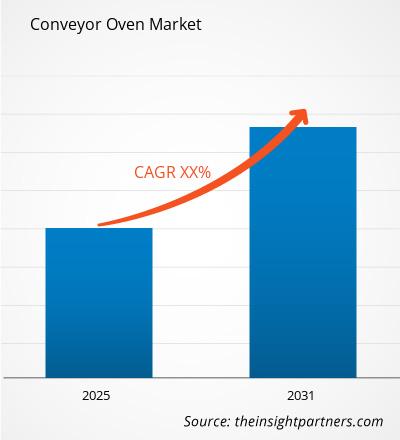
The conveyor oven market was valued at US$ 108.65 Million in 2025 and is projected to reach US$ 143.58 Million by 2034. The market is expected to register a CAGR of 3.15% during 2026–2034. Demand reflects the need for repeatable, continuous thermal processing across commercial kitchens and industrial production lines, where controlled dwell time, throughput, and product consistency remain central purchasing criteria.
Across North America, the conveyor oven market size is supported by an estimated 2.8–3.2% CAGR through 2034. Restaurant standardization, labor scarcity, and replacement of older gas-intensive equipment underpin demand. Industrial buyers also prioritize programmable airflow, compact footprints, and serviceable controls, while electrification programs encourage efficient electric platforms where grid capacity and operating economics permit.
Conveyor Oven Market Assessment and Insights
- North America accounted for 41–45% share in 2025 and is projected to expand at 2.8–3.2% CAGR between 2026–2034, supported by chain restaurant upgrades, labor-saving equipment, and a mature industrial thermal-processing base.
- US represented 80–84% of North American demand in 2025 and is expected to grow at 2.9–3.3% CAGR between 2026–2034 as operators replace aging equipment.
- Europe held 25–29% share in 2025 and is forecast to record 2.6–3.0% CAGR between 2026–2034. Germany leads, while the UK, France, Italy, and Spain sustain foodservice and industrial demand.
- Asia Pacific captured 20–24% share in 2025 and is projected to post 4.0–4.5% CAGR between 2026–2034, led by China, Japan, South Korea, India, and Australia.
- Largest Segment Electric conveyor ovens held 57–61% market share in 2025 and are projected to expand at 3.5–4.0% CAGR between 2026–2034.
- High Growth Segment Countertop systems represented 34–38% market share in 2025 and are forecast to grow at 4.1–4.6% CAGR between 2026–2034.
- Key companies analyzed in detail: Infratrol, LLC; International Thermal Systems, LLC; LEWCO, Inc.; Mahan Oven & Engineering Co., Inc.; Moretti Forni S.p.A.; OEM – Ali Group S.r.l.; The Middleby Corporation; Wisconsin Oven Corporation; XLT Ovens; Davron Technologies, Inc.
Source: The Insight Partners' analysis based on proprietary research, government publications, company annual reports, investor presentations, industry databases, and expert interviews.
The development of product technology continues to progress from mechanically controlled belts and fixed heat zones to programmable air impingement, infrared-assisted heating, speed control, and memory of recipes. Consumer products are now incorporating small cavities along with high intensity heat transfer while industrial products focus on modular zones, documentation of temperatures, and integration with pre-coating and food preparation equipment. The production process requires a considerable amount of engineering because the material of belts, air-flow patterns, exhausts, sanitation, and safety controls need to match the product being processed.
The investment opportunities will increase in Asian manufacturing centers, food service facilities in the Gulf, and European retrofitting projects. Regulations on energy efficiency, work safety, and food hygiene encourage the use of insulated cabinets, efficient burners, automatic shutdown systems, and electricity-based designs. Suppliers with regional application engineering and lifecycle services should get more orders for replacement because their customers need documented thermal uniformity, quick start-up, and spares.
Conveyor Oven Market Report Scope
| Report Attribute | Details |
|---|---|
| Market size in 2025 | US$ 108.65 Million |
| Market Size by 2034 | US$ 143.58 Million |
| Global CAGR (2026 - 2034) | 3.15% |
| Historical Data | 2021-2024 |
| Forecast period | 2026-2034 |
Conveyor Oven Market Analysis
Market drivers of the Conveyor Oven market are built on high volume environments where variability of batches increases cost due to labor and quality concerns. Restaurants using quick-service prepare their foods using the method of continuous cooking, which is also used in the manufacturing process for processes like drying, curing, annealing, and bonding. Demand therefore covers distributors, system integrators, suppliers, conveyor systems, control suppliers, and maintenance companies.
Supply is influenced by the raw material needed like stainless steel, insulation, burners, electrical elements, motors, sensors, and programmable controls. Lead time increases for engineered industrial lines due to the need for validation, factory acceptance testing, installation and exhaust systems. The countertop ovens have shorter lead times through the dealers, but good suppliers rely on easily available components and commissioning.
The market analysis for conveyor ovens highlights a fragmented market split between foodservice branded platforms and industrial customized solutions. Moretti Forni S.p.A, Middleby Corporation, OEM – Ali Group S.r.l., and XLT Ovens compete in terms of cooking performance, digital control, venting, and distribution coverage. Meanwhile, Infratrol, LLC, International Thermal Systems, LLC, LEWCO, Inc., Wisconsin Oven Corporation, Mahan Oven & Engineering Co., Inc., and Davron Technologies, Inc. offer differentiated features based on engineered air flow and customized processes.
Capital investment strategies are focused on recipe software, reduced energy use, remote diagnostics, application labs, and regional coverage. Positioning in the market should be based not on headline capacity but rather on economics including start up times, idle energy consumption, cleaning, utilization, and belt life. Companies which are able to document such results are better positioned in terms of pricing and industrial multiple sites or repeat orders.
● REPORT CUSTOMIZATION
Tailor This Report To Align With Your Specific Business Requirements
This report can be customized to align precisely with your business objectives, scope, and target markets. Customization options include tailored segmentation, geography, competitive analysis, and strategic insights to support informed decision-making.
Customize This Report →WHAT YOU CAN ADJUST
- ● Segmentations
- ● Geography
- ● Competitive Analysis
- ● Language Preferences
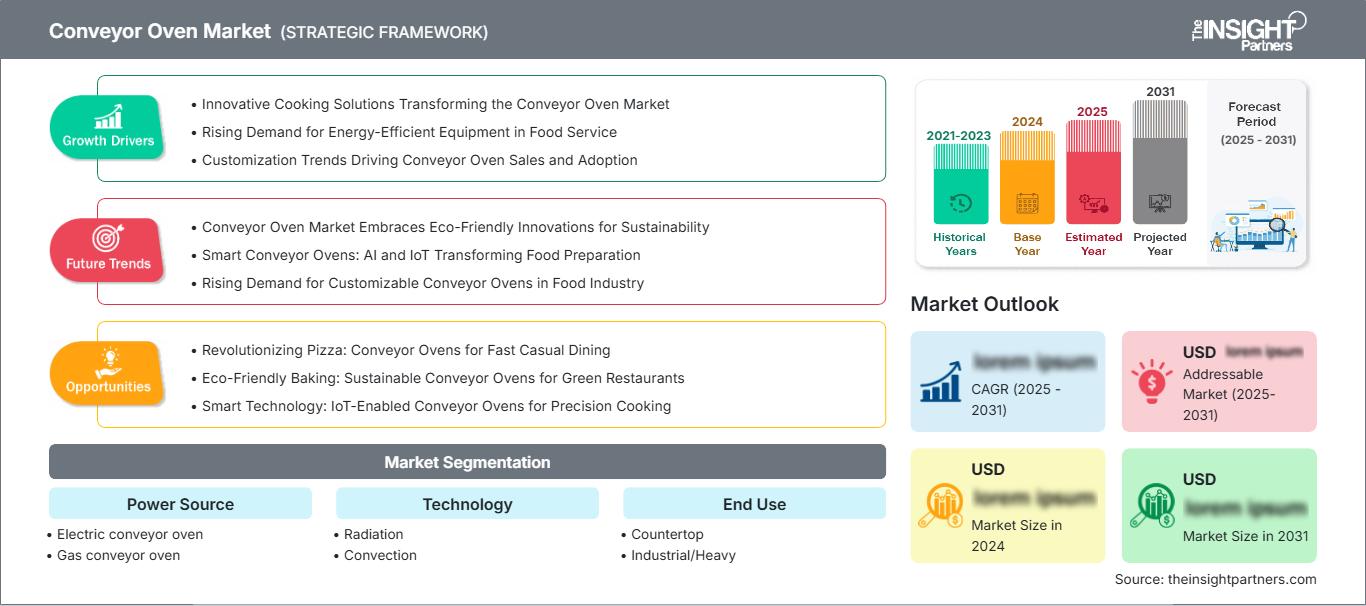
Conveyor Oven Market: Strategic Insights
Regional Insights
North America conveyor oven market
North America held 41–45% of conveyor oven market share in 2025 and is expected to register 2.8–3.2% CAGR through 2034. Densely distributed QSR outlets, expensive labor, presence of dealers for equipment and installation, and large existing customer base generate repeat business. The buyers look for programmable cooking recipes, quick recovery, and stand-by options to make the units profitable.
The industrial market is driven by the need for automotive parts, coatings, electronics, batteries, and engineered materials. Regional distributors profit from application laboratories and field service coverage; clients appreciate documentation of compliance with regulatory standards and testing of thermal uniformity. Electrification develops unevenly, yet gas is still used in some cases.
U.S. Conveyor Oven Market
The U.S. represented 80–84% of North American demand in 2025 and is projected to expand at 2.9–3.3% CAGR through 2034. Conveyor ovens are used in chain restaurants for pizzas, sandwiches, proteins, and baked goods as they help to minimize operator variations via belt speeds and settings. Counter tops become more popular in kitchens that have throughput demands without increasing kitchen space.
Middleby Corporation and XLT Ovens keep their presence visible in the foodservice industry; whereas, Infratrol, LLC, International Thermal Systems, LLC, LEWCO, Inc., Wisconsin Oven Corporation, Mahan Oven & Engineering Co., Inc., and Davron Technologies, Inc. cater to industrial processes. New investments tend to look at diagnostics, exhaust, sanitation, and idle-energy savings.
Europe Conveyor Oven Market
Europe accounted for 25–29% share in 2025 and is forecast to grow at 2.6–3.0% CAGR through 2034. Germany takes charge via industrial machinery, automobile supply chain operations, and careful energy management policies. United Kingdom provides replacement demand in chained foodservice sector, whereby small size electric equipment and venting considerations dictate requirements.
France integrates bakery, ready-meal, and hospitality demands, whereas Italy gains from its robust professional pizza equipment sector comprising Moretti Forni S.p.A. and OEM – Ali Group S.r.l. Spain contributes with installation of restaurants and tourism establishments. In the region, effective insulation, heat recovery, maintenance accessibility, and adaptability with low-carbon electric power become the procurement consideration.
APAC Conveyor Oven Market
Asia Pacific held 20–24% share in 2025 and is projected to post 4.0–4.5% CAGR through 2034. China excels at manufacturing scale and restaurant chain growth, whereas Japan and South Korea focus on small and accurate machines. India focuses on foodservice growth, and Australia continues its replacement cycle.
Policy initiatives favoring electronics, battery development, and manufacturing drive the need for precise continuous heat processing. Consumers are asking for local serviceability, voltage capability, ease-of-use controls, and machinery that can process multiple products quickly without changing anything.
Middle East & Africa Conveyor Oven Market
Middle East and Africa is forecast to grow at 3.5–4.0% CAGR through 2034. Saudi Arabia leads through hospitality, entertainment, and foodservice infrastructure investment, while the UAE supports premium restaurant and central-kitchen installations. South Africa remains the principal sub-Saharan equipment market.
Elsewhere, adoption depends on distributor capability, power reliability, gas availability, and import economics. Insulated cabinets, simple controls, resilient components, and responsive maintenance are decisive because harsh operating environments and limited spare-parts inventories can raise lifecycle risk.
Segmentation Analysis
Power Source
The power source segment is projected to record 3.1–3.6% CAGR during 2026–2034. Conveyor oven market scope across this category is governed by utility prices, ventilation needs, heat recovery, installation capacity, and decarbonization targets. Electric platforms gain where precise zoning and cleaner kitchens matter, while gas retains relevance for high-load operations with favorable fuel economics.
- Electric conveyor oven systems lead adoption because they offer granular zone control, simple modulation, and compatibility with cleaner electricity, making them strategically important for urban kitchens and precision industrial processes.
- Gas conveyor oven systems remain important in high-throughput facilities where fuel infrastructure, rapid heating, and operating-cost advantages outweigh ventilation complexity and direct-emission considerations.
Technology
The technology segment is expected to expand at 3.0–3.5% CAGR during 2026–2034. Selection depends on product geometry, moisture management, surface finish, dwell time, and allowable temperature variation. Radiation provides direct energy transfer, whereas convection supports uniformity across irregular loads. Hybridized architectures increasingly combine both mechanisms to balance speed, repeatability, and quality.
- Radiation delivers rapid surface heating and focused energy transfer, supporting products that need browning, curing, or fast temperature response while limiting unnecessary heating of surrounding air.
- Convection remains broadly adopted because controlled airflow improves thermal uniformity, moisture removal, and repeatability across changing loads, reinforcing its role in foodservice and industrial drying applications.
End Use
The end use segment is projected to grow at 3.2–3.7% CAGR during 2026–2034. Countertop models address space-constrained operations and standardized menus, while industrial or heavy equipment serves continuous manufacturing with engineered conveyors, multiple zones, and validation requirements. Purchasing criteria diverge sharply around footprint, throughput, sanitation, controls, and installation complexity.
- Countertop units support quick-service restaurants, convenience outlets, cafés, and compact production kitchens where limited space, simplified operation, and rapid menu execution determine investment priorities.
- Industrial/Heavy systems serve coating, curing, drying, heat treatment, and large-scale food processing, where engineered airflow, traceability, rugged conveying, and dependable service justify higher capital expenditure.
Opportunity Snapshot
| End Use | Revenue Contribution | Trend Tag | Adoption Stage |
| Countertop | Medium | Compact Automation | Scaling |
| Industrial/Heavy | High | Process Integration | Mature |
Conveyor Oven Market Growth Drivers and Impact Analysis
Labor Pressure and Repeatable Throughput
There is ongoing demand from commercial kitchens and factory floors for greater productivity through fewer people with skills. With conveyor ovens, the motion of products, their dwell time, and the application of heat become settable parameters, lowering reliance on hands and correction. For the restaurant industry, this helps create consistency in menus through time and shifts. In the manufacturing industry, continuous production means matching up heating with the automation that comes before and after it. In the marketplace, this applies most directly where there is a lot of labor turnover, quality costs, and predictable peaks in demand.
Energy Efficiency and Lifecycle Cost Discipline
Energy is an issue of board-level operational cost to restaurant chains and industrial processors. Insulation, heat retention, burner effectiveness, standby, variable air flow rates, and automated shutdowns are among issues being considered by buyers along with acquisition cost. Very efficient natural gas conveyor ovens have baking energy efficiencies exceeding a benchmark of 42%. Standby techniques may be employed in order to minimize energy consumption when not in use. Operational benefits in such situations will bring a shorter payback period for equipment used for long periods of time. Market implications are that vendors will benefit if they can provide utility performance and savings numbers for specific applications.
Expansion of Standardized Foodservice Formats
Quick-service restaurants, convenience stores, kitchen delivery centers, and bakery chains operate using repeatable recipes that can be performed by distributed teams. Conveyor ovens meet this criterion because the operator loads the items on the belt and repeats the time and temperature profile without having to handle the product very much. The entry of chains into new cities means that equipment standardization becomes easier for training, menu introductions, quality control, and spare part logistics. The market influence goes beyond opening new locations because existing locations replace equipment from time to time to offer better services or expanded menu offerings.
Conveyor Oven Market Future Trends
Adaptive Sensing and Recipe Automation
The Conveyor Oven Market trends are set to revolve around sensor systems that detect the product state and control air flow or belt speeds, as well as documenting results. The VISION system by Moretti Forni is an example of progress towards automatic identification of fresh, chilled, frozen or partially baked products. Eventually, oven manufacturers will integrate temperature sensing, motor status, energy usage and service notifications into operator dashboards. The use will have to start with chains and valuable industrial processes where quality consistency justifies integration cost. The importance of open interfaces will come from the need of the customers to make ovens share information with kitchen management or manufacturing execution systems.
Electrified, Modular Thermal Platforms
Future designs will use modular electric heating zones, improved insulation, and configurable conveyors to address decarbonization and product flexibility. Rather than replacing an entire line when recipes change, customers will seek adjustable belt widths, swappable airflow modules, and independently controlled zones. Electric systems will gain where renewable power, indoor air requirements, or emissions policies strengthen the business case. Gas will remain competitive in energy-intensive applications, encouraging hybrid portfolios rather than immediate displacement. Manufacturers that design around upgradeable controls, service access, and standardized modules should improve lifecycle value while reducing commissioning time for multi-site foodservice and industrial customers.
Conveyor Oven Market Opportunities
Retrofit Analytics for Installed Equipment
A large installed base creates an opportunity to sell controls, sensors, insulation improvements, burner tuning, and preventive-maintenance packages before full replacement becomes necessary. The global conveyor oven market forecasts support steady rather than explosive expansion, making aftermarket revenue strategically important. Vendors can prioritize sites with high runtime, rising utility bills, repeated quality deviations, or obsolete controls. A structured retrofit offer should include baseline measurement, modeled savings, installation scheduling, and post-upgrade verification. Industrial specialists can bundle thermal profiling and airflow balancing, while foodservice suppliers can add recipe management and remote diagnostics. This approach lowers customer capital barriers and deepens service relationships that influence future equipment purchases.
Localized Platforms for Emerging Urban Markets
Asia Pacific and Gulf markets offer room for suppliers that adapt equipment to local voltage, fuel quality, kitchen dimensions, menu formats, and service capabilities. Investment should focus on regional demonstration kitchens, application engineers, spare-parts hubs, and distributor training rather than simple export sales. Compact electric systems suit dense urban locations, while rugged gas or hybrid units can address infrastructure variability. Industrial vendors can pursue electronics, battery, coatings, and packaged-food projects where continuous heating improves throughput. Winning platforms will balance global engineering standards with localized controls, documentation, and maintenance, reducing commissioning risk for operators expanding beyond established metropolitan centers.
Recent Developments
- August 2026: LEWCO, Inc. – The company detailed a custom conveyor oven engineered for high-throughput annealing at a Tier 1 automotive supplier. The project demonstrates continued demand for application-specific airflow, continuous material handling, and thermal consistency in industrial production environments.
- September 2025: The Middleby Corporation – Middleby Marshall introduced the LongWave infrared conveyor oven, positioning long-wave infrared heating as a way to improve cooking consistency and operational performance in commercial kitchens. The launch reinforces supplier investment in alternative heat-transfer methods and recipe-focused productivity
- March 2025: XLT Ovens – XLT announced the unveiling of new conveyor-oven technology at Pizza Expo 2025, emphasizing food safety, product quality, and labor efficiency. Live demonstrations were scheduled for March 25 and 26, highlighting the role of trade events in commercial validation
Frequently Asked Questions

- Comprehensive Market Sizing and Forecast Analysis
- Detailed Segmentation Analysis
- In-Depth Market Dynamics Assessment
- Regional and Country-Level Insights
- Competitive Landscape and Company Benchmarking
- Strategic Business Intelligence
Recent Reports
Testimonials

The Insight Partners' SCADA System Market report is comprehensive, with valuable insights on current trends and future forecasts. The team was highly professional, responsive, and supportive throughout. We are very satisfied and highly recommend their services.
RAN KEDEM Partner, Reali Technologies LTDs
I requested a report on a very specific software market and the team produced the report in a few days. The information was very relevant and well presented. I then requested some changes and additions to the report. The team was again very responsive and I got the final report in less than a week.
JEAN-HERVE JENN Chairman, Future Analytica
We worked with The Insight Partners for an important market study and forecast. They gave us clear insights into opportunities and risks, which helped shape our plans. Their research was easy to use and based on solid data. It helped us make smart, confident decisions. We highly recommend them.
PIYUSH NAGPAL Sr. Vice President, High Beam Global
The Insight Partners delivered insightful, well-structured market research with strong domain expertise. Their team was professional and responsive throughout. The user-friendly website made accessing industry reports seamless. We highly recommend them for reliable, high-quality research services
YUKIHIKO ADACHI CEO, Deep Blue, LLC.
This is the first time I have purchased a market report from The Insight Partners.While I was unsure at first, I visited their web site and felt more comfortable to take the risk and purchase a market report.I am completely satisfied with the quality of the report and customer service. I had several questions and comments with the initial report, but after a couple of dialogs over email with their analyst I believe I have a report that I can use as input to our strategic planning process.Thank you so much for taking the extra time and making this a positive experience.I will definitely recommend your service to others and you will be my first call when we need further market data.
JOHN SUZUKI President and Chief Executive Officer, Board Director, BK Technologies
I wish to appreciate your support and the professionalism you displayed in the course of attending to my request for information regarding to infectious disease IVD market in Nigeria. I appreciate your patience, your guidance, and the fact that you were willing to offer a discount, which eventually made it possible for us to close a deal. I look forward to engaging The Insight Partners in the future, all thanks to the impression you have created in me as a result of this first encounter.
DR CHIJIOKE ONYIA MANAGING DIRECTOR, PineCrest Healthcare Ltd.Reason to Buy
- Informed Decision-Making
- Understanding Market Dynamics
- Competitive Analysis
- Identifying Emerging Markets
- Customer Insights
- Market Forecasts
- Risk Mitigation
- Boosting Operational Efficiency
- Strategic Planning
- Investment Justification
- Tracking Industry Innovations
- Aligning with Regulatory Trends





 Get Free Sample for