
Cool Roof Coating Market Growth, Trends & Forecast by 2034
Coverage: By Product (Elastomeric, IR Reflector, Others); Application (Residential, Commercial, Industrial) , and Geography (North America, Europe, Asia Pacific, and South and Central America)
- Status : Data Released
- Report Code : TIPRE00006091
- Category : Chemicals and Materials
- No. of Pages : 150
- Available Report Formats :


- Last update date : September 01, 2026


2025 Market Size
US$ 5.1 Bn
Base year value
2034 Forecast
US$ 8.06 Bn
Projected by 2034
CAGR 2026-2034
5.22 %
Growth rate
Addressable Market
US$ 59.71 Bn
(2026-2034)
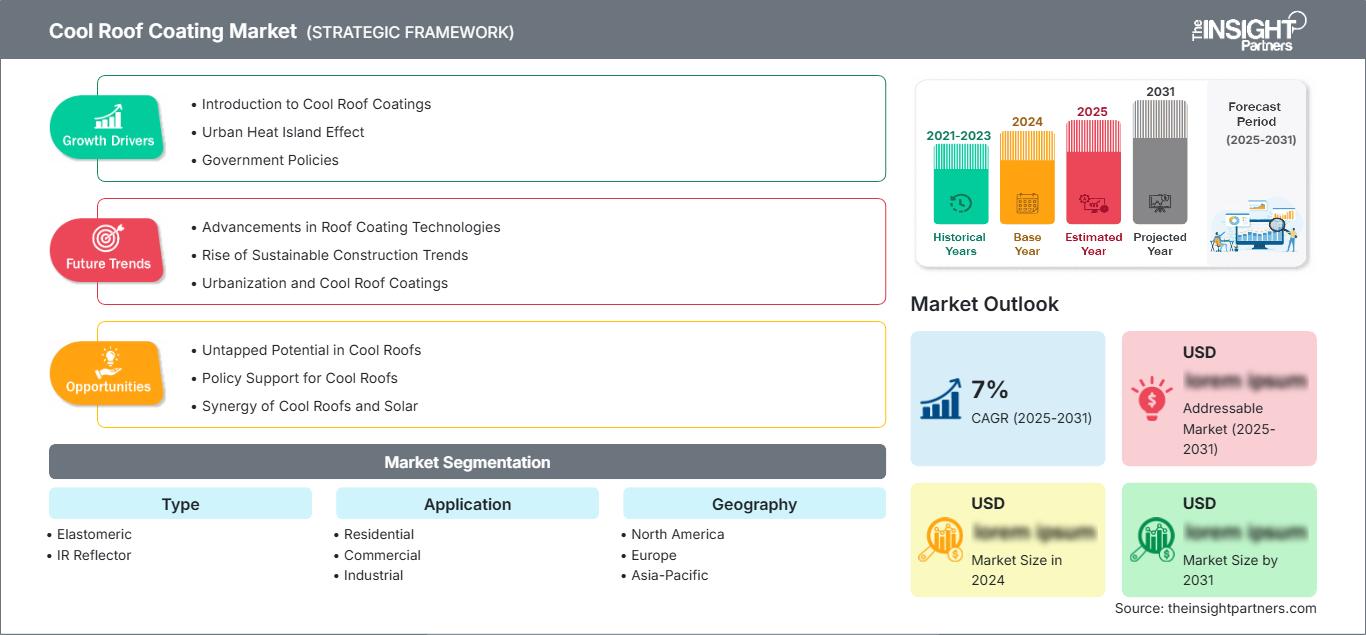
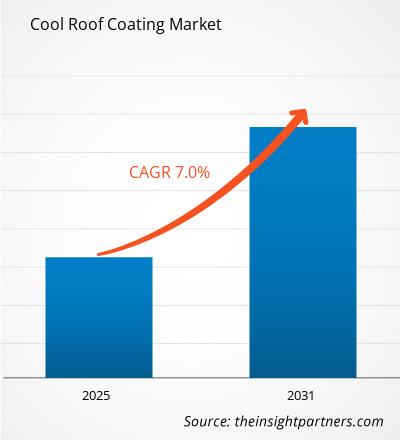
The global Cool Roof Coating market was valued at US$ 5.1 billion in 2025 and is expected to reach US$ 8.06 billion by 2034; it is estimated to record a CAGR of 5.22% during 2026-2034.
Cool Roof Coating Market Assessment and Insights
- North America: North America is estimated to account for 33–37% Cool Roof Coating Market share in 2025, supported by established roofing standards and refurbishment demand, with the market growing at a 5.5–6.1% CAGR during 2026–2034.
- US: The US represents approximately 74–78% of North American demand in 2025 and is expected to expand at a 5.4–5.9% CAGR through 2034.
- Europe: Europe is estimated at 23–27% share in 2025, led by Germany, the UK, France, Italy, and Spain, with a 5.1–5.7% CAGR through 2034 as energy-performance requirements strengthen.
- Asia Pacific: Asia Pacific is estimated to hold 28–32% share in 2025, led by China, Japan, India, South Korea, and Australia, with a 6.5–7.2% CAGR through 2034.
- Largest Segment: Elastomeric coatings represent the leading type, with a 58–62% market share in 2025 and an estimated 5.4–5.9% CAGR during 2026–2034.
- High Growth Segment: IR Reflector coatings are the fastest-growing type, representing a 38–42% market share in 2025 and expanding at a 6.5–7.2% CAGR through 2034.
- Key companies analyzed in detail: BASF SE, Excel Coatings, GAF Materials Corporation, Monarch Industries, Inc., NuTech Paint, Protexion LLP, Shouguang Fengyuan Commercial Co., Ltd., Sika AG, The Sherwin-Williams Company, Weifang Hongxin Waterproof Material Co., Ltd.
Source: The Insight Partners' analysis based on proprietary research, government publications, company annual reports, investor presentations, industry databases, and expert interviews.
The Cool Roof Coating Market has moved from simple reflective paint systems to engineered liquid-applied systems that combine weather resistance, elasticity, adhesion, UV resistance, and thermal efficiency. Acrylic elastomeric systems continue to be popular because they have flexibility and are ideal for refurbishment. There is also a move by formulators to include reflectivity, advanced polymer technology, and low VOC systems to ensure the product satisfies performance and lifecycle requirements.
Going forward, it will be advantageous for the market in relation to urban areas getting hotter, increased building performance standards, and capital investments in the existing buildings stock. Emerging markets provide further opportunities as a result of construction growth in commercial, industrial, and residential buildings. In terms of innovation, there will be emphasis on extended longevity, quick cure times, improved dirt resistance, low emissions, and photovoltaic installation compatibility.
Cool Roof Coating Market Report Scope
| Report Attribute | Details |
|---|---|
| Market size in 2025 | US$ 5.1 Billion |
| Market Size by 2034 | US$ 8.06 Billion |
| Global CAGR (2026 - 2034) | 5.22% |
| Historical Data | 2021-2024 |
| Forecast period | 2026-2034 |
Cool Roof Coating Market Analysis
According to the Cool Roof Coating Market forecast, the demand in this market is driven mainly by the needs of the building owners to minimize roof heat buildup, increase the service life of the roof, and delay the cost of replacing the roof. The commercial and industrial buildings having extensive roofs present excellent case studies as the coating can bring back the protective properties without dismantling the existing roof system. The supply chain consists of raw material suppliers, coating manufacturers, roofing companies, distributors, contractors, testing agencies, and building owners.
Factors affecting the supply in the Cool Roof Coating Market include the presence of acrylic, silicone, polyurethane, pigments, additives, and polymers. The manufacturers differentiate themselves in terms of the formulation durability, compatibility with substrates, ease of application, warranty programs, and regional compliance. It is also increasingly becoming important due to sensitivity of liquid coating to logistics costs and formulation needs.
The Cool Roof Coating Market continues to exhibit moderate fragmentation in terms of a combination of large coatings and building materials companies and specialized regional formulators. GAF Materials Corporation has a diverse commercial liquid applied roofings portfolio, whereas Sika AG focuses on liquid-applied membranes and roofing systems. BASF SE offers its participation in this market through polymer and dispersion technologies used in coating formulations. Sherwin Williams Company leverages its portfolio of Valspar coatings while regional companies rely on application specialization and regional distribution.
Increased investment in the Cool Roof Coating Market is now focused on performance, capacity, sustainability, and technical support versus pure capacity expansion. Competitive positioning is defined by the ability to offer consistent reflectivity, durability, low VOCs, fast application, and substrate bonding. Companies that offer roofing system solutions may leverage their position in order to cross-sell coatings along with membranes and waterproofing solutions while specialists compete through formulations and application performance.
● REPORT CUSTOMIZATION
Tailor This Report To Align With Your Specific Business Requirements
This report can be customized to align precisely with your business objectives, scope, and target markets. Customization options include tailored segmentation, geography, competitive analysis, and strategic insights to support informed decision-making.
Customize This Report →WHAT YOU CAN ADJUST
- ● Segmentations
- ● Geography
- ● Competitive Analysis
- ● Language Preferences
Cool Roof Coating Market: Strategic Insights
Regional Insights
North America Cool Roof Coating Market
North America represents an estimated 33–37% share of the Cool Roof Coating Market in 2025 and is expected to grow at a 5.5–6.1% CAGR through 2034. The US is the dominant region in terms of regional consumption, while Canada contributes to the demand for coatings through building renovations and energy-efficient building constructions. Experience in coating application, testing facilities, and awareness of reflective roofing technologies are some of the factors that contribute to adoption.
Demand within the region is heavily influenced by the age of commercial roofs, warehouse buildings, industrial buildings, and efforts to reduce heat islands. The use of coatings is becoming more popular among building owners as they view coatings as alternatives to full roof replacement in cases where the substrates are in good shape.
U.S. Cool Roof Coating Market
The U.S. accounts for approximately 74–78% of North American demand in 2025 and is projected to expand at a 5.4–5.9% CAGR through 2034. Adoptions are limited to commercial, industrial, warehouse, retail, institutional, and multi-family structures where large roof areas offer substantial refurbishment potential. Recognition by authorities of reflectivity and emittance values also facilitates qualification of the products.
Application within the commercial sector has continued significance because it is possible to re-coat an existing roof structure without tear-offs. GAF Materials Corporation, Sika AG, and other major manufacturers have maintained a solid offering for contractors. There is demand from other sources like efficiency programs, urban heat island reduction, and a preference for roof maintenance without heavy construction.
Europe Cool Roof Coating Market
Europe is estimated to hold 23–27% share in 2025 and is expected to register a 5.1–5.7% CAGR through 2034. Germany is an important market for the industry, followed by the UK, France, Italy, and Spain. Renovation, energy performance considerations, and climate-resilience concerns drive demand, but cold weather climates need careful consideration of seasonal energy impacts.
Important refurbishment markets include the UK and Germany, where demand is focused on warehouses, industrial buildings, office buildings, and institutional buildings. Additional demand can be found in France, Italy, and Spain due to renovation activity and warm climates. Spain and Italy represent especially good markets for reflective products because there are more demands for cooling and higher sun exposure. Germany is a dominant country due to its large building stock and focus on energy-efficient buildings.
APAC Cool Roof Coating Market
APAC is estimated to represent 28–32% share in 2025 and is projected to grow at a 6.5–7.2% CAGR through 2034. Demand is highest in China, followed by Japan, India, South Korea, and Australia. Growth in commercial and industrial installations is driven by growth in industrial construction, warehousing, urbanization, and the need for cooling.
China takes advantage of its large construction industry and manufacturing capabilities, India has growing opportunities for warehouses and commercial properties, while Japan and South Korea focus on energy efficient buildings and refurbishing. Australia, meanwhile, presents favorable market opportunities due to abundant sunshine. Policy efforts at the regional level related to energy efficiency and heat reduction can further enhance adoption.
Middle East & Africa Cool Roof Coating Market
Middle East and Africa demand is supported by extreme heat, high cooling requirements, commercial construction, and infrastructure development. Saudi Arabia and the UAE lead regional adoption, while South Africa represents an important market for commercial and industrial refurbishment. The region is expected to record a 5.8–6.5% CAGR through 2034.
Saudi Arabia benefits from large construction and infrastructure programs, while the UAE has strong demand from commercial, hospitality, and industrial properties. South Africa provides opportunities in warehouses, retail, and institutional buildings. Rest of MEA markets remain smaller but can benefit from climate-adapted construction. Reflective coatings are increasingly relevant where reducing roof heat gain can complement broader cooling-efficiency measures.
Segmentation Analysis
Type
Elastomeric and IR Reflector technologies serve different performance priorities. Elastomeric coatings remain the established option because of flexibility, adhesion, waterproofing, and broad substrate compatibility. IR Reflector systems increasingly address applications requiring enhanced solar-energy rejection without relying exclusively on visibly white surfaces. The type segment is expected to develop at differentiated rates as formulators improve pigments, binders, durability, and color retention.
- Elastomeric: Elastomeric coatings maintain the largest position because they combine flexibility, crack-bridging capability, weather resistance, and broad applicability across existing roofing substrates. Their established contractor base supports recurring refurbishment demand.
- IR Reflector: IR Reflector coatings address demand for enhanced solar reflectance and thermal management, particularly where building owners seek reflective performance with greater color flexibility. Their strategic importance is increasing in hot climates.
Application
Application demand is influenced by roof area, building ownership, replacement cycles, climate, and energy requirements. Commercial buildings represent an important addressable base because of extensive low-slope roofing and recurring maintenance needs. Residential adoption is supported by energy-conscious homeowners and building-code requirements, while industrial facilities increasingly use coatings where roof refurbishment can protect production and storage environments.
- Residential: Residential adoption is supported by warm-climate construction, energy-efficiency awareness, and reroofing activity. Products emphasizing easy application, appearance, durability, and compatibility with common roof substrates are strategically important.
- Commercial: Commercial buildings provide strong demand because large roof areas, maintenance schedules, and energy-management priorities create favorable economics for liquid-applied refurbishment and reflective coating systems.
- Industrial: Industrial facilities use coatings to protect extensive roof surfaces exposed to weather, UV radiation, temperature cycling, and operational traffic. Durability, chemical resistance, and application reliability are important purchasing criteria.
Opportunity Snapshot
| Application | Revenue Contribution (High/Medium/Low) | Trend Tag | Adoption Stage |
| Residential | Medium | Heat Reduction | Scaling |
| Commercial | High | Roof Renewal | Mature |
| Industrial | High | Asset Protection | Scaling |
Cool Roof Coating Market Growth Drivers and Impact Analysis
Expansion of energy-efficient building requirements
Energy-efficiency requirements are encouraging building owners to evaluate roof surfaces as part of broader building-performance strategies. Reflective coatings can reduce solar heat gain and complement insulation, efficient HVAC systems, and other envelope improvements. This creates a practical pathway for coating suppliers to participate in retrofit projects rather than relying solely on new construction. Demand is particularly relevant in warm regions where cooling loads materially affect operating costs. Building codes, green-building programs, utility incentives, and heat-island initiatives can further improve the economic case for reflective roofing. The impact extends across the value chain because contractors need compliant products, distributors require reliable inventories, and formulators must maintain verified radiative performance. Consequently, regulatory alignment increasingly becomes a competitive requirement rather than a supplementary product attribute.
Growing preference for roof restoration over complete replacement
Roof restoration is becoming strategically important as property owners seek to control capital expenditure while extending the usable life of existing assets. Liquid-applied coatings can be installed over suitable substrates after cleaning, preparation, and repair, reducing the material removal associated with complete roof replacement. This approach is particularly relevant for large commercial and industrial properties where tear-off can disrupt operations and increase project complexity. Coating manufacturers therefore have an opportunity to differentiate through systems that combine waterproofing, flexibility, reflectivity, and long-term weather resistance. Contractor training and warranty structures also influence adoption because building owners require confidence that restoration will deliver predictable performance. The resulting demand favors suppliers able to provide complete systems, technical assessment, application guidance, and maintenance support alongside the coating itself.
Increasing exposure to extreme heat and urban heat-island conditions
Increasing temperatures and urban heat-island conditions are strengthening interest in reflective building surfaces. Roofs with high solar reflectance can limit heat transfer into occupied spaces and contribute to lower surrounding surface temperatures. The commercial impact is greatest in densely developed cities where large expanses of roofs combine with paved surfaces to intensify heat accumulation. This creates opportunities for coatings positioned around thermal management rather than waterproofing alone. Municipal programs can further accelerate adoption when cool roofs become part of climate-resilience strategies. Suppliers may therefore benefit from partnerships involving building owners, contractors, utilities, municipalities, and energy consultants. Product performance must remain measurable, however, because purchasing decisions increasingly consider solar reflectance, thermal emittance, durability, and aged performance rather than relying solely on color or initial appearance.
Cool Roof Coating Market Future Trends
Development of multifunctional reflective coating systems
The Cool Roof Coating Market trends show that future product development is expected to combine thermal management with waterproofing, UV resistance, dirt resistance, self-cleaning behavior, and longer service life. Formulators are likely to focus on polymer architectures and pigment technologies that preserve reflective performance after weathering. IR-reflective pigments can become increasingly important where architects and building owners want darker colors without sacrificing thermal functionality. Another direction involves compatibility with photovoltaic installations, rooftop equipment, and complex roof geometries. Digital specification tools may also improve product selection by linking climate conditions, substrate type, reflectance requirements, and expected service conditions. These developments can shift competition from basic coating supply toward engineered roof-system solutions. Manufacturers that demonstrate consistent aged performance and easier application will be better positioned as building owners increasingly evaluate lifecycle outcomes rather than initial purchase price.
Integration of coatings with whole-building energy strategies
The next stage of adoption is likely to involve closer integration between roof coatings and broader building energy-management programs. Building owners may evaluate reflective roof systems alongside insulation, HVAC optimization, rooftop solar, and envelope improvements instead of treating the roof as an isolated maintenance asset. This creates opportunities for suppliers to provide performance data that supports whole-building modeling and investment decisions. Coating specifications may increasingly reference climatic zones, roof orientation, substrate condition, and expected maintenance intervals. In parallel, contractors can expand their role from application providers to roof-performance advisors. This trend could favor manufacturers with technical service capabilities, documented product testing, and established installation networks. The commercial opportunity is particularly strong in portfolio-based real estate, where standardized coating specifications can be applied across multiple buildings.
Cool Roof Coating Market Opportunities
Expansion in emerging commercial and industrial construction
According to the Cool Roof Coating Market report, emerging economies provide an attractive opportunity because rapid commercial development is increasing the amount of roof area exposed to intense solar radiation. Warehouses, logistics centers, factories, retail buildings, and institutional properties are suitable targets because owners can incorporate reflective coatings during construction or refurbishment. Suppliers can capture demand by adapting formulations to local substrates, application practices, climate conditions, and contractor capabilities. Distribution partnerships can reduce market-entry barriers where specialized roofing channels remain fragmented. Local manufacturing or regional blending can further improve cost competitiveness and supply reliability. Companies should prioritize markets combining high cooling requirements with expanding building stock and developing energy-efficiency policies. Product education will remain important because purchasers need to understand the difference between conventional roof paint and engineered systems designed to maintain reflective and waterproofing performance over time.
Premium coatings for high-performance refurbishment
Premium refurbishment creates another opportunity for manufacturers to move beyond commodity coating competition. Building owners with high-value properties may prioritize longer service intervals, superior adhesion, faster curing, low odor, improved chemical resistance, and documented thermal performance. Such requirements support differentiated formulations and can increase the role of technical specification teams in purchasing decisions. Suppliers can target airports, logistics hubs, data-intensive facilities, hospitals, hotels, and large industrial properties where operational disruption carries meaningful costs. Bundled inspection, preparation, application, warranty, and maintenance services can strengthen customer retention while creating recurring revenue opportunities. The most attractive strategies will combine measurable performance with application simplicity. Companies that can demonstrate lifecycle economics, compatibility with existing roofing systems, and reliable contractor execution should be positioned to capture premium restoration projects.
Recent Developments
- August 2026: i2Cool, a technology company specializing in electricity-free cooling solutions, launched i2Coating CorroCool, a new functional coating designed to protect industrial metal surfaces from both excessive heat and corrosion.
- June 2026: HMG Paints participated in the international ‘Cool Roofs. Smarter Choice’ campaign. This initiative, launched in collaboration with the Nova Paint Club in Vancouver in May, aims to accelerate the adoption of solar-reflective coatings to combat rising urban temperatures, improve building comfort, and reduce energy consumption across the UK and around the globe.
Frequently Asked Questions

- Comprehensive Market Sizing and Forecast Analysis
- Detailed Segmentation Analysis
- In-Depth Market Dynamics Assessment
- Regional and Country-Level Insights
- Competitive Landscape and Company Benchmarking
- Strategic Business Intelligence
Recent Reports
Testimonials

The Insight Partners provided valuable market intelligence that supported our global go-to-market strategy. Their team was professional, responsive, and attentive to our feedback, providing thoughtful analysis and helpful methodological clarifications throughout the project.
Junmo Kim Chief Financial Officer (CFO), Enertech Co., Ltd.
The Insight Partners' SCADA System Market report is comprehensive, with valuable insights on current trends and future forecasts. The team was highly professional, responsive, and supportive throughout. We are very satisfied and highly recommend their services.
RAN KEDEM Partner, Reali Technologies LTDs
I requested a report on a very specific software market and the team produced the report in a few days. The information was very relevant and well presented. I then requested some changes and additions to the report. The team was again very responsive and I got the final report in less than a week.
JEAN-HERVE JENN Chairman, Future Analytica
We worked with The Insight Partners for an important market study and forecast. They gave us clear insights into opportunities and risks, which helped shape our plans. Their research was easy to use and based on solid data. It helped us make smart, confident decisions. We highly recommend them.
PIYUSH NAGPAL Sr. Vice President, High Beam Global
The Insight Partners delivered insightful, well-structured market research with strong domain expertise. Their team was professional and responsive throughout. The user-friendly website made accessing industry reports seamless. We highly recommend them for reliable, high-quality research services
YUKIHIKO ADACHI CEO, Deep Blue, LLC.
This is the first time I have purchased a market report from The Insight Partners.While I was unsure at first, I visited their web site and felt more comfortable to take the risk and purchase a market report.I am completely satisfied with the quality of the report and customer service. I had several questions and comments with the initial report, but after a couple of dialogs over email with their analyst I believe I have a report that I can use as input to our strategic planning process.Thank you so much for taking the extra time and making this a positive experience.I will definitely recommend your service to others and you will be my first call when we need further market data.
JOHN SUZUKI President and Chief Executive Officer, Board Director, BK Technologies
I wish to appreciate your support and the professionalism you displayed in the course of attending to my request for information regarding to infectious disease IVD market in Nigeria. I appreciate your patience, your guidance, and the fact that you were willing to offer a discount, which eventually made it possible for us to close a deal. I look forward to engaging The Insight Partners in the future, all thanks to the impression you have created in me as a result of this first encounter.
DR CHIJIOKE ONYIA MANAGING DIRECTOR, PineCrest Healthcare Ltd.Reason to Buy
- Informed Decision-Making
- Understanding Market Dynamics
- Competitive Analysis
- Identifying Emerging Markets
- Customer Insights
- Market Forecasts
- Risk Mitigation
- Boosting Operational Efficiency
- Strategic Planning
- Investment Justification
- Tracking Industry Innovations
- Aligning with Regulatory Trends





 Get Free Sample for