
Cosmetic Products Market Share, Demand & Growth by 2034
Coverage: By Type (Face Makeup, Eye Makeup, Lip Makeup); Category (Natural, Conventional); Distribution Channel (Supermarkets and Hypermarkets, Specialty Stores, Online Retail); and Geography (North America, Europe, Asia Pacific, and South and Central America)
- Status : Data Released
- Report Code : TIPRE00040432
- Category : Consumer Goods
- No. of Pages : 150
- Available Report Formats :


- Last update date : March 18, 2026


2025 Market Size
US$ 349.21 Bn
Base year value
2034 Forecast
US$ 591.71 Bn
Projected by 2034
CAGR 2026-2034
6.0 %
Growth rate
Addressable Market
US$ 4,253.66 Bn
(2026-2034)
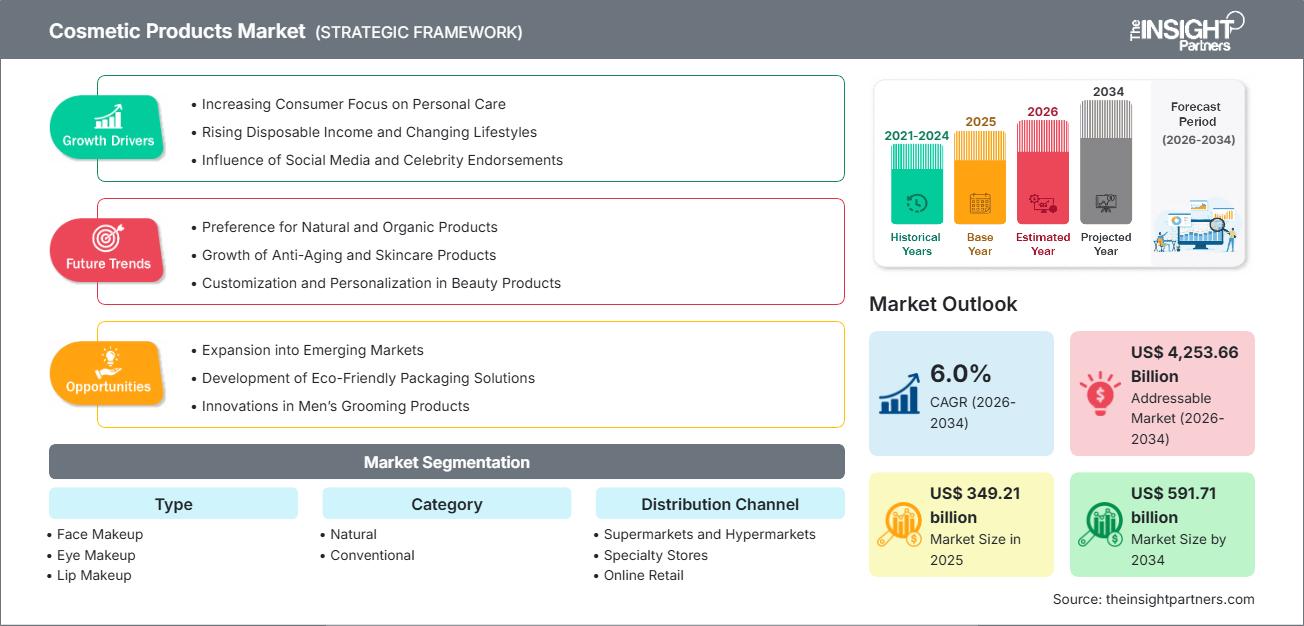
The global Cosmetic Products Market size is projected to reach US$ 591.71 billion by 2034 from US$ 349.21 billion in 2025. The market is anticipated to register a CAGR of 6.00% during the forecast period 2026–2034
Key market dynamics include a heightening global focus on self-care and personal grooming, rising consumer awareness regarding the efficacy of active ingredients, and a significant shift toward clean beauty and ethical consumerism. Additionally, the market is expected to benefit from the growing popularity of gender-neutral product lines, expansion in organized retail channels across emerging economies, and the increasing inclusion of cosmetic technology in high-value segments like AI-driven hyper-personalization and virtual try-on tools.
Cosmetic Products Market Analysis
The cosmetic products market analysis shows a shift toward high-value functional aesthetics as consumers prioritize skin health alongside visual enhancement. Procurement trends indicate the market is splitting into traditional mass-market chemical formulations and high-growth clean-label sectors in North America and Western Europe. Strategic opportunities are emerging in the cosmeceutical segment, where makeup products enriched with skincare actives, such as hyaluronic acid and SPF, offer a clear competitive advantage to urban professionals. The analysis also notes that market expansion depends on digital supply chain transparency for ingredients and sustainable packaging innovations to reduce plastic waste. Competitive differentiation now stands out depending on branding that tells a story and highlights vegan certifications, cruelty-free testing, and being able to track where ingredients come from. This approach helps brands charge premium prices in a market characterized by intense brand loyalty and rapidly shifting social media trends.
Cosmetic Products Market Overview
Cosmetic products are shifting from a luxury indulgence to a daily essential commodity. While historically focused on prestige color cosmetics for formal occasions, the market is expanding into value-added daily wear products like tinted moisturizers, long-wear lip pigments, and specialized eye serums. Both global conglomerates and digital-first indie brands are part of this market, making use of influencer-driven marketing and D2C (Direct-to-Consumer) platforms. More health-conscious consumers in Europe and Asia-Pacific are looking for alternatives to traditional synthetic formulas, which has helped organic and herbal cosmetics gain popularity as a safer choice for long-term use. North America remains a leader in prestige innovation. Still, Asia-Pacific region has emerged as a powerhouse for both manufacturing and consumption, particularly through the K-Beauty and C-Beauty movements. For instance, the market in the US represents a highly mature and innovation-led landscape where consumer demand is increasingly dictated by dermatological backing and clinical transparency. The market is characterized by a strong preference for prestige brands and a rapid adoption of omnichannel retail strategies. High levels of disposable income and a pervasive digital culture continue to sustain a robust appetite for premium, high-performance cosmetic solutions across all age demographics.
Market Assessment and Insights
- Global market for Cosmetic Products was valued at US$ 349.21 Billion in 2025
- Annual market size is expected to reach US$ 591.71 Billion by 2034
- Total addressable market (TAM) during 2026-2034 is projected to reach approximately US$ 4,253.66 Billion
- Market is anticipated to register a CAGR of 6% during the forecast period
- The United States represents a key market, supported by Increasing Consumer Focus on Personal Care, Rising Disposable Income and Changing Lifestyles, Influence of Social Media and Celebrity Endorsements, as well as evolving industry dynamics
- Market analysis covers North America, Europe, Asia-Pacific, South and Central America, Middle East and Africa, with growth evaluated across the forecast period
- Market opportunities such as Expansion into Emerging Markets, Development of Eco-Friendly Packaging Solutions, Innovations in Men's Grooming Products are expected to influence market dynamics and addressable market
- Report profiles industry participants, including Unilever, Procter and Gamble, Loreal Group, Estee Lauder, Sheseido, Kao Corporation, Beiersdorf, Coty Inc, Elf Cosmetics Inc, Revlon, while analyzing competitive strategies and innovation developments
-
Source: The Insight Partners' analysis based on proprietary research, government publications, company annual reports, investor presentations, industry databases, and expert interviews.
● REPORT CUSTOMIZATION
Tailor This Report To Align With Your Specific Business Requirements
This report can be customized to align precisely with your business objectives, scope, and target markets. Customization options include tailored segmentation, geography, competitive analysis, and strategic insights to support informed decision-making.
Customize This Report →WHAT YOU CAN ADJUST
- ● Segmentations
- ● Geography
- ● Competitive Analysis
- ● Language Preferences
Cosmetic Products Market: Strategic Insights
-
Get Top Key Market Trends of this report.This FREE sample will include data analysis, ranging from market trends to estimates and forecasts.
Cosmetic Products Market Drivers and Opportunities
Market Drivers:
- Increasing Demand for Active-Infused Makeup: Modern consumers are looking for hybrid products that provide cosmetic coverage while offering skincare benefits. The integration of ingredients like Vitamin C, Niacinamide, and Peptides into foundations and lip products is driving significant volume growth.
- Influence of Digital Media and Social Commerce: The rise of platforms like TikTok and Instagram has revolutionized product discovery. Influencer endorsements and viral beauty hacks act as major catalysts for rapid inventory turnover and brand awareness.
- Growth of Men's Grooming and Inclusive Beauty: Expanding societal definitions of beauty have led to a surge in cosmetics tailored for men and a broader range of foundation shades for diverse skin tones. This inclusivity is opening new revenue streams previously untapped by mainstream brands.
Market Opportunities:
- Expansion into AI and Beauty-Tech: Strategic opportunities exist in developing personalized beauty apps that use skin-scanning technology to recommend specific shades and formulations, enhancing the consumer's digital shopping experience.
- Growth in Sustainable and Circular Packaging: With rising environmental regulations, brands that adopt refillable packaging systems and biodegradable materials have a significant opportunity to capture the loyalty of eco-conscious Gen Z and Millennial consumers.
- Diversification into Emerging APAC and MEA Markets: Rising urbanization and an expanding middle class in India, Vietnam, and Saudi Arabia offer high-margin opportunities for global players to introduce masstige (mass-prestige) portfolios.
Cosmetic Products Market Report Segmentation Analysis
The Cosmetic Products Market share is analyzed across various segments to provide a clearer understanding of its structure, growth potential, and emerging trends. Below is the standard segmentation approach used in most industry reports:
By Type:
- Face Makeup: This segment covers essential base products such as foundations, concealers, and primers. It is a major revenue driver as consumers seek flawless finishes and long-lasting wear.
- Eye Makeup: Includes mascaras, eyeliners, and eyeshadows. This segment benefits from high innovation in waterproof and smudge-proof technologies.
- Lip Makeup: Comprises lipsticks, glosses, and liners. Frequent product launches and high seasonal variability in color trends characterize it.
By Category:
- Natural: A fast-growing niche that aligns with global wellness trends. It is increasingly preferred by consumers who prioritize plant-based ingredients and chemical-free production.
- Conventional: The dominant volume driver, particularly within the mass-market retail sectors, due to established chemical formulations that offer high performance at cost-effective price points.
By Distribution Channel:
- Supermarkets & Hypermarkets: Remains a primary channel for mass-market brands, offering convenience and the benefit of physical product testing during routine shopping.
- Specialty Stores: This channel, including dedicated beauty retailers, is preferred for prestige and luxury brands where expert consultation is available.
- Online Retail: The fastest-rising channel, enabling cross-border imports and benefiting from the convenience of subscription models and digital try-on features.
By Geography:
- North America
- Europe
- Asia Pacific
- South & Central America
- Middle East & Africa
Cosmetic Products Market Report Scope
| Report Attribute | Details |
|---|---|
| Market size in 2025 | US$ 349.21 billion |
| Market Size by 2034 | US$ 591.71 billion |
| Global CAGR (2026 - 2034) | 6.0% |
| Historical Data | 2021-2024 |
| Forecast period | 2026-2034 |
| Segments Covered |
By Type
|
| Regions and Countries Covered |
North America
|
| Market leaders and key company profiles |
|
Cosmetic Products Market Players Density: Understanding Its Impact on Business Dynamics
The Cosmetic Products Market is growing rapidly, driven by increasing end-user demand due to factors such as evolving consumer preferences, technological advancements, and greater awareness of the product's benefits. As demand rises, businesses are expanding their offerings, innovating to meet consumer needs, and capitalizing on emerging trends, which further fuels market growth.
Cosmetic Products Market Share Analysis by Geography
Asia-Pacific is expected to grow fastest in the coming years. Emerging markets in South & Central America, the Middle East, and Africa also have many untapped opportunities for premium cosmetic producers and sustainable brand manufacturers to expand.
The cosmetic products market is undergoing a significant transformation, moving from traditional department store sales to a tech-enabled, consumer-centric global industry. Growth is driven by the rising influence of social media, a surge in demand for cruelty-free labels, and the expansion of the masstige sector. Below is a summary of market share and trends by region:
North America
- Market Share: Holds a substantial share of global revenue, led by a highly sophisticated consumer base and a strong presence of global beauty conglomerates.
- Key Drivers:
- High consumer spending on prestige and luxury high-performance cosmetics.
- Rapid integration of Augmented Reality (AR) tools in the retail experience.
- Strong demand for Clean at Sephora style ingredient transparency.
- Trends: A significant move toward minimalist makeup routines and the mainstreaming of dermatologist-led brand collaborations.
Europe
- Market Share: A dominant region anchored by the heritage of French and Italian luxury houses and strict EU regulations on ingredient safety.
- Key Drivers:
- Strong cultural emphasis on skincare-first cosmetic applications.
- Leadership in sustainable packaging and green chemistry innovations.
- Robust demand for premium fragrance-infused color cosmetics.
- Trends: A strategic shift toward Circular Beauty, where brands focus on refillable components and carbon-neutral manufacturing processes.
Asia-Pacific
- Market Share: The fastest-growing region, with China, South Korea, and Japan acting as the primary engines for product innovation and volume sales.
- Key Drivers:
- Massive expansion of the middle class with high aspirations for Western and premium local brands.
- Deep penetration of mobile-first e-commerce and live-stream shopping.
- Dominance of the glass skin aesthetic is driving demand for hydrating face makeup.
- Trends: Heavy reliance on K-Beauty influence and the rapid rise of local C-Beauty brands that offer high quality at competitive prices.
South and Central America
- Market Share: An emerging market with a strong cultural affinity for vibrant color cosmetics and personal grooming.
- Key Drivers:
- Growing urbanization in Brazil and Argentina is leading to higher beauty spending.
- Rising influence of local beauty influencers on social media platforms.
- Increasing availability of international brands through expanded retail franchises.
- Trends: Growth of the Nature-Inspired segment and the introduction of sweat-proof formulations tailored for tropical climates.
Middle East and Africa
- Market Share: A developing market with a high preference for luxury, long-wear, and Halal-certified cosmetic products.
- Key Drivers:
- Significant investments in high-end shopping malls and luxury retail infrastructure.
- High demand for pigment-rich products such as eyeliners and lipsticks.
- Strategic focus on Smart Agriculture for sourcing regional natural ingredients like Argan and Oud.
- Trends: Implementation of digital-first luxury boutiques and a growing interest in high-SPF cosmetics to combat extreme UV exposure.
High Market Density and Competition
Competition is intensifying due to the presence of established leaders such as L'Oréal S.A., The Estée Lauder Companies Inc., and The Procter & Gamble Company. Regional experts and niche players like Shiseido Company, Limited (Japan) and Coty Inc. (USA), alongside disruptive innovators such as Fenty Beauty and Rare Beauty, contribute to a diverse and rapidly expanding market landscape.
This competitive environment pushes vendors to differentiate through:
- Functional Branding: Positioning cosmetics as Skin-First by emphasizing dermatological benefits and the exclusion of parabens and sulfates.
- Hyper-Personalization: Using AI to offer custom-blended foundations and personalized shade palettes tailored to individual skin tones.
- Omnichannel Excellence: Ensuring a seamless transition between social media discovery, virtual try-ons, and physical in-store testing.
Opportunities and Strategic Moves
- Partner with Clean Beauty retailers and e-commerce giants to tap into the surging demand for ethical and hypoallergenic products in the North American and European markets.
- Incorporate sustainable sourcing and biodegradable packaging to appeal to environmentally conscious younger demographics seeking brand transparency.
Major Companies operating in the Cosmetic Products Market are:
- Unilever
- Procter and Gamble
- Loreal Group
- Estée Lauder
- Sheseido
- Kao Corporation
- Beiersdorf
- Coty Inc
- Elf Cosmetics Inc
- Revlon
Disclaimer: The companies listed above are not ranked in any particular order.
Cosmetic Products Market News and Recent Developments
- In April 2024, The Estée Lauder Companies (ELC) and Microsoft Corp. announced the creation of an AI Innovation Lab as an expansion of their global strategic relationship. By leveraging cutting-edge generative AI capabilities in Microsoft Azure OpenAI Service, the companies worked together to develop solutions that further empowered ELC's more than 20 prestige beauty brands. These efforts aimed to create closer consumer connections and increase speed to market for their Cosmetic Products with local relevancy. The AI Innovation Lab further positioned both companies as leaders at the forefront of reimagining the beauty industry with generative AI.
- In February 2024, Coty Inc., one of the world's largest beauty companies with a portfolio of iconic brands, signed a new agreement with the luxury Italian fashion house, Etro. This partnership authorized Coty to produce and distribute Etro's signature fragrance lines and home scent collections beyond 2040. Both companies are committed to working together to explore new categories and innovations, further expanding the brand's presence within the global market for Cosmetic Products. This strategic move reinforced Coty's reputation as a leading partner for fashion houses looking to elevate their beauty portfolios through long-term collaborations.
Cosmetic Products Market Report Coverage and Deliverables
The Cosmetic Products Market Size and Forecast (2021–2034) report provides a detailed analysis of the market covering below areas:
- Cosmetic Products Market size and forecast at global, regional, and country levels for all the key market segments covered under the scope
- Cosmetic Products Market trends, as well as market dynamics such as drivers, restraints, and key opportunities
- Detailed PEST and SWOT analysis
- Cosmetic Products Market analysis covering key market trends, global and regional framework, major players, regulations, and recent market developments
- Industry landscape and competition analysis covering market concentration, heat map analysis, prominent players, and recent developments in the Cosmetic Products Market.
- Detailed company profiles
Frequently Asked Questions

- Comprehensive Market Sizing and Forecast Analysis
- Detailed Segmentation Analysis
- In-Depth Market Dynamics Assessment
- Regional and Country-Level Insights
- Competitive Landscape and Company Benchmarking
- Strategic Business Intelligence
Recent Reports
Testimonials

The Insight Partners' SCADA System Market report is comprehensive, with valuable insights on current trends and future forecasts. The team was highly professional, responsive, and supportive throughout. We are very satisfied and highly recommend their services.
RAN KEDEM Partner, Reali Technologies LTDs
I requested a report on a very specific software market and the team produced the report in a few days. The information was very relevant and well presented. I then requested some changes and additions to the report. The team was again very responsive and I got the final report in less than a week.
JEAN-HERVE JENN Chairman, Future Analytica
We worked with The Insight Partners for an important market study and forecast. They gave us clear insights into opportunities and risks, which helped shape our plans. Their research was easy to use and based on solid data. It helped us make smart, confident decisions. We highly recommend them.
PIYUSH NAGPAL Sr. Vice President, High Beam Global
The Insight Partners delivered insightful, well-structured market research with strong domain expertise. Their team was professional and responsive throughout. The user-friendly website made accessing industry reports seamless. We highly recommend them for reliable, high-quality research services
YUKIHIKO ADACHI CEO, Deep Blue, LLC.
This is the first time I have purchased a market report from The Insight Partners.While I was unsure at first, I visited their web site and felt more comfortable to take the risk and purchase a market report.I am completely satisfied with the quality of the report and customer service. I had several questions and comments with the initial report, but after a couple of dialogs over email with their analyst I believe I have a report that I can use as input to our strategic planning process.Thank you so much for taking the extra time and making this a positive experience.I will definitely recommend your service to others and you will be my first call when we need further market data.
JOHN SUZUKI President and Chief Executive Officer, Board Director, BK Technologies
I wish to appreciate your support and the professionalism you displayed in the course of attending to my request for information regarding to infectious disease IVD market in Nigeria. I appreciate your patience, your guidance, and the fact that you were willing to offer a discount, which eventually made it possible for us to close a deal. I look forward to engaging The Insight Partners in the future, all thanks to the impression you have created in me as a result of this first encounter.
DR CHIJIOKE ONYIA MANAGING DIRECTOR, PineCrest Healthcare Ltd.Reason to Buy
- Informed Decision-Making
- Understanding Market Dynamics
- Competitive Analysis
- Identifying Emerging Markets
- Customer Insights
- Market Forecasts
- Risk Mitigation
- Boosting Operational Efficiency
- Strategic Planning
- Investment Justification
- Tracking Industry Innovations
- Aligning with Regulatory Trends





 Get Free Sample for