
Cosmetic Prosthetics Market Share, Demand & Growth by 2034
Coverage: By Type (Dental, Cosmetic, Body Prosthesis, and Others); Material (Metals, Polymers, Ceramic, Silicone, and Others); , and Geography (North America, Europe, Asia Pacific, and South and Central America)
- Status : Data Released
- Report Code : TIPMD00002014
- Category : Life Sciences
- No. of Pages : 150
- Available Report Formats :


- Last update date : July 29, 2026


2025 Market Size
US$ 1.34 Bn
Base year value
2034 Forecast
US$ 2.26 Bn
Projected by 2034
CAGR 2026-2034
5.98 %
Growth rate
Addressable Market
US$ 16.31 Bn
(2026-2034)
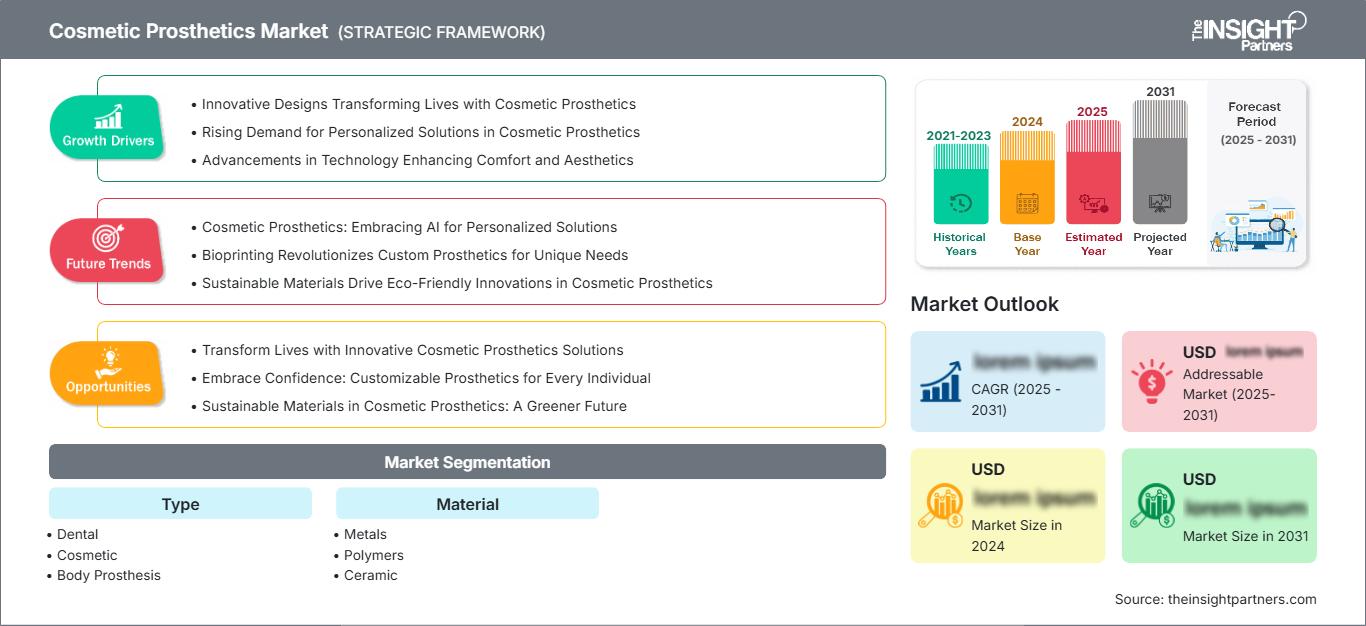
The Cosmetic Prosthetics Market is estimated to be valued at US$ 1.34 Billion in 2025 and is anticipated to reach a value of US$ 2.26 Billion by 2034, growing at a CAGR of 5.98% between 2026 and 2034. Market growth will be driven by the growing prevalence of congenital or acquired physical deformities, growing demand for cosmetic rehabilitation, and constant innovation in prosthetic materials and technologies. Increased focus on patient-specific prosthetics, digital technologies for design and production, and reconstructive medicine will drive future growth of the market.
In North America, the market for reconstructive and rehabilitation services is constantly developing, which provides a good environment for use of cosmetic prosthetics. The Cosmetic Prosthetics Market size in the region is predicted to grow at an estimated CAGR range of 6.0–6.5% between 2026 and 2034. This growth will be driven by increased demand for custom-made prostheses, widespread use of digital scanning and additive manufacturing technologies, and expanding availability of specialized reconstructive clinics and rehabilitation facilities.
Cosmetic Prosthetics Market Assessment and Insights
- North America accounted for a leading position in the market with an estimated 37–41% Cosmetic Prosthetics Market share in 2025 and is projected to expand at a CAGR range of 6.0–6.5% during 2026–2034. Regional leadership is supported by advanced healthcare infrastructure, high patient awareness, favorable reimbursement for selected prosthetic procedures, and increasing adoption of customized aesthetic prostheses.
- US represented the dominant country within North America with an estimated 77–81% share of the regional market in 2025 and is expected to register a CAGR range of 6.1–6.6% between 2026–2034. Strong clinical expertise, widespread availability of advanced prosthetic technologies, and increasing reconstructive procedures continue to support sustained market demand.
- Europe held an estimated 28–32% market share in 2025 and is anticipated to grow at a CAGR range of 5.5–6.0% during 2026–2034. Germany, the UK, France, Italy, and Spain remain major contributors owing to established reconstructive surgery networks, favorable healthcare systems, and increasing adoption of advanced prosthetic materials.
- Asia Pacific captured an estimated 22–26% share in 2025 and is forecast to expand at a CAGR range of 6.5–7.2% from 2026–2034. China, Japan, India, South Korea, and Australia are strengthening healthcare infrastructure while increasing investments in maxillofacial reconstruction, dental restoration, and customized prosthetic technologies.
- Largest Segment – Type (Dental) accounted for an estimated 46–50% market share in 2025 and is expected to grow at a CAGR range of 6.0–6.4% during 2026–2034, supported by growing demand for implant-supported restorations, cosmetic dentistry, and digital prosthetic fabrication.
- High Growth Segment – Material (Silicone) represented an estimated 30–34% market share in 2025 and is projected to register a CAGR range of 6.6–7.2% between 2026–2034 due to superior aesthetics, flexibility, biocompatibility, and increasing utilization in facial and body prosthetic applications.
- Key companies analyzed in detail: Danaher Corporation, Zimmer Biomet Holdings, Inc., Mentor Worldwide LLC, POLYTECH Health & Aesthetics GmbH, MORCHER GmbH, Blatchford Limited, Artificial Limb Specialists, Inc., Prosthetics in Motion, Aesthetic Prosthetics, BioHorizons IPH, Inc.
Source: The Insight Partners' analysis based on proprietary research, government publications, company annual reports, investor presentations, industry databases, and expert interviews.
Evolution of the Cosmeceuticals and Cosmetic Prosthetics Market is characterized by unceasing advancements in biomaterials, digital fabrication, and personalized prosthetic design. The combination of 3D scanning, computer-aided design, additive manufacturing, and advanced silicone manufacturing has enhanced the performance of prostheses by increasing the degree of their resemblance to natural tissues, making them more comfortable and effective. Cooperation between prosthetic companies, reconstructive surgeons, dentists, rehabilitation specialists, and research centers will continue to drive innovation and increase access to treatments in developed and developing healthcare markets.
The future development of the market will be driven by the growth of reconstructive healthcare services, increased financing of digital fabrication technologies for prostheses, and initiatives for the improvement of patients' rehabilitation and quality of life. The use of artificial intelligence technologies for design, customization of implants, and innovative materials will enable more precise treatment and provide many prospects for manufacturers and clinicians.
Cosmetic Prosthetics Market Report Scope
| Report Attribute | Details |
|---|---|
| Market size in 2025 | US$ 1.34 Billion |
| Market Size by 2034 | US$ 2.26 Billion |
| Global CAGR (2026 - 2034) | 5.98% |
| Historical Data | 2021-2024 |
| Forecast period | 2026-2034 |
Cosmetic Prosthetics Market Analysis
The Cosmetic Prosthetics Market is boosted by the rising number of requests from the part of people suffering from congenital defects, traumas, surgery due to cancer, and aging-induced loss of tissues. There are increased public awareness about reconstructive techniques, better access to healthcare, and technology advancements in the field of manufacturing of personalized prosthetics that are driving up the demand for prosthetics globally. The value chain involves raw materials suppliers, digital design software providers, prosthetics manufacturers, hospitals, reconstructive surgeons, dentists, physical therapists, and distributors.
From the supply-side, there is an increasing trend towards the improvement of material's resistance, manufacturing process, and personalization features of prosthetics. The companies keep on investing in 3D printing technologies, silicone materials, light composites, and digital work flow in order to boost the quality of their products and shorten manufacturing time. Cooperation between manufacturers and healthcare providers is facilitating efficient product development and increased availability of personalized cosmetic prosthetic solutions.
Competitive dynamics within the Cosmetic Prosthetics Market analysis show a growing focus on innovations in technologies, mergers & acquisitions, expansion of product lineups and penetration into new markets abroad. Danaher Corporation, Zimmer Biomet Holdings, Inc., Mentor Worldwide LLC, POLYTECH Health & Aesthetics GmbH, and MORCHER GmbH are consistently enhancing their competitive positioning by means of investing in advanced prosthetic technologies and customized solutions for reconstruction procedures. Blatchford Limited, Artificial Limb Specialists, Inc., Prosthetics in Motion, Aesthetic Prosthetics, and BioHorizons IPH, Inc. are consistently developing specialized product lineups and improving cooperation with clinicians, digital workflows and individual manufacturing.
Increased attention is being paid to investment in digital laboratories for prosthetics, prosthetics designing with artificial intelligence, advanced materials and additive manufacturing that can enhance accuracy and shorten production time. Market players are developing their manufacturing facilities, conducting clinical education and strategic partnership programs in order to improve global availability. Competitiveness will be determined not only by innovations but also by regulatory compliance, production scalability, cost-effectiveness and ability to develop highly customized solutions.
● REPORT CUSTOMIZATION
Tailor This Report To Align With Your Specific Business Requirements
This report can be customized to align precisely with your business objectives, scope, and target markets. Customization options include tailored segmentation, geography, competitive analysis, and strategic insights to support informed decision-making.
Customize This Report →WHAT YOU CAN ADJUST
- ● Segmentations
- ● Geography
- ● Competitive Analysis
- ● Language Preferences
Cosmetic Prosthetics Market: Strategic Insights
Regional Insights
North America Cosmetic Prosthetics Market
The North American region had an estimated market share of 39-43% in 2025 and is expected to grow at a CAGR of 6.0-6.5% over 2026-2034. The market share for Cosmetic Prosthetics in North America is driven by advanced reconstructive healthcare facilities, reimbursement of certain types of prosthetic procedures, and adoption of digitally designed prosthetics. Continuous investment in dental restoration technology and rehabilitation services drives the demand for cosmetic prosthetics in the region.
The US is leading the regional market while Canada is developing its prosthetic care sector through increased rehabilitation services and adoption of digitized prosthetics. Increasing incidence of trauma cases, cancer reconstruction, and aging population losing teeth have increased the need for customized cosmetic prosthetics in the region. Continued innovation in technology, training, and modernization of healthcare facilities will help drive the market growth in the region in the coming years.
U.S. Cosmetic Prosthetics Market
The US accounted for about 77% to 81% share of the North American market in 2025 and will record a CAGR range of 6.1% to 6.6% during 2026 to 2034. Healthcare spending, comprehensive services of prosthetic rehabilitation, and increased use of digital dental technology keep on playing roles in making the country a market leader. Patient preference towards customized cosmetic restoration has been driving demand through specialized treatment centers.
Major players such as Danaher Corporation, Zimmer Biomet Holdings, Inc., Mentor Worldwide LLC, BioHorizons IPH, Inc., and Blatchford Limited hold strong positions in the market through advanced dental implants, cosmetic prostheses, and prosthetic rehabilitation solutions. Investments in digital technology, additive manufacturing, and patient-specific prosthetic solutions will help improve treatment accuracy while sustaining market growth.
Europe Cosmetic Prosthetics Market
The region has an estimated market share of 28-32% in 2025 and is expected to grow at a CAGR of 5.6-6.1% during 2026-2034. Germany holds the position as the most prominent regional market due to its well-developed dental technology, advanced medical devices manufacturing, and extensive usage of customized prosthetics. The United Kingdom grows reconstructive health care through investments in digital dentistry and prosthetic rehabilitation.
France, Italy, and Spain have been making efforts towards the adoption of prosthetics through upgrading healthcare facilities, raising awareness on reconstructive care, and digital manufacturing technology. Collaboration between research organizations, clinicians, and manufacturers in developing lightweight materials and customized prosthetics, and minimally-invasive restoration procedures has played a vital role in the steady growth of the regional market.
APAC Cosmetic Prosthetics Market
Asia Pacific represented an estimated 20–24% share of the global market in 2025 and is projected to expand at a CAGR range of 6.6–7.2% during 2026–2034. China remains the largest regional market owing to rapid expansion of dental care infrastructure, increasing reconstructive surgical procedures, and growing investments in advanced medical manufacturing technologies.
Japan, South Korea, India, and Australia are strengthening market development through rising healthcare expenditure, wider adoption of digital dentistry, increasing availability of customized prosthetic solutions, and supportive government initiatives promoting rehabilitation services. Improvements in healthcare accessibility and growing demand for aesthetic restorative procedures continue to accelerate regional expansion.
Middle East & Africa Cosmetic Prosthetics Market
The Middle East & Africa market is expected to register a CAGR range of 5.2–5.8% between 2026–2034. Saudi Arabia and the UAE remain the leading regional markets due to continuous investments in advanced healthcare infrastructure, cosmetic surgery centers, and rehabilitation facilities. South Africa also contributes through expanding prosthetic rehabilitation services and increasing adoption of digital fabrication technologies.
Across the Rest of MEA, healthcare modernization initiatives, improving access to reconstructive procedures, and increasing collaboration with international prosthetic manufacturers are supporting gradual market expansion. Continued investments in specialized rehabilitation centers and advanced medical technologies are expected to improve long-term accessibility to customized cosmetic prosthetic solutions.
Segmentation Analysis
Type
The Type segment represents the largest component of the Cosmetic Prosthetics Market scope and is projected to expand at a CAGR range of 5.9–6.4% during 2026–2034. Growing demand for personalized restorative procedures, technological advancements in prosthetic design, and increasing acceptance of aesthetic rehabilitation continue to support adoption across hospitals, dental clinics, and specialized rehabilitation centers. Digital manufacturing technologies and improved biomaterials are further enhancing long-term market potential.
- Dental remains the largest sub-segment owing to increasing prevalence of tooth loss, rising implant procedures, and growing demand for aesthetically superior restorative solutions supported by digital dentistry and CAD/CAM technologies.
- Cosmetic prosthetics continue gaining traction as patients increasingly seek customized facial and external prosthetic solutions following trauma, congenital conditions, and oncological reconstructive procedures requiring natural aesthetic appearance.
- Body Prosthesis supports rehabilitation following limb loss and congenital deformities through customized prosthetic devices designed to improve functional mobility while delivering enhanced cosmetic appearance and patient confidence.
Material
The Material segment is anticipated to register a CAGR range of 5.8–6.3% during 2026–2034 as manufacturers increasingly develop lightweight, durable, and highly biocompatible materials capable of improving patient comfort and long-term clinical performance. Continuous innovation in advanced polymers, ceramics, and silicone technologies supports wider adoption across dental, facial, and body prosthetic applications while improving aesthetic outcomes and durability.
- Metals continue serving high-strength prosthetic applications where structural durability, corrosion resistance, and long-term mechanical stability remain essential for permanent restorative procedures.
- Polymers are witnessing expanding utilization because of their lightweight characteristics, design flexibility, and compatibility with advanced digital manufacturing processes supporting customized prosthetic fabrication.
- Ceramic materials remain widely preferred for premium dental restorations due to their excellent aesthetics, color stability, wear resistance, and close resemblance to natural teeth.
- Silicone plays a critical role in facial and external cosmetic prosthetics by providing realistic skin texture, flexibility, patient comfort, and highly customized aesthetic reconstruction.
Opportunity Snapshot
| Segment Name | Revenue Contribution | Trend Tag | Adoption Stage |
| Dental | High | Digital Dentistry | Mature |
| Cosmetic | Medium | Facial Restoration | Scaling |
| Body Prosthesis | Medium | Smart Prosthetics | Scaling |
Cosmetic Prosthetics Market Growth Drivers and Impact Analysis
Growing Demand for Aesthetic and Reconstructive Healthcare
The rising incidence of traumatic injuries, congenital deformities, cancer-related reconstructive procedures, and age-related tooth loss continues to increase demand for advanced cosmetic prosthetic solutions. Patients increasingly seek prostheses that combine functional restoration with a natural appearance, encouraging healthcare providers to adopt customized treatment approaches. Improvements in reconstructive surgery, prosthetic rehabilitation, and digital treatment planning have expanded patient eligibility across multiple applications. Healthcare systems are also investing in multidisciplinary rehabilitation programs that integrate surgeons, prosthetists, dentists, and rehabilitation specialists. These developments are encouraging manufacturers to introduce patient-specific prosthetic solutions with enhanced aesthetics, durability, and comfort, supporting long-term market expansion across both developed and emerging healthcare systems.
Advancements in Digital Manufacturing and Biomaterials
Continuous innovation in CAD/CAM technology, three-dimensional printing, digital scanning, and advanced biomaterials is transforming cosmetic prosthetic production. Modern manufacturing techniques enable greater precision, shorter production cycles, and improved customization compared with conventional fabrication methods. Silicone, ceramic, polymer, and titanium-based materials are being engineered to improve durability, biocompatibility, and aesthetic realism while enhancing patient comfort. Digital workflows also improve communication between clinicians and laboratories, reducing treatment timelines and minimizing fitting adjustments. These technological developments enable manufacturers to deliver highly personalized prosthetic solutions while improving operational efficiency, product consistency, and long-term clinical outcomes across dental, facial, and body prosthetic applications.
Expansion of Rehabilitation and Specialized Healthcare Infrastructure
Governments and private healthcare organizations continue expanding rehabilitation services, specialized prosthetic centers, and advanced dental facilities to address increasing demand for restorative care. Growing investments in healthcare modernization, clinician education, and prosthetic reimbursement programs are improving patient access to advanced cosmetic prosthetic solutions. Rehabilitation centers are adopting integrated treatment models that combine surgical reconstruction, prosthetic fitting, and long-term patient support to improve functional and psychological outcomes. Manufacturers are strengthening regional distribution networks and collaborating with hospitals and rehabilitation providers to improve service accessibility. These initiatives are expected to support sustained market penetration while encouraging adoption of technologically advanced cosmetic prosthetics across diverse healthcare settings.
Cosmetic Prosthetics Market Future Trends
Expansion of AI-Enabled Digital Prosthetic Design
The Cosmetic Prosthetics Market trends indicate increasing adoption of artificial intelligence, digital scanning, and automated design platforms to improve prosthetic customization and manufacturing precision. Future workflows are expected to integrate predictive modeling, cloud-based collaboration, and additive manufacturing technologies that reduce production time while improving clinical outcomes. Healthcare providers are increasingly investing in digital treatment planning platforms capable of delivering highly personalized prosthetic solutions. These advancements are expected to improve patient satisfaction, streamline laboratory operations, and strengthen collaboration among clinicians, manufacturers, and rehabilitation specialists.
Growing Adoption of Advanced Personalized Biomaterials
Manufacturers are increasingly focusing on next-generation biomaterials that closely replicate natural tissue appearance, flexibility, and durability. Continuous research into medical-grade silicone, high-performance polymers, bioengineered ceramics, and lightweight composite materials is expected to improve long-term clinical performance and patient comfort. Personalized material selection supported by digital design technologies will enable clinicians to optimize cosmetic outcomes while addressing patient-specific anatomical requirements. Future product innovation is expected to strengthen differentiation across reconstructive, dental, and external prosthetic applications while improving treatment accessibility globally.
Cosmetic Prosthetics Market Opportunities
Expanding Digital Dentistry and Prosthetic Manufacturing Investments
The Cosmetic Prosthetics Market Forecasts indicate strong investment opportunities arising from wider adoption of digital dentistry, three-dimensional printing, and automated prosthetic manufacturing technologies. Healthcare providers continue investing in integrated digital workflows that improve customization, production efficiency, and patient satisfaction. Manufacturers expanding localized production facilities, strengthening digital laboratory partnerships, and investing in clinician education are expected to improve commercial competitiveness. Continued modernization of dental laboratories and rehabilitation centers across emerging economies is likely to generate long-term revenue opportunities while supporting broader adoption of personalized cosmetic prosthetic solutions.
Strategic Partnerships Across Rehabilitation and Healthcare Networks
Collaborative partnerships among prosthetic manufacturers, dental laboratories, rehabilitation providers, hospitals, and academic institutions present significant opportunities for product innovation and market expansion. Joint research initiatives focused on advanced biomaterials, digital manufacturing, and patient-specific prosthetic design can accelerate commercialization of next-generation solutions. Companies strengthening regional distribution networks and expanding clinical training programs are expected to improve product accessibility across underserved markets. These strategic collaborations also support regulatory compliance, technology transfer, and long-term business growth while improving patient access to advanced cosmetic prosthetic care.
Recent Developments
- May 2025: Zimmer Biomet Holdings, Inc. announced expanded digital dentistry capabilities through enhancements to its dental workflow solutions, supporting improved implant planning, restorative precision, and clinician efficiency across integrated dental practices. The development strengthens the company's strategy of advancing digitally enabled oral rehabilitation solutions.
- February 2025: Danaher Corporation highlighted continued innovation across its dental platform through advancements in digital imaging, intraoral scanning, and CAD/CAM restorative technologies designed to improve clinical productivity and patient-specific treatment planning.
- September 2024: POLYTECH Health & Aesthetics GmbH announced continued expansion of its breast implant education and clinical collaboration initiatives to support reconstructive and aesthetic surgical practices while reinforcing product quality and long-term patient safety standards.
Frequently Asked Questions

- Comprehensive Market Sizing and Forecast Analysis
- Detailed Segmentation Analysis
- In-Depth Market Dynamics Assessment
- Regional and Country-Level Insights
- Competitive Landscape and Company Benchmarking
- Strategic Business Intelligence
Recent Reports
Testimonials

The Insight Partners provided valuable market intelligence that supported our global go-to-market strategy. Their team was professional, responsive, and attentive to our feedback, providing thoughtful analysis and helpful methodological clarifications throughout the project.
Junmo Kim Chief Financial Officer (CFO), Enertech Co., Ltd.
The Insight Partners' SCADA System Market report is comprehensive, with valuable insights on current trends and future forecasts. The team was highly professional, responsive, and supportive throughout. We are very satisfied and highly recommend their services.
RAN KEDEM Partner, Reali Technologies LTDs
I requested a report on a very specific software market and the team produced the report in a few days. The information was very relevant and well presented. I then requested some changes and additions to the report. The team was again very responsive and I got the final report in less than a week.
JEAN-HERVE JENN Chairman, Future Analytica
We worked with The Insight Partners for an important market study and forecast. They gave us clear insights into opportunities and risks, which helped shape our plans. Their research was easy to use and based on solid data. It helped us make smart, confident decisions. We highly recommend them.
PIYUSH NAGPAL Sr. Vice President, High Beam Global
The Insight Partners delivered insightful, well-structured market research with strong domain expertise. Their team was professional and responsive throughout. The user-friendly website made accessing industry reports seamless. We highly recommend them for reliable, high-quality research services
YUKIHIKO ADACHI CEO, Deep Blue, LLC.
This is the first time I have purchased a market report from The Insight Partners.While I was unsure at first, I visited their web site and felt more comfortable to take the risk and purchase a market report.I am completely satisfied with the quality of the report and customer service. I had several questions and comments with the initial report, but after a couple of dialogs over email with their analyst I believe I have a report that I can use as input to our strategic planning process.Thank you so much for taking the extra time and making this a positive experience.I will definitely recommend your service to others and you will be my first call when we need further market data.
JOHN SUZUKI President and Chief Executive Officer, Board Director, BK Technologies
I wish to appreciate your support and the professionalism you displayed in the course of attending to my request for information regarding to infectious disease IVD market in Nigeria. I appreciate your patience, your guidance, and the fact that you were willing to offer a discount, which eventually made it possible for us to close a deal. I look forward to engaging The Insight Partners in the future, all thanks to the impression you have created in me as a result of this first encounter.
DR CHIJIOKE ONYIA MANAGING DIRECTOR, PineCrest Healthcare Ltd.Reason to Buy
- Informed Decision-Making
- Understanding Market Dynamics
- Competitive Analysis
- Identifying Emerging Markets
- Customer Insights
- Market Forecasts
- Risk Mitigation
- Boosting Operational Efficiency
- Strategic Planning
- Investment Justification
- Tracking Industry Innovations
- Aligning with Regulatory Trends





 Get Free Sample for