
Counter IED System Market Share, Growth & Forecast by 2034
Coverage: By Mounting Type (Aircraft Mounted, Naval Vessels Mounted, Vehicle Mounted, Man-Portable); System (Electronic Countermeasures, Counter-IED Vehicles, Unmanned Systems, Others); End Users (Military, Homeland Security) , and Geography (North America, Europe, Asia Pacific, and South and Central America)
- Status : Data Released
- Report Code : TIPTE100000681
- Category : Aerospace and Defense
- No. of Pages : 150
- Available Report Formats :


- Last update date : March 27, 2026


2025 Market Size
US$ 2.4 Bn
Base year value
2034 Forecast
US$ 3.35 Bn
Projected by 2034
CAGR 2026-2034
3.8 %
Growth rate
Addressable Market
US$ 26.15 Bn
(2026-2034)
The global Counter IED System market size is projected to reach US$ 3.35 billion by 2034 from US$ 2.4 billion in 2025. The market is anticipated to register a CAGR of 3.8% during the forecast period 2026–2034.
Key market dynamics include the rising incidence of asymmetric warfare, the increasing use of improvised explosive devices by non-state actors, and a heightening global focus on troop protection. Additionally, the market is expected to benefit from the integration of Artificial Intelligence (AI) and Machine Learning (ML) into detection sensors, the rapid adoption of unmanned ground and aerial vehicles for standoff neutralization, and the expansion of homeland security initiatives to protect critical civilian infrastructure and public spaces.
Counter IED System Market Analysis
The counter IED system market analysis indicates a strategic pivot toward multi-domain integration and autonomous threat mitigation. Procurement trends show a transition from reactive jamming to proactive, sensor-fused detection platforms that can identify explosive precursors at a distance. Strategic opportunities are emerging in the development of system-of-systems architectures, where handheld detectors, vehicle-mounted jammers, and unmanned aerial surveillance pods operate on a unified data link to provide 360-degree force protection. The analysis also notes that market success is increasingly tied to software-defined capabilities, allowing systems to be updated in the field to counter evolving trigger frequencies and new IED designs. Competitive differentiation is now defined by the ability to offer low-SWaP (Size, Weight, and Power) solutions that do not compromise on jamming range or detection sensitivity, particularly for dismounted soldiers and small tactical units.
Counter IED System Market Overview
Counter IED system is shifting from specialized, niche equipment to a standard requirement for modern military and internal security forces. Originally focused on heavy mine-resistant vehicles and basic metal detection, the market has expanded into sophisticated electronic countermeasures, robotic neutralization arms, and advanced ground-penetrating radar. The ecosystem comprises major defense conglomerates providing integrated vehicle suites and agile technology firms specializing in portable sensors and AI-driven signal analysis. As insurgent tactics evolve to include drone-delivered IEDs and non-metallic components, the demand for Counter-Everywhere solutions has grown, pushing the market beyond traditional conflict zones into urban law enforcement and border security applications. For instance, the market in the US represents the largest share of global demand, driven by massive defense appropriations and a focus on maintaining technological superiority. US agencies prioritize high-end electronic warfare suites and robotic systems to minimize personnel risk. The market is characterized by rapid prototyping and frequent software-defined upgrades to counter emerging global threats.
Market Assessment and Insights
- Global market for Counter IED System was valued at US$ 2.40 Billion in 2025
- Annual market size is expected to reach US$ 3.35 Billion by 2034
- Total addressable market (TAM) during 2026-2034 is projected to reach approximately US$ 26.15 Billion
- Market is anticipated to register a CAGR of 3.8% during the forecast period
- The United States represents a key market, supported by Increasing Developments of Counter-IED Systems, Rising Global Threat of Terrorism and Insurgency, as well as evolving industry dynamics
- Market analysis covers North America, Europe, Asia-Pacific, South and Central America, Middle East and Africa, with growth evaluated across the forecast period
- Market opportunities such as Rising Competitiveness Among Vendors, Growing Use of UAVs are expected to influence market dynamics and addressable market
- Report profiles industry participants, including BAE Systems, Elbit Systems Ltd., General Dynamics Corporation, L3Harris Technologies Inc., Israel Aerospace Industries Ltd., Lockheed Martin Corporation, Northrop Grumman Corporation, Raytheon Company, Rheinmetall AG, Thales Group, while analyzing competitive strategies and innovation developments
-
Source: The Insight Partners' analysis based on proprietary research, government publications, company annual reports, investor presentations, industry databases, and expert interviews.
● REPORT CUSTOMIZATION
Tailor This Report To Align With Your Specific Business Requirements
This report can be customized to align precisely with your business objectives, scope, and target markets. Customization options include tailored segmentation, geography, competitive analysis, and strategic insights to support informed decision-making.
Customize This Report →WHAT YOU CAN ADJUST
- ● Segmentations
- ● Geography
- ● Competitive Analysis
- ● Language Preferences
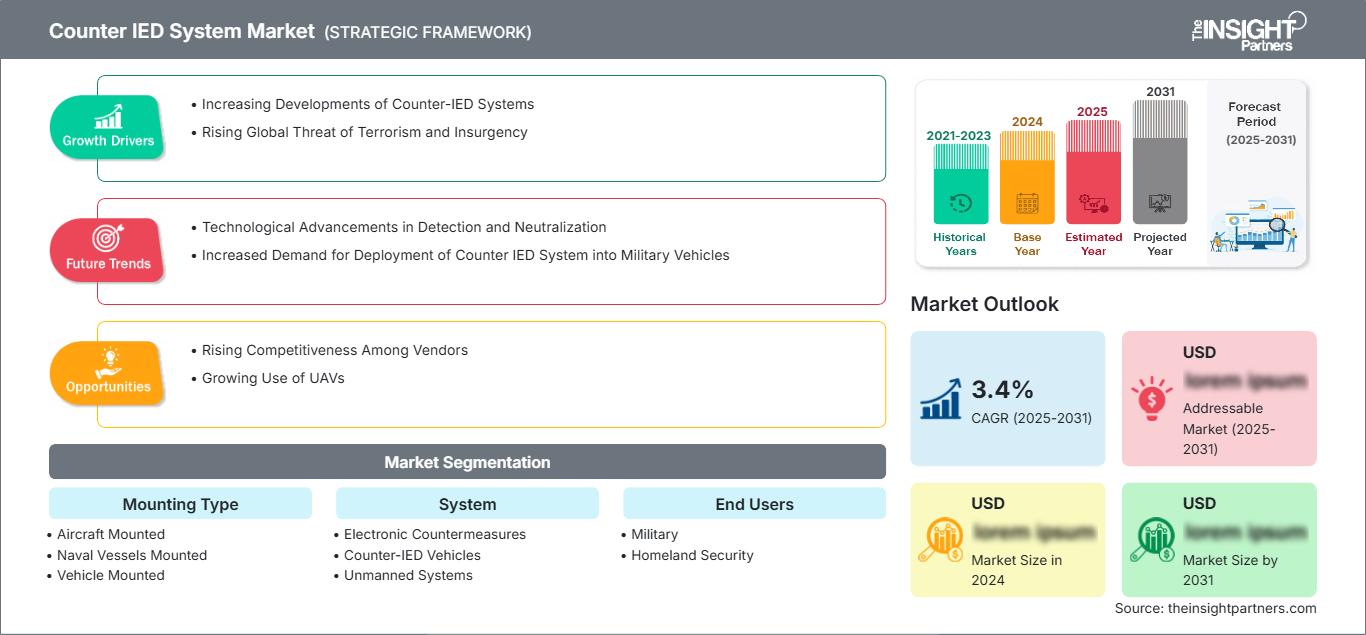
Counter IED System Market: Strategic Insights
-
Get Top Key Market Trends of this report.This FREE sample will include data analysis, ranging from market trends to estimates and forecasts.
Counter IED System Market Drivers and Opportunities
Market Drivers:
- Rising Global Asymmetric Warfare and Terrorism: The proliferation of low-cost, high-impact improvised devices by insurgent groups remains the primary driver. As conventional militaries engage in irregular conflicts, the demand for robust force protection and route clearance systems has become a budgetary priority.
- Technological Advancements in Autonomous Systems: The integration of robotics and unmanned platforms (UGVs and UAVs) allows for the detection and neutralization of threats without direct human exposure. Enhanced sensor fusion, combining thermal imaging with ground-penetrating radar, has significantly reduced false-alarm rates.
- Increased Defense Spending in Emerging Economies: Heightened territorial tensions in regions such as Asia-Pacific and the Middle East are leading to larger allocations for specialized counter-terrorism equipment. Modernization programs are increasingly including C-IED capabilities as a core component of armored vehicle procurement.
Market Opportunities:
- Expansion of Homeland Security and Public Safety: Beyond the battlefield, there is a significant opportunity to deploy C-IED technologies in airports, transit hubs, and government buildings. Growing concerns over domestic radicalization are driving demand for handheld and walk-through detection systems.
- Integration with Counter-UAS Technologies: As IEDs are increasingly integrated with small drones, there is a growing market for unified platforms that can jam both the IED trigger and the drone's control signal, providing a comprehensive electronic shield for convoys.
- Development of Dual-Use Humanitarian Solutions: Strategic moves into the demining and humanitarian aid sector offer long-term growth. Modular C-IED systems can be repurposed for clearing landmines in post-conflict zones, facilitating the safe return of displaced populations and infrastructure rebuilding.
Counter IED System Market Report Segmentation Analysis
The Counter IED System Market share is analyzed across various segments to provide a clearer understanding of its structure, growth potential, and emerging trends. Below is the standard segmentation approach used in most industry reports:
By Mounting Type:
- Vehicle Mounted: The largest segment by volume, involving the integration of jammers and detection arrays onto tactical and armored vehicles to protect convoys during transit.
- Man-Portable: A critical growth area focusing on lightweight, battery-operated equipment for dismounted infantry and explosive ordnance disposal (EOD) teams.
- Aircraft-mounted: Increasingly utilized for wide-area surveillance and standoff detection using specialized pods attached to manned helicopters or fixed-wing assets.
- Naval Vessels Mounted: Specialized systems designed to protect maritime assets and harbors from waterborne improvised threats and sea mines.
By System:
- Electronic Countermeasures: Dominant technology segment involving RF jammers and signal inhibitors that prevent the remote detonation of explosive devices.
- Unmanned Systems: Fastest-growing category, including ground robots and aerial drones used for remote inspection and safe disposal of suspected threats.
- Counter-IED Vehicles: Purpose-built or heavily modified armored platforms designed for high-survivability during route clearance and demining missions.
- Others: Includes specialized detection sensors, chemical sniffers, and explosive-resistant personal protective equipment (PPE).
By End Users:
- Military: The primary consumer, focused on large-scale procurement for international deployments, peacekeeping missions, and frontline combat operations.
- Homeland Security: A rising segment encompassing law enforcement, border patrol, and critical infrastructure protection agencies responding to domestic terror threats.
By Geography:
- North America
- Europe
- Asia Pacific
- South & Central America
- Middle East & Africa
Counter IED System Market Report Scope
| Report Attribute | Details |
|---|---|
| Market size in 2025 | US$ 2.4 Billion |
| Market Size by 2034 | US$ 3.35 Billion |
| Global CAGR (2026 - 2034) | 3.8% |
| Historical Data | 2021-2024 |
| Forecast period | 2026-2034 |
| Segments Covered |
By Mounting Type
|
| Regions and Countries Covered |
North America
|
| Market leaders and key company profiles |
|
Counter IED System Market Players Density: Understanding Its Impact on Business Dynamics
The Counter IED System Market is growing rapidly, driven by increasing end-user demand due to factors such as evolving consumer preferences, technological advancements, and greater awareness of the product's benefits. As demand rises, businesses are expanding their offerings, innovating to meet consumer needs, and capitalizing on emerging trends, which further fuels market growth.
Counter IED System Market Share Analysis by Geography
Asia-Pacific is expected to grow fastest in the coming years due to rising regional instabilities and military modernization in China and India. Emerging markets in South & Central America, the Middle East, and Africa also have many untapped opportunities as governments formalize their counter-terrorism infrastructure to protect economic interests and urban centers.
The counter IED system market is undergoing a significant transformation, moving from reactive battlefield tools to integrated, intelligence-led security solutions. Growth is driven by the global rise in irregular warfare and the continuous evolution of explosive trigger technologies. Below is a summary of market share and trends by region:
North America
- Market Share: Holds the largest global share, anchored by the massive US Department of Defense budget and advanced R&D ecosystems.
- Key Drivers:
- Sustained investment in next-generation electronic warfare and smart jamming technologies.
- Strict mandates for troop protection and the highest survivability standards for tactical vehicles.
- Mainstreaming of EOD robotics within domestic law enforcement and SWAT teams.
- Trends: Integration of AI for predictive threat analysis and the rapid procurement of man-portable backpack jammers for special operations forces.
Europe
- Market Share: A mature market with strong growth driven by NATO interoperability requirements and increasing border security concerns.
- Key Drivers:
- Modernization of armored vehicle fleets across Eastern European nations in response to regional tensions.
- Strong presence of domestic defense giants (Thales, BAE, Rheinmetall) fostering local innovation.
- Increasing use of C-IED systems in pan-European counter-terrorism and public event security.
- Trends: A shift toward open architecture systems that allow different NATO members to share detection data and software-defined jamming waveforms seamlessly.
Asia-Pacific
- Market Share: The fastest-growing region, propelled by indigenous manufacturing initiatives and rising internal security threats.
- Key Drivers:
- Large-scale Make in India and Chinese self-reliance programs for indigenous C-IED vehicle production.
- Persistent border disputes and insurgencies require constant route clearance operations.
- Urbanization and the need to protect burgeoning megacities from extremist threats.
- Trends: Heavy investment in unmanned ground vehicles (UGVs) and low-cost detection sensors to monitor vast and varied terrains.
South and Central America
- Market Share: Emerging market primarily focused on internal security and countering organized crime and narco-terrorism.
- Key Drivers:
- Growing adoption of portable detection equipment for police units operating in high-risk urban and jungle environments.
- Modernization of military equipment to support regional peacekeeping and stability missions.
- Rising interest in multi-sensor fusion to detect unconventional explosives used by criminal cartels.
- Trends: Growth in the procurement of used/refurbished MRAP vehicles from North American surpluses, upgraded with modern localized jamming kits.
Middle East and Africa
- Market Share: High-demand market with significant operational experience, transitioning toward high-tech indigenous solutions.
- Key Drivers:
- Frequent operational requirements in active conflict zones and anti-insurgency campaigns.
- Strategic investments in Smart Defense by Gulf nations to secure oil and gas infrastructure.
- Increased international military aid and training programs focused on EOD and mine clearance.
- Trends: Rapid adoption of high-power, vehicle-mounted jammers and a focus on ruggedized, heat-resistant electronics for desert environments.
High Market Density and Competition
Competition is intensifying due to the presence of established leaders such as Lockheed Martin Corporation, Raytheon (RTX), and Northrop Grumman. Regional experts and niche players like Elbit Systems (Israel) and Thales Group (France), alongside innovators such as L3Harris Technologies and BAE Systems, contribute to a diverse and rapidly expanding market landscape.
This competitive environment pushes vendors to differentiate through:
- Interoperability and Modular Design: Systems are now built to be plug-and-play with existing vehicle electronics and battle management systems, reducing integration costs for defense ministries.
- Advanced Sensor Fusion: Companies are combining GPR, infrared, and acoustic sensors into single platforms to ensure detection of non-metallic or zero-metal IEDs.
- Autonomy and AI: Using machine learning to distinguish between harmless metallic clutter and actual threats, significantly reducing the cognitive load on operators in high-stress environments.
- Life-cycle Sustainment: Vendors are offering comprehensive training, maintenance, and rapid software update packages to ensure equipment remains effective against evolving threat tactics.
Opportunities and Strategic Moves
- Collaborate with Unmanned Platform Manufacturers: Forming partnerships to integrate C-IED sensors onto third-party drones and robots to tap into the surging demand for autonomous standoff capabilities.
- Target the Dual-Use Market: Adapting military-grade detection technology for humanitarian demining and civilian infrastructure security to diversify revenue streams.
Major Companies operating in the Counter IED System Market are:
- BAE Systems
- Elbit Systems Ltd.
- General Dynamics Corporation
- L3Harris Technologies Inc.
- Israel Aerospace Industries Ltd.
- Lockheed Martin Corporation
- Northrop Grumman Corporation
- Raytheon Company
- Rheinmetall AG
- Thales Group
Disclaimer: The companies listed above are not ranked in any particular order.
Counter IED System Market News and Recent Developments
- In September 2024, BAE Systems acquired Kirintec, an innovative UK-based cyber and electromagnetic activities (CEMA) company. This acquisition strategically expanded BAE Systems' portfolio by integrating Kirintec's specialized expertise in electronic warfare and the development of the Counter IED System, ensuring more robust protection against evolving explosive and uncrewed aerial threats.
- In September 2024, L3Harris Technologies received a five-year contract worth up to $587.4 million to deliver custom tactical jamming pods designed to modernize the U.S. Navy's Aerial Electronic Attack capability. As an advanced airborne electronic warfare solution, this system significantly enhanced the fleet's Counter IED System capacity by consolidating high-speed processing with increased jamming power. The modular, open-system architecture was engineered to stay ahead of adversarial capabilities while ensuring seamless future technology integration for joint and allied forces.
Counter IED System Market Report Coverage and Deliverables
The Counter IED System Market Size and Forecast (2021–2034) report provides a detailed analysis of the market covering below areas:
- Counter IED System Market size and forecast at global, regional, and country levels for all the key market segments covered under the scope
- Counter IED System Market trends, as well as market dynamics such as drivers, restraints, and key opportunities
- Detailed PEST and SWOT analysis
- Counter IED System Market analysis covering key market trends, global and regional framework, major players, regulations, and recent market developments.
- Industry landscape and competition analysis covering market concentration, heat map analysis, prominent players, and recent developments in the Counter IED System Market.
- Detailed company profiles
Frequently Asked Questions

- Comprehensive Market Sizing and Forecast Analysis
- Detailed Segmentation Analysis
- In-Depth Market Dynamics Assessment
- Regional and Country-Level Insights
- Competitive Landscape and Company Benchmarking
- Strategic Business Intelligence
Recent Reports
Testimonials

The Insight Partners provided valuable market intelligence that supported our global go-to-market strategy. Their team was professional, responsive, and attentive to our feedback, providing thoughtful analysis and helpful methodological clarifications throughout the project.
Junmo Kim Chief Financial Officer (CFO), Enertech Co., Ltd.
The Insight Partners' SCADA System Market report is comprehensive, with valuable insights on current trends and future forecasts. The team was highly professional, responsive, and supportive throughout. We are very satisfied and highly recommend their services.
RAN KEDEM Partner, Reali Technologies LTDs
I requested a report on a very specific software market and the team produced the report in a few days. The information was very relevant and well presented. I then requested some changes and additions to the report. The team was again very responsive and I got the final report in less than a week.
JEAN-HERVE JENN Chairman, Future Analytica
We worked with The Insight Partners for an important market study and forecast. They gave us clear insights into opportunities and risks, which helped shape our plans. Their research was easy to use and based on solid data. It helped us make smart, confident decisions. We highly recommend them.
PIYUSH NAGPAL Sr. Vice President, High Beam Global
The Insight Partners delivered insightful, well-structured market research with strong domain expertise. Their team was professional and responsive throughout. The user-friendly website made accessing industry reports seamless. We highly recommend them for reliable, high-quality research services
YUKIHIKO ADACHI CEO, Deep Blue, LLC.
This is the first time I have purchased a market report from The Insight Partners.While I was unsure at first, I visited their web site and felt more comfortable to take the risk and purchase a market report.I am completely satisfied with the quality of the report and customer service. I had several questions and comments with the initial report, but after a couple of dialogs over email with their analyst I believe I have a report that I can use as input to our strategic planning process.Thank you so much for taking the extra time and making this a positive experience.I will definitely recommend your service to others and you will be my first call when we need further market data.
JOHN SUZUKI President and Chief Executive Officer, Board Director, BK Technologies
I wish to appreciate your support and the professionalism you displayed in the course of attending to my request for information regarding to infectious disease IVD market in Nigeria. I appreciate your patience, your guidance, and the fact that you were willing to offer a discount, which eventually made it possible for us to close a deal. I look forward to engaging The Insight Partners in the future, all thanks to the impression you have created in me as a result of this first encounter.
DR CHIJIOKE ONYIA MANAGING DIRECTOR, PineCrest Healthcare Ltd.Reason to Buy
- Informed Decision-Making
- Understanding Market Dynamics
- Competitive Analysis
- Identifying Emerging Markets
- Customer Insights
- Market Forecasts
- Risk Mitigation
- Boosting Operational Efficiency
- Strategic Planning
- Investment Justification
- Tracking Industry Innovations
- Aligning with Regulatory Trends





 Get Free Sample for