
Crawler Cranes Market Trends, Size & Forecast by 2034
Coverage: By Capacity (Below 100 Tons, 100 to 250 Tons, 250 to 400 Tons, Above 400 Tons); Application (Construction, Oil and Gas, Shipping and Port Building, Power and Utilities, Others), and Geography (North America, Europe, Asia Pacific, and South and Central America)
- Status : Data Released
- Report Code : TIPRE00015339
- Category : Manufacturing and Construction
- No. of Pages : 150
- Available Report Formats :


- Last update date : July 21, 2026


2025 Market Size
US$ 5.49 Bn
Base year value
2034 Forecast
US$ 10.02 Bn
Projected by 2034
CAGR 2026-2034
6.92 %
Growth rate
Addressable Market
US$ 70.08 Bn
(2026-2034)
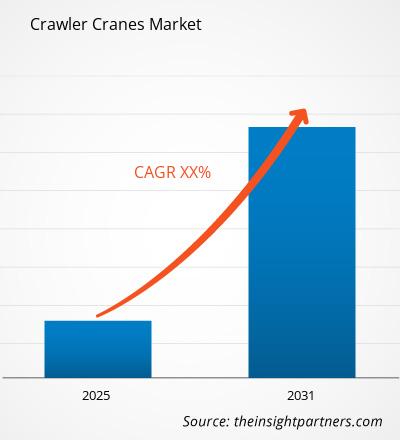
The crawler cranes market size is estimated to grow from US$ 5.49 Billion in 2025 to US$ 10.02 Billion in 2034 at a CAGR of 6.92%. The market growth is driven by heavy-lifting needs in the construction, oil & gas, shipping & port construction, and power and utilities segments, where steady tracked machines provide support for heavy-load operations on rough terrain for extended periods.
In North America, factors like equipment lifecycle renewal, government allocations for infrastructure investments, grid strengthening, and LNG construction are expected to sustain regional growth within 5.8-6.4% CAGR over 2034. In addition, in North America, the market is driven by modernizing of rental fleets due to the preference for flexible access to equipment from 100 to 250 tons and larger.
Crawler Cranes Market Assessment and Insights
- North America accounted for 30–32% share in 2025 and is projected to grow at 5.8–6.4% CAGR between 2026–2034, supported by infrastructure renewal, energy terminals, and rental fleet upgrades.
- US represented 78–82% of North America in 2025 and is expected to grow at 5.9–6.5% CAGR between 2026–2034, led by bridge, LNG, and utility projects.
- Europe held 21–23% share in 2025 and is forecast to grow at 5.2–5.8% CAGR between 2026–2034, with Germany, the UK, France, Italy, and Spain leading demand.
- Asia Pacific captured 34–37% share in 2025 and is expected to post 7.6–8.3% CAGR between 2026–2034, driven by China, India, Japan, South Korea, and Australia.
- Largest Segment Construction held 42–46% market share in 2025 and is expected to grow at 6.5–7.1% CAGR between 2026–2034, reflecting broad infrastructure use.
- High Growth Segment Power and Utilities held 18–21% market share in 2025 and is projected to grow at 7.8–8.6% CAGR between 2026–2034, supported by grid and renewable projects.
- Key companies analyzed in detail: Hitachi Sumitomo Heavy Industries Construction Crane Co., Ltd.; KATO WORKS CO., LTD.; Kobelco Construction Machinery Co., Ltd.; Liebherr-International AG; SANY Group Co., Ltd.; The Manitowoc Company, Inc.; XCMG Group; Zoomlion Heavy Industry Science and Technology Co., Ltd.; SENNEBOGEN Maschinenfabrik GmbH; Jekko S.r.l.
Source: The Insight Partners' analysis based on proprietary research, government publications, company annual reports, investor presentations, industry databases, and expert interviews.
Product development trends in the crawler crane sector have shifted from focusing on lifting capacity to modular booms, telematics, safety technology, and reduced-emission engines. In terms of design, there is an increasing effort among manufacturers to cater to the need for heavy-duty lattice booms as well as telescopic crawler cranes in order to minimize setup time at restricted sites. Manufacturing trends are increasingly being influenced by fluctuations in steel prices, engine specifications, availability of electronic components, and the need for portable crane solutions.
Future demand is forecast to expand into India, Southeast Asia, the Gulf region, and certain African countries due to the rise of transport routes, ports, petrochemical complexes, and power infrastructure. Budgets for infrastructure development along with private investment in energy are bolstering crane usage, while higher levels of site safety requirements are facilitating the uptake of monitored lifting solutions.
Crawler Cranes Market Report Scope
| Report Attribute | Details |
|---|---|
| Market size in 2025 | US$ 5.49 Billion |
| Market Size by 2034 | US$ 10.02 Billion |
| Global CAGR (2026 - 2034) | 6.92% |
| Historical Data | 2021-2024 |
| Forecast period | 2026-2034 |
Crawler Cranes Market Analysis
Growth opportunities in the crawler cranes market will depend on civil projects, renewable energy plants, port facilities, and petrochemical installations. Growth will be highest where crane reach, surface stability, and load positioning accuracy play an important role. Value Chain components include structural steel, hydraulics, engines, control software, booms, rental businesses, construction engineering firms, crane operators, and service firms.
Growth will continue to be influenced by fabrication capacity, component imports, and local certifications. High utilization levels of rental fleets will impact procurement cycles since many contractors prefer not to own underutilized heavy machinery. Power plant construction and renewable energy generation will drive the lifting need as per the International Energy Agency's grid and renewables outlook.
The Crawler Cranes market market analysis is characterized by competition among global producers, each with unique advantages. High capacity engineering and servicing are key competitive edges of the companies such as Liebherr-International AG and The Manitowoc Company, Inc. Broad product range, cost-effectiveness and international expansion are strategies used by SANY Group Co., Ltd., XCMG Group and Zoomlion Heavy Industry Science and Technology Co., Ltd.
Specialized markets of crane lifting are served by Kobelco Construction Machinery Co., Ltd., Hitachi Sumitomo Heavy Industries Construction Crane Co., Ltd., KATO WORKS CO., LTD., SENNEBOGEN Maschinenfabrik GmbH and Jekko S.r.l. Investments will be allocated to technological solutions related to digital diagnosis, fuel economy, and operator assistance.
● REPORT CUSTOMIZATION
Tailor This Report To Align With Your Specific Business Requirements
This report can be customized to align precisely with your business objectives, scope, and target markets. Customization options include tailored segmentation, geography, competitive analysis, and strategic insights to support informed decision-making.
Customize This Report →WHAT YOU CAN ADJUST
- ● Segmentations
- ● Geography
- ● Competitive Analysis
- ● Language Preferences
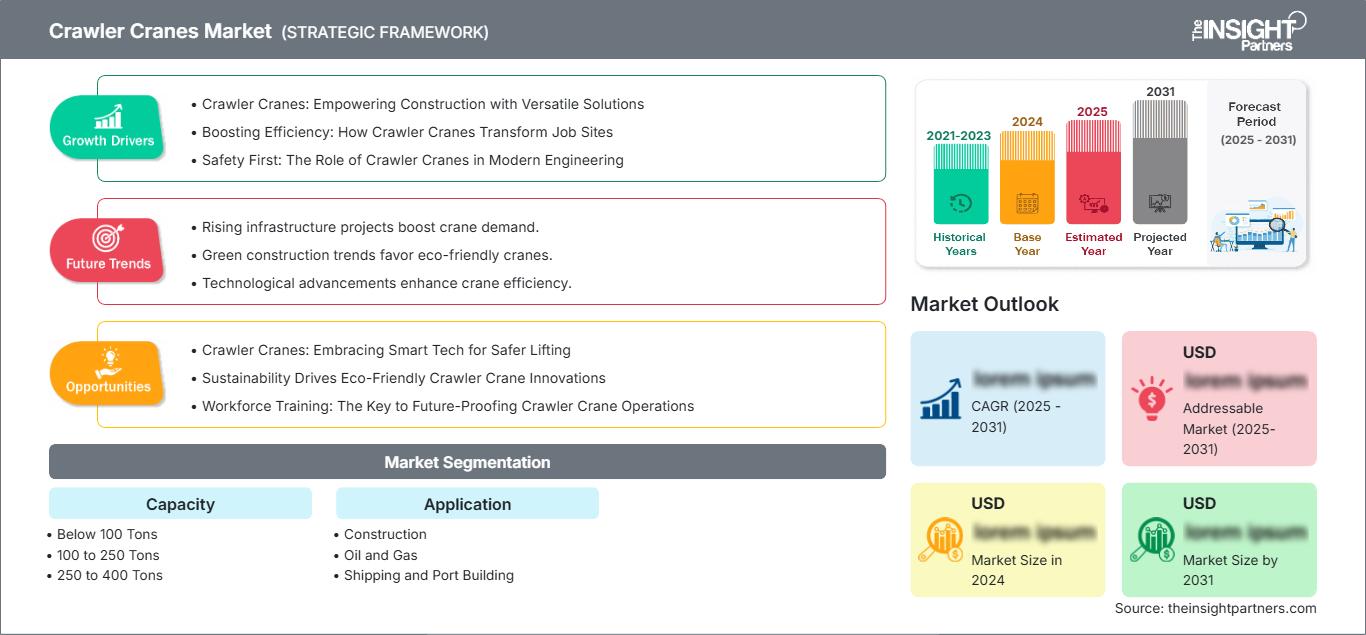
Crawler Cranes Market: Strategic Insights
Regional Insights
North America Crawler Cranes Market
North America represented 30–32% of global revenue in 2025 and is forecast to expand at 5.8–6.4% CAGR through 2034. The regional crawler cranes market share is supported by bridge rehabilitation, semiconductor facilities, LNG export terminals, offshore wind preparation, and utility transmission work that requires high lifting stability.
The rental market is large, especially for 100- to 250-ton excavators in various construction and energy applications. Fleet operators have an interest in telematics solutions, emissions solutions, and transportability. Companies that have good support services gain from the situation, because the possibility of downtime is critical for equipment purchase decisions.
U.S. Crawler Cranes Market
The United States represents 78–82% of North America and is estimated to expand at a 5.9–6.5% CAGR during 2026-2034. Government investments in infrastructure, port dredging activities, refinery maintenance work, gas processing, and transmission expansion provide many opportunities for tracked lifting machinery in several states.
The presence of the companies can be attributed to The Manitowoc Company, Inc., Liebherr-International AG, Kobelco Construction Machinery Co., Ltd., SANY Group Co., Ltd., and XCMG Group. Uses of the machines have been moving towards bridge modules, industrial assemblies, wind-related machinery, and utilities.
Europe Crawler Cranes Market
The share of Europe was 21-23% in 2025 and is forecasted to grow at 5.2-5.8% CAGR during 2026-2034. Germany is the leader of the region due to industrial construction, energy transition activities, port development, and engineering expertise in crane technology. The UK enjoys advantages of offshore wind staging, railway development, and urban renewal.
France, Italy, and Spain contribute to the segment through transportation and utility construction, refinery repairs, and renewable energy installations. Safety systems, zero emissions, and compact transport are essential for buyers because of restrictions in European construction sites. There is also an advantage for local suppliers due to dense network and engineering experience.
APAC Crawler Cranes Market
APAC had market share of 34-37% in 2025 and is expected to grow with a 7.6-8.3% CAGR until 2034, emerging as the fastest growing region. China is leading demand in the region whereas India, Japan, South Korea, and Australia aid purchases through metros, ports, power plants, and industrial constructions.
In-region infrastructure pipelines and manufacturing localization are boosting the regional supply chain. Chinese manufacturers have been ramping up their exports whereas Japanese and European brands are competing in premium and specialized applications. Logistics corridors and renewables goals of India are particularly significant for the medium and heavy crawler cranes market.
Middle East & Africa Crawler Cranes Market
Middle East and Africa market forecasted to grow at 6.9%-7.5% CAGR between 2026-2034. Leading countries include Saudi Arabia, which is led by gigaprojects, refineries, ports, and utilities construction. UAE, South Africa, and Rest of MEA contribute to demand from logistics, mining, and energy infrastructure sectors.
Energy investment continues to be the main regional driver because oil and gas assets, power generation, and grid projects require heavy-lifting solutions. Dependency on imports, operators availability, and working conditions impact purchase decisions, making companies with training, maintenance services, and robust designs for desert and industrial sites preferable.
Segmentation Analysis
Capacity
Capacity is expected to grow at 6.4–7.2% CAGR during 2026–2034. The crawler cranes market scope by capacity is shaped by project scale, lift radius, transport limits, and ground conditions. Medium-capacity models remain broadly used, while above 400 ton units gain relevance in wind, petrochemical, nuclear, bridge, and port megaprojects.
- Below 100 Tons machines serve compact construction, maintenance, urban utilities, and confined sites where mobility, lower transport cost, and rapid deployment are more important than extreme lifting capacity.
- 100 to 250 Tons cranes form the core rental and contractor fleet, balancing lifting strength, job-site flexibility, and utilization across buildings, bridges, industrial plants, and energy projects.
- 250 to 400 Tons cranes address heavier infrastructure, refinery, marine, and wind work where contractors need longer booms, higher stability, and capacity for prefabricated modules.
- Above 400 Tons models support specialized heavy lift work in nuclear, offshore wind, petrochemical, and port projects, where fewer units command high strategic value and strict planning requirements.
Application
Application is projected to grow at 6.8–7.5% CAGR during 2026–2034. Construction remains the largest revenue contributor, but power and utilities are becoming more strategically important as grid expansion, renewable installations, and energy storage projects increase heavy lifting intensity. Oil and gas and port building provide cyclical but high-value demand.
- Construction demand is anchored by bridges, metros, high-rise structures, and industrial buildings, where crawler cranes provide stability for heavy components and support predictable project sequencing.
- Oil and Gas applications include refinery turnarounds, LNG modules, pipeline facilities, and petrochemical plants, where high-capacity lifting, safety compliance, and uptime are procurement priorities.
- Shipping and Port Building uses crawler cranes for quay construction, container terminal expansion, shipyard modules, and breakwater works, especially where ground bearing and long reach matter.
- Power and Utilities demand is rising with transmission towers, substations, wind projects, thermal plants, and grid assets requiring precision lifting and reliable operation in remote locations.
Opportunity Snapshot
| Application | Revenue Contribution | Trend Tag | Adoption Stage |
| Construction | High | Bridge Lifts | Mature |
| Oil and Gas | Medium | LNG Modules | Scaling |
| Shipping and Port Building | Medium | Port Expansion | Scaling |
| Power and Utilities | High | Grid Buildout | Scaling |
Crawler Cranes Market Growth Drivers and Impact Analysis
Infrastructure Renewal and Megaproject Execution
Infrastructure renewal emerges as the first mover because bridges, rail networks, ports, tunnels, airports, and industrial parks require repeated lifting operations in a well-scheduled manner. Crawler cranes are preferred where tracked stability eliminates the need for groundwork and allows lifting on uneven or temporary ground. Investment programs of the governments of U.S., Europe, India and Gulf have provided multiyear visibility for equipment usage. The effect has been seen most in the segments of 100-250 ton and 250-400 ton, which cater to the civil construction sector and also allow for modular placement.
Energy Transition and Grid Expansion Projects
Investment in energy transition is increasing the scope of work for heavy lifting machinery. Heavy lifting of wind turbine parts, transformer sets, substations, battery installations, and transmission towers are necessary. The International Energy Agency has continued to emphasize the need for robust grids with growing electrification trends, favoring utility work beyond conventional power stations. Practically speaking, this means increased demand for cranes with increased boom length, increased load charts, telematics and monitoring capabilities. Moreover, power developers and engineering contractors have expressed needs for equipment capable of operating in harsh terrains unsuitable for mobile cranes.
Rental Fleet Modernization and Utilization Economics
Rental fleet modernization is improving access to crawler cranes while reducing upfront capital pressure on contractors. Large projects often need specific capacities for limited periods, making rental economics attractive when interest rates, maintenance costs, and operator shortages are considered. Fleet owners are therefore investing in machines with easier transport, diagnostics, safer control systems, and lower emissions. This creates recurring replacement demand even when end-user purchasing slows. Manufacturers with reliable parts supply, training support, and digital service tools are positioned to capture higher lifecycle value. The result is a more service-oriented competitive model rather than one based only on equipment sales.
Crawler Cranes Market Future Trends
Lower-Emission and Electric-Assist Crane Platforms
One of the most important crawler cranes market trends is the transition toward lower-emission operation. Urban construction rules, industrial decarbonization targets, and customer reporting requirements are encouraging hybrid, electric-assist, and alternative power solutions. While diesel will remain relevant for remote high-load sites, electric site operation can reduce noise, local emissions, and fuel exposure in regulated zones. Manufacturers are expected to combine battery support, smart power management, and telematics to improve operating efficiency. Adoption will likely begin in Europe, Japan, and major North American cities before scaling into rental fleets in emerging markets.
Digital Lift Planning and Remote Diagnostics
Digital lift planning will become a differentiator as projects demand safer execution, fewer delays, and better fleet productivity. Load simulation, job-site data, remote diagnostics, and predictive maintenance can help contractors reduce uncertainty before cranes arrive on site. Equipment owners will use utilization analytics to decide when to redeploy, maintain, or replace assets. Manufacturers that integrate software with control systems can create stickier service relationships. The trend will also support operator training by translating complex lift conditions into clearer planning workflows, reducing dependence on informal site experience alone.
Crawler Cranes Market Opportunities
Power and Utilities Fleet Specialization
Power and utilities offer attractive crawler cranes market forecasts because grid expansion, renewable integration, and substation construction require repeatable lifting programs across dispersed sites. Suppliers can create value by configuring cranes for wind, transmission, transformer, and remote utility applications rather than selling generic capacity. Rental firms can also build dedicated fleets with trained operators, lift planning support, and maintenance packages for utility contractors. This approach improves utilization and customer retention. In emerging markets, bundled financing and service agreements could accelerate adoption where utilities face budget constraints but still require reliable heavy-lift capability for long-term electrification goals.
Localized Service Networks in High-Growth Regions
High-growth regions create a service-led opportunity because crane buyers often face delays from imported parts, limited technicians, and uneven operator training. Manufacturers that localize spare parts, certification support, and field maintenance can reduce downtime and justify premium positioning. India, Southeast Asia, Saudi Arabia, and Africa are especially relevant because infrastructure pipelines are expanding faster than specialized service ecosystems. Partnerships with rental companies, engineering contractors, and vocational institutes can deepen market access. Over time, service capability may become as important as machine specifications in procurement decisions for complex lifting projects.
Recent Developments
- May 2026: The Manitowoc Company, Inc. — Ceccanti reportedly became the first North American customer to take delivery of the Grove GHC220 telescopic crawler crane, marking a regional milestone for Manitowoc’s telescopic crawler portfolio and reinforcing demand for flexible tracked lifting equipment in U.S. construction applications
- July 2026: SANY has expanded its crawler crane portfolio with the launch of the new SCA1100TB telescopic crawler crane, designed to provide enhanced mobility, lifting performance, and operational flexibility for construction and infrastructure projects. The SCA1100TB combines the stability of a crawler undercarriage with the versatility of a telescopic boom, allowing contractors to perform lifting operations in challenging jobsite conditions. The crane offers a maximum lifting capacity of 110 U.S. tons and features a boom length of up to approximately 174 feet (53.1 meters)
Frequently Asked Questions

- Comprehensive Market Sizing and Forecast Analysis
- Detailed Segmentation Analysis
- In-Depth Market Dynamics Assessment
- Regional and Country-Level Insights
- Competitive Landscape and Company Benchmarking
- Strategic Business Intelligence
Recent Reports
Testimonials

The Insight Partners provided valuable market intelligence that supported our global go-to-market strategy. Their team was professional, responsive, and attentive to our feedback, providing thoughtful analysis and helpful methodological clarifications throughout the project.
Junmo Kim Chief Financial Officer (CFO), Enertech Co., Ltd.
The Insight Partners' SCADA System Market report is comprehensive, with valuable insights on current trends and future forecasts. The team was highly professional, responsive, and supportive throughout. We are very satisfied and highly recommend their services.
RAN KEDEM Partner, Reali Technologies LTDs
I requested a report on a very specific software market and the team produced the report in a few days. The information was very relevant and well presented. I then requested some changes and additions to the report. The team was again very responsive and I got the final report in less than a week.
JEAN-HERVE JENN Chairman, Future Analytica
We worked with The Insight Partners for an important market study and forecast. They gave us clear insights into opportunities and risks, which helped shape our plans. Their research was easy to use and based on solid data. It helped us make smart, confident decisions. We highly recommend them.
PIYUSH NAGPAL Sr. Vice President, High Beam Global
The Insight Partners delivered insightful, well-structured market research with strong domain expertise. Their team was professional and responsive throughout. The user-friendly website made accessing industry reports seamless. We highly recommend them for reliable, high-quality research services
YUKIHIKO ADACHI CEO, Deep Blue, LLC.
This is the first time I have purchased a market report from The Insight Partners.While I was unsure at first, I visited their web site and felt more comfortable to take the risk and purchase a market report.I am completely satisfied with the quality of the report and customer service. I had several questions and comments with the initial report, but after a couple of dialogs over email with their analyst I believe I have a report that I can use as input to our strategic planning process.Thank you so much for taking the extra time and making this a positive experience.I will definitely recommend your service to others and you will be my first call when we need further market data.
JOHN SUZUKI President and Chief Executive Officer, Board Director, BK Technologies
I wish to appreciate your support and the professionalism you displayed in the course of attending to my request for information regarding to infectious disease IVD market in Nigeria. I appreciate your patience, your guidance, and the fact that you were willing to offer a discount, which eventually made it possible for us to close a deal. I look forward to engaging The Insight Partners in the future, all thanks to the impression you have created in me as a result of this first encounter.
DR CHIJIOKE ONYIA MANAGING DIRECTOR, PineCrest Healthcare Ltd.Reason to Buy
- Informed Decision-Making
- Understanding Market Dynamics
- Competitive Analysis
- Identifying Emerging Markets
- Customer Insights
- Market Forecasts
- Risk Mitigation
- Boosting Operational Efficiency
- Strategic Planning
- Investment Justification
- Tracking Industry Innovations
- Aligning with Regulatory Trends





 Get Free Sample for