
Cyclosporine Drugs Market Trends, Demand & Growth by 2034
Cyclosporine Drugs Market Size and Forecasts (2021–2034), Global and Regional Share, Trends, and Growth Opportunity Analysis Report Coverage : by Indication (Transplant Rejection Prophylaxis, Rheumatoid Arthritis, Psoriasis, Autoimmune Myasthenia Gravis, Dry Eye); Route of Administration (Oral and Parenteral); and Geography (North America, Europe, Asia Pacific, and South and Central America)
- Status : Data Released
- Report Code : TIPRE00040713
- Category : Life Sciences
- No. of Pages : 150
- Available Report Formats :


- Last update date : August 13, 2026


2025 Market Size
US$ 1.65 Bn
Base year value
2034 Forecast
US$ 2.67 Bn
Projected by 2034
CAGR 2026-2034
5.49 %
Growth rate
Addressable Market
US$ 19.58 Bn
(2026-2034)
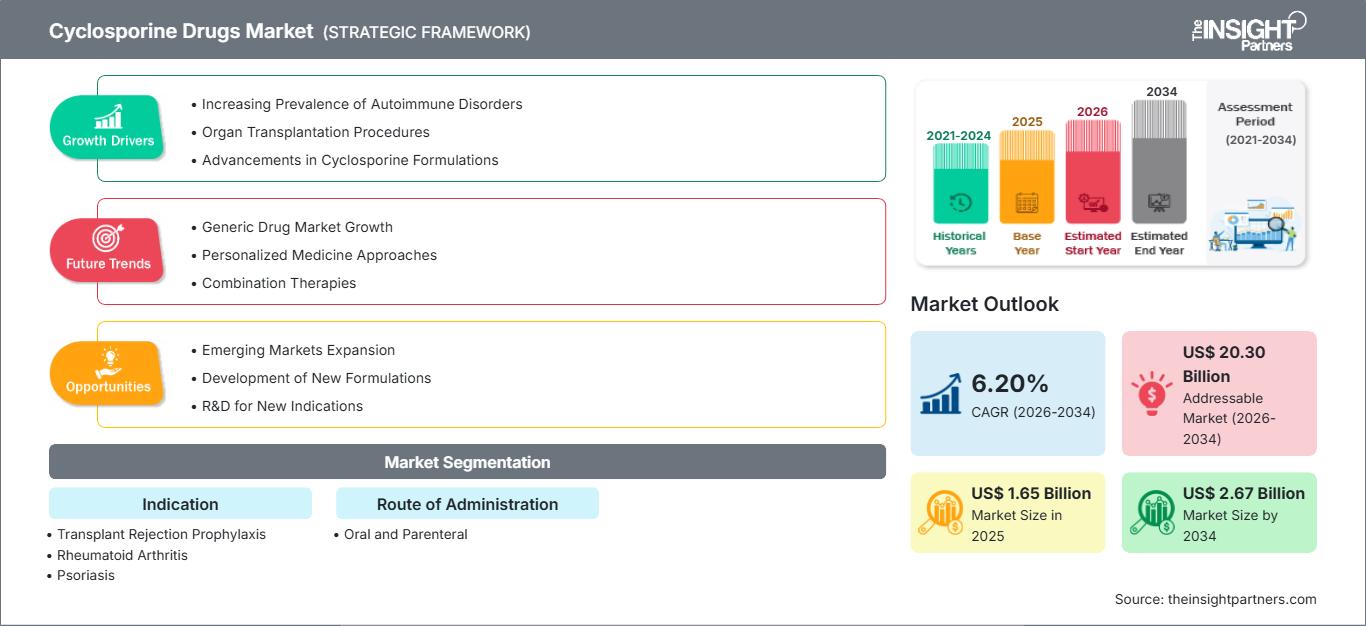
The Cyclosporine Drugs market was valued at US$ 1.65 billion in 2025 and is expected to reach US$ 2.67 billion by 2034; it is estimated to record a CAGR of 5.49% during 2026-2034.
Cyclosporine Drugs Market Assessment and Insights
- North America: The region demonstrates strong adoption due to transplantation networks and advanced healthcare facilities. Cyclosporine Drugs Market Share in 2025 is estimated at 36–40%, with CAGR between 2026–2034 projected at 5.8–6.6% supported by clinical demand and pharmaceutical innovation.
- US: The country remains a major contributor through transplant procedures and autoimmune treatment adoption. Share in 2025 is estimated at 30–34%, growing at a CAGR range of 5.7–6.5% during 2026–2034.
- Europe: European countries including Germany, France, the UK, and Italy contribute through established immunology practices and healthcare access. Share in 2025 is estimated at 27–31%, with CAGR between 2026–2034 ranging from 5.2–6.0%.
- Asia Pacific: China, Japan, India, and South Korea are expanding usage through improving transplant programs and healthcare modernization. Share in 2025 is estimated at 20–24%, with CAGR between 2026–2034 ranging from 6.5–7.4%.
- Largest Segment: Transplant Rejection Prophylaxis leads with established clinical usage and broad physician acceptance. It represents a market share of 55–60% in 2025, with CAGR ranging from 5.8–6.5%.
- High Growth Segment: Dry Eye application shows increasing demand from ophthalmic therapies. It accounts for a market share of 8–12% in 2025, with CAGR ranging from 7.0–8.0%.
- Key companies analyzed in detail: Novartis, Teva Pharmaceuticals, Roche, Mylan, Hetero Healthcare, Sun Pharmaceutical Industries, Cipla, Astellas Pharma, Glenmark Pharmaceuticals, Dr. Reddy's Laboratories.
Source: The Insight Partners' analysis based on proprietary research, government publications, company annual reports, investor presentations, industry databases, and expert interviews.
Changes in the development of the Cyclosporine Drugs Market can be seen in the move towards optimal use of immunosuppressive agents, improvements in technology used in formulations, and expanding uses in therapy. Pharmaceutical companies have turned their attention to developing methods of bioavailability increase, controlled delivery systems, and improvement in quality for sustained efficacy. Production capabilities have improved due to the development of a global supply chain system, improvements in regulation, and higher production efficiency. These factors have helped increase availability of cyclosporine drugs in transplant centers, specialized clinics, and hospitals.
Cyclosporine Drugs Market report indicates that future growth will depend on emerging markets in healthcare, expansion of transplantation services, and the development of pharmaceutical manufacturing capabilities. Regulatory frameworks that would foster generic drug competition and efficient treatment options will determine the availability of the products. Countries that will improve healthcare facilities and specialized medical services will also open up new areas of opportunity.
Cyclosporine Drugs Market Report Scope
| Report Attribute | Details |
|---|---|
| Market size in 2025 | US$ 1.65 Billion |
| Market Size by 2034 | US$ 2.67 Billion |
| Global CAGR (2026 - 2034) | 5.49% |
| Historical Data | 2021-2024 |
| Forecast period | 2026-2034 |
Cyclosporine Drugs Market Analysis
Need for immunosuppressant drugs is growing on account of an increased demand for transplant rejection and autoimmune conditions. Growth factors driving the Cyclosporine Drugs Market include healthcare professionals' preference for calcineurin inhibitors, an increasing number of transplants, and widening availability of specialty drugs. Stakeholders in this market ecosystem include pharma companies, drug ingredient suppliers, regulatory agencies, hospitals, transplant centers, and distributors.
Drivers of the supply chain include availability of raw materials, production capabilities, and standards for production of drugs. Firms have been investing in systems ensuring high-quality products as well as streamlining the production process to ensure consistency in supply. Increased use of generics has helped improve accessibility of drugs in cost-constrained health systems.
Cyclosporine Drugs Market analysis suggests that formulation expertise, regulatory approval, and global distribution channels are key factors. Some of the established names like Novartis and Astellas Pharma have managed to establish their foothold in the market because of branded immunosuppressants, whereas companies like Teva Pharmaceuticals, Mylan, Sun Pharmaceutical Industries, Cipla, and Dr. Reddy’s Laboratories have managed to do so by offering generics.
Investment is made in establishing production networks, meeting regulatory norms, and increasing patient accessibility. Roche, Hetero Healthcare, and Glenmark Pharmaceuticals have been making an impact in the field of cyclosporine drugs because of their pharmaceutical expertise. There are other players who are exploring opportunities for using the drug in ophthalmic formulations and autoimmune conditions.
● REPORT CUSTOMIZATION
Tailor This Report To Align With Your Specific Business Requirements
This report can be customized to align precisely with your business objectives, scope, and target markets. Customization options include tailored segmentation, geography, competitive analysis, and strategic insights to support informed decision-making.
Customize This Report →WHAT YOU CAN ADJUST
- ● Segmentations
- ● Geography
- ● Competitive Analysis
- ● Language Preferences
Cyclosporine Drugs Market: Strategic Insights
Regional Insights
North America Cyclosporine Drugs Market
North America constitutes a significant regional market holding a share ranging from 36% to 40% by 2025 and growing at a CAGR of 5.8% to 6.6% from 2026 to 2034. Well-developed transplant programs, well-developed hospital network, and prevalence of specialty drugs drive demand in the region. Clinical protocols associated with kidney, liver, and heart transplants, for which immunosuppressant treatment is a necessity, have been developed in the region.
The US provides a major share in terms of demand owing to the presence of well-developed transplant facilities, robust research, and drug industry. Besides, Canada also facilitates adoption with better accessibility to specialty drugs and modernization of healthcare facilities. Rising emphasis on treating autoimmune diseases and applications in ophthalmology are generating new avenues for growth.
U.S. Cyclosporine Drugs Market
The U.S. Cyclosporine Drugs Market accounts for an estimated 82–86% share of North America in 2025 and is projected to grow at a CAGR of 5.7–6.5% during 2026–2034. The country maintains a strong position due to high transplant volumes, advanced healthcare facilities, and extensive use of immunosuppressive therapies across specialty care settings.
Major pharmaceutical companies, including Novartis, Teva Pharmaceuticals, and Sun Pharmaceutical Industries, maintain market presence through branded and generic formulations. Application trends are expanding beyond transplantation toward autoimmune disorders and dry eye treatment. Increased clinical monitoring and personalized treatment strategies are supporting optimized therapy outcomes. Research institutions and healthcare providers continue to improve treatment pathways, reinforcing long-term demand for cyclosporine-based medicines.
Europe Cyclosporine Drugs Market
Europe is anticipated to have a market share of 27-31% in 2025, based on developed healthcare systems and organized transplantation programs. The region will experience a CAGR of 5.2-6.0% during 2026-2034. Germany will be a dominant market player in this region owing to its sophisticated healthcare infrastructure and is followed by the UK, France, Italy, and Spain, where access to specialty pharmaceuticals is improving.
The market for the UK is driven by the presence of transplant facilities and research-based healthcare institutions. Germany will be a strong market owing to its demand generated through expertise in clinical practices and pharmaceutical drug manufacturing facilities. In France, Italy, and Spain, the market is growing owing to the rising diagnoses of autoimmune diseases and increasing access to specialty drugs.
APAC Cyclosporine Drugs Market
APAC accounts for an approximate share of 20%-24% in 2025 and is anticipated to witness a CAGR of 6.5%-7.4% over 2026-2034. China is at the forefront of regional growth due to growing number of transplant surgeries, healthcare spending and drug manufacturing.
Japan and South Korea are contributing with their superior clinical services whereas India and Australia are contributing with their improved specialty services. Healthcare programs, increased disease prevalence and investment in healthcare infrastructure are the factors aiding regional growth.
Middle East & Africa Cyclosporine Drugs Market
Middle East & Africa is expected to experience growth within a CAGR of 4.8%-5.8% during 2026-2034, owing to the development of healthcare infrastructure and increased availability of specialty treatment. The Kingdom of Saudi Arabia is one of the key markets in terms of investments in advanced medical facilities and transplants.
The United Arab Emirates and South Africa are enhancing their capabilities in healthcare through modernization initiatives and specialty care services. RoMEA regions are increasingly deploying advanced immunosuppressive agents as their healthcare infrastructure becomes more advanced. Economic development due to energy in selected countries is allowing investments in hospitals and specialty centers.
Segmentation Analysis
Indication
The indication segment is expected to register a CAGR of 5.9–6.7% between 2026–2034, supported by the continued importance of immunosuppressive therapy across transplantation and autoimmune conditions. The Cyclosporine Drugs Market scope within this segment is influenced by rising transplant procedures, improved patient monitoring, and expanding therapeutic applications. Healthcare providers continue to rely on cyclosporine because of its established clinical effectiveness and long-term usage history.
- Transplant Rejection Prophylaxis remains the dominant application area due to extensive use in kidney, liver, and heart transplant patients. Demand is supported by increasing transplant procedures and the requirement for long-term immune response management.
- Rheumatoid Arthritis applications benefit from the continued need for immunomodulatory therapies. Cyclosporine usage remains relevant in selected treatment pathways where conventional approaches require additional therapeutic options.
- Psoriasis adoption is supported by clinical utilization in severe cases requiring systemic immune regulation. The segment benefits from growing awareness of advanced dermatological treatment strategies.
- Autoimmune Myasthenia Gravis represents a specialized application area where immunosuppressive management supports symptom control. Continued neurological research contributes to gradual adoption in clinical practice.
- Dry Eye applications are expanding due to increasing demand for ophthalmic therapies. Cyclosporine-based eye treatments are used to manage inflammatory conditions affecting tear production and ocular comfort.
Route of Administration
The route of administration segment is projected to achieve a CAGR of 5.5–6.4% from 2026–2034, influenced by patient preference, therapeutic requirements, and treatment settings. Oral formulations maintain widespread acceptance because of convenience and established prescribing patterns. Parenteral options remain important in specialized clinical environments requiring controlled administration.
- Oral formulations represent the primary route due to ease of use, outpatient suitability, and broad physician familiarity. These products support long-term treatment management across transplant and autoimmune indications.
- Parenteral administration serves specialized medical situations requiring supervised delivery. Hospitals and advanced treatment centers utilize these formulations when oral therapy is unsuitable or immediate clinical management is required.
Opportunity Snapshot
| Segment Name | Revenue Contribution (High/Medium/Low) | Trend Tag | Adoption Stage |
|---|---|---|---|
| Transplant Rejection Prophylaxis | High | Transplant Care | Mature |
| Rheumatoid Arthritis | Medium | Immune Therapy | Scaling |
| Psoriasis | Medium | Dermatology Care | Scaling |
| Autoimmune Myasthenia Gravis | Low | Neurology Care | Emerging |
| Dry Eye | Medium | Ocular Therapy | Scaling |
| Oral | High | Patient Convenience | Mature |
| Parenteral | Medium | Hospital Therapy | Mature |
Cyclosporine Drugs Market Growth Drivers and Impact Analysis
Increasing Transplant Procedures and Immunosuppressive Therapy Demand
Increased transplantation surgeries around the world have been boosting the need for effective immunosuppressants. Cyclosporine is one of the existing drugs that can be used for suppressing the immune system after transplantation surgery to prevent any form of rejection, mainly after the kidney, liver, and heart transplants. The development of transplant facilities, increased surgical capacity, and enhanced monitoring systems for post-surgery have boosted the use of the drug. Health care systems are now allocating resources to develop specialist transplant programs, which is leading to consistent demand from hospitals and specialist clinics. Awareness on organ donation schemes and developments in the field of transplantation are further contributing to patient access.
Rising Prevalence of Autoimmune Disorders
Increased incidence of autoimmune diseases is driving an increase in the usage of immunomodulating drugs in various health care facilities. Diseases like rheumatoid arthritis, psoriasis, and auto-immune neurology demand effective immune system regulation, resulting in more applications of the cyclosporine drug. With improved diagnosis of immune-based diseases, physicians are able to prescribe treatment based on the problem. Specialists are beginning to adopt advanced treatment methods in cases where other treatments do not work. Pharmaceutical companies are working on developing better formulations for targeted therapy requirements. With the increased presence of autoimmune diseases programs in developed and emerging markets, it is anticipated that this will affect prescribing trends in the forecast period.
Expansion of Ophthalmic Applications
As there is an increased understanding of inflammatory diseases of the eye, the scope for cyclosporine based ocular products is expanding. With the increase in dry eye disease patients owing to various reasons, such as aging demographics and certain lifestyle influences, there is an increased need for therapies which can address such issues. There is growing use of prescription drugs for ocular conditions that focus on the inflammation aspect instead of mere symptomatic treatment. The advancements in the drug delivery methods of the eye drugs are improving the convenience levels for the patients. Pharmaceutical companies are working towards improving formulations, particularly in terms of stability and ease of administration.
Cyclosporine Drugs Market Future Trends
Growth of Personalized Immunosuppressive Treatment Approaches
Future treatment strategies are expected to increasingly focus on personalized immunosuppressive management based on patient characteristics, therapeutic response, and monitoring data. Advances in pharmacogenomics and clinical monitoring technologies may support more precise cyclosporine dosage adjustments, reducing adverse effects and improving treatment outcomes. Healthcare providers are exploring approaches that balance immune protection with long-term safety considerations. Integration of digital health tools and laboratory-based monitoring systems can improve therapy management in transplant and autoimmune patients. These developments are expected to influence future prescribing practices and encourage pharmaceutical companies to develop formulations aligned with individualized care models. The Cyclosporine Drugs Market trends are likely to reflect greater emphasis on precision treatment, improved adherence, and optimized clinical outcomes.
Increasing Adoption of Advanced Drug Delivery Technologies
Future developments in drug delivery systems are expected to influence the evolution of cyclosporine-based therapies. Manufacturers are exploring formulation technologies designed to improve absorption, stability, and patient convenience. Advances in controlled-release approaches and ophthalmic delivery platforms may create opportunities for differentiated products. These innovations can address limitations associated with traditional administration methods and support better treatment experiences. Pharmaceutical companies are expected to focus on formulation research, regulatory approvals, and lifecycle management strategies to strengthen product portfolios. Expansion of specialty pharmaceutical capabilities across emerging economies may also accelerate access to advanced therapies. These technology-driven changes are expected to reshape competitive strategies and encourage continued innovation throughout the healthcare ecosystem.
Cyclosporine Drugs Market Opportunities
Expansion Across Emerging Healthcare Markets
Emerging healthcare markets present significant opportunities through increasing healthcare expenditure, improving medical infrastructure, and expanding access to specialty treatments. Countries across Asia Pacific, Latin America, and selected Middle Eastern markets are strengthening transplant capabilities and autoimmune disease management programs. Pharmaceutical companies can benefit by developing regional distribution strategies, supporting regulatory approvals, and improving availability of cost-effective formulations. Growing investments in hospitals and specialty clinics are creating additional channels for immunosuppressive therapies. The Cyclosporine Drugs Market Forecasts indicate that companies focusing on accessibility, affordability, and localized supply networks may capture opportunities in developing healthcare systems. Strategic collaborations with regional healthcare providers can further support market penetration and long-term commercial growth.
Innovation in Specialty Formulations and Therapeutic Applications
Innovation in specialty formulations provides opportunities for companies seeking differentiation in a competitive pharmaceutical environment. Development of improved oral formulations, ophthalmic solutions, and patient-friendly delivery approaches can support stronger market positioning. Research into additional therapeutic applications may expand the role of cyclosporine beyond traditional indications. Companies investing in formulation improvements, clinical research, and regulatory expertise can address evolving healthcare requirements. Collaboration between pharmaceutical manufacturers and research institutions may accelerate development pathways. Growing demand for effective chronic disease management solutions creates opportunities for differentiated products with improved safety profiles and enhanced patient adherence. These strategies can support sustainable value creation while addressing unmet needs across multiple therapeutic segments.
Recent Developments
- March 2026: Novartis continued strengthening its immunology and transplantation medicine portfolio through ongoing pharmaceutical innovation activities and global healthcare initiatives focused on improving patient treatment outcomes. The company’s established presence in immunosuppressive therapies supports continued development and accessibility of advanced treatment solutions across international markets.
- November 2025: Astellas Pharma expanded its focus on transplantation and immunology-related healthcare solutions through research activities and strategic pharmaceutical initiatives. Its continued investment in specialty medicines reflects efforts to address complex patient needs requiring long-term immune management and advanced therapeutic approaches.
- July 2025: Sun Pharmaceutical Industries continued expanding its specialty pharmaceutical capabilities through portfolio development and global market initiatives. Its activities across complex therapeutic areas support broader availability of advanced medicines and strengthen its position in providing treatment options across diverse healthcare systems.
Frequently Asked Questions

- Comprehensive Market Sizing and Forecast Analysis
- Detailed Segmentation Analysis
- In-Depth Market Dynamics Assessment
- Regional and Country-Level Insights
- Competitive Landscape and Company Benchmarking
- Strategic Business Intelligence
Recent Reports
Testimonials

The Insight Partners provided valuable market intelligence that supported our global go-to-market strategy. Their team was professional, responsive, and attentive to our feedback, providing thoughtful analysis and helpful methodological clarifications throughout the project.
Junmo Kim Chief Financial Officer (CFO), Enertech Co., Ltd.
The Insight Partners' SCADA System Market report is comprehensive, with valuable insights on current trends and future forecasts. The team was highly professional, responsive, and supportive throughout. We are very satisfied and highly recommend their services.
RAN KEDEM Partner, Reali Technologies LTDs
I requested a report on a very specific software market and the team produced the report in a few days. The information was very relevant and well presented. I then requested some changes and additions to the report. The team was again very responsive and I got the final report in less than a week.
JEAN-HERVE JENN Chairman, Future Analytica
We worked with The Insight Partners for an important market study and forecast. They gave us clear insights into opportunities and risks, which helped shape our plans. Their research was easy to use and based on solid data. It helped us make smart, confident decisions. We highly recommend them.
PIYUSH NAGPAL Sr. Vice President, High Beam Global
The Insight Partners delivered insightful, well-structured market research with strong domain expertise. Their team was professional and responsive throughout. The user-friendly website made accessing industry reports seamless. We highly recommend them for reliable, high-quality research services
YUKIHIKO ADACHI CEO, Deep Blue, LLC.
This is the first time I have purchased a market report from The Insight Partners.While I was unsure at first, I visited their web site and felt more comfortable to take the risk and purchase a market report.I am completely satisfied with the quality of the report and customer service. I had several questions and comments with the initial report, but after a couple of dialogs over email with their analyst I believe I have a report that I can use as input to our strategic planning process.Thank you so much for taking the extra time and making this a positive experience.I will definitely recommend your service to others and you will be my first call when we need further market data.
JOHN SUZUKI President and Chief Executive Officer, Board Director, BK Technologies
I wish to appreciate your support and the professionalism you displayed in the course of attending to my request for information regarding to infectious disease IVD market in Nigeria. I appreciate your patience, your guidance, and the fact that you were willing to offer a discount, which eventually made it possible for us to close a deal. I look forward to engaging The Insight Partners in the future, all thanks to the impression you have created in me as a result of this first encounter.
DR CHIJIOKE ONYIA MANAGING DIRECTOR, PineCrest Healthcare Ltd.Reason to Buy
- Informed Decision-Making
- Understanding Market Dynamics
- Competitive Analysis
- Identifying Emerging Markets
- Customer Insights
- Market Forecasts
- Risk Mitigation
- Boosting Operational Efficiency
- Strategic Planning
- Investment Justification
- Tracking Industry Innovations
- Aligning with Regulatory Trends





 Get Free Sample for