
Dementia Drugs Market Size, Growth & Demand by 2034
Dementia Drugs Market Size and Forecasts (2021–2034), Global and Regional Share, Trends, and Growth Opportunity Analysis Report Coverage : by Drug Type (Cholinesterase Inhibitors, Glutamate Regulators, Anti-amyloid Agents, Disease-Modifying Therapies); Disease Type (Alzheimer’s Disease, Vascular Dementia, Lewy Body Dementia, Frontotemporal Dementia, Mixed Dementia, and Others); End-User (Hospitals, Clinics, Home Care Settings, Long-Term Care Facilities); and Geography
- Status : Data Released
- Report Code : TIPRE00040026
- Category : Life Sciences
- No. of Pages : 150
- Available Report Formats :


- Last update date : August 17, 2026


2025 Market Size
US$ 10.6 Bn
Base year value
2034 Forecast
US$ 20.12 Bn
Projected by 2034
CAGR 2026-2034
7.38 %
Growth rate
Addressable Market
US$ 138.51 Bn
(2026-2034)
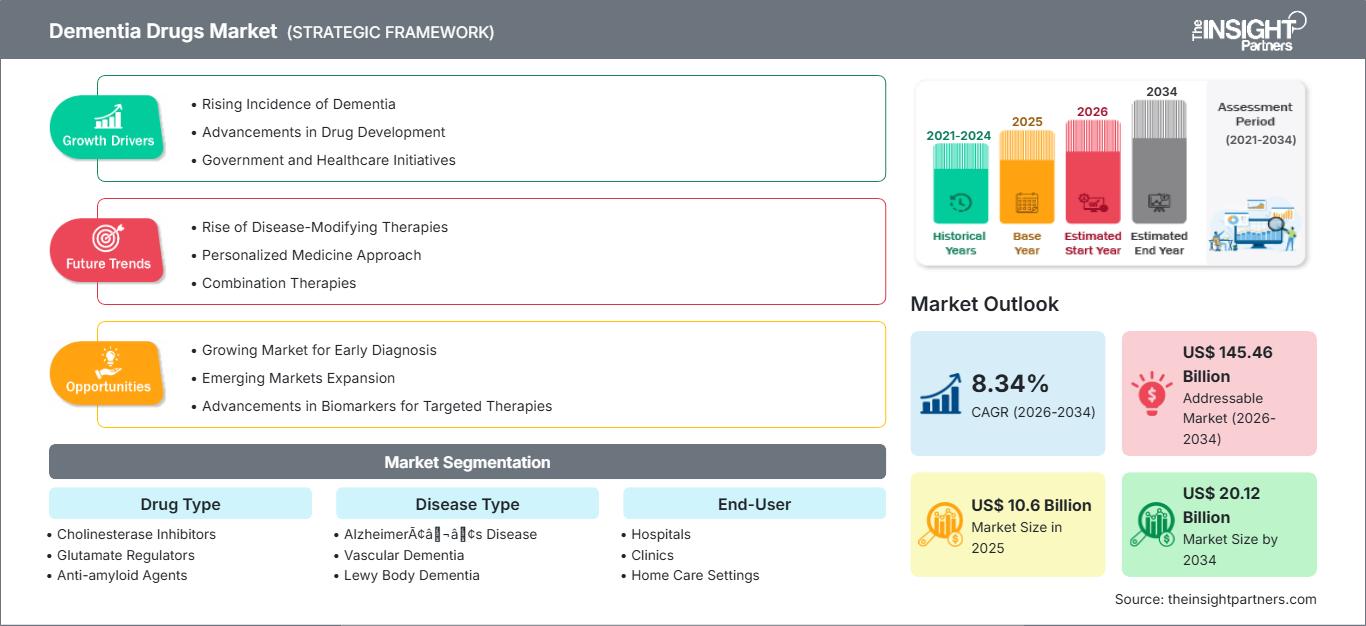
The Dementia Drugs market was valued at US$ 10.6 billion in 2025 and is expected to reach US$ 20.12 billion by 2034; it is estimated to record a CAGR of 7.38% during 2026-2034.
Dementia Drugs Market Assessment and Insights
- North America: Strong specialist infrastructure and faster uptake of advanced therapies position North America as the leading regional market, with a 2025 share of 39–43% and CAGR of 8.1–8.7% between 2026–2034.
- US: The US represents 84–88% of North America in 2025, supported by broad specialist access, diagnostic capabilities, and accelerating adoption of newer treatment modalities, with CAGR of 8.0–8.6% through 2034.
- Europe: Germany, the UK, France, Italy, and Spain underpin European demand through aging populations and expanding neurological care capacity. Europe holds a 2025 share of 27–31% and is projected to grow at 7.6–8.2% CAGR.
- Asia Pacific: China, Japan, South Korea, India, and Australia provide the principal demand base, while improving diagnosis and healthcare investment support a 21–25% 2025 share and 9.1–9.8% CAGR.
- Largest Segment: Alzheimer’s Disease remains dominant, representing a 60–64% market share in 2025, with a 7.9–8.4% CAGR as diagnosis and disease-specific treatment expand.
- High Growth Segment: Disease-Modifying Therapies account for a 16–20% market share in 2025 and are expected to record a 12.0–13.0% CAGR as treatment paradigms evolve.
- Key companies analyzed in detail: Eli Lilly and Company, Biogen Inc., AstraZeneca PLC, Roche Holding AG, Merck & Co., Inc., Novartis AG, Johnson & Johnson, Pfizer Inc., AbbVie Inc., H. Lundbeck A/S.
Source: The Insight Partners' analysis based on proprietary research, government publications, company annual reports, investor presentations, industry databases, and expert interviews.
Therapy development is transitioning from symptomatic approaches to biomarker-based treatments, thus setting new demands in terms of diagnosis, therapy choice, treatment monitoring, and management of disease course. Accordingly, manufacturing is turning into production of complex biologics, innovative delivery systems, and scalable analytics. Nevertheless, oral medicines that have already been on the market are significant, since they offer a wider range of options, lower administration complexity, and prescribing procedures already in place.
During the forecasted period, funding will be allocated primarily on the areas of disease diagnosis, disease-modifying treatment, neuroinflammation, tau biology, and more efficient administration of medicine. New markets will be important due to the expansion of networks of neurologists and improved diagnostics infrastructure. The regulatory requirements will become more significant during the process of commercialization due to the need for proving clinical benefit and safety, selecting patients, and gathering post-marketing data.
Dementia Drugs Market Report Scope
| Report Attribute | Details |
|---|---|
| Market size in 2025 | US$ 10.6 Billion |
| Market Size by 2034 | US$ 20.12 Billion |
| Global CAGR (2026 - 2034) | 7.38% |
| Historical Data | 2021-2024 |
| Forecast period | 2026-2034 |
Dementia Drugs Market Analysis
Growth of Dementia Drugs Market is being driven by the shift towards early treatment and biomarker-based drug decisions. Demand includes symptomatic medications, novel anti-amyloid drugs, new experimental disease modifying treatments, and supportive treatment paths. Key participants of the ecosystem are drug producers, diagnostic labs, imaging facilities, neurologists, hospitals, pharmacies, caregivers, insurers, and long-term care facilities. Suppliers will benefit if they can guarantee steady production of biologicals while satisfying special storage, administration, and quality demands.
Increasing integration is another key trend for the value chain as therapy selection is becoming increasingly dependent on disease diagnosis and staging. Thus, diagnostics influences the treatable demand not just by providing supportive services but having impact on it. For the companies, it opens up opportunities of drug development matching biomarker strategy, companion diagnostics, patient identification, and monitoring. Pricing, reimbursement, capacity for infusions, safety monitoring, and clinician education are commercial factors that need to be taken into account.
The Dementia Drugs Market Report shows competition among diversified drugmakers along with neuroscience specialists. Eli Lilly and Company has enhanced the positioning for its Alzheimer’s drugs portfolio by leveraging the development of donanemab, while Biogen Inc. retains strategic importance with its association with Eisai for lecanemab. On the other hand, Roche Holding AG is developing a combined medicines and diagnostics approach, while Novartis AG is conducting clinical studies into new mechanisms in Alzheimer’s disease. This approach reflects the trend of differentiation within therapeutic platforms rather than reliance on one drug class.
In recent times, investments are increasing in areas like disease modification, patient selection using biomarkers, and drug delivery to minimize the burden of treatment. Additional competition is available from companies like AstraZeneca PLC, Merck & Co., Inc., Johnson & Johnson, Pfizer Inc., AbbVie Inc., and H. Lundbeck A/S. Each has its own neuroscience portfolio and/or a different pipeline strategy or manufacturing capability.
● REPORT CUSTOMIZATION
Tailor This Report To Align With Your Specific Business Requirements
This report can be customized to align precisely with your business objectives, scope, and target markets. Customization options include tailored segmentation, geography, competitive analysis, and strategic insights to support informed decision-making.
Customize This Report →WHAT YOU CAN ADJUST
- ● Segmentations
- ● Geography
- ● Competitive Analysis
- ● Language Preferences
Dementia Drugs Market: Strategic Insights
Regional Insights
North America Dementia Drugs Market
North America constitutes 39-43% of the 2025 Dementia Drugs Market Share and is anticipated to grow at a CAGR of 8.1-8.7% over the period until 2034. The region enjoys the advantage of an extensive network of specialists, diagnostics infrastructure, clinical trials, and fast commercialization of novel drugs in neurology. The United States is still the largest demand driver due to the development of pharmaceuticals in the country.
Canada plays a lesser role in the market thanks to the system of public health care and a growing focus on managing dementia patients. In the whole region, the use of drugs is driven by the accessibility of neurologists, reimbursement issues, imaging technologies, and biomarkers that allow selecting the right candidates.
U.S. Dementia Drugs Market
The US contributes between 84% and 88% of North America's 2025 market share and is expected to have a CAGR of 8.0%-8.6% from 2026-2034. The country's importance stems from its large population base, strong specialist infrastructure, innovation in pharma, and routes to bring new neurological medicines to the market.
Key firms such as Eli Lilly and Company, Biogen Inc., Roche Holding AG, Johnson & Johnson, Pfizer Inc., and AbbVie Inc., amongst others, retain considerable strategic importance. Emerging trends include early intervention, use of biomarkers, and therapy options that can be easily integrated into specialist and outpatient practice. Availability of imaging services, laboratory tests, and infusions will continue to be critical to the success of disease-modifying therapies.
Europe Dementia Drugs Market
Europe accounts for 27-31% of the global market in 2025 and is projected to have a CAGR of 7.6-8.2%. Germany remains the most dominant market in the region due to the presence of well-developed hospital networks as well as high proportions of elderly people. The United Kingdom and France provide demand owing to their well-developed neurological services and research facilities, as well as healthcare systems.
Germany possesses both a high level of expertise and well-developed pharmaceutical research and hospital networks. The United Kingdom acts as an environment that facilitates the use of innovative drugs based on scientific proof of their efficiency. The presence of many patients in France, Italy, and Spain should not be overlooked, although some other aspects may impact adoption.
APAC Dementia Drugs Market
APAC is estimated to have a 21–25% market share in 2025 and grow at a CAGR of 9.1–9.8%. China accounts for scale in the region; other contributors include aging demographics and neurological care improvements by Japan, South Korea, India, and Australia.
Increased investments from industry, better drug-making abilities, and health-care policy developments help make treatments more available. China and Japan are especially crucial in product development and manufacturing, and India provides a significant population base for the future. Growth in the region depends on diagnostics and access, specialist availability, affordability, development of reimbursement programs, and therapies for diverse healthcare environments.
Middle East & Africa Dementia Drugs Market
MEA is expected to record a CAGR of 7.0–7.8% through 2034. Saudi Arabia and the UAE lead regional investment, while South Africa represents an important clinical and healthcare hub. Rest of MEA remains comparatively fragmented because specialist neurological services and diagnostic capacity vary substantially.
Expansion of healthcare infrastructure, improvements to hospital infrastructure, and government funding have helped in increasing access to treatment for chronic diseases. Revenues generated from energy for the government in the Gulf nations can help fund high-end healthcare facilities, whereas South Africa offers clinical expertise. The key challenges include affordability, diagnosis rates, availability of specialists, and treatment infrastructure.
Segmentation Analysis
Drug Type
Drug Type segmentation reflects the transition from established symptomatic treatment toward therapies intended to influence underlying disease biology. The segment is projected to expand at a CAGR of 9.2–10.1% during 2026–2034. Adoption will depend on clinical differentiation, treatment safety, biomarker confirmation, administration requirements, and payer willingness to reimburse newer therapies.
- Cholinesterase Inhibitors: Established symptomatic medicines remain strategically important because of broad clinical familiarity, established prescribing patterns, and continued use across Alzheimer’s disease management pathways.
- Glutamate Regulators: These therapies retain relevance for patients requiring established symptomatic management, particularly where clinicians seek complementary approaches to cognitive and functional symptom control.
- Anti-amyloid Agents: Demand is expanding as biomarker-defined treatment becomes more practical, although administration logistics, imaging requirements, safety monitoring, and patient eligibility remain important adoption considerations.
- Disease-Modifying Therapies: This category is strategically positioned around slowing disease progression and represents the strongest pipeline-driven opportunity as developers pursue earlier intervention and biologically targeted treatment.
Disease Type
Disease Type is projected to grow at a CAGR of 8.0–8.8% through 2034. Alzheimer’s disease dominates treatment demand because of its prevalence and expanding disease-specific therapeutic options. Other dementia types remain clinically important, but drug development and commercial investment are more concentrated around Alzheimer’s biology and diagnosis.
- Alzheimer’s Disease: The largest treatment category benefits from extensive clinical research, established symptomatic therapies, and increasing availability of disease-specific approaches targeting underlying pathology.
- Vascular Dementia: Management remains closely associated with vascular risk reduction and symptomatic support, creating a comparatively different treatment pathway from biomarker-defined Alzheimer’s therapies.
- Lewy Body Dementia: Complex cognitive, behavioral, and movement-related symptoms create demand for carefully tailored treatment strategies and continued specialist involvement.
- Frontotemporal Dementia: Limited disease-specific pharmacological options create an unmet-need environment where clinical research and mechanism-based development could substantially reshape future treatment pathways.
- Mixed Dementia: Patients with overlapping pathologies require individualized treatment decisions, increasing the importance of accurate diagnosis and coordinated management across neurological conditions.
End-User
End-User demand is expected to increase at a CAGR of 7.7–8.5% during 2026–2034. Hospitals remain central for complex diagnosis and treatment initiation, while clinics, home care settings, and long-term care facilities increasingly influence treatment continuity, monitoring, and caregiver support.
- Hospitals: Hospitals remain central to diagnosis, specialist consultation, treatment initiation, infusion services, imaging, and management of complex neurological cases requiring multidisciplinary support.
- Clinics: Neurology and specialist clinics can expand access by providing outpatient assessment, treatment monitoring, follow-up, and longitudinal management outside major hospital centers.
- Home Care Settings: Home-based care is gaining strategic importance as caregivers and healthcare providers seek treatment models that reduce travel, simplify monitoring, and support continuity.
- Long-Term Care Facilities: These facilities remain important for patients with advanced functional dependency, requiring coordinated medication management, supervision, and integration with broader supportive care services.
Opportunity Snapshot
| Segment Name | Revenue Contribution (High/Medium/Low) | Trend Tag | Adoption Stage |
|---|---|---|---|
| Hospitals | High | Specialist Care | Mature |
| Clinics | High | Early Diagnosis | Scaling |
| Home Care Settings | Medium | Home Dosing | Scaling |
| Long-Term Care Facilities | Medium | Care Integration | Mature |
Dementia Drugs Market Growth Drivers and Impact Analysis
Earlier Diagnosis and Biomarker-Based Patient Selection
Earlier diagnosis is becoming a commercial driver because disease-modifying treatment requires greater confidence about underlying pathology and disease stage. Wider use of blood biomarkers, imaging, and specialized laboratory testing can increase the proportion of patients who reach treatment pathways before substantial functional decline. This creates a direct link between diagnostic infrastructure and pharmaceutical demand. For developers, stronger diagnostic capabilities can enlarge eligible populations while improving trial recruitment and post-launch patient identification. Healthcare providers may also reorganize dementia services around referral pathways that combine primary care screening, specialist confirmation, biomarker testing, and treatment monitoring. The resulting ecosystem shift can increase utilization of targeted therapies while creating new service requirements for imaging, laboratory testing, and clinical follow-up.
Expansion of Disease-Modifying Treatment Approaches
Disease-modifying development is changing investment priorities because therapies targeting pathological mechanisms can command strategic attention beyond established symptomatic treatment. Successful clinical differentiation can encourage pharmaceutical companies to allocate capital toward amyloid, tau, neuroinflammatory, and other biological targets. Commercial impact extends beyond drug sales because treatment adoption can stimulate demand for diagnostic confirmation, safety monitoring, specialist consultation, and longitudinal assessment. As clinical evidence accumulates, companies with strong development capabilities may seek partnerships or acquisitions to strengthen neuroscience pipelines. Competition is also likely to become more segmented by treatment stage, administration route, safety profile, and biomarker requirements. This environment rewards companies capable of integrating clinical development with manufacturing, regulatory strategy, diagnostics, and market-access planning.
Growing Economic and Caregiver Burden
The rising economic burden associated with dementia creates pressure for healthcare systems to improve disease management and delay progression. Families, caregivers, hospitals, and long-term care providers bear substantial costs when cognitive decline produces increasing dependency. Consequently, treatments that can preserve function or slow progression may generate value beyond direct clinical outcomes, particularly when health systems assess hospitalization, institutional care, caregiver time, and quality-of-life implications. This dynamic can influence reimbursement discussions and evidence requirements for emerging therapies. It also creates opportunities for pharmaceutical companies to demonstrate broader health-economic value through real-world evidence. Over time, demand should increasingly reflect not only the number of diagnosed patients but also the willingness of health systems to invest in interventions that may reduce downstream care intensity.
Dementia Drugs Market Future Trends
Biomarker-Enabled Precision Treatment Pathways
Dementia Drugs Market trends are likely to increasingly center on precision treatment pathways that combine blood biomarkers, imaging, genetic information, and clinical assessments. Such integration can help clinicians distinguish disease biology, determine eligibility, and monitor treatment response more efficiently. Blood-based biomarkers are particularly important because they may reduce reliance on resource-intensive diagnostic procedures and extend assessment beyond specialized centers. Pharmaceutical companies are likely to incorporate biomarker strategies directly into clinical development, patient identification, and post-commercialization monitoring. This convergence can also encourage partnerships between drug developers, diagnostic companies, laboratories, and healthcare providers. As evidence standards mature, treatment decisions may become progressively more individualized, with therapy selection influenced by disease stage, biological profile, risk characteristics, and anticipated treatment benefit.
Convenience-Oriented Administration Models
Administration convenience is expected to become an increasingly important differentiator as long-term treatment expands. Therapies requiring repeated specialist visits can create capacity constraints for hospitals and increase travel and caregiver burdens. Developers therefore have incentives to investigate subcutaneous, oral, or otherwise simplified administration approaches that can shift selected treatment activities toward outpatient or home settings. This transition will require appropriate patient education, safety protocols, pharmacy support, and monitoring infrastructure. Convenience may also affect adherence and treatment persistence, particularly among older patients and caregivers managing multiple healthcare responsibilities. Competitive positioning could consequently evolve from efficacy alone toward a broader value proposition incorporating treatment frequency, administration setting, monitoring burden, patient independence, and healthcare resource utilization.
Dementia Drugs Market Opportunities
Expansion Across Underdiagnosed Patient Populations
Dementia Drugs Market Forecasts indicate an opportunity to address substantial treatment gaps by expanding diagnosis and referral pathways in underserved populations. Developers can support this opportunity through collaborations with primary-care networks, diagnostic laboratories, community health organizations, and digital health providers. The commercial objective is not simply increasing prescriptions, but creating reliable pathways that identify appropriate patients earlier and connect them with specialist evaluation. Emerging markets offer particular potential where aging populations are increasing faster than neurological infrastructure. Companies entering these markets can prioritize scalable diagnostics, local clinical education, evidence generation, and flexible distribution models. Strategic investment in regional partnerships may reduce barriers created by limited specialist availability while building sustainable demand for both established symptomatic medicines and newer disease-modifying treatments.
Integrated Therapeutic and Diagnostic Platforms
Integrated therapeutic and diagnostic platforms offer another opportunity for companies seeking stronger strategic differentiation. Pairing medicines with validated biomarker workflows can improve patient selection, support treatment monitoring, and provide evidence for health-system decision-making. Pharmaceutical developers can collaborate with diagnostic organizations to create standardized pathways spanning confirmation, treatment initiation, safety assessment, and follow-up. Such integration may also strengthen real-world evidence generation by connecting clinical outcomes with biological characteristics. Investors should evaluate companies not only on individual drug candidates but also on the depth of their diagnostic relationships, biomarker capabilities, manufacturing infrastructure, and commercialization networks. Over time, integrated platforms could create more defensible positions because competitors would need to reproduce both therapeutic efficacy and the surrounding clinical ecosystem.
Recent Developments
- July 2026: Roche Holding AG presented new Alzheimer’s data covering trontinemab, including long-term Phase Ib/IIa findings and the design of the Phase III PrevenTRON study in preclinical disease. The company also highlighted Elecsys pTau217 blood testing, reinforcing its strategy of combining disease-modifying medicines with earlier diagnostic identification.
- July 2026: Biogen Inc. and Eisai announced FDA approval of LEQEMBI IQLIK, a once-weekly subcutaneous autoinjector formulation of lecanemab for initiation of early Alzheimer’s treatment. The companies stated that the US launch was planned for late August 2026, potentially expanding treatment administration beyond intravenous initiation.
- July 2026: Eli Lilly and Company announced a broad Alzheimer’s research program for AAIC 2026, including additional Kisunla analyses and research comparing P-tau217 blood testing with amyloid PET. The program covered long-term treatment outcomes, diagnostic performance, patient experience, and real-world prescribing patterns.
Frequently Asked Questions

- Comprehensive Market Sizing and Forecast Analysis
- Detailed Segmentation Analysis
- In-Depth Market Dynamics Assessment
- Regional and Country-Level Insights
- Competitive Landscape and Company Benchmarking
- Strategic Business Intelligence
Recent Reports
Testimonials

The Insight Partners' SCADA System Market report is comprehensive, with valuable insights on current trends and future forecasts. The team was highly professional, responsive, and supportive throughout. We are very satisfied and highly recommend their services.
RAN KEDEM Partner, Reali Technologies LTDs
I requested a report on a very specific software market and the team produced the report in a few days. The information was very relevant and well presented. I then requested some changes and additions to the report. The team was again very responsive and I got the final report in less than a week.
JEAN-HERVE JENN Chairman, Future Analytica
We worked with The Insight Partners for an important market study and forecast. They gave us clear insights into opportunities and risks, which helped shape our plans. Their research was easy to use and based on solid data. It helped us make smart, confident decisions. We highly recommend them.
PIYUSH NAGPAL Sr. Vice President, High Beam Global
The Insight Partners delivered insightful, well-structured market research with strong domain expertise. Their team was professional and responsive throughout. The user-friendly website made accessing industry reports seamless. We highly recommend them for reliable, high-quality research services
YUKIHIKO ADACHI CEO, Deep Blue, LLC.
This is the first time I have purchased a market report from The Insight Partners.While I was unsure at first, I visited their web site and felt more comfortable to take the risk and purchase a market report.I am completely satisfied with the quality of the report and customer service. I had several questions and comments with the initial report, but after a couple of dialogs over email with their analyst I believe I have a report that I can use as input to our strategic planning process.Thank you so much for taking the extra time and making this a positive experience.I will definitely recommend your service to others and you will be my first call when we need further market data.
JOHN SUZUKI President and Chief Executive Officer, Board Director, BK Technologies
I wish to appreciate your support and the professionalism you displayed in the course of attending to my request for information regarding to infectious disease IVD market in Nigeria. I appreciate your patience, your guidance, and the fact that you were willing to offer a discount, which eventually made it possible for us to close a deal. I look forward to engaging The Insight Partners in the future, all thanks to the impression you have created in me as a result of this first encounter.
DR CHIJIOKE ONYIA MANAGING DIRECTOR, PineCrest Healthcare Ltd.Reason to Buy
- Informed Decision-Making
- Understanding Market Dynamics
- Competitive Analysis
- Identifying Emerging Markets
- Customer Insights
- Market Forecasts
- Risk Mitigation
- Boosting Operational Efficiency
- Strategic Planning
- Investment Justification
- Tracking Industry Innovations
- Aligning with Regulatory Trends





 Get Free Sample for