
Dental CAD Market Size, Growth & Demand by 2034
Dental CAD Market Size and Forecasts (2021–2034), Global and Regional Share, Trends, and Growth Opportunity Analysis Report Coverage : by Component (Scanners, Milling Machines, Software, Other Components); Application (Dental Prosthesis and Dental Implants); and Geography (North America, Europe, Asia Pacific, and South and Central America)
- Status : Data Released
- Report Code : TIPRE00040707
- Category : Life Sciences
- No. of Pages : 150
- Available Report Formats :


- Last update date : August 21, 2026


2025 Market Size
US$ 2.81 Bn
Base year value
2034 Forecast
US$ 6.36 Bn
Projected by 2034
CAGR 2026-2034
10.75 %
Growth rate
Addressable Market
US$ 43.62 Bn
(2026-2034)
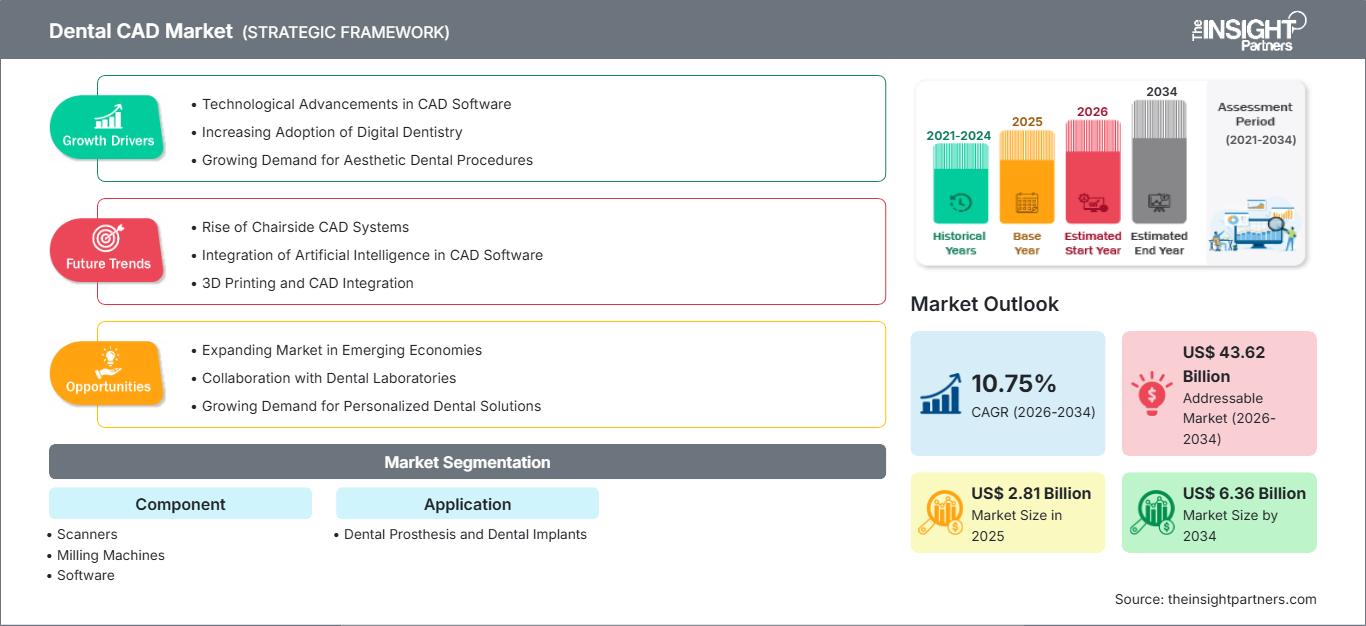
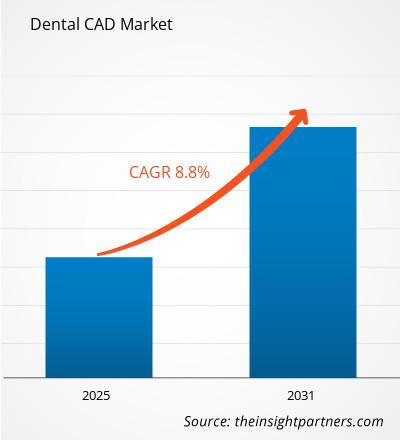
The Dental CAD Market represents a rapidly digitizing segment of restorative and implant dentistry. The market is valued at US$ 2.81 Billion in 2025 and is projected to reach US$ 6.36 Billion by 2034, registering a CAGR of 10.75% during 2026–2034. Expansion is supported by increasing adoption of digital impressions, computer-aided design, automated milling, and software-enabled treatment workflows across dental clinics and laboratories.
Across North America, Dental CAD Market size is supported by established digital dentistry infrastructure, high dental expenditure, and broad availability of intraoral scanning and chairside manufacturing systems. The regional outlook indicates a CAGR of 9.8–10.5% during 2026–2034, with replacement demand, workflow automation, and investments in integrated digital platforms providing structural support for continued adoption.
Dental CAD Market Assessment and Insights
- North America: The region maintains a leading position, supported by mature digital workflows and extensive clinical infrastructure, with a 38–39% share in 2025 and a CAGR of 9.8–10.5% between 2026–2034.
- US: The US accounts for 92–94% of North American demand in 2025, supported by established dental practices, high spending, and accelerating adoption, with a CAGR of 10.0–10.8% between 2026–2034.
- Europe: Europe represents a 33–34% share in 2025, led by Germany, France, the UK, Italy, and Spain, with mature laboratories and clinics supporting a CAGR of 9.3–10.0% between 2026–2034.
- Asia Pacific: Asia Pacific holds an 18–20% share in 2025, led by China, Japan, India, South Korea, and Australia, while expanding clinic networks and digital investment support a CAGR of 11.5–12.5% between 2026–2034.
- Largest Segment: Milling Machines hold a 38–42% market share in 2025, reflecting laboratory production requirements and restoration manufacturing demand, with a CAGR of 9.5–10.5% during 2026–2034.
- High Growth Segment: Software holds a 20–24% market share in 2025, benefiting from AI-assisted design and cloud workflows, with a CAGR of 12.0–13.0% during 2026–2034.
- Key companies analyzed in detail: 3Shape A/S, Dentsply Sirona Inc., Straumann Holding AG, Carestream Health, Inc., Planmeca Oy, Align Technology, Inc., MediTEC Dental, exocad GmbH, Dental Wings Inc., Amann Girrbach AG.
Source: The Insight Partners' analysis based on proprietary research, government publications, company annual reports, investor presentations, industry databases, and expert interviews.
Dental CAD Market has developed from individual pieces of laboratory equipment to interconnected digital ecosystems comprising scanning, designing, manufacturing, and treatment planning technologies. Accurate milling, fast scanning, seamless software integration, and automatic designing have become critical technological factors for differentiation. Moreover, manufacturing is moving towards integrated processes, in which laboratories and clinics collaborate through digital file sharing, rather than using physical impression and conventional fabrication procedures.
Future investments will probably be made in new markets in Asia, and in the digitalization of dental clinics. Software security, patient information management, compatibility of medical devices, and environmental responsibility of materials will become more important for product development in the future. Adoption of cloud-based solutions can also facilitate recurring software revenue and decrease dependency on hardware purchases, especially for multi-site clinics and laboratories.
Dental CAD Market Report Scope
| Report Attribute | Details |
|---|---|
| Market size in 2025 | US$ 2.81 Billion |
| Market Size by 2034 | US$ 6.36 Billion |
| Global CAGR (2026 - 2034) | 10.75% |
| Historical Data | 2021-2024 |
| Forecast period | 2026-2034 |
Dental CAD Market Analysis
Growth in Demand for Dental CAD Market is largely dependent on the development of the digital workflow system associated with restorative dentistry. The value chain includes scanning or imaging inside the mouth or in the lab environment, then design using the software and finally milling or other digital fabrication. It means that vendors are competing on such factors as performance of the hardware, software capabilities, material capabilities, training and service. Increasing volume of treatments makes the automation more beneficial, and the labs can take advantage of centralization of manufacturing.
The current supply dynamic favors suppliers who can integrate various stages of workflows. The miller machine is a relatively expensive acquisition, while scanners and software can be acquired gradually. It means that there is a step-by-step process of adoption: first customers digitize impressions, then move to design and finally fabricate in-house. The ecosystem is affected by such factors as restorative materials, implant library, cloud capability, service and others.
The competitive environment in the Dental CAD market report involves well-known players in dental technologies along with specialized software and scanning companies. Dentsply Sirona offers an integrated system consisting of CEREC hardware, software, and restorative solutions, while Planmeca provides an integrated solution combining scanning, CAD/CAM, imaging, and clinical equipment. 3Shape and exocad place their bets on software-driven digital workflows, and Align Technology brings together scanners and CAD/CAM software in broader digital dentistry solutions.
Strategic positioning is shifting from devices towards ecosystems. Straumann specializes in digital implant solutions, Amann Girrbach is focused on laboratory production, and Carestream Health keeps its position in digital imaging and scanning. Investments are made into AI-driven design, cloud licensing, interoperability, and workflow automation, which is beneficial for those suppliers that can prove reduced chair time, number of remakes, design time, and lab production time.
● REPORT CUSTOMIZATION
Tailor This Report To Align With Your Specific Business Requirements
This report can be customized to align precisely with your business objectives, scope, and target markets. Customization options include tailored segmentation, geography, competitive analysis, and strategic insights to support informed decision-making.
Customize This Report →WHAT YOU CAN ADJUST
- ● Segmentations
- ● Geography
- ● Competitive Analysis
- ● Language Preferences
Dental CAD Market: Strategic Insights
Regional Insights
North America Dental CAD Market
North America accounted for 38–39% of the Dental CAD Market Share in 2025, thus being the key regional player. The estimated regional CAGR stands at 9.8–10.5% until 2034. Advanced dental facilities, technology adoption, replacement demand, and well-developed laboratories underlie sustained adoption. The major player is the US, but Canada offers extra demand because of established private dentistry services and growing digitalization.
The structural demand is driven by high dental spending and large numbers of practicing professionals. Annual dental spending of the US exceeded US$189 billion in 2024 according to the American Dental Association. In addition, there is an increasing tendency to employ digital technologies to accelerate restoration manufacturing. Providers analyze different configurations of scanners, software, and milling machines integration.
U.S. Dental CAD Market
The US is responsible for about 92-94% of the total demand in North America, growing at a CAGR of 10.0-10.8% in 2025. This growth can be attributed to advanced dental laboratories, group practices, dental service organizations, and well-established supply chains. There are also many dental practitioners in the region, along with considerable spending on aesthetic and restorative treatments.
The demand from the applications includes crowns, bridges, implants, restorations, and digitally designed prosthetics. Clinical settings consider chairside scanning and manufacturing systems through economic workflows, while the laboratories emphasize milling throughput and software integration. Leading players such as Dentsply Sirona, Align Technology, 3Shape, Planmeca, and Straumann have considerable presence in the region.
Europe Dental CAD Market
Europe is anticipated to occupy 33-34% share and experience growth rate at 9.3-10.0% CAGR. Germany is the key country market due to advanced dental laboratories, manufacturing, and development of digital dentistry. United Kingdom and France also have high contribution, whereas Italy and Spain drive demand from private clinics, dental laboratories, and cosmetic dentistry.
United Kingdom will be driven by established laboratory networks and increasing use of digital workflows, Germany by advanced dental manufacturing and high demand for milling and scanning devices. Italy and Spain will continue adoption of digital dentistry solutions due to upgrading of equipment at clinics and need for more efficient production at laboratories. European companies also benefit from geographic proximity to key technology developers.
APAC Dental CAD Market
APAC held a share of 18% to 20% of the market in 2025, and it will register the fastest regional CAGR between 11.5% and 12.5%. APAC is led by China, followed by Japan, India, South Korea, and Australia. Growing numbers of clinics, improved laboratories, dental tourism, and technological advancements are making it easier to reach more customers.
Procurement changes in China have helped in getting dental implants and services, and both Japan and South Korea still have advanced technology. There are good growth opportunities in India due to private dental infrastructure, and Australia represents a well-established market of technology.
Middle East & Africa Dental CAD Market
MEA region is estimated to have a CAGR of 8.5-9.0% during 2026-2034. Saudi Arabia and UAE are the leaders in the region’s development, backed by private investment into the health care sector, modern clinics, dental tourism, and infrastructure initiatives. South Africa still acts as the key sub-Saharan country, whereas the rest of the MEA region evolves thanks to urbanization and private dental facilities expansion.
Healthcare infrastructure investments and high-quality dental services in Saudi Arabia and UAE will generate demand for the workflow solution integration. South Africa is an existing laboratory market, whereas other MEA countries are at the earlier adoption stage. Equipment purchase is affected by the cost of imports, technical assistance, electricity supply, and human resources availability.
Segmentation Analysis
Component
Component represents the technology foundation of digital dental production. The segment is estimated to expand at a CAGR of 9.8–10.8% during 2026–2034. Hardware continues to generate substantial revenue because scanners and milling machines remain essential production assets, while software is gaining strategic importance through AI, automation, and cloud connectivity. Dental CAD Market scope is therefore broadening from equipment purchases toward integrated technology platforms.
- Scanners: Digital scanners support impression capture, workflow standardization, and rapid data transfer, making them strategically important for clinics and laboratories transitioning away from conventional physical impressions.
- Milling Machines: Milling systems remain central to high-volume restoration manufacturing, supporting crowns, bridges, implant restorations, and other digitally fabricated prostheses across laboratory and chairside environments.
- Software: Design software converts digital scans into manufacturable restorations, with automation, AI-assisted proposals, cloud collaboration, and implant libraries strengthening its strategic role in workflow integration.
- Other Components: Supporting components enable connectivity, workflow integration, calibration, and equipment interoperability, helping users maintain reliable digital production across different hardware and software configurations.
Application
Application is estimated to grow at a CAGR of 10.2–11.2% during 2026–2034. Dental prosthetic workflows represent the larger demand base because crowns, bridges, and related restorations generate recurring digital cases. Implant applications are expanding faster as implant planning, customized abutments, and digitally designed restorations become increasingly integrated with scanning and manufacturing platforms.
- Dental Prosthesis: Digital prosthesis production benefits from repeatable design, standardized manufacturing, rapid modifications, and improved communication between clinics and laboratories, supporting broad adoption across restorative dentistry.
- Dental Implants: Implant workflows increasingly combine digital impressions, virtual planning, implant libraries, and customized restorative design, strengthening the strategic importance of integrated CAD solutions for complex cases.
Opportunity Snapshot
| Application | Revenue Contribution (High/Medium/Low) | Trend Tag (MAX 2 words) | Adoption Stage (Emerging/Scaling/Mature) |
| Dental Prosthesis | High | Same-Day Restorations | Mature |
| Dental Implants | Medium | Digital Implantology | Scaling |
Dental CAD Market Growth Drivers and Impact Analysis
Rising Burden of Oral Disease and Restorative Treatment
The underlying treatment requirement remains a fundamental demand catalyst. The World Health Organization reports that oral diseases affect nearly 3.7 billion people globally, while untreated dental caries remains the most common oral condition. Such disease prevalence creates a recurring need for restorative interventions, where digital design and manufacturing can improve production consistency. The commercial impact is strongest where treatment volumes justify investment in scanning, design, and milling infrastructure. Dental laboratories can process more cases with standardized digital files, while clinics can reduce reliance on manual impressions and external fabrication. As restorative procedures become increasingly digitized, equipment suppliers gain opportunities to sell complete workflows rather than individual devices, increasing the economic value of software, service contracts, and compatible consumables.
Higher Dental Expenditure and Practice Modernization
Growing dental expenditure is improving the economic foundation for technology investment, particularly in developed markets. US national dental expenditures reached US$189 billion in 2024, representing 3.6% of total health expenditure. This spending environment supports capital purchases when digital systems demonstrate measurable productivity benefits. Practices can evaluate CAD/CAM equipment through chair-time reduction, fewer physical impressions, faster restoration delivery, and improved laboratory coordination. Group practices and dental service organizations can also standardize equipment and software across multiple locations, improving purchasing leverage and training efficiency. In emerging markets, modernization is more selective, with clinics initially adopting scanners or cloud software before progressing toward complete chairside manufacturing. This staged purchasing model can expand the customer base without requiring immediate full-system investment.
AI, Cloud Connectivity, and Workflow Automation
AI and cloud technologies are shifting competitive value toward software-enabled productivity. Modern dental platforms increasingly automate margin detection, tooth proposals, bite alignment, implant design, and case communication. The practical impact is a reduction in repetitive design tasks and a greater ability to manage higher case volumes without proportional increases in labor. Cloud-based licensing also allows suppliers to distribute updates and introduce new functionality without requiring complete equipment replacement. 3Shape's recent software releases demonstrate how AI-assisted workflows are becoming embedded within dental design environments, while Dentsply Sirona has expanded AI-supported CEREC workflows. These developments encourage customers to assess platforms based on cumulative workflow performance rather than hardware specifications alone, increasing the strategic importance of software ecosystems and interoperability.
Dental CAD Market Future Trends
AI-Native Design and Automated Case Preparation
Dental CAD Market trends are expected to increasingly favor AI-native software that performs routine design preparation before clinician or technician review. Future systems will likely combine scan interpretation, automated tooth segmentation, margin identification, occlusion analysis, implant-library matching, and restoration proposals within a unified interface. This evolution can reduce repetitive labor while preserving professional control over final treatment decisions. Vendors with large case datasets and strong software ecosystems may gain an advantage because algorithm performance depends partly on training quality and workflow integration. The next phase will therefore involve deeper embedding of AI into existing scanners and design platforms rather than treating artificial intelligence as a separate application. Regulatory validation, traceability, cybersecurity, and explainability will become important purchasing criteria as automated recommendations influence clinical and laboratory decisions.
Cloud-Based Collaborative Production Networks
Cloud connectivity is likely to become a core architecture for multi-location dental practices and laboratories. Digital cases can increasingly move from scanner to designer, laboratory, milling center, and clinician through shared platforms, reducing file-transfer friction and improving visibility across production stages. This model supports distributed manufacturing, where a clinic can capture data locally while specialized laboratories perform complex design or fabrication remotely. Future platforms may also connect ordering, production status, quality checks, billing, and device monitoring within one environment. The commercial implication is a shift from one-time equipment sales toward recurring software, service, and workflow revenues. Suppliers that provide secure interoperability across competing scanners, milling systems, and design tools may be positioned to capture a larger portion of this connected production ecosystem.
Dental CAD Market Opportunities
Expansion Through Mid-Sized Clinics and Regional Laboratories
Dental CAD Market Forecasts indicate an opportunity to address practices that are too large for basic digital tools but too small to justify highly complex laboratory infrastructure. Modular systems can provide a practical pathway, allowing customers to acquire scanners first and add software, milling, or cloud services as utilization increases. Suppliers can strengthen this opportunity through financing, subscription pricing, trade-in programs, standardized training, and remote technical support. Regional laboratories are another attractive target because they can consolidate cases from multiple clinics and improve equipment utilization. Vendors that design scalable configurations around workload rather than maximum technical capacity can reduce adoption barriers. Partnerships with dental service organizations, laboratory groups, and distributors can further accelerate deployment by simplifying procurement and creating standardized technology packages.
Integrated Implant and Prosthetic Digital Workflows
An important investment opportunity lies in connecting implant planning with restorative CAD workflows. Straumann's digital initiatives illustrate how implant providers are increasingly linking treatment planning, CAD libraries, prosthetic design, and laboratory collaboration. Integrated systems can reduce manual data transfer and improve consistency between surgical and restorative stages. Suppliers can capture value by offering interoperable libraries, guided design modules, customized abutment workflows, and connected production services. Dental laboratories can benefit from standardized implant interfaces and repeatable digital production, while clinics can improve communication with laboratories and patients. Investment should prioritize software compatibility and open data exchange because customers increasingly operate mixed technology environments. The strongest opportunities are therefore likely to emerge around platforms that connect existing assets rather than requiring complete replacement of established equipment.
Recent Developments
- October 2025: Align Technology, Inc. announced new iTero Digital Solutions innovations combining intraoral scanning with integrated software tools, including enhanced chairside visualization and capabilities supporting in-house fabrication of mock-ups and prosthetics. The development strengthens the company's positioning around connected digital dentistry and expands the role of scanning beyond image capture toward broader treatment and workflow engagement.
- September 2025: Dentsply Sirona Inc. announced an expanded AI-powered CEREC workflow and two new milling units, CEREC Primemill Lite and CEREC Go, alongside CEREC Cercon 4D zirconia CAD/CAM blocks. The company positioned the additions around broader access to single-visit dentistry and increased workflow flexibility for dental practices.
- March 2025: Planmeca Oy introduced three CAD/CAM products for IDS 2025, including a new wireless-capable Planmeca Onyx intraoral scanner, a desktop scanner, and a high-precision 3D printer. The launches expanded its digital workflow portfolio from scanning and design through manufacturing and were designed for practices, laboratories, dental schools, and larger group practices.
Frequently Asked Questions

- Comprehensive Market Sizing and Forecast Analysis
- Detailed Segmentation Analysis
- In-Depth Market Dynamics Assessment
- Regional and Country-Level Insights
- Competitive Landscape and Company Benchmarking
- Strategic Business Intelligence
Recent Reports
Testimonials

The Insight Partners' SCADA System Market report is comprehensive, with valuable insights on current trends and future forecasts. The team was highly professional, responsive, and supportive throughout. We are very satisfied and highly recommend their services.
RAN KEDEM Partner, Reali Technologies LTDs
I requested a report on a very specific software market and the team produced the report in a few days. The information was very relevant and well presented. I then requested some changes and additions to the report. The team was again very responsive and I got the final report in less than a week.
JEAN-HERVE JENN Chairman, Future Analytica
We worked with The Insight Partners for an important market study and forecast. They gave us clear insights into opportunities and risks, which helped shape our plans. Their research was easy to use and based on solid data. It helped us make smart, confident decisions. We highly recommend them.
PIYUSH NAGPAL Sr. Vice President, High Beam Global
The Insight Partners delivered insightful, well-structured market research with strong domain expertise. Their team was professional and responsive throughout. The user-friendly website made accessing industry reports seamless. We highly recommend them for reliable, high-quality research services
YUKIHIKO ADACHI CEO, Deep Blue, LLC.
This is the first time I have purchased a market report from The Insight Partners.While I was unsure at first, I visited their web site and felt more comfortable to take the risk and purchase a market report.I am completely satisfied with the quality of the report and customer service. I had several questions and comments with the initial report, but after a couple of dialogs over email with their analyst I believe I have a report that I can use as input to our strategic planning process.Thank you so much for taking the extra time and making this a positive experience.I will definitely recommend your service to others and you will be my first call when we need further market data.
JOHN SUZUKI President and Chief Executive Officer, Board Director, BK Technologies
I wish to appreciate your support and the professionalism you displayed in the course of attending to my request for information regarding to infectious disease IVD market in Nigeria. I appreciate your patience, your guidance, and the fact that you were willing to offer a discount, which eventually made it possible for us to close a deal. I look forward to engaging The Insight Partners in the future, all thanks to the impression you have created in me as a result of this first encounter.
DR CHIJIOKE ONYIA MANAGING DIRECTOR, PineCrest Healthcare Ltd.Reason to Buy
- Informed Decision-Making
- Understanding Market Dynamics
- Competitive Analysis
- Identifying Emerging Markets
- Customer Insights
- Market Forecasts
- Risk Mitigation
- Boosting Operational Efficiency
- Strategic Planning
- Investment Justification
- Tracking Industry Innovations
- Aligning with Regulatory Trends





 Get Free Sample for