
Dental Crowns and Bridges Market Share, Growth & Demand by 2034
Dental Crowns and Bridges Market Size and Forecasts (2021–2034), Global and Regional Share, Trends, and Growth Opportunity Analysis Report Coverage : by Material (Ceramic Materials, Metals, Porcelain-Fused-to-Metal); Product (Crowns, Bridges); and Geography (North America, Europe, Asia Pacific, and South and Central America)
- Status : Data Released
- Report Code : TIPRE00040789
- Category : Life Sciences
- No. of Pages : 150
- Available Report Formats :


- Last update date : August 21, 2026


2025 Market Size
US$ 3.64 Bn
Base year value
2034 Forecast
US$ 6.81 Bn
Projected by 2034
CAGR 2026-2034
8.14 %
Growth rate
Addressable Market
US$ 49.44 Bn
(2026-2034)
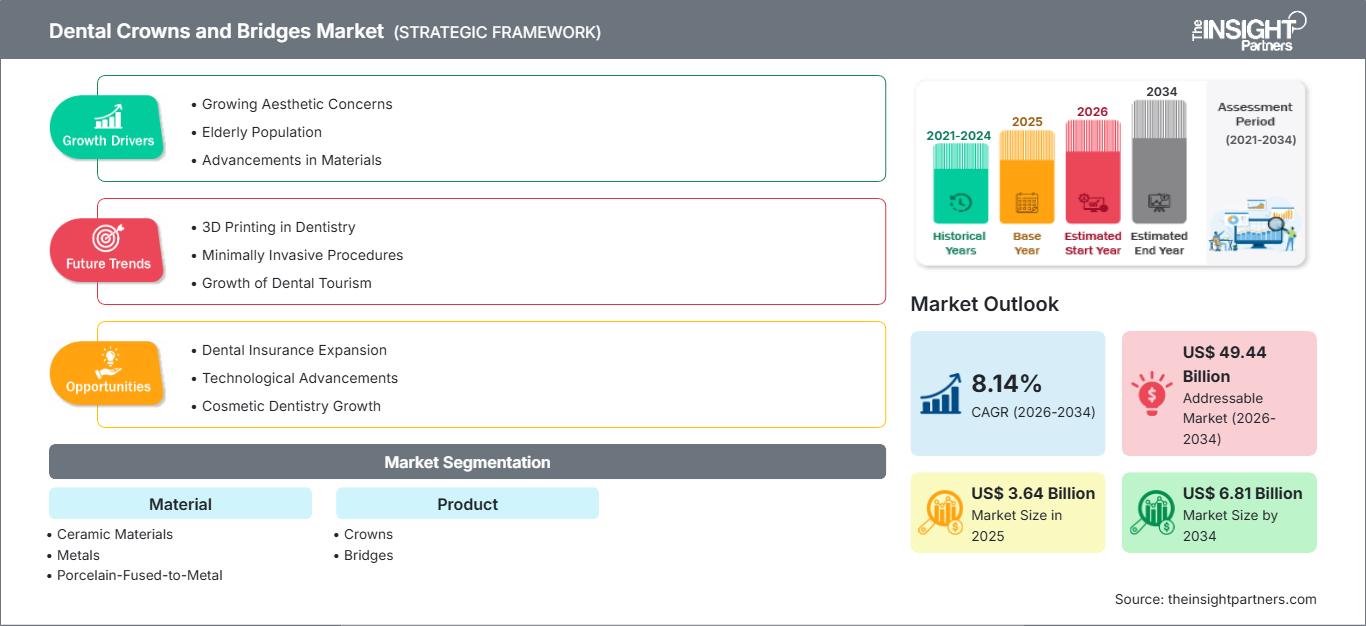
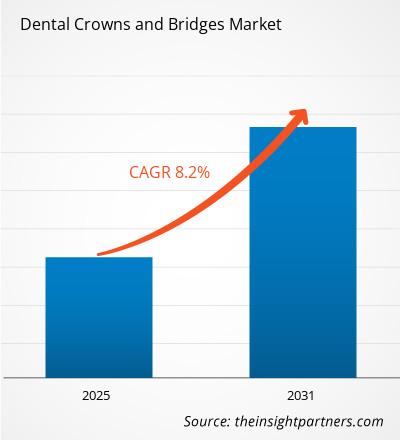
The Dental Crowns And Bridges Market is expanding as restorative dentistry adopts digital design, advanced ceramics, and increasingly integrated chairside and laboratory workflows. Valued at US$ 3.64 Billion in 2025 and forecasted to reach US$ 6.81 Billion by 2034, growing at a CAGR of 8.14% from 2026 to 2034. The growth would be driven by treatment volume for restorative care, patient preferences for aesthetics, treatment with implant rehabilitation and increased accessibility of digitally aided prosthodontics procedures.
North America's growth in the period of 2026-2034 is expected to be 7.7–8.1%, driven by replacement of older restorations, expansion of dental service organizations and adoption of chairside CAD/CAM. Another factor contributing to the Dental Crowns And Bridges Market Size is increased use of zirconia and esthetic ceramics in addition to intraoral scanning, milling and digital connectivity in laboratories.
Dental Crowns and Bridges Market Assessment and Insights
- North America: North America is expected to retain a substantial position, with a 2025 share of 31–35% and a CAGR of 7.7–8.1% between 2026–2034, supported by restorative demand and rapid digital workflow adoption.
- US: The US accounts for 80–84% of North American value in 2025, with a projected CAGR of 7.8–8.2% through 2034, reflecting DSO expansion and replacement procedures.
- Europe: Europe represents a 28–32% 2025 share and is expected to grow at 7.2–7.6% CAGR through 2034, led by Germany, the UK, France, Italy, and Spain.
- Asia Pacific: Asia Pacific holds a 23–27% share in 2025 and is projected to expand at 9.0–9.5% CAGR, led by China, Japan, South Korea, India, and Australia.
- Largest Segment: Ceramic Materials hold a 62–66% market share in 2025 and are projected to grow at a 7.7–8.1% CAGR, supported by esthetic and CAD/CAM adoption.
- High Growth Segment: Bridges represent a 35–39% share in 2025 and are projected to expand at 9.0–9.4% CAGR as implant-supported and digitally fabricated multi-unit restorations increase.
- Key companies analyzed in detail: Dentsply Sirona, 3M, Nobel Biocare, Straumann, Ivoclar Vivadent, Henry Schein, VITA Zahnfabrik, GC Corporation, Argen Corporation, KaVo Kerr.
Source: The Insight Partners' analysis based on proprietary research, government publications, company annual reports, investor presentations, industry databases, and expert interviews.
The market of dental crowns and bridges has changed significantly from mostly cast metal and porcelain fused to metal systems to digitally designed, milled, and monolithic restoration. Ceramics, such as zirconia and other systems, became relevant due to esthetic and mechanical properties. This development results in increased use of automated designing, standard blanks, precise milling, and lab processes linked digitally.
Further growth of the market will be influenced by emerging Asian markets, consolidation of dental labs, investments in scanning, design, milling, and printing technologies. The requirements for material traceability and patient safety in regulations will give an advantage to companies with certified manufacturing systems. The dental labs will attempt to implement flexible manufacturing with central manufacture and local finishing. The dental clinics will begin considering restoration systems according to the processing speed and efficiency.
Dental Crowns and Bridges Market Report Scope
| Report Attribute | Details |
|---|---|
| Market size in 2025 | US$ 3.64 Billion |
| Market Size by 2034 | US$ 6.81 Billion |
| Global CAGR (2026 - 2034) | 8.14% |
| Historical Data | 2021-2024 |
| Forecast period | 2026-2034 |
Dental Crowns and Bridges Market Analysis
Some of the key drivers for the development of the Dental Crowns and Bridges Market are underdiagnosis of the teeth injury, failure of the restorations, aging population, and patient preference for performance and esthetics. The supply chain actors are manufacturers of the materials, CAD/CAM systems, dental laboratories, dentists, distributors, and implant providers. The trends in the supply chain are moving toward standard ceramic blocks, databases, milling centers, and software allowing to scan clinically and manufacture in the laboratory.
The choice of materials continues to be determined by the location of the tooth, the level of occlusal force, the esthetic needs, preparation, and dentist’s preference. Zirconia plays an important role for digitally manufactured restorations, whereas porcelain-fused-to-metal products are still popular due to their laboratory processes and clinical experience. As such, the competition between manufacturers is based on material features, shade systems, workflow, technical support, and manufacturing efficiency rather than the cost per unit.
Integrated competitive positioning in the Dental Crowns And Bridges Market Report is taking shape as companies link restorative materials with scanners, CAD/CAM systems, implants and laboratory services. Dentsply Sirona builds its CEREC platform, while Straumann offers an integrated implant and prosthetics platform. Ivoclar Vivadent specializes in restorative materials and digital solutions, while VITA Zahnfabrik specializes in ceramic materials. Nobel Biocare and KaVo Kerr compete based on implant and restorative workflow integration.
The focus of investments in terms of strategic positioning is shifting towards digital dentistry, automation technologies for manufacturing, material science and laboratory integration. Henry Schein provides distribution capabilities, GC Corporation and 3M have diversified dental offerings. Argen Corporation concentrates on laboratory-oriented restorative solutions. The market research on Dental Crowns And Bridges highlights the ability of suppliers who combine predictable materials with digital workflow solutions to increase lab output and decrease manufacturing variability.
● REPORT CUSTOMIZATION
Tailor This Report To Align With Your Specific Business Requirements
This report can be customized to align precisely with your business objectives, scope, and target markets. Customization options include tailored segmentation, geography, competitive analysis, and strategic insights to support informed decision-making.
Customize This Report →WHAT YOU CAN ADJUST
- ● Segmentations
- ● Geography
- ● Competitive Analysis
- ● Language Preferences
Dental Crowns and Bridges Market: Strategic Insights
Regional Insights
North America Dental Crowns And Bridges Market
North America is projected to maintain a 31–35% of the Dental Crowns And Bridges Market share in 2025 and a 7.7–8.1% CAGR through 2034. The US dominates regional consumption because restorative procedures are supported by established dental infrastructure, high technology penetration, and a large network of independent practices, DSOs, laboratories, and specialist providers.
Another positive for the region is the growing integration of intraoral scanning systems, computer-aided design (CAD)/computer-aided manufacturing (CAM) milling, and laboratory production. The Canadian country adds to this market share by its demand for private dental care and restorations. Mexico makes its contribution by its manufacture and laboratory facilities.
U.S. Dental Crowns And Bridges Market
The US holds around 80-84% value share of North America by 2025 and will register growth at a CAGR of 7.8-8.2% until 2034. Large networks of DSOs, specialty practices, and dental labs cater to repetitive restorative demand, while the cycle of replacements drives the consumption of materials.
Dentsply Sirona, 3M, Nobel Biocare, Straumann, Henry Schein, and KaVo Kerr are some of the players holding substantial commercial presence in the restorative market and the adjacent dental processes. Application demand is moving towards esthetic crowns, implants, and digital bridges. The US is becoming increasingly receptive towards the process of scanning and milling, thereby facilitating certain restorations being performed on a day basis.
Europe Dental Crowns And Bridges Market
Europe has a share of 28–32%, and the region is expected to grow at a rate of 7.2–7.6% CAGR. Germany is the key player due to the presence of an advanced laboratory system, advanced dental manufacturing, and ceramic know-how. The other contributing countries are the UK and France, where restorative procedures are performed in the private dental sector.
Germany is characterized by an advanced laboratory system, and the use of CAD/CAM systems and ceramics is widespread. In the case of the UK, there is a strong development of private restorative dentistry and digital dentistry. France, Italy, and Spain are diverse in terms of demand owing to prosthodontics, dental laboratories, and aesthetic dentistry.
APAC Dental Crowns And Bridges Market
APAC occupies a market share ranging between 23% to 27% in 2025 and is expected to record a CAGR of 9.0-9.5%. This will make APAC the fastest growing region amongst the major regions. China is the biggest country followed by Japan, South Korea, India, and Australia.
Increased development in dental infrastructure and lab digitization will fuel growth in consumption. Market growth will be driven by industrial growth through manufacturing activities, transfer of technology, and public efforts towards improved access to oral healthcare. India and China offer huge volume opportunity, while Japan and South Korea offer high-level restorative processes.
Middle East & Africa Dental Crowns And Bridges Market
The MEA and Africa region will witness a growth rate of 7.0-7.5% CAGR till 2034. Saudi Arabia will be the key driver of demand from the region due to investments in healthcare infrastructure, while UAE will be driven by private dental clinics and medical tourism. South Africa will continue to be the leading sub-Saharan market.
The other MEA markets are defined by lack of infrastructure development, dependency on imports, and uneven distribution of dental professionals. Investments in infrastructure development and private healthcare, along with wider availability of specialists, will favor adoption of restoration. The issues of energy and logistics will stay important due to imports of sophisticated materials.
Segmentation Analysis
Material
Ceramic Materials, Metals, and Porcelain-Fused-to-Metal constitute the material structure of the Dental Crowns And Bridges Market. The segment is projected to expand at a 7.7–8.1% CAGR from 2026–2034. Ceramic systems benefit from esthetic expectations and digital fabrication, while metals retain utility in demanding restorative situations and porcelain-fused-to-metal remains relevant within established clinical protocols.
- Ceramic Materials: Ceramic materials occupy the strongest position because zirconia and related systems support natural-looking restorations, digital milling, standardized shade selection, and efficient laboratory production across diverse restorative cases.
- Metals: Metals remain strategically important where strength, longevity, and established fabrication methods are prioritized, particularly for selected posterior restorations and applications requiring robust mechanical performance.
- Porcelain-Fused-to-Metal: Porcelain-fused-to-metal maintains demand through established clinician familiarity, proven laboratory techniques, and balanced mechanical and esthetic characteristics, particularly where conventional workflows remain economically attractive.
Product
Crowns and Bridges represent the product structure, with the segment expected to grow at an 8.4–8.8% CAGR during 2026–2034. Crowns benefit from high procedural frequency, while bridges gain from multi-unit tooth replacement and implant-supported rehabilitation. Digital planning and standardized manufacturing increasingly influence product selection, turnaround expectations, and laboratory production economics.
- Crowns: Crowns remain the core restorative product because they address individual tooth damage, fracture, decay, and post-endodontic restoration while supporting both functional rehabilitation and cosmetic treatment objectives.
- Bridges: Bridges serve multi-tooth replacement requirements and are increasingly produced through CAD/CAM workflows, enabling precise frameworks, consistent contacts, and improved coordination between clinicians, laboratories, and material suppliers.
Opportunity Snapshot
| Product | Revenue Contribution (High/Medium/Low) | Trend Tag (MAX 2 words) | Adoption Stage |
| Crowns | High | Chairside CAD/CAM | Mature |
| Bridges | Medium | Digital Frameworks | Scaling |
Dental Crowns and Bridges Market Growth Drivers and Impact Analysis
Rising Demand for Esthetic and Durable Restorations
Increasing patient demand for functional longevity as well as aesthetic properties of restorations increases the need for ceramic crowns and digitally fabricated prosthetics. With aging populations and restoration history there comes an element of recurrent replacements, and the rise of cosmetic dentistry adds a non-therapeutic element to restorative care. This leads to the market effect of greater need for flexible ceramic systems by labs and selective use of material depending on location, loads, and aesthetics on the side of clinicians. Translucency, mechanical properties, shade compatibility, and milled aesthetics are improved in response from manufacturers. The market effect of such developments is moving towards increased value of materials used in restoration as well as standardization of digital process. In addition, suppliers will benefit more from predictable and efficient restorative treatment in their ability to meet recurrent lab demand.
Expansion of Digital Dentistry Across Clinical and Laboratory Workflows
Intraoral scanning, CAD software, milling, and digital communication are changing how restorative cases move between dentists and laboratories. Digital impressions reduce conventional handling steps, while automated design and standardized milling can improve repeatability. The impact extends beyond equipment sales because each digital workflow increases demand for compatible blocks, discs, blanks, software modules, and finishing materials. Dental laboratories can also consolidate production and distribute digitally designed cases to centralized manufacturing facilities. This increases the importance of interoperability and workflow integration in supplier selection. Over time, digital adoption can lower remakes associated with communication or manual fabrication discrepancies, shorten turnaround times, and improve production planning. The commercial effect is therefore broader than a technology upgrade, influencing recurring consumable purchases and strengthening relationships between material suppliers, laboratories, and dental technology providers.
Increasing Implant-Supported and Multi-Unit Restorative Procedures
Expansion of implant treatment creates additional demand for crowns and bridges used in definitive prosthetic rehabilitation. Implant-supported restorations require close coordination between implant components, abutments, digital design, materials, and laboratory manufacturing. As implant procedures become more integrated with digital planning, restorative suppliers gain opportunities to provide compatible components and material systems rather than isolated products. This supports portfolio expansion across prosthetic workflows and encourages collaboration between implant manufacturers and laboratories. The effect is particularly relevant for bridges, where multi-unit cases require accurate component positioning, passive fit, and predictable occlusal relationships. Manufacturers can differentiate through compatibility, workflow guidance, material selection, and digital libraries. The Market is consequently influenced by the broader economics of implant dentistry, with restorative consumption increasingly linked to the installed base and procedural volume of implant systems.
Dental Crowns and Bridges Market Future Trends
AI-Assisted Crown Design and Automated Workflow Validation
Artificial intelligence is likely to move from diagnostic support toward restorative design assistance, particularly in automated margin detection, tooth morphology proposals, occlusal analysis, and case validation. Emerging research demonstrates increasing attention to automated crown generation from intraoral scans, indicating a direction toward software that reduces repetitive technician tasks. Future systems may generate initial designs that technicians refine rather than creating restorations entirely manually. Integration with cloud platforms could allow standardized design libraries, centralized quality controls, and continuous software improvement. The commercial consequence will be greater value placed on connected ecosystems that link scanners, CAD software, materials, and milling systems. Providers may increasingly compete on workflow intelligence, interoperability, and the ability to reduce design time while maintaining clinician oversight and regulatory compliance.
Convergence of Additive and Subtractive Restorative Manufacturing
Restorative production is likely to become more flexible as milling and additive manufacturing develop complementary roles. Subtractive milling remains well suited to dense ceramic blocks and established crown workflows, while additive methods can address selected provisional, framework, and model applications. In the Dental Crowns And Bridges Market Trends, laboratories may adopt hybrid production cells that select technologies according to material, geometry, production volume, and required finishing. This could reduce dependence on a single manufacturing method and improve utilization of laboratory equipment. Material developers will therefore face pressure to formulate products for specific digital manufacturing processes rather than simply reproducing conventional material characteristics. Standardized validation, post-processing protocols, and workflow documentation will become increasingly important as laboratories seek predictable outcomes across mixed production environments.
Dental Crowns and Bridges Market Opportunities
Centralized Digital Manufacturing for Laboratory Networks
Dental laboratory consolidation creates an opportunity for centralized production hubs serving multiple clinics and smaller laboratories. Investors and manufacturers can target facilities equipped for high-volume CAD/CAM milling, quality-controlled finishing, and digitally managed case distribution. Such models can spread equipment costs across greater production volumes and reduce duplication of specialized machinery. The opportunity is strongest where independent laboratories lack sufficient case volume to justify comprehensive in-house systems. Suppliers can participate through material contracts, equipment leasing, software integration, or outsourced manufacturing partnerships. The Dental Crowns And Bridges Market Forecasts indicate that increasing digital connectivity could make geographically distributed case management more practical. Strategic investment should prioritize interoperable systems, standardized quality assurance, reliable logistics, and technician training to establish scalable production without compromising restoration customization or clinical communication.
Premium Ceramic Platforms in Emerging Dental Economies
Emerging dental economies offer an opportunity to expand premium restorative materials as private dental infrastructure, specialist capacity, and patient awareness improve. Suppliers can localize distribution, training, shade systems, and laboratory support rather than relying solely on imported product availability. India, China, Southeast Asia, and selected Middle Eastern markets are particularly relevant because expanding urban dental networks can support greater adoption of digitally fabricated restorations. Investment strategies should distinguish between high-volume value segments and premium aesthetic applications, allowing product portfolios to match local purchasing power. Successful expansion will depend on dependable supply, regulatory registration, technician education, and partnerships with laboratories capable of demonstrating material performance. These conditions can improve conversion from conventional restorative methods to higher-value ceramic workflows while supporting sustainable channel development.
Recent Developments
- July 2026: Dentsply Sirona reported that PDS Health had surpassed five million CEREC chairside restorations, highlighting scaled use of digitally enabled restorative dentistry. The milestone reinforces the commercial relevance of integrated scanning, design, and manufacturing workflows for same-visit care and demonstrates how large practice networks can accelerate utilization of digital crown and restorative systems.
- June 2026: Straumann Group published its 2026 Medentika prosthetic catalog, expanding access to components supporting crown, bridge, and implant prosthetic workflows. The portfolio includes standard, customized, and multi-unit solutions, reflecting continued development of digitally compatible restorative components and broader integration between implant platforms and laboratory-oriented CAD/CAM production.
- July 2026: Ivoclar Vivadent scheduled a dedicated digital workflow course covering crown and bridge restorations, including intraoral and model scanning, 3Shape Dental System, 3D printing, and milling. The program illustrates the industry's emphasis on practical digital workflow education as laboratories and clinicians expand technology-enabled restorative production.
Frequently Asked Questions

- Comprehensive Market Sizing and Forecast Analysis
- Detailed Segmentation Analysis
- In-Depth Market Dynamics Assessment
- Regional and Country-Level Insights
- Competitive Landscape and Company Benchmarking
- Strategic Business Intelligence
Recent Reports
Testimonials

The Insight Partners' SCADA System Market report is comprehensive, with valuable insights on current trends and future forecasts. The team was highly professional, responsive, and supportive throughout. We are very satisfied and highly recommend their services.
RAN KEDEM Partner, Reali Technologies LTDs
I requested a report on a very specific software market and the team produced the report in a few days. The information was very relevant and well presented. I then requested some changes and additions to the report. The team was again very responsive and I got the final report in less than a week.
JEAN-HERVE JENN Chairman, Future Analytica
We worked with The Insight Partners for an important market study and forecast. They gave us clear insights into opportunities and risks, which helped shape our plans. Their research was easy to use and based on solid data. It helped us make smart, confident decisions. We highly recommend them.
PIYUSH NAGPAL Sr. Vice President, High Beam Global
The Insight Partners delivered insightful, well-structured market research with strong domain expertise. Their team was professional and responsive throughout. The user-friendly website made accessing industry reports seamless. We highly recommend them for reliable, high-quality research services
YUKIHIKO ADACHI CEO, Deep Blue, LLC.
This is the first time I have purchased a market report from The Insight Partners.While I was unsure at first, I visited their web site and felt more comfortable to take the risk and purchase a market report.I am completely satisfied with the quality of the report and customer service. I had several questions and comments with the initial report, but after a couple of dialogs over email with their analyst I believe I have a report that I can use as input to our strategic planning process.Thank you so much for taking the extra time and making this a positive experience.I will definitely recommend your service to others and you will be my first call when we need further market data.
JOHN SUZUKI President and Chief Executive Officer, Board Director, BK Technologies
I wish to appreciate your support and the professionalism you displayed in the course of attending to my request for information regarding to infectious disease IVD market in Nigeria. I appreciate your patience, your guidance, and the fact that you were willing to offer a discount, which eventually made it possible for us to close a deal. I look forward to engaging The Insight Partners in the future, all thanks to the impression you have created in me as a result of this first encounter.
DR CHIJIOKE ONYIA MANAGING DIRECTOR, PineCrest Healthcare Ltd.Reason to Buy
- Informed Decision-Making
- Understanding Market Dynamics
- Competitive Analysis
- Identifying Emerging Markets
- Customer Insights
- Market Forecasts
- Risk Mitigation
- Boosting Operational Efficiency
- Strategic Planning
- Investment Justification
- Tracking Industry Innovations
- Aligning with Regulatory Trends





 Get Free Sample for