
Dental Extraction Forceps Market Size, Trends & Demand by 2034
Coverage: By Type (Maxillary Forceps, Mandibular Forceps, Others); Application (Extraction Forceps For Adults, Extraction Forceps For Children), and Geography (North America, Europe, Asia Pacific, and South and Central America)
- Status : Data Released
- Report Code : TIPRE00015175
- Category : Life Sciences
- No. of Pages : 150
- Available Report Formats :


- Last update date : August 21, 2026


2025 Market Size
US$ 108.66 Mn
Base year value
2034 Forecast
US$ 174.02 Mn
Projected by 2034
CAGR 2026-2034
5.37 %
Growth rate
Addressable Market
US$ 1,281.89 Mn
(2026-2034)
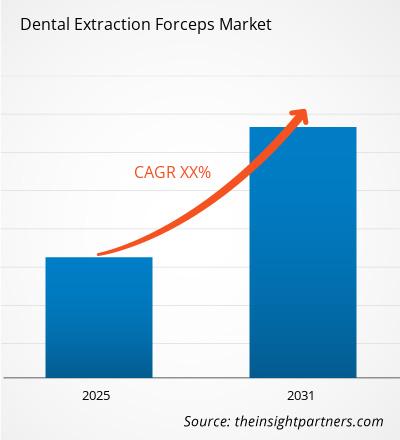
The Dental Extraction Forceps Market was valued at US$ 108.66 Million in 2025 and is projected to reach US$ 174.02 Million by 2034, registering a CAGR of 5.37% during 2026–2034. Expansion will be facilitated due to the continuous demand for extraction due to tooth decay, periodontal disease, tooth loss, and surgery. The replacement of product, increase in the ability to provide dental care, and demand for anatomically suitable instruments are anticipated to support procurement from hospitals, clinics, and dental facilities.
The market is estimated to grow with a CAGR of 5.0–5.5% from 2026–2034 due to dental practice in the region along with replacement of reusable surgical instruments. The Dental Extraction Forceps Market size is driven by preference for durable stainless steel instruments, organized procurement, familiarity with standard patterns of forceps, and investments in oral surgeries in the region.
Dental Extraction Forceps Market Assessment and Insights
- North America: North America is estimated to hold a 33–37% share in 2025 and expand at a CAGR of 5.0–5.5% between 2026–2034, supported by mature dental infrastructure, replacement demand, and established surgical instrument distribution.
- US: The US represents 82–86% of North American demand in 2025 and is projected to grow at a CAGR of 5.0–5.5% during 2026–2034, supported by organized dental practices and oral surgery activity.
- Europe: Europe is estimated to account for a 27–31% share in 2025 and grow at a CAGR of 5.1–5.6% during 2026–2034, with Germany, the UK, France, Italy, and Spain representing leading national markets.
- Asia Pacific: Asia Pacific is estimated to represent a 20–24% share in 2025 and register a CAGR of 6.1–6.7% through 2034, led by China, Japan, South Korea, India, and Australia.
- Largest Segment: Maxillary Forceps is estimated to command a 54–58% market share in 2025 and grow at a CAGR of 5.1–5.5% during 2026–2034, reflecting broad clinical use.
- High Growth Segment: Extraction Forceps For Children is estimated to hold an 18–22% market share in 2025 and expand at a CAGR of 5.8–6.3% during 2026–2034, supported by pediatric dental capacity.
- Key companies analyzed in detail: KRUUSE; OTTO LEIBINGER GmbH; Carl Martin GmbH; Helmut Zepf Medizintechnik GmbH; ASA DENTAL S.p.A.; J & J Instruments, Inc.; Karl Schumacher Dental, LLC; iM3; Erbrich Instrumente; HuFriedyGroup.
Source: The Insight Partners' analysis based on proprietary research, government publications, company annual reports, investor presentations, industry databases, and expert interviews.
Dental Extraction Forceps Market is based on reusable stainless steel products designed for specific anatomical features and methods of tooth extraction. Current product innovation is focused on such factors as beak shape, feel, handle ergonomics, surface finish, and durability in multiple rounds of sterilization. At the same time, there are ongoing efforts to create pediatric forceps and those designed specifically for tooth roots, molars, premolars, and anterior teeth; manufacturing is now becoming more complex due to combination of mechanical treatment and manual work.
Going forward, growth is expected to be influenced by oral health care development in emerging countries, replacement of outdated tools, and improvements in organized dentistry. Opportunities in Market include developments in oral surgery procedures in Asia Pacific and some countries in the Middle East, as well as demands in Europe for better quality management and traceability in medical devices.
Dental Extraction Forceps Market Report Scope
| Report Attribute | Details |
|---|---|
| Market size in 2025 | US$ 108.66 Million |
| Market Size by 2034 | US$ 174.02 Million |
| Global CAGR (2026 - 2034) | 5.37% |
| Historical Data | 2021-2024 |
| Forecast period | 2026-2034 |
Dental Extraction Forceps Market Analysis
Growing demands for treatment help drive the Dental Extraction Forceps Market through tooth decay, periodontal disease, tooth loss, and other oral diseases that increase the need for extraction. The ecosystem includes stainless steel manufacturers, forging companies, machining vendors, instrument makers, sterilizers, distributors, dental clinics, hospitals, and dental practitioners. Competitiveness is linked to the accuracy of manufacturing, material uniformity, ease of reprocessing, and reliable channel access.
The reusable nature of the forceps leads to a more replacement-based purchase cycle than one based solely on procedures. Clinics usually keep a variety of patterns for the varying teeth and their extraction methods, while hospitals and surgical centers have greater varieties. The makers of the forceps, then, must balance making standardized high-volume patterns along with the specialized patterns.
Influence of Competitive Positioning in the Market can be derived from portfolio diversification, manufacturing experience, ergonomics, and specialization in use of instruments. The Dental Extraction Forceps Market Report is characterized by a diversified supplier base that competes on differentiated offerings and instrument quality instead of technology platform. HuFriedyGroup is known to manufacture many varieties of extraction forceps, while Karl Schumacher Dental focuses on precision instruments and extraction equipment.
Europe-based manufacturers add to the high end segment of the market through precise manufacturing and regulation ability. OTTO LEIBINGER GmbH specializes in manufacturing dental and surgical instruments together with customization services, whereas Carl Martin GmbH is known for manufacturing many dental instruments. ASA DENTAL S.p.A., Helmut Zepf Medizintechnik GmbH, KRUUSE, J & J Instruments, Inc., iM3, and Erbrich Instrumente add to the competition in different segments.
● REPORT CUSTOMIZATION
Tailor This Report To Align With Your Specific Business Requirements
This report can be customized to align precisely with your business objectives, scope, and target markets. Customization options include tailored segmentation, geography, competitive analysis, and strategic insights to support informed decision-making.
Customize This Report →WHAT YOU CAN ADJUST
- ● Segmentations
- ● Geography
- ● Competitive Analysis
- ● Language Preferences
Dental Extraction Forceps Market: Strategic Insights

Regional Insights
North America Dental Extraction Forceps Market
North America is estimated to hold a 33–37% of the Dental Extraction Forceps Market Share in 2025 and is projected to grow at a CAGR of 5.0–5.5% through 2034. The region benefits from mature dental infrastructure, established oral-surgery practices, organized purchasing, and strong availability of reusable surgical instruments. Replacement demand remains important because forceps are repeatedly cleaned, sterilized, inspected, and eventually replaced when performance deteriorates.
However, most demand emanates from the US, whereas in Canada, there is the application of dental instruments in private practices, hospitals, and specialty dentistry. The present purchasing procedure is inclined toward the purchase of tools that deliver anatomical cutting precision, corrosion-resistant features, ergonomics, and the ability to reprocess them using the standard procedures. The distributors have the advantage of being well-established, whereas the manufacturers have an edge in offering various pattern choices.
U.S. Dental Extraction Forceps Market
North America accounts for 82-86% of the US share, and is forecasted to grow at a CAGR of 5.0-5.5% from 2026 to 2034. There is a huge number of private dental clinics, oral surgeons, hospitals and educational institutes that drive demand for both basic and specialized extraction instruments through standard purchase policies that ensure consistent replacements of basic instrument patterns.
The main companies operating in the market are: HuFriedyGroup, Karl Schumacher Dental, LLC and J & J Instruments, Inc. along with foreign companies operating via distributors and specialists. Application areas include adult extraction, pediatric extraction, surgical dentistry and complicated root management. Increasingly, instruments that ensure consistency of beak alignment, controlled grip, good finish and consistent sterilization performance are appreciated in practices.
Europe Dental Extraction Forceps Market
Europe is estimated to account for a 27–31% share of the Dental Extraction Forceps Market in 2025 and is projected to grow at a CAGR of 5.1–5.6% through 2034. Germany is the leading country, supported by its established medical-technology manufacturing base. The UK, France, Italy, and Spain provide additional demand through private dentistry, hospitals, oral-surgery centers, and professional distribution networks.
There is a wide array of dentistry practices and institutions across the UK that generate a need for standardized re-usable equipment. The acquisition of these products focuses on their durability, reprocessing ability, availability, and compatibility with current extraction procedures. Private practices are still major customers, but procurement by institutions takes into account life-cycle values and supplier reliability.
Germany has a particular strength in this sector due to manufacturers like OTTO LEIBINGER GmbH, Carl Martin GmbH, and Helmut Zepf Medizintechnik GmbH. Their suppliers rely on precision machining, high-grade stainless steel, ergonomic design, and customization. Suppliers from France, Italy, and Spain support the region with their dental industry and growing specialty care services.
APAC Dental Extraction Forceps Market
APAC region is expected to occupy a 20-24% market share by 2025, growing at a CAGR of 6.1-6.7% up to 2034. Major markets include China, Japan, South Korea, India, and Australia. The reasons for growth lie in an improved dental infrastructure, opening of private clinics, local production and availability of services, and more access to professional oral care.
Local industrialization and investments in health care ensure domestic availability and reasonable pricing of products. India and China have significant demand potential for a long time to come, while Japan and Australia are focused on quality and compliance standards. Training and specialist dentistry help adopt forceps with different anatomies.
Middle East & Africa Dental Extraction Forceps Market
The Middle East & Africa market is expected to grow at a CAGR of 4.4–4.9% during 2026–2034. Saudi Arabia is the leading market, followed by the UAE and South Africa. Healthcare infrastructure investment, private hospital expansion, and dental-clinic modernization support demand for reusable extraction instruments across established and developing care networks.
Gulf nations have energy sources that are capable of facilitating modernization in healthcare systems and provision of medical equipment. South Africa has a more developed infrastructure in terms of dentistry services than other parts of the MEA region. The other parts of MEA depend more on distributors with procurement based on cost, availability, robustness of instruments, and reprocessing needs.
Segmentation Analysis
Type
Type segmentation reflects anatomical differences between upper and lower teeth, requiring manufacturers to maintain distinct beak geometries, angulation, and gripping characteristics. The Dental Extraction Forceps Market scope is shaped by clinicians’ preference for instruments that provide controlled engagement while minimizing unnecessary pressure. Maxillary Forceps is estimated to grow at a CAGR of 5.1–5.5% during 2026–2034, supported by broad use across routine and surgical extractions.
- Maxillary Forceps: Maxillary patterns maintain a leading position because upper-tooth extraction requires specialized beak alignment and access. Their broad use across anterior, premolar, and molar procedures supports consistent institutional and clinic procurement.
- Mandibular Forceps: Mandibular configurations address lower-tooth anatomy and posterior access requirements. Demand is sustained by routine extractions, surgical applications, and the need for patterns suited to different crown and root structures.
Application
Application demand differs according to patient anatomy, clinical setting, and procedural complexity. Adult extraction remains the larger purchasing base because it covers routine and surgical dentistry across most dental facilities. Extraction Forceps For Children is estimated to register a CAGR of 5.8–6.3% during 2026–2034, supported by pediatric dental access and greater attention to anatomically adapted instruments.
- Extraction Forceps For Adults: Adult patterns represent the principal application base, serving routine extraction, periodontal treatment, oral surgery, and complex tooth-removal procedures across clinics, hospitals, and specialist practices.
- Extraction Forceps For Children: Pediatric patterns address smaller primary teeth and specialized handling requirements. Their strategic importance is increasing as pediatric dentistry expands and clinicians emphasize controlled, atraumatic extraction techniques.
Opportunity Snapshot
| Application | Revenue Contribution (High/Medium/Low) | Trend Tag (MAX 2 words) | Adoption Stage (Emerging/Scaling/Mature) |
|---|---|---|---|
| Extraction Forceps For Adults | High | Routine Extraction | Mature |
| Extraction Forceps For Children | Medium | Pediatric Precision | Scaling |
Dental Extraction Forceps Market Growth Drivers and Impact Analysis
Rising Global Burden of Oral Disease and Tooth Loss
The global burden of oral disease creates a broad clinical foundation for extraction-related instrument demand. The World Health Organization reports that nearly 3.7 billion people are affected by oral diseases, while untreated dental caries remains the most common health condition globally. This burden does not translate directly into extraction procedures, but it establishes a substantial pool of patients requiring restorative, periodontal, surgical, or tooth-replacement care. As treatment systems expand, forceps inventories must accommodate routine extractions and more complex procedures. The commercial impact is strongest in regions where dental access is improving from a lower base. Suppliers that offer durable, affordable, anatomically differentiated instruments can address institutional procurement as well as growing private-practice demand.
Replacement Demand from Reusable Instrument Workflows
Reusable extraction forceps operate within repeated cleaning, sterilization, inspection, and clinical-use cycles, creating a durable replacement market independent of new clinic openings. Instrument wear can affect surface condition, alignment, grip, and mechanical performance, making replacement necessary when refurbishment is no longer economical. This dynamic supports steady purchasing among established practices with mature inventories. Hospitals and larger clinics can also standardize forceps patterns and maintain replacement schedules, creating predictable procurement requirements. Manufacturers benefit when their products combine long service life with identifiable pattern systems that simplify replenishment. The market impact is therefore linked not only to extraction volumes but also to installed-base management, instrument care practices, reprocessing quality, and the economic balance between maintenance and replacement.
Demand for Anatomically Adapted and Ergonomic Instruments
Clinical emphasis on controlled extraction is strengthening demand for forceps designed around tooth morphology and operator handling. Anatomically adapted beaks can improve engagement with the tooth while reducing the need for excessive pressure, whereas ergonomic handles can support clinician control during repeated procedures. Product differentiation consequently extends beyond stainless-steel grade to geometry, serration, balance, surface treatment, and tactile response. Premium manufacturers increasingly position specialized patterns for specific tooth groups, roots, pediatric cases, and difficult access conditions. This creates opportunities for suppliers to expand value through application-specific portfolios rather than competing only on unit price. Procurement decisions are increasingly shaped by the expected combination of procedural control, durability, reprocessing compatibility, and clinician familiarity.
Dental Extraction Forceps Market Future Trends
Digital Traceability and Instrument Lifecycle Management
Digital traceability is likely to become more relevant as dental practices and hospitals seek greater control over reusable instrument inventories. Identification technologies, digital maintenance records, and standardized instrument databases can help facilities monitor purchasing, usage, sterilization cycles, repairs, and replacement timing. Manufacturers may increasingly provide digital product records that connect pattern numbers with technical specifications, care instructions, and reordering information. Such systems could reduce inventory duplication and improve procurement accuracy, particularly for organizations operating multiple clinics. Over time, lifecycle data may also influence product development by revealing which patterns experience greater usage, replacement frequency, or maintenance requirements. This trend could shift supplier relationships from transactional purchasing toward data-supported instrument management and standardized fleet optimization.
Specialized Pediatric and Atraumatic Designs
Pediatric and atraumatic extraction designs are expected to receive greater product-development attention as clinicians seek better adaptation to primary teeth and controlled force application. Smaller beaks, refined contours, improved serration patterns, and ergonomic handles can address the distinctive anatomy and access limitations associated with pediatric procedures. The Dental Extraction Forceps Market trend also aligns with wider clinical interest in preserving surrounding tissues and minimizing unnecessary procedural trauma. Manufacturers may expand dedicated pediatric ranges rather than relying on scaled versions of adult instruments. At the same time, specialized designs for fractured roots and difficult posterior teeth can increase portfolio depth among oral-surgery users. The result should be greater segmentation by procedure, tooth anatomy, and clinician technique rather than a purely generic forceps category.
Dental Extraction Forceps Market Opportunities
Regional Manufacturing Partnerships and Distributor Expansion
Regional manufacturing partnerships can create attractive routes into markets where dental infrastructure is expanding but imported instruments face higher logistics costs or longer replenishment times. Investors and manufacturers can use local machining, finishing, packaging, or distribution relationships to improve availability without replicating complete production operations. The Dental Extraction Forceps Market Forecasts are particularly relevant for APAC, where expanding private dentistry and manufacturing capabilities can support localized supply models. Partnerships can also improve regulatory navigation, after-sales service, training, and inventory management. Suppliers with established product standards may benefit from selective localization while preserving centralized quality control. The strategy is most suitable for companies seeking scalable market access without assuming the capital requirements of wholly owned regional manufacturing facilities.
Lifecycle Service Models for Multi-Clinic Buyers
Multi-clinic operators offer an opportunity to shift forceps purchasing from isolated transactions toward standardized lifecycle programs. Suppliers can develop bundled procurement arrangements covering instrument sets, replacement schedules, sharpening or refurbishment, reprocessing guidance, and inventory rationalization. Such programs can reduce administrative complexity for buyers while helping manufacturers secure repeat orders across geographically dispersed practices. Hospitals and dental service organizations may also benefit from standardized pattern coding, consistent training, and centralized purchasing. Service-oriented positioning can differentiate suppliers where product specifications are otherwise similar. The strongest opportunity lies in combining durable instruments with dependable availability and technical support, creating a commercial proposition based on continuity of clinical operations rather than solely on the acquisition price of individual forceps.
Recent Developments
- July 2026: HuFriedyGroup opened its new Northbrook campus in Illinois, describing the facility as a major investment in manufacturing, advanced technology, workforce development, and customer service. The new site strengthens domestic production capabilities and provides additional infrastructure for continued development of dental instruments and infection-prevention solutions.
- June 2026: ASA DENTAL S.p.A. highlighted its participation in CIOSP 2026 in São Paulo and AEEDC Dubai 2026 as part of its 2026 exhibition program. The company continues to showcase its extractive surgery, oral surgery, implant surgery, restorative, periodontal, and orthodontic instrument portfolio through international professional events.
- 2025: OTTO LEIBINGER GmbH reported successful MDR certification as part of its 2025 company milestones, reinforcing its regulatory readiness for dental and surgical instruments. Its quality system remains certified to EN ISO 13485, supporting continued manufacture and distribution of reusable dental instruments under European medical-device requirements.
Frequently Asked Questions

- Comprehensive Market Sizing and Forecast Analysis
- Detailed Segmentation Analysis
- In-Depth Market Dynamics Assessment
- Regional and Country-Level Insights
- Competitive Landscape and Company Benchmarking
- Strategic Business Intelligence
Recent Reports
Testimonials

The Insight Partners provided valuable market intelligence that supported our global go-to-market strategy. Their team was professional, responsive, and attentive to our feedback, providing thoughtful analysis and helpful methodological clarifications throughout the project.
Junmo Kim Chief Financial Officer (CFO), Enertech Co., Ltd.
The Insight Partners' SCADA System Market report is comprehensive, with valuable insights on current trends and future forecasts. The team was highly professional, responsive, and supportive throughout. We are very satisfied and highly recommend their services.
RAN KEDEM Partner, Reali Technologies LTDs
I requested a report on a very specific software market and the team produced the report in a few days. The information was very relevant and well presented. I then requested some changes and additions to the report. The team was again very responsive and I got the final report in less than a week.
JEAN-HERVE JENN Chairman, Future Analytica
We worked with The Insight Partners for an important market study and forecast. They gave us clear insights into opportunities and risks, which helped shape our plans. Their research was easy to use and based on solid data. It helped us make smart, confident decisions. We highly recommend them.
PIYUSH NAGPAL Sr. Vice President, High Beam Global
The Insight Partners delivered insightful, well-structured market research with strong domain expertise. Their team was professional and responsive throughout. The user-friendly website made accessing industry reports seamless. We highly recommend them for reliable, high-quality research services
YUKIHIKO ADACHI CEO, Deep Blue, LLC.
This is the first time I have purchased a market report from The Insight Partners.While I was unsure at first, I visited their web site and felt more comfortable to take the risk and purchase a market report.I am completely satisfied with the quality of the report and customer service. I had several questions and comments with the initial report, but after a couple of dialogs over email with their analyst I believe I have a report that I can use as input to our strategic planning process.Thank you so much for taking the extra time and making this a positive experience.I will definitely recommend your service to others and you will be my first call when we need further market data.
JOHN SUZUKI President and Chief Executive Officer, Board Director, BK Technologies
I wish to appreciate your support and the professionalism you displayed in the course of attending to my request for information regarding to infectious disease IVD market in Nigeria. I appreciate your patience, your guidance, and the fact that you were willing to offer a discount, which eventually made it possible for us to close a deal. I look forward to engaging The Insight Partners in the future, all thanks to the impression you have created in me as a result of this first encounter.
DR CHIJIOKE ONYIA MANAGING DIRECTOR, PineCrest Healthcare Ltd.Reason to Buy
- Informed Decision-Making
- Understanding Market Dynamics
- Competitive Analysis
- Identifying Emerging Markets
- Customer Insights
- Market Forecasts
- Risk Mitigation
- Boosting Operational Efficiency
- Strategic Planning
- Investment Justification
- Tracking Industry Innovations
- Aligning with Regulatory Trends





 Get Free Sample for