
Dental Implants Abutment Systems Market Size, Share & Demand by 2034
Coverage: By Product (Stock Abutments, Custom Abutments, and Others), Material (Titanium, Zirconia, and Others), End Use (Dental Clinics, Dental Laboratories, Others), and Geography (North America, Europe, Asia Pacific, the Middle East and Africa, and South and Central America)
- Status : Data Released
- Report Code : TIPRE00043073
- Category : Life Sciences
- No. of Pages : 150
- Available Report Formats :


- Last update date : August 21, 2026


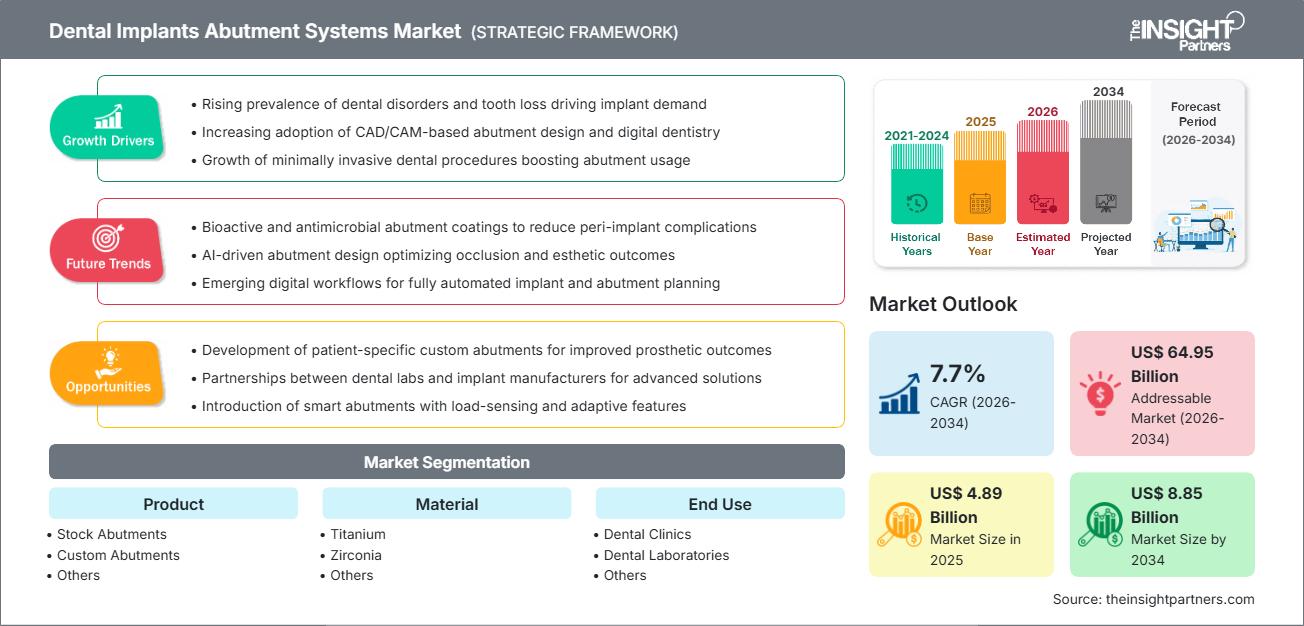
2025 Market Size
US$ 4.89 Bn
Base year value
2034 Forecast
US$ 8.85 Bn
Projected by 2034
CAGR 2026-2034
7.7 %
Growth rate
Addressable Market
US$ 64.95 Bn
(2026-2034)
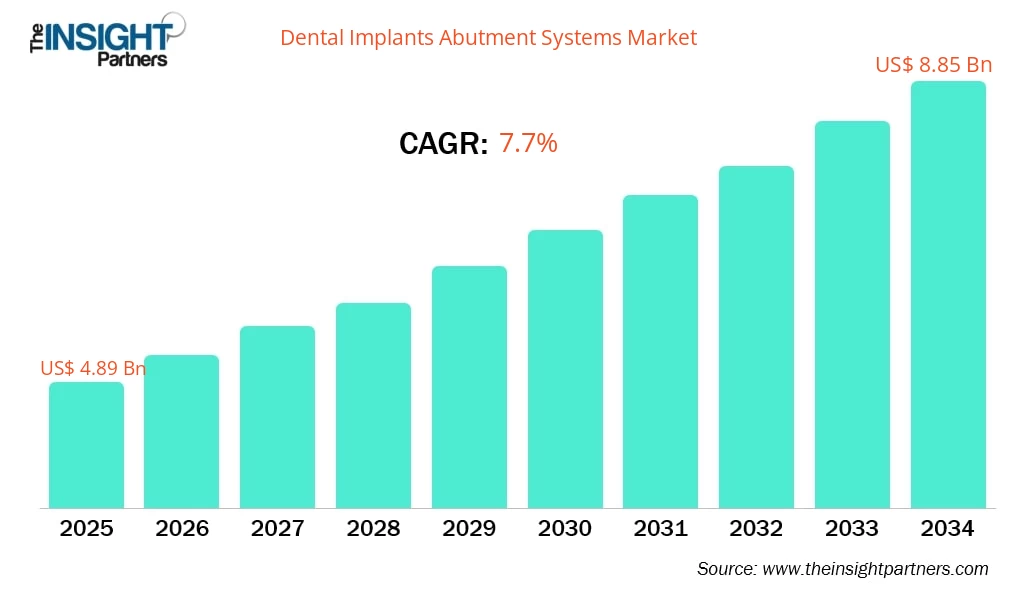
The Dental Implants Abutment Systems Market was valued at US$ 4.89 Billion in 2025 and is projected to reach US$ 8.85 Billion by 2034, registering a CAGR of 7.7% during 2026–2034. The market growth will be driven by rising demands for restorative dentistry, growing adoption of implants, improved digital workflow, and the ongoing development of prosthetic parts that provide a perfect combination of mechanical stability, biological compatibility, and aesthetics.
The Dental Implants Abutment Systems Market Size is anticipated to grow at around 6.0%-6.6% CAGR until 2034 in North America. The growth will be driven by existing implants base, high adoption of digitally designed restorations, specialists availability, and demand for tooth restoration for aesthetics and functionality in aging patients.
Dental Implants Abutment Systems Market Assessment and Insights
- North America: North America represented an estimated 34–38% share in 2025 and is expected to grow at a 6.0–6.6% CAGR between 2026–2034, supported by mature implant practices and advanced restorative workflows.
- US: The US accounted for an estimated 86–90% share of North America in 2025 and is projected to grow at a 6.0–6.5% CAGR during 2026–2034, supported by established clinical adoption.
- Europe: Europe held an estimated 25–29% share in 2025 and is projected to expand at a 6.2–6.8% CAGR during 2026–2034, with Germany, the UK, France, Italy, and Spain forming important demand centers.
- Asia Pacific: Asia Pacific captured an estimated 27–31% share in 2025 and is expected to register an 8.5–9.5% CAGR during 2026–2034, led by China, Japan, South Korea, India, and Australia.
- Largest Segment: Stock Abutments represented an estimated 54–58% market share in 2025 and are projected to grow at a 5.2–5.9% CAGR during 2026–2034, retaining volume leadership.
- High Growth Segment: Custom Abutments represented an estimated 34–38% share in 2025 and are projected to expand at an 8.8–9.6% CAGR during 2026–2034, reflecting digital customization.
- Key companies analyzed in detail: Institut Straumann AG, ZimVie Inc., OSSTEM IMPLANT CO., LTD., DENTSPLY SIRONA Inc., BioHorizons Implant Systems, Inc., Nobel Biocare Services AG, MIS Implants Technologies Ltd., Zest Dental Solutions, LLC, Neoss Group, Bioconcept Co., Ltd., and Cortex Dental (Implements Industries) Ltd.
Source: The Insight Partners' analysis based on proprietary research, government publications, company annual reports, investor presentations, industry databases, and expert interviews.
The development of the market will appear in standardization of prosthetics' parts into custom abutments via digitalization of design. Features of titanium depend on mechanics and clinical application, while features of zirconia abutments are widely used in esthetic areas. The process of making is becoming connected with scanning, digitalization, milling and lab work because of decreasing manual fabrication requirements.
With regard to future opportunities, increased adoption is anticipated to occur within emerging Asian countries where dental infrastructure is growing and implant procedures are becoming more available. Market dynamics will be determined by regulatory issues, investments into digital dentistry, laboratory automation, and purchasing initiatives. China is a good example of a procurement-oriented pricing policy that facilitates rapid adoption of procedure, while at the same time demanding efficiency from manufacturers.
Dental Implants Abutment Systems Market Report Scope
| Report Attribute | Details |
|---|---|
| Market size in 2025 | US$ 4.89 Billion |
| Market Size by 2034 | US$ 8.85 Billion |
| Global CAGR (2026 - 2034) | 7.7% |
| Historical Data | 2021-2024 |
| Forecast period | 2026-2034 |
Dental Implants Abutment Systems Market Analysis
The increase in the number of toothless patients and need for fixed restorations has created repetitive demand for components in the field of implants. Implant manufacturers, abutment manufacturers, dental practices, laboratories, dental milling machines, distributors, and dental professionals form the ecosystem. Digital impressions are becoming common in linking up clinic and laboratory operations. Standardized interfaces have enabled manufacturers to expand their restoration product range into all types of implants.
Supply chain in the Dental Implants Abutment Systems Market depends more and more on precision engineering, machining of titanium and ceramic materials, surface treatments, quality control systems, and validation of connections between implants and abutments. Manufacturers must manage the need to offer many components without creating excess inventory since dental practices and laboratories need compatibility of components based on the diameter of implants, restorative applications, and prosthetic designs.
The concept of fragmentation in the Dental Implants Abutment Systems Market Report is also witnessed in competition where differentiations in terms of implant compatibility, restorability capacity, data collection, digitization, and geographical area prevail. Some of the companies that emphasize the approach of holistic methods are: Institut Straumann AG, DENTSPLY SIRONA Inc., ZimVie Inc., Nobel Biocare Services AG, and OSSTEM IMPLANT CO., LTD. On the other hand, some of the competitors emphasize specialization and regional methods are: BioHorizons Implant Systems, Inc., MIS Implants Technologies Ltd., Zest Dental Solutions, LLC, Neoss Group, Bioconcept Co., Ltd., and Cortex Dental (Implements Industries) Ltd.
Current investment trends target digital workflows, simplification of product offerings, education, and differentiated implant-restorative platforms. Latest portfolio moves demonstrate changes in competitive environment through decreasing numbers of connection interfaces, modularity of surgical instruments, biological emergence profiles, and extended full-arch capabilities. The strategic orientation, therefore, requires not only consideration of cost of individual components but also optimization of workflow costs, clinician education, laboratory interfaces, regulatory coverage, and serving premium and value segments.
● REPORT CUSTOMIZATION
Tailor This Report To Align With Your Specific Business Requirements
This report can be customized to align precisely with your business objectives, scope, and target markets. Customization options include tailored segmentation, geography, competitive analysis, and strategic insights to support informed decision-making.
Customize This Report →WHAT YOU CAN ADJUST
- ● Segmentations
- ● Geography
- ● Competitive Analysis
- ● Language Preferences
Dental Implants Abutment Systems Market: Strategic Insights
Regional Insights
North America Dental Implants Abutment Systems Market
North America is estimated to hold a 34–38% of the Dental Implants Abutment Systems Market share in 2025 and is projected to register a 6.0–6.6% CAGR through 2034. The region benefits from advanced dental infrastructure, established implantology practices, specialist availability, and comparatively broad access to restorative technologies. The US represents the principal regional market, while Canada and Mexico provide additional demand through expanding private dental services and cross-border treatment activity.
The development of structural growth is made possible through the use of digital treatment planning, CAD/CAM restorations, aesthetic dentistry, and increased adoption of implant-supported rehabilitation. The availability of components is wide due to manufacturing and distribution in North America. More and more laboratories are utilizing digital scanning and milling processes. There is a tendency in this market that favors those providers who can offer clinical evidence, connectivity, prosthetics, training, and fulfillment.
U.S. Dental Implants Abutment Systems Market
The US is estimated to account for 86–90% of North American revenue in 2025, with a 6.0–6.5% CAGR through 2034. Its position reflects a large installed base of implant practices, sophisticated dental laboratories, established manufacturers, and broad availability of digitally planned restorative procedures. The market also benefits from continued interest in cosmetic and functional rehabilitation, although patient affordability remains an important purchasing consideration.
Current trends in the Dental Implants Abutment Systems Market for the application of products include digitally-designed restoration, personalized emergence design, immediate and full arch procedures, and better chairside-laboratory collaboration. Organizations such as DENTSPLY SIRONA Inc., ZimVie Inc., BioHorizons Implant Systems, Inc., Nobel Biocare Services AG, Zest Dental Solutions, LLC, and Institut Straumann AG have significant commercial influence in the market. However, competition is becoming more focused on streamlining procedures, compatible components, and restorative results rather than selling individual components.
Europe Dental Implants Abutment Systems Market
The estimated market share for Europe in 2025 will be around 25-29%, while the region is anticipated to grow at a CAGR of 6.2-6.8% between 2024 and 2034. Germany stands out as the leading country, driven by its significant dental infrastructure, expertise in implantology, well-established implant manufacturers, and awareness of implant-assisted rehabilitation methods. The UK, France, Italy, and Spain generate additional demand thanks to private dentistry and dental tourism and digital restoration technologies.
Germany is still the most prominent market in Europe due to the availability of well-equipped laboratories, highly developed education of implantologists, and successful treatment protocols. The UK has a positive impact on restorative dentistry through its private dental sector, and laboratory digitization. France has an aging population and the use of technology. In turn, Italy and Spain have dental tourism and advanced implantology, as well as prosthetic component digitization.
APAC Dental Implants Abutment Systems Market
The Asia Pacific region is projected to comprise 27-31% of world revenues by 2025 and will be growing at an 8.5-9.5% CAGR during 2024-2034, the highest among all regions. China dominates on the regional scale; Japan, South Korea, India, and Australia participate in the region's development via their implant infrastructure.
High levels of industrial investment, dental tourism, increasing treatment awareness, and laboratory digitization promote adoption within the region. Procurement policies in China may increase access to treatments, adding to price competition, while India develops its infrastructure alongside the growth of cost-effective restorative procedures. South Korea has a developed manufacturing sector for implants, Japan provides a mature market for clinical demand, and Australia has premium restorative procedures.
Middle East & Africa Dental Implants Abutment Systems Market
Middle East and Africa is projected to expand at a 6.0–6.8% CAGR through 2034. Saudi Arabia leads regional demand, followed by the UAE and South Africa, while the Rest of MEA remains an emerging opportunity. Dental infrastructure investment, private healthcare expansion, medical tourism, and urbanization are improving access to implant-supported restorative services.
Gulf economies' energy-related investment capabilities ensure that they have modern healthcare facilities and specialized dental facilities, while South Africa has an existing clinical and laboratory infrastructure. UAE capitalizes on its international patient traffic and superior dental services, but Saudi Arabia has benefited from healthcare reform programs. The development of the market is hindered by issues of affordability, specialist availability, and country-specific regulatory and payment environments.
Segmentation Analysis
Product
The product segment in the Dental Implants Abutment Systems Market is shaped by the balance between standardized efficiency and patient-specific restoration. Customization is gaining strategic importance as digital impressions and CAD/CAM workflows become more accessible, while stock solutions remain essential for routine cases requiring predictable availability, standardized connections, and shorter procurement cycles. Product competition increasingly centers on fit, emergence profile, workflow compatibility, and laboratory integration.
- Stock Abutments: Standardized components remain important for routine restorative cases because predictable dimensions, broad availability, and simplified ordering support efficient clinical workflows and inventory management across high-volume implant practices.
- Custom Abutments: Patient-specific components support individualized emergence profiles, restorative positioning, and esthetic requirements, making them strategically important as digital scanning and CAD/CAM manufacturing become more accessible.
- Others: Specialized configurations address selected clinical and restorative requirements where conventional stock or custom solutions do not provide the necessary prosthetic interface.
Material
Material segment in the Dental Implants Abutment Systems Market selection depends on mechanical loading, biological response, esthetic requirements, restorative location, and manufacturing process. Titanium remains foundational for strength and established clinical performance, whereas zirconia is gaining strategic relevance where tissue appearance and optical properties influence treatment selection. Material suppliers increasingly compete through processing consistency, surface characteristics, and compatibility with digital manufacturing platforms.
- Titanium: Titanium maintains broad clinical relevance because strength, biocompatibility, established evidence, and compatibility with implant platforms make it suitable for numerous restorative and load-bearing applications.
- Zirconia: Zirconia supports esthetic restoration requirements through tooth-colored appearance and increasing use in visible areas, particularly where soft-tissue aesthetics influence prosthetic selection.
- Others: Alternative materials and hybrid configurations serve specialized applications, allowing manufacturers to address niche requirements where conventional titanium or zirconia solutions may be unsuitable.
End Use
End-use dynamics in the Dental Implants Abutment Systems Market reflect the increasing coordination between clinicians and laboratories. Dental clinics remain central because implant placement and restoration decisions originate within clinical workflows, while laboratories provide growing value through digital design and manufacturing. The expansion of integrated digital workflows is strengthening collaboration between these settings and increasing demand for compatible component libraries.
- Dental Clinics: Clinics represent the primary decision environment for implant treatment, with demand influenced by patient volume, clinician expertise, treatment complexity, digital planning adoption, and restorative preferences.
- Dental Laboratories: Laboratories are gaining strategic importance as digital impressions, CAD/CAM design, milling, and customized prosthetic production increasingly shape restoration workflows and turnaround expectations.
- Others: Other users encompass specialized healthcare and institutional settings where implant-supported rehabilitation is performed or evaluated under specific clinical, educational, or research requirements.
Opportunity Snapshot
| End Use | Revenue Contribution (High/Medium/Low) | Trend Tag | Adoption Stage |
|---|---|---|---|
| Dental Clinics | High | Digital Planning | Mature |
| Dental Laboratories | Medium | CAD/CAM Milling | Scaling |
| Others | Low | Specialized Care | Emerging |
Dental Implants Abutment Systems Market Growth Drivers and Impact Analysis
Rising Burden of Tooth Loss and Edentulism
The expanding global burden of oral disease creates a structural patient pool for restorative treatment. The World Health Organization estimates that oral diseases affect nearly 3.7 billion people, while untreated dental caries remains the most common health condition globally. Tooth loss and severe periodontal disease create clinical situations where implant-supported rehabilitation can restore function and aesthetics. This does not translate directly into implant demand because affordability, clinical suitability, and treatment access remain limiting factors. However, the underlying disease burden enlarges the addressable population and supports long-term procedural volume. Manufacturers benefit when implant adoption expands because each procedure requires compatible prosthetic components, creating recurring demand for abutments across single-tooth, multi-unit, and full-arch restorations.
Expansion of Digitally Integrated Restorative Dentistry
Digital scanning, CAD/CAM design, guided surgery, and computer-controlled milling are changing how abutments are designed, ordered, and produced. Digital workflows reduce dependence on manual impressions and enable laboratories to reproduce patient-specific geometry with greater consistency. For manufacturers, this creates opportunities to distribute validated digital libraries and connect component portfolios with widely used design platforms. Custom abutments particularly benefit because their value proposition depends on precise anatomy, emergence profile, restorative positioning, and esthetic control. The resulting workflow integration can increase switching costs because clinicians and laboratories become accustomed to specific libraries, interfaces, and manufacturing protocols. Competitive impact therefore extends beyond component specifications toward software compatibility, technical support, training, and end-to-end workflow reliability.
Increasing Demand for Aesthetic and Full-Arch Rehabilitation
Patient expectations are shifting toward restorations that combine functional longevity with natural-looking tissue contours and improved smile aesthetics. This trend increases the importance of abutment geometry because emergence profile, collar configuration, angulation, and restorative positioning can influence the visual integration of implant-supported restorations. Full-arch treatment adds another layer of demand for multi-unit abutments and compatible prosthetic components. Manufacturers responding to these requirements can differentiate through biological design, simplified connections, restorative flexibility, and immediate-treatment compatibility. Recent product development increasingly demonstrates this direction, with companies emphasizing tissue space, emergence profile, connection harmonization, and full-arch workflow efficiency. Such developments expand the strategic role of abutments from commodity connectors to clinically differentiated restorative components.
Dental Implants Abutment Systems Market Future Trends
AI-Assisted Abutment Design and Automated Personalization
AI-assisted design in the Dental Implants Abutment Systems Market Trends is expected to move from experimental applications toward practical support for customized restorative planning. Automated systems can analyze oral scans, identify implant interfaces, and recommend geometry based on anatomical constraints, restorative objectives, and available component libraries. This could reduce design time while improving consistency across laboratories with different levels of digital expertise. Over time, manufacturers may integrate algorithmic design assistance directly into digital platforms, allowing automated selection of abutment dimensions, emergence profiles, and restorative interfaces. The strategic implication is a shift from selling individual components toward supplying connected design ecosystems. Companies able to combine validated component libraries, machine-learning assistance, and manufacturing automation may gain advantages in turnaround time, customization scalability, and laboratory retention.
Biologically Oriented Prosthetic Interface Design
Future product development is likely to place greater emphasis on peri-implant tissue management, emergence geometry, and long-term biological stability. Concave profiles, platform shifting, improved surface treatments, and connection architectures designed around tissue preservation can become increasingly important differentiators. Manufacturers are expected to use clinical evidence more actively to support design claims and guide component selection. This trend could also influence regulatory submissions, professional education, and purchasing decisions as clinicians seek solutions that connect mechanical reliability with biological outcomes. The commercial opportunity extends beyond premium components because simplified restorative systems can standardize preferred biological design principles across multiple indications. Portfolio rationalization around common connections may therefore coexist with greater customization at the restoration level.
Dental Implants Abutment Systems Market Opportunities
Localized Digital Manufacturing in Emerging Markets
Emerging markets offer an opportunity in the Dental Implants Abutment Systems Market Forecast to establish regional production and digital laboratory networks that reduce lead times and improve affordability. India, China, Southeast Asia, and selected Middle Eastern markets combine expanding dental infrastructure with rising awareness of implant treatment. Localized milling, validated component libraries, and distributor partnerships can allow suppliers to serve cost-sensitive practices without abandoning quality controls. The strongest opportunity lies in models that combine standardized interfaces with locally customized restorative production. Such approaches can reduce inventory requirements while supporting patient-specific treatment. Companies entering these markets should prioritize regulatory compliance, clinician education, laboratory partnerships, and dependable after-sales support. Regional manufacturing can also create resilience against shipping disruptions and strengthen responsiveness to procurement conditions and changing treatment economics.
Integrated Full-Arch and Immediate-Restoration Platforms
Full-arch rehabilitation provides a strategic opportunity to bundle implants, multi-unit abutments, restorative components, planning software, and clinical education into integrated treatment platforms. Such offerings can increase customer retention because clinicians value coordinated workflows when treating complex cases. Immediate placement and provisionalization further increase the need for components that support predictable angulation, restorative access, and rapid fabrication. Suppliers can capture additional value by combining prosthetic components with digital planning, guided surgery, and laboratory services. The opportunity is particularly relevant for manufacturers seeking differentiation in mature markets, where basic component availability is less decisive. Integrated platforms can also support emerging markets by simplifying training and reducing the number of separate suppliers required for complex implant rehabilitation.
Recent Developments
- June 2026: BioHorizons Implant Systems, Inc. launched the Pro Zygoma implant, its first product in a remote anchorage portfolio, designed for immediate placement in advanced full-arch procedures involving severely resorbed maxillae. The launch expands the company’s restorative and implant offering into complex cases where conventional anchorage may be limited
- April 2026: Nobel Biocare Services AG launched a next-generation conical connection restorative portfolio featuring redesigned healing, impression, and temporary abutments and a new Universal Base ASC. The portfolio emphasizes slimmer, concave emergence profiles and greater restorative flexibility across clinical indications.
- February 2026: ZimVie Inc. introduced its TSX Surgical Kit, a modular implant system designed to support TSX, TSV, and Eztetic implant platforms. The two-level configuration allows clinicians to customize instrumentation around clinical requirements while consolidating surgical and restorative workflow components.
Frequently Asked Questions

- Comprehensive Market Sizing and Forecast Analysis
- Detailed Segmentation Analysis
- In-Depth Market Dynamics Assessment
- Regional and Country-Level Insights
- Competitive Landscape and Company Benchmarking
- Strategic Business Intelligence
Recent Reports
Testimonials

The Insight Partners provided valuable market intelligence that supported our global go-to-market strategy. Their team was professional, responsive, and attentive to our feedback, providing thoughtful analysis and helpful methodological clarifications throughout the project.
Junmo Kim Chief Financial Officer (CFO), Enertech Co., Ltd.
The Insight Partners' SCADA System Market report is comprehensive, with valuable insights on current trends and future forecasts. The team was highly professional, responsive, and supportive throughout. We are very satisfied and highly recommend their services.
RAN KEDEM Partner, Reali Technologies LTDs
I requested a report on a very specific software market and the team produced the report in a few days. The information was very relevant and well presented. I then requested some changes and additions to the report. The team was again very responsive and I got the final report in less than a week.
JEAN-HERVE JENN Chairman, Future Analytica
We worked with The Insight Partners for an important market study and forecast. They gave us clear insights into opportunities and risks, which helped shape our plans. Their research was easy to use and based on solid data. It helped us make smart, confident decisions. We highly recommend them.
PIYUSH NAGPAL Sr. Vice President, High Beam Global
The Insight Partners delivered insightful, well-structured market research with strong domain expertise. Their team was professional and responsive throughout. The user-friendly website made accessing industry reports seamless. We highly recommend them for reliable, high-quality research services
YUKIHIKO ADACHI CEO, Deep Blue, LLC.
This is the first time I have purchased a market report from The Insight Partners.While I was unsure at first, I visited their web site and felt more comfortable to take the risk and purchase a market report.I am completely satisfied with the quality of the report and customer service. I had several questions and comments with the initial report, but after a couple of dialogs over email with their analyst I believe I have a report that I can use as input to our strategic planning process.Thank you so much for taking the extra time and making this a positive experience.I will definitely recommend your service to others and you will be my first call when we need further market data.
JOHN SUZUKI President and Chief Executive Officer, Board Director, BK Technologies
I wish to appreciate your support and the professionalism you displayed in the course of attending to my request for information regarding to infectious disease IVD market in Nigeria. I appreciate your patience, your guidance, and the fact that you were willing to offer a discount, which eventually made it possible for us to close a deal. I look forward to engaging The Insight Partners in the future, all thanks to the impression you have created in me as a result of this first encounter.
DR CHIJIOKE ONYIA MANAGING DIRECTOR, PineCrest Healthcare Ltd.Reason to Buy
- Informed Decision-Making
- Understanding Market Dynamics
- Competitive Analysis
- Identifying Emerging Markets
- Customer Insights
- Market Forecasts
- Risk Mitigation
- Boosting Operational Efficiency
- Strategic Planning
- Investment Justification
- Tracking Industry Innovations
- Aligning with Regulatory Trends





 Get Free Sample for