
Dental Impression Systems Market Size, Share & Demand by 2034
Coverage: By Product (Impression Material, Intraoral Scanners, and Trays); Application (Restorative and Prosthodontics Dentistry, and Orthodontics); End User (Hospitals, Dental Laboratories, Forensic Laboratories, and Others), and Geography (North America, Europe, Asia Pacific, and South and Central America)
- Status : Data Released
- Report Code : TIPRE00022572
- Category : Life Sciences
- No. of Pages : 150
- Available Report Formats :


- Last update date : August 24, 2026


2025 Market Size
US$ 1.86 Bn
Base year value
2034 Forecast
US$ 3.84 Bn
Projected by 2034
CAGR 2026-2034
8.41 %
Growth rate
Addressable Market
US$ 25.62 Bn
(2026-2034)
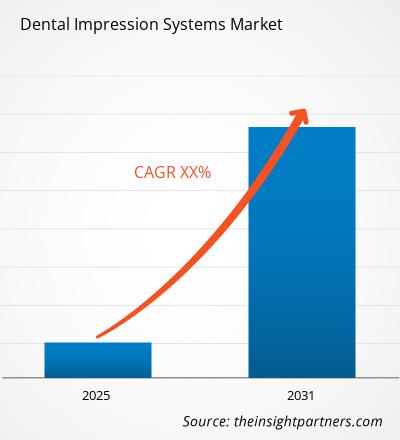
The Dental Impression Systems Market was valued at US$ 1.86 Billion in 2025 and is projected to reach US$ 3.84 Billion by 2034, registering a CAGR of 8.41% during 2026–2034. It includes not only traditional impression materials and trays but also modern intraoral scanning devices that help to create images of the dentition. The growth of the market is caused by the growing demand for restorations, orthodontic care, digitization of laboratories, as well as the transformation from traditional impressions into digital impressions.
North America is forecasted to grow at an estimated rate of 7.4%-8.0% CAGR up to 2034, which is possible due to the existing dental facilities and conversion of traditional impressions into intraoral scanning. Moreover, the Dental Impression Systems Market size depends on the presence of advanced dental laboratories, digital treatment planning, and purchases of multi-location dental practices and dental service organizations.
Dental Impression Systems Market Assessment and Insights
- North America: North America held an estimated 33–37% share in 2025 and is projected to grow at a 7.4–8.0% CAGR between 2026–2034, supported by mature restorative dentistry and rapid digital workflow adoption.
- US: The US represented an estimated 84–88% share of North America in 2025 and is expected to grow at a 7.5–8.1% CAGR during 2026–2034, led by scanner adoption.
- Europe: Europe accounted for an estimated 25–29% share in 2025 and is expected to grow at a 7.2–7.8% CAGR, with Germany, the UK, France, Italy, and Spain providing major demand.
- Asia Pacific: Asia Pacific represented an estimated 28–32% share in 2025 and is projected to expand at an 9.4–10.2% CAGR, led by China, Japan, South Korea, India, and Australia.
- Largest Segment: Impression Material held an estimated 52–56% market share in 2025 and is projected to grow at a 5.8–6.5% CAGR during 2026–2034, retaining volume leadership.
- High Growth Segment: Intraoral Scanners represented an estimated 27–31% market share in 2025 and are projected to grow at an 11.0–12.0% CAGR during 2026–2034, driven by digitization.
- Key companies analyzed in detail: Dentsply Sirona Inc., Envista Holdings Corporation, Henry Schein, Inc., Mitsui Chemicals, Inc., Kuraray Co., Ltd., COLTENE Holding AG, Keystone Industries, Kettenbach GmbH & Co. KG, Ultradent Products, Inc., Zest Dental Solutions, LLC, Ivoclar Vivadent AG, GC Corporation, BEGO GmbH & Co. KG, Septodont Holding, Parkell, Inc., DETAX GmbH, DMG America LLC, Premier Dental Products Company, and Kerr Corporation.
Source: The Insight Partners' analysis based on proprietary research, government publications, company annual reports, investor presentations, industry databases, and expert interviews.
The market is evolving from processes mainly involving elastomeric and alginate materials to hybrid processes that involve traditional materials and digital scanning. The intraoral scanner is now increasingly being used for capturing data, designing with CAD, communicating in the lab environment, as well as orthodontic planning and restoration. Connectivity through the cloud and smaller heads of the scanning equipment are other trends influencing equipment, even as traditional materials continue to play an important role where tactile control, minimal capital outlay, and laboratory expertise matter.
Future growth is best suited in markets where the development of the dental infrastructure is outpacing the adoption of digital equipment. There is significant scope for conversion in Asia Pacific, whereas North America and Europe will present possibilities for replacement and upgrades. Future buying decisions will take into account regulatory concerns on device safety, software connectivity, security, sterilization, and performance of materials.
Dental Impression Systems Market Report Scope
| Report Attribute | Details |
|---|---|
| Market size in 2025 | US$ 1.86 Billion |
| Market Size by 2034 | US$ 3.84 Billion |
| Global CAGR (2026 - 2034) | 8.41% |
| Historical Data | 2021-2024 |
| Forecast period | 2026-2034 |
Dental Impression Systems Market Analysis
The demand is driven by restoration and prosthodontics, orthodontic case volume, replacements, and laboratory production. The Dental Impression Systems Market development is enabled by high incidence of oral disease, as the World Health Organization estimates that oral diseases were affecting some 3.5 billion people worldwide, and untreated dental caries 2.5 billion.
The value chain comprises material producers, scanner makers, tray suppliers, distributors, dental offices, hospitals, laboratories, and software developers. Traditional impressions are characterized by material processing, choice of tray, disinfection, delivery, casting, and modeling. Digital impressioning involves combining several processes in one, thus shifting the focus to the hardware, software, service contracts, calibration, data processing, while keeping laboratories as important downstream users.
The increasing competitive intensity in the Dental Impression Systems Market Report is driven by hardware, consumable, workflow integration, and customer switching costs assessment. Dentsply Sirona Inc. integrates scanning capabilities with software, Envista Holdings Corporation offers a comprehensive range of dental technologies. Henry Schein, Inc. focuses on distribution and interoperability of devices, and therefore represents a distinct value proposition from material providers such as Kettenbach GmbH & Co. KG and DETAX GmbH.
Current investment areas include cloud-based scanning, open system architectures, artificial intelligence, and lab integration. Mitsui Chemicals, Inc., Kuraray Co., Ltd., COLTENE Holding AG, Ivoclar Vivadent AG, and GC Corporation are companies which provide capabilities related to material and digital dentistry, whereas Ultradent Products, Inc., Zest Dental Solutions, LLC, and Keystone Industries cater for clinical needs. Competition is becoming dependent upon workflows instead of standalone products.
● REPORT CUSTOMIZATION
Tailor This Report To Align With Your Specific Business Requirements
This report can be customized to align precisely with your business objectives, scope, and target markets. Customization options include tailored segmentation, geography, competitive analysis, and strategic insights to support informed decision-making.
Customize This Report →WHAT YOU CAN ADJUST
- ● Segmentations
- ● Geography
- ● Competitive Analysis
- ● Language Preferences
Dental Impression Systems Market: Strategic Insights

Regional Insights
North America Dental Impression Systems Market
North America is predicted to have a market share of 33–37% in 2025 and is expected to exhibit a growth rate of 7.4–8.0% CAGR during the forecast period up until 2034. North America has well-developed dental practices, specialty availability, laboratory facilities, distributor networks, and relatively high adoption of digital treatment planning technologies. The United States leads demand in the region, whereas Canada contributes through private dentistry practices and laboratory digitization. Dental service organizations help standardize the process of technology acquisition.
North America Dental Impression Systems Market Share are a result of both traditional consumables demand and scanner adoption. Dentist laboratories can now receive digital files directly from clinics, eliminating the need to transport physical models. There is also a demand for scanners because of integration with restorative, orthodontic, and implant cases. Competitive advantages are provided by software compatibility, education, ergonomics, serviceability, and financing, whereas traditional impression materials are important for budget-sensitive dentists and processes that rely on physical workflows.
U.S. Dental Impression Systems Market
The US is expected to capture 84-88% of North American revenue by 2025 and is forecasted to witness a CAGR of 7.5-8.1% from 2025 to 2034. Factors contributing to growth include the presence of extensive dental practice networks, labs with specialists, private insurance, and large investment capabilities. Digital impressions are most prevalent when practices can use scanners in association with CAD/CAM restoration, orthodontic treatment planning, laboratory order, and patient communications.
Leading competitors Dentsply Sirona Inc., Envista Holdings Corporation, Henry Schein, Inc. and others have been competing in equipment, software, materials, and logistics sectors. Demand is focused on applications in restorative and prosthodontic dentistry, while orthodontics is the important digital scanning application. Additionally, the US market represents the environment for testing cloud-enabled work flows and interoperability. Practices are increasingly looking for technologies which allow them to connect with different vendors.
Europe Dental Impression Systems Market
Europe will contribute to a 25-29% share in 2025 and is projected to have a 7.2-7.8% CAGR up to 2034. Germany is expected to be a leader driven by developed laboratories, dental industry, speciality dentistry, and active engagement in the digital process. The UK, France, Italy, and Spain are other demand centers through private dental services, restoration, orthodontics, and digitization of dental laboratories.
Germany features well-developed manufacturing and laboratory capacities that provide good conditions for the adoption of scanners, CAD/CAM systems, and high-quality impression materials. In the UK, digital coordination of restorative and orthodontic processes is preferred, whereas in France there is a developed clinical infrastructure coupled with higher technology adoption rates. In Italy and Spain, the contribution will be provided through private dentistry, dental tourism, laboratory modernization, and digital impressions.
APAC Dental Impression Systems Market
The APAC region has been assessed to have a 28–32% market share in 2025 and is expected to witness growth in the 9.4–10.2% CAGR until 2034, which makes it the fastest-growing region among all the regions. China accounts for the largest regional scale, after which comes Japan, South Korea, India, and Australia. The growing dental infrastructure, increased patient awareness, lab automation, and availability of digital equipment drive adoption.
In China, manufacturing as well as large processes can be provided, but in Japan, there is development in terms of restoration and workflow needs. In South Korea, there is capability in dental technology, and in India, there is capability in terms of conversion to workflow, while in Australia, there is adoption of digital equipment. The growth in industrialization and modernization in healthcare will facilitate adoption of scanners.
Middle East & Africa Dental Impression Systems Market
The Middle East and Africa region is expected to experience a 7.0%-7.6% CAGR until 2034, with demand dominated by Saudi Arabia, followed by the UAE and South Africa. Healthcare infrastructure investments, development of private dentistry, medical tourism and urbanization are driving the adoption of more sophisticated impression technologies. RoMEA is under-penetrated but represents a good long-term prospect as the number of specialists grows.
Gulf countries have energy-related capacity to invest in healthcare and well-equipped private healthcare facilities. The UAE capitalizes on the influx of foreign patients, whereas Saudi Arabia is increasing its healthcare facilities. South Africa boasts a developed lab and clinic infrastructure. Affordability issues, lack of specialists, and varying regulatory systems limit the adoption rate; distributor quality and local services are key selection factors.
Segmentation Analysis
Product
The Product segment is expected to register a 7.7–8.4% CAGR during 2026–2034. Product dynamics increasingly reflect coexistence between established materials and rapidly expanding digital scanners. Conventional systems retain advantages in acquisition cost and procedural familiarity, while scanners gain value through faster communication, repeatability, digital storage, and direct integration with laboratory production. This creates a gradual migration rather than immediate replacement.
- Impression Material: Impression materials retain a broad installed base because they support familiar chairside protocols, multiple restorative indications, and laboratory procedures without requiring significant equipment investment.
- Intraoral Scanners: Intraoral scanners are strategically important for digital transformation, enabling direct three-dimensional capture, electronic case transfer, and integration with CAD/CAM and orthodontic planning workflows.
- Trays: Trays remain necessary for conventional impression procedures and are selected according to arch size, material characteristics, clinical indication, and compatibility with established impression techniques.
Application
The Application segment is projected to grow at an 8.0–8.7% CAGR through 2034. Restorative and prosthodontic dentistry remains the larger application base because impressions support crowns, bridges, dentures, and related procedures. Orthodontics is becoming increasingly digital, particularly as scanners enable virtual models, treatment simulation, aligner planning, and easier patient communication.
- Restorative and Prosthodontics Dentistry: This application remains central because accurate anatomical capture supports crowns, bridges, dentures, implants, and complex restorative planning across diverse clinical settings.
- Orthodontics: Orthodontic workflows increasingly favor digital capture because virtual models can support treatment planning, monitoring, aligner workflows, patient visualization, and electronic laboratory communication.
End User
The End User segment is expected to expand at a 7.8–8.5% CAGR during 2026–2034. Dental laboratories remain influential because they receive impressions or digital files and convert anatomical information into restorative or orthodontic outputs. Hospitals provide institutional demand, while forensic laboratories represent a specialized application requiring accurate anatomical records and dependable documentation.
- Hospitals: Hospitals use impression systems within restorative, oral surgery, maxillofacial, and multidisciplinary dental workflows, particularly where specialized clinical infrastructure supports complex cases.
- Dental Laboratories: Dental laboratories are central to digital conversion because they receive scan files, design restorations, manufacture prostheses, and increasingly connect directly with clinics through integrated platforms.
- Forensic Laboratories: Forensic laboratories use dental records and physical or digital impressions for identification and documentation, creating specialized demand based on case requirements rather than routine procedure volume.
Opportunity Snapshot
| End User | Revenue Contribution (High/Medium/Low) | Trend Tag | Adoption Stage |
|---|---|---|---|
| Hospitals | Medium | Digital Capture | Scaling |
| Dental Laboratories | High | CAD Integration | Mature |
| Forensic Laboratories | Low | Evidence Capture | Emerging |
Dental Impression Systems Market Growth Drivers and Impact Analysis
Digital Workflow Integration Is Reshaping Impression Acquisition
Cloud-connected scanners are changing the economics of impression acquisition by reducing physical handling between clinics and laboratories. Dentsply Sirona Inc. introduced Primescan 2 as a cloud-native scanner, while Henry Schein, Inc. launched LinkIt to connect practice-management systems with digital imaging, planning, and design platforms. These developments illustrate how value is moving from capture alone toward connected workflows. The commercial impact extends to laboratories because digital files can enter design and production processes without physical transport. Practices can also delegate scanning within teams and reuse digital records for consultations or treatment planning. As interoperability improves, purchasing decisions increasingly consider software ecosystems, data portability, service contracts, and workflow continuity alongside scanner accuracy.
Persistent Oral Disease Burden Supports Procedure Volumes
Underlying oral disease prevalence provides a durable demand base for dental diagnostic and restorative procedures. WHO reports that oral diseases affect approximately 3.5 billion people, with untreated caries affecting about 2.5 billion and severe periodontal disease affecting around 1 billion. Although these figures do not translate directly into impression-system purchases, they indicate a large population requiring assessment, restoration, replacement, or orthodontic intervention. The impact is strongest where dental infrastructure is expanding and patients move from emergency treatment toward planned restorative care. As treatment volumes rise, clinics require dependable impression materials, trays, and digital acquisition tools. Suppliers able to offer products across multiple price points can therefore address both established premium markets and developing healthcare systems.
Laboratory Digitization Raises Demand for Direct Digital Inputs
Dental laboratories are increasingly structured around digital design and manufacturing, increasing the value of electronically captured anatomy. Once scan data reaches a laboratory, it can support CAD design, virtual articulation, restoration planning, and automated production without the physical model transfer required by conventional impressions. This changes purchasing priorities for both clinics and laboratories. Clinics increasingly evaluate scanner compatibility with laboratory software, while laboratories prioritize file quality, open workflows, and reliable data transfer. The result is a network effect: greater laboratory digitization makes scanners more useful to clinics, and greater scanner adoption encourages laboratories to upgrade their production infrastructure. The commercial consequence is sustained investment in scanners, software, connectivity, training, and supporting digital services rather than hardware purchases alone.
Dental Impression Systems Market Future Trends
AI-Assisted Scan Quality and Automated Case Preparation
AI-assisted scanning is likely to become more important as vendors seek to reduce operator variability and shorten case-preparation time. Future systems may automatically identify missing anatomy, flag scan-quality defects, segment teeth and gingiva, and recommend rescanning before a case reaches the laboratory. This can reduce remakes and improve consistency, particularly for inexperienced operators. AI in the Dental Impression Systems Market Trends could also connect scanning with automated treatment visualization, orthodontic monitoring, and restorative design. Research published in 2026 demonstrates continued progress in automated dental scan segmentation and reconstruction, although clinical validation, standardized datasets, cybersecurity, and regulatory oversight remain necessary before broad autonomous use. The strategic opportunity therefore lies in assistive intelligence that improves clinician decisions rather than replacing professional judgment.
Open Architecture Will Become a Procurement Differentiator
Open architecture is expected to gain importance as practices attempt to avoid technology silos. Buyers increasingly want scanners, practice-management systems, CAD software, laboratories, and production equipment to exchange data without repeated manual entry. Henry Schein's LinkIt platform demonstrates this direction by connecting Dentrix with multiple digital imaging, planning, and design systems. Future competition may therefore shift toward ecosystem neutrality, application programming interfaces, standardized file formats, and secure cloud connectivity. Vendors with closed systems will need to justify switching costs through superior clinical functionality or workflow economics. Open platforms can also accelerate innovation because laboratories and third-party software providers can participate without replacing the entire installed technology base.
Dental Impression Systems Market Opportunities
Localized Scanner and Laboratory Ecosystems in Emerging Markets
Emerging economies present an opportunity to build localized digital dentistry ecosystems rather than simply importing individual scanners. Suppliers can combine competitively priced hardware with distributor training, laboratory partnerships, cloud services, financing, and locally supported software. India, China, Southeast Asia, and selected Middle Eastern markets are particularly relevant because dental infrastructure is expanding while digital penetration remains below mature-market levels. The Dental Impression Systems Market Forecasts should therefore consider ecosystem development rather than equipment sales alone. Local laboratories can act as adoption accelerators by receiving digital cases from multiple clinics and demonstrating the workflow benefits of scanning. Manufacturers that establish regional service capabilities, validated workflows, and affordable upgrade paths can lower adoption barriers while improving recurring software and consumables revenue.
Hybrid Impression Strategies Can Extend Market Reach
The continued relevance of conventional materials creates an opportunity for suppliers to pursue hybrid strategies instead of assuming immediate digital replacement. Practices often maintain physical impression capability for specific indications, backup procedures, training, or cost-sensitive cases while gradually adopting scanners for high-value restorative and orthodontic workflows. Manufacturers can serve this transition by linking material portfolios with digital laboratory services, scanning education, and interoperable workflow tools. Such positioning protects existing consumables revenue while creating pathways into higher-value digital products. Suppliers can also use data from recurring material purchases to identify practices approaching the economic threshold for scanner adoption. This creates a practical cross-selling model based on workflow maturity, clinical mix, laboratory connectivity, and investment capacity rather than generic technology promotion.
Recent Developments
- May 2026: Dentsply Sirona Inc. announced that Primescan 2 Cart received the 2026 iF Design Award for medical product design. The company highlighted its ergonomic design, wireless operation, portability, and integration with cloud-based digital workflows. The announcement also noted the company’s estimate that intraoral scanning had reached 25–30% adoption across dental practices worldwide.
- September 2025: Henry Schein, Inc. and Henry Schein One expanded LinkIt with an end-to-end prosthetic workflow, including custom nightguards initiated through Dentrix. The platform connects practice-management data with scanning and production workflows, reinforcing the company’s focus on open architecture and reducing repeated data entry across clinical and laboratory processes.
- March 2025: COLTENE Holding AG introduced six new solutions at IDS 2025 spanning infection control, endodontics, and restorative dentistry. The launches included products intended to improve clinical workflow efficiency, restorative procedures, and instrument sterilization, demonstrating continued investment in consumable and small-equipment innovation alongside the broader digitization of dental practices.
Frequently Asked Questions

- Comprehensive Market Sizing and Forecast Analysis
- Detailed Segmentation Analysis
- In-Depth Market Dynamics Assessment
- Regional and Country-Level Insights
- Competitive Landscape and Company Benchmarking
- Strategic Business Intelligence
Recent Reports
Testimonials

The Insight Partners' SCADA System Market report is comprehensive, with valuable insights on current trends and future forecasts. The team was highly professional, responsive, and supportive throughout. We are very satisfied and highly recommend their services.
RAN KEDEM Partner, Reali Technologies LTDs
I requested a report on a very specific software market and the team produced the report in a few days. The information was very relevant and well presented. I then requested some changes and additions to the report. The team was again very responsive and I got the final report in less than a week.
JEAN-HERVE JENN Chairman, Future Analytica
We worked with The Insight Partners for an important market study and forecast. They gave us clear insights into opportunities and risks, which helped shape our plans. Their research was easy to use and based on solid data. It helped us make smart, confident decisions. We highly recommend them.
PIYUSH NAGPAL Sr. Vice President, High Beam Global
The Insight Partners delivered insightful, well-structured market research with strong domain expertise. Their team was professional and responsive throughout. The user-friendly website made accessing industry reports seamless. We highly recommend them for reliable, high-quality research services
YUKIHIKO ADACHI CEO, Deep Blue, LLC.
This is the first time I have purchased a market report from The Insight Partners.While I was unsure at first, I visited their web site and felt more comfortable to take the risk and purchase a market report.I am completely satisfied with the quality of the report and customer service. I had several questions and comments with the initial report, but after a couple of dialogs over email with their analyst I believe I have a report that I can use as input to our strategic planning process.Thank you so much for taking the extra time and making this a positive experience.I will definitely recommend your service to others and you will be my first call when we need further market data.
JOHN SUZUKI President and Chief Executive Officer, Board Director, BK Technologies
I wish to appreciate your support and the professionalism you displayed in the course of attending to my request for information regarding to infectious disease IVD market in Nigeria. I appreciate your patience, your guidance, and the fact that you were willing to offer a discount, which eventually made it possible for us to close a deal. I look forward to engaging The Insight Partners in the future, all thanks to the impression you have created in me as a result of this first encounter.
DR CHIJIOKE ONYIA MANAGING DIRECTOR, PineCrest Healthcare Ltd.Reason to Buy
- Informed Decision-Making
- Understanding Market Dynamics
- Competitive Analysis
- Identifying Emerging Markets
- Customer Insights
- Market Forecasts
- Risk Mitigation
- Boosting Operational Efficiency
- Strategic Planning
- Investment Justification
- Tracking Industry Innovations
- Aligning with Regulatory Trends





 Get Free Sample for