
Dental Laboratory Composites Ovens Market Share, Growth & Forecast by 2034
Coverage: By Product (Muffle, Vacuum, Infrared, Microwave, Other); Application (Dental Laboratories, Scientific Research) , and Geography (North America, Europe, Asia Pacific, and South and Central America)
- Status : Data Released
- Report Code : TIPRE00025156
- Category : Life Sciences
- No. of Pages : 150
- Available Report Formats :


- Last update date : August 25, 2026


2025 Market Size
US$ 268.67 Mn
Base year value
2034 Forecast
US$ 406 Mn
Projected by 2034
CAGR 2026-2034
5.30 %
Growth rate
Addressable Market
US$ 3,158.33 Mn
(2026-2034)
The Dental Laboratory Composites Ovens Market is projected to reach US$ 406 Million by 2034 from US$ 268.67 Million in 2025, registering a CAGR of 5.30% during the forecast period. The factors that drive demand include the adoption of laboratory automation, advancements in restorative material technologies, accuracy in thermal processing, and the continuous shift towards digitally driven dental manufacturing facilities.
North America is anticipated to grow at a CAGR of 5.6-6.1% during 2026-2034. The Dental Laboratory Composites Ovens Market Size growth drivers include established dental laboratories, high adoption rates of CAD/CAM restorations, replacement of existing thermal technology and the need for repeatability of firing and curing processes.
Dental Laboratory Composites Ovens Market Assessment and Insights
- North America: North America is expected to account for a 31–35% share in 2025 and grow at a CAGR of 5.6–6.1% between 2026–2034, supported by mature laboratories, replacement cycles, digital workflows, and high-value restorative production.
- US: The US is estimated to represent 72–76% of North American demand in 2025 and grow at a CAGR of 5.7–6.2% between 2026–2034, supported by laboratory consolidation and technology upgrades.
- Europe: Europe is projected to hold a 27–31% share in 2025 and expand at a CAGR of 5.2–5.8% between 2026–2034, with Germany, Italy, France, the UK, and Spain supporting demand through established laboratory manufacturing.
- Asia Pacific: Asia Pacific is estimated at a 22–26% share in 2025 and is expected to grow at a CAGR of 6.0–6.7% between 2026–2034, led by China, Japan, India, South Korea, and Australia as laboratory capacity expands.
- Largest Segment: Muffle products are estimated to hold a 42–46% market share in 2025 and grow at a CAGR of 4.8–5.4% through 2034, reflecting broad laboratory applicability.
- High Growth Segment: Scientific Research applications are estimated at an 18–22% market share in 2025 and grow at a CAGR of 6.2–6.9%, supported by materials development and process validation.
- Key companies analyzed in detail: Kerr Corporation, Dentalfarm S.r.l., Ivoclar Vivadent AG, Nabertherm GmbH, REITEL Feinwerktechnik GmbH, ROKO, Shenpaz Dental, Tokmet, FRANCE-ETUVES, VITA Zahnfabrik H. Rauter GmbH & Co. KG.
Source: The Insight Partners' analysis based on proprietary research, government publications, company annual reports, investor presentations, industry databases, and expert interviews.
There is now an array of instruments, which varies from thermal ovens to more complicated devices with a concentration on temperature distribution, vacuum, energy, and repeatability. While muffle-type instruments remain essential for lab functions, vacuum and infrared models are used where there is need for greater accuracy. There is a move in manufacturing of such equipment towards modular electronic parts, interchangeable heaters, digital control panels, and compact size, which would allow equipment producers to cater both to centralized laboratories and technical labs.
The capital spending will concentrate on thermal processing and lab equipment connection in the coming years. Asian manufacturing centers will make the volume increase, while the key emphasis in Europe and North America will lie on lifecycle optimization, validation, and maintainability. The increased attention to electrical safety, materials compatibility, energy consumption, and documentation in regulations will make suppliers develop their monitoring and standardization procedures.
Dental Laboratory Composites Ovens Market Report Scope
| Report Attribute | Details |
|---|---|
| Market size in 2025 | US$ 268.67 Million |
| Market Size by 2034 | US$ 406 Million |
| Global CAGR (2026 - 2034) | 5.30% |
| Historical Data | 2021-2024 |
| Forecast period | 2026-2034 |
Dental Laboratory Composites Ovens Market Analysis
Market expansion in Dental Laboratory Composites Ovens market can be attributed to the increasing demand for thermal processing of dental restorative materials such as composites, ceramics, investment materials, and other laboratory materials. The procurement of such equipment involves the manufacturers, special distributors, services, and CAD/CAM suppliers. Consequently, the value chain encompasses heating elements, insulation, controller, vacuum system, software, consumables, installation, calibration, and maintenance services.
Factors affecting the demand in this market include throughput at the laboratory level. Large laboratories emphasize on chamber size, cycle repeatability, automation, and reliability, while small laboratories consider size, cost, and easy programming. The supply is relatively specialized due to the involvement of engineering in terms of thermal uniformity, temperature control, and material-specific programming. Increasing energy costs favor the development of more efficient heating profiles, stand-by controls, insulation improvement, and short cycle times.
Competitive positioning in the Dental Laboratory Composites Ovens Market Report merges thermal engineering with dental process expertise. Ivoclar Vivadent AG positions itself on the strength of its firing, pressing, and sintering capabilities, while Nabertherm GmbH relies on its furnace engineering, lab hardiness, and specialized dental configurations. REITEL Feinwerktechnik GmbH, Shenpaz Dental, Tokmet, and Dentalfarm S.r.l. respond to the needs of professional laboratories with specialized equipment lines and configurations.
Investment is being made in systems that include programmable control systems, rapid heating and cooling cycles, modularity of service, and compatibility with new dental materials. The Kerr Corporation adds additional restorative expertise to the mix, whereas VITA Zahnfabrik H. Rauter GmbH & Co. KG contributes by adding their own furnace and material systems to the mix. ROKO and FRANCE-ETUVES add additional specialist competition, leading to a market where reliability and support networks are almost as critical as equipment specifications.
● REPORT CUSTOMIZATION
Tailor This Report To Align With Your Specific Business Requirements
This report can be customized to align precisely with your business objectives, scope, and target markets. Customization options include tailored segmentation, geography, competitive analysis, and strategic insights to support informed decision-making.
Customize This Report →WHAT YOU CAN ADJUST
- ● Segmentations
- ● Geography
- ● Competitive Analysis
- ● Language Preferences
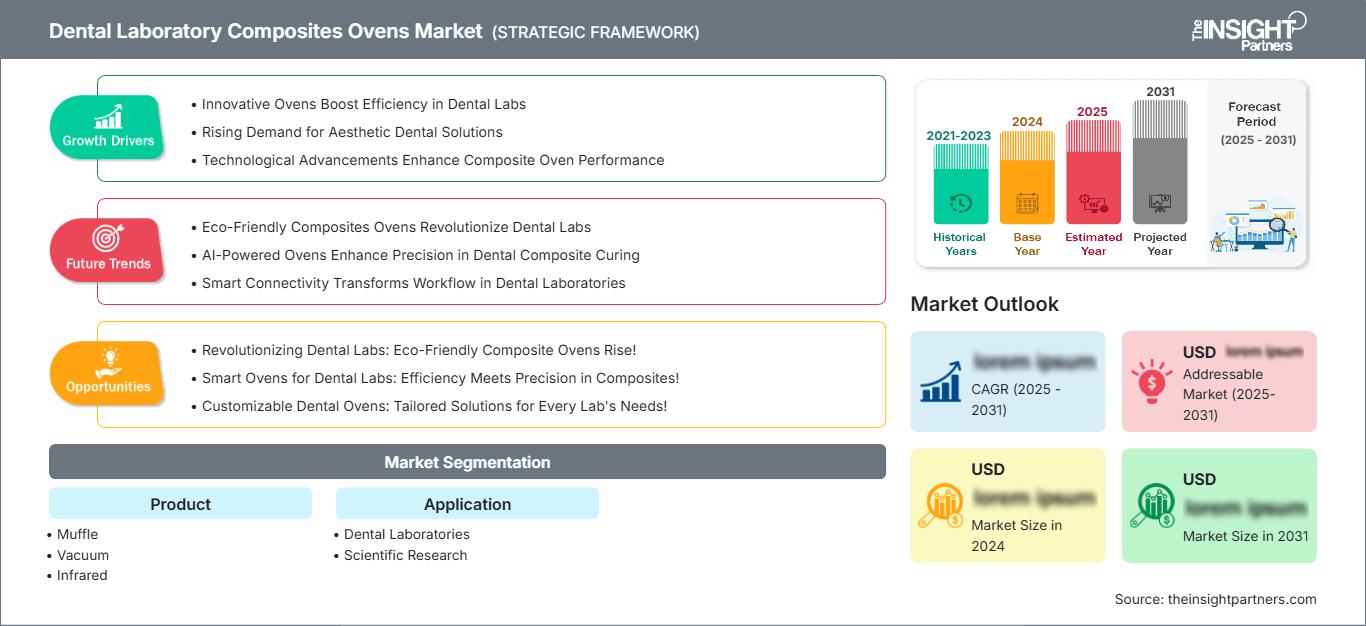
Dental Laboratory Composites Ovens Market: Strategic Insights
Regional Insights
North America Dental Laboratory Composites Ovens Market
North America will have a Dental Laboratory Composites Ovens Market share of 31–35% in global demand by 2025 and grow at a CAGR of 5.6-6.1% through 2034. The US leads regional demand as dental laboratories are integrating milling, printing, finishing, and thermal processes in standardized production cells. Canada contributes via specialized laboratories and research work from universities.
The structural demand is driven by consolidation of laboratories, upgrading of old ovens, and focus on consistent restorative results. Consumers have become aware of factors like energy efficiency, consistency in chambers, programable cycles, serviceability, and ability to handle newer dental materials. North America also has the advantage of an established distribution chain and high levels of available capital.
U.S. Dental Laboratory Composites Ovens Market
The US is estimated to represent 72–76% of North American demand in 2025 and grow at a CAGR of 5.7–6.2% during 2026–2034. Large commercial laboratories, dental service organizations, specialist laboratories, and educational institutions form the principal purchasing base. The market favors programmable equipment that can support repeatable processing across multiple technicians and production sites.
The application is moving toward devices which are compatible with digitally designed dental restorations and also require reduced manufacturing cycles. The suppliers like Kerr Corporation, Ivoclar Vivadent AG, Nabertherm GmbH, etc. operate in the market using the distribution network, laboratories, and technical support. The cost of ownership, preventive maintenance needs, temperature accuracy, and computerized operation are important factors considered while replacing existing machinery.
Europe Dental Laboratory Composites Ovens Market
In 2025, Europe will have a market share of 27–31%, which is projected to grow at a rate of 5.2–5.8% during 2024–2034, where Germany stands out as the major country market. This is thanks to the regional structure having clusters for manufacturing dental products, dedicated laboratories, good engineering skills, and the need for durable devices with documented performance processes.
In the UK, there is sustained demand for the product due to private laboratories, restorative dentistry, and research at universities. The emphasis while making purchases is on compact equipment that can be programmed easily. Germany is helped by the presence of a wide manufacturing base in dental technologies and laboratories. In France, Italy, and Spain, it is because of the already existing base for prosthetic production, laboratory upgrades, and digitally coordinated restorative procedures.
APAC Dental Laboratory Composites Ovens Market
APAC is estimated to account for a 22–26% share in 2025 and grow at a CAGR of 6.0–6.7%. China is the leading country, followed by Japan, South Korea, India, and Australia. Industrial expansion, laboratory outsourcing, dental tourism, and modernization of technical facilities support regional equipment demand.
China and India offer volume potential as laboratory capability increases, but Japan and South Korea focus on accuracy and reproducibility. Australia has its strengths in professional standards and laboratory capability upgrades. Investment in the healthcare system by government and digital dentistry by the private sector is slowly growing the addressable installed base.
Middle East & Africa Dental Laboratory Composites Ovens Market
MEA & Africa is forecast to grow with a CAGR of 5.8%-6.5% until 2034, where Saudi Arabia will be a notable market. The UAE market will benefit from investments in healthcare infrastructures and dental tourism, and South Africa will act as a good laboratory infrastructure provider and service center for the region.
Rest of MEA is more fragmented, where the purchasing will be driven by the access of distributors, economic benefits of imports, equipment durability, and technical assistance. Investments in the energy infrastructure will make laboratories more reliable, and investments in private healthcare facilities will allow introducing modern thermal equipment.
Segmentation Analysis
Product
The Product segment is expected to grow at a CAGR of 4.9–5.4% from 2026–2034. Demand is differentiated by heating mechanism, process requirements, chamber configuration, and laboratory throughput. Muffle systems retain broad adoption because of their familiar operating architecture, while vacuum, infrared, and microwave designs address more specialized requirements involving precision, speed, or process optimization. Product selection increasingly considers energy consumption and maintenance.
- Muffle: Muffle ovens maintain a strong position because enclosed heating chambers provide dependable thermal stability, broad material compatibility, straightforward operation, and established familiarity among dental technicians and laboratory managers.
- Vacuum: Vacuum ovens serve applications requiring controlled atmospheric conditions and consistent processing, making them strategically relevant where ceramic quality, oxidation control, and repeatability influence restoration outcomes.
- Infrared: Infrared systems attract laboratories seeking rapid, targeted heat transfer and improved process responsiveness, particularly where shorter cycles and direct temperature management can increase equipment utilization.
- Microwave: Microwave ovens represent a specialized technology pathway, with potential value where rapid volumetric heating and differentiated processing methods can reduce cycle duration or support experimental material development.
Application
The Application segment is projected to expand at a CAGR of 5.5–6.2% during 2026–2034. Dental Laboratories remain the principal commercial users because thermal equipment is directly linked to routine restorative manufacturing. Scientific Research applications provide a smaller but strategically important base, particularly for evaluating new composites, ceramics, processing profiles, and material performance under controlled laboratory conditions.
- Dental Laboratories: Dental laboratories represent the core demand base, requiring reliable daily operation, repeatable cycles, appropriate chamber capacity, and service support to maintain restoration throughput and quality consistency.
- Scientific Research: Scientific research facilities use specialized ovens for material characterization, process development, experimental formulations, and validation studies, creating demand for precise controls and adaptable operating parameters.
Opportunity Snapshot
| Application | Revenue Contribution | Trend Tag | Adoption Stage |
|---|---|---|---|
| Dental Laboratories | High | Cycle Control | Mature |
| Scientific Research | Low | Material Testing | Scaling |
Dental Laboratory Composites Ovens Market Growth Drivers and Impact Analysis
Expansion of Digitally Coordinated Dental Production
Digital dentistry is changing how laboratories organize restorative production, increasing the importance of thermal equipment that can operate predictably within multi-stage workflows. The American Dental Association continues to develop standards covering CAD/CAM terminology, accuracy, interoperability, and digitally manufactured dental products, reinforcing the need for process consistency. As digital design, milling, and printing become more integrated, ovens must accommodate standardized material programs and repeatable finishing cycles. The resulting impact is a gradual shift from standalone equipment purchases toward workflow-oriented investments. Manufacturers can capture this demand by improving programmable controls, data logging, connectivity, and material-specific profiles. Laboratories benefit through fewer process deviations, more consistent technician output, and improved scheduling of downstream finishing activities.
Rising Laboratory Throughput and Restoration Complexity
Growing restoration variety is increasing the number of thermal processing requirements within professional laboratories. Zirconia, lithium disilicate, veneering ceramics, composites, and hybrid restorative materials can require different heating, cooling, or atmospheric conditions. The WHO estimates that oral diseases affect nearly 3.7 billion people, maintaining a broad underlying need for restorative and preventive dental services. Although this burden does not directly translate into oven purchases, it supports long-term laboratory activity. Greater case complexity can increase the value of equipment capable of managing multiple programs and repeatable cycles. Manufacturers therefore gain opportunities to differentiate through chamber flexibility, programmable recipes, controlled cooling, rapid recovery, and service diagnostics rather than relying solely on maximum temperature specifications.
Energy Efficiency and Lifecycle Cost Optimization
Energy performance is becoming more relevant as dental laboratories evaluate equipment beyond initial acquisition cost. Thermal devices can operate repeatedly throughout the working day, making insulation quality, heating efficiency, standby consumption, cooling behavior, and maintenance requirements important components of total ownership cost. Manufacturers increasingly incorporate improved insulation, power-saving modes, efficient controllers, and optimized heating profiles. This creates a commercial incentive for laboratories to replace older units even when existing equipment remains operational. The impact is strongest among larger facilities where multiple ovens operate simultaneously and energy consumption accumulates across shifts. Suppliers that demonstrate measurable operating efficiency while maintaining thermal uniformity can strengthen replacement demand and create recurring opportunities for upgrades, controllers, heating components, calibration, and preventive maintenance.
Dental Laboratory Composites Ovens Market Future Trends
Connected Thermal Process Monitoring
Dental laboratories are likely to adopt more connected thermal equipment that records cycle parameters, operating conditions, maintenance events, and material-specific programs in the Dental Laboratory Composites Ovens Market Trends. Future systems should increasingly support secure data transfer between ovens and laboratory management environments, allowing technicians to document processing conditions without manual transcription. Connectivity can also enable remote diagnostics, software updates, usage analytics, and service scheduling. For multi-site laboratory groups, standardized digital profiles could help reproduce validated thermal procedures across facilities while reducing dependence on individual technician settings. Artificial intelligence may eventually assist with anomaly detection by identifying unusual temperature curves or heating behavior, although human oversight will remain necessary for quality assurance. Suppliers that combine connectivity with simple interfaces can address the operational gap between advanced functionality and everyday laboratory usability.
Lower-Carbon Thermal Processing Architectures
Environmental considerations are likely to influence the next generation of laboratory ovens through lower-energy heating elements, improved insulation, longer component life, and smarter standby operation. Procurement teams may increasingly assess equipment using lifecycle criteria rather than purchase price alone, particularly in laboratories operating several units across extended shifts. Future product development could include improved heat recovery, adaptive heating curves, automatic shutdown logic, and more precise cooling control. Manufacturers may also redesign replaceable components to extend service intervals and reduce equipment disposal. These changes would align thermal equipment with wider healthcare sustainability objectives while preserving process reliability. The commercial opportunity lies in demonstrating efficiency without sacrificing temperature stability, because laboratories cannot accept lower restoration quality simply to reduce energy consumption.
Dental Laboratory Composites Ovens Market Opportunities
Regional Manufacturing and Service Hubs in Asia
Asia offers manufacturers a combination of expanding dental laboratory capacity, developing healthcare infrastructure, and growing technical expertise. China and India are particularly relevant because domestic laboratory production can serve large patient populations while also supporting export-oriented dental manufacturing. Companies seeking expansion can establish distributor partnerships, localized service centers, training programs, and regional spare-parts inventories rather than relying exclusively on cross-border sales. The Dental Laboratory Composites Ovens Market Forecasts should therefore consider service accessibility as a strategic variable alongside equipment pricing. Localization can shorten repair times, improve technician training, and strengthen confidence in higher-specification systems. Suppliers can also develop region-specific configurations that reflect voltage standards, laboratory footprints, purchasing budgets, and prevalent restorative materials.
Research Partnerships for Advanced Heating Technologies
Research institutions provide a route for testing emerging thermal architectures before broad commercial deployment. Partnerships with dental schools, materials laboratories, universities, and restorative manufacturers can support evaluation of infrared heating, microwave processing, advanced vacuum control, rapid thermal cycles, and new composite formulations. The opportunity is particularly relevant where laboratory ovens are used not only for routine production but also for experimental validation. The Dental Laboratory Composites Ovens Market Forecasts can incorporate a widening role for research-driven equipment development as restorative materials become more diverse. Vendors that create application laboratories or joint testing programs can generate technical evidence, refine operating profiles, and reduce adoption barriers. Such collaborations can also reveal future customer requirements earlier than conventional distributor feedback.
Recent Developments
- August 2025: VITA Zahnfabrik H. Rauter GmbH & Co. KG introduced the VITA vPad LITE and VITA vPad PRO control units for firing and sintering furnaces. The new controllers replace previous generations and add updated interfaces, programmable start functions, and expanded connection capabilities. Availability was announced for October 20, 2025, reinforcing the shift toward more digitally managed thermal workflows.
- March 2025: REITEL Feinwerktechnik GmbH participated in IDS 2025 in Cologne, reporting engagement with customers, new contacts, and partners around its laboratory equipment portfolio. The company highlighted the event's international reach, with more than 2,000 exhibitors and over 135,000 professional visitors, providing a major channel for product exposure and commercial discussions.
- June 2025: Ivoclar Vivadent AG promoted Programat furnace bundles combining firing or pressing furnaces with vacuum pumps, covering P310 G2, P510 G2, P710 G2, EP 3010 G2, EP 5010 G2, and S2 models. The initiative demonstrated continued commercial emphasis on integrated furnace configurations and coordinated laboratory equipment purchases.
Frequently Asked Questions

- Comprehensive Market Sizing and Forecast Analysis
- Detailed Segmentation Analysis
- In-Depth Market Dynamics Assessment
- Regional and Country-Level Insights
- Competitive Landscape and Company Benchmarking
- Strategic Business Intelligence
Recent Reports
Testimonials

The Insight Partners' SCADA System Market report is comprehensive, with valuable insights on current trends and future forecasts. The team was highly professional, responsive, and supportive throughout. We are very satisfied and highly recommend their services.
RAN KEDEM Partner, Reali Technologies LTDs
I requested a report on a very specific software market and the team produced the report in a few days. The information was very relevant and well presented. I then requested some changes and additions to the report. The team was again very responsive and I got the final report in less than a week.
JEAN-HERVE JENN Chairman, Future Analytica
We worked with The Insight Partners for an important market study and forecast. They gave us clear insights into opportunities and risks, which helped shape our plans. Their research was easy to use and based on solid data. It helped us make smart, confident decisions. We highly recommend them.
PIYUSH NAGPAL Sr. Vice President, High Beam Global
The Insight Partners delivered insightful, well-structured market research with strong domain expertise. Their team was professional and responsive throughout. The user-friendly website made accessing industry reports seamless. We highly recommend them for reliable, high-quality research services
YUKIHIKO ADACHI CEO, Deep Blue, LLC.
This is the first time I have purchased a market report from The Insight Partners.While I was unsure at first, I visited their web site and felt more comfortable to take the risk and purchase a market report.I am completely satisfied with the quality of the report and customer service. I had several questions and comments with the initial report, but after a couple of dialogs over email with their analyst I believe I have a report that I can use as input to our strategic planning process.Thank you so much for taking the extra time and making this a positive experience.I will definitely recommend your service to others and you will be my first call when we need further market data.
JOHN SUZUKI President and Chief Executive Officer, Board Director, BK Technologies
I wish to appreciate your support and the professionalism you displayed in the course of attending to my request for information regarding to infectious disease IVD market in Nigeria. I appreciate your patience, your guidance, and the fact that you were willing to offer a discount, which eventually made it possible for us to close a deal. I look forward to engaging The Insight Partners in the future, all thanks to the impression you have created in me as a result of this first encounter.
DR CHIJIOKE ONYIA MANAGING DIRECTOR, PineCrest Healthcare Ltd.Reason to Buy
- Informed Decision-Making
- Understanding Market Dynamics
- Competitive Analysis
- Identifying Emerging Markets
- Customer Insights
- Market Forecasts
- Risk Mitigation
- Boosting Operational Efficiency
- Strategic Planning
- Investment Justification
- Tracking Industry Innovations
- Aligning with Regulatory Trends





 Get Free Sample for