
Dental Laboratory Dust Suction Unit Market Size, Growth & Trends by 2034
Coverage: By Product (Mobile, Fixed); Application (Hospitals, Dental Clinics, Others), and Geography (North America, Europe, Asia Pacific, and South and Central America)
- Status : Data Released
- Report Code : TIPRE00013711
- Category : Life Sciences
- No. of Pages : 150
- Available Report Formats :


- Last update date : August 21, 2026


2025 Market Size
US$ 161.67 Mn
Base year value
2034 Forecast
US$ 272.91 Mn
Projected by 2034
CAGR 2026-2034
5.99 %
Growth rate
Addressable Market
US$ 1,968.27 Mn
(2026-2034)
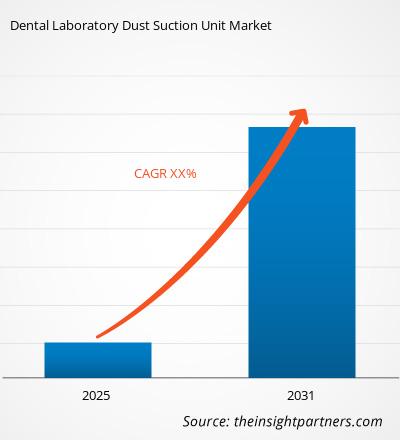
The Dental Laboratory Dust Suction Unit Market is positioned within the broader dental laboratory equipment ecosystem, with the market valued at US$ 161.67 Million in 2025 and projected to reach US$ 272.91 Million by 2034, reflecting a CAGR of 5.99% from 2026 to 2034. Demand is shaped by laboratory digitization, occupational dust-control requirements, equipment replacement cycles, and greater emphasis on cleaner, ergonomically designed production environments.
North American purchasing patterns indicate that Dental Laboratory Dust Suction Unit Market size is influenced by established dental laboratory infrastructure, replacement demand, and workplace exposure controls. The regional market is estimated to expand at a 5.7–6.2% CAGR during 2026–2034, supported by continued CAD/CAM adoption and stricter attention to source capture, filtration performance, noise reduction, and technician safety.
Dental Laboratory Dust Suction Unit Market Assessment and Insights
- North America: North America is expected to account for a 32–36% share in 2025 and expand at a 5.7–6.2% CAGR between 2026–2034, supported by mature laboratory networks, replacement demand, and occupational dust-control priorities.
- US: The US is expected to represent 82–86% of North America’s 2025 share and grow at a 5.6–6.1% CAGR between 2026–2034, led by established laboratories and equipment modernization.
- Europe: Europe is estimated to hold a 29–33% share in 2025 and grow at a 5.3–5.8% CAGR between 2026–2034. Germany, the UK, France, Italy, and Spain support demand through established laboratory manufacturing and quality-focused equipment procurement.
- Asia Pacific: Asia Pacific is estimated to command a 24–28% share in 2025 and register a 6.3–6.9% CAGR between 2026–2034. China, Japan, India, South Korea, and Australia are important markets as laboratory capacity and digital production expand.
- Largest Segment: Fixed systems represent the largest segment, with a 56–60% market share in 2025 and a 5.4–5.9% CAGR during 2026–2034, reflecting established laboratory installations.
- High Growth Segment: Mobile systems hold a 40–44% market share in 2025 and are projected to grow at a 6.7–7.2% CAGR during 2026–2034, supported by flexible workflows.
- Key companies analyzed in detail: 88Dent Lab and Clinical, Aixin Medical Equipment Co., Ltd., Erio S.r.l., Handler Manufacturing Company, Inc., Renfert GmbH, ROKO, Zubler Gerätebau GmbH, B and D Dental Technologies, CadBlu Dental, Cato Odontotecnica S.r.l.
Source: The Insight Partners' analysis based on proprietary research, government publications, company annual reports, investor presentations, industry databases, and expert interviews.
The Dental Laboratory Dust Suction Unit Market has seen the progression from rudimentary dust suctioning devices to dedicated equipment that integrates source capture, multiple stages of filtration, reduced noise generation, and better ergonomics. The design of products is more often than not taking into account the requirement of small size, replaceable filters, stable airflow, and compatibility with grinding, polishing, milling, and sandblasting stations.
For future growth opportunities, the market will need to focus more on newly developing centers for dental manufacturing where the lab modernization and digital dentistry adoption is going on simultaneously. Purchasing decisions will see more consideration of life cycle costs, filtration validation, energy consumption, and installation flexibility. The regulatory concerns around exposure, ventilation, and environmental management will further drive the investments in engineered dust control systems beyond PPEs.
Dental Laboratory Dust Suction Unit Market Report Scope
| Report Attribute | Details |
|---|---|
| Market size in 2025 | US$ 161.67 Million |
| Market Size by 2034 | US$ 272.91 Million |
| Global CAGR (2026 - 2034) | 5.99% |
| Historical Data | 2021-2024 |
| Forecast period | 2026-2034 |
Dental Laboratory Dust Suction Unit Market Analysis
The growth prospects for the Dental Laboratory Dust Suction Unit are based on the requirement to remove the particles produced from grinding, polishing, trimming, milling, and sandblasting. Dental laboratories are known to include suction units with benches, handpieces, model trimmers, blast equipment, and CAD/CAM equipment. The supply chain therefore includes motors, pumps, filters, hoses, separators, cabinets, control, distributors, installers, and maintenance service providers.
The supply side is increasingly inclined toward the provision of systems capable of handling different dust loads without impacting air flow and noise performance. CDC and NIOSH evaluations have revealed the risk of dust exposure during dental laboratory procedures, particularly when grinding and sandblasting. This has caused an increasing need for local exhaust ventilation and source capture systems. The competitive positioning of manufacturers relies on filterability, ease of service, motor life, compactness, and suitability to laboratory tables and manufacturing equipment.
The competitive positioning in the evaluation of the Dental Laboratory Dust Suction Unit Market Report has a highly fragmented structure in terms of existence of specialists in extracting machines alongside generalists in dental machines. Renfert GmbH competes in mobile and stationary extractors while Zubler Gerätebau GmbH competes in integrating the suction system with filtering and controlling systems. Handler Manufacturing Company, Inc. maintains a wide array of dental laboratory machines including dust extraction machines.
ROKO, Aixin Medical Equipment Co., Ltd. and Erio S.r.l. compete in terms of application-oriented configurations, whereas Cato Odontotecnica S.r.l. is entering the market with the help of specialized laboratory furniture and flow chart design. The investment focus is shifting toward compact designs, high-efficient and brushless motorization, electronic monitoring, filtration and modular installation. Small players have opportunities to differentiate themselves in terms of customization and after sales service.
● REPORT CUSTOMIZATION
Tailor This Report To Align With Your Specific Business Requirements
This report can be customized to align precisely with your business objectives, scope, and target markets. Customization options include tailored segmentation, geography, competitive analysis, and strategic insights to support informed decision-making.
Customize This Report →WHAT YOU CAN ADJUST
- ● Segmentations
- ● Geography
- ● Competitive Analysis
- ● Language Preferences
Dental Laboratory Dust Suction Unit Market: Strategic Insights

Regional Insights
North America Dental Laboratory Dust Suction Unit Market
The forecasted North America Dental Laboratory Dust Suction Unit Market size in 2025 is between 32-36%, with an anticipated growth rate of 5.7-6.2% CAGR over the period of 2034. The region has an advantage of mature dental laboratories, proven supply chains, and replacement demand for old extraction equipment. The US laboratories are the main market, while Canada has contribution in the form of specialized laboratories and institutional supply chains. Filtering ability, acoustics, availability of services, and digital compatibility of products are the most sought-after attributes.
Awareness about exposure control technologies is also higher in the region. Technicians working on grinding, polishing, casting, and sandblasting operations need localized extraction to minimize particulate exposure in the air. The United States holds 82-86% share in the North American region and is predicted to have a CAGR of 5.6-6.1%. The countries of Canada and Mexico offer smaller but developing markets.
U.S. Dental Laboratory Dust Suction Unit Market
The United States constitutes about 82–86% of North America’s 2025 market share and will grow with a 5.6–6.1% CAGR up to 2034. The demand comes primarily from commercial laboratories, specialty laboratories, dental laboratories in dental offices, and educational institutions. There are competitive companies such as Renfert GmbH and Handler Manufacturing Company, Inc. who compete based on mobile, bench-mounted, and centralized designs. Replacements remain significant since the equipment operates under continuous particulates loads.
There is an increasing trend of application towards extraction of particulates during grinding and finishing operations. Digital fabrication does not make it easy for adjustments to be done hence there is need for point of source capturing during milling, polishing, and finishing operations. The buyers also consider replacement of the filter, noise, access for maintenance, energy consumption, and compatibility with laboratory furniture.
Europe Dental Laboratory Dust Suction Unit Market
Europe is expected to account for a 29-33% share by 2025, growing at a 5.3-5.8% CAGR up to 2034, with Germany being the leading national market in terms of the market size. The UK and Germany are providing significant demand; however, France, Italy, and Spain have a good number of laboratory equipment ecosystems. In Europe, purchasing considerations focus on technical compatibility, safety of the staff, filtration efficacy, energy consumption, and longevity.
In the UK, there is a need for replacing old extraction units due to the presence of well-developed laboratory network and digitization of work processes. Germany has a developed infrastructure for the production of dental technologies. There is also an additional demand for the product in France, Italy, and Spain due to laboratories specializing in dentistry, educational programs in the field, and private practices.
APAC Dental Laboratory Dust Suction Unit Market
The APAC region is forecast to account for a 24-28% market share in 2025 and is expected to register the fastest growth rate of 6.3-6.9% CAGR over the period till 2034. China has been seen leading in terms of regional demand followed by Japan, India, South Korea, and Australia.
Factors such as industrial modernization, safety consciousness among technicians, and formation of well-organized dental laboratories have been seen playing important roles. While China has its own manufacturing capabilities and equipment consumption increasing, Japan focuses on precision and reliability, India and South Korea benefit due to increase in digital processes, and Australia has been seen sustaining in demand for compliant laboratories.
Middle East & Africa Dental Laboratory Dust Suction Unit Market
The forecasted growth rate for the MEA and Africa market for 2034 is expected to be a CAGR of 6.1-6.6%. The leading countries in terms of demand include Saudi Arabia and the UAE; factors contributing to this include investments in healthcare infrastructure, private dental clinics, and laboratories. The principal country in Africa includes South Africa, while RoMEA relies mainly on distributors.
Factors such as energy availability, laboratory infrastructure, and import logistics affect equipment selection. Users prefer serviceable and compact machines that can work well in varying facility settings. Dental centers in the region are developing new restorative techniques, which opens up potential markets for extraction equipment combined with milling, polishing, and laboratory machines.
Segmentation Analysis
Product
Product segmentation in the Dental Laboratory Dust Suction Unit Market distinguishes equipment according to installation flexibility and laboratory workflow requirements. The segment is projected to expand at a 5.5–6.2% CAGR during 2026–2034. Fixed systems remain important for established workstations, while mobile configurations address smaller laboratories, decentralized production, and applications requiring equipment movement between work areas. Procurement increasingly weighs footprint, filtration, maintenance, and connection requirements.
- Muffle configurations serve applications where contained thermal or processing environments require controlled extraction, supporting specialized laboratory workflows and localized equipment integration.
- Vacuum configurations provide direct particulate capture and remain relevant for grinding, polishing, and finishing processes where stable suction is required at the workstation.
- Infrared configurations support specialized heating-related laboratory processes where localized extraction can complement equipment operation and help maintain controlled working environments.
- Microwave configurations address specialized laboratory processing applications and can be integrated where controlled extraction requirements accompany compact equipment layouts.
Application
Application segmentation in the Dental Laboratory Dust Suction Unit Market is expected to grow at a 5.8–6.4% CAGR during 2026–2034. Dental laboratories remain the core demand base because grinding, polishing, trimming, and blasting generate recurring particulate loads. Hospitals increasingly require localized laboratory or prosthetic production capabilities, creating incremental demand for compact extraction equipment suited to controlled clinical environments.
- Hospitals represent a specialized application base where internal dental laboratories, prosthetic services, and controlled technical areas require compact extraction with predictable maintenance and straightforward integration.
- Dental Clinics provide expanding demand as chairside milling, finishing, denture adjustment, and small laboratory activities increasingly occur within practices rather than exclusively at centralized laboratories.
Opportunity Snapshot
| Application | Revenue Contribution | Trend Tag | Adoption Stage |
|---|---|---|---|
| Hospitals | Medium | Local Capture | Scaling |
| Dental Clinics | High | Mobile Extraction | Scaling |
Dental Laboratory Dust Suction Unit Market Growth Drivers and Impact Analysis
Increasing Focus on Source-Capture Workplace Controls
Exposure management is becoming a direct purchasing consideration because dental technicians can encounter respirable dust during grinding, sandblasting, polishing, and material handling. CDC and NIOSH guidance has emphasized local exhaust ventilation as an important engineering control for dental laboratory dust. This converts safety requirements into equipment specifications involving capture proximity, filtration, airflow stability, and maintenance access. The market impact extends beyond large laboratories because compact extraction systems can provide localized control without requiring complete facility redesign. Suppliers that demonstrate reliable filtration, accessible filter replacement, and compatibility with existing workstations can therefore compete on measurable operational performance rather than equipment price alone. Over time, this driver should favor engineered extraction systems over improvised vacuum arrangements.
Expansion of Digitally Enabled Dental Laboratory Production
CAD/CAM manufacturing is changing the distribution and intensity of particulate-generating tasks across dental laboratories. Milling zirconia, polymers, ceramics, and other materials creates dust during finishing even when digital design and automated manufacturing reduce manual production steps. As laboratories invest in mills, scanners, printers, and finishing stations, extraction systems increasingly become part of the equipment infrastructure rather than separate accessories. The market impact is particularly relevant for laboratories upgrading multiple workstations because centralized or coordinated suction can simplify installation and maintenance. Suppliers can benefit by developing extraction interfaces compatible with digital production equipment, standardized connection points, intelligent airflow control, and service alerts. This driver supports demand for both fixed systems and mobile units used around decentralized finishing tasks.
Growth of In-House Laboratory and Chairside Technical Workflows
Dental practices are gradually performing more technical procedures internally, including finishing temporary restorations, adjusting appliances, and operating compact milling or printing systems. This trend creates a different equipment requirement from traditional large laboratories because space, noise, portability, and ease of cleaning become more important. Mobile extraction systems can address these constraints by moving between rooms or workstations while providing localized dust capture. The commercial impact is an expansion of the addressable customer base beyond dedicated dental laboratories. Manufacturers can respond by reducing equipment footprints, simplifying controls, improving filtration, and integrating lighting or protective shields. Distributor strategies may also shift toward bundled workstation solutions, enabling suppliers to reach smaller practices that would not previously have purchased standalone laboratory extraction equipment.
Dental Laboratory Dust Suction Unit Market Future Trends
Connected Extraction and Predictive Filter Management
The Dental Laboratory Dust Suction Unit Market trends landscape is likely to move toward connected monitoring that provides operating-status information, filter-loading alerts, maintenance reminders, and airflow diagnostics. Sensors can help laboratories identify performance deterioration before dust capture becomes visibly inadequate, reducing unplanned downtime and improving technician safety. Mobile applications may allow service teams to review equipment status remotely and schedule maintenance according to actual operating conditions rather than fixed intervals. Future systems could also adapt suction intensity to workstation activity, reducing unnecessary energy consumption during idle periods. Integration with CAD/CAM equipment may further enable automated activation when milling or finishing begins. These capabilities would shift competitive differentiation toward software-enabled lifecycle management, particularly among laboratories operating multiple extraction points.
Low-Noise Modular Systems for Flexible Laboratory Layouts
Future demand is expected to favor modular extraction platforms that can be configured around changing laboratory layouts without extensive infrastructure modifications. Compact motors, improved acoustic insulation, efficient filtration, and flexible hose arrangements can enable installation in smaller rooms and decentralized production areas. Modular architecture may also allow laboratories to add extraction points as technician numbers or equipment fleets increase. Mobile systems are likely to benefit from battery operation, lightweight construction, integrated lighting, and compact protective shields, while fixed systems can evolve toward expandable multi-station configurations. This trend creates opportunities for manufacturers to design common platforms with interchangeable filtration, connection, and control modules. Such architectures can reduce product complexity while allowing customers to tailor equipment according to workspace size and dust intensity.
Dental Laboratory Dust Suction Unit Market Opportunities
Localized Solutions for Emerging Dental Production Centers
The Dental Laboratory Dust Suction Unit Market Forecasts outlook indicates an opportunity to target emerging laboratory clusters in Asia Pacific, the Middle East, and selected Latin American markets. These regions are expanding digital dental production while many facilities still operate with mixed-generation equipment. Suppliers can capture demand by offering compact systems that require limited installation work, tolerate variable operating environments, and have readily available replacement filters and components. Distributor partnerships can reduce service barriers and shorten procurement cycles. Localized product configurations should emphasize simple controls, multilingual documentation, voltage compatibility, and modular maintenance. Manufacturers that align extraction equipment with regional laboratory furniture, milling systems, and technical training programs can create broader workflow propositions without relying exclusively on large centralized laboratory customers.
Integrated Extraction Packages for Digital Workstations
Investment opportunities also exist in integrated workstation packages combining extraction, furniture, filtration, lighting, and equipment interfaces. The Dental Laboratory Dust Suction Unit scope is expanding as laboratories seek fewer disconnected components and more predictable installation outcomes. Manufacturers can collaborate with furniture suppliers, milling equipment providers, and laboratory designers to develop standardized configurations for common production tasks. Such packages can reduce installation complexity while improving airflow routing and ergonomic positioning. A modular commercial model could allow customers to begin with one workstation and add extraction points as capacity grows. Suppliers should prioritize serviceable filters, low-noise operation, connection standardization, and documented performance. This approach may be particularly effective among mid-sized laboratories balancing digital investment with limited floor space and constrained technical staffing.
Recent Developments
- April 2026: Renfert GmbH – Renfert expanded its dental laboratory workflow portfolio with Renfert Polish for 3D-printed materials and a complementary polishing kit. The development supports finishing workflows associated with digitally produced restorations and demonstrates continued movement toward integrated material-processing solutions around modern dental production environments.
- February 2025: Dürr Dental SE – Dürr Dental announced new suction and compressed-air solutions ahead of IDS 2025, including the Tyscor Tandem Flex, designed to provide scalable suction capacity as dental practices expand. The company positioned the system around flexibility, operational efficiency, and easier integration of additional capacity within growing practices.
- February 2025: Handler Manufacturing Company, Inc. – Handler published guidance emphasizing the role of dust collectors and splash hoods in dental laboratories, highlighting fine dust, debris, workplace safety, cleaner workspaces, and operating efficiency. The company also maintains a dedicated portfolio of dust collection equipment and accessories for laboratory applications.
Frequently Asked Questions

- Comprehensive Market Sizing and Forecast Analysis
- Detailed Segmentation Analysis
- In-Depth Market Dynamics Assessment
- Regional and Country-Level Insights
- Competitive Landscape and Company Benchmarking
- Strategic Business Intelligence
Recent Reports
Testimonials

The Insight Partners' SCADA System Market report is comprehensive, with valuable insights on current trends and future forecasts. The team was highly professional, responsive, and supportive throughout. We are very satisfied and highly recommend their services.
RAN KEDEM Partner, Reali Technologies LTDs
I requested a report on a very specific software market and the team produced the report in a few days. The information was very relevant and well presented. I then requested some changes and additions to the report. The team was again very responsive and I got the final report in less than a week.
JEAN-HERVE JENN Chairman, Future Analytica
We worked with The Insight Partners for an important market study and forecast. They gave us clear insights into opportunities and risks, which helped shape our plans. Their research was easy to use and based on solid data. It helped us make smart, confident decisions. We highly recommend them.
PIYUSH NAGPAL Sr. Vice President, High Beam Global
The Insight Partners delivered insightful, well-structured market research with strong domain expertise. Their team was professional and responsive throughout. The user-friendly website made accessing industry reports seamless. We highly recommend them for reliable, high-quality research services
YUKIHIKO ADACHI CEO, Deep Blue, LLC.
This is the first time I have purchased a market report from The Insight Partners.While I was unsure at first, I visited their web site and felt more comfortable to take the risk and purchase a market report.I am completely satisfied with the quality of the report and customer service. I had several questions and comments with the initial report, but after a couple of dialogs over email with their analyst I believe I have a report that I can use as input to our strategic planning process.Thank you so much for taking the extra time and making this a positive experience.I will definitely recommend your service to others and you will be my first call when we need further market data.
JOHN SUZUKI President and Chief Executive Officer, Board Director, BK Technologies
I wish to appreciate your support and the professionalism you displayed in the course of attending to my request for information regarding to infectious disease IVD market in Nigeria. I appreciate your patience, your guidance, and the fact that you were willing to offer a discount, which eventually made it possible for us to close a deal. I look forward to engaging The Insight Partners in the future, all thanks to the impression you have created in me as a result of this first encounter.
DR CHIJIOKE ONYIA MANAGING DIRECTOR, PineCrest Healthcare Ltd.Reason to Buy
- Informed Decision-Making
- Understanding Market Dynamics
- Competitive Analysis
- Identifying Emerging Markets
- Customer Insights
- Market Forecasts
- Risk Mitigation
- Boosting Operational Efficiency
- Strategic Planning
- Investment Justification
- Tracking Industry Innovations
- Aligning with Regulatory Trends





 Get Free Sample for