
Dental Laboratory Micromotor Market Share, Size & Demand by 2034
Coverage: By Type (Standard, Pedal-operated, Knee-operated); Application (Dental Laboratory, Hospital, Others), and Geography (North America, Europe, Asia Pacific, and South and Central America)
- Status : Data Released
- Report Code : TIPRE00017809
- Category : Life Sciences
- No. of Pages : 150
- Available Report Formats :


- Last update date : August 24, 2026


2025 Market Size
US$ 1.27 Bn
Base year value
2034 Forecast
US$ 2.56 Bn
Projected by 2034
CAGR 2026-2034
8.09 %
Growth rate
Addressable Market
US$ 17.21 Bn
(2026-2034)
The Dental Laboratory Micromotor Market is valued at US$ 1.27 Billion in 2025 and is projected to reach US$ 2.56 Billion by 2034, registering a CAGR of 8.09% during 2026–2034. Expansion reflects increasing demand for precise rotary equipment across dental laboratories and hospitals, supported by replacement cycles, laboratory modernization, ergonomic equipment requirements, and broader adoption of digitally enabled restorative workflows that require controlled finishing, polishing, cutting, and adjustment operations.
In North America, the Dental Laboratory Micromotor Market Size is expected to advance at an estimated 7.4–7.9% CAGR during 2026–2034. Structural growth is supported by laboratory consolidation, high equipment replacement standards, increasing utilization of electric rotary systems, and continued investment in restorative and prosthodontic workflows. The region also benefits from established distribution networks, technician specialization, and relatively high adoption of precision dental equipment.
Dental Laboratory Micromotor Market Assessment and Insights
- North America: North America is expected to hold a 34–38% share in 2025 and grow at a CAGR of 7.4–7.9% between 2026–2034, supported by established laboratories, equipment replacement demand, specialist technicians, and technology-oriented procurement practices.
- US: The US is estimated to represent 78–82% of North America's 2025 market and expand at a CAGR of 7.3–7.8% during 2026–2034, led by laboratory modernization and specialized restorative production.
- Europe: Europe is projected to account for a 28–32% share in 2025 and grow at a CAGR of 7.5–8.0% during 2026–2034, with Germany, the UK, France, Italy, and Spain providing established laboratory infrastructure and replacement demand.
- Asia Pacific: Asia Pacific is estimated at a 22–26% share in 2025 and is projected to grow at a CAGR of 9.0–9.6% during 2026–2034, with China, Japan, India, South Korea, and Australia supporting expansion.
- Largest Segment: Standard is expected to command a 55–60% market share in 2025 and register a CAGR of 7.4–7.9% during 2026–2034, reflecting broad applicability and established procurement patterns.
- High Growth Segment: Hospital application is expected to represent a 20–24% market share in 2025 and grow at a CAGR of 8.6–9.2% during 2026–2034, supported by specialized treatment infrastructure.
- Key companies analyzed in detail: Aseptico, Inc, BPR Swiss GmbH, DBI America Corp, DENTALEZ, Inc, DENTALFARM SRL, DIAGRAM srl, Dentflex, Esacrom S.R.L., Schick GmbH, Sirio Dental S.R.L.
Source: The Insight Partners' analysis based on proprietary research, government publications, company annual reports, investor presentations, industry databases, and expert interviews.
Production and technology innovation are increasingly based on compact electrical motors with speed variation, torque stabilization, vibration reduction, and increased hand piece adaptation. Laboratories are weighing capital costs against precision, thus pushing suppliers to compete on the basis of motor longevity, ergonomic design, maintainability, and foot control options. Consequently, the Dental Laboratory Micromotor Market is evolving from a basic function of rotating tools into tools designed for repeatable polishing operations and high volume use by technicians.
Further growth will be more substantial in emerging dental manufacturing industries in which laboratories upgrade their equipment away from labor-intensive operations. Specific investments in laboratory infrastructure, digital restoration fabrication, and technician training will help the adoption of micromotors. The regulatory focus on performance quality, electrical safety, sterilization compatibility, and traceability will also benefit manufacturers that can prove consistent performance throughout their international marketing channels and institutional purchasing programs.
Dental Laboratory Micromotor Market Report Scope
| Report Attribute | Details |
|---|---|
| Market size in 2025 | US$ 1.27 Billion |
| Market Size by 2034 | US$ 2.56 Billion |
| Global CAGR (2026 - 2034) | 8.09% |
| Historical Data | 2021-2024 |
| Forecast period | 2026-2034 |
Dental Laboratory Micromotor Market Analysis
Demand is also being driven by the necessity for controlled rotary performance in connection with crown adjustments, denture finishing, polishing, and other technician-dependent activities related to implants, among other applications. The projected growth rate of the Dental Laboratory Micromotor Market also indicates the greater burden that oral health care has according to the World Health Organization, which states that almost 3.7 billion people worldwide have oral diseases.
The industry consists of motor makers, handpiece makers, machine suppliers, laboratories, hospitals, technicians, service companies, and parts makers. Motors, bearings, electronics, shaft, foot switches, and proper handpieces make up the supply chain. Things to consider during the procurement process are total cost of ownership, reparability, noise, vibration, heat dissipation, and consistency of performance.
Competitive strategy encompasses laboratory specializations together with comprehensive dental equipment offerings. Aseptico, Inc and BPR Swiss GmbH concentrate on motorized and portable dental equipment, while DBI America Corp, DENTALEZ, Inc, and DENTALFARM SRL offer their products across the spectrum of equipment types and laboratory focused systems. DIAGRAM srl, Dentflex, Esacrom S.R.L., Schick GmbH, and Sirio Dental S.R.L. represent additional competition with specialist offerings across laboratory micromotors.
Increasingly, investment interest shifts toward precision engineering, miniaturization, ergonomics, and products that can be used in multiple applications. The analysis of the Dental Laboratory Micromotor Market Report reveals that firms that possess distribution, technical service, and availability of replacement parts can lower the risks associated with purchasing. Therefore, product differentiation is likely to rely on reliability of the product during its lifecycle, compatibility of accessories, training, and local support as much as on the motor.
● REPORT CUSTOMIZATION
Tailor This Report To Align With Your Specific Business Requirements
This report can be customized to align precisely with your business objectives, scope, and target markets. Customization options include tailored segmentation, geography, competitive analysis, and strategic insights to support informed decision-making.
Customize This Report →WHAT YOU CAN ADJUST
- ● Segmentations
- ● Geography
- ● Competitive Analysis
- ● Language Preferences
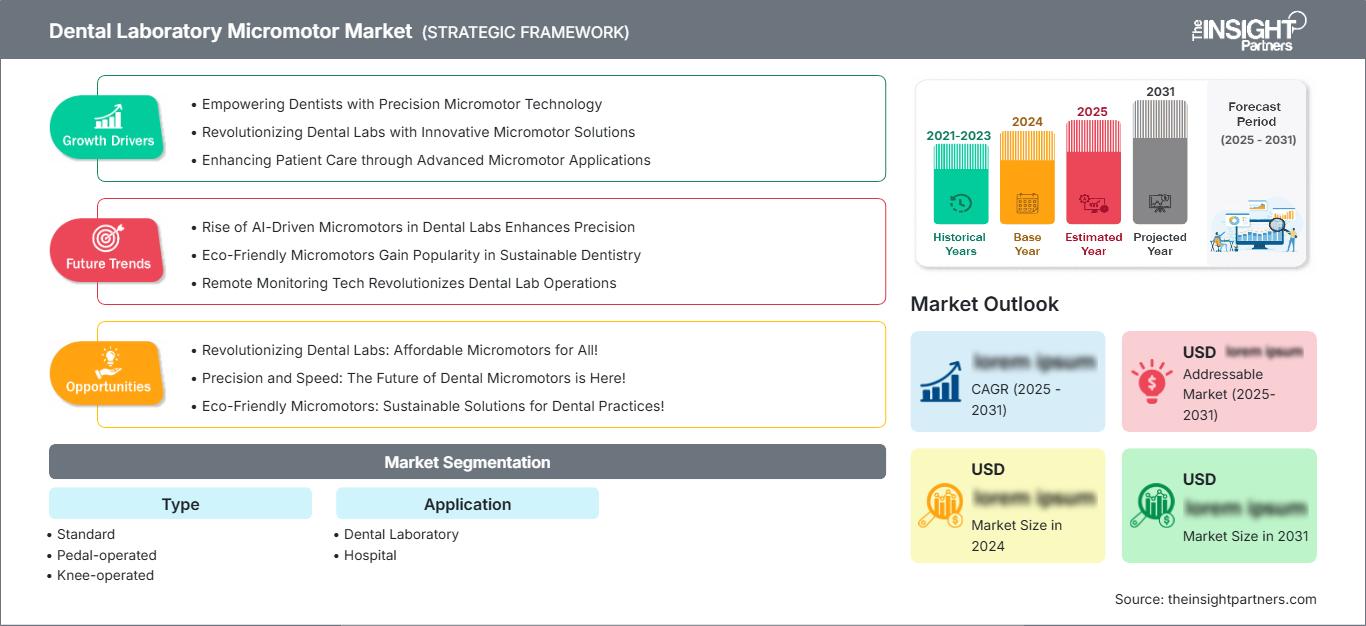
Dental Laboratory Micromotor Market: Strategic Insights
Regional Insights
North America Dental Laboratory Micromotor Market
The region North America will account for 34%–38% market share in 2025 and exhibit a CAGR of 7.4%–7.9% between 2026 and 2034. Dominated by the US market, this region is propelled by well-established dental laboratories, value-added restorative treatments, laboratory amalgamation, and periodic replacement of equipment. The Canadian and Mexican markets contribute in terms of specialization of laboratories and adoption of technology.
Greater attention is being paid to precision, reliability, ease of use, and service aspects in regional procurement. Laboratories that work on high volumes of crowns, bridges, dentures, and implants need precision and controlled finishing. Hospitals employ specialized units for which portability, control, and durability of equipment play roles in purchase decisions. Established vendors and distributors ensure greater access to motors, handpieces, spare parts, and after-sales service.
U.S. Dental Laboratory Micromotor Market
The United States is expected to contribute 78–82% of the North American total requirement in 2025 and will exhibit a CAGR of 7.3–7.8% up to 2034. Maturity of the laboratory segment, presence of specialty technicians, availability of dental equipment distribution channels, and high expectations regarding equipment reliability drive adoption. Key vendors with presence include Aseptico, Inc., DBI America Corp, DENTALEZ, Inc., and Schick GmbH.
Demand for the application exists in independent laboratories, laboratory groups, hospitals, and dental clinics. In laboratories, the key aspect concerns precision and efficient operations in the process of restoration finishing, whereas in hospitals, the important aspect is reliable equipment in dental institutions. The factors that have an effect on the replacement cycles include motor wear, control efficiency, maintenance cost, and compatibility with other handpieces.
Europe Dental Laboratory Micromotor Market
Europe is projected to represent a 28-32% share by 2025 with a growth rate of 7.5-8.0% CAGR. Germany is projected to be the largest market, driven by sophisticated laboratory manufacturing, established network of technicians, and robust equipment engineering skills. The UK also provides a significant demand base, while France, Italy, and Spain have an established application base in laboratories and hospitals.
The UK offers private dentistry along with laboratory outsourcing and special restorative procedures. The German market has sophisticated laboratory manufacturing tradition and high demand for high precision equipment. France, Italy, and Spain have been using the upgraded rotary system as their laboratories are upgrading their equipment due to ergonomics issues. Across the European region, decisions for purchase will be influenced by durability of the products, technical literature, serviceability, and laboratory compatibility.
APAC Dental Laboratory Micromotor Market
APAC is projected to represent 22–26% of global demand in 2025 and grow at a 9.0–9.6% CAGR, making it the fastest-growing major region. China is expected to lead, followed by Japan, India, South Korea, and Australia. Expanding dental service capacity, laboratory modernization, and increasing adoption of digitally supported restorative workflows are important demand factors.
Industrialization helps increase the availability of machinery locally, whereas modernization of the healthcare sector provides scope for investing capital. Dental laboratories can be developed in India and China, allowing access to competitively priced precision machinery. Reliability and performance form the focus in Japan and South Korea, whereas professional standards are advantageous for Australia.
Middle East & Africa Dental Laboratory Micromotor Market
The Middle East and Africa region is forecasted to grow at a CAGR of 8.0–8.6%. In this region, both Saudi Arabia and UAE will lead in terms of equipment demand. South Africa will continue to remain a significant market in Africa, whereas RoMEA is long-term due to dental infrastructure development. Hospital construction, private health care investment, dental tourism, and specialist clinics will drive equipment purchases.
Access to energy sources, reliance on imported equipment, and development of laboratory infrastructure impact purchasing decisions. Now, buyers prefer equipment that is reliable and easily maintainable. The UAE and Saudi Arabia are fortunate in having modern healthcare infrastructures and investments programs; meanwhile, South Africa is a professional market. Thus, growth in the region depends on infrastructure, distribution, technicians, and investments.
Segmentation Analysis
Type
Type is segmented into Standard, Pedal-operated, and Knee-operated systems. The segment is expected to grow at a CAGR of 7.7–8.1% during 2026–2034. Demand is shaped by workspace configuration, operator preference, control precision, laboratory throughput, and compatibility with existing equipment. Standard systems retain broad adoption, while alternative control formats address ergonomic and workflow-specific requirements.
- Standard: Standard systems remain widely applicable because they support conventional laboratory workflows and straightforward equipment integration. Their established operating format makes them relevant for replacement purchases, general finishing, polishing, and routine technician applications.
- Pedal-operated: Pedal-operated systems provide hands-free speed management and can improve workflow continuity during detailed laboratory procedures. Demand is supported by technicians seeking precise control while maintaining both hands on the workpiece.
- Knee-operated: Knee-operated configurations provide an alternative control method where bench layout and operator ergonomics favor lower-limb activation. Their strategic relevance is strongest in specialized workstations requiring flexible positioning and uninterrupted manual handling.
Application
Application comprises Dental Laboratory and Hospital settings. The segment is projected to expand at a CAGR of 8.0–8.4% during 2026–2034. Dental laboratories remain the principal demand center because micromotors are embedded in repeated fabrication and finishing activities. Hospitals represent a comparatively smaller but faster-growing opportunity as dental departments expand specialized services and upgrade technical infrastructure.
- Dental Laboratory: Dental laboratories generate recurring equipment demand because rotary systems support repeated fabrication, adjustment, finishing, and polishing tasks. Purchasing emphasizes durability, precision, serviceability, and compatibility with laboratory workstations and handpieces.
- Hospital: Hospitals use micromotor systems within specialized dental departments and procedural environments. Demand is influenced by infrastructure expansion, multidisciplinary treatment capacity, equipment standardization, infection-control requirements, and procurement policies favoring reliable clinical technology.
Opportunity Snapshot
| Application | Revenue Contribution (High/Medium/Low) | Trend Tag (MAX 2 words) | Adoption Stage (Emerging/Scaling/Mature) |
|---|---|---|---|
| Dental Laboratory | High | Lab Automation | Mature |
| Hospital | Medium | Clinical Expansion | Scaling |
Dental Laboratory Micromotor Market Growth Drivers and Impact Analysis
Expansion of Digital Restorative Workflows
The increasing use of digital scanning, CAD/CAM design, milling, and digitally planned restorative production is changing the precision requirements placed on laboratory equipment. FDI adopted a digital dentistry policy in 2025 covering scanners, CAD/CAM systems, electronic records, artificial intelligence, and related technologies. Although micromotors are not themselves digital systems, they remain important in post-milling adjustment, finishing, polishing, and manual refinement. This creates demand for equipment capable of stable torque and repeatable operation. Manufacturers can benefit by designing motors that fit digitally enabled workstations without compromising conventional laboratory functionality. The market impact is therefore strongest where digital workflows increase throughput while retaining manual finishing stages.
Growing Burden of Oral Disease and Restorative Treatment
The global burden of oral disease creates a structural foundation for continued dental treatment and laboratory activity. WHO reported in 2025 that oral diseases affect nearly 3.7 billion people, while untreated dental caries remains the most common health condition. Increased restorative treatment does not translate directly into proportional equipment purchases, but greater procedure volumes create recurring requirements for crowns, prostheses, dentures, and adjustments. Laboratories consequently need reliable rotary systems capable of sustained daily use. This driver particularly benefits replacement demand because worn motors can affect productivity, finishing consistency, and technician comfort. Suppliers that address reliability and maintenance requirements can capture expenditure associated with laboratory modernization and capacity expansion.
Demand for Ergonomic and Controlled Laboratory Equipment
Ergonomics is becoming a practical procurement consideration as dental technicians perform repetitive rotary procedures for extended periods. Motor vibration, acoustic output, control placement, handpiece weight, and activation method can influence operator comfort and workflow consistency. Pedal-operated and knee-operated configurations offer alternatives to conventional controls, allowing workstations to be adapted to individual preferences. The resulting demand is not limited to new laboratories because existing facilities can upgrade control systems during replacement cycles. Manufacturers that combine compact construction with stable speed regulation and accessible maintenance can improve product differentiation. Over time, ergonomic considerations may shift purchasing decisions from simple functional replacement toward equipment evaluated on productivity, operator fatigue, and total workflow suitability.
Dental Laboratory Micromotor Market Future Trends
Connected Motor Platforms and Condition Monitoring
Future systems in the Dental Laboratory Micromotor Market Trends are likely to incorporate greater electronic intelligence into motor controllers, enabling operating data, maintenance alerts, usage tracking, and fault diagnostics. Such capabilities could help laboratories move from reactive servicing toward scheduled maintenance based on operating conditions. Connected functionality may also support centralized equipment management in larger laboratory groups with multiple workstations. Integration with broader laboratory software remains technically challenging because micromotors operate within heterogeneous equipment environments. Consequently, early adoption is likely to favor modular systems that provide diagnostic value without requiring complete workstation replacement. Over time, data-enabled maintenance could become an important differentiator where laboratories prioritize uptime, asset utilization, and standardized service procedures across geographically distributed facilities.
Compact Precision Systems for High-Throughput Laboratories
Laboratory consolidation and increasing restoration volumes may encourage manufacturers to develop smaller, quieter, and more efficient motor platforms designed for continuous operation. Future equipment could combine higher torque stability with reduced heat generation, improved bearings, and refined vibration control. Compact systems can also help laboratories optimize workstation space as additional digital equipment enters the production environment. The resulting product architecture is likely to emphasize modular handpiece compatibility and simplified servicing. Rather than pursuing maximum speed alone, manufacturers may increasingly compete on controllability across operating ranges, thermal stability, and repeatability. This approach aligns equipment performance with the increasingly varied materials and finishing requirements encountered in modern restorative production.
Dental Laboratory Micromotor Market Opportunities
Localized Service and Replacement Ecosystems
Manufacturers can expand addressable revenue by developing localized service networks in emerging dental manufacturing markets. Equipment downtime can impose disproportionate costs on laboratories because a failed motor can interrupt several downstream finishing activities. Regional repair centers, stocked replacement components, preventive maintenance programs, and technician training can reduce operational risk while strengthening customer retention. The opportunity is particularly relevant in Asia Pacific, Latin America, and selected Middle Eastern markets where imported equipment may face longer service lead times. Suppliers can structure distributor agreements around measurable response times, spare-part availability, and technical certification. These capabilities may provide a competitive advantage even where competing products have similar basic motor specifications.
Application-Specific Motor Packages for Specialized Laboratories
An attractive investment opportunity lies in configuring motor systems around specific laboratory procedures rather than selling standardized hardware alone. Packages could combine motors, compatible handpieces, controls, accessories, and maintenance support for prosthodontic, implant, denture, or polishing workflows. Such configurations simplify procurement for laboratories while allowing manufacturers to communicate performance characteristics relevant to defined tasks. Hospitals could receive separate packages emphasizing reliability, cleaning requirements, and standardized equipment management. The Dental Laboratory Micromotor Market Forecasts therefore point toward greater segmentation by workflow and purchasing environment rather than only by motor architecture. Suppliers capable of tailoring bundles without creating excessive configuration complexity can address diverse laboratories while preserving manufacturing efficiency.
Recent Developments
- March 2026: Aseptico, Inc released its 2026 catalog, highlighting new wireless on/off and variable foot controls compatible with most Aseptico motors, alongside an EU MDR-certified AEU-350 GO portable system. The updates demonstrate continued investment in motor-control flexibility and broader international availability of portable dental equipment.
- February 2025: Aseptico, Inc announced that its AMC-15 Mobile Dental Cart was recognized as a Top Innovative Product for 2025 by Dentistry Today. The portable system provides dental equipment without external air or plumbing connections, illustrating continued development of flexible motorized equipment platforms for locations where conventional fixed infrastructure is impractical.
- February 2025: DENTALEZ, Inc published its 2025 equipment and utility catalog and subsequently maintained updated handpiece and equipment catalogs. The company's 2025 portfolio activity indicates continued product-line management across dental equipment categories, including handpieces and related systems used within professional dental environments.
Frequently Asked Questions

- Comprehensive Market Sizing and Forecast Analysis
- Detailed Segmentation Analysis
- In-Depth Market Dynamics Assessment
- Regional and Country-Level Insights
- Competitive Landscape and Company Benchmarking
- Strategic Business Intelligence
Recent Reports
Testimonials

The Insight Partners' SCADA System Market report is comprehensive, with valuable insights on current trends and future forecasts. The team was highly professional, responsive, and supportive throughout. We are very satisfied and highly recommend their services.
RAN KEDEM Partner, Reali Technologies LTDs
I requested a report on a very specific software market and the team produced the report in a few days. The information was very relevant and well presented. I then requested some changes and additions to the report. The team was again very responsive and I got the final report in less than a week.
JEAN-HERVE JENN Chairman, Future Analytica
We worked with The Insight Partners for an important market study and forecast. They gave us clear insights into opportunities and risks, which helped shape our plans. Their research was easy to use and based on solid data. It helped us make smart, confident decisions. We highly recommend them.
PIYUSH NAGPAL Sr. Vice President, High Beam Global
The Insight Partners delivered insightful, well-structured market research with strong domain expertise. Their team was professional and responsive throughout. The user-friendly website made accessing industry reports seamless. We highly recommend them for reliable, high-quality research services
YUKIHIKO ADACHI CEO, Deep Blue, LLC.
This is the first time I have purchased a market report from The Insight Partners.While I was unsure at first, I visited their web site and felt more comfortable to take the risk and purchase a market report.I am completely satisfied with the quality of the report and customer service. I had several questions and comments with the initial report, but after a couple of dialogs over email with their analyst I believe I have a report that I can use as input to our strategic planning process.Thank you so much for taking the extra time and making this a positive experience.I will definitely recommend your service to others and you will be my first call when we need further market data.
JOHN SUZUKI President and Chief Executive Officer, Board Director, BK Technologies
I wish to appreciate your support and the professionalism you displayed in the course of attending to my request for information regarding to infectious disease IVD market in Nigeria. I appreciate your patience, your guidance, and the fact that you were willing to offer a discount, which eventually made it possible for us to close a deal. I look forward to engaging The Insight Partners in the future, all thanks to the impression you have created in me as a result of this first encounter.
DR CHIJIOKE ONYIA MANAGING DIRECTOR, PineCrest Healthcare Ltd.Reason to Buy
- Informed Decision-Making
- Understanding Market Dynamics
- Competitive Analysis
- Identifying Emerging Markets
- Customer Insights
- Market Forecasts
- Risk Mitigation
- Boosting Operational Efficiency
- Strategic Planning
- Investment Justification
- Tracking Industry Innovations
- Aligning with Regulatory Trends





 Get Free Sample for