
Dental Laboratory Mixer Market Size, Trends & Demand by 2034
Coverage: By Type (Rotary, Vibrating); End User (Hospitals, Dental Clinics, Others); and Geography, and Geography (North America, Europe, Asia Pacific, and South and Central America)
- Status : Data Released
- Report Code : TIPRE00017810
- Category : Life Sciences
- No. of Pages : 150
- Available Report Formats :


- Last update date : August 27, 2026


2025 Market Size
US$ 1.32 Bn
Base year value
2034 Forecast
US$ 2.46 Bn
Projected by 2034
CAGR 2026-2034
7.14 %
Growth rate
Addressable Market
US$ 17.04 Bn
(2026-2034)
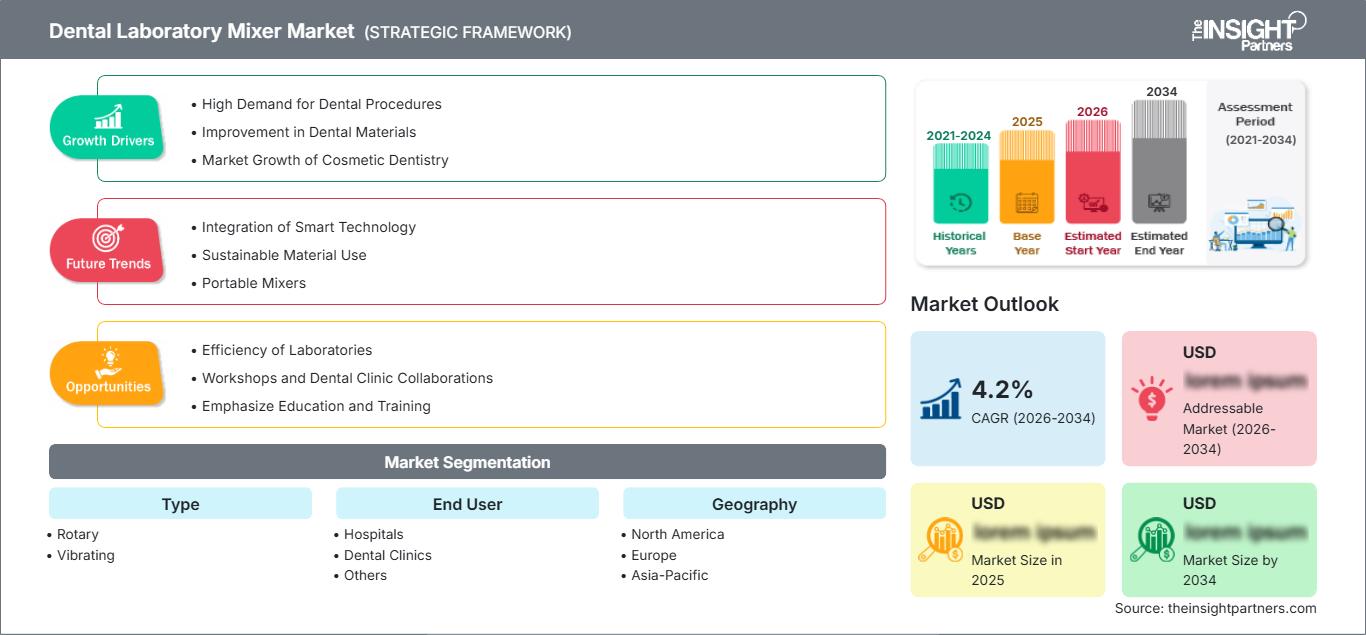
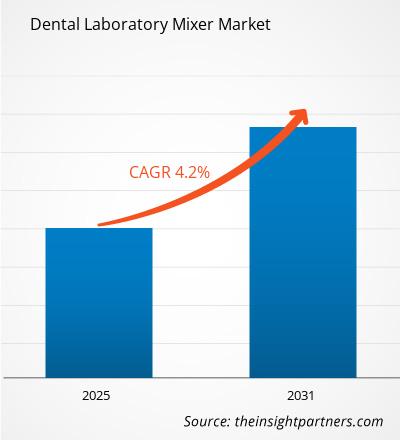
The Dental Laboratory Mixer Market was valued at US$ 1.32 Billion in 2025 and is projected to reach US$ 2.46 Billion by 2034, registering a CAGR of 7.14% during 2026–2034. Market development is supported by demand for controlled material preparation, reproducible laboratory workflows, and equipment that improves consistency across dental prosthetic manufacturing processes. Rotary and vibrating configurations address different laboratory requirements across hospitals, dental clinics, and other professional settings.
North America remains a structurally important geography, supported by established dental laboratories, high equipment replacement activity, and continued investment in workflow automation. The Dental Laboratory Mixer Market size in the region is influenced by demand for standardized mixing, labor efficiency, and integration with broader laboratory equipment systems. The regional outlook indicates a mid-single-digit expansion rate through 2034.
Dental Laboratory Mixer Market Assessment and Insights
- North America: The region maintains a leading position, supported by mature dental laboratory infrastructure and replacement demand. Its share in 2025 is estimated at 32–36%, with growth of 6.2–6.8% CAGR between 2026–2034.
- US: The US represents the dominant North American market, reflecting extensive laboratory capacity and established equipment adoption. It accounts for 82–86% of North America Dental Laboratory Mixer Market share in 2025, growing at 6.1–6.7% CAGR during 2026–2034.
- Europe: Germany, the UK, France, Italy, and Spain provide a broad installed base for laboratory equipment. Europe holds 27–31% share in 2025 and is projected to expand at 6.4–7.0% CAGR during 2026–2034.
- Asia Pacific: China, Japan, South Korea, and India support regional expansion through increasing dental service capacity and laboratory modernization. APAC represents 22–26% share in 2025, with 8.0–8.8% CAGR during 2026–2034.
- Largest Segment: Rotary mixers hold the leading position with a 58–62% market share in 2025 and a 6.8–7.3% CAGR during 2026–2034, reflecting broad laboratory applicability.
- High Growth Segment: Dental clinics represent a high-growth end-user category, with a 44–48% market share in 2025 and 7.6–8.2% CAGR during 2026–2034, supported by decentralized workflows.
- Key companies analyzed in detail: 3M ESPE, Aixin Medical Equipment Co., Ltd., Amann Girrbach AG, CARLO DE GIORGI S.R.L., DENSTAR CO., LTD., Dentalfarm S.r.l., DENTAMERICA INC., EMVAX, EUROCEM S.r.l., and TALLERES MESTRAITÚA, S.L.
Source: The Insight Partners' analysis based on proprietary research, government publications, company annual reports, investor presentations, industry databases, and expert interviews.
Dental Laboratory Mixer Market has transformed from manual control of material mixing to machinery that is focused on repeatability, vacuum mixing process, rotation control and integration into laboratory setup. Modern machinery has the ability to minimize differences in performance by an operator and provide for gypsum, investment, alginate, silicone and other materials. Design of modern products focuses on digital control, programmability, ergonomics and reduction in size due to need in predictable throughput.
In the future, usage will become more widespread in emerging economies that require dentistry services where there is growth of lab capacity and restorative/prosthetic treatments. Focus on quality, traceability and consistent production of devices is supposed to drive upgrading of less standard machines. Example of this policy trend is the European Commission's initiative to simplify medical device regulations and promote digitalization by 2025.
Dental Laboratory Mixer Market Report Scope
| Report Attribute | Details |
|---|---|
| Market size in 2025 | US$ 1.32 Billion |
| Market Size by 2034 | US$ 2.46 Billion |
| Global CAGR (2026 - 2034) | 7.14% |
| Historical Data | 2021-2024 |
| Forecast period | 2026-2034 |
Dental Laboratory Mixer Market Analysis
The demand for Dental Laboratory Mixer Market products is rooted in the necessity to ensure consistency in material properties along with minimizing the time involved and dependency on the operator. This means that market expansion is tightly connected to restorative dentistry, production of prosthesis, outsourcing and expansion of the in-house manufacture of dental products. Oral diseases are diagnosed in almost 3.7 billion people worldwide according to WHO, which highlights the need for prevention and restoration services.
This market consists of mixers producers, dental material producers, distributors, dental laboratories, clinics and hospitals and technical services. Producers compete through providing better performance, vacuum ability, size of the bowl, programmable controls, easy servicing and compatibility with dental materials. Supply conditions favor producers having distribution networks because dental laboratories value availability of equipment, technical support, ability to obtain spare parts and reliability more than low prices.
The Dental Laboratory Mixer Market analysis suggests that the market structure is fragmented and consists of diversified dental companies, as well as laboratory-equipment manufacturers. 3M ESPE focuses on automation of impression material mixing; Aixin Medical Equipment Co., Ltd., EUROCEM S.r.l., and TALLERES MESTRAITÚA, S.L. have lab-focused equipment portfolios. Amann Girrbach AG specializes in integrated digital dentistry solutions, which opens up possibilities for promotion of mixing along with laboratory production systems.
More money is invested into productivity of the workflow, instead of just functionality of individual machines. Positioning among competitors requires automation, compact design, repeatability of the process and integration with adjacent laboratory equipment. Renfert GmbH is not a part of the company list provided, however it is a good example of the wider range of laboratory equipment due to recent introductions of laboratory automation and digital production solutions.
● REPORT CUSTOMIZATION
Tailor This Report To Align With Your Specific Business Requirements
This report can be customized to align precisely with your business objectives, scope, and target markets. Customization options include tailored segmentation, geography, competitive analysis, and strategic insights to support informed decision-making.
Customize This Report →WHAT YOU CAN ADJUST
- ● Segmentations
- ● Geography
- ● Competitive Analysis
- ● Language Preferences
Dental Laboratory Mixer Market: Strategic Insights
Regional Insights
North America Dental Laboratory Mixer Market
North America accounted for an estimated 32–36% share in 2025 and is projected to expand at 6.2–6.8% CAGR through 2034. While the USA is the key driver for the regional demand, Canada is represented via dental laboratories, privately run clinics, and prosthetics manufacturers. Fully mature replacement cycles allow for the upgrading of equipment despite any fluctuations in volume of procedures.
The installed base in the region receives its share of benefits via professional standardization and reproducibility of the laboratory procedures. Statistics for the dental lab technicians employment in the USA reveal that there are 34,410 workers in 2025, which suggests that there is a highly skilled labor force requiring reliable equipment.
U.S. Dental Laboratory Mixer Market
The US represented approximately 82–86% of North America share in 2025 and is expected to record 6.1–6.7% CAGR through 2034. Demands are based on existing dental laboratories, private dental practices, prosthodontic services, and the need for periodic replacement of equipment. Increasingly, choices are made based on uniformity, cleaning, ergonomics, and compatibility.
Usage ranges from mixing of gypsums and investments to preparation of alginate and silicone materials. Data regarding oral health status in the US also indicate that a fifth of adults aged 20-64 years have an untreated cavity. This is indicative of the continuing need for restorative dentistry work and corresponding demands for laboratory equipment.
Europe Dental Laboratory Mixer Market
Europe represented 27–31% share in 2025, with 6.4–7.0% CAGR projected through 2034. Germany holds a leading position in the regional market due to its advanced manufacturing of dental technologies. The UK, France, Italy, and Spain present diversified demand for laboratory and clinical activities. The process of modernization of regulations and digital workflows facilitates the replacement process.
The UK is able to secure demand due to well-established private and state dental services, Germany thanks to its advanced skills in dental laboratory activities and equipment manufacturing, France and Italy for their combined advanced practices of prosthetics and specific manufacturers, while Spain is characterized by the expansion of its private dental services and laboratory activities. Economic situation of the region is varied according to IMF forecasts.
APAC Dental Laboratory Mixer Market
APAC held 22–26% share in 2025 and is expected to grow at 8.0–8.8% CAGR, making it the fastest-expanding major region. China is the largest regional demander, after which come Japan, South Korea, India, and Australia. This is attributed to laboratory expansions, increased restorative procedures access, and equipment upgrade.
The capacity of industry and healthcare policy developments are improving the addressable market base. In Singapore, for instance, there was an increase in the dental subsidy program and more than 900 private dental clinics through CHAS program.
Middle East & Africa Dental Laboratory Mixer Market
The Middle East and Africa region is projected to record 7.4–8.2% CAGR through 2034. Saudi Arabia and UAE dominate the regional opportunities, driven by infrastructure investments in healthcare sector, whereas South Africa offers laboratory expertise and a base for dental services. The demand for the rest of MEA is fragmented, with sensitivity to the cost of the equipment.
Revenues from energy sectors and infrastructure investments in the Gulf economies finance the investments into healthcare facilities, specialized clinics, and diagnostic centers. Saudi Arabia and UAE can be considered as centers of adoption, whereas South Africa will offer laboratory expertise and distribution across the region. The market development will depend on technicians, coverage, imports, and investments in healthcare sector.
Segmentation Analysis
Type
The Type segment is divided into Rotary and Vibrating configurations. The Dental Laboratory Mixer Market scope within this segment is shaped by material characteristics, laboratory throughput, required consistency, and equipment footprint. Rotary systems hold the leading position because they address diverse mixing requirements and can incorporate vacuum-assisted or programmable operation. The segment is projected to grow at 6.8–7.3% CAGR during 2026–2034.
- Rotary: Rotary mixers maintain broad laboratory acceptance because controlled rotational movement supports consistent blending of gypsum, investments, alginates, and related materials. Their adaptability makes them strategically important for laboratories seeking one platform across multiple preparation workflows.
- Vibrating: Vibrating mixers serve applications where controlled agitation assists material preparation and handling. Their relatively straightforward operating principle supports adoption in laboratories prioritizing practical equipment, compact installation, and specialized mixing requirements.
End User
The End User segment comprises Hospitals, Dental Clinics, and Others. The Dental Laboratory Mixer Market analysis across end users shows stronger expansion where restorative procedures are increasingly performed through decentralized or integrated care settings. Dental clinics are projected to grow at 7.6–8.2% CAGR during 2026–2034, supported by compact equipment requirements and expanding in-house workflows.
- Hospitals: Hospitals use laboratory mixers within dental departments, maxillofacial services, and specialized restorative workflows. Procurement decisions emphasize reliability, cleaning protocols, workflow standardization, and compatibility with institutional equipment-management procedures.
- Dental Clinics: Dental clinics increasingly require compact, efficient mixing solutions for in-house preparation and faster turnaround. Adoption supports decentralized production, reduces dependence on external laboratory steps, and improves control over routine restorative workflows.
- Others: This category encompasses additional professional settings outside hospitals and dental clinics. Its strategic relevance lies in specialized laboratory activities and institutional applications requiring dedicated equipment configurations.
Opportunity Snapshot
| End User | Revenue Contribution (High/Medium/Low) | Trend Tag (MAX 2 words) | Adoption Stage (Emerging/Scaling/Mature) |
|---|---|---|---|
| Hospitals | Medium | Institutional Workflow | Mature |
| Dental Clinics | High | In-house Mixing | Scaling |
| Others | Low | Specialized Labs | Emerging |
Dental Laboratory Mixer Market Growth Drivers and Impact Analysis
Expansion of Restorative and Prosthetic Treatment Capacity
The global burden of oral disease places an enduring need on the provision of equipment for treatment. According to the World Health Organization, there are about 3.7 billion people suffering from oral diseases, and untreated dental caries are the most prevalent health condition in its global burden of disease statistics. As dental care service networks increase, there is a need for laboratories to have equipment that allows consistent preparation of materials in a greater volume of cases. This becomes especially significant in developing countries where the modernization of laboratories may be connected with the development of new clinics, hospitals, and specialist centers. This trend makes it necessary for mixer manufacturers to provide reliable equipment.
Pressure to Reduce Operator Variability in Laboratory Preparation
Consistency has become a central procurement criterion as dental laboratories seek to reduce variation between technicians, shifts, and production batches. Automated mixing can regulate operating time, movement, vacuum conditions, and material handling more consistently than manual preparation. Zhermack's current equipment portfolio, for example, emphasizes standardized and reproducible mixing, while Renfert's laboratory systems highlight controlled vacuum mixing and parameter entry. The market impact extends beyond productivity because repeatability can reduce rework, material waste, and downstream corrections. Laboratories therefore increasingly evaluate mixers as process-control assets rather than simple mechanical devices, strengthening demand for programmable, ergonomic, and serviceable equipment.
Growth of Digitally Integrated Dental Production Workflows
Digital dentistry is changing the sequence through which laboratories capture, design, manufacture, and finish restorations. Amann Girrbach's portfolio illustrates the direction through integrated scanning, software, milling, materials, and workflow-management capabilities. Although mixing remains a physical process, its performance increasingly matters within a broader production chain where predictable intermediate steps support digital manufacturing. The impact is strongest among laboratories combining conventional material preparation with CAD/CAM, model production, and additive manufacturing. Suppliers that connect mixers with broader workflow requirements can strengthen customer retention, while buyers increasingly assess equipment according to interoperability, footprint, maintenance requirements, and overall process efficiency rather than mixing performance alone.
Dental Laboratory Mixer Market Future Trends
Increasing Adoption of Smart and Parameter-Controlled Mixing
The Dental Laboratory Mixer Market trends point toward greater use of digital controls, stored mixing parameters, programmable cycles, and operator-guidance features. Future equipment is likely to combine intuitive interfaces with sensors that monitor operating conditions and identify deviations before they affect material consistency. Connected diagnostics could also support preventive maintenance and remote service scheduling, reducing downtime for laboratories operating with tight production windows. Manufacturers may increasingly differentiate through software-assisted workflows rather than motor performance alone. Smaller clinics are likely to favor compact systems with simplified controls, while high-volume laboratories may prioritize programmable recipes, data logging, and automated material handling. These capabilities could make process standardization a measurable purchasing criterion.
Compact Equipment for Decentralized Laboratory Production
Decentralized dental production is expected to increase demand for compact equipment that can operate within dental clinics, satellite laboratories, and smaller professional facilities. The trend is supported by expanding digital workflows, shorter turnaround expectations, and pressure to retain selected production steps closer to the patient. Equipment manufacturers are likely to respond with smaller footprints, quieter operation, simplified cleaning, and flexible power configurations. Vacuum-assisted systems may remain important where material quality requires controlled processing. The strategic consequence is a widening addressable customer base beyond conventional laboratories. Suppliers capable of maintaining professional performance in compact formats can address clinics and smaller laboratories without requiring the infrastructure associated with large centralized production environments.
Dental Laboratory Mixer Market Opportunities
Localized Manufacturing and Distribution in Emerging Dental Economies
The Dental Laboratory Mixer Market Forecasts indicate an opportunity to establish localized manufacturing, assembly, distribution, and technical-support networks in high-growth dental economies. China, India, South Korea, and Southeast Asian markets combine expanding dental infrastructure with growing interest in laboratory modernization. Local partnerships can shorten delivery times, improve spare-parts availability, and reduce service barriers that often influence capital-equipment purchases. Manufacturers can also adapt product configurations to regional power standards, laboratory sizes, and purchasing constraints. The opportunity is particularly relevant for suppliers that already possess established equipment platforms but require stronger regional reach. Investment in training centers and distributor certification can further improve adoption by addressing technician familiarity and maintenance capability.
Integrated Equipment Bundles for Dental Clinics and Laboratories
A second opportunity lies in bundling mixers with complementary laboratory equipment, materials, service contracts, and workflow support. Buyers increasingly evaluate total process performance rather than individual machines, creating scope for suppliers to package mixing with model fabrication, curing, vacuum, finishing, or digital-production systems. Such bundles can simplify procurement for smaller clinics while creating recurring relationships through consumables and maintenance services. Manufacturers with broader portfolios can use this approach to increase equipment utilization and reduce customer switching. Specialized mixer companies can pursue partnerships with material suppliers, distributors, or digital-dentistry providers. The opportunity therefore favors commercially flexible strategies that connect equipment sales with training, service, replacement planning, and workflow optimization.
Recent Developments
- July 2026: Amann Girrbach AG announced the new Ceramill Therm CS furnace, expanding its laboratory technology portfolio with a system positioned around broader material-processing flexibility. The development reinforces the company's strategy of connecting equipment, materials, and digital laboratory workflows within a coordinated production environment.
- March 2026: Renfert GmbH introduced the POWER steamer 1 and POWER steamer 2 as a new generation of steam-cleaning units. The company positioned the products around reliability and laboratory workflow support, demonstrating continued equipment innovation across preparation and finishing activities used alongside dental laboratory production.
- June 2025: Amann Girrbach AG entered a distribution partnership with Henry Schein Dental Deutschland, making its complete portfolio available through the distributor in Germany. The arrangement covers materials, milling units, articulators, scanners, and software, strengthening access to integrated digital laboratory workflows.
Frequently Asked Questions

- Comprehensive Market Sizing and Forecast Analysis
- Detailed Segmentation Analysis
- In-Depth Market Dynamics Assessment
- Regional and Country-Level Insights
- Competitive Landscape and Company Benchmarking
- Strategic Business Intelligence
Recent Reports
Testimonials

The Insight Partners provided valuable market intelligence that supported our global go-to-market strategy. Their team was professional, responsive, and attentive to our feedback, providing thoughtful analysis and helpful methodological clarifications throughout the project.
Junmo Kim Chief Financial Officer (CFO), Enertech Co., Ltd.
The Insight Partners' SCADA System Market report is comprehensive, with valuable insights on current trends and future forecasts. The team was highly professional, responsive, and supportive throughout. We are very satisfied and highly recommend their services.
RAN KEDEM Partner, Reali Technologies LTDs
I requested a report on a very specific software market and the team produced the report in a few days. The information was very relevant and well presented. I then requested some changes and additions to the report. The team was again very responsive and I got the final report in less than a week.
JEAN-HERVE JENN Chairman, Future Analytica
We worked with The Insight Partners for an important market study and forecast. They gave us clear insights into opportunities and risks, which helped shape our plans. Their research was easy to use and based on solid data. It helped us make smart, confident decisions. We highly recommend them.
PIYUSH NAGPAL Sr. Vice President, High Beam Global
The Insight Partners delivered insightful, well-structured market research with strong domain expertise. Their team was professional and responsive throughout. The user-friendly website made accessing industry reports seamless. We highly recommend them for reliable, high-quality research services
YUKIHIKO ADACHI CEO, Deep Blue, LLC.
This is the first time I have purchased a market report from The Insight Partners.While I was unsure at first, I visited their web site and felt more comfortable to take the risk and purchase a market report.I am completely satisfied with the quality of the report and customer service. I had several questions and comments with the initial report, but after a couple of dialogs over email with their analyst I believe I have a report that I can use as input to our strategic planning process.Thank you so much for taking the extra time and making this a positive experience.I will definitely recommend your service to others and you will be my first call when we need further market data.
JOHN SUZUKI President and Chief Executive Officer, Board Director, BK Technologies
I wish to appreciate your support and the professionalism you displayed in the course of attending to my request for information regarding to infectious disease IVD market in Nigeria. I appreciate your patience, your guidance, and the fact that you were willing to offer a discount, which eventually made it possible for us to close a deal. I look forward to engaging The Insight Partners in the future, all thanks to the impression you have created in me as a result of this first encounter.
DR CHIJIOKE ONYIA MANAGING DIRECTOR, PineCrest Healthcare Ltd.Reason to Buy
- Informed Decision-Making
- Understanding Market Dynamics
- Competitive Analysis
- Identifying Emerging Markets
- Customer Insights
- Market Forecasts
- Risk Mitigation
- Boosting Operational Efficiency
- Strategic Planning
- Investment Justification
- Tracking Industry Innovations
- Aligning with Regulatory Trends





 Get Free Sample for