
Dental Laboratory Welders Market Share, Growth & Forecast by 2034
Coverage: by Type (Manual, and Automatic); Application (Cast Repairs, New Clasp Assembly, Loops and Posts for Implants, Wrought Wire Single-Arm Clasping, Crown and Bridge Cases, and Implant Restorations); End Use (Hospitals, Clinics, and Others), and Geography (North America, Europe, Asia Pacific, and South and Central America)
- Status : Data Released
- Report Code : TIPRE00023662
- Category : Life Sciences
- No. of Pages : 150
- Available Report Formats :


- Last update date : August 27, 2026


2025 Market Size
US$ 171.85 Mn
Base year value
2034 Forecast
US$ 323.18 Mn
Projected by 2034
CAGR 2026-2034
7.27 %
Growth rate
Addressable Market
US$ 2,233.00 Mn
(2026-2034)
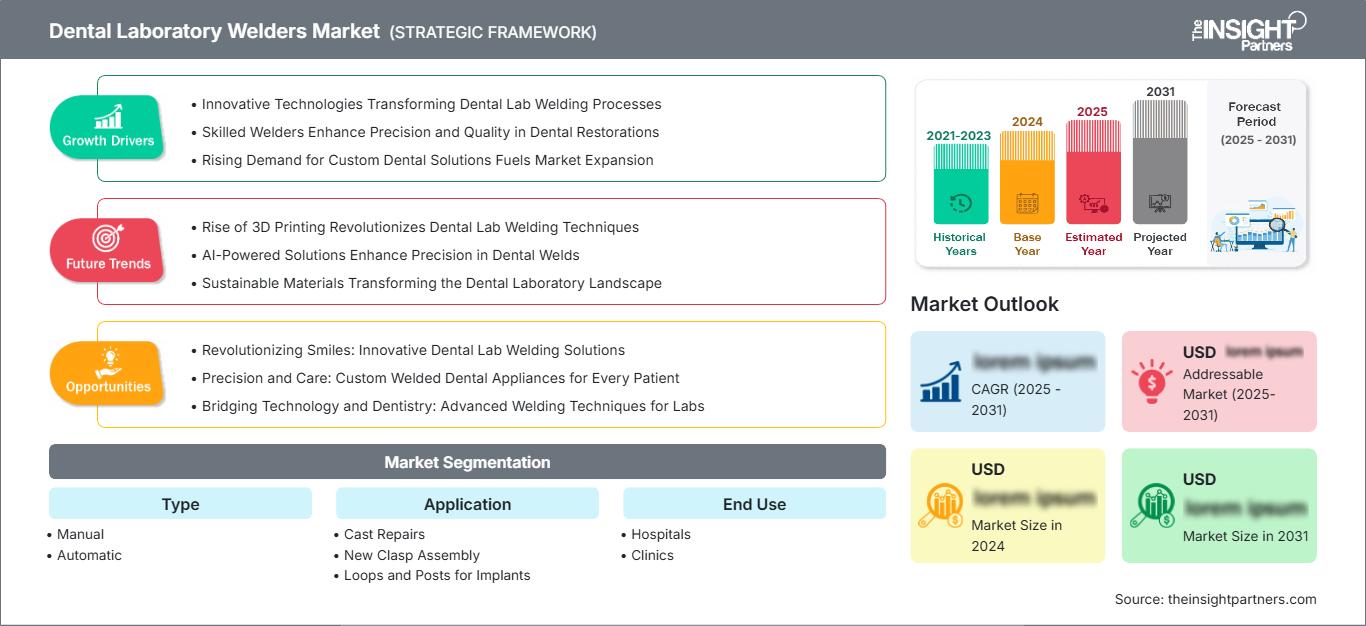
The Dental Laboratory Welders market was valued at US$ 171.85 million in 2025 and is expected to reach US$ 323.18 million by 2034; it is estimated to record a CAGR of 7.27% during 2026-2034.
Dental Laboratory Welders Market Assessment and Insights
- North America: North America held a 38–41% Dental Laboratory Welders Market share in 2025 and is projected to expand at 7.2–7.8% CAGR between 2026–2034, supported by mature laboratories, implant restoration activity, skilled technicians, and established equipment distribution.
- US: The US represented 77–80% of North America share in 2025 and is expected to grow at 7.1–7.7% CAGR during 2026–2034, led by advanced laboratories and implant-focused workflows.
- Europe: Germany, Italy, the UK, France, and Spain support a mature European base. Europe accounted for 29–32% share in 2025 and is expected to grow at 7.4–8.0% CAGR during 2026–2034, supported by precision manufacturing expertise and laboratory modernization.
- Asia Pacific: China, Japan, South Korea, and India are strengthening regional demand through laboratory expansion and digital dentistry adoption. APAC represented 22–25% share in 2025 and is forecast to grow at 9.0–9.7% CAGR during 2026–2034.
- Largest Segment: Manual systems held a 56–60% market share in 2025 and are projected to grow at 7.8–8.3% CAGR during 2026–2034, reflecting broad technician familiarity and flexible case handling.
- High Growth Segment: Implant Restorations represented a 22–26% market share in 2025 and are projected to expand at 9.1–9.8% CAGR during 2026–2034, driven by implant-supported prosthetic complexity.
- Key companies analyzed in detail: LaserStar Technologies Corporation, Sunstone Engineering LLC, Primotec USA, IPG Photonics Corporation, Maxphotonics Co., Ltd., Alpha Laser GmbH, ElettroLaser S.r.l., Orion, Dentalcompare, Micro Precision Welding, Vista Dental Products, Inc., and Schütz Dental GmbH.
Source: The Insight Partners' analysis based on proprietary research, government publications, company annual reports, investor presentations, industry databases, and expert interviews.
Innovations in Dental Laboratory Welders Market technology are moving devices from mere joining to controlled energy delivery, localized heating, better visualization, and specific application parameter controls. Laser technologies can be used in dental alloy welding in crown and bridge, implant, orthodontic, and removable appliances, whereas pulse-arc technologies will be more suitable for repair works in compact form. Modern technologies put focus on repeatability, ergonomics, and minimization of thermal distortion.
Further advancements are likely to be oriented toward the development of compact technologies, enhanced digital controls, and broader application in the newly emerging dental manufacturing facilities. Innovations in the regulatory landscape facilitate investments into equipment by promoting traceability, quality management, and safe use of technologies. The 2025 revision of EU legislation in the sphere of medical devices proposed by the European Commission aims at simplification, digitalization, and keeping patients’ safety standards.
Dental Laboratory Welders Market Report Scope
| Report Attribute | Details |
|---|---|
| Market size in 2025 | US$ 171.85 Million |
| Market Size by 2034 | US$ 323.18 Million |
| Global CAGR (2026 - 2034) | 7.27% |
| Historical Data | 2021-2024 |
| Forecast period | 2026-2034 |
Dental Laboratory Welders Market Analysis
Dental Laboratory Welders Market growth is directly dependent on restorative dentistry, implantology, production of orthodontic appliances, and repair of metallic prosthetic structures. Welding allows lab technicians to change or fix components without being limited to soldering and using localized energy to avoid undesirable thermal effects. LaserStar describes applications such as cast clasp joining, loops and posts, wrought-wire clasp work, implant bars, and bridgework.
The ecosystem consists of companies manufacturing dental welders, companies manufacturing lasers, optical components, dental alloy makers, distributors, labs, clinics, and services. Differentiation within the supply chain is based on pulse energy, beam manipulation, microscope system design, inert gas flow, automation, maintenance, and application training. The Primotec dental welding systems are an example of products focused on pulsed micro-arc technology and dental alloys compatibility.
Dental Laboratory Welders market research suggests a fragmented competition ranging from specialists in dental welding through laser technology providers. In this context, LaserStar Technologies Corporation and Sunstone Engineering LLC specialize in dental and micro-welding operations, whereas IPG Photonics Corporation produces highly advanced fiber lasers that can be used for welding. Schütz Dental GmbH offers both dental material, equipment, and laboratory digitization solution, placing the company in a wider workflow perspective.
The trend of investment now moves toward more compact workstations, controllable energy delivery, applications software, and equipment which is capable of working with different alloys or restorations. Sunstone Engineering LLC produces welding equipment under the Orion brand, whereas Alpha Laser GmbH produces flexible and mobile laser systems. The competitive advantage now depends on workflow value, technician assistance, training, services, and integration of welding process into the laboratory workflow.
● REPORT CUSTOMIZATION
Tailor This Report To Align With Your Specific Business Requirements
This report can be customized to align precisely with your business objectives, scope, and target markets. Customization options include tailored segmentation, geography, competitive analysis, and strategic insights to support informed decision-making.
Customize This Report →WHAT YOU CAN ADJUST
- ● Segmentations
- ● Geography
- ● Competitive Analysis
- ● Language Preferences
Dental Laboratory Welders Market: Strategic Insights
Regional Insights
North America Dental Laboratory Welders Market
North America accounted for 38–41% share in 2025 and is projected to grow at 7.2–7.8% CAGR through 2034. The United States leads regional demand, although Canada and Mexico contribute lesser but growing lab bases. Dental industry maturity, implant-supported restorations, and replacement needs ensure further investments in precise welding technology.
The regional labor force offers an essential operational base. In 2025, there were 34,410 dental laboratory technicians in the US based on statistics from Bureau of Labor Statistics. Dental laboratory technicians are employed in manufacturing and dental services industries. Existing distribution networks and technician expertise in laser and micro arc systems should drive adoption efforts.
U.S. Dental Laboratory Welders Market
The US represented 77–80% of North America share in 2025 and is forecast to expand at 7.1–7.7% CAGR through 2034. Demand will be created through the fabrication of implants, production of crowns and bridges, orthodontic appliances, and repairs in laboratories. High-end laboratories now consider factors like accuracy, versatility, safety, and training capabilities when evaluating machines.
The nation also has many dental laboratory technicians but the level of automation and digital production of devices is decreasing the reliance on manual production techniques. Employment of dental laboratory technicians is expected to fall from 35,200 in 2024 to 33,600 by 2034 according to the Bureau of Labor Statistics.
Europe Dental Laboratory Welders Market
Europe held 29–32% share in 2025 and is projected to record 7.4–8.0% CAGR through 2034. Germany is the number one country, followed by UK, Italy, France, and Spain. The market enjoys good infrastructure in terms of dental manufacturing, specialized laboratories, precision engineering knowledge, and requirement of long-lasting prosthetic constructs.
UK sustains the demand due to private dental services and outsourcing of laboratories, whereas Germany takes advantage of the good manufacturing infrastructure of dental technology. France has good clinical infrastructure and modernized laboratories, whereas Italy has expertise in dental devices and precision manufacturing. Spain is assisted by private dental network along with increasing implant-based procedures. European access to dental care is still not uniform with private spending being significant.
APAC Dental Laboratory Welders Market
APAC represented 22–25% share in 2025 and is expected to expand at 9.0–9.7% CAGR, the fastest rate among major regions. China leads regional demand, followed by Japan, South Korea, India, and Australia. Expanding dental laboratories and digital manufacturing support investment.
Industrial development, outsourcing, and broader access to restorative dentistry are strengthening the regional addressable base. WHO identifies oral disease as a major burden in Southeast Asia, with approximately 900 million cases reported across the region, reinforcing the need for expanded oral-health capacity.
Middle East & Africa Dental Laboratory Welders Market
Middle East and Africa demand is expected to grow at 8.0–8.7% CAGR through 2034. Saudi Arabia and the UAE lead regional adoption, followed by South Africa, while the Rest of MEA remains fragmented. Healthcare infrastructure investment and specialist dental-center development support capital-equipment demand.
Gulf markets benefit from substantial infrastructure spending and growing private healthcare capacity, while South Africa provides an established technical and laboratory base. Adoption depends on technician availability, imported-equipment economics, local service coverage, and investment in specialized restorative and implantology facilities. Suppliers with regional distributors and application-training capabilities are positioned to address these operating requirements.
Segmentation Analysis
Type
The Type segment comprises Manual and Automatic systems. Manual equipment remains important because technicians can directly control weld positioning, energy application, filler material, and restoration geometry. The Dental Laboratory Welders Market scope within this segment is therefore influenced by technician expertise and case diversity. Manual systems are projected to grow at 7.8–8.3% CAGR during 2026–2034.
- Manual: Manual welders maintain broad adoption because technicians can visually control intricate repairs and adapt parameters to individual restoration geometries. Their flexibility supports clasp repairs, implant frameworks, orthodontic components, and small-batch laboratory work.
- Automatic: Automatic systems support standardized production by controlling welding sequences, positioning, and repeatable parameters. Their strategic importance increases in high-volume laboratories seeking consistent output, reduced operator dependence, and integration with automated production environments.
Application
The Application segment includes Cast Repairs, New Clasp Assembly, Loops and Posts for Implants, Wrought Wire Single-Arm Clasping, Crown and Bridge Cases, and Implant Restorations. Demand varies according to restoration complexity, metal type, repair frequency, and laboratory specialization. Implant Restorations are projected to grow at 9.1–9.8% CAGR during 2026–2034.
- Cast Repairs: Cast repair applications remain a practical entry point because welding can restore damaged or modified components while limiting the need for complete remanufacture. Laboratories use these systems where repair turnaround and dimensional control are priorities.
- New Clasp Assembly: Clasp assembly requires localized joining and accurate positioning, making controlled welding useful for removable prosthetic fabrication. Demand remains linked to partial-denture production and laboratory capabilities for customized appliance construction.
- Loops and Posts for Implants: Implant-related loops and posts require precise joining around complex geometries. Welding equipment provides laboratories with a method for creating or modifying structures while maintaining controlled heat application around sensitive components.
- Wrought Wire Single-Arm Clasping: Wrought-wire clasping benefits from precise joining because thin wires can be affected by excessive heat. Equipment supporting fine energy control is strategically useful for orthodontic and removable-prosthetic workflows.
- Crown and Bridge Cases: Crown and bridge applications require accurate connections across metallic structures and repairs. Laser welding can provide localized heat application, supporting passive-fit requirements and minimizing unnecessary thermal exposure.
- Implant Restorations: Implant restoration applications demand precision across frameworks, bars, abutment structures, and customized components. Their increasing technical complexity supports investment in equipment capable of controlled energy delivery and repeatable joining.
End Use
The End Use segment consists of Hospitals and Clinics. Hospitals generally require equipment for specialized dental, maxillofacial, and prosthetic services, whereas clinics may use compact welding systems for selected in-house procedures or laboratory functions. The segment is projected to grow at 7.6–8.2% CAGR during 2026–2034.
- Hospitals: Hospitals require dependable equipment for specialized restorative and maxillofacial applications. Procurement typically emphasizes safety, serviceability, equipment documentation, training, and compatibility with broader institutional technology-management procedures.
- Clinics: Clinics represent an expanding opportunity as compact welding systems become easier to operate and integrate. In-house capability can shorten repair cycles and provide greater control over selected prosthetic and orthodontic adjustments.
Opportunity Snapshot
| Segment Name | Revenue Contribution (High/Medium/Low) | Trend Tag (MAX 2 words) | Adoption Stage (Emerging/Scaling/Mature) |
|---|---|---|---|
| Hospitals | Medium | Complex Repairs | Mature |
| Clinics | High | In-house Welding | Scaling |
Dental Laboratory Welders Market Growth Drivers and Impact Analysis
Rising Complexity of Implant-Supported Restorations
Increasingly complicated prosthetic treatments are increasing the demand for accurate welding, shaping, and repairing of metallic framework constructions. Implant bars, individually designed abutment frameworks, and multi-unit restorations may necessitate welding in cases where soldering cannot be applied because of specific geometrical shapes. It has the greatest effect on laboratories specialized in treating complicated restorations and those involving whole arches. The suppliers of such equipment may capitalize on the rising demand by ensuring their ability to work with titanium and other dental metals, stable optical visualization and parameter control, enabling technicians to handle fragile weld areas. With greater customization of restorations, the welding equipment becomes a process-related piece of equipment rather than a repair tool alone.
Need for Lower Thermal Distortion and Improved Joining Precision
Precise joining has become crucial since too much heat can deform frameworks, impair their passive fitting ability, or even damage other materials. In laser welding, heat is applied to a tiny spot, thus providing more control than the traditional thermal joining techniques which generate more heat. Dentalcompare shows applications in crown and bridgework, implants, implant-supported restorations, orthodontics, and removable prosthetics, which proves the versatility of precise joining. The market effect is shown through purchase considerations that focus more on spot control, duration of pulses, microscope visualization, gas delivery, and repeatability. Companies that can provide joining for various alloys can serve a wider range of customers.
Technician Productivity and Workforce Replacement Requirements
Labor availability is becoming an important equipment-selection factor as dental laboratories face pressure to maintain output with fewer highly experienced technicians. In the US, the Bureau of Labor Statistics projects dental laboratory technician employment to decrease by 5% between 2024 and 2034, while replacement needs continue generating annual openings across the broader occupational group. Welding equipment can mitigate some productivity constraints by standardizing energy delivery, reducing repetitive manual processes, and enabling technicians to complete repairs within the laboratory. The commercial impact favors intuitive interfaces, application presets, training programs, and reliable service. Suppliers that reduce the learning curve while preserving technician control can improve adoption among laboratories managing workforce transitions.
Dental Laboratory Welders Market Future Trends
Greater Integration of Digital Parameter Control and Quality Monitoring
The Dental Laboratory Welders Market trends are moving toward digital parameter management, stored welding programs, improved user interfaces, and increasingly measurable process control. Future systems are likely to incorporate more sophisticated monitoring of energy delivery, pulse behavior, and operating conditions, allowing technicians to reproduce successful welding recipes across similar cases. Closed-loop concepts already emerging in industrial laser welding provide a technological reference for how quality monitoring can evolve. IPG Photonics demonstrated real-time weld sensing and integrated welding technologies in 2025, showing how measurement and process control are becoming increasingly important within advanced welding platforms. Dental applications are likely to adopt these concepts selectively as equipment costs and workflow requirements align.
Compact Systems for Distributed Dental Production
Compact welding platforms are likely to gain relevance as laboratories become more distributed across clinics, satellite facilities, and specialized production centers. Smaller footprints can reduce installation barriers while allowing selected repairs and adjustments to be performed closer to the point of clinical care. Future products may combine enclosed work areas, simplified cooling requirements, touchscreen controls, and modular optical configurations. Such designs can broaden adoption among smaller laboratories that cannot justify large industrial workstations. The commercial opportunity also extends to training environments, where compact systems can provide practical welding instruction without requiring extensive infrastructure. Manufacturers that combine professional performance with straightforward installation can address a wider range of customer profiles.
Dental Laboratory Welders Market Opportunities
Regional Manufacturing and Service Networks in Emerging Markets
The Dental Laboratory Welders Market Forecasts indicate an opportunity for suppliers to strengthen manufacturing partnerships, distribution channels, and technical-service infrastructure across India, China, Southeast Asia, and selected Middle Eastern markets. These regions combine expanding dental capacity with increasing laboratory sophistication, but equipment purchases can be constrained by service availability and technician familiarity. Localized training centers, certified distributors, spare-parts inventories, and application laboratories could reduce those barriers. Manufacturers can also adapt systems to local facility sizes and procurement preferences. The opportunity is particularly relevant for specialized suppliers seeking geographic expansion without establishing complete direct operations. Stronger regional support can shorten sales cycles while improving equipment utilization and customer retention.
Workflow Bundling Across Welding, Materials, and Digital Laboratory Systems
An additional opportunity exists in combining welding equipment with dental alloys, welding wire, scanners, CAD/CAM systems, finishing equipment, and technical services. Laboratories increasingly evaluate production workflows rather than individual machines, creating scope for suppliers to build integrated purchasing propositions. Schütz Dental GmbH demonstrates this broader approach through a portfolio spanning dental materials, equipment, CAD/CAM technologies, and implantology. Specialized welder manufacturers can pursue partnerships with material producers and digital-platform companies to improve interoperability and training. Bundling can also create recurring revenue through consumables, preventive maintenance, software support, and application services. Such strategies may be particularly effective among medium-sized laboratories seeking simplified procurement and coordinated technology upgrades.
Recent Developments
- November 2025: Alpha Laser GmbH highlighted its ALW Seated Laser Welding System, a workstation designed around an enclosed Class 1 laser-protected housing and precision welding of materials including titanium, medical alloys, and precious metals. The launch emphasizes operator ergonomics, integrated safety, and suitability for demanding production environments, reinforcing the industry's movement toward enclosed, application-focused welding platforms.
- June 2025: IPG Photonics Corporation announced new fiber-laser technologies for Laser World of Photonics 2025, including the LDD-1000-DS for real-time deep-weld sensing, integrated on-the-fly welding solutions, and additional laser-processing technologies. The development highlights increased emphasis on weld measurement, automation, and quality assurance within advanced laser platforms.
- June 2025: Sunstone Engineering LLC introduced the Orion mPulse PRO pulse-arc welder with energy capability up to 60 joules and expanded application coverage for jewelry, dental laboratories, orthodontic laboratories, manufacturing, and research environments. The development demonstrates continued product diversification around compact micro-welding systems serving specialized dental and precision-fabrication requirements.
Frequently Asked Questions

- Comprehensive Market Sizing and Forecast Analysis
- Detailed Segmentation Analysis
- In-Depth Market Dynamics Assessment
- Regional and Country-Level Insights
- Competitive Landscape and Company Benchmarking
- Strategic Business Intelligence
Recent Reports
Testimonials

The Insight Partners' SCADA System Market report is comprehensive, with valuable insights on current trends and future forecasts. The team was highly professional, responsive, and supportive throughout. We are very satisfied and highly recommend their services.
RAN KEDEM Partner, Reali Technologies LTDs
I requested a report on a very specific software market and the team produced the report in a few days. The information was very relevant and well presented. I then requested some changes and additions to the report. The team was again very responsive and I got the final report in less than a week.
JEAN-HERVE JENN Chairman, Future Analytica
We worked with The Insight Partners for an important market study and forecast. They gave us clear insights into opportunities and risks, which helped shape our plans. Their research was easy to use and based on solid data. It helped us make smart, confident decisions. We highly recommend them.
PIYUSH NAGPAL Sr. Vice President, High Beam Global
The Insight Partners delivered insightful, well-structured market research with strong domain expertise. Their team was professional and responsive throughout. The user-friendly website made accessing industry reports seamless. We highly recommend them for reliable, high-quality research services
YUKIHIKO ADACHI CEO, Deep Blue, LLC.
This is the first time I have purchased a market report from The Insight Partners.While I was unsure at first, I visited their web site and felt more comfortable to take the risk and purchase a market report.I am completely satisfied with the quality of the report and customer service. I had several questions and comments with the initial report, but after a couple of dialogs over email with their analyst I believe I have a report that I can use as input to our strategic planning process.Thank you so much for taking the extra time and making this a positive experience.I will definitely recommend your service to others and you will be my first call when we need further market data.
JOHN SUZUKI President and Chief Executive Officer, Board Director, BK Technologies
I wish to appreciate your support and the professionalism you displayed in the course of attending to my request for information regarding to infectious disease IVD market in Nigeria. I appreciate your patience, your guidance, and the fact that you were willing to offer a discount, which eventually made it possible for us to close a deal. I look forward to engaging The Insight Partners in the future, all thanks to the impression you have created in me as a result of this first encounter.
DR CHIJIOKE ONYIA MANAGING DIRECTOR, PineCrest Healthcare Ltd.Reason to Buy
- Informed Decision-Making
- Understanding Market Dynamics
- Competitive Analysis
- Identifying Emerging Markets
- Customer Insights
- Market Forecasts
- Risk Mitigation
- Boosting Operational Efficiency
- Strategic Planning
- Investment Justification
- Tracking Industry Innovations
- Aligning with Regulatory Trends





 Get Free Sample for