
Dental Loupe Market Demand, Share & Growth by 2034
Coverage: By Type (Clip-on, Headband mounted); Application (Surgical Application, Dental Applications, Other Applications); End User (Hospitals, Clinics, Ambulatory Surgery Center, Other End Users) , and Geography (North America, Europe, Asia Pacific, and South and Central America)
- Status : Data Released
- Report Code : TIPRE00018033
- Category : Life Sciences
- No. of Pages : 150
- Available Report Formats :


- Last update date : August 27, 2026


2025 Market Size
US$ 245.49 Mn
Base year value
2034 Forecast
US$ 452.21 Mn
Projected by 2034
CAGR 2026-2034
7.02 %
Growth rate
Addressable Market
US$ 3,149.52 Mn
(2026-2034)
The Dental Loupe Market is projected to expand from US$ 245.49 Million in 2025 to US$ 452.21 Million by 2034, reflecting a CAGR of 7.02% during 2026–2034. Demand is being shaped by wider use of magnification in precision dentistry, greater attention to clinician ergonomics, and improvements in optical systems, illumination, and mounting configurations. The market increasingly spans routine dental procedures, complex surgery, teaching environments, and specialized clinical workflows.
North America remains structurally important because established dental practices, high equipment replacement cycles, and clinician awareness of ergonomic working positions support premium loupe adoption. The Dental Loupe Market size outlook in the region is supported by precision-oriented procedures and technology-intensive clinical environments, with an estimated CAGR of 6.7–7.1% between 2026–2034.
Dental Loupe Market Assessment and Insights
- North America: Mature dental infrastructure and strong adoption of magnification support a 2025 Dental Loupe Market share of 38–42%, with growth at a CAGR of 6.7–7.1% between 2026–2034.
- US: The US represents 77–82% of North American demand in 2025, supported by specialist dentistry and established procurement channels, growing at a CAGR of 6.8–7.2% between 2026–2034.
- Europe: Germany, the UK, France, Italy, and Spain support a diversified market, representing a 2025 share of 25–29% and expanding at a CAGR of 6.2–6.7% between 2026–2034.
- Asia Pacific: China, Japan, India, South Korea, and Australia underpin expanding adoption, giving the region a 2025 share of 20–24% and a CAGR of 8.4–9.2% between 2026–2034.
- Largest Segment: Dental Applications represents the largest segment, with a market share of 42–46% in 2025 and a CAGR of 6.8–7.2% during 2026–2034.
- High Growth Segment: Headband mounted configurations are the high-growth segment, with a market share of 30–34% in 2025 and a CAGR of 7.7–8.3% during 2026–2034.
- Key companies analyzed in detail: LW Scientific, GF Health Products, Inc., MedLite Ltd., Keeler Limited, Thermo Fisher Scientific Inc., Integra LifeSciences Corporation, Orascoptic, NEITZ INSTRUMENTS CO., LTD., Carl Zeiss AG, and Rose Micro Solutions LLC.
Source: The Insight Partners' analysis based on proprietary research, government publications, company annual reports, investor presentations, industry databases, and expert interviews.
The focus of market growth now involves light optical designs, improved fields of vision, customized working distances, and better ergonomics in mounting. The manufacturers have integrated optical design with lighting and prescriptiveness, and product design strategies have now shifted to favor configuration rather than one format product designs. For instance, Zeiss now provides both Galilean and Kepler optical designs at varying magnifications and mounts.
According to the Dental Loupe Market report, future growth will increasingly involve penetration into developing dental systems, postgraduate education, specialized centers, and outpatient procedures. The product development investment will increasingly shift towards custom fitting, magnification adjustment, illumination capability, and light-weighted design. Regulatory compliance, professional education, and the growing focus on the clinician's musculoskeletal health will enhance purchases, especially when clinicians assess equipment on the basis of life cycle and workflow.
Dental Loupe Market Report Scope
| Report Attribute | Details |
|---|---|
| Market size in 2025 | US$ 245.49 Million |
| Market Size by 2034 | US$ 452.21 Million |
| Global CAGR (2026 - 2034) | 7.02% |
| Historical Data | 2021-2024 |
| Forecast period | 2026-2034 |
Dental Loupe Market Analysis
The increase in demand is associated with the increased complexity of restorative, endodontic, periodontal, implantology and surgical procedures. Hence, the forecasted growth in the Dental Loupe Market will depend on the interplay between procedure complexity, ergonomics of the dentist, exposure to training, and replacement needs. Manufacturers, suppliers of optical components, illumination services, distributors, dentistry organizations, hospitals, and educational institutions make up an interconnected ecosystem where customization and after-sale services affect buying decisions.
Supply trends in the Dental Loupe Market increasingly favor modular construction and configurability. Various combinations of optical assemblies, frames, illumination systems, prescription glasses, and mountings could be made to satisfy various demands of the dentists, while the distributors will play their role in demonstrating, fitting, service, and replacement. Premium products will rely on optics and ergonomics while the value segment will depend on availability, durability, and ease of procurement.
The Dental Loupe Market is scattered among dedicated loupe producers and diversified companies involved in medical technology. The study shows that positioning is becoming more and more dependent on such factors as the optics, customization, ergonomics, illumination, and service, and not on magnification only. Orascoptic has been focusing on adjustable magnification and ergonomic eyepieces, while Carl Zeiss AG integrates loupes with its dental visualization products.
Investments are shifting toward such aspects as unique optics, customizable frames, light-weighted design, and product development in accordance with workflow needs. Such participants of the market as LW Scientific, GF Health Products, Inc., MedLite Ltd., Keeler Limited, and Rose Micro Solutions LLC are represented by their dedicated product range, while Thermo Fisher Scientific Inc. and Integra LifeSciences Corporation are involved in broader areas of medical technology.
● REPORT CUSTOMIZATION
Tailor This Report To Align With Your Specific Business Requirements
This report can be customized to align precisely with your business objectives, scope, and target markets. Customization options include tailored segmentation, geography, competitive analysis, and strategic insights to support informed decision-making.
Customize This Report →WHAT YOU CAN ADJUST
- ● Segmentations
- ● Geography
- ● Competitive Analysis
- ● Language Preferences
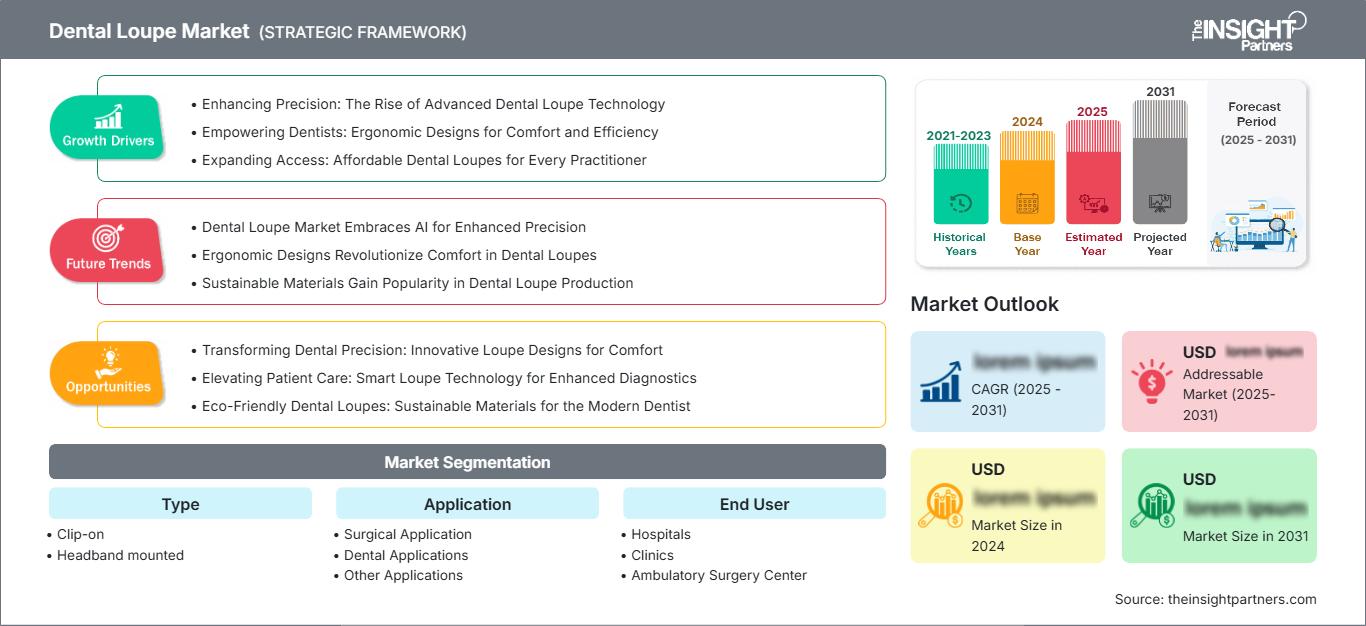
Dental Loupe Market: Strategic Insights
Regional Insights
North America Dental Loupe Market
North America is estimated at 38–42% of global revenue in 2025, with a CAGR of 6.7–7.1% through 2034. The area is helped by the presence of private practices, specialized dentistry, procurement of quality equipment, and above average ergonomics awareness. External evidence about the market also places North America as the leader in the regional market, which justifies the modeled 2025 value range used here.
The US represents 77-82% of the North American Dental Loupe Market, with the rest coming from Canada. The replacement cycle, continued professional training, and the use of complicated restorative and surgical processes aid in the repetitive purchase of the equipment. There are also distributors in the region that help in fitting, customization, repair, and demonstrations of the products.
U.S. Dental Loupe Market Market
The US represents 77–82% of North American revenue in 2025 and is projected to expand at a CAGR of 6.8–7.2%. Application environments still largely include dental clinics, with other applications coming from hospitals and ambulatory surgical centers through oral surgeries. The developed dental technology distribution channel in the country will also help in the acquisition of the high-end customized systems.
The firm has widespread representation through Orascoptic, Carl Zeiss AG, LW Scientific, GF Health Products, Inc., MedLite Ltd., and Rose Micro Solutions LLC. Magnification, working distance, field of vision, illumination, frame weight, and posture are some factors influencing the purchase of these products. Academic courses may also promote usage of magnification through exposure of students and residents to these products.
Europe Dental Loupe Market
Europe is estimated to hold a 25–29% share in 2025 and grow at a CAGR of 6.2–6.7%. Germany dominates regional demand, followed by the UK, France, Italy, and Spain. Market growth is attributed to specialization within dentistry, well-developed healthcare infrastructure, professional training programs, and the need for ergonomic equipment.
The UK and Germany are significant markets for several reasons, including specialization in dentistry, high volumes of specialized treatments, and effective distribution of equipment. France, Italy, and Spain also provide significant demand from private practices, dental groups, university dentistry, and oral surgery. The advanced optical and medical technology market in Germany adds value to regional innovation and professional adoption. European suppliers have begun focusing on customized working distances, compatibility, frame design, and illumination.
APAC Dental Loupe Market
APAC represents 20–24% of 2025 demand and is expected to expand at a CAGR of 8.4–9.2%, making it the fastest-growing major region. While China leads in regional size, Japan, South Korea, India, and Australia contribute through the increasing provision of dental services and specialization.
Industrialization, dental training, the proliferation of clinics, and modernization of health care will facilitate implementation. India and China offer significant long-term opportunities because of their increasing capacity, whereas Japan and South Korea emphasize sophisticated technologies. Australia is helped by professional standards and established dental practice. The involvement of local manufacturers and distributors becomes more critical.
Middle East & Africa Dental Loupe Market Market
Middle East and Africa is projected to grow at a CAGR of 7.0–7.6% through 2034. Demand from Saudi Arabia and the UAE leads that in the Middle East region, facilitated by investments in the healthcare infrastructure and private dentistry industry growth, whereas demand in South Africa is the dominant one among the countries in Africa.
The demand in the rest of MEA is more fragmented and depends on the availability of the equipment, geographical distribution, and clinical infrastructure. The availability of energy revenues and healthcare infrastructure improvements in the Gulf countries will help in capital investments, while South Africa offers a more advanced basis for dental services.
Segmentation Analysis
Type
The Type segment is expected to grow at a CAGR of 6.7–7.3% during 2026–2034. The Dental Loupe Market scope within this segment is shaped by clinician preference for mounting stability, ease of removal, working posture, field of view, and compatibility with prescription eyewear. Product selection increasingly reflects procedure-specific requirements and long-duration comfort.
- Clip-on: Clip-on systems serve users seeking flexible attachment and lower commitment to dedicated frames. Their removable format can appeal to occasional magnification users, training environments, and clinicians requiring adaptable equipment across different clinical situations.
- Headband mounted: Headband mounted systems support stable positioning and higher customization for demanding procedures. Their ergonomic potential makes them strategically relevant where clinicians require consistent alignment, longer working periods, or higher magnification.
Application
Application demand is forecast to increase at a CAGR of 6.8–7.4% through 2034. Clinical complexity, precision requirements, and procedure duration influence purchasing decisions. Dental practices remain central, while surgical use supports higher-performance configurations requiring stronger visualization and ergonomic stability.
- Surgical Application: Surgical use requires precise visualization, stable positioning, and appropriate illumination. Demand is concentrated in procedures where small anatomical structures, controlled access, and sustained visual concentration make magnification particularly valuable.
- Dental Applications: Dental applications represent the largest demand pool because routine and specialist procedures can incorporate magnification. Endodontics, restorative dentistry, periodontics, prosthodontics, and implantology provide multiple use cases for recurring equipment adoption.
- Other Applications: Other applications include selected medical and technical settings where close visual inspection is required. Their strategic importance comes from widening utilization beyond conventional dentistry and supporting cross-specialty product diversification.
End User
The End User segment is projected to expand at a CAGR of 6.6–7.2% during 2026–2034. Hospitals and clinics differ in procurement scale, procedure mix, and budget structures, while academic institutions can influence future adoption through training. Institutional purchasing increasingly considers durability, service availability, fitting, and standardized clinician support.
- Hospitals: Hospitals require equipment suitable for multidisciplinary oral and maxillofacial procedures, specialist dentistry, and surgical environments. Procurement can emphasize durability, standardized support, and compatibility with broader clinical visualization systems.
- Clinics: Clinics represent the core recurring customer base because independent practices and dental groups frequently use magnification during restorative, endodontic, periodontal, and implant procedures requiring sustained visual precision.
- Ambulatory Surgery Center: Ambulatory centers provide demand for compact, procedure-focused visualization equipment, particularly where oral surgery and specialized interventions require portability, rapid setup, and ergonomic support.
- Other End Users: Other users include educational and specialized healthcare environments where magnification supports training, demonstrations, or focused clinical procedures. These settings can broaden adoption through institutional exposure and professional development.
Opportunity Snapshot
| End User | Revenue Contribution (High/Medium/Low) | Trend Tag (MAX 2 words) | Adoption Stage (Emerging/Scaling/Mature) |
|---|---|---|---|
| Hospitals | Medium | Surgical Precision | Scaling |
| Clinics | High | Routine Magnification | Mature |
| Ambulatory Surgery Center | Medium | Procedure Mobility | Scaling |
| Other End Users | Low | Training Use | Emerging |
Dental Loupe Market Growth Drivers and Impact Analysis
Ergonomic Dentistry Is Increasing Equipment Evaluation Depth
The evolution of clinician ergonomics means that purchasing of loupes will be moving away from mere considerations of magnification to more comprehensive evaluation of postural needs, working distance, ocular positioning, frame weight, and procedure time. The effect of this will be change in the competitive landscape, where devices that offer magnification but at the same time induce poor postural habits will lose favor in long procedures. Manufacturers have been adapting through ergonomics oculars, declination angles, light frames, and adjustable working distances. ZEISS offers an entire loupe portfolio built on principles of upright postural position, while Orascoptic's 2025 ErgoZoom release highlighted ergonomic oculars along with variable magnification.
Specialty Dental Procedures Increase the Value of Magnified Visualization
The extension of treatment procedures involving endodontic, implant, periodontal, restorative, and oral surgery makes for a greater base addressable for magnification devices. Such treatments include those which are associated with the presence of small anatomical structures or constrained fields of vision, where magnification is practically useful. As the range of treatments becomes increasingly specialized, clinics will be able to upgrade their equipment based on the need for treatment rather than overall use. This will affect a wide range of equipment, including optics, lighting, mounting systems, and replacement parts. Clinics may also choose to standardize magnification among their team members as a way to ensure consistency in procedures.
Customization Is Raising the Strategic Importance of Product Configuration
Dental Loupe Market trends indicate that individualized fitting is becoming a meaningful competitive differentiator because clinicians vary in prescription requirements, working distances, posture, magnification preferences, and procedure mix. A configurable product architecture can therefore serve multiple use cases without forcing manufacturers to maintain completely separate product families. ZEISS, for example, provides individualized systems, flip-up formats, prescription options, multiple magnification levels, and different optical architectures. This model can improve customer retention because clinicians may upgrade selected components or configurations instead of replacing the entire system. For manufacturers, customization also creates opportunities for higher-value accessories, fitting services, illumination, repairs, and replacement components. The resulting commercial model increasingly combines product revenue with service and configuration support.
Dental Loupe Market Future Trends
Adjustable Magnification Will Move Toward Mainstream Clinical Configurations
Adjustable magnification is likely to become more relevant as clinicians seek one system capable of supporting routine examinations and higher-detail procedures. Instead of maintaining separate loupes for different tasks, users can increasingly select magnification according to treatment complexity while preserving a consistent working distance. Orascoptic's ErgoZoom illustrates this direction by combining adjustable magnification from 3.5x to 5.5x with ergonomic oculars. Future products may further integrate mechanical adjustment, optical optimization, illumination control, and personalized presets. Such configurations could reduce equipment switching, simplify clinician workflows, and strengthen the value proposition of premium systems. The trend also creates opportunities for manufacturers to differentiate through ease of adjustment, optical consistency, durability, and serviceability rather than magnification range alone.
Loupe Systems Will Become More Integrated With Digital Visualization Workflows
The Dental Loupe Market forecast indicates that next stage of product development is likely to connect magnification more closely with illumination, documentation, education, and digital treatment workflows. While loupes remain primarily optical devices, clinicians increasingly operate in practices where imaging, cameras, patient communication, and digital records are interconnected. ZEISS is already positioning loupes alongside microscopes and digital visualization technologies within dental workflows. Future systems could therefore emphasize modular illumination, documentation accessories, training compatibility, and seamless movement between magnified clinical work and digital patient communication. This development may particularly benefit specialist practices and teaching institutions, where visual information has value beyond the immediate procedure. Manufacturers that build interoperable ecosystems could capture broader equipment budgets.
Dental Loupe Market Opportunities
Premium Clinical Systems in Emerging Dental Economies
Emerging dental economies offer an opportunity to build demand beyond established North American and European markets. India, China, Southeast Asia, and selected Middle Eastern markets combine expanding private dentistry with increasing specialization and professional education. Investment strategies should emphasize tiered product portfolios, local fitting services, distributor training, and financing models that reduce initial purchasing barriers. The Dental Loupe Market Forecasts indicate that faster regional expansion can arise when manufacturers align premium optical technology with locally appropriate price points and service structures. Partnerships with dental schools and specialist associations can also accelerate clinician familiarity. Companies that establish service capabilities early may gain an advantage because fitting, repairs, prescription support, and replacement components are particularly important for customized equipment.
Institutional Training Programs Can Accelerate Long-Term Adoption
Dental schools, residency programs, specialist training centers, and hospital education departments provide a distinct investment opportunity because equipment exposure during training can influence later professional preferences. Suppliers can develop institutional packages combining entry-level loupes, training support, fitting, illumination, and upgrade pathways. The strategy creates a structured progression from basic magnification to higher-performance configurations as clinicians move into specialist practice. Training institutions can also provide feedback on frame comfort, working distances, magnification requirements, and durability, supporting product refinement. A strong educational presence may reduce the reliance on direct promotional selling because clinicians experience the workflow benefits before entering independent practice. For manufacturers, this approach can generate durable demand across both institutional procurement and subsequent individual purchases.
Recent Developments
- February 2026: Integra LifeSciences Corporation reported full-year 2025 revenue of US$1.635 billion and outlined 2026 guidance while continuing operational and quality-system initiatives. Although its portfolio extends beyond loupes, the update is relevant to its broader medical technology positioning and investment capacity.
- January 2026: Carl Zeiss AG presented its medical loupe and dental microscope portfolio at AEEDC in Dubai, emphasizing precision, illumination, ergonomic posture, and applications spanning prophylaxis, endodontics, and surgery. The company also demonstrated EyeMag systems alongside digital dental visualization technologies.
- September 2025: Orascoptic unveiled ErgoZoom, combining adjustable 3.5x–5.5x magnification with ergonomic oculars. The company positioned the system for demanding procedures, emphasizing posture, visual clarity, and the ability to adapt magnification without changing loupes.
Frequently Asked Questions

- Comprehensive Market Sizing and Forecast Analysis
- Detailed Segmentation Analysis
- In-Depth Market Dynamics Assessment
- Regional and Country-Level Insights
- Competitive Landscape and Company Benchmarking
- Strategic Business Intelligence
Recent Reports
Testimonials

The Insight Partners' SCADA System Market report is comprehensive, with valuable insights on current trends and future forecasts. The team was highly professional, responsive, and supportive throughout. We are very satisfied and highly recommend their services.
RAN KEDEM Partner, Reali Technologies LTDs
I requested a report on a very specific software market and the team produced the report in a few days. The information was very relevant and well presented. I then requested some changes and additions to the report. The team was again very responsive and I got the final report in less than a week.
JEAN-HERVE JENN Chairman, Future Analytica
We worked with The Insight Partners for an important market study and forecast. They gave us clear insights into opportunities and risks, which helped shape our plans. Their research was easy to use and based on solid data. It helped us make smart, confident decisions. We highly recommend them.
PIYUSH NAGPAL Sr. Vice President, High Beam Global
The Insight Partners delivered insightful, well-structured market research with strong domain expertise. Their team was professional and responsive throughout. The user-friendly website made accessing industry reports seamless. We highly recommend them for reliable, high-quality research services
YUKIHIKO ADACHI CEO, Deep Blue, LLC.
This is the first time I have purchased a market report from The Insight Partners.While I was unsure at first, I visited their web site and felt more comfortable to take the risk and purchase a market report.I am completely satisfied with the quality of the report and customer service. I had several questions and comments with the initial report, but after a couple of dialogs over email with their analyst I believe I have a report that I can use as input to our strategic planning process.Thank you so much for taking the extra time and making this a positive experience.I will definitely recommend your service to others and you will be my first call when we need further market data.
JOHN SUZUKI President and Chief Executive Officer, Board Director, BK Technologies
I wish to appreciate your support and the professionalism you displayed in the course of attending to my request for information regarding to infectious disease IVD market in Nigeria. I appreciate your patience, your guidance, and the fact that you were willing to offer a discount, which eventually made it possible for us to close a deal. I look forward to engaging The Insight Partners in the future, all thanks to the impression you have created in me as a result of this first encounter.
DR CHIJIOKE ONYIA MANAGING DIRECTOR, PineCrest Healthcare Ltd.Reason to Buy
- Informed Decision-Making
- Understanding Market Dynamics
- Competitive Analysis
- Identifying Emerging Markets
- Customer Insights
- Market Forecasts
- Risk Mitigation
- Boosting Operational Efficiency
- Strategic Planning
- Investment Justification
- Tracking Industry Innovations
- Aligning with Regulatory Trends





 Get Free Sample for