
Dental Mallets Market Trends, Size & Forecast by 2034
Coverage: By Product Type (Metal Face Mallets, Nylon Face Mallets, Others); Technology (Manual Mallets, Electromagnetic Mallets); End User (Hospitals, Specialty Clinics, Others), and Geography (North America, Europe, Asia Pacific, and South and Central America)
- Status : Data Released
- Report Code : TIPRE00015176
- Category : Life Sciences
- No. of Pages : 150
- Available Report Formats :


- Last update date : August 27, 2026


2025 Market Size
US$ 486.37 Mn
Base year value
2034 Forecast
US$ 871.25 Mn
Projected by 2034
CAGR 2026-2034
6.69 %
Growth rate
Addressable Market
US$ 6,135.94 Mn
(2026-2034)
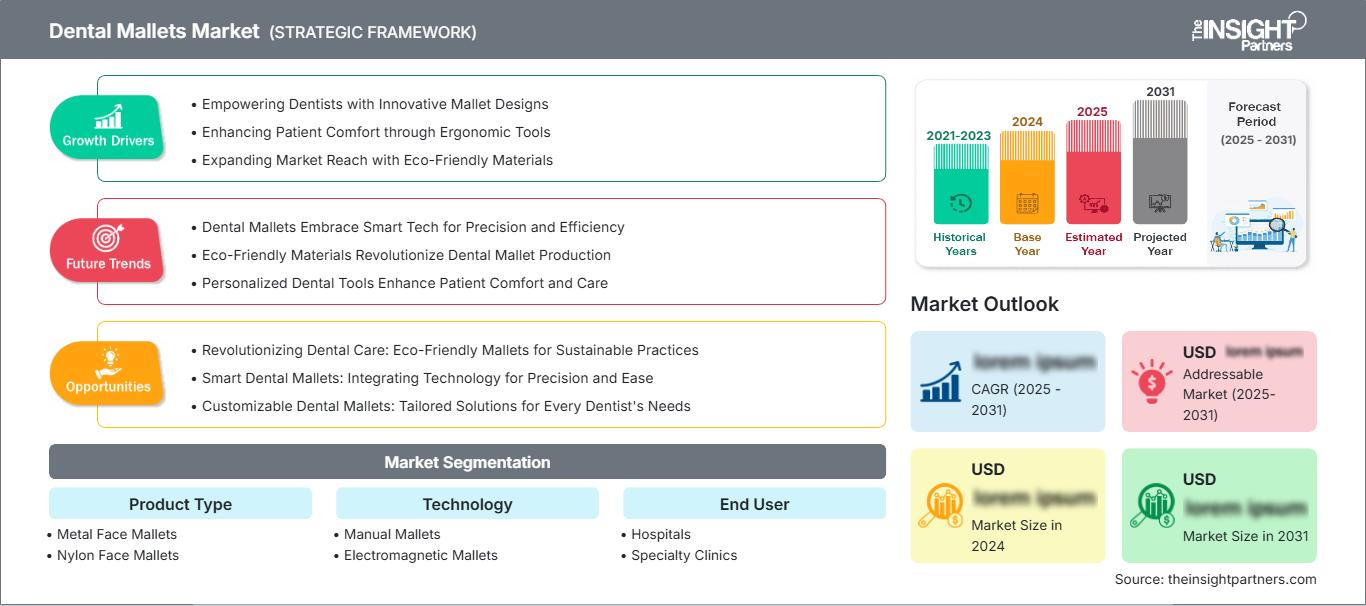
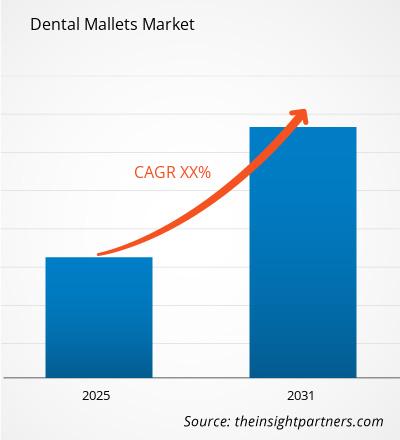
The Dental Mallets Market is projected to expand from US$ 486.37 Million in 2025 to US$ 871.25 Million by 2034, registering a CAGR of 6.69% during 2026–2034. Growth reflects sustained utilization of mallets in restorative, extraction, implantology, and oral surgery procedures, alongside gradual adoption of ergonomically designed instruments and controlled-impact technologies. Demand is supported by procedure volumes, replacement cycles, expanding specialty dental care, and continued modernization of clinical instrumentation.
North American Dental Mallets Market size is expected to advance at an estimated CAGR range of 6.2–6.8% during 2026–2034. Structural growth is linked to high dental expenditure, established specialty-care infrastructure, recurring instrument replacement, and increasing preference for precision-oriented surgical workflows. The U.S. remains the principal demand center, while Canada provides incremental opportunities through expanding access to preventive and specialty oral healthcare services.
Dental Mallets Market Assessment and Insights
- North America: North America maintains the leading regional position, with a 2025 Dental Mallets Market share range of 39–42% and a CAGR range of 6.2–6.8% between 2026–2034, supported by mature clinical infrastructure and high procedural utilization.
- US: The U.S. represents 82–84% of North American demand in 2025 and is expected to grow at a CAGR of 6.1–6.7%, reflecting strong specialist adoption and replacement demand.
- Europe: Europe holds a 2025 share range of 25–28% and is projected to grow at 6.0–6.6% CAGR, with Germany, the UK, France, Italy, and Spain forming the principal demand centers.
- Asia Pacific: Asia Pacific accounts for 21–24% of 2025 demand and is expected to register the strongest regional CAGR of 7.1–7.8%, led by China, Japan, South Korea, India, and Australia.
- Largest Segment: Metal Face Mallets represent the largest segment, with a 2025 market share range of 55–60% and CAGR range of 6.2–6.7%, reflecting broad procedural familiarity.
- High Growth Segment: Electromagnetic Mallets hold a 2025 share range of 15–20% and are projected to grow at 7.2–7.8% CAGR as controlled-impact surgical techniques gain acceptance.
- Key companies analyzed in detail: Carl Martin GmbH, Pearson Dental Supply Company, Hu-Friedy Mfg. Co., LLC, YDM CORPORATION, ASA DENTAL S.P.A., Fasa Group, Karl Hammacher GmbH, Lorien Industries, Medical-One S.r.l., and Otto Leibinger GmbH.
Source: The Insight Partners' analysis based on proprietary research, government publications, company annual reports, investor presentations, industry databases, and expert interviews.
In the Dental Mallets Market, there has been an evolution from hand tools towards differentiated designs based on controlled impact, handle design, replaceable heads, sterilization capability, and geometry for specific applications. Metal mallets have continued to be significant because they offer durability and reliable impact transmission, while nylon heads cater to applications which call for reduced surface shock. Electromagnetism introduces controlled impulses and has become relevant in implantology and oral surgery. Production is involving precise machining, stainless steel, polymers, inspection, and finishing.
Further evolution in the Dental Mallets Market is anticipated in terms of development in the Asia Pacific region, specialized surgery applications, and designs which enable reproducible handling. Priorities of investment include higher value instruments, geographical reach, regulatory compliance documentation, and educational adoption. The increasing regulation of medical devices and infection control also makes the purchase process more rigorous. The focus of the WHO on incorporating oral care in wider health services adds the necessary context for capacity growth especially where the coverage is lacking.
Dental Mallets Market Report Scope
| Report Attribute | Details |
|---|---|
| Market size in 2025 | US$ 486.37 Million |
| Market Size by 2034 | US$ 871.25 Million |
| Global CAGR (2026 - 2034) | 6.69% |
| Historical Data | 2021-2024 |
| Forecast period | 2026-2034 |
Dental Mallets Market Analysis
Dental Mallets Market growth will be driven by the number of procedures carried out in various dental extraction, restoration, implantation, prosthetics, and oral surgery cases. The value chain will consist of specialty steel/polymer suppliers, machining and forming, polishing and cleaning, sterilization cycle validation, packaging, distributors, dental wholesalers, hospitals, and clinics. Product choice depends on its impact properties, durability, resistance to sterilization cycles, design of grip, and familiarity with the product.
Patterns of demand in the Dental Mallets Market vary depending on the care settings. Hospital and specialty clinics will consider instruments based on procurement requirements, lifetime cost and versatility of use, while smaller practices will focus on availability, durability, and replacement of instruments. The supply side will be fragmented due to the fact that mallets are highly specialized products in the wide scope of dental instruments. European production will offer highly engineered tools, North American distribution will have wide catalog selection, and Asian production will offer cost effective and local sourcing options.
Competitive positioning is becoming increasingly reliant on breadth of portfolio, manufacturing accuracy, distribution, and capability to support traditional as well as advanced surgery workflows. As per the Dental Mallets Market report, traditional instrument producers compete with precision manufacturing and specialized relationships, and distributors enhance their market presence by means of large catalogues and procurement services. Hu-Friedy Mfg. Co., LLC incorporates instrumentation and procedure/infection prevention, while Carl Martin GmbH highlights a broad range of dental instrument portfolio.
Market investment is directed not only at standalone mallet capacity but also at integration of dental instruments portfolio, automation of manufacturing processes, product innovation, and regional distribution. ASA DENTAL S.P.A. has a comprehensive surgical and restoration instruments, YDM CORPORATION distributes hand-instruments internationally, and Karl Hammacher GmbH specializes in stainless steel hand instruments. Pearson Dental Supply Company has a broad U.S. distribution network, while Otto Leibinger GmbH delivers precision manufacturing from Germany.
● REPORT CUSTOMIZATION
Tailor This Report To Align With Your Specific Business Requirements
This report can be customized to align precisely with your business objectives, scope, and target markets. Customization options include tailored segmentation, geography, competitive analysis, and strategic insights to support informed decision-making.
Customize This Report →WHAT YOU CAN ADJUST
- ● Segmentations
- ● Geography
- ● Competitive Analysis
- ● Language Preferences
Dental Mallets Market: Strategic Insights
Regional Insights
North America Dental Mallets Market
North America holds a 2025 share range of 39–42% and is expected to grow at a CAGR of 6.2–6.8% through 2034. The area has good dental spending, specialty clinics, surgical capabilities, and good instrument replacement policies. In addition, purchasing criteria in the U.S. include durability, sterilization compatibility, traceability, and reliability of the vendor. All these traits favor the development of quality instrument positioning and repeat business.
A smaller but structurally favorable market is found in Canada, which has more generous public dental insurance, increased preventive care efforts, and investment in up-to-date facilities. Implantology, oral surgery, and restorative treatments drive the demand for impact instruments in the region. The dealers have developed a sophisticated distribution system and there are good professional education channels among manufacturers and distributors. Replacement demand is critical due to constant exposure to mechanical stress and sterilization.
U.S. Dental Mallets Market Market
The U.S. accounts for 82–84% of North American demand in 2025 and is projected to grow at a CAGR of 6.1–6.7%. The need arises in hospital settings, oral and maxillofacial surgery offices, implant-specific specialty clinics, and large dental practices. High-level purchasing mechanisms encourage uniformity in products, reliable quality documentation, and distributors’ availability. Special procedures create chances for high-end instrument designs.
Trends in applications include minimally invasive extraction, implant site preparation, ridge expansion, and restoration work requiring controlled instrumentation. The existence of reputable suppliers such as Pearson Dental Supply Company and Hu-Friedy Mfg. Co., LLC ensures wide product availability. The U.S. market serves as a testbed for new technologies in controlled impact since dentists have access to training, specialty centers, and technology procurement initiatives.
Europe Dental Mallets Market Market
Europe represents a 2025 share range of 25–28% and is forecast to expand at a CAGR of 6.0–6.6%, with Germany serving as the leading country. Fully developed dental infrastructure, presence of instruments manufacturing and quality-centric regulation drive consistent demand. The major country players include Germany, the UK, France, Italy, and Spain, with distribution serving to enhance the availability of the products in the region.
The UK enjoys the advantage of having a lot of private dental practices, while Germany is strong not only because of its manufacturing but also because of having a high number of dental practitioners. France relies on its hospitals as well as on its private dental clinics in maintaining demand. Italy plays an important role in the production and export of dental instruments, with companies like ASA DENTAL S.P.A. playing their part in the supply chain.
APAC Dental Mallets Market Market
APAC holds a 2025 share range of 21–24% and is projected to grow at a CAGR of 7.1–7.8%, making it the fastest-growing major region. China ranks highest in terms of scale in the region, followed by Japan, South Korea, India, and Australia. Growing dental clinic facilities, increase in private health spending, and urbanization will drive demand for instruments.
China and India offer the best opportunities in terms of volume, while Japan and South Korea are benefitted because of their advanced clinical facilities. Australia is benefitted owing to its established specialty dentistry and procurement capabilities. The National Oral Health Program of India has helped establish thousands of dental care facilities, thus improving the availability of infrastructural facilities.
Middle East & Africa Dental Mallets Market Market
Middle East and Africa demand is developing from a smaller base, with growth supported by healthcare infrastructure investment, specialist hospitals, and private dental expansion. Saudi Arabia leads the regional opportunity, followed by the UAE and South Africa. The MEA CAGR is estimated at 5.0–5.8% through 2034, reflecting gradual capacity development.
Saudi Arabia and the UAE benefit from healthcare modernization, specialist facilities, and medical tourism strategies, while South Africa provides the region's more established dental services ecosystem. Rest of MEA demand remains uneven because purchasing power and specialist availability differ materially between countries. Infrastructure projects, imported medical technology, and distributor-led supply models will remain central to market development.
Segmentation Analysis
Product Type
The product type segment is projected to grow at a CAGR of 6.3–6.8% during 2026–2034. Metal faces remain widely used because they withstand repeated impacts and sterilization, while polymer-faced alternatives address procedures where lower shock transmission is preferred. The Dental Mallets Market scope therefore spans durability-oriented instruments and application-specific face materials, allowing manufacturers to target different clinical requirements.
- Metal Face Mallets: These instruments occupy the established core of the category, supported by durability, predictable force transfer, and familiarity across restorative and surgical applications. Their longevity supports recurring institutional procurement.
- Nylon Face Mallets: Nylon-faced designs provide softer impact characteristics and are strategically relevant where clinicians seek reduced shock transmission. Their positioning supports applications requiring controlled manipulation and lower surface hardness.
Technology
The technology segment is expected to register a CAGR of 6.8–7.4% through 2034. Manual mallets retain broad use because of low complexity and straightforward sterilization, while electromagnetic designs introduce controlled impulses and differentiated surgical functionality. Technology selection increasingly depends on procedure type, clinician training, capital budgets, and evidence supporting improved workflow consistency.
- Manual Mallets: Manual products remain the practical standard for many routine applications because they require limited infrastructure, are simple to maintain, and fit established procedural techniques.
- Electromagnetic Mallets: Electromagnetic systems are strategically important for controlled-impact applications, particularly implantology and oral surgery. Their adoption is linked to precision requirements, clinician education, and investment in advanced surgical workflows.
End User
The end-user segment is projected to grow at a CAGR of 6.4–6.9% during 2026–2034. Hospitals benefit from complex surgical caseloads and centralized procurement, while specialty clinics provide targeted demand for implantology and oral-surgery instruments. The mix increasingly favors facilities able to justify higher-value instruments through procedural specialization and utilization.
- Hospitals: Hospitals represent a strategically important purchasing environment because centralized procurement, surgical departments, and higher procedure complexity create demand for durable and standardized instruments.
- Specialty Clinics: Specialty clinics emphasize application-specific tools for implantology, oral surgery, and advanced restorative procedures. Their purchasing behavior can support premium instruments where ergonomic or controlled-impact characteristics improve procedural fit.
Opportunity Snapshot
| End User | Revenue Contribution (High/Medium/Low) | Trend Tag | Adoption Stage |
|---|---|---|---|
| Hospitals | High | Surgical Standardization | Mature |
| Specialty Clinics | High | Implant Workflow | Scaling |
Dental Mallets Market Growth Drivers and Impact Analysis
Expansion of Implant and Oral Surgery Workflows
An increased incidence of procedures including implant placement, ridge preparation, extraction, and other similar types of surgery represents a direct opening for hammer manufacturers as these procedures necessitate a certain level of mechanical manipulation. Studies analyzing magnetic hammers have been carried out with regards to extraction and implant placement, signifying that there is a definite amount of clinical research available regarding this type of hammer, even though further research needs to be randomized. It should be noted that an expansion of the capacity of specialists does not only lead to increased demand on a unit basis but also alters the product mix in favor of instruments suited for specific procedures. In this regard, those companies that are able to produce inserts, ergonomic handles, and specialized instruments will be able to benefit from the procurement process.
Demand for Ergonomic and Sterilization-Compatible Instruments
The need for ergonomic instruments has gained significance due to the desire of clinicians for devices that minimize the handling fatigue and deliver reliable manipulation when used repeatedly in procedures. Mallets experience repeated impacts and cycles of sterilization; hence handle strength, choice of materials, resistance to corrosion, and finishing are among key factors considered during procurement of instruments. There is market influence not only in product development but in procurement as well, since hospitals have become interested in the performance of instruments during their lifecycle instead of their purchase price alone. There are differentiating features of manufacturers such as good balance, replaceable faces, grip design, and characteristics of reprocessing. All of the above also applies to the requirements of private clinics for reliable instruments that would be replaced less frequently.
Expansion of Structured Oral Healthcare Infrastructure
Both public and private investment in infrastructure related to oral healthcare is increasing the addressable base of specialized dental equipment. According to WHO, more than 3.7 billion people are affected by oral diseases, and there is growing emphasis on integration of oral health care services with primary healthcare services and universal coverage in the oral health care agenda of WHO. In India, the National Oral Health Care Program provides for dental units and related equipment in public health institutions, thus showing how infrastructure programs can lead to acquisition of specialized instruments. In similar capacity-building exercises undertaken in emerging markets, there is a growing demand for instruments that are standardized, workable, and can be used under procurement constraints. The significance of the development will be felt especially by the manufacturers who have a network of distributors and product training capacity and product flexibility.
Dental Mallets Market Future Trends
Greater Integration of Controlled-Impact Technologies
The Dental Mallets Market trends are expected to move toward greater integration of controlled-impact technologies in procedures where force consistency and tissue management are important. Electromagnetic systems can provide electronically controlled impulses, creating opportunities for more reproducible handling than conventional manual impact. Future products may incorporate configurable force profiles, improved handpiece ergonomics, interchangeable attachments, and clearer procedural feedback. Adoption will remain dependent on clinical evidence, training requirements, acquisition costs, and regulatory clearance. As digital treatment planning becomes more common, mallet systems may increasingly be selected as part of coordinated surgical workflows rather than as isolated instruments. This could encourage suppliers to package devices, attachments, education, and maintenance services around specific procedures. The result would be a gradual transition from standalone instruments toward more application-defined surgical platforms.
Application-Specific Instrument Architecture
Future development is likely to favor mallets designed around specific procedural requirements rather than broad-purpose configurations. Manufacturers can differentiate through interchangeable faces, specialized tips, weight balancing, compact form factors, and sterilization-ready materials matched to extraction, implant, restorative, or laboratory tasks. Such architecture allows clinicians to select instruments according to force characteristics and procedural access. Customization may also extend to markings, instrument identification, and standardized surgical sets for multi-room facilities. Hospitals increasingly seek consistency across teams, creating opportunities for manufacturers to supply coordinated instrument families rather than individual products. At the same time, specialty clinics may prefer compact systems that reduce tray complexity while retaining multiple clinical functions. These developments could improve product segmentation and support higher-value purchasing decisions without requiring wholesale replacement of established manual workflows.
Dental Mallets Market Opportunities
Expansion Through Emerging Dental Care Networks
Dental Mallets Market Forecasts indicate an actionable opportunity in emerging dental networks where clinic numbers and specialist capacity are increasing from relatively low installed bases. Manufacturers can prioritize India, Southeast Asia, the Gulf states, and selected Latin American markets through distributor agreements, localized training, and tiered product portfolios. Entry strategies should distinguish between basic manual instruments and premium controlled-impact systems because purchasing criteria vary substantially by facility maturity. Local inventory is also important where imported instruments face longer replenishment cycles. Companies that combine dependable availability with technical education can reduce adoption barriers among clinicians unfamiliar with newer technologies. Partnerships with dental schools and specialty training centers can further establish product familiarity before practitioners enter private or hospital settings. The opportunity is therefore strongest for suppliers capable of adapting pricing, channel structure, education, and product complexity to local market conditions.
Development of Procedure-Centered Product Portfolios
A second opportunity lies in creating procedure-centered portfolios that combine mallets with compatible surgical instruments, inserts, storage systems, and maintenance services. Buyers increasingly value simplified procurement when multiple instruments are required for standardized procedures. Manufacturers can organize portfolios around extraction, implant site preparation, ridge expansion, restorative work, and laboratory applications, allowing sales teams to address clinical workflows rather than isolated product specifications. Such positioning may increase cross-selling and create stronger customer retention because replacement decisions become connected to complete procedural sets. Digital catalogs and instrument identification systems can further simplify ordering and inventory management. The most attractive investment cases will likely involve products that solve a clearly defined procedural requirement while maintaining compatibility with existing sterilization and storage processes. This approach can support differentiated pricing without depending solely on material or cosmetic upgrades.
Recent Developments
- July 2026: Hu-Friedy Mfg. Co., LLC announced the opening of a new Northbrook campus in Illinois, reinforcing its U.S. manufacturing footprint and positioning the facility as part of its long-term dental instrument and infection-prevention operations. The development is relevant to procurement resilience, manufacturing capacity, and the company’s broader instrument portfolio.
- January 2026: ASA DENTAL S.P.A. presented its latest product innovations at AEEDC Dubai from January 19–21, 2026. The company used the event to engage dental professionals and partners around instrument solutions and new products, strengthening its visibility across the Middle East and international distribution channels
- March 2025: Carl Martin GmbH introduced three ergonomically focused retractors through its IDS 2025 activities, including the Zygoma Lopes, Double Hook Lopes, and Full Arch Lopes Retractors. The products emphasized smaller form factors, multifunctionality, improved access, and handling efficiency for implant and full-arch procedures.
Frequently Asked Questions

- Comprehensive Market Sizing and Forecast Analysis
- Detailed Segmentation Analysis
- In-Depth Market Dynamics Assessment
- Regional and Country-Level Insights
- Competitive Landscape and Company Benchmarking
- Strategic Business Intelligence
Recent Reports
Testimonials

The Insight Partners' SCADA System Market report is comprehensive, with valuable insights on current trends and future forecasts. The team was highly professional, responsive, and supportive throughout. We are very satisfied and highly recommend their services.
RAN KEDEM Partner, Reali Technologies LTDs
I requested a report on a very specific software market and the team produced the report in a few days. The information was very relevant and well presented. I then requested some changes and additions to the report. The team was again very responsive and I got the final report in less than a week.
JEAN-HERVE JENN Chairman, Future Analytica
We worked with The Insight Partners for an important market study and forecast. They gave us clear insights into opportunities and risks, which helped shape our plans. Their research was easy to use and based on solid data. It helped us make smart, confident decisions. We highly recommend them.
PIYUSH NAGPAL Sr. Vice President, High Beam Global
The Insight Partners delivered insightful, well-structured market research with strong domain expertise. Their team was professional and responsive throughout. The user-friendly website made accessing industry reports seamless. We highly recommend them for reliable, high-quality research services
YUKIHIKO ADACHI CEO, Deep Blue, LLC.
This is the first time I have purchased a market report from The Insight Partners.While I was unsure at first, I visited their web site and felt more comfortable to take the risk and purchase a market report.I am completely satisfied with the quality of the report and customer service. I had several questions and comments with the initial report, but after a couple of dialogs over email with their analyst I believe I have a report that I can use as input to our strategic planning process.Thank you so much for taking the extra time and making this a positive experience.I will definitely recommend your service to others and you will be my first call when we need further market data.
JOHN SUZUKI President and Chief Executive Officer, Board Director, BK Technologies
I wish to appreciate your support and the professionalism you displayed in the course of attending to my request for information regarding to infectious disease IVD market in Nigeria. I appreciate your patience, your guidance, and the fact that you were willing to offer a discount, which eventually made it possible for us to close a deal. I look forward to engaging The Insight Partners in the future, all thanks to the impression you have created in me as a result of this first encounter.
DR CHIJIOKE ONYIA MANAGING DIRECTOR, PineCrest Healthcare Ltd.Reason to Buy
- Informed Decision-Making
- Understanding Market Dynamics
- Competitive Analysis
- Identifying Emerging Markets
- Customer Insights
- Market Forecasts
- Risk Mitigation
- Boosting Operational Efficiency
- Strategic Planning
- Investment Justification
- Tracking Industry Innovations
- Aligning with Regulatory Trends





 Get Free Sample for