
Dental Polymerization Flasks Market Share, Growth & Demand by 2034
Coverage: By Type (Round, Square, Triangular, Other); Application (Dental Laboratories, Scientific Research) , and Geography (North America, Europe, Asia Pacific, and South and Central America)
- Status : Data Released
- Report Code : TIPRE00021161
- Category : Life Sciences
- No. of Pages : 150
- Available Report Formats :


- Last update date : September 07, 2026


2025 Market Size
US$ 124.03 Mn
Base year value
2034 Forecast
US$ 296.33 Mn
Projected by 2034
CAGR 2026-2034
10.16 %
Growth rate
Addressable Market
US$ 1,867.92 Mn
(2026-2034)
The Dental Polymerization Flasks Market was valued at US$ 124.03 Million in 2025 and is projected to reach US$ 296.33 Million by 2034, registering a CAGR of 10.16% during 2026–2034. The market encompasses flask systems that are used for containment, compression, and polymerization of the denture base materials. The market demand is driven by removable prosthodontics, dental laboratory practices, the longevity of the flasks, dimensional accuracy, and compatibility with traditional as well as evolving methods of polymerization processes.
The North American Dental Polymerization Flasks Market Size is anticipated to hold a major share, driven by an existing base of dental laboratories and the need for removable prosthetic fabrication. The regional growth is estimated at a CAGR of 9.1–9.7% up until 2034. Equipment replacement and corrosion resistance as well as accurate fitment of the flasks are the underlying drivers.
Dental Polymerization Flasks Market Assessment and Insights
- North America: North America is estimated to hold a 27–31% share in 2025 and grow at a 9.1–9.7% CAGR between 2026–2034, supported by established laboratories, replacement demand, and advanced prosthetic workflows.
- US: The US is estimated to represent 80–84% of North America's 2025 market and expand at a 9.0–9.6% CAGR between 2026–2034, supported by laboratory modernization.
- Europe: Europe is estimated to account for a 31–35% share in 2025 and grow at a 9.4–10.0% CAGR between 2026–2034, led by Germany, Italy, France, the UK, and Spain.
- Asia Pacific: Asia Pacific is estimated at a 20–24% share in 2025 and a 11.0–11.8% CAGR between 2026–2034, with China, Japan, South Korea, and India driving laboratory capacity expansion.
- Largest Segment: Round flasks are estimated to command a 46–51% market share in 2025 and grow at a 9.7–10.3% CAGR through 2034, reflecting broad laboratory utility.
- High Growth Segment: Triangular flasks are estimated at a 17–22% market share in 2025 and a 11.2–12.0% CAGR through 2034, supported by optimized space utilization.
- Key companies analyzed in detail: Dentalfarm Srl., Merz Dental GmbH, Aixin Medical Equipment, Inc., Handler MFG., Kentzler-Kaschner Dental GmbH, MESTRA Talleres Mestraitua, S.L., P.P.M. Srl., Prodont-Holliger SAS, SCHULER-DENTAL GmbH & Co. KG, and CANDULOR AG.
Source: The Insight Partners' analysis based on proprietary research, government publications, company annual reports, investor presentations, industry databases, and expert interviews.
The Dental Polymerization Flasks Market has grown from metal-based flasks to those that provide accuracy of closure, precise pressure, protection from corrosion, ease of separation, and compatibility with diverse curing processes. The manufacture process features enhanced tolerances in the machining process and better surface finishing. Design differentiation also takes place via geometric forms, including those with triangular shapes that ensure a proper ratio between height and width, along with special flasks designed for injection and pack-pressing processes.
The Dental Polymerization Flasks Market Forecast depends on the growth of dental laboratory capabilities especially in the Asian Pacific region and some Middle Eastern countries. Investment into prosthetic production equipment, laboratory training, and computer dentures should affect demand. Regulatory requirements regarding the quality of medical devices, traceability of materials used, and workplace safety are motivating laboratories to replace old equipment with standard solutions.
Dental Polymerization Flasks Market Report Scope
| Report Attribute | Details |
|---|---|
| Market size in 2025 | US$ 124.03 Million |
| Market Size by 2034 | US$ 296.33 Million |
| Global CAGR (2026 - 2034) | 10.16% |
| Historical Data | 2021-2024 |
| Forecast period | 2026-2034 |
Dental Polymerization Flasks Market Analysis
Dental Polymerization Flasks Market Growth is highly related to the production of removable prosthodontics, output from laboratories, and the replacement of aged machinery. The industry includes material providers, machine producers, distribution companies, laboratories, prosthodontists, and education centers. Sales depend on the volume of cases treated with dentures, method of polymerization, shape of flasks, and the requirement of repeatable compression.
The supply side is relatively specialized since the functioning of flasks depends on accuracy of fit, robustness, durability, and proper pressure application. Companies with own machining or casting operations are able to regulate consistency and customization of products. Distribution continues to be significant where laboratories acquire the whole system rather than individual parts. Standardization of equipment by dental laboratories makes compatibility with presses and polymer materials very significant.
There are specialist dental equipment manufacturers who have a long history with laboratories. Merz Dental GmbH is a manufacturer of processing equipment that includes the Swiss Jet flask. Handler MFG. is also a company with a large range of legacy flasks and presses. Dentalfarm Srl., MESTRA Talleres Mestraitua, S.L., and SCHULER-DENTAL GmbH & Co. KG compete using the scope of laboratory equipment they manufacture and distribute. The Dental Polymerization Flasks Market report therefore focuses on product engineering, along with sales channels.
Strategic investment is more often made in the sphere of manufacturing precision, process integration, and digital laboratory support. Aixin Medical Equipment, Inc. is an inexpensive manufacturing solution for Asia, while Kentzler-Kaschner Dental GmbH and Prodont-Holliger SAS enhance the European specialist segment. There are other competitors in the form of P.P.M. Srl. and CANDULOR AG focused on laboratory and prosthodontic application. Firms with reliable supplies, specifications, durability of products, and distribution are well placed to secure their laboratory clientele.
● REPORT CUSTOMIZATION
Tailor This Report To Align With Your Specific Business Requirements
This report can be customized to align precisely with your business objectives, scope, and target markets. Customization options include tailored segmentation, geography, competitive analysis, and strategic insights to support informed decision-making.
Customize This Report →WHAT YOU CAN ADJUST
- ● Segmentations
- ● Geography
- ● Competitive Analysis
- ● Language Preferences
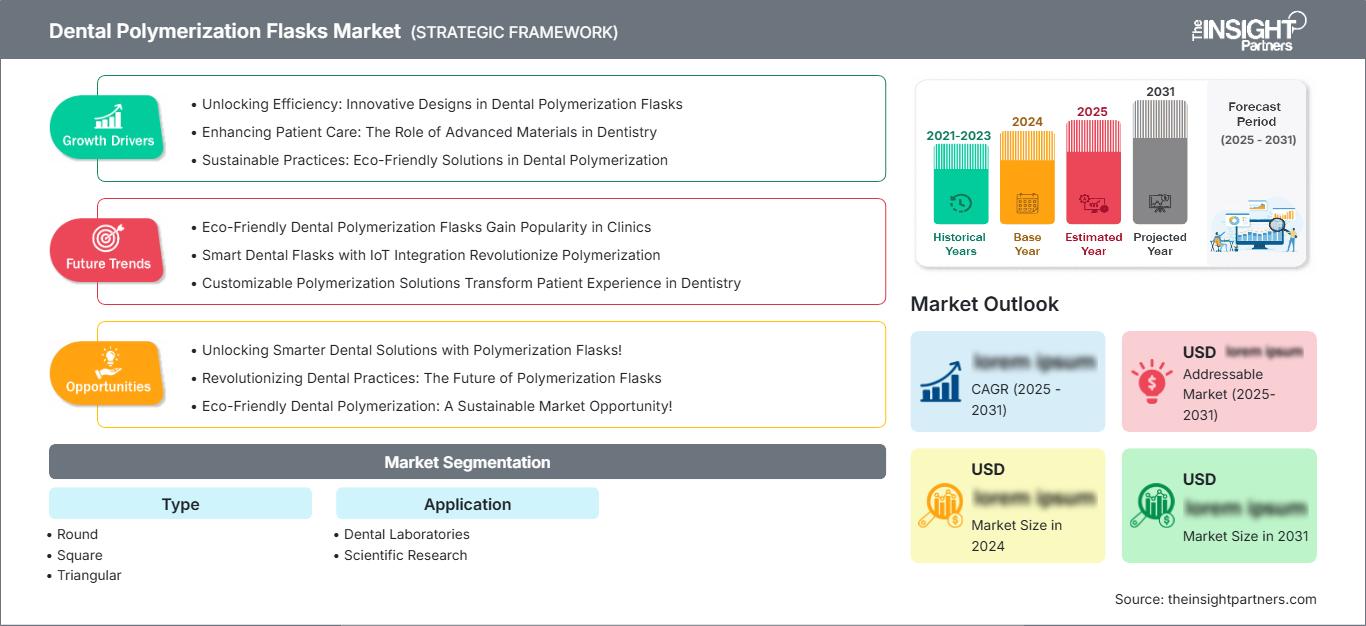
Dental Polymerization Flasks Market: Strategic Insights
Regional Insights
North America Dental Polymerization Flasks Market
North America accounts for 27% to 31% of the 2025 market and will grow at a rate of 9.1% to 9.7% CAGR up to 2034. There are several benefits to the region including well-developed dental laboratory network, mature removable prosthetic manufacturing, and the need for equipment enabling repeatable polymerization cycles. There is still replacement buying as laboratories working with old generation presses and flasks want to achieve better accuracy in closing, more corrosion resistance and ease of deflasking. The USA is driving the market, with contributions from Canada due to dental laboratory upgrading and specialization in prosthesis manufacturing.
There is increased emphasis on standardization of the workflow and lifetime of equipment rather than just low cost when buying in North America. Higher case loads enable justification of buying equipment which will ensure high reliability and repeatability. Specialized flask geometry and equipment integration can be offered in the region. It is anticipated that demand will be maintained at the level of 9.1% to 9.7% CAGR up to 2034.
U.S. Dental Polymerization Flasks Market
US is believed to comprise around 80-84% of North America’s market for 2025 and will experience an annual growth rate of 9.0-9.6% through 2034. The US market shares its position based on having a significant dental laboratory industry, having developed prosthodontic services, and distribution routes capable of delivering special equipment for the laboratories. Modern laboratories prefer equipment offering repeated pressure, accurate flask positioning, and easy separation after curing. Hence, the demand depends on investments in new laboratories and the replacement of aging machinery.
In addition, the market is supported by the existence of equipment manufacturers and distributors targeting dental technicians. Flask and press equipment by Handler MFG. and international dental equipment providers such as Merz Dental GmbH and Prodont-Holliger SAS expand the product line up. Application demand is limited to dental laboratories, as denture production requires higher specialization in these organizations. US accounts for 80-84% of North America, with a CAGR of 9.0-9.6%.
Europe Dental Polymerization Flasks Market
The European market is projected to capture a share of 31–35% in 2025 and post a CAGR of 9.4-10.0% over 2034. Germany is projected to be the market leader owing to its existing dental lab industry, equipment manufacturing, and technical training infrastructure. Italy, France, the United Kingdom, and Spain offer complementary demand in the form of mature prosthetics and established labs.
Both the UK and Germany are considered mature markets, and demand for equipment is becoming more driven by considerations of durability, dimensional stability, and efficient laboratory operation. Germany will be helped by its existing dental manufacturing capability and technological expertise in laboratories, while the UK will offer demand in the form of private dental services and specialized laboratories. France, Italy, and Spain will provide regional volume through their mature prosthetics and modernization of laboratories.
APAC Dental Polymerization Flasks Market
The APAC region is projected to account for 20-24% of the 2025 market size and grow at a CAGR of 11.0-11.8% through 2034. Within the region, China will dominate, followed by Japan, South Korea, India, and Australia. The growth of laboratory capacity, production of local equipment, and prosthetic treatment volume will contribute to the growth of the regional base.
China and India have the greatest volume opportunities, whereas Japan, South Korea, and Australia offer a more advanced lab market. Manufacturing sites and industrial production methods will guarantee competitive economics, whereas healthcare regulation will help gain access to dental care services. The higher CAGR growth rate in the region is due to the establishment of new laboratories and replacement of old equipment.
Middle East & Africa Dental Polymerization Flasks Market
MEA is expected to record a 7.7–8.5% CAGR through 2034, with Saudi Arabia and the UAE leading Gulf demand and South Africa representing an important African market. Dental infrastructure investment, private healthcare development, and specialist laboratory expansion are improving the equipment base.
Saudi Arabia is the prominent Gulf country on account of healthcare infrastructure development and private sector involvement. The UAE enjoys advanced clinical settings and presence of medical tourism, whereas South Africa has a well-established laboratory ecosystem. Rest of MEA region is fragmented with demand depending on healthcare investments and import availability. Energy revenues-driven infrastructure spending creates the basis for laboratory development.
Segmentation Analysis
Type
Type selection affects cavity geometry, polymer distribution, pressure transmission, handling, and deflasking efficiency. Round designs remain widely applicable because of their established use in conventional laboratory procedures, while triangular configurations can improve spatial efficiency and support specific processing approaches. The type segment is projected to grow at a 9.9–10.5% CAGR during 2026–2034, supported by replacement demand and workflow modernization.
- Round: Round flasks retain a broad laboratory position because technicians are familiar with their handling and established processing procedures. Their strategic importance lies in compatibility with conventional denture fabrication and widely used press systems.
- Square: Square flasks provide a structured working geometry that can support selected laboratory setups and case configurations. Demand is influenced by equipment compatibility, technician preference, and replacement of established systems.
- Triangular: Triangular designs offer efficient dimensional relationships and can accommodate particular polymer-processing configurations. Their strategic relevance is increasing where laboratories prioritize space utilization, pressure consistency, and specialized denture workflows.
Application
Application demand is shaped by the intensity of prosthetic fabrication and the availability of dedicated laboratory infrastructure. Dental laboratories represent the principal purchasing environment because they perform polymerization directly, while scientific research uses flasks for controlled material studies and process evaluation. The application segment is projected to grow at a 10.2–10.8% CAGR during 2026–2034.
- Dental Laboratories: Dental laboratories generate recurring equipment demand because polymerization is integral to removable prosthetic fabrication. Purchasing decisions emphasize durability, repeatability, compatibility with presses, and ease of maintenance.
- Scientific Research: Research institutions use controlled flask systems to investigate polymer materials, curing behavior, dimensional stability, and processing variables. Demand is smaller but strategically important for method development and material innovation.
Opportunity Snapshot
| Segment Name | Revenue Contribution (High/Medium/Low) | Trend Tag (MAX 2 words) | Adoption Stage (Emerging/Scaling/Mature) |
|---|---|---|---|
| Dental Laboratories | High | Prosthetic Processing | Mature |
| Scientific Research | Low | Material Testing | Scaling |
Dental Polymerization Flasks Market Growth Drivers and Impact Analysis
Expansion of Removable Prosthetic Fabrication Capacity
Increasing access to prosthetic treatment is creating a broader installed base of laboratories capable of processing denture polymers. WHO identifies oral diseases as affecting approximately 3.5 billion people globally, reinforcing the scale of unmet oral-health needs and the long-term requirement for restorative and prosthetic services. As laboratories expand capacity, equipment purchases extend beyond CAD/CAM systems to supporting tools used in conventional and hybrid workflows. Polymerization flasks remain relevant where acrylic-based denture fabrication is performed, especially in markets where conventional techniques remain cost effective. The impact is strongest in emerging economies, where new laboratories can enter the market with modern equipment rather than inheriting older systems. Suppliers that offer durable flasks, compatible presses, training support, and replacement components can benefit as laboratories transition from informal processing toward more standardized production environments.
Demand for Consistent Polymerization and Dimensional Control
Prosthetic quality depends on controlled processing conditions, making flask alignment, pressure stability, cavity geometry, and material handling important equipment considerations. Variations during polymerization can contribute to dimensional inaccuracies, processing defects, or additional laboratory adjustments. Consequently, laboratories increasingly evaluate flasks as precision tools rather than basic metal containers. Manufacturers can create differentiation through tighter tolerances, corrosion-resistant materials, accurate locking mechanisms, and designs that facilitate consistent pressure distribution. This trend can increase replacement demand when older equipment no longer provides reliable closure or when laboratories modernize their processing systems. It also supports premium positioning for products that integrate with specialized injection or press techniques. The commercial impact extends across both developed and developing markets because process consistency improves productivity regardless of laboratory size, although sophisticated laboratories are generally more likely to pay for measurable performance advantages.
Laboratory Modernization and Equipment Replacement
Dental laboratories are increasingly balancing conventional prosthetic expertise with digital production technologies, creating a modernization cycle across the broader equipment base. Even laboratories investing heavily in CAD/CAM may continue using polymerization equipment for selected denture, repair, relining, and hybrid workflows. This creates a replacement opportunity for flasks that offer better ergonomics, corrosion resistance, and compatibility with contemporary processing systems. Equipment modernization can also encourage laboratories to standardize flask dimensions across technicians and locations, reducing training complexity and maintenance requirements. Suppliers benefit when they can provide complete processing ecosystems rather than isolated products, particularly where presses, accessories, and consumables can be coordinated. The market impact is therefore broader than incremental unit demand: modernization can shift purchasing toward higher-value equipment with longer service expectations, better documentation, and clearer compatibility specifications, strengthening established suppliers while creating openings for specialized manufacturers.
Dental Polymerization Flasks Market Future Trends
Greater Integration of Conventional and Digital Denture Workflows
Dental Polymerization Flasks Market trends are likely to increasingly reflect hybrid laboratory workflows in which digital design and conventional polymer processing operate within the same production environment. Digitally designed dentures may still require physical polymerization, finishing, repair, or characterization steps, maintaining relevance for accurately engineered flask systems. Manufacturers can respond by developing products compatible with standardized digital-to-physical workflows, including repeatable positioning and documented processing parameters. Future designs may emphasize faster setup, clearer orientation markers, and compatibility with a wider range of denture-base materials. The integration of digital records with physical equipment could also improve process traceability, allowing laboratories to document materials, curing conditions, and case identifiers more consistently. This transition should favor suppliers able to combine traditional mechanical engineering with broader laboratory workflow knowledge.
Material-Compatible Flask Engineering
Future product development is likely to focus more closely on compatibility with evolving denture-base polymers and processing methods. Different materials can impose varying requirements for pressure, temperature, curing time, shrinkage control, and separation from the mold. Flask manufacturers can therefore differentiate through geometry and surface characteristics optimized for particular material families. Corrosion-resistant construction and durable mating surfaces may become more important as laboratories seek equipment that withstands repeated processing cycles. The Dental Polymerization Flasks Market trends may also include modular components that allow selected parts to be replaced rather than requiring complete flask replacement. Such engineering could reduce lifecycle costs while supporting sustainability objectives. As laboratories diversify their material portfolios, equipment suppliers that document compatibility clearly and maintain consistent manufacturing tolerances should gain greater influence over purchasing decisions.
Dental Polymerization Flasks Market Opportunities
Regional Production and Distributor Partnerships
Dental Polymerization Flasks Market Forecasts indicate an opportunity for manufacturers to deepen regional production and distribution relationships in high-growth economies. China and India offer manufacturing scale and expanding dental laboratory networks, while Gulf markets provide opportunities linked to healthcare infrastructure investment. Regional partnerships can shorten delivery times, reduce import complexity, and improve access to replacement components. Manufacturers can also tailor pack configurations, technical documentation, and service arrangements to local laboratory practices without altering core engineering. Distributor partnerships are especially valuable where specialist dental equipment is purchased through established professional channels rather than general industrial suppliers. Companies entering these markets should prioritize regulatory documentation, product training, after-sales support, and inventory availability. A regional strategy combining localized supply with established technical standards can capture growth while reducing the logistical disadvantages of centralized production.
Premium Systems for High-Throughput Laboratories
High-throughput laboratories present an opportunity to commercialize premium flask systems based on durability, processing consistency, and reduced handling time. Larger laboratories can place greater economic value on equipment that minimizes failed cycles, simplifies deflasking, and maintains dimensional stability over repeated use. Suppliers can address this segment through corrosion-resistant construction, precision locking, ergonomic handling features, and integration with compatible presses. Additional value can come from documented processing protocols and technician training, particularly when equipment is deployed across multiple production teams. Dental Polymerization Flasks Market Forecasts suggest that higher-value systems can gain relevance as laboratories professionalize and procurement becomes more focused on lifecycle economics. Investors and manufacturers should therefore assess opportunities beyond unit volumes, considering replacement frequency, service revenue, accessory compatibility, and the potential for recurring institutional contracts.
Recent Developments
- June 2026: Merz Dental GmbH introduced M-PRINT Model 2.0, a new 3D-printing polymer for highly precise master, stump, and functional models. The launch demonstrates the company's continuing expansion of digital laboratory materials while maintaining its broader prosthetic processing portfolio, including flask-based systems. The development is relevant to the market because laboratories increasingly combine conventional polymer-processing equipment with digitally produced models.
- December 2025: CANDULOR AG announced Alexander Ewert as managing director of its Swiss headquarters and German subsidiary, effective January 1, 2026. Ewert, a trained dental technician and former marketing and education director, was positioned to continue the company's strategic development with emphasis on product quality, customer service, and dependable delivery.
- March 2025: MESTRA Talleres Mestraitua, S.L. promoted laboratory equipment through its 2025 special-offer program, covering workstations and accessories designed around integrated dental laboratory environments. The offering emphasized ergonomic configuration and compatibility with other MESTRA equipment, reflecting continued investment in coordinated laboratory workflows and equipment modernization.
Frequently Asked Questions

- Comprehensive Market Sizing and Forecast Analysis
- Detailed Segmentation Analysis
- In-Depth Market Dynamics Assessment
- Regional and Country-Level Insights
- Competitive Landscape and Company Benchmarking
- Strategic Business Intelligence
Recent Reports
Testimonials

The Insight Partners provided valuable market intelligence that supported our global go-to-market strategy. Their team was professional, responsive, and attentive to our feedback, providing thoughtful analysis and helpful methodological clarifications throughout the project.
Junmo Kim Chief Financial Officer (CFO), Enertech Co., Ltd.
The Insight Partners' SCADA System Market report is comprehensive, with valuable insights on current trends and future forecasts. The team was highly professional, responsive, and supportive throughout. We are very satisfied and highly recommend their services.
RAN KEDEM Partner, Reali Technologies LTDs
I requested a report on a very specific software market and the team produced the report in a few days. The information was very relevant and well presented. I then requested some changes and additions to the report. The team was again very responsive and I got the final report in less than a week.
JEAN-HERVE JENN Chairman, Future Analytica
We worked with The Insight Partners for an important market study and forecast. They gave us clear insights into opportunities and risks, which helped shape our plans. Their research was easy to use and based on solid data. It helped us make smart, confident decisions. We highly recommend them.
PIYUSH NAGPAL Sr. Vice President, High Beam Global
The Insight Partners delivered insightful, well-structured market research with strong domain expertise. Their team was professional and responsive throughout. The user-friendly website made accessing industry reports seamless. We highly recommend them for reliable, high-quality research services
YUKIHIKO ADACHI CEO, Deep Blue, LLC.
This is the first time I have purchased a market report from The Insight Partners.While I was unsure at first, I visited their web site and felt more comfortable to take the risk and purchase a market report.I am completely satisfied with the quality of the report and customer service. I had several questions and comments with the initial report, but after a couple of dialogs over email with their analyst I believe I have a report that I can use as input to our strategic planning process.Thank you so much for taking the extra time and making this a positive experience.I will definitely recommend your service to others and you will be my first call when we need further market data.
JOHN SUZUKI President and Chief Executive Officer, Board Director, BK Technologies
I wish to appreciate your support and the professionalism you displayed in the course of attending to my request for information regarding to infectious disease IVD market in Nigeria. I appreciate your patience, your guidance, and the fact that you were willing to offer a discount, which eventually made it possible for us to close a deal. I look forward to engaging The Insight Partners in the future, all thanks to the impression you have created in me as a result of this first encounter.
DR CHIJIOKE ONYIA MANAGING DIRECTOR, PineCrest Healthcare Ltd.Reason to Buy
- Informed Decision-Making
- Understanding Market Dynamics
- Competitive Analysis
- Identifying Emerging Markets
- Customer Insights
- Market Forecasts
- Risk Mitigation
- Boosting Operational Efficiency
- Strategic Planning
- Investment Justification
- Tracking Industry Innovations
- Aligning with Regulatory Trends





 Get Free Sample for