
Dental Polymerization Lamps Market Size, Share & Trends by 2034
Coverage: By Product Type (LED Light, Halogen Light, Plasma Arc Curing (PAC) Lights, Laser Light); End User (Hospital, Dental Clinics, Others), and Geography (North America, Europe, Asia Pacific, and South and Central America)
- Status : Data Released
- Report Code : TIPRE00018034
- Category : Life Sciences
- No. of Pages : 150
- Available Report Formats :


- Last update date : September 08, 2026


2025 Market Size
US$ 1.80 Bn
Base year value
2034 Forecast
US$ 3.07 Bn
Projected by 2034
CAGR 2026-2034
6.12 %
Growth rate
Addressable Market
US$ 22.06 Bn
(2026-2034)
The Dental Polymerization Lamps market was valued at US$ 1.80 Billion in 2025 and is projected to reach US$ 3.07 Billion by 2034, expanding at a CAGR of 6.12% during 2026–2034. The Market is a rapidly growing segment of dental devices dedicated to the process of light-induced polymerization of restorative materials. Innovation in product development concentrates on increased energy efficiency of LEDs, control of irradiance, ergonomics of design, heat dissipation, and the use of various types of photopolymerized restorative materials.
North America is still an important region in terms of demand; Market Size in North America is driven by the existing infrastructure for restorative dentistry, replacement of equipment and widespread adoption of advanced dental technology at chairside. The Market is expected to grow at a 5.8-6.5% CAGR over 2026-2034. The development of products is oriented towards increasing the efficiency of LEDs, regulating irradiation levels, ergonomic designs, thermodynamics, and adaptability to increasingly diverse photopolymerized restorations. North America continues being a key area of demand, while the Dental Polymerization Lamps Market size is sustained by the presence of the dental restorative dentistry ecosystem, equipment replacement activities, and wide usage of advanced chair-side technologies.
Dental Polymerization Lamps Market Assessment and Insights
- North America: The region is estimated to hold a 35–39% share in 2025, with the Dental Polymerization Lamps Market growing at a 5.8–6.5% CAGR between 2026–2034. Mature restorative practices and replacement cycles support demand.
- US: The US represents approximately 84–88% of North American demand, with a 5.7–6.4% CAGR between 2026–2034, supported by established dental infrastructure and technology-oriented clinics.
- Europe: Europe is estimated at a 27–31% share in 2025 and a 5.5–6.2% CAGR between 2026–2034. Germany, the UK, France, Italy, and Spain remain important markets because of established dental manufacturing and clinical ecosystems.
- Asia Pacific: Asia Pacific is estimated at a 22–26% share in 2025 and a 7.0–7.8% CAGR between 2026–2034, led by China, Japan, India, and South Korea as dental infrastructure expands.
- Largest Segment: LED Light is estimated to command a 72–77% market share in 2025 and expand at a 6.3–6.9% CAGR during 2026–2034, reflecting efficiency and clinical convenience.
- High Growth Segment: Hospital end users are estimated to represent a 31–36% market share in 2025 and grow at a 6.5–7.2% CAGR during 2026–2034 as institutional procurement modernizes.
- Key companies analyzed in detail: Ivoclar Vivadent AG, TALLERES MESTRAITUA S.L, 3M Company, Bio-Art Equipamentos Odontológicos Ltd, Foshan Gladent Medical Instrument Co. Ltd, Den-Mat Holdings, LLC., Mectron s.p.a., Tecno-Gaz S.p.A., Flight Dental Systems, and DENTSPLY SIRONA Inc.
Source: The Insight Partners' analysis based on proprietary research, government publications, company annual reports, investor presentations, industry databases, and expert interviews.
With regard to form factor, low energy consumption, high operating time and controllable light output, the technology base has clearly migrated to LED technology platforms. Contemporary devices have begun to focus on uniform beam profile, replaceable tips, battery powered and cooling system. As a result of the above mentioned developments, manufacturing has become based on integrated electronics, precise optical system, rechargeable power sources and modules rather than traditional bulb-based designs.
As for the forecast period, the investments will be focused on multiple wavelength capabilities, ergonomics and workflow compatibility. Lower-cost LED technologies may prove to be helpful for developing dental market as clinics network grows, while already existing one will focus on proven light output and maintenance. The regulators' attention is to remain focused on performance, infection control, labeling, electromagnetic safety and proper operator protection.
Dental Polymerization Lamps Market Report Scope
| Report Attribute | Details |
|---|---|
| Market size in 2025 | US$ 1.80 Billion |
| Market Size by 2034 | US$ 3.07 Billion |
| Global CAGR (2026 - 2034) | 6.12% |
| Historical Data | 2021-2024 |
| Forecast period | 2026-2034 |
Dental Polymerization Lamps Market Analysis
It should be remembered that demand is linked to the use of light-cured composites, adhesives, cements, etc. As such, the Dental Polymerization Lamps market growth will depend on the number of restorative treatments which require polymerization. The ecosystem consists of photoinitiators-compatible products, dental lamps, suppliers of optical parts, distributors, dental clinics, hospitals, and service providers.
The supply chain trend is moving toward companies that can develop lamps incorporating LEDs, optics, battery, heat sinks, sensors, and control circuitry in a small handheld package. The purchase decisions are influenced by consistent output, wavelength, curing period, battery quality, tip quality, and sterilization needs. According to the American Dental Association, curing performance is affected by wavelength, irradiance, duration of exposure, tip distance, and incidence angle.
There is fragmentation in competition among both specialist suppliers of dental equipment and diversified companies dealing in dental technology. According to the Dental Polymerization Lamps Market report, the bigger firms are emphasizing curing equipment together with restorative products, digital workflows and overall practice equipment. Ivoclar Vivadent AG concentrates on Bluephase, while DENTSPLY SIRONA Inc. offers SmartLite Pro for restorative processes.
Strategic positioning is influenced by modularity, geographical reach, and service delivery as well. 3M Company takes advantage of its wide range of restorative products, while TALLERES MESTRAITUA S.L, Mectron s.p.a., Tecno-Gaz S.p.A., and other specialists use their specialized equipment as competitive advantages. Increased investments are channeled into improved products instead of mere light-source replacements.
● REPORT CUSTOMIZATION
Tailor This Report To Align With Your Specific Business Requirements
This report can be customized to align precisely with your business objectives, scope, and target markets. Customization options include tailored segmentation, geography, competitive analysis, and strategic insights to support informed decision-making.
Customize This Report →WHAT YOU CAN ADJUST
- ● Segmentations
- ● Geography
- ● Competitive Analysis
- ● Language Preferences
Dental Polymerization Lamps Market: Strategic Insights
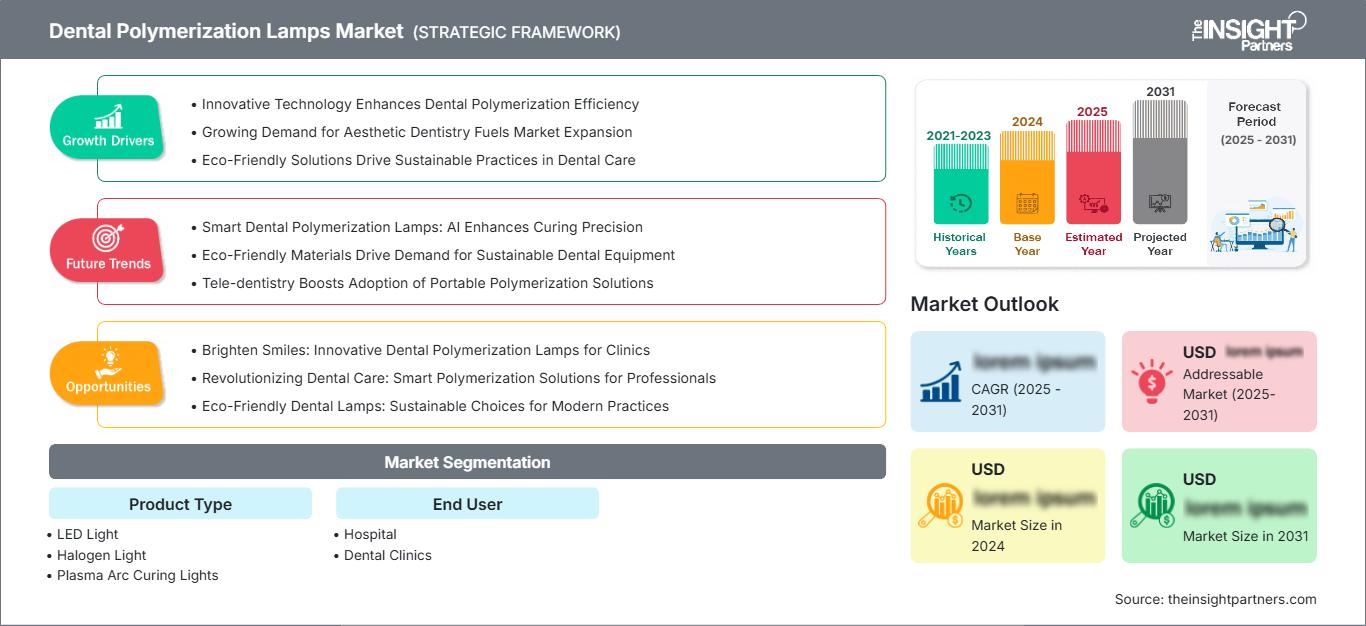
Regional Insights
North America Dental Polymerization Lamps Market
North America is forecasted to constitute 35%-39% of the Dental Polymerization Lamps Market Share in 2025 and grow at a CAGR of 5.8%-6.5% till 2034. The US is the major consumption region backed by a high number of dental practices, advanced dental restoration process, and existing equipment infrastructure. Canada provides demand via its private dental practices, institutions, and upgradations.
LED lights are preferred by regional buyers due to their consistent light intensity, rechargeable mode, ergonomics, and ease in infection control process. Dental practice consolidation is also beneficial for standardization of equipment purchase from multiple locations. Demand for replacement is also driven by requirement for consistency as aged equipment and damaged optical systems can hamper the process of polymerization.
U.S. Dental Polymerization Lamps Market
The United States accounts for roughly 84–88% of the North American market and is expected to register a CAGR of 5.7–6.4% between 2024 and 2034. This can be attributed to the prevalence of restorative dental treatments, high equipment availability, and the adoption of LED curing lights. Suppliers have business and clinical relations with independent dental practices, dental service organizations, hospitals, and distributors.
While hospitals look at equipment availability and standard procurement, dental clinics focus on portability, efficiency, battery duration, and workflow integration. Some of the key suppliers who support restorative dental treatments include DENTSPLY SIRONA Inc. and 3M Company. The FDA 510(k) clearance of dental curing lights further adds the element of regulatory documentation to the commercialization considerations of the US suppliers.
Europe Dental Polymerization Lamps Market
Europe is expected to command a share of 27-31% in 2025 with a CAGR of 5.5-6.2% till 2034. Germany leads the regional markets, due to its mature dental manufacturing sector and established laboratory and clinical networks. Restorative dentistry from the UK, France, Italy, and Spain will offer demand support, along with private clinics and equipment replacement.
The UK market will place an emphasis on workflow optimization and equipment serviceability. Germany will enjoy its domestic manufacturing base and technological capabilities. Italy, France, and Spain have stable demand for equipment replacement from independent practices and networked clinics. European purchasing will increasingly include factors like energy efficiency, robustness, ease of cleaning, and lifetime costs apart from price, offering chances for technically advanced LED platforms.
APAC Dental Polymerization Lamps Market
The APAC region accounts for 22% to 26% of demand in 2025 and will grow at a rate of 7.0% to 7.8% during 2025-2034. The largest markets in the region are China, Japan, India, South Korea, and Australia. Growing dental infrastructure and increased treatment capacities drive adoption of the equipment.
Growing industrialization improves manufacturing and distribution capabilities within the region, whereas investments made in public healthcare and growth in private clinics increase the availability of modern dental equipment. The price sensitive market demands reliable basic LED lights, while the sophisticated facilities increasingly look for high-intensity and multi-spectral devices.
Middle East & Africa Dental Polymerization Lamps Market
The Middle East and Africa region is expected to grow at a CAGR of 5.2-6.0% up to 2034. Saudi Arabia will be the major consumer driven by healthcare upgrades, whereas the UAE will be fueled by private spending on dentistry and medical tourism. South Africa continues to be the leading country in Sub-Saharan Africa, followed by other MEA countries that develop more slowly.
Energy and healthcare infrastructure investment fuels new dental centers and equipment renewal. Purchasing decisions are influenced by total cost of ownership, service provision, and reliable distribution channels. Vendors who can offer reliable battery solutions, easy maintenance, and local technical assistance can overcome the procurement barriers of regions where specialist maintenance is not yet common.
Segmentation Analysis
Product Type
LED Light remains the dominant technology, while the Dental Polymerization Lamps Market scope increasingly reflects the transition from conventional illumination toward efficient solid-state systems. The segment is estimated to grow at a 6.3–6.9% CAGR during 2026–2034. Adoption is supported by compact design, reduced maintenance, battery operation, and increasingly sophisticated optical control. Manufacturers are also improving heat management and wavelength coverage to accommodate diverse photoinitiator systems.
- LED Light: The principal technology category, favored for efficient energy use, compact construction, long service life, and compatibility with contemporary restorative workflows. Demand remains strongest where rapid, repeatable curing is important.
- Halogen Light: Used mainly within legacy installed bases and replacement-sensitive practices. Procurement is constrained by bulb replacement, heat generation, and comparatively higher maintenance requirements, limiting its strategic role in new equipment purchases.
- Plasma Arc Curing Lights: Positioned around high-intensity curing applications where rapid exposure is valued. The category remains specialized, with purchasing decisions influenced by clinical workflow, equipment cost, and material compatibility.
- Laser Light: Represents a specialized technology pathway where controlled optical energy and precision are prioritized. Its strategic relevance depends on broader clinical integration, cost justification, and demonstrated compatibility with restorative materials.
End User
The end-user segment is projected to expand at a 6.1–6.8% CAGR during 2026–2034. Procurement differs according to clinical scale, procedure volume, budget, and equipment standardization. Dental clinics account for substantial recurring demand because of their large installed base, while hospitals can generate higher-value procurement programs when restorative equipment is incorporated into broader technology upgrades.
- Hospital: Institutional buyers emphasize equipment reliability, standardized procurement, serviceability, infection-control compatibility, and operational continuity across multiple treatment environments. Replacement cycles are often linked to broader modernization budgets.
- Dental Clinics: Clinics prioritize portability, ease of use, battery performance, curing consistency, and ergonomic handling. Independent practices and multi-site organizations create diverse purchasing patterns ranging from value-focused replacements to premium workflow systems.
Opportunity Snapshot
| End User | Revenue Contribution (High/Medium/Low) | Trend Tag (MAX 2 words) | Adoption Stage |
|---|---|---|---|
| Hospital | Medium | Central Procurement | Scaling |
| Dental Clinics | High | Chairside Efficiency | Mature |
Dental Polymerization Lamps Market Growth Drivers and Impact Analysis
Expansion of Light-Cured Restorative Procedures
The increasing use of resin-based composites, adhesives, sealants, and light-activated cements directly expands the addressable installed base for polymerization equipment. Dental professionals require controlled light energy to achieve adequate polymer conversion, making curing devices integral to restorative workflows rather than optional accessories. This relationship creates recurring demand when clinics introduce additional treatment rooms or replace aging equipment. The commercial impact extends beyond unit sales because compatibility between curing lamps and restorative materials influences purchasing decisions. Suppliers that coordinate material recommendations with curing performance can strengthen customer retention. Procedure growth also encourages investments in higher-output devices that shorten exposure times while maintaining polymerization quality. As restorative treatment becomes more standardized across organized clinic networks, procurement can shift from individual practitioner choices toward fleet-level equipment specifications.
Demand for Faster and More Consistent Clinical Workflows
Dental practices increasingly evaluate equipment according to procedure time, repeatability, ergonomics, and workflow integration. Curing lights directly influence these metrics because inadequate output can require additional exposure cycles, whereas consistent irradiance supports predictable processing. Higher patient throughput can improve utilization of treatment rooms and strengthen the economic case for upgraded devices. The impact is especially relevant to multi-location dental organizations that seek standardized operating procedures across clinicians. Manufacturers therefore compete through beam uniformity, thermal management, battery design, interchangeable tips, and simplified controls rather than relying solely on higher headline irradiance. Training also becomes important because distance and angulation affect delivered energy. Suppliers that combine reliable equipment with clear operating protocols can reduce performance variability and improve the practical value of each installed device.
Modernization of Dental Infrastructure in Emerging Economies
Expansion of private dental clinics, urban healthcare infrastructure, and organized dental service networks across emerging economies is broadening the customer base for polymerization equipment. New facilities typically adopt LED systems instead of extending legacy halogen installations, creating a replacement and greenfield opportunity simultaneously. Local distributors increasingly influence purchasing by providing financing, demonstrations, technical support, and maintenance. The market impact is strongest where dental education and specialist training expand alongside infrastructure, because clinicians become more familiar with performance parameters such as wavelength and irradiance. Manufacturers can address heterogeneous purchasing power through differentiated product tiers, from basic portable LED units to advanced multi-wavelength systems. Localization of assembly, distribution, and service can further reduce lead times and ownership costs while improving access to replacement parts.
Dental Polymerization Lamps Market Future Trends
Multi-Wavelength Curing Architectures
Future devices in the Dental Polymerization Lamps market trends are likely to increasingly support multiple photoinitiator absorption ranges rather than optimizing performance around a single wavelength. This evolution can broaden compatibility with restorative materials and reduce the need for practices to maintain separate curing platforms. Optical engineering will focus on uniform energy distribution across the restoration surface, while embedded controls may allow clinicians to select programs according to material or procedure. Manufacturers are also likely to pair multi-wavelength emitters with thermal monitoring, battery diagnostics, and automatic exposure controls. These developments could shift purchasing criteria from nominal power ratings toward validated energy delivery and material compatibility. Over time, interoperability with manufacturer-specific restorative ecosystems may become a stronger differentiator, particularly among organized clinics seeking standardized equipment across multiple locations and clinical teams.
Connected Monitoring and Predictive Maintenance
Connected curing devices could introduce a more measurable approach to equipment maintenance by tracking operating cycles, battery condition, output performance, and service intervals. Dental organizations managing multiple locations may benefit from centralized visibility into equipment status and replacement requirements. Integrated diagnostics could identify declining output before clinical performance is materially affected, supporting preventive maintenance rather than reactive replacement. Future systems may also connect usage records with training tools, allowing organizations to identify inconsistent curing practices. Such capabilities would create a secondary value proposition around quality assurance and asset management. However, adoption will depend on simple interfaces, cybersecurity safeguards, reasonable connectivity costs, and clear evidence that monitoring improves clinical or operational outcomes. Premium systems are therefore likely to lead adoption before connected functionality becomes broadly standardized.
Dental Polymerization Lamps Market Opportunities
Localized Manufacturing and Distribution in Asia Pacific
The Dental Polymerization Lamps Market Forecasts indicate an opportunity for manufacturers to establish stronger regional production and distribution models in Asia Pacific, where demand is expanding faster than in mature markets. Local assembly can shorten supply chains, reduce import exposure, and enable product configurations suited to regional price points. Partnerships with dental distributors, educational institutions, and clinic groups can accelerate product demonstrations and clinician training. Suppliers should prioritize durable entry-level LED platforms while maintaining premium offerings for technologically advanced practices. Localization can also improve after-sales support, an important purchasing criterion where equipment downtime affects clinic productivity. Investment opportunities extend beyond manufacturing into battery servicing, optical component supply, technical training, and distributor networks. Companies that build regional ecosystems rather than relying solely on imported finished units can improve responsiveness and market coverage.
Workflow-Based Product Bundling
An attractive strategic opportunity lies in bundling curing equipment with restorative materials, adhesives, accessories, and clinical training rather than selling lamps as isolated devices. The approach can help manufacturers differentiate on workflow performance while increasing customer engagement across the restorative procedure. Dental clinics may value validated combinations that reduce uncertainty about wavelength compatibility, curing exposure, and handling requirements. Hospitals can similarly benefit from standardized procurement packages covering equipment, consumables, maintenance, and staff training. Vendors should develop application-specific bundles for direct restorations, indirect cementation, pediatric dentistry, and high-throughput clinical environments. The approach also creates opportunities for recurring revenue through replacement tips, batteries, service contracts, and training programs. Effective bundling requires transparent performance evidence and compatibility information so purchasing decisions remain clinically defensible.
Recent Developments
- August 2026: DENTSPLY SIRONA Inc. reported second-quarter 2026 results, including US$898 million in reported net sales, while announcing an expanded Medline Sinclair relationship to broaden access to its professional dental portfolio. The development reinforces the company's distribution-led commercial strategy and wider technology ecosystem across dental practices.
- May 2026: DENTSPLY SIRONA Inc. launched Smart View - Detect, an FDA-cleared AI-enabled diagnostic aid for identifying teeth with periapical radiolucencies in CBCT scans. Although focused on diagnostics rather than curing equipment, the launch demonstrates continued investment in connected dental workflows and integrated technology platforms.
- January 2026: Ivoclar Vivadent AG introduced Adhese 2, a universal adhesive supporting both light and dual curing. The product expands compatibility across curing modalities and is designed to simplify clinical workflows, demonstrating continued development of restorative systems that depend on controlled polymerization performance.
Frequently Asked Questions

- Comprehensive Market Sizing and Forecast Analysis
- Detailed Segmentation Analysis
- In-Depth Market Dynamics Assessment
- Regional and Country-Level Insights
- Competitive Landscape and Company Benchmarking
- Strategic Business Intelligence
Recent Reports
Testimonials

The Insight Partners' SCADA System Market report is comprehensive, with valuable insights on current trends and future forecasts. The team was highly professional, responsive, and supportive throughout. We are very satisfied and highly recommend their services.
RAN KEDEM Partner, Reali Technologies LTDs
I requested a report on a very specific software market and the team produced the report in a few days. The information was very relevant and well presented. I then requested some changes and additions to the report. The team was again very responsive and I got the final report in less than a week.
JEAN-HERVE JENN Chairman, Future Analytica
We worked with The Insight Partners for an important market study and forecast. They gave us clear insights into opportunities and risks, which helped shape our plans. Their research was easy to use and based on solid data. It helped us make smart, confident decisions. We highly recommend them.
PIYUSH NAGPAL Sr. Vice President, High Beam Global
The Insight Partners delivered insightful, well-structured market research with strong domain expertise. Their team was professional and responsive throughout. The user-friendly website made accessing industry reports seamless. We highly recommend them for reliable, high-quality research services
YUKIHIKO ADACHI CEO, Deep Blue, LLC.
This is the first time I have purchased a market report from The Insight Partners.While I was unsure at first, I visited their web site and felt more comfortable to take the risk and purchase a market report.I am completely satisfied with the quality of the report and customer service. I had several questions and comments with the initial report, but after a couple of dialogs over email with their analyst I believe I have a report that I can use as input to our strategic planning process.Thank you so much for taking the extra time and making this a positive experience.I will definitely recommend your service to others and you will be my first call when we need further market data.
JOHN SUZUKI President and Chief Executive Officer, Board Director, BK Technologies
I wish to appreciate your support and the professionalism you displayed in the course of attending to my request for information regarding to infectious disease IVD market in Nigeria. I appreciate your patience, your guidance, and the fact that you were willing to offer a discount, which eventually made it possible for us to close a deal. I look forward to engaging The Insight Partners in the future, all thanks to the impression you have created in me as a result of this first encounter.
DR CHIJIOKE ONYIA MANAGING DIRECTOR, PineCrest Healthcare Ltd.Reason to Buy
- Informed Decision-Making
- Understanding Market Dynamics
- Competitive Analysis
- Identifying Emerging Markets
- Customer Insights
- Market Forecasts
- Risk Mitigation
- Boosting Operational Efficiency
- Strategic Planning
- Investment Justification
- Tracking Industry Innovations
- Aligning with Regulatory Trends





 Get Free Sample for