
Dental Presses Market Size, Share & Trends by 2034
Coverage: By Type (Hydraulic, Manual, Electronic); Application (Dental Laboratory, Hospital, Others) , and Geography (North America, Europe, Asia Pacific, and South and Central America)
- Status : Data Released
- Report Code : TIPRE00018035
- Category : Life Sciences
- No. of Pages : 150
- Available Report Formats :


- Last update date : September 07, 2026


2025 Market Size
US$ 2.61 Bn
Base year value
2034 Forecast
US$ 4.61 Bn
Projected by 2034
CAGR 2026-2034
6.52 %
Growth rate
Addressable Market
US$ 32.64 Bn
(2026-2034)
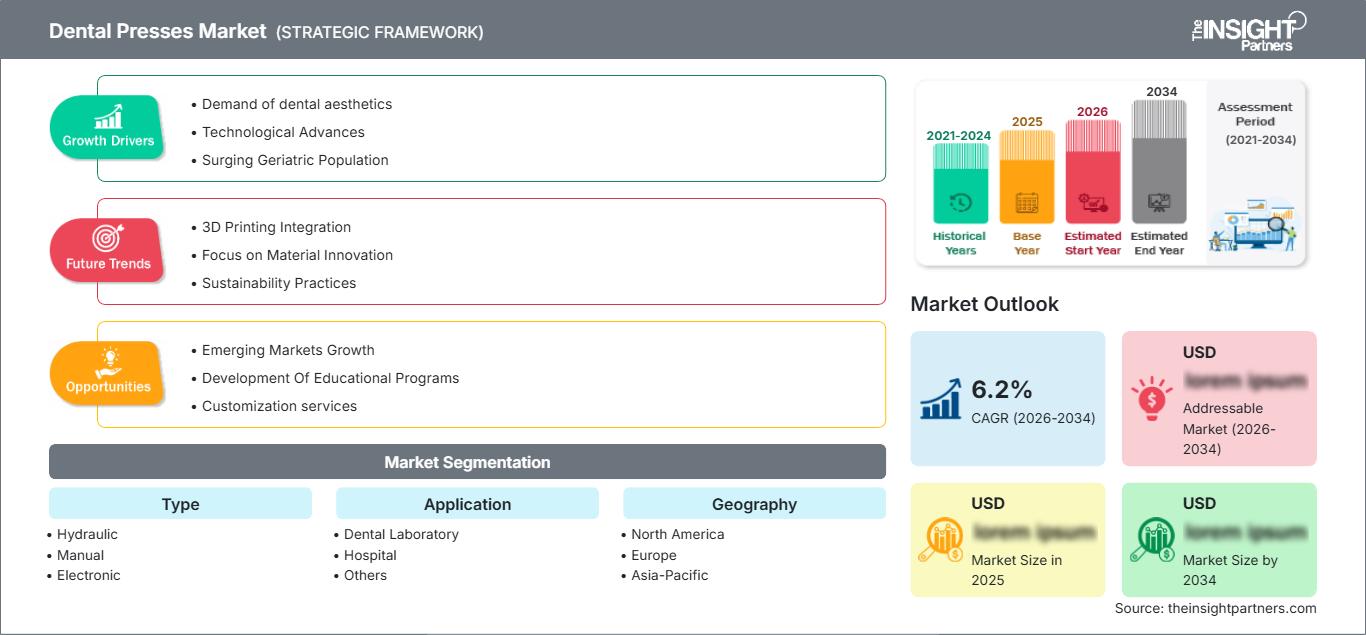
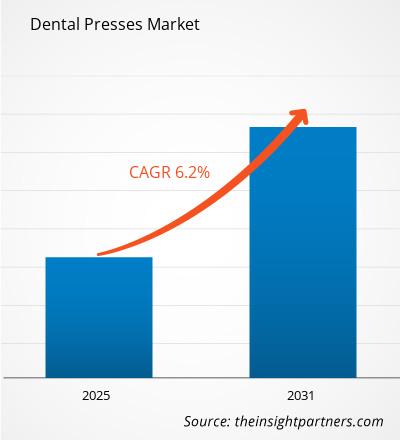
The Dental Presses Market is projected to expand from US$ 2.61 Billion in 2025 to US$ 4.61 Billion by 2034, registering a CAGR of 6.52% during 2026–2034. The market consists of equipment utilized in applying pressure within the processes carried out in the dental laboratories, especially those involving prosthetic and restoration manufacturing. Factors influencing demand include productivity needs of dental labs, equipment replacement needs, workflow standardization, and pressure-based process manufacturing despite the rise in digital manufacturing in dentistry.
North America is projected to continue being an important regional market owing to existing dental lab infrastructure, replacement opportunities, and relatively high utilization of repeatable manufacturing equipment. The Dental Presses market size forecast suggests a modeled CAGR of 6.3% to 6.8% from 2026 to 2034, which will be boosted by investments in productivity equipment among other factors.
Dental Presses Market Assessment and Insights
- North America: North America maintains a substantial installed base, with a modeled share in 2025 of 34–38% and a CAGR between 2026–2034 of 6.3–6.8%, supported by mature laboratories and replacement-led procurement.
- US: The US represents 72–76% of North American demand in 2025, with a CAGR of 6.2–6.7%, reflecting laboratory consolidation and continued equipment modernization.
- Europe: Europe accounts for 28–32% share in 2025 and is projected at 6.0–6.5% CAGR between 2026–2034. Germany, Italy, France, the UK, and Spain provide established laboratory demand and strong equipment manufacturing capabilities.
- Asia Pacific: Asia Pacific holds a modeled 22–26% share in 2025 and is expected to grow at 7.1–7.7% CAGR between 2026–2034. China, Japan, South Korea, and India lead demand through expanding laboratory capacity.
- Largest Segment: Hydraulic equipment represents the largest segment, with a 2025 market share of 52–56% and CAGR of 6.1–6.5%, reflecting dependable force generation and established laboratory usage.
- High Growth Segment: Electronic presses represent the high-growth segment, holding 14–18% share in 2025 and recording 7.4–8.0% CAGR through 2034 as automated control gains relevance.
- Key companies analyzed in detail: Aixin Medical Equipment, CLEMDE Dental, DentalEZ, Inc., Dentalfarm S.r.l., EUROCEM, IP Division Technische Produkte GmbH, SCHULER-DENTAL AG, SILFRADENT SRL, Sirio Dental S.R.L., Wassermann Dental-Maschinen GmbH.
Source: The Insight Partners' analysis based on proprietary research, government publications, company annual reports, investor presentations, industry databases, and expert interviews.
The technology used in production processes is evolving to facilitate pressure consistency, operator ergonomics, and repeatability of the process. Hydraulically powered machines are still useful for they generate significant forces without the need for complicated electronic technology; however, electronically controlled systems are gaining popularity due to their programming and monitoring capabilities. Competing on size, durability, maintainability, and ability to integrate into the laboratory procedures are additional strategies for manufacturers.
During the forecast period, opportunities will increase in new dental production centers where equipment replacement is not as prevalent and laboratory facilities continue expanding. Purchases are likely to focus on machines that offer both excellent mechanical properties and digital technologies, while regulations and safety standards continue having a great impact on purchase decisions.
Dental Presses Market Report Scope
| Report Attribute | Details |
|---|---|
| Market size in 2025 | US$ 2.61 Billion |
| Market Size by 2034 | US$ 4.61 Billion |
| Global CAGR (2026 - 2034) | 6.52% |
| Historical Data | 2021-2024 |
| Forecast period | 2026-2034 |
Dental Presses Market Analysis
Dental Presses Market Drivers include ongoing requirements for the creation of prosthetics, fabrication of dentures, laboratory restoration techniques, and force-based material manipulation. The market participants include equipment producers, material providers, laboratories, distributors, and service providers. The most intense demand exists where there is a need to apply regular forces to fabricate cases. The market supply is affected by metal manufacturing prices, hydraulic systems, electronics, tools, and regional distributors.
Complementary equipment like curing machines, mixers, furnaces, casters, and polishers provides additional value within the value chain, offering opportunities to sell multiple laboratory equipment. Increasingly product differentiation relies on consistency of performance, maintenance needs, space requirement, and compatibility with existing laboratory process flows. Therefore, growth of Dental Presses Market is based not only on unit demand but also on upgrades and expansion of laboratories' capacities.
The market has competitors in both dental equipment specialists and lab equipment specialists. While Dentalfarm specializes in hydraulic pressing machines, Wassermann Dental-Maschinen GmbH offers a wider line-up of dental lab equipment. CLEMDE Dental focuses on pressing technology for flexible prosthetic materials while SILFRADENT SRL provides hydraulic presses in addition to the wider line-up of lab equipment. Aixin Medical Equipment and DentalEZ, Inc. compete with their larger line-ups and distribution networks.
Positioning strategies have moved to focus on the number of applications, reliability, support services, and integration into laboratory processes. IP Division Technische Produkte GmbH, SCHULER-DENTAL AG, Sirio Dental S.R.L., and EUROCEM are also important players in various specialist equipment segments. The Dental Presses Market report highlights that the current investments in the segment are moving towards controllability, modularity, ease of maintenance, and equipment sets that increase lab efficiency without full process replacement.
● REPORT CUSTOMIZATION
Tailor This Report To Align With Your Specific Business Requirements
This report can be customized to align precisely with your business objectives, scope, and target markets. Customization options include tailored segmentation, geography, competitive analysis, and strategic insights to support informed decision-making.
Customize This Report →WHAT YOU CAN ADJUST
- ● Segmentations
- ● Geography
- ● Competitive Analysis
- ● Language Preferences
Dental Presses Market: Strategic Insights
Regional Insights
North America Dental Presses Market
The North America Dental Presses Market Share was modeled at 34-38% in 2025 and is expected to increase at a CAGR of 6.3-6.8% till 2034. Factors driving demand include the presence of developed dental labs, high procedure volumes, consolidation of labs, and repeat purchasing. USA makes up for most of the regional demand whereas Canada contributes through specialized labs and dental services.
Demand for structures will be supplemented by modernization in the labs along with a need for supporting technicians that deal with larger procedure volumes. Bigger labs will be able to afford electronically controlled equipment, while smaller labs will opt for reliable hydraulic or manually operated devices. The distributors in the region may affect purchases through maintenance and spare parts supply. Dental Presses Market share in North America is thus bolstered by not only replacements but also new capacities, rather than first-time acquisitions alone.
U.S. Dental Presses Market
The United States holds an estimated 72-76% share of North American demand in 2025 and is forecast to register a 6.2-6.7% CAGR. The market share is underpinned by abundant laboratory capacity, widespread utilization of dental services, and the availability of laboratory equipment. The market includes independent laboratories, consolidated laboratories, dental facilities, and institutions that require controlled fabrication process.
Application trends will increasingly lean toward equipment that minimizes the variability from manual processes and enables repeatable process workflow. Companies like DentalEZ, Inc. belong to the wider market of US laboratory equipment while specialty equipment providers market their products via distributors. Factors considered during the procurement process include service response, equipment lifespan, training requirements, and integration with current laboratory equipment. As such, replacement may be as important a factor as the creation of new laboratories in ensuring demand up to 2034.
Europe Dental Presses Market
Europe had a modeled market share of 28-32% in 2025 and is expected to expand at 6.0–6.5% CAGR till 2034. Germany is the most dominant country due to the strong dental manufacturing industry and developed laboratory infrastructure. Italy is another contributor due to its specialists in equipment production and export-oriented manufacturing.
United Kingdom and Germany have advanced laboratory markets that are driven by replacement considerations, productivity issues, and the dependability of equipment. Germany is favored by the technical manufacturing skills as well as the dense network of specialists. Italy has both a domestic market and international manufacturers of its products. The other markets in Europe include those in France and Spain, which are driven by dental clinics, laboratories, and prosthetics services.
APAC Dental Presses Market
APAC was a modeled 22–26% share in 2025 and will grow at 7.1–7.7% CAGR. The major countries include China, Japan, South Korea, India, and Australia. Increase in dental laboratory capacity and sophistication drive demand in large cities.
Rising industrialization, improvements in healthcare infrastructure, and availability of dental services provide further procurement opportunities. China possesses both manufacturing and domestic markets while India has growth potential in terms of expanding laboratories and private dental services. Precision and process efficiency are key for Japan and South Korea, while Australia represents replacement demands in the matured laboratories. This leads to diverse needs for manual, hydraulic, and electronically-controlled systems.
Middle East & Africa Dental Presses Market
The demand for MEA is expected to rise at a forecast rate of 6.4-6.9% CAGR during 2034, with Saudi Arabia being the major market player in this region. The UAE functions as the key distributor and healthcare hub, and South Africa as the one with a set of well-established laboratories.
The investments in the healthcare infrastructure made by Saudi Arabia help in modernizing the dental laboratories and facilities. UAE demand is affected by private healthcare and international patient inflow, while South Africa includes both the well-established laboratories and replacements. Other MEA regions depend on the distributor's reach, import costs, and infrastructure availability.
Segmentation Analysis
Type
Type segmentation comprises Hydraulic, Manual, and Electronic equipment. Hydraulic systems remain dominant because they provide substantial and stable force for established laboratory procedures. Manual units serve cost-sensitive environments and smaller workloads, while electronic systems address requirements for programmable control and process consistency. Type-level competition will increasingly depend on the balance between acquisition cost, control precision, serviceability, and operator productivity.
- Hydraulic: Hydraulic presses remain the principal equipment choice for laboratories requiring dependable force application, robust construction, and compatibility with established prosthetic processing workflows.
- Manual: Manual presses address laboratories prioritizing straightforward operation, lower equipment complexity, and affordability, particularly where production volumes do not justify automated controls.
- Electronic: Electronic presses offer programmable operation and greater process monitoring, making them strategically relevant for laboratories seeking improved repeatability, workflow standardization, and reduced operator variability.
Application
Application segmentation includes Dental Laboratory, Hospital, and Others. Dental laboratories remain the central application because pressing equipment is closely associated with prosthetic and restorative fabrication workflows. Hospitals use such systems selectively where in-house dental or maxillofacial laboratory capabilities exist. The application structure is influenced by laboratory volumes, procurement budgets, workflow specialization, and the degree of centralized dental production.
- Dental Laboratory: Dental laboratories represent the core application base, with demand linked to prosthetic production, technician workflows, equipment replacement, and the need for consistent processing across recurring cases.
- Hospital: Hospitals use presses selectively for specialized dental, prosthetic, and maxillofacial applications, with procurement influenced by in-house laboratory capacity and institutional equipment standards.
- Others: Other applications include specialized institutional and technical environments where pressing requirements are occasional, making equipment versatility, compactness, and low maintenance strategically important.
Opportunity Snapshot
| Application | Revenue Contribution (High/Medium/Low) | Trend Tag (MAX 2 words) | Adoption Stage (Emerging/Scaling/Mature) |
| Dental Laboratory | High | Lab Throughput | Mature |
| Hospital | Medium | In-house Prosthetics | Scaling |
| Others | Low | Specialized Fabrication | Emerging |
Dental Presses Market Growth Drivers and Impact Analysis
Rising Dental Laboratory Throughput Requirements
Higher laboratory throughput requirements are encouraging operators to evaluate equipment according to productivity, repeatability, and operator time rather than acquisition price alone. Consolidation of laboratory operations can increase case volumes at centralized facilities, creating a stronger economic rationale for durable presses and electronically controlled alternatives. The market impact extends beyond equipment purchases because higher utilization also increases demand for maintenance, replacement components, tooling, and technical support. Manufacturers capable of demonstrating consistent force application and straightforward servicing can therefore strengthen recurring revenue opportunities. Smaller laboratories remain more price-sensitive, creating room for differentiated product tiers. This demand structure favors suppliers that can offer multiple equipment configurations without compromising core pressure performance. As laboratories professionalize workflow management, equipment selection increasingly becomes part of broader capacity planning rather than an isolated capital purchase.
Expansion of Prosthetic and Restorative Dental Services
Increasing access to restorative and prosthetic dental services supports equipment demand by expanding the volume of laboratory-produced components and appliances. Greater dental service availability in developing urban markets creates opportunities for laboratories to add capacity, while mature markets generate replacement demand as installed equipment ages. Presses remain relevant because many laboratory workflows continue to combine conventional and digital production methods rather than replacing one process entirely. The resulting hybrid environment supports equipment that can operate reliably alongside scanners, milling systems, furnaces, and polymer-processing tools. Manufacturers can benefit when their equipment fits within these mixed workflows and does not require extensive process redesign. Demand is consequently influenced by the breadth of laboratory applications supported, ease of training, and compatibility with existing technical procedures.
Demand for Consistent and Controlled Processing
Greater emphasis on process consistency is increasing the strategic value of controlled pressing systems. Manual pressure application can introduce operator variation, whereas hydraulic and electronic equipment can improve repeatability when properly calibrated and maintained. This distinction becomes more important as laboratories standardize workflows across multiple technicians or locations. Electronic systems can additionally support programmable operating parameters, potentially reducing dependence on individual operator technique. The impact is strongest in higher-volume laboratories where small process variations can accumulate into material waste, rework, or longer production times. Suppliers can respond by improving pressure monitoring, control interfaces, safety features, and service diagnostics. The resulting differentiation encourages gradual migration from basic mechanical systems toward equipment that provides greater visibility into operating conditions without eliminating established pressing methods.
Dental Presses Market Future Trends
Integration with Digitally Coordinated Laboratory Workflows
Future equipment development is likely to connect pressing operations more closely with digitally coordinated laboratory workflows. Instead of treating a press as an isolated mechanical device, manufacturers can introduce interfaces that record operating parameters, maintenance events, and process settings. Such connectivity could support standardized production recipes across laboratories, improve technician training, and simplify troubleshooting. The trend may be particularly relevant to multi-site laboratory groups seeking common operating procedures. Digital coordination could also allow equipment performance data to inform preventive maintenance, reducing unexpected downtime. However, adoption will depend on practical value, cybersecurity considerations, interface simplicity, and compatibility with existing laboratory software. Systems that provide useful operational information without imposing complex infrastructure requirements are likely to gain greater acceptance among laboratories transitioning toward increasingly connected production environments.
Hybrid Production Combining Conventional Pressing and Digital Fabrication
A second emerging Dental Presses Market trend is the continued coexistence of conventional pressing with additive and subtractive digital fabrication. Rather than disappearing, pressure-based methods can remain relevant for selected materials, appliance types, and workflows where established laboratory expertise provides cost or performance advantages. Digital technologies can complement these methods by improving design, modeling, case documentation, and upstream preparation. Manufacturers may therefore develop presses that fit within broader hybrid production cells instead of competing directly with digital equipment. This approach creates opportunities for modular systems, standardized fixtures, and workflow documentation. Over time, purchasing decisions are likely to focus less on whether a process is analog or digital and more on which combination delivers acceptable quality, throughput, labor efficiency, and material utilization for a particular laboratory application.
Dental Presses Market Opportunities
Localized Manufacturing and Distributor-Led Expansion
Emerging dental production centers provide opportunities for manufacturers to develop localized distribution, service, and assembly strategies. Buyers in these markets may prioritize equipment availability, spare-parts access, technical training, and total ownership cost over advanced automation alone. Suppliers can respond by establishing regional partnerships that shorten delivery times and improve after-sales support. Localized configurations may also address differences in electrical standards, laboratory space, technician skill levels, and procurement practices. Dental Presses Market Forecasts point toward sustained opportunity where laboratory infrastructure is expanding faster than installed equipment replacement cycles. Investment strategies should therefore evaluate not only market size but also distributor capability, service economics, import requirements, and training infrastructure. A strong local support model can reduce adoption barriers and create durable relationships with laboratories entering formalized production workflows.
Specialized Pressing Systems for Advanced Dental Materials
Material innovation creates a distinct opportunity for equipment suppliers to design pressing systems around specific processing requirements. Flexible polymers, high-performance thermoplastics, and advanced restorative materials may require controlled temperature, force, timing, or injection conditions that differ from conventional workflows. Manufacturers can capture value by combining presses with compatible heating, molding, or curing equipment and by providing validated operating protocols. This strategy can shift competition from hardware specifications toward complete application solutions. The opportunity is particularly relevant for specialist laboratories seeking to expand material capabilities without building entirely new production lines. Companies investing in application engineering, technician education, and material-equipment compatibility can potentially establish stronger differentiation than suppliers competing primarily on mechanical force or purchase price.
Recent Developments
- June 2025: CLEMDE SA DE CV received a US FDA 510(k) decision for Partial Flex, with the agency determining the device substantially equivalent to a legally marketed predicate. The clearance covers fabrication of partial or full removable dentures and related dental applications through injection molding, strengthening the regulatory foundation for CLEMDE's flexible-material processing portfolio.
- 2025: Dentalfarm S.r.l. continued commercial availability of its A5701 hydraulic press, which accommodates multiple flasks and uses a hydraulic circuit designed for laboratory pressing. A 2025 dental-equipment promotion also listed the A5701 PRESS, indicating continued distribution activity for the established hydraulic platform in European laboratory channels.
- 2025/2026: Wassermann Dental-Maschinen GmbH published its 2025/26 product catalogue and continued listing its WW-33 hydraulic press and APR-1 ejection press within its laboratory equipment portfolio. The company also highlights ongoing product development and manufacturing in Germany, supporting its positioning across dental laboratories and related technical applications.
Frequently Asked Questions

- Comprehensive Market Sizing and Forecast Analysis
- Detailed Segmentation Analysis
- In-Depth Market Dynamics Assessment
- Regional and Country-Level Insights
- Competitive Landscape and Company Benchmarking
- Strategic Business Intelligence
Recent Reports
Testimonials

The Insight Partners' SCADA System Market report is comprehensive, with valuable insights on current trends and future forecasts. The team was highly professional, responsive, and supportive throughout. We are very satisfied and highly recommend their services.
RAN KEDEM Partner, Reali Technologies LTDs
I requested a report on a very specific software market and the team produced the report in a few days. The information was very relevant and well presented. I then requested some changes and additions to the report. The team was again very responsive and I got the final report in less than a week.
JEAN-HERVE JENN Chairman, Future Analytica
We worked with The Insight Partners for an important market study and forecast. They gave us clear insights into opportunities and risks, which helped shape our plans. Their research was easy to use and based on solid data. It helped us make smart, confident decisions. We highly recommend them.
PIYUSH NAGPAL Sr. Vice President, High Beam Global
The Insight Partners delivered insightful, well-structured market research with strong domain expertise. Their team was professional and responsive throughout. The user-friendly website made accessing industry reports seamless. We highly recommend them for reliable, high-quality research services
YUKIHIKO ADACHI CEO, Deep Blue, LLC.
This is the first time I have purchased a market report from The Insight Partners.While I was unsure at first, I visited their web site and felt more comfortable to take the risk and purchase a market report.I am completely satisfied with the quality of the report and customer service. I had several questions and comments with the initial report, but after a couple of dialogs over email with their analyst I believe I have a report that I can use as input to our strategic planning process.Thank you so much for taking the extra time and making this a positive experience.I will definitely recommend your service to others and you will be my first call when we need further market data.
JOHN SUZUKI President and Chief Executive Officer, Board Director, BK Technologies
I wish to appreciate your support and the professionalism you displayed in the course of attending to my request for information regarding to infectious disease IVD market in Nigeria. I appreciate your patience, your guidance, and the fact that you were willing to offer a discount, which eventually made it possible for us to close a deal. I look forward to engaging The Insight Partners in the future, all thanks to the impression you have created in me as a result of this first encounter.
DR CHIJIOKE ONYIA MANAGING DIRECTOR, PineCrest Healthcare Ltd.Reason to Buy
- Informed Decision-Making
- Understanding Market Dynamics
- Competitive Analysis
- Identifying Emerging Markets
- Customer Insights
- Market Forecasts
- Risk Mitigation
- Boosting Operational Efficiency
- Strategic Planning
- Investment Justification
- Tracking Industry Innovations
- Aligning with Regulatory Trends





 Get Free Sample for