
Dental Prosthetics Market Growth, Demand & Size by 2034
Coverage: By Product Type (Crowns, Bridges, Dentures, Veneers / Inlays & Onlays, Abutments, Dental Implants), Material Type (Metal / Metal Alloys, Ceramic, Composites / Polymers, and Others), End User (Dental Hospitals & Clinics, Dental Laboratories, Other), and Geography (North America, Europe, Asia Pacific, the Middle East and Africa, and South and Central America)
- Status : Data Released
- Report Code : TIPRE00043074
- Category : Life Sciences
- No. of Pages : 150
- Available Report Formats :


- Last update date : September 08, 2026


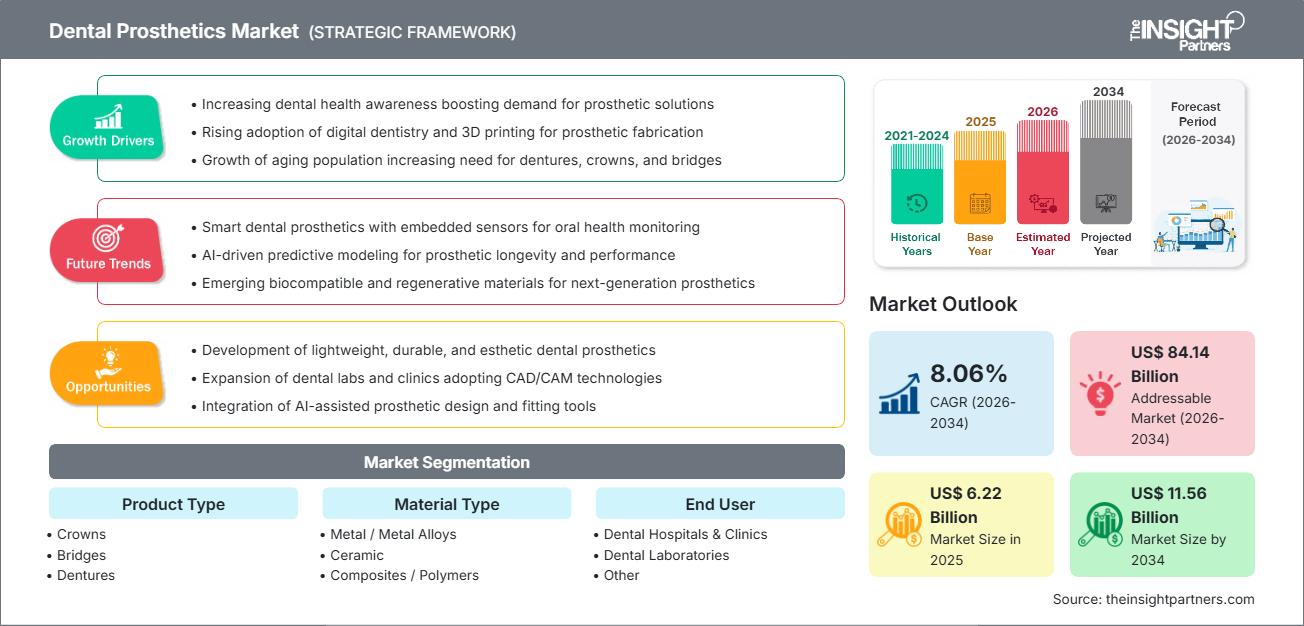
2025 Market Size
US$ 6.22 Bn
Base year value
2034 Forecast
US$ 11.56 Bn
Projected by 2034
CAGR 2026-2034
8.06 %
Growth rate
Addressable Market
US$ 84.14 Bn
(2026-2034)
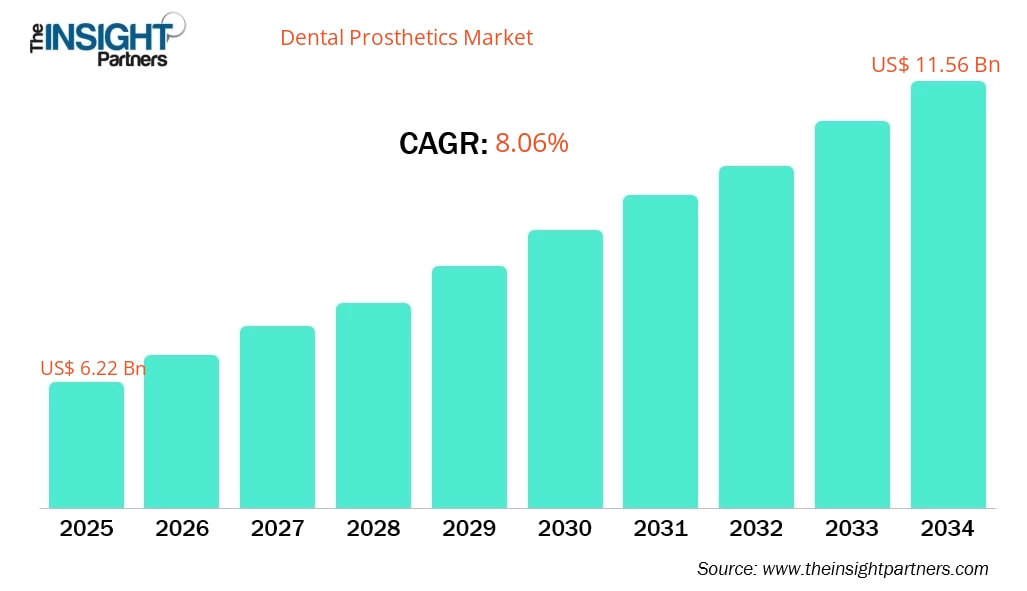
The Dental Prosthetics Market is projected to expand from US$ 6.22 Billion in 2025 to US$ 11.56 Billion by 2034, registering a CAGR of 8.06% from 2026 to 2034. The market includes restorative and replacement products such as crowns, bridges, dentures, veneers, abutments, and implants driven by rising volume of restorative treatments, digital dentistry, material advancements, and availability of dental laboratory and chairside manufacturing technologies.
North America will continue to be a structurally attractive market due to established dental infrastructure, high prevalence of restorative treatments, and fast adoption of digital technologies. The Dental Prosthetics Market Size in this region is estimated to be influenced by the CAGR of 7.20–7.70% from 2026 to 2034.
Dental Prosthetics Market Assessment and Insights
- North America: The region is expected to represent a 36–40% share in 2025, with the Dental Prosthetics Market growing at a CAGR of 7.20–7.70% between 2026 and 2034, supported by established restorative care and digital workflows.
- US: The US is estimated to account for 83–87% of North America's 2025 market, expanding at a CAGR of 7.10–7.60% between 2026 and 2034 as clinics increasingly adopt digitally designed restorations.
- Europe: Europe is projected to hold a 27–30% share in 2025 and grow at a CAGR of 7.60–8.10% between 2026 and 2034, led by Germany, the UK, France, Italy, and Spain, with mature laboratory networks supporting adoption.
- Asia Pacific: Asia Pacific is estimated at a 22–25% share in 2025 and is projected to grow at a CAGR of 9.00–9.50% between 2026 and 2034, led by China, Japan, South Korea, and India through expanding dental capacity.
- Largest Segment: Crowns are estimated to command a 25–29% market share in 2025, with a CAGR of 7.40–7.90% between 2026 and 2034, reflecting broad restorative utilization.
- High Growth Segment: Dental Implants are estimated at an 18–22% market share in 2025, expanding at a CAGR of 9.20–9.80% between 2026 and 2034, supported by replacement and implant-supported restoration demand.
- Key companies analyzed in detail: Institut Straumann AG, Envista Holdings Corporation, DENTSPLY Sirona, Inc., Zimmer Biomet Holdings, Inc., Henry Schein, Inc., Mitsui Chemicals, Inc., Osstem Implant Co., Ltd., BioHorizons IPH, Inc., Cortex Dental Implants Industries Ltd., and Dentium Co., Ltd.
Source: The Insight Partners' analysis based on proprietary research, government publications, company annual reports, investor presentations, industry databases, and expert interviews.
The process of making dental prosthetics has shifted from manual laboratory processes to digitally controlled processes that include intraoral scanning, design using CAD, milling, and even 3D printing. The choice of materials used for making such devices has also changed since zirconium, lithium disilicate, resins and even high performance polymers have been added to the already available metals. Such processes will lead to a reduction in reworks and improvement in reproducibility and allow the laboratories to make central manufacturing of the product. Hence, The Dental Prosthetics Market can be seen as being able to connect the process of clinical diagnosis and standardized digital production.
In future, there will be wider adoption of the technology in other markets where there will be investment made by laboratories and clinics in the Asia Pacific region and selected economies in the Middle East. It is important to note that regulatory focus will be made on traceability, material safety, and device quality. This will mean that suppliers who are able to maintain specifications of the products will get a competitive advantage.
Dental Prosthetics Market Report Scope
| Report Attribute | Details |
|---|---|
| Market size in 2025 | US$ 6.22 Billion |
| Market Size by 2034 | US$ 11.56 Billion |
| Global CAGR (2026 - 2034) | 8.06% |
| Historical Data | 2021-2024 |
| Forecast period | 2026-2034 |
Dental Prosthetics Market Analysis
Demand is influenced by tooth loss, restorative therapy needs, the need for replacement of old prosthetic appliances, and the patient’s need for durable and esthetically satisfactory restoration. The Dental Prosthetics Market growth path also takes into account increasing clinical acceptance of implants-based restoration and digital crowns fabrication. The market comprises the following players: material suppliers, implant producers, dental labs, distributors, clinics, hospitals, software firms, and equipment makers, thus providing many opportunities for value capturing.
Supply drivers more and more go in favor of vertically integrated manufacturers, who can link materials, components, design databases, manufacturing machines, and clinical procedures. The dental lab will continue playing an intermediary role due to its ability to translate clinical indications into customized restoration. Outsourced central milling services and outsourced CAD/CAM technology may help reduce capital expenditures of small labs, whereas chairside solutions would enable select clinics to shorten the process of treatment.
Competitive positioning now relies heavily on portfolio diversification, clinical evidence, workflow integration, and lab integration. Institut Straumann AG offers combined implant and prosthetics capabilities, while Envista Holdings Corporation offers a diversified dental portfolio ranging from implant, restorative, imaging, to workflow solutions. The focus of DENTSPLY Sirona, Inc. is on digital dentistry integration, while Henry Schein, Inc. makes its contribution by distribution and connectivity. Thus, the Dental Prosthetics Market Report requires an account for product differentiation and ecosystems access.
In terms of strategic investments, companies invest in digital manufacturing, differentiated biomaterials, implant-prosthetic compatibility, and education. Companies that invest in implant-linked restorative pathways include Zimmer Biomet Holdings, Inc., Osstem Implant Co., Ltd., and Dentium Co., Ltd. Mitsui Chemicals, Inc. is engaged in materials development. Ivoclar is not among the group of analyzed companies, which is in line with provided competitive universe. Specialized companies including BioHorizons IPH, Inc. and Cortex Dental Implants Industries Ltd. are competing in the market through implant and restorative offerings.
● REPORT CUSTOMIZATION
Tailor This Report To Align With Your Specific Business Requirements
This report can be customized to align precisely with your business objectives, scope, and target markets. Customization options include tailored segmentation, geography, competitive analysis, and strategic insights to support informed decision-making.
Customize This Report →WHAT YOU CAN ADJUST
- ● Segmentations
- ● Geography
- ● Competitive Analysis
- ● Language Preferences
Dental Prosthetics Market: Strategic Insights
Regional Insights
North America Dental Prosthetics Market
In 2025, North America will contribute 36% to 40% and Dental Prosthetics Market Share of 7.20% to 7.70% until 2034. The United States will be responsible for the largest activities in the region, with Canada participating by virtue of their private dental practices, specialists, and laboratories. Heavy usage of restorative procedures, demand for replacement among older people, and insurance coverage will enable the region’s robust buying environment. Digital impressions and CAD/CAM manufacturing increasingly influence laboratory purchases.
The regional supply landscape has the advantage of well-established distributors, professional dental technicians, and strong manufacturer-clinic relationships. Buying decisions are increasingly based on delivery time, esthetic appearance, fitment, and long-term performance and not necessarily on cost of purchase alone. Digital manufacturing enables standardization of the quality control process in multi-location laboratories. As treatment planning becomes more data-intensive, North American buyers will be expected to prefer suppliers that offer integration solutions.
U.S. Dental Prosthetics Market
Estimations predict that the US will account for 83–87% of the North American 2025 market, registering a CAGR of 7.10–7.60% during the period of 2022 to 2034. Demand is diversified from large dental service organizations, independent practices, hospitals, and laboratories. Crowns and bridges are the base, but implants and digital dentures become more important. Envista Holdings Corporation, DENTSPLY Sirona, Inc., Henry Schein, Inc., and Zimmer Biomet Holdings, Inc. are companies having significant commercial footprint.
There is a tendency of application development in the direction of same-day or reduced visits restorations, especially in cases when dental clinics have intraoral scanning and chairside manufacturing capabilities. The lab is still important in cases when multilayered ceramics, abutments, or complex full-arch restoration is needed. Other important aspects are related to reimbursement issues, technicians availability, compliance requirements, and interoperability between scanners, software, and manufacturing.
Europe Dental Prosthetics Market
Europe will account for 27–30% by 2025, growing at a CAGR of 7.60–8.10% until 2034. In the region, Germany will be the primary country. It will be supported by its advanced laboratory infrastructure and high demand for esthetic restorations dentistry and digital production. The major countries will include Germany, the United Kingdom, France, Italy, and Spain. However, the procurement approach will vary greatly.
The UK market is characterized by the presence of private dentistry and digitized laboratories. Germany has an advanced dental laboratory infrastructure and manufacturing capacity. France, Italy, and Spain have matured clinical markets and use CAD/CAM systems more extensively in private restorative dentistry. In Europe, the factors that play a role in purchases include material certification, regulatory control of devices, laboratory requirements, and traceability. The manufacturers capable of combining quality with efficiency in digital solutions will increase their market share.
APAC Dental Prosthetics Market
APAC will constitute a 22-25% market share in 2025 and witness a CAGR of 9.00-9.50% till 2034. China will lead the market, followed by Japan, South Korea, India, and Australia. Growth will be supported by growth in dental facilities, rise in specialists, and higher implant-supported restorations demand. The local production is also favorable due to cost-sensitive purchasing.
Policy support, expansion in private clinics, upgrading of laboratories, and medical tourism will support adoption. Japan prioritizes high-quality products and aging population requiring restorations, China and India will provide large patient bases and growing networks of providers. South Korea will continue dominating in implants manufacturing and Australia will have strong clinical expertise. Therefore, the APAC Dental Prosthetics Market share will shift towards digital and locally scalable production.
Middle East & Africa Dental Prosthetics Market
Middle East & Africa is growing from a small base, with Saudi Arabia and UAE being the key Gulf market players and South Africa driving sub-Saharan region. Regional development is driven by private investments into healthcare industry, specialized dentistry centers, medical tourism, and greater accessibility to advanced restorative solutions. Development of the healthcare industry in Saudi Arabia and international patient facilities in UAE provide additional boost.
Energy income is used for building healthcare infrastructure in Gulf countries, while laboratory infrastructure varies among other regional countries. RoMEA is forecasted to become increasingly dependent on component imports, lab facilities, and distributors. Growth potential of the region is, thus, related to development of infrastructure, education of clinicians, affordability and availability of digital prosthetic systems.
Segmentation Analysis
Product Type
Product Type is expected to expand at a CAGR of 8.30–8.80% between 2026 and 2034. The segment spans conventional restorations and implant-linked solutions, creating different purchasing cycles across clinics and laboratories. Crowns and bridges benefit from recurring restorative requirements, while implants support higher-value treatment pathways. The Dental Prosthetics Market scope increasingly reflects convergence between restorative materials, digital design, and implant components.
- Crowns: Crowns remain central to restorative workflows because they address damaged or treated teeth across anterior and posterior indications. Demand increasingly favors digitally designed, esthetic, durable restorations.
- Bridges: Bridges retain importance where patients require fixed tooth replacement without implant placement. Laboratories increasingly use digital frameworks to improve fit, consistency, and production repeatability.
- Dentures: Dentures serve partially and completely edentulous patients, with digital denture workflows improving customization, record preservation, and manufacturing efficiency across laboratory networks.
- Veneers / Inlays & Onlays: These conservative restorations support esthetic and tooth-preserving treatment strategies. Material advances and digital design improve consistency while expanding indications for minimally invasive restorative care.
- Abutments: Abutments connect implant fixtures with final restorations and require precise dimensional compatibility. Customized digital abutments support individualized emergence profiles, esthetics, and prosthetic positioning.
- Dental Implants: Dental implants support durable tooth replacement and implant-retained prostheses. Demand is strengthened by edentulism management, clinician familiarity, and improved digital planning and restorative coordination.
Material Type
Material Type is projected to grow at a CAGR of 7.50–7.90% between 2026 and 2034. Selection increasingly balances strength, esthetics, biocompatibility, machinability, cost, and workflow compatibility. Ceramic systems are gaining attention for esthetic applications, while metals retain relevance where mechanical performance and established laboratory processes remain decisive. The Dental Prosthetics Market analysis indicates material diversification will remain a major competitive variable.
- Metal / Metal Alloys: Metals and alloys retain applications requiring mechanical strength, established processing methods, and long clinical experience. Their durability supports selected crowns, frameworks, bridges, and implant components.
- Ceramic: Ceramic materials are strategically important for esthetic restorations because they offer tooth-like optical characteristics. Digital milling and improved strength profiles support broader clinical adoption.
- Composites / Polymers: Composites and polymers provide flexibility in temporary, removable, and selected definitive applications. Their processability and compatibility with additive manufacturing create further laboratory opportunities.
- Others: Other materials encompass specialized formulations and emerging systems used for specific clinical or manufacturing requirements. Their role is shaped by innovation, regulatory acceptance, and compatibility.
End User
End User segment in the Dental Prosthetics Market is expected to register a CAGR of 7.80–8.20% between 2026 and 2034. Dental hospitals and clinics increasingly influence material and component selection through treatment protocols, while laboratories remain critical for customized fabrication. Procurement is gradually shifting toward integrated suppliers capable of supporting digital impressions, design, manufacturing, and restorative delivery. Workflow interoperability will remain central to end-user decisions.
- Dental Hospitals & Clinics: Hospitals and clinics increasingly adopt digital scanning, treatment planning, and selected chairside production capabilities. Their procurement priorities include turnaround time, clinical reliability, interoperability, and patient experience.
- Dental Laboratories: Laboratories remain the principal customization hub for complex restorations. Investment in CAD/CAM, milling, printing, and centralized production allows laboratories to improve throughput and manage increasingly diverse restorative specifications.
- Other: Other end users include specialized care settings and institutional providers. Their purchasing patterns generally emphasize standardized supply, procedural reliability, and access to qualified restorative services.
Opportunity Snapshot
| End User | Revenue Contribution (High/Medium/Low) | Trend Tag (MAX 2 words) | Adoption Stage |
|---|---|---|---|
| Dental Hospitals & Clinics | High | Chairside CAD | Scaling |
| Dental Laboratories | High | Digital Milling | Mature |
| Other | Low | Specialist Care | Emerging |
Dental Prosthetics Market Growth Drivers and Impact Analysis
Rising Burden of Tooth Loss and Restorative Treatment
Population aging, cumulative dental disease, trauma, and treatment-related tooth loss create a recurring requirement for restorative and replacement solutions. The World Health Organization continues to position oral health within broader universal health coverage and noncommunicable disease strategies, reinforcing the importance of accessible treatment and rehabilitation. Commercially, this expands the addressable pool for crowns, bridges, dentures, and implant-supported restorations. Demand is not limited to first-time procedures because prostheses require maintenance, repair, and eventual replacement. Suppliers can therefore benefit from recurring clinical workflows rather than one-off treatment episodes. The impact is strongest where aging populations coincide with expanding private dental capacity. Manufacturers with broad restorative portfolios can capture value across multiple stages of the patient journey while laboratories gain opportunities from higher case complexity and customization.
Digital Dentistry Accelerates Production Efficiency
Digital impressions, CAD design, centralized milling, and additive manufacturing are changing how restorations move from prescription to delivery. Digital workflows reduce dependence on repeated physical impressions and can improve communication between dentists and technicians. They also allow production files to be stored, modified, and reproduced when replacement becomes necessary. This creates operational benefits for laboratories managing high case volumes and multi-location dental organizations seeking consistent protocols. The commercial impact extends beyond equipment sales because scanners, software, materials, manufacturing services, and compatible prosthetic components become interconnected purchases. Straumann's current portfolio illustrates this direction through customized prosthetics, digital services, and integrated laboratory workflows. As digital adoption spreads, suppliers that maintain open interfaces and validated material libraries can increase customer retention while reducing switching incentives within the production ecosystem.
Material Innovation Raises Performance and Esthetic Expectations
Advances in ceramics, polymers, composites, titanium-based components, and hybrid restorative systems are widening the range of clinically viable prosthetic solutions. Patients increasingly expect restorations that combine natural appearance with durability, while clinicians require predictable fit and manageable chairside or laboratory processing. Material innovation responds to these requirements by improving optical properties, fracture resistance, machinability, and workflow compatibility. For manufacturers, differentiated materials can support premium positioning and create recurring demand through proprietary discs, blocks, components, or compatible systems. Laboratories benefit when new materials can be processed through existing digital equipment without substantial workflow disruption. Regulatory validation remains essential because performance claims must be supported by appropriate evidence and quality controls. Over time, successful material platforms can influence restoration design preferences and reshape procurement toward suppliers offering complete material-to-manufacturing solutions.
Dental Prosthetics Market Future Trends
AI-Assisted Design and Automated Quality Control
Artificial intelligence is expected to become increasingly embedded in prosthetic design, case triage, margin detection, occlusal assessment, and manufacturing quality control. Rather than replacing clinicians or technicians, AI tools are likely to handle repetitive interpretation tasks and flag potential inconsistencies before production. This could reduce design time for routine crowns and bridges while allowing technicians to concentrate on complex aesthetic and full-arch cases. Cloud-based software may also enable continuous updates to design libraries and quality algorithms. The commercial opportunity will favor vendors capable of integrating AI into existing scanning, CAD, and laboratory platforms without requiring complete workflow replacement. Over the forecast period, interoperability, explainability, cybersecurity, and validation will become increasingly important purchasing criteria as automated recommendations move closer to clinical decision points and regulated production environments.
Patient-Specific Full-Arch and Hybrid Restoration Workflows
Full-arch rehabilitation is likely to become more standardized through combinations of digital planning, guided implant placement, customized abutments, and digitally fabricated prostheses. Providers are increasingly seeking protocols that reduce appointments while maintaining individualized esthetics and occlusal function. The Dental Prosthetics Market Trend should encourage manufacturers to develop coordinated implant, component, material, and software portfolios rather than isolated products. Laboratories may increasingly receive complete digital case packages that integrate scans, treatment plans, implant positions, and restoration specifications. This can improve production predictability and simplify communication between clinicians and technicians. Emerging markets may adopt these workflows selectively as training capacity improves and equipment costs decline. Over time, standardized digital protocols could make complex full-arch treatment more repeatable, expanding access while creating new demand for customized components and specialized laboratory services.
Dental Prosthetics Market Opportunities
Regional Laboratory Digitization Partnerships
Manufacturers can pursue partnerships with regional laboratories that are transitioning from conventional fabrication to CAD/CAM production. Such arrangements can combine equipment access, validated materials, training, design services, and component supply within a single commercial relationship. This model is particularly relevant in Asia Pacific, the Middle East, and selected Latin American markets where laboratory modernization is uneven but private dental capacity is expanding. The Dental Prosthetics Market Forecasts can therefore support investment decisions focused on local production rather than direct import dependence. Suppliers can reduce adoption barriers by offering outsourced milling, cloud design, financing, technician education, and staged equipment deployment. Regional partnerships also generate valuable workflow data that can guide product localization. The strongest opportunities are likely to emerge where distributors already possess relationships with laboratories and can provide technical support after installation.
Integrated Implant-to-Restoration Ecosystems
An important investment opportunity lies in integrating implants, abutments, restorative materials, digital libraries, and manufacturing services into coherent treatment ecosystems. Clinics increasingly value predictable compatibility because fragmented component sourcing can increase chairside adjustments and laboratory complexity. Companies can respond through proprietary or interoperable libraries, standardized connections, customized abutment services, and centralized manufacturing. The approach can also strengthen recurring revenue because each implant case may generate associated prosthetic component and laboratory activity. Investors should assess not only implant volume but also the company's ability to capture downstream restorative value. Partnerships with laboratories and software providers can accelerate adoption without requiring every clinic to own advanced production equipment. In emerging markets, localized education and distribution will be particularly important for converting clinical interest into sustained utilization.
Recent Developments
- August 2026: Envista Holdings Corporation reported second-quarter 2026 sales of US$731 million, representing 5.0% core sales growth year over year. The company raised its 2026 outlook for core sales growth, adjusted EBITDA growth, and adjusted earnings per share, reflecting continued performance across reporting segments and major geographies.
- August 2026: DENTSPLY Sirona, Inc. reported second-quarter 2026 net sales of US$898 million and announced an expanded Medline Sinclair relationship that broadens access to its Connected Technology Solutions portfolio in Canada. The company also reiterated its 2026 outlook while continuing its Return-to-Growth Action Plan.
- July 2026: Institut Straumann AG continued expanding its digital and prosthetic education activities, including an August 2026 Japanese implant surgery and prosthetics course covering implant treatment, CAD/CAM-assisted prosthetics, maintenance, and clinical protocols. Its 2026 product materials also emphasize digital workflows and prosthetic efficiency across clinical and laboratory settings.
Frequently Asked Questions

- Comprehensive Market Sizing and Forecast Analysis
- Detailed Segmentation Analysis
- In-Depth Market Dynamics Assessment
- Regional and Country-Level Insights
- Competitive Landscape and Company Benchmarking
- Strategic Business Intelligence
Recent Reports
Testimonials

The Insight Partners provided valuable market intelligence that supported our global go-to-market strategy. Their team was professional, responsive, and attentive to our feedback, providing thoughtful analysis and helpful methodological clarifications throughout the project.
Junmo Kim Chief Financial Officer (CFO), Enertech Co., Ltd.
The Insight Partners' SCADA System Market report is comprehensive, with valuable insights on current trends and future forecasts. The team was highly professional, responsive, and supportive throughout. We are very satisfied and highly recommend their services.
RAN KEDEM Partner, Reali Technologies LTDs
I requested a report on a very specific software market and the team produced the report in a few days. The information was very relevant and well presented. I then requested some changes and additions to the report. The team was again very responsive and I got the final report in less than a week.
JEAN-HERVE JENN Chairman, Future Analytica
We worked with The Insight Partners for an important market study and forecast. They gave us clear insights into opportunities and risks, which helped shape our plans. Their research was easy to use and based on solid data. It helped us make smart, confident decisions. We highly recommend them.
PIYUSH NAGPAL Sr. Vice President, High Beam Global
The Insight Partners delivered insightful, well-structured market research with strong domain expertise. Their team was professional and responsive throughout. The user-friendly website made accessing industry reports seamless. We highly recommend them for reliable, high-quality research services
YUKIHIKO ADACHI CEO, Deep Blue, LLC.
This is the first time I have purchased a market report from The Insight Partners.While I was unsure at first, I visited their web site and felt more comfortable to take the risk and purchase a market report.I am completely satisfied with the quality of the report and customer service. I had several questions and comments with the initial report, but after a couple of dialogs over email with their analyst I believe I have a report that I can use as input to our strategic planning process.Thank you so much for taking the extra time and making this a positive experience.I will definitely recommend your service to others and you will be my first call when we need further market data.
JOHN SUZUKI President and Chief Executive Officer, Board Director, BK Technologies
I wish to appreciate your support and the professionalism you displayed in the course of attending to my request for information regarding to infectious disease IVD market in Nigeria. I appreciate your patience, your guidance, and the fact that you were willing to offer a discount, which eventually made it possible for us to close a deal. I look forward to engaging The Insight Partners in the future, all thanks to the impression you have created in me as a result of this first encounter.
DR CHIJIOKE ONYIA MANAGING DIRECTOR, PineCrest Healthcare Ltd.Reason to Buy
- Informed Decision-Making
- Understanding Market Dynamics
- Competitive Analysis
- Identifying Emerging Markets
- Customer Insights
- Market Forecasts
- Risk Mitigation
- Boosting Operational Efficiency
- Strategic Planning
- Investment Justification
- Tracking Industry Innovations
- Aligning with Regulatory Trends





 Get Free Sample for